Presumptuous Politics

Sunday, March 8, 2020

America's Made In China Medicine Cartoons


Targets of crackdown in China fear government’s reach in US

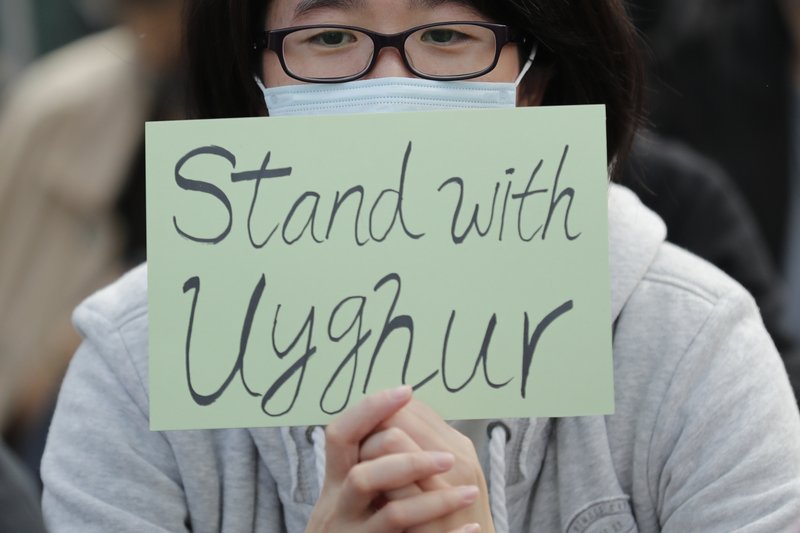
FILE - In this Dec. 22, 2019, file photo, a man holds a sign during a rally to show support for Uighurs and their fight for human rights in Hong Kong. People from western China who are targets of a Chinese government crackdown say they have been threatened and harassed in the United States. Those fleeing the crackdown on the predominantly Muslim Uighur ethnic group typically receive U.S. asylum. But Uighurs tell The Associated Press and human rights groups they still afraid amid threats aimed at them and their families back in China. (AP Photo/Lee Jin-man, File)

WASHINGTON (AP) — The photo of his father was barely recognizable. The old man looked unusually pale and tired, and his customary beard was shaved off. The son who received the photo over WhatsApp was immediately suspicious.
He hadn’t heard from his family in western China for two years while he studied at a U.S. university.
His family are Uighurs, a predominantly Muslim ethnic group that has become the target of a massive crackdown in China. Since 2017, more than 1 million people have been confined to internment camps and many more are monitored in their own homes.
Why would he get this message now? And why would it come over WhatsApp? The messaging platform is censored for ordinary people in China, but often is used by authorities.
No words accompanied the photo, but he interpreted it as a kind of warning.
“I feel like I’m being watched even in the United States,” he said, speaking on condition of anonymity because he fears reprisals from the Chinese government. “They have all of our information. They know where we live.”
Such fear of surveillance has become a fact of life for thousands of Uighurs living outside China and struggling to rebuild lives abroad, while family and friends go missing in China’s western Xinjiang region. Within China, the State Department says, many Uighurs have been subjected to torture and other abuse.
Even Uighurs who now live in the relative safety of the United States, where their situation has sparked bipartisan concern in Congress, say they still fear being monitored and worry that speaking freely may spur reprisals against family members in Xinjiang.
“I hear these stories all the time,” said Kuzzat Altay, president of the Uighur American Association whose own father renounced him in a video released by Chinese authorities on social media. “People come to me crying.”
Altay, who came to the U.S. as a refugee and has become a citizen, started a Uighur entrepreneurship network outside Washington. But most of the 25 members dropped out at the urging of family members in Xinjiang who had been visited by local authorities.
Altay said he thinks Chinese authorities worried that his entrepreneurship group would have discussed the crackdown back home.
The Chinese Embassy in Washington did not respond to a request for comment.
Ferkat Jawdat is a naturalized American citizen who came to the U.S. nine years ago and works as a software engineer in Virginia. His mother was taken into the Xinjiang internment camps in 2018.
Last May, when she was briefly released, she called and told him not to speak out about Uighur issues. He later learned from relatives that she had contacted him at police insistence and was taken back into police custody the very next day.
The Chinese government is broadly suspicious of Uighurs who have spent significant time abroad, said Brian Mezger, an immigration lawyer who specializes in Uighur asylum cases.
“The Chinese government views exposure to foreign influence as basically polluting the Uighurs,” said Mezger, whose practice is based in Rockville, Maryland.
A dozen Uighurs in the U.S. interviewed by The Associated Press, most of whom did not want their names used, described various forms of intimidation.
They described calls from Chinese government officials instructing them to “check in” at Chinese consulates. Some were told their Chinese passports would not be renewed and were offered one-way travel documents back to China. Several said relatives back home were visited by local police looking for information about family members abroad.
The young man who received the photo of his father in June, two years after family members in Xinjiang warned him to cut off contact, says he doesn’t know what authorities wanted from him.
He also received a series of unsettling text messages in the Uighur language, but he responded in Chinese to ask why the sender had contacted him. The person sending the messages said that if he wanted to have a video chat with my father, he could arrange it. “He wouldn’t say what he wanted from me.”
These accounts of harassment match reports compiled by activists and human rights groups, including Amnesty International, which last month documented widespread fear of surveillance and retribution among 400 Uighurs living in 22 countries.
The Uighur global diaspora is estimated to be between 1 million and 1.6 million people.
There are several thousand Uighurs in the United States, with the largest concentration living in the Washington D.C. area.
“This is happening to people’s neighbors, to fellow Americans — that’s what’s so scary,” said Francisco Bencosme, an Asia-Pacific advocacy manager for Amnesty International.
Uighurs qualify for asylum in the U.S. because today they face almost certain detention if they return to China, said Mezger, who has represented hundreds of people from Xinjiang. He said nearly all of his cases have been successful.
The wait for asylum, however, can take years and the anxiety can be grueling.
“Even if you’re free in the U.S., you can’t leave the U.S. while your asylum application is pending,” said James Millward, a professor of history who researches Xinjiang at Georgetown University. “If you have relatives in Europe or Canada, you can’t go see them. You can’t travel there for work. And you may have to wait for years.”
Xinjiang, which means “new frontier” in Chinese, was brought under control of Chinese authorities in Beijing in the 19th century. But the western desert region has longstanding cultural, religious, and linguistic ties to Central Asia and to Turkey.
Uighurs have faced numerous previous persecution and assimilation campaigns by the Chinese government.
An enhanced security state began to take shape in Xinjiang after 2009, when race riots left around 200 people dead in the capital city of Urumqi. In recent years, surveillance cameras and police checkpoints have become ubiquitous.
The government began to build internment camps in 2017 as a means of intimidation and social control. Former camp detainees have previously told the AP that after being confined in the camps, they were forced to renounce their faith and swear fealty to China’s ruling Communist Party.
Uighurs face limits on the use of their language in schools, their ability to check into hotels and restrictions on cultural practices such as wearing beards and fasting during religious holidays.
The government’s goal is to “eradicate Uighur culture,” said Dolkun Isa, president of the World Uighur Congress.
He added that social controls have grown more stringent since the inception of Chinese leader Xi Jinping’s Belt and Road Initiative — an overseas infrastructure funding policy — has enhanced the strategic importance of Xinjiang’s location bordering Central Asia.
China’s foreign ministry regularly bristles at international criticism of policies in Xinjiang, which it views as an internal matter. It has said that measures in Xinjiang are intended to curb religious extremism and that the detention camps are “vocational centers,” where people are held voluntarily. But it has refused to permit independent monitors to visit.
It’s not possible to confirm that the intimidating messages received by Uighurs abroad come from Chinese officials. But the Uighurs’ accounts of harassment have been consistent enough that both Republicans and Democrats in Congress back legislation that would require the FBI to help protect Uighurs in the United States.
The young man who received the photo of his father and the string of suspicious messages said he called the FBI and that two agents met with him. The agency wouldn’t comment on whether it investigated the particular case, but said in a statement, “Without discussing specifics, we take all reports of threats or intimidation seriously.”
Meanwhile, the man has continued his studies while he awaits a decision on his asylum application and worries about relatives in China. “They could punish my family, if they haven’t already sent them to the camps, because I didn’t cooperate.”
“Even if you have physical freedom, it’s very difficult to escape the reach of the Chinese government,” said Mezger, the attorney.

Venezuela on agenda for Trump’s meeting with Brazil’s leader

FILE - In this Jan. 7, 2020 file photo, Brazil's President Jair Bolsonaro speaks to journalists after meeting with military commanders at the Defense Ministry in Brasilia, Brazil. President Donald Trump and Bolsonaro are expected to discuss the crisis in Venezuela, a possible free-trade agreement between their countries and Chinese telecom company Huawei over a working dinner Saturday, March 7 at Trump's resort in Florida. (AP Photo/Eraldo Peres, File)

PALM BEACH, Fla. (AP) — President Donald Trump would not commit Saturday to continue holding off on hitting Brazil with tariffs on imports of its aluminum and steel, saying “I don’t make any promises.”
Trump commented in the presence of Brazilian President Jair Bolsonaro, who Trump was hosting for dinner at his resort home in southern Florida.
In a tweet in December, Trump accused Bolsonaro’s government of hurting American farmers by manipulating its currency. He pledged to slap tariffs on Brazilian aluminum and steel, but withdrew the threat days later.
“We have a very good relationship as to tariffs ... we want to always help Brazil,” said Trump, who appeared with Bolsonaro at the front door of his Mar-a-Lago estate. U.S. and Brazilian flags fluttered in the breeze on either side of the doorway.
“The friendship is probably stronger now than it’s never been,” Trump said.
Asked whether his comments meant no new tariffs on Brazil, Trump declined to commit.
“I don’t make any promises,” he said, before he led Bolsonaro to a dinner table on the club’s bustling outdoor patio. U.S. National Security Adviser Robert O’Brien, and Trump’s daughter Ivanka and her husband, Jared Kushner, both senior White House advisers, were also at the table along with several Brazilian government officials.
Trump also praised Bolsonaro’s leadership.
“He’s doing a fantastic job. Great job. Brazil loves him and the USA loves him,” Trump said.
Brazil is coping with a double-digit unemployment rate and economic growth that is half of what Bolsonaro promised as a candidate. He is also struggling to get legislation through congress.
White House officials said the crisis in Venezuela, a possible U.S.-Brazil trade deal and Chinese telecom company Huawei were discussion topics for the leaders. A statement the White House released after the meeting did not mention Huawei.
Bolsonaro is on a three-day trip to the United States that includes a visit to the Miami headquarters of U.S. Southern Command, which oversees U.S. military operations in Central and South America, and the Caribbean. Bolsonaro also scheduled meetings with Florida Sens. Marco Rubio and Rick Scott, both Republicans. Trump is in Florida through Monday.
Trump’s administration has been the most important ally for Venezuela’s opposition since Juan Guaidó leaped to the center of Venezuela’s tumultuous political landscape more than a year ago. He pledged to force President Nicolás Maduro from power and restore democracy.
Though Guaidó has the backing of more than 60 nations, his popularity has faded, coupled with a failed military uprising.
The United States is continuing its “maximum pressure” campaign against Maduro and will continue to work on unspecified “bottlenecks” to a trade agreement with Brazil, said a senior Trump administration official who briefed reporters before the leaders met.
The U.S. has been pressuring governments worldwide to ban the Chinese tech giant Huawei from having any stake in their 5G networks. But Trump’s campaign was dealt a blow when U.S. ally Britain decided to grant Huawei a limited role in supplying new high-speed network equipment to wireless carriers. The U.S. sees Huawei as an intelligence threat.
Bolsonaro, called the “the Trump of the tropics,” has turned his relationship with the U.S. president into a cornerstone of his foreign diplomacy. The far-right Brazilian leader has used Trump to shore up his base, often praising him and posting videos of himself on social media simply watching Trump speeches on television.
Trump likes Bolsonaro and says they have a good relationship. He hosted Bolsonaro at the White House last March.
The U.S. trip comes as a welcome respite for Bolsonaro, who at home is dealing with a weak economy and a strained relationship with congress. Several opposition parties published a manifesto this week, encouraging Brazilians to demonstrate against the government.
Bolsonaro’s allies see the invitation to dinner at Mar-a-Lago, Trump’s private, dues-paying club in Palm Beach, as another sign that Bolsonaro’s alignment with America is paying off.
Trump last year granted Brazil the status of privileged ally outside NATO and backed its bid for membership in the Organization for Economic Cooperation and Development.
But U.S. support can be fickle and government critics question whether Brazil’s seemingly unconditional embrace of Trump’s brand of politics will yield any real benefits. Trump’s refusal to commit to holding off on tariffs most likely would be viewed as an example.
Brazil also is struggling to combat growing illegal deforestation in the vast Amazon rainforest and was criticized for its poor handling of devastating fires in the region last summer.

Judge Jeanine slams media's coronavirus coverage: It's 'doomsday reporting'


Judge Jeanine Pirro slammed the media Saturday night for stoking the flames of the coronavirus panic.
"If you listen to the mainstream media, it's time to buy the family burial plot, visit the cemetery where the dirt is definitely cleaner than your kitchen counter or your bathroom handles," Pirro said on "Justice with Judge Jeanine."
Pirro called out the media for their coverage, saying all they do is impact America negatively.
"So what's the downside of their doomsday reporting? The downside is predictable. When people are scared, when people think it's just a question of time before they start dropping like flies, they go into survival mode," Pirro said. "They don't spend money. The economy suffers. They don't invest. The market suffers. They talk about taking their children out of school. Education suffers. They talk about canceling March Madness, Coachella and local businesses suffer."
The host took issue in particular with the coverage of the stock market, asking where the media's coverage was when it was when Wall Street numbers were soaring.
"You want to focus on the Dow now? Where were you when the Dow, the S&P 500 and Nasdaq all repeatedly reached record highs under President Trump? You weren't interested then, were you?" Pirro said. "Where were you when the Dow closed at a record high more than 100 times since Donald Trump's election? Where were you when animal spirits were driving this country to new economic heights?"
"For your information, our economy can sustain a 3,000-point drop because we are at record highs," Pirro added.
Pirro downplayed the manufactured panic, saying, "As the weather warms, fewer and fewer people will get sick with the virus. Some of the meds need to be left for people who may need them."
Finally, Pirro made the most basic suggestion to those afraid of contracting the virus -- but likely the most helpful.
"And wash your damn hands, wash them and then wash them again," Pirro said.

New Jersey security guard arrested over licensed gun, legal ammo

Roosevelt Twyne


A New Jersey gun owner is fighting charges for carrying a firearm for which he had a permit and ammunition state police have publicly said is legal.
Roosevelt Twyne, a 25-year-old African-American security guard, was arrested by Roselle Park Police in February after a traffic stop stemming from tinted windows on his car. Evan Nappen, Twyne's attorney, told the Washington Free Beacon that his client was then erroneously charged for illegally carrying a firearm and being in possession of so-called hollow point ammunition.
"He was arrested for the hollow point ammunition," Nappen told the Free Beacon. "Then they claimed he was transporting his handgun illegally. He had a permit to carry a handgun. The law … makes it clear that it's illegal to transport unless you are licensed pursuant to chapter 58. And that is precisely what a handgun carry permit is."
Nappen said the ammunition that led to Twyne's arrest was the same ammunition issued by his employer. He also pointed to a New Jersey State Police website that says the polymer-tipped Hornady "Critical Duty" ammunition in question is "not considered to be hollow point ammunition" and not illegal to possess in the state—the website goes so far as to specifically name "Critical Duty" as an example of legal ammunition.
"It's lawful," Nappen told the Free Beacon. "It's publicly announced as lawful because it is. It's not hollow. It's filled."
Roselle Park police chief Daniel J. McCaffery did not return a request for comment. The Union County Prosecutor's Office did not respond to questions about the charges against Twyne but did say his case will be heard next month in New Jersey Superior Court.
The charges against Twyne are representative of the difficulties of navigating New Jersey's gun laws, which are among the strictest in the nation. They may also reveal issues in the police's understanding of the state's voluminous, complex gun restrictions. The case also shows how disruptive gun-related charges can be, even when the accused has a clean record and is not alleged to have done anything violent.
Twyne said he has not been able to work in nearly a month and his life has been turned upside down.

GOP Rep. Elise Stefanik blasts ‘radical Far-Left’ after finding ‘vile’ note on car while grocery shopping


U.S. Rep. Elise Stefanik, a freshman congresswoman from New York state who drew national attention for defending President Trump during impeachment hearings on Capitol Hill last year, has become the latest victim of public incivility against Republicans.
Stefanik wrote Saturday on Twitter that when she returned to her car earlier in the day after grocery shopping with her husband, she found what she described as a “vile anonymous note.”
“Rot in Hell FASCIST PIG,” the hand-scrawled note said.
STARTLING THREATS AND VIOLENCE AGAINST GOP VOTERS: PART OF A PATTERN?
Stefanik posted a photo of the note, along with her own reaction.
“It is truly sad that the radical Far-Left cannot see beyond their vicious hate,” she wrote. “My husband and I went grocery shopping this morning before district events and enjoyed chatting with constituents throughout the store. This vile anonymous note was left on our car.”
Other incidents this year involving incivility – or even violence – against conservatives and Republicans have included a vehicle smashing a GOP voter-registration table in Florida, an alleged assault of a 15-year-old Trump supporter in New Hampshire, the smashing of a College Republicans information table in California, an individual’s threat, caught on video, to “slash Republicans’ throats" in Arizona, an alleged assault of a retired police officer wearing a Trump-style hat and shirt in Tennessee and a suspect being sentenced to 90 days in jail for slapping and spitting on a Trump supporter in Florida.

Favorite target of Democrats

Stefanik became a favorite target of Democrats and liberals during the House impeachment inquiry late last year, particularly for becoming a thorn in the side of House Intelligence Committee Chairman Adam Schiff, D-Calif.
One of the most explosive moments of the impeachment hearings came Nov. 15, 2019, when ranking member Rep. Devin Nunes, R-Calif., yielded some of his time to Stefanik. But as she spoke, Schiff slammed down his gavel, arguing that it was not allowed under committee rules.
“The gentlewoman will suspend,” Schiff said.
“What is the interruption for now?” she shot back.
What followed was a debate between Nunes and Schiff as to whether the Republican could offer his time to a fellow member of Congress, rather than minority counsel. Stefanik repeatedly tried to speak, only for Schiff to bang his gavel again.
"You're gagging the young lady from New York?" Nunes laughed at one point.
"This is the fifth time you have interrupted a duly-elected member of Congress," Stefanik told Schiff, who repeatedly told her she was "not recognized" to speak.
Stefanik's performance at that moment and throughout the hearings earned her praise from fellow Republicans and likely contributed to her being named an honorary chair for the Trump 2020 Campaign in early January.
“I’m looking forward to working with his campaign to deliver another decisive victory in my district. President Trump’s record of results will win handily over far-left radical resistance in November," she said at the time.
Fox News’ Brooke Singman, Tyler Olson and Adam Shaw contributed to this story.

Saturday, March 7, 2020

Liberal Media Cartoons


Biden invokes Obama, swipes at Sanders with six-state ad buy

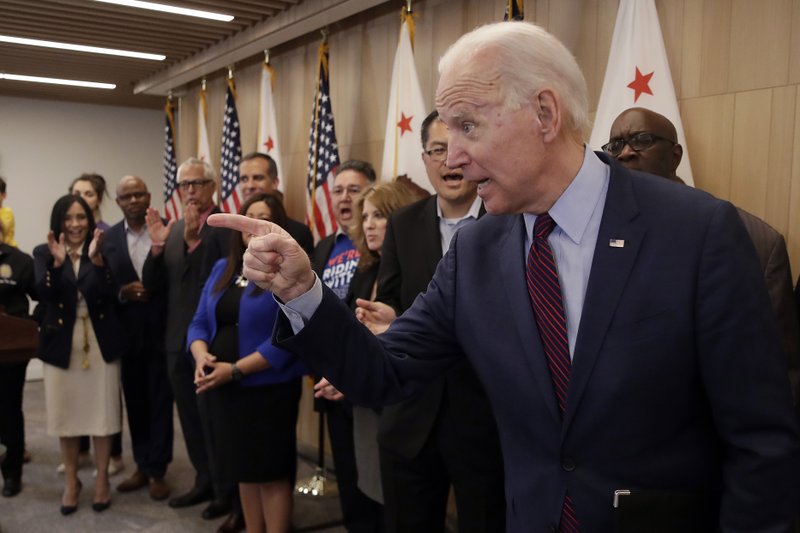
Democratic presidential candidate former Vice President Joe Biden points as reporters ask questions Wednesday, March 4, 2020, in Los Angeles. (AP Photo/Marcio Jose Sanchez)

ATLANTA (AP) — Joe Biden’s presidential campaign is plowing $12 million into a six-state ad buy ahead of the March 10 and March 17 primaries, his largest single advertising effort of the 2020 campaign and a demonstration of his resurgent campaign’s new financial footing.
The former vice president is using two television and digital ads, one a spot touting his relationship with President Barack Obama, the other a new counter to rival Bernie Sanders’ current ad campaign hammering Biden on his Social Security record.
The purchase, Biden’s first since his commanding South Carolina primary victory and Super Tuesday surge generated an influx of donor support, underscores that both Biden and Sanders now have the wherewithal to fight it out on the airwaves as long as the nominating fight continues.
A new Biden ad, “Always,” defends against Sanders’ characterization that Biden is a threat to Social Security benefits, a contention the Vermont senator has made for months but ratcheted up since Biden climbed past him in the national delegate count after winning 10 out of 14 Super Tuesday states.
“Joe Biden has always been a strong supporter of Social Security. Biden will increase Social Security benefits and protect it for generations to come,” a narrator intones, before turning the matter back on Sanders. “Negative ads will only help Donald Trump. It’s time we bring our party together.”
A Sanders ad airing in upcoming primary states features Senate audio from a 1990s debate on a balanced-budget amendment to the Constitution. Biden, then a Delaware senator, talks of his work on long-term budget deals that could have curbed some entitlement spending.
The second Biden ad, “Service,” features video of Obama awarding Biden the Presidential Medal of Freedom shortly before the pair ended their second terms in national office. “Joe’s candid, honest counsel made me a better president and a better commander in chief,” Obama says in the video, touting Biden’s various roles in his administration. “All of this makes him the finest vice president we have ever seen. The best part is he’s nowhere close to finished.”
Obama has been a shadow throughout the 2020 contest, with Biden invoking their relationship regularly as he campaigns. Other candidates alternated between criticizing part of the Obama record, such as when Julian Castro hammered Biden in an early debate over Obama-era deportations, and embracing Obama, as billionaire Mike Bloomberg did in his ubiquitous television advertising campaign. Biden expressed frustration at both tacks, defending Obama’s record and noting that his old boss was staying out of the primary and not endorsing anyone.
While that may be the case, Obama has crept back in recently. The former president called Biden to congratulate him on his South Carolina victory Feb. 29, a source with knowledge of the conversation confirmed. With neither Obama or Biden disputing that account, some observers read it as the former president tacit nod toward his vice president as the field winnowed. Sources also confirm that Obama has seen the ad using clips from Biden’s White House medal ceremony.
Separately, Biden has in recent weeks reminded voters that Sanders, a democratic socialist well to Obama’s left, once floated the idea of a primary campaign against the president in his 2012 re-election year.
Still, Social Security may promise to be the bigger fight between Biden and Sanders in the coming weeks. Some Sanders aides have for months surfaced various comments and votes from Biden over the years on entitlement spending, without acknowledging that Sanders himself in the 1990s expressed openness to Social Security “adjustments,” a word that some Sanders allies argued Biden and others used as a euphemism for cuts. Then a representative from Vermont, Sanders also praised an overhaul of the popular safety net program that reduced benefits and increased some taxes under President Ronald Reagan, a Republican.
As presidential candidates in 2020, Sanders and Biden each have proposed protecting and expanding Social Security, so it’s not clear whether either candidate will be able to capitalize on the matter. The Biden campaign on social media this week has pushed back at Sanders by noting that Trump and his fellow Republicans are the more realistic threats to Social Security.
Biden told donors via telephone on Friday that he wanted to avoid “a negative bloodbath” with Sanders.
The new advertising effort includes $8 million on television, with the $4 million spread across radio and digital platforms. The ads will appear across Michigan, Missouri and Mississippi ahead of the March 10 primaries, and in Florida, Illinois and Ohio ahead of the March 17 primaries.
Currently, Biden has 664 delegates to Sanders’ 573, according to Associated Press calculations, with some delegates remaining to be allocated from Super Tuesday. More than 900 delegates are at stake the next two weeks; 1,991 are needed for the nomination.

CartoonDems