Wednesday, February 15, 2017
Pennsylvania college group wants pins to start conversation on 'white privilege'
![]() | ||||
| College students wear pins to identify white privilege |
Elizabethtown College Democrats are asking students to wear a white puzzle piece pin every day to encourage people to give further thought about how racial identity affects their lives, Lancaster Online reported.
Aileen Ida, president of the College Democrats, told Local 21 News that she noticed a Wisconsin pastor wearing the pin and wanted to help spread the message.
She said the conversation on white privilege is necessary in central Pennsylvania because of the demographics. According to the latest census, Lancaster County is 83 percent white, 10 percent Hispanic, 4 percent black and 2 percent Asian.
Ida said she’s excited to see how the project could spark a discussion about racial identity.
“This project will encourage people to have conversations about race and how their inherent white privilege has a part in the systematic oppression of minorities — whether or not they purposefully participate in the system,” she told Lancaster Online.
Sawa Alabsi, a student at the school, told local media that she is concerned her classmates would join the campaign to simply fit in.
“I feel like a lot of people don’t necessarily know or do any research into certain issues,” she said. “And they’re kind of like, ‘Oh, my friends have this side, so I’m going to pick that side.’”
Ida hopes prospective participants can commit to wearing the pin for at least one month.
Her fellow students supported the idea in conversations with Local 21 News. One student told the station that he would wear a pin if it was given to him.
"Elizabethtown is a majority white campus, so I think white Privilege is a great place to start,” he said.
Ida said the idea wasn’t meant to call out white people, but remind students that racial identity is an important conversation to have. She hopes to have 100 people wearing the pin by Friday.
Paul reportedly leaves meeting with House Republicans on Obamacare
Sen. Rand Paul, R-Ky., on Tuesday reportedly left a meeting with fellow Senate Republicans as House Speaker Paul Ryan worked to reassure skeptical colleagues about the next steps in taking on Obamacare.
Politico reported that Paul was unhappy with the meeting and the prospect of keeping health law’s Medicaid expansion. He called creating tax credits a “new entitlement program.”
“I hear things that are unacceptable to me,” Paul told the website. “If they don’t seem to care what conservatives think about complete repeal of Obamacare, they’re going to be shocked when they count the votes.”
Attendees reportedly said Ryan laid out a timeline that would start the repeal process by the end of February and pass it by the end of March.
President Trump, according to some in the party, has been fueling the confusion by not being specific about how he plans to take on the six-and-a-half-year-old Obamacare. He has said, during his candidacy that he would “repeal and replace” the law with “something far better.”
VIDEO: DEMOCRATS PLAN TO RALLY SUPPORT BEHIND OBAMACARE
Trump has been edging away from the promise to quickly eliminate the entire law. Still, annulling its taxes would be a partial victory and is irresistible for many GOP lawmakers and the conservative voters at the core of their support.
"We should do full repeal," said Rep. Jim Jordan, R-Ohio, a leading House conservative. "And full repeal means not taking the taxes" from people.
Yet voiding those levies erases a mammoth war chest Republicans would love to have - and may well need - as they try replacing Obama's law. It's a major rift GOP leaders face as they try crafting a health care package that can pass Congress.
“Right now, I would say it’s not that easy to repeal it,” Rep. Peter King, R-N.Y., told Politico. “I don’t know where the White House is. The president has said he’s not going to be kicking people off the program, off the rolls. He’s not going to do that.”
If the taxes are repealed and Republicans need money for their replacement plan, do they pay for it with higher federal deficits? Do they deeply cut Medicaid, which provides health care for low-income people, or carve savings from Medicare, which serves the elderly? Might they raise other taxes, something that's been anathema to the GOP for decades?
Paul came up with his own plan, which contains what he calls “conservative reforms.” His plan includes opening up the insurance market and allowing individuals to pool their insurance with others to secure the lowest premium.
“There’s not one item in the plan that we think a Republican would object to,” he told Fox News’ “Sunday Morning Futures.”
"There's going to be a temptation for policymakers to take the easy way out" and simply let deficits rise, said Maya MacGuineas, president of the bipartisan Committee for a Responsible Federal Budget. She said for Republicans promising for decades to improve the nation's fiscal health, that choice "is going to look hypocritical."
Media helped force out Flynn, but leakers' real target is Donald Trump
![]() |
| Kurtz: Why Flynn had to go |
It was close to midnight when I had to kill a column
I’d already filed for Fox News and write about the Michael Flynn
resignation.
The inescapable irony: The spiked column said that some positive stories for President Trump, such as his meetings with the leaders of Canada and Japan, were being drowned out by the controversies surrounding the White House—some self-inflicted, some overblown by the media.
The Flynn situation was another battle between the president and the press, and in this case the Washington Post story about the national security adviser’s contacts with the Russian ambassador made it impossible for Flynn to survive. Unlike some of the stories dismissed by Trump as fake news, this one could not be waved away—especially because Flynn had misled Mike Pence about what happened in those pre-inaugural conversations.
This was good reporting, and Pence’s televised defense of Flynn was based on an earlier piece by Post columnist David Ignatius, disclosing that Flynn had a post-Christmas call with Russian Ambassador Sergey Kislyak.
At the same time, the Post story would not have been possible without the cooperation of nine unnamed senior officials who furnished the leaked information. They wanted Flynn out and were trying to undermine the president.
Trump, who has also been hit by unflattering leaks about his calls with foreign leaders, seized on this issue. “The real story here is why are there so many illegal leaks coming out of Washington?” he tweeted. “Will these leaks be happening as I deal on N.Korea etc?”
But it must be said that the leakers’ information was right on target. And that in the end Flynn’s problem was not so much discussing U.S. sanctions with Russia before Trump took office as misleading the VP, as Kellyanne Conway stressed on the morning shows yesterday.
The messaging has been decidedly mixed. Conway, based on the information she had, told MSNBC on Monday afternoon that the president had full confidence in Flynn. Hours later he resigned.
Conway insisted in her interviews on “Today,” “GMA” and “Fox & Friends” that it was the retired lieutenant general’s choice to resign. But when Sean Spicer briefed the press yesterday afternoon, he flatly said that Trump asked for Flynn’s resignation—meaning he fired him—after things reached critical mass.
The debacle doesn’t end the story, as often happens when a top official is forced out under a cloud.
The Post reported yesterday that Acting Attorney General Sally Yates warned the White House three weeks ago that Flynn was potentially vulnerable to Russian blackmail and that she believed he had misled administration officials about the calls. Yates is the Obama holdover later fired by Trump for refusing to defend his temporary travel ban.
That revelation raises the serious question of why the White House didn’t act sooner on that warning, well before any of this became public, and just what the president knew about these matters.
Now there’s media chatter about whether these events will lead to a broader White House shakeup.
And here’s a footnote: Michael G. Flynn, the former official’s son, drew attention last year for tweeting about various conspiracy theories, including the “Pizzagate” fiction tying Hillary Clinton to a supposed child sex ring at a Washington restaurant. It was Mike Pence who said that Flynn’s son had nothing to do with the Trump transition team. But that was wrong, and officials soon confirmed that Trump had fired the younger Flynn from the transition team over the tweets.
Flynn Jr. reactivated his account and tweeted yesterday: “The disinformation campaign against my father won.”
Howard Kurtz is a Fox News analyst and the host of "MediaBuzz" (Sundays 11 a.m. and 5 p.m. ET). He is the author of five books and is based in Washington. Follow him at @HowardKurtz. Click here for more information on Howard Kurtz.
The inescapable irony: The spiked column said that some positive stories for President Trump, such as his meetings with the leaders of Canada and Japan, were being drowned out by the controversies surrounding the White House—some self-inflicted, some overblown by the media.
The Flynn situation was another battle between the president and the press, and in this case the Washington Post story about the national security adviser’s contacts with the Russian ambassador made it impossible for Flynn to survive. Unlike some of the stories dismissed by Trump as fake news, this one could not be waved away—especially because Flynn had misled Mike Pence about what happened in those pre-inaugural conversations.
This was good reporting, and Pence’s televised defense of Flynn was based on an earlier piece by Post columnist David Ignatius, disclosing that Flynn had a post-Christmas call with Russian Ambassador Sergey Kislyak.
At the same time, the Post story would not have been possible without the cooperation of nine unnamed senior officials who furnished the leaked information. They wanted Flynn out and were trying to undermine the president.
Trump, who has also been hit by unflattering leaks about his calls with foreign leaders, seized on this issue. “The real story here is why are there so many illegal leaks coming out of Washington?” he tweeted. “Will these leaks be happening as I deal on N.Korea etc?”
But it must be said that the leakers’ information was right on target. And that in the end Flynn’s problem was not so much discussing U.S. sanctions with Russia before Trump took office as misleading the VP, as Kellyanne Conway stressed on the morning shows yesterday.
The messaging has been decidedly mixed. Conway, based on the information she had, told MSNBC on Monday afternoon that the president had full confidence in Flynn. Hours later he resigned.
Conway insisted in her interviews on “Today,” “GMA” and “Fox & Friends” that it was the retired lieutenant general’s choice to resign. But when Sean Spicer briefed the press yesterday afternoon, he flatly said that Trump asked for Flynn’s resignation—meaning he fired him—after things reached critical mass.
The debacle doesn’t end the story, as often happens when a top official is forced out under a cloud.
The Post reported yesterday that Acting Attorney General Sally Yates warned the White House three weeks ago that Flynn was potentially vulnerable to Russian blackmail and that she believed he had misled administration officials about the calls. Yates is the Obama holdover later fired by Trump for refusing to defend his temporary travel ban.
That revelation raises the serious question of why the White House didn’t act sooner on that warning, well before any of this became public, and just what the president knew about these matters.
Now there’s media chatter about whether these events will lead to a broader White House shakeup.
And here’s a footnote: Michael G. Flynn, the former official’s son, drew attention last year for tweeting about various conspiracy theories, including the “Pizzagate” fiction tying Hillary Clinton to a supposed child sex ring at a Washington restaurant. It was Mike Pence who said that Flynn’s son had nothing to do with the Trump transition team. But that was wrong, and officials soon confirmed that Trump had fired the younger Flynn from the transition team over the tweets.
Flynn Jr. reactivated his account and tweeted yesterday: “The disinformation campaign against my father won.”
Howard Kurtz is a Fox News analyst and the host of "MediaBuzz" (Sundays 11 a.m. and 5 p.m. ET). He is the author of five books and is based in Washington. Follow him at @HowardKurtz. Click here for more information on Howard Kurtz.
Flynn was probed by FBI over calls with Russian ambassador, official says
![]() |
| Intel committee chairman asks FBI to review Flynn leak |
The interview with FBI agents reportedly came after a Jan. 23 press conference where White House Press Secretary Sean Spicer told reporters that Flynn did not discuss the matter with Russia’s ambassador to the U.S.
The Wall Street Journal, citing unnamed sources, said intelligence officials had already intercepted conversations in which they discussed the sanctions.
Flynn sought to persuade the Russian ambassador not to “overreact” to then-President Obama’s punitive measures against Moscow for the alleged meddling in the U.S. election, the sources said. Flynn reportedly suggested that the Trump administration would be friendlier to Moscow.
The Wall Street Journal reported that it is unclear what was discussed in the meeting with the FBI agents, but said that it is a crime to lie to the FBI.
“The [Senate] Intelligence Committee is already looking at Russian involvement in our election,” Senate Majority Leader Mitch McConnell, R-Ky., said Tuesday. “It’s highly likely they’d want to take a look at this episode as well. They have the broad jurisdiction.”
Shortly before his resignation, Flynn told The Daily Caller his conversation with the ambassador “wasn’t about sanctions. It was about the 35 guys who were thrown out… It was basically, ‘Look, I know this happened. We’ll review everything.’ I never said anything such as ‘We’re going to review sanctions,’ or anything like that.’’
Law enforcement sources close to the matter told Fox News that the broad investigation into the Trump campaign's ties to Russian officials is active and ongoing. Senior law enforcement sources told Fox News last month that Flynn's contacts with the Russians escalated after the election.
Seperately, intercepted phone calls show that members of Trump’s presidential campaign had repeated contacts with senior Russian intelligence officials, The New York Times reported.
The report, citing unnamed sources, said intelligence officials intercepted these contacts around the same time they were looking into the Democratic National Committee. The officials said that they have yet to find any sort of cooperation between the Trump campaign and the Russians into the hacking effort.
The Times report said that it was unclear what was discussed in the conversations. The intercepted calls are reportedly separate from Flynn’s phone calls.
Paul Manafort, who was Trump’s campaign manager for a few months, was reportedly one of those who made a call that was intercepted. Manafort denied the allegation, saying “I have never knowingly spoken to Russian intelligence officers."
The White House has denied the claims that any individuals from his campaign were in touch with Russian officials prior to the election.
Tuesday, February 14, 2017
Jorge Ramos: 'Deportation czar' Trump 'destroying American families'
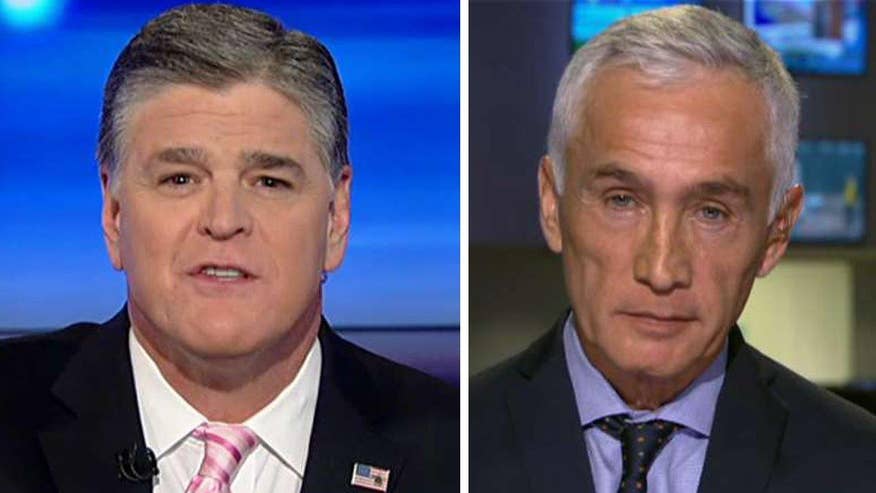
Univision anchor Jorge Ramos squared off with Fox News' Sean Hannity Monday night in a debate over President Donald Trump's illegal immigration policy, with Ramos calling the president the "deportation czar."
Ramos, who famously confronted Trump on the campaign trail over his promise to build a wall across the southern border hours after the president took credit for a series of raids that netted 680 undocumented immigrants in six major cities.
TRUMP PRAISES IMMIGRAION RAIDS, SCHUMER PRESSES FOR MORE INFO
"The vast majority of immigrants in this country," Ramos told Hannity, "are not criminals, are not terrorists, and are not rapists ... Immigrants are less likely to be criminals than those born in the United States. Immigrants are less likely to be behind bars than U.S. citizens."
"That's not true," responded Hannity, who later asked Ramos "Should every criminal illegal alien be thrown out of this country? Every one?"
"If they committed a crime, a real crime,
absolutely," said Ramos, who pointed out that FBI statistics showed
violent crime in America has dropped 48 percent since 1990, a period in
which the number of undocumented immigrants increased threefold.""Even though you might want to present undocumented
immigrants as criminals, that’s not the case," said Ramos, who later
added, "Thanks to immigrants, crime is going down in this country."In response, Ramos conceded that "cities and states, they’re spending billions of dollars on immigrants. I agree with that. [But] undocumented immigrants, they pay taxes, they create jobs, they do the jobs that nobody else wants to do."
Seattle judge says Trump travel ban case can proceed in lower court
SEATTLE – A lawsuit by Washington state and Minnesota challenging President Donald Trump's travel ban will proceed as an appellate court considers a preliminary injunction in the case, a federal judge ruled Monday in Seattle.
The Justice Department had wanted to put the case on hold while the 9th U.S. Circuit Court of Appeals decides whether a larger, 11-judge panel will review a government request to allow the ban.
But U.S. District Judge James Robart, who previously issued a temporary restraining order halting the ban, said the lawsuit can go forward. The states said that process wouldn't interfere with review by appellate courts.
Robart directed both sides to prepare for their arguments on whether Trump's travel ban should be permanently blocked.
A three-judge federal appeals court panel last week refused to toss out the injunction and reinstate the travel ban. The panel unanimously rejected the administration's claim of presidential authority in the matter.
Washington and Minnesota argued that formal evidence gathering should begin immediately in the case.
"Given the gravity of the states' constitutional allegations, defendants' stated national security concerns and the public interests at stake, the states respectfully submit that discovery should proceed without delay," the state lawyers said in a legal brief.
Michelle Bennett, a Justice Department lawyer, told Robart there was no basis for speeding up the process, arguing the states are not being harmed because there's a temporary injunction in place.
She asked Robart to stick with a previous schedule that gives the government until April 3 to file a response to the states' complaint. Robart said he was "surprised" by that statement, since the president had said he wants to "see you in court."
After the 9th Circuit panel ruled against the Justice Department, Trump sent out a tweet saying, "SEE YOU IN COURT, THE SECURITY OF OUR NATION IS AT STAKE!"
Robart said there is a "very sensitive time issue" in the case and he wasn't prepared to slow it down.
Last week, the three-judge appellate panel sided with Washington and Minnesota, which say the ban illegally targets Muslims. Justice Department lawyers say it is intended to prevent terrorism and can't be second-guessed by courts.
Trump's ban temporarily suspended the nation's refugee program and immigration from Iran, Iraq, Libya, Somalia, Syria, Sudan and Yemen — nations that have sparked terrorism concerns.
In deciding whether to put Trump's order on hold, the three-judge panel said the administration presented no evidence that any foreigner from the seven countries was responsible for a terrorist attack in the U.S.
Trump's initial executive order sparked protests nationwide and confusion at airports as some travelers were detained.
Three candidates emerge to replace Flynn as national security adviser
President Trump’s embattled national security adviser Michael Flynn resigned Monday night and three names have emerged as possible replacements.
Vice Adm. Bob Harward is one name that has come up to replace Flynn as national security adviser, and the leading candidate to get the job, a senior official told Fox News.
Harward is a U.S. Navy SEAL, but also has a previous relationship with Secretary of Defense James Mattis. Harward was the deputy commander of the U.S. Central Command under Mattis and was also the deputy commander of U.S. Joint Forces Command.
He also served on the National Security Council for President George W. Bush and commissioned the National Counter Terrorism Center.
TRUMP’S NATIONAL SECURITY ADVISER MICHAEL FLYNN RESIGNS
White House sources described Harward as the “toughest guy in the SEALs” and a “real rock.”
A senior administration official added that if Howard is the choice to replace Flynn, he could be in place by the end of the week.
Lt. Gen. Joseph Keith Kellogg, Jr. has been floated as a permanent replacement for Flynn. Trump named him the acting national security adviser after Flynn resigned.
Kellogg is a decorated U.S. Army veteran, having served from 1967 to 2003. He earned the Silver Star, the Bronze Star with “V” device and the Air Medal with “V” device during his time in the Vietnam War.
Kellogg was chief operating officer of the Coalition Provisional Authority in Iraq, the interim governing body following the fall of Saddam Hussein in 2003. He previously worked as executive vice president of research and technology for Virginia-based information technology firm CACI International, which works as a contractor for defense, intelligence and homeland security agencies.
Another name floated as a possible replacement for Flynn is retired Gen. David Petraeus.
Trump routinely dropped Petraeus’ name during his election campaign. Trump said that Petraeus was punished more severely for leaking classified documents to his mistress than Hillary Clinton was punished for setting up a private email server during his time as Secretary of State.
READ: MICHAEL FLYNN’S LETTER OF RESIGNATION AS NATIONAL SECURITY ADVISER
Petraeus was briefly considered for the secretary of state job, but was passed up because of his rocky tenure as CIA chief and the possibility that he wouldn’t be confirmed in the Senate because of those issues.
According to the Washington Examiner, Bush’s former national security adviser Stephen Hadley and Tom Bossert, a former national security aide under Bush have been considered a Flynn’s replacement. The paper added that Adm. James Stavridis, a dean at Tufts University, is also on the table.
Flynn’s resignation ended speculation about his fate following reports he had misled Vice President Pence and other officials about his contacts with Russia.
Flynn conceded that discussions of sanctions may have come up during several calls with the Russian ambassador during the transition period leading up to Trump's Jan. 20 inauguration.
He acknowledged that he gave "incomplete information" about those discussions to Pence who, apparently relying on information from the national security adviser, initially said Flynn had not discussed sanctions with the Russian envoy.
Whoever emerges as Trump's choice will take the helm of the National Security Council at a time when the young administration is grappling with a series of national security challenges, including North Korea's reported ballistic missile launch. The president, who was joined at his Mar-a-Lago estate by Japanese Prime Minister Shinzo Abe over the weekend, voiced solidarity with Japan.
The White House is also dealing with fallout from the rocky rollout of Trump's immigration executive order, which has been blocked by the courts. The order was intended to suspend the nation's refugee program and bar citizens of seven Muslim-majority countries from entering the United States.
Trump national security adviser Michael Flynn resigns
President Trump’s embattled national security adviser Michael Flynn resigned Monday night, after days of controversy over his past contact with the Russian ambassador.
Flynn, in his resignation letter, wrote that he "inadvertently" briefed top officials with incomplete information regarding a call with Ambassador Sergey Kislyak.
"I have sincerely apologized to the president and the vice president, and they have accepted my apology," the letter read.
Vice President Mike Pence, after being briefed by Flynn, said in television interviews that Flynn had not discussed sanctions with the ambassador, although Flynn later admitted the issue may have been raised.
Flynn, separately, told Fox News in an email: "I have nothing to be ashamed for and everything to be proud of."
Trump has named Lt. Gen Joseph Keith Kellogg, Jr., as his acting national security adviser.
The White House earlier said Trump was "evaluating the situation" regarding Flynn's conversations with Russia's ambassador to the U.S., deepening the uncertainty surrounding Flynn's future in the new administration.
White House spokesman Sean Spicer said Trump was consulting with Pence about his conversations with the national security adviser. Asked whether the president had been aware that Flynn might discuss sanctions with the Russian envoy, Spicer said, "No, absolutely not."
VIDEO: WHAT FLYNN FLAP REVEALS ABOUT TRUMP'S INNER CIRCLE
Trump, who comments on a steady stream of issues on his Twitter feed, has been conspicuously silent about the matter since The Washington Post reported last week that Flynn had discussed sanctions with the Russian envoy. A U.S. official told The Associated Press that Flynn was in frequent contact with Ambassador Sergey Kislyak on the day the Obama administration slapped sanctions on Russia for election-related hacking, as well as at other times during the transition.
Earlier Monday, White House counselor Kellyanne Conway said Trump had "full confidence" in Flynn, though her assertions were not backed up by other senior Trump aides. Spicer would say only that Flynn was continuing to carry out "his daily functions."
The conflicting signals created confusion at the White House, with reporters crowding around Spicer's office for hours Monday afternoon seeking information on Flynn's future.
Subscribe to:
Comments (Atom)
-
How many times do we need to say this? If you’re here illegally and get caught, you’re going back. It’s the la...
-
The problem with the courts is the same as the problem with many of our other institutions. Called the Skins...
-
CNN’s Scott Jennings once again took liberals to the cleaners on the Abrego Garcia case, the ‘Maryland man...