Texas Republican Dan Crenshaw got the last laugh Tuesday, easily being elected to the U.S. House of Representatives after being mocked for his war injury days earlier on "Saturday Night Live."
Crenshaw,
34, was favored to beat Democrat Todd Litton to win the seat being
vacated by Republican Ted Poe before last weekend’s "SNL" episode in
which castmember Pete Davidson made fun of his appearance, the Houston Chronicle reported.
Crenshaw won with 53 percent of the vote compared to Litton's 44.4 percent, according to Politico.
During
a "Weekend Update" segment, Davidson said Crenshaw looked like "a
hitman in a porno movie," when he referred to the veteran's black
eyepatch. Davidson continued, "You may be surprised to hear he’s a
congressional candidate from Texas and not a hitman in a porno movie.
I'm sorry. I know he lost his eye in war or whatever."
Crenshaw lost his right eye in 2012 after a bomb exploded during a mission in Afghanistan, his third military deployment.
Davidson also poked fun at Florida Gov. Rick Scott and New York Gov. Andrew Cuomo.
At
his election victory party in Houston, Crenshaw brushed off the joke,
saying “I’m from the SEAL team so we don’t really get offended,”
according to the Chronicle.
Davidson's comments were widely
denounced by Republicans, Democrats and veterans groups as insensitive.
Some Republicans called on Davidson and the show to apologize.
Sen. Tammy Duckworth, D-Ill., who lost her legs in Iraq, demanded Davidson issue an apology.
"No
one should ever mock a Veteran for the wounds they received while
defending our great nation, regardless of political party or what you
think of their politics. Pete Davidson owes Dan Crenshaw an apology,"
she said.
On Monday, Crenshaw said he wasn’t interested in an
apology. He instead called for those affiliated with the show to donate
$1 million to veterans groups, the Washington Post reported.
“There’s a lot of veterans that really need help, and frankly, this kind of thing is offensive to them,” Crenshaw said on CNN. “They feel laughed at.”
After years in the political wilderness on Capitol Hill, Democrats will have the power to push their
legislative agenda in Congress after winning the House majority
Tuesday. But faced with a Republican-controlled Senate and White House,
the Democrats are in for a series of showdowns that could leave the
party undertaking more modest legislative goals on issues
from prescription drug prices to infrastructure, while laying
the groundwork for a more ambitious national agenda ahead of the
2020 presidential race.
Meanwhile, President Trump's wide-ranging
wishlist, including his recently announced plan for a 10-percent
middle-class tax cut and Senate Majority Leader Mitch McConnell's
renewed call for an ObamaCare repeal, now requires significant
revisions. Compromise between Democrats and Republicans will surely
remain elusive as the midterm season is overtaken by presidential
election politics, though analysts say both sides may be forced to
strike some deals in pursuit of legislative wins.
Democrats' first
major initiative will likely be to enact rules changes that govern the
House, because those internal regulations do not require Senate passage.
In the wake of the dramatic arrest of Rep. Chris Collins, R-N.Y., in
August on insider trading charges related to his role on the board of a
prominent biotechnology company, ethics reforms are set to be a marquee
area of focus. DEMS RETAKE HOUSE, BUT GOP EXPANDS SENATE MAJORITY -- GIVING THEM CONTROL OVER JUDICIAL APPOINTMENTS
Nancy
Pelosi, D-Calif., who has her eyes on the speaker's gavel, signaled as
much on Tuesday night, vowing that "we will have a Congress that is open
transparent and accountable to the American people."
“Tomorrow will be a new day in America,” Pelosi declared.
"It's about restoring the Constitution's checks and balances to the
Trump administration. ... It's about ending wealthy special interests'
free rein over Washington."
She promised to "clean up corruption to make Washington work for all Americans."
Pelosi
similarly pledged to lead "the most ethical Congress in history"
when she first rose to the speakership in 2007 -- a boast that became
a liability when she placed then-Rep. William Jefferson on the
Homeland Security Committee, despite allegations he had stashed $90,000
in bribe money in his freezer. (Jefferson was later convicted on bribery
charges.)
"Members of Congress should not be sitting on boards of
companies, especially those whose are impacted by policies — policy
decisions and the government — so this is appalling, but it shows the
brazenness of it all," Pelosi said on MSNBC earlier this year.
More
substantive legislative changes are also possible on a series
of high-profile policy items on which both parties have signaled
they could ultimately have some common ground.
"The only legislative initiative that appears to be at stake is tax reform 2.0. Other than that, the same things happen." — Fmr Congressional Budget Office director Douglas Holtz-Eaken
In
June, Trump supported a compromise immigration bill that would
have secured $25 billion for border wall construction while also
providing a pathway to citizenship for so-called Dreamers, or illegal
immigrants brought to the U.S. as children. But after the legislation
hit a wall of its own as moderate and conservative Republicans
splintered, Trump seemingly withdrew that support and said his party
should try again if a "red wave" materialized in November. DEMS TO FLEX MUSCLE, AS HOUSE AFFORD THEM POWER TO SUBPOENA TRUMP ADMIN
Roosevelt
University politics professor David Faris, who has said that the GOP
likely wouldn't have made much legislative progress even it had retained
control of the House, told Fox News that Trump might revisit that
short-lived compromise effort in the coming months.
"If Democrats
are willing to fund the border wall in exchange for the Dreamers -- I
think that broad compromise has been there a long time," Faris said.
"The real question is whether the president is willing to let go on
restrictions on legal immigration. If he can let that go, I think the
compromise is there."
Leaders from both parties have also publicly
lamented soaring prescription drug costs. Trump has hammered Pfizer and
other pharmaceutical giants on the issue, saying in July that they
"should be ashamed that they have raised drug prices for no reason" and
"are merely taking advantage of the poor."
The president has
framed drug prices as an affront to his "America First" worldview,
writing on Twitter that the companies are "giving bargain basement
prices to other countries in Europe & elsewhere." Soon after his
election, he charged that drug companies were "getting away with
murder."
A 2015 Reuters study found that on average, prices for
the world's top-20 highest selling medicines are three times more
expensive in the U.S. than they are in Britain, owing to government
pricing controls there.
On Tuesday, Pelosi promised to take action in brief remarks as early election returns poured in.
"Democrats
will lower health care costs and prescription drug prices for seniors
and families across America," she said. "Instead Mitch McConnell and the
Republicans have put Medicare and Medicaid on the chopping block, and
will continue their cruel assault from the protections for people with
preexisting conditions.
But the issue of soaring drug prices may
be trickier to resolve than it appears. Trump already signed a
bipartisan bill in October that guaranteed pharmacists the right to tell
consumers when paying cash would be cheaper than using insurance for
their prescriptions, over the objection of insurance companies. And
Democrats, although united in their concern over soaring prices, are
split on how to resolve the underlying problem.
Some Democrats
want to allow the federal government to negotiate Medicare drug prices,
even though similar efforts in the past may have made the problem worse.
On Tuesday night, Pelosi hinted at taking "very strong legislative
action to negotiate down the price control of prescription drugs that is
burdening seniors and families across America."
"I think it deserves some hearings, but it’s not as easy as it sounds. It’s not a magic bullet." — Rep. Scott Peters, D-Calif., on Dems' plan for prescription drug prices
In
1990, Congress mandated that federal Medicaid programs either receive a
15 percent discount on drugs off their list prices, or the most
competitive price offered to private payers -- an initiative that
ultimately led drug companies to slash private discounts to roughly 15 percent off list prices.
But
some in her party are skeptical. “It’s a great talking point,” Rep.
Scott Peters, D-Calif., told Roll Call, referring to the idea of having
the federal government negotiate with drug companies. “I think it
deserves some hearings, but it’s not as easy as it sounds. It’s not a
magic bullet.”
Infrastructure reform could also be an area of bipartisan consensus, as
Democrats have vowed to use the committee process to build agreement on
any proposal to improve the nation's roads, bridges, sewer systems, and
schools.
On Tuesday, Pelosi specifically touted her plans to
"deliver a transformational investment in America's infrastructure,"
including broadband networks, housing, schools, and sewers.
"Infrastructure has never been partisan," she claimed.
In
October, Trump signed a bipartisan bill to provide several billions of
dollars to fund drinking-water initiatives and Army Corps of Engineers
projects, just one day after he signed a similarly bipartisan bill to
combat the opioid epidemic and just two months after he signed a massive
defense spending bill into law.
"If you want to know about
bipartisan accomplishments, look no further than this Congress,"
Stephanie Penn, press secretary for Senate Majority Leader Mitch
McConnell, R-Ky., told Fox News. "Water infrastructure, opioids,
defense, etc. All passed with overwhelming bipartisan support."
Trump's
own infrastructure proposal, which called for a $200 billion federal
investment in the hopes of spurring $1.5 trillion in additional funding
from states and private investors, stalled in Congress earlier this
year. Democrats balked at further spending cuts to pay for the measue,
and instead suggested rolling back the GOP's recent tax overhaul.
Republicans, meanwhile, split on whether to fund the plan with a gas tax
or other mechanism. RED-STATE DEMS WHO OPPOSED KAVANAUGH DROP LIKE FLIES IN MIDTERMS
Another
potential showdown looms over Trump's recently renegotiated trade
agreement with Mexico and Canada, which is slated to replace the North
American Free Trade Agreement (NAFTA). The new
United States-Mexico-Canada Agreement (USMCA) secures greater U.S.
access to Canadian dairy markets and changes regulations to bring back
more auto manufacturing to the U.S. and is considered one of the White
House's crowning foreign policy achievements -- but it requires
congressional authorization.
"The bar for supporting a new NAFTA
will be high,” Rep. Richard Neal, D-Mass., who is poised to become the
chairman of the House Ways and Means Committee, told Politico. And Trump
himself has similarly sounded a note of caution: "Anything you submit
to Congress is trouble," he said.
But other analysts have warned
that Democrats, by fighting Trump on trade, would risk drawing attention
to his accomplishments -- and play into his critiques that they are
only interested in obstruction. One of the only major concessions by the
U.S. in the USMCA is that it preserves a tariff-dispute regulatory
regime that Canada had insisted was a sine qua non.
"Given the
modest nature of the revisions he pursued with these trade agreements, I
don't see Democrats dying on that hill," Faris told Fox News. "I think
the opinion within Congress is broadly supportive of these agreements.
... You could argue that's an area where the president has succeeded,
and I don't think Democrats want to highlight that success by trying to
stop it."
Still, Faris added, if Trump decides to escalate the ongoing trade conflict with China, a congressional clash could be imminent.
"The
collision course possible here is with China," Faris said. "If we get
to the point where we're talking aboutmost-favored-nation status, I
could see a potentially significant battle with Congress over
that." (The U.S. has afforded China permanent normal trade relations
since 2000, an arrangement that afforded China the same trade advantages
as other countries with that designation.)
While more partisan
fireworks are likely in the next two years, Faris said, the actual
impact of divided government may not be as significant as it might
appear, owing to the lack of pending, articulated GOP policy proposals
that actually hang in the balance.
Douglas Holtz-Eakin, who
previously directed the Congressional Budget Office and now heads the
conservative American Action Forum think tank, agreed, telling Fox News
that the Democratic takeover of the House won't actually "change much."
"The
only legislative initiative that appears to be at stake is tax reform
2.0," Holtz-Eaken said. "Other than that, the same things happen -- with
[Democrats] doing a lot more oversight."
Incumbent Senate Democrats in battleground states who opposed the
Brett Kavanaugh Supreme Court nomination appeared to have paid a price
on Election Day, with senators Heidi Heitkamp of North Dakota, Indiana's
Joe Donnelly, Claire McCaskill of Missouri and Florida's Bill Nelson
all suffering defeat.
In fact, every Democrat incumbent who
opposed Kavanaugh in states rated "toss up" by Fox News lost their
race. In contrast, the lone Democrat who voted for Kavanaugh, Sen. Joe
Manchin of West Virginia, won his race.
"Every Dem Senator in a
competitive race who voted against Kavanaugh lost," tweeted Tom Bevan,
Co-founder of RealClearPolitics. Fox News polling offered evidence the
Kavanaugh issue was a major problem for those battleground incumbent
Democrats.
A Fox News poll from early October, just before the
Kavanaugh confirmation vote, found 34 percent of North Dakotans said
they would be less likely to vote for Heitkamp if she voted against
Kavanaugh, with just 17 percent saying it would make them more likely to
vote for her.
In Missouri, among the 28 percent of voters who said they could still switch candidates, almost twice as many said they'd be less likely to support McCaskill if she opposed Kavanaugh.
In
Indiana, a Fox News poll found 32 percent said they would be less
likely to vote for Braun if he voted against Kavanaugh, compared to 30
percent who would be more likely.
Sen. Manchin got grief for his
vote for Kavanaugh, and was shouted at by protestors with chants of
"shame!" One reporter asked him: "Do you think there's still a place for
you in the Democratic Party after this?"
Manchin replied by saying, "I'm just a West Virginian."
Manchin
also came under fire from his Republican opponent for waiting to
announce his vote until after the Republicans had already secured enough
votes. Many speculated that had been the deciding vote, he would have
gone against Kavanaugh.
But he survived that charge.
The
other incumbents Democrats took a different tack. Heitcamp told CNN she
had been ready to support Kavanaugh until she heard his testimony. "I
saw somebody who was very angry, who was very nervous," she said.
Donnelly
came out with a more full-throated statement. “As I have made clear
before, sexual assault has no place in our society," he said. "When it
does occur, we should listen to the survivors and work to ensure it
never happens again."
Lindsey Graham, who was outspoken in
condemning what he saw as unfair treatment of Kavanaugh during the
hearings -- he told Senate Democrats "God you all want power. I hope you
never get it -- chimed in on the subject Tuesday night.
"One of
the reasons we are winning big in the Senate tonight is because of the
way Democrats treated Brett Kavanaugh," he tweeted.
The incoming Democratic majority in the House of Representatives has the power to open a slew of investigations
into the White House and President Trump when the new Congress is
seated in January, and early indications are that Democrats plan to
aggressively take advantage of their new authority.
Bogging down
the Trump administration with burdensome document requests and subpoenas
could backfire, political analysts tell Fox News, but there is little
doubt that the strategy -- made more viable by heightened partisanship
and loosened congressional norms -- would impair Republicans' messaging
and even policy goals for the next two years.
House Minority
Leader Nancy Pelosi, who aims to reclaim the position of House speaker
when her colleagues vote on leadership roles in the coming weeks,
recently seemed to threaten to use congressional subpoenas as a cudgel
against the White House.
“Subpoena power is interesting, to use it
or not to use it,” Pelosi said at a conference in October, referring to
the authority of House committees to summon individuals and
organizations to testify or provide documents under penalty of perjury.
“It is a great arrow to have in your quiver in terms of negotiating on
other subjects." She added that she would use the power "strategically." DEMS RETAKE HOUSE, BUT GOP EXPANDS SENATE MAJORITY -- GIVING THEM CONTROL OVER JUDICIAL APPOINTMENTS
On
Tuesday night, as it became clear Democrats would retake the House,
Pelosi appeared to double down on that rhetoric, declaring that the
midterms were about “restoring the Constitution’s checks and balances to
the Trump administration."
"In sharp contrast to the GOP
Congress, a Democratic Congress will be led with transparency and
openness, so the public can see what's happening and how it affects
them. ... We will have accountability," Pelosi said.
"A Democratic Congress will be led with transparency and openness." — House Minority Leader Nancy Pelosi, D-Calif.
Pelosi
has said that unearthing Trump's personal tax returns would be "one of
the first things we'd do" in an interview with The San Francisco
Chronicle, calling it the "easiest thing in the world" to obtain them
using statutory authority granted to congressional committees under the
Internal Revenue Service code. Democrats made several efforts to obtain
Trump's returns while in the minority, only to be rejected by House
Republicans.
Trump would likely seek to stall those requests with
legal challenges, and it remains unclear whether Democrats could
publicly release his tax returns even if they obtained them for
investigative purposes.
Before a rally in Indiana on Monday, Trump
appeared unconcerned about the matter. "I don't care," he said. "They
can do whatever they want, and I can do whatever I want."
House
committees can effectively hold in statutory contempt anyone who refuses
to fully comply with a subpoena relevant to the committee's legislative
purpose and pertinent to its investigation. While criminal penalties,
including fines and even imprisonment, are then possible with a judge's
approval, separation-of-powers issues emerge when the House tries to
penalize a member of the Executive branch.
In 2014, a federal
judge denied House Republicans' efforts to hold then-Attorney General
Eric Holder in contempt of court, saying the move was "entirely
unnecessary." FROM MAXINE WATERS TO JERRY NADLER, MEET THE LIKELY NEW HEADS OF KEY HOUSE COMMITTEES
But
even fruitless investigations can beleaguer and derail administrations,
and historical evidence suggests they are becoming a popular partisan
tool in the lower chamber for that reason.
Research conducted by Cornell University political science professor Douglas Kriner, who co-wrote the 2016 book "Investigating the President: Congressional Checks on Presidential Power,"
underscores how important control of the House, as opposed to the
generally less partisan and slower-moving Senate, is to these
congressional probes.
"We examined every congressional
investigation from 1898 to 2014 – more than 11,900 days of investigative
hearings," Kriner told Fox News. "What we found is that divided
government is a major driver of investigations in the House. This is
particularly true in periods of intense partisan polarization. For
example, from 1981-2014, the House averaged holding 67 days of
investigative hearings per year in divided government, versus only 18
per year in unified government." KAVANAUGH EFFECT? RED-STATE DEMS WHO OPPOSED KAVANAUGH ALL OUSTED IN MIDTERMS
Kriner
added that modern congressional probes seem geared towards
"maximiz[ing] the political damage on the White House," rather than
producing more substantive results. "Investigations are less likely to
trigger new legislation than in previous, less polarized eras," Kriner
told Fox News.
President Trump has repeatedly derided the ongoing
investigation by Special Counsel Robert Mueller into possible illegal
Russian collusion and obstruction of justice as a "partisan witch hunt,"
saying it's fueled by Democrats upset that he won the 2016 election.
But it's not clear how effective those attacks have been: An August poll
showed that 59 percent of registered voters approve of Mueller's
investigation. SECRET WATERGATE 'ROAD MAP' COULD OFFER GUIDANCE FOR MUELLER PROBE
The
House Intelligence Committee’s top Democrat, Adam Schiff, already has
warned his party would relaunch the Russia probe in the House with
Democrats in charge.
“We will be able to get answers the Republicans were unwilling to pursue,” he recently told CNN.
Democrats
have an array of potential avenues of investigation to pursue aside
from Russia. In September, a federal judge ruled that Democrats have
standing to sue Trump over potential violations of the Constitution's
Emoluments Clause, which ostensibly precludes the president from
accepting certain foreign favors. While the legal argument that Trump is
violating this clause by maintaining lucrative and profitable overseas
investments is far from settled, Democrats' pursuit of this line of
argument offers some clues into what their investigations might focus
on.
University of North Carolina Law Professor Michael Gerhardt, a
constitutional expert who testified during impeachment proceedings of
former President Bill Clinton, told Fox News in an interview that
Democrats might focus on Trump's financial ties to Saudi Arabia.
"It
is possible — would not be a surprise — if there were some interest in
exploring the president’s Saudi connections or finances," Gerhardt said,
before adding: "It would also not surprise me if the Democrats did not
pursue these things." TRUMP: SAUDI ARABIA DIDN'T KNOW HOW TO USE US-MADE BOMBS IN YEMEN
The killing of dissident Jamal Khashoggi in the Saudi Consulate
in Turkey last month led to heightened scrutiny of the past connections
between Trump's business empire and the Islamic country. The president
initially condemned what he characterized as a rush to judgment against
the Saudi government, before saying that its agents had apparently
engaged in the "worst cover-up ever."
Trump has tweeted that he
has "no financial interests in Saudi Arabia," and there is no evidence
that he currently does. However, he has repeatedly touted his real
estate deals with the country, saying at a 2015 rally that "they buy
apartments from me" and "spend $40 million, $50 million. Am I supposed
to dislike them? I like them very much."
In August, Axios
published a spreadsheet circulating among Republican circles on Capitol
Hill documenting possible areas of focus for Democratic investigations.
They include the White House's revocation of top former officials'
security clearances, Trump's unreleased tax returns, and the
administration's proposed travel ban and a prohibition on transgender
individuals in the military. Other topics on the list, which Axios said
originated in the office of a senior Republican lawmaker, are Trump's
personal iPhone use and his personal payment to porn star Stormy Daniels
-- a move that implicated, but did not appear to definitively violate
campaign finance law.
Frequent Trump critic Rep. Ted Lieu,
D-Calif., said in an interview last week that Democrats intend to
"exercise oversight over the executive branch the way the Framers
intended." NAVY SEAL MOCKED BY 'SNL' FOR EYE INJURY WINS HOUSE SEAT
He
went on to mirror Pelosi's threat: "We would be able to get Donald
Trump's tax returns to see if he's being influenced by foreign entities.
... We can call in the secretary of Homeland Security [to] ask her why
she still has hundreds of children she has not reunited that she ripped
away from parents at the border. There are a lot of things that we can
do with our oversight responsibility."
House Oversight and
Government Reform Committee ranking member Elijah Cummings, D-Md., who
is poised to become the committee's chairman, offered another possible
angle in an interview with The Hill. "I want to look at what President
Trump has done, aided and abetted by the Republicans in Congress, to
tear down the foundations of our democracy," he said.
Republicans
who control the Oversight committee have rejected more than 50
Democratic requests for subpoenas of Trump administration documents,
covering everything from the White House's decision not to defend key
provisions of ObamaCare in court, to perks used by Cabinet members.
A
particularly prominent possible investigation would revolve around
Trump's decision to fire FBI Director James Comey, which critics have
cited as potential obstruction of justice in part because Trump
acknowledged that Russia-related matters were on his mind at the time.
“The
cover-up is always worse than the crime, and this one is very shady,”
Andrew Hall, who represented a top adviser to then-President Richard
Nixon during Watergate, said in an interview. Hall has maintained that
Trump will "undoubtedly be impeached."
However, legal experts,
including emeritus Harvard Law professor Alan Dershowitz, have said that
penalizing the president for firing an FBI director who serves at his
pleasure would be unconstitutional, and others have pointed out that
Comey's firing would have done little to halt the Russia probe
generally. TRUMP QUOTES BEN STEIN, SAYS MIDTERMS WERE A 'TREMENDOUS SUCCESS' AS GOP EXPANDS HOLD IN SENATE
Mueller's
findings, which are expected to be submitted to Congress in a matter of
months, might provide a launching point not only for further
investigations but for even impeachment proceedings.
"Impeachments
tend to be driven by particular events that are instances of grave
misconduct — not liking someone or being an opponent is not likely to be
enough to get the whole process started," Gerhardt told Fox News.
Such
an escalation, analysts warn, would potentially pose a risk to
Democrats. "I don’t think there is something as well developed as a
tradition not to seek an impeachment when it appears conviction is
unlikely or unthinkable," Gerhardt added. "Nonetheless, I think there is
always awareness of the possible risks of seeking an impeachment when
conviction is impossible."
Handling many of these congressional
inquiries will be the new White House Counsel, veteran high-powered
Washington lawyer Pat Cipollone, who will oversee an office that
dwindled from a staff of approximately 50 to fewer than 30 in recent
weeks. That headcount is expected to expand significantly in the wake of
Democrats' House takeover.
"He’s very talented and he’s a very
good man," Trump said last month, referring to Cipollone. In a campaign
email in the days leading up to Tuesday's vote, the president made an
impassioned effort to cut down on Cipollone's workload, saying Democrats
are interested only in "vicious obstruction and mindless resistance."
"We
can only imagine what they’d do with legitimate power in our
government," Trump said. "We can’t hand Democrats the keys to Congress.
We can’t go back.”
Ted Cruz and Jim Carrey engaged in a contentious back-and-forth on Twitter on Monday.
(AP)
Liberal Hollywood actor
Jim Carrey and GOP Texas Senator Ted Cruz engaged in a contentious
back-and-forth on Twitter Monday, just hours before voters in the state
head to polling stations to help determine Cruz’s fate in the Senate.
Cruz
is holding a slight lead in his race against Democratic Rep. Beto
O’Rourke in the Lone Star State, according to the recent polls. So
Carrey, a vocal liberal who recently urged Americans to ‘stop apologizing’ and ‘say yes to socialism,' got into the fray by tweeting his support for the Democrat.
“Go Beto! Go Democrats! Vote like there’s no tomorrow,” the “Ace Ventura” star tweeted
Monday. “Let’s make this Tuesday like the end of every great vampire
movie. Pull back the curtains and let the sunshine turn all those
bloodsuckers to dust.”
The tweet accompanied the actor's art showing O’Rourke opening a window curtain as Cruz fled from sunlight.
“Hollywood liberals all in for Beto,” Cruz soon tweeted
in response. “But (self-described socialist) Jim Carrey made a mistake
here: Vampires are dead, and everyone knows the dead vote Democrat...”
But Carrey didn’t back down from his Cruz criticism and instead doubled-down in a Monday night response. CLICK FOR COMPLETE FOX NEWS 2018 MIDTERMS COVERAGE
“Wow...sorry I rattled your chain, @TedCruz,” the actor wrote.
“I thought you would have more important things to do two days before
an election — like sucking up to the guy who called your wife ugly and
accused your dad of murder. But I get it! It’s hard to say no when Trump
grabs ya by the p----!”
President Trump and the Texas senator had
a contentious relationship during the last presidential primary season
but apparently mended ties ahead of Tuesday’s midterm elections. 'TAYLOR SWIFT EFFECT' ON SENATE RACE DISMISSED BY TENNESSEE STUDENTS
Cruz, however, isn’t the only GOP politician Carrey has targeted; the actor's recently painted a series of unflattering portraits of Trump administration officials.
“I don't know when it'll stop,” he said in August.
The crowd at President Donald Trump’s rally in Missouri on Monday
evening began singing "Amazing Grace" after a woman collapsed and needed
medical attention.
Trump paused his rally for roughly five
minutes after asking the audience to say a prayer as emergency
responders made their way to the woman.
"Is there a doctor in the
house, please? Doctor? Please. Thank you," the president said while
pointing to the woman in the crowd, according to The Hill.
As the woman received medical treatment, the crowd of thousands broke out into song.
"That was beautiful," Trump said after resuming his spot behind the podium. “Hopefully she’ll be OK.”
"Amazing Grace" has been recorded more than 6,600 times, according to reports.
The
song was written in 1779 (or a few years earlier) by John Newton, an
English poet and clergyman who died in 1807. Newton, as a young man,
deserted the English Navy, was recaptured and punished and became
involved in slave trading. He later had a religious awakening during a
storm at sea before becoming a prolific hymn composer.
More than
two centuries later, it's a fixture across spiritual and secular
culture. It's been played at some of the country's most somber
gatherings: Memorial services following the 9/11 terrorist attacks, the
Oklahoma City bombing and the attack that killed 32 students at Virginia
Tech.
The familiar, inspirational first verse: "Amazing grace, how sweet the sound
"That saved a wretch like me.
"I once was lost but now am found.
"Was blind, but now I see."
Subsequent verses offer reassurance, protection and fulfillment.
During Monday night’s rally in Cape Girardeau, Missouri, Trump touted his administration’s progress the past two years, while making his final case for Republican candidates as voters head to the polls for the midterm elections on Tuesday.
Medical
emergencies are common at presidential rallies, where security requires
attendees to be in place for hours ahead of time.
It’s finally here.
After
hundreds of campaign rallies, billions of dollars in donations, a
nonstop blitz of TV advertising and polling that’s been in full swing
since summer, Election Day has arrived – and with it, voters’ midterm
verdict on whether Republicans should hold or lose their grip on power
in Washington.
Democrats have been working toward this day since
the moment President Trump was sworn in. They’ve waited two long years
for the shot to win enough seats in Congress to cripple the 45th
president’s agenda.
In the end, the elections will go one of three
ways: Republicans hold both chambers, Democrats take the majority in
both, or the parties split the House and Senate. Either of the latter
two scenarios would be problematic for Trump, immediately putting a
damper on his agenda.
By the numbers, 35 Senate seats, 36
gubernatorial seats and 435 House seats are up for grabs on Tuesday. And
the biggest names in both parties say the stakes couldn’t be higher.
“America
is at a crossroads right now,” former President Barack Obama told
supporters in Illinois over the weekend, saying it “might be the most
important election of my lifetime, maybe more important than 2008.”
Trump
himself has been campaigning non-stop in recent days, telling voters
they must keep Democrats from taking back control of the House and
Senate, or his agenda could be in jeopardy. The party of the president
has historically lost seats in their first midterm elections.
“We
have to win,” Trump told supporters Monday during a telephone town hall,
ticking off accomplishments during his first years in office and
warning everything he’s accomplished as president can be “undone and
changed by the Democrats.”
Here’s the lay of the land on Election Day:
For
Democrats, their best shot at winning back control of a body of
Congress is in the House, where they need to net 23 seats for a
majority. Whether they flip the House or not, Democrats are still
expected to gain seats in the chamber, given the favorable political
environment for Democrats.
Republicans currently hold a slim
51-49 majority in the Senate, and Democrats have long aimed to win back
control. But it will be more difficult for Democrats to be victorious in
the Senate by netting two seats in part because of the large number of
incumbent Democrats running for re-election in states won by Trump in
2016.
Republicans currently control 33 governorships, with
Democrats holding 16. But with 36 seats up this year, Democrats are
likely to pick up at least some seats. According to the Fox News
Gubernatorial Power Rankings, Republicans are favored to control at
least 22 seats by the end of the night and Democrats are favored have at
least 20 seats, with 8 additional toss-up races.
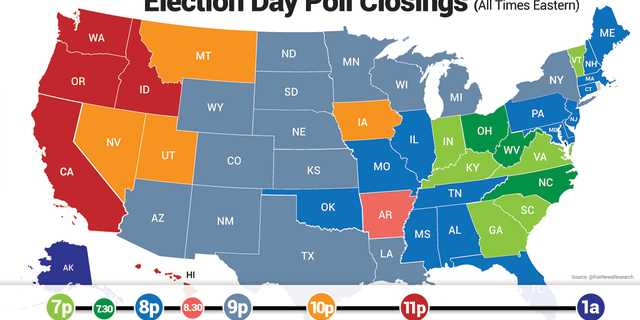
Election
watchers could be in for a long time. The first polls, on the East
Coast, close at 7 p.m. ET. After polls on the West Coast close at 11
p.m. ET, the last will close in Alaska at 1 a.m. ET.
Ahead
of the vote, House Democratic leader Nancy Pelosi confidently predicted
last week that Democrats would indeed win back the House.
“Let me
say this. Up until today, I would’ve said, ‘If the election were held
today, we would win,’” Pelosi said on “The Late Show with Stephen
Colbert” Tuesday. “What now I’m saying is, ‘We will win.’”
But
there are no guarantees about Election Day, even as generic
congressional ballots show Democrats with the advantage over
Republicans. While Democrats need to net 23 seats for a majority, the
Fox News House Power Rankings indicate there are 29 “toss-up” races.
If
Democrats are victorious, the Trump administration likely will be in
for a challenging 2019. Should Democrats re-take the House, there are
signs some in the conference may launch a push to impeach the president –
though the leadership has not yet backed the effort. Pelosi has said
impeachment is "not a priority," at least not until Special Counsel
Robert Mueller announces the conclusions of his probe into the Trump
administration's alleged dealings with Russia.
Trump, though,
almost assuredly will face an avalanche of investigations into his tax
returns, his payments to adult-film star Stormy Daniels and his
relationship with Russia if Democrats win back the House – which comes
with the much-coveted power to subpoena and launch congressional
investigations. PRESIDENT TRUMP'S CLOSING ARGUMENT: VOTE REPUBLICAN AND CONTINUE THE JOBS BOOM
A
number of prominent anti-Trump Democrats also would be poised to assume
control of key committees if Republicans lose control of the House.
Rep.
Maxine Waters, D-Calif., likely would be elevated to chairwoman of the
House Financial Services Committee, where she currently serves as
ranking member. Another top California Democratic representative, Adam
Schiff, would likely rise to chair the House Intelligence Committee,
where he is now the ranking member. And Pelosi would look to regain the
speakership.
Still, if Democrats win the House – but Republicans hold the Senate – their legislative priorities likely would stall.
In
the Senate, the Fox News Senate Power Rankings lists Florida, Indiana,
Missouri, Arizona and Nevada as the five most competitive races. Of
those races, Democrats in three states won by Trump are defending their
seats.
Republicans feel more confident about keeping control of
the Senate – or possibly adding to their majority. But the threat to the
Trump agenda is real if they lose control. Democrats have a narrow path
to the majority if they run the table in the toss-ups and pick off one
GOP-favored seat, like Texas or Tennessee. If Democrats win control of
both houses of Congress, they could send legislation to Trump’s desk.
And, in the Senate, they would have the votes to block any of Trump's
nominees – coming after Justice Brett Kavanaugh’s brutal confirmation
fight last month.
On the day before America votes, Trump hopscotched to rallies in three battleground states -- in Ohio, Indiana and Missouri.
In
Ohio, Trump campaigned for a slate of Republicans, including Jim
Renacci in his bid to unseat Democrat Sen. Sherrod Brown. Trump won the
state with 52 percent of the vote in 2016 but the Fox News Senate Power
Rankings lists that contest as “likely Democrat.”
Later Monday,
the president flew to Fort Wayne, Indiana, where he is hoping to give
Republican Mike Braun an assist to defeat incumbent Democratic Sen. Joe
Donnelly. He then traveled to Missouri to lend a hand to Josh Hawley in
his campaign to beat incumbent Democratic Sen. Claire McCaskill.
Meanwhile,
in state capitals across the country, Republicans have control of a
majority of governorships, holding 33 to the Democrats’ 16 seats.
Democrats
are likely to pick up at least some seats, with 36 gubernatorial seats
up for grabs this year. According to the Fox News Gubernatorial Power
Rankings, 15 of the contested seats lean Republican, 13 lean Democrat
and eight are tossups.
For Republicans, holding on to control of
state houses is important, considering that’s where real policy changes
may take place if Democrats win control of Congress and Washington
effectively deadlocks.
Among the most-watched races: Wisconsin GOP
Gov. Scott Walker is locked in a tight re-election battle with
Democratic challenger Tony Evers and Tallahassee Democratic Mayor Andrew
Gillum is facing off against Trump-backed GOP Rep. Ron DeSantis in
Florida.
Though the political environment seems to favor
Democrats, Trump argued Monday that Republican voters are energized
heading into Tuesday’s vote, saying he hasn’t felt such “electricity”
since he was elected president in 2016.
"Tomorrow, with your votes, you can stop the radical resistance in its tracks," Trump told the crowd in Cleveland. Fox News’ Gregg Re contributed to this report.
To
some Republicans' chagrin, President Trump has openly embraced
Democrats' efforts to cast Tuesday's midterm elections as a referendum
on his record and political clout, a kind of ultimate test after a
bruising midterm season that saw many of his hand-picked candidates
surge to victories in key primaries.
Election Day marks voters'
first nationwide opportunity to react not only to Trump's tenure, but
also to the slew of recent developments that have reverberated in the
public consciousness, including the deadly mass shooting at a Pittsburgh synagogue, the swelling migrant caravans making their way to the U.S. border with Mexico, and the mail bombs sent to prominent liberals by an outspoken supporter of the president.
"In
a sense, I am on the ticket,” Trump told a raucous election-eve rally
in Ohio, one of three he held in the final hours before Election
Day. "The midterm elections used to be, like, boring, didn't they?" he
added. "Do you even remember what they were? People say midterms, they
say, 'What is that, what is it,' right? Now it's like the hottest
thing."
Trump has held 26 rallies since October as he
criss-crossed the country, boosting not only local candidates but also
his own stake in Tuesday's vote. In Mississippi in October, Trump urged
supports to imagine they could vote for him when they head into the
voting booth: “I'm not on the ballot, but in a certain way, I'm on the
ballot. I want you to vote. ... Pretend I’m on the ballot.”
At an
airport in Indiana ahead of another Monday evening rally, Trump
simultaneously seemed to downplay his role while also expressing an
eagerness to bear the responsibility for his party's performance on
Tuesday.
"It's really about the candidate, but if they want to
give me the credit or the liability, I'll be willing to take it," Trump
told reporters.
"In a sense, I am on the ticket." — President Trump
Over
the past several months, Trump has unabashedly taken credit for the big
wins enjoyed by several Republican candidates throughout this
year's primary season, which often came directly after his endorsement.
Georgia
Secretary of State Brian Kemp, who is locked in a tight gubernatorial
race against Stacey Abrams, had surged ahead of Lt. Gov. Casey Cagle
only after he secured Trump's backing. Similarly, Republican John
Cox secured a spot on Tuesday's ballot in California's gubernatorial
race when Trump urged the party to coalesce behind him. KEMP ANNOUNCES LAST-MINUTE PROBE INTO POSSIBLE VOTER HACKING BY GEORGIA DEMOCRATS
Perhaps
the most stunning example of Trump's influence unfolded on June 12 in
South Carolina, when Trump-bashing Rep. Mark Sanford was unseated by
Katie Arrington. As voters headed to the polls, Trump tweeted that
"Sanford has been very unhelpful to me in my campaign to MAGA" and
called him "MIA and nothing but trouble."
Also attributable, at
least in part, to Trump's endorsements: Republican State Sen. Troy
Balderson pushing back a challenge from insurgent Democrat Danny
O’Connor in Ohio's special election in August; South Carolina Gov. Henry
McMaster's win over rival businessman John Warren; and New York Rep.
Dan Donovan's rise to beat Michael Grimm.
"When I decided to go to
Ohio for Troy Balderson, he was down in early voting 64 to 36," Trump
tweeted. "That was not good. After my speech on Saturday night, there
was a big turn for the better. Now Troy wins a great victory during a
very tough time of the year for voting. He will win BIG in Nov." (Fox
News currently rates Balderson's bid for Ohio's 12th Congressional
District as lean Republican.) TRUMP
ANNOUNCES PLAN TO DENY ASLYUM-SEEKERS WHO DON'T ARRIVE AT PORT OF
ENTRY, IN APPARENT ATTEMPT TO REJECT MANY CARAVAN MEMBERS
But
as voters head to the polls, some Republicans are suggesting
that Trump's fiery, immigration-focused messaging may have derailed the
GOP's electoral chances in some key races. And Trump himself seemingly
acknowledged that, despite his efforts, his party is looking at long
odds in several congressional races.
“I think we’re going to do
well in the House," Trump said. "But, as you know, my primary focus has
been on the Senate, and I think we’re doing really well in the Senate.”
Last
week, Trump rebuked House Speaker Paul Ryan, R-Wis., and told him that
he "should be focusing on holding the Majority" rather than challenge
his proposal to end birthright citizenship -- which was widely seen as an effort to cast some blame on Ryan if Democrats retake the lower chamber.
Last
Friday's jobs report showed the unemployment rate holding steady at 3.7
percent, the lowest it has been in nearly 50 years, and that employers
added roughly 250,000 jobs in October. Consumer confidence is at
record-high levels. In an exclusive Fox News op-ed published Monday, Trump focused extensively on the economy, which he called "red-hot" and "the envy of the world." TRUMP MAKES CLOSING ARGUMENT IN FOX NEWS OP-ED: VOTE REPUBLICAN AND CONTINUE THE JOBS BOOM
At times, though, Trump has appeared unwilling to discuss those figures publicly.
"Sometimes
it’s not as exciting to talk about the economy because we have a lot of
other things to talk about," Trump said at a rally Wednesday night in
West Virginia. He proceeded to discuss the migrant caravan and
birthright citizenship -- more contentious issues that analysts say may
turn off some moderate voters.
"Does that bring a single person to
the polls? Is it moving any undecided voter — toward you, anyway?"
Americans for Tax Reform President Grover Norquist asked, in an
interview with The Washington Examiner. "Immigration is not a consensus issue within the current Republican Party because so many Republican voters are immigrants."
In an interview with The Los Angeles Times
on Monday, former House Speaker Newt Gingrich said Trump "owns the
Republican Party even more than Reagan" -- and he's wielding that
historic influence accordingly.
"He has polarized the election on
the issues he believes in, on his terms, despite the news media,"
Gingrich said. "You can argue whether or not it’s the right gamble. But
it’s his gamble.”