Democrat Stacey Abrams said she expects a federal judge to rule
Wednesday in largely her favor regarding the federal lawsuit from her
campaign filed over the weekend in hopes of forcing a runoff election
in Georgia’s unsettled governor's race.
In a tweet on
Tuesday, Abrams said her legal team plans on receiving “a ruling by
noon tomorrow, and we expect to receive most of the relief we have asked
for.”
If the judge rules in favor of Abrams, the suit would prevent officials from certifying county vote totals until Wednesday
and could restore at least 1,095 votes that weren't counted as it would
require officials to tally any votes that were wrongly rejected. The
campaign said thousands of more ballots could be affected.
Each of
Georgia's 159 counties must certify final returns by Tuesday, and many
have done so already. The state must certify a statewide result by Nov.
20.
Brian Kemp, her Republican challenger, issued a statement on
Saturday, a day before Abrams filed the lawsuit, calling for his
opponent to concede. Kemp has declared victory and said it is
"mathematically impossible" for her campaign to force a runoff.
Kemp had 50.3 percent of the vote as of late Tuesday evening, according to The New York Times and was leading by roughly 59,000 ballots.
Abrams’
campaign manager, Lauren Groh-Wargo, tweeted Tuesday afternoon that
"it's not just provisionals, there are still Election Day and mail votes
being reported in places that were ‘100%’ reported, & none from
Gwinnett."
She said Abrams received 84.6 percent of the 2,738
votes reported Tuesday, before adding that the margin to force a runoff
election has narrowed to 18,617. In a separate lawsuit, a federal judge on Monday ordered Georgia
to take steps to protect provisional ballots and to wait until Friday
to certify the results of the midterm elections that include an
unsettled race for governor.
Common Cause, a nonpartisan group,
claimed in the suit that Kemp, while secretary of state, failed to
maintain "the security of voter information despite known
vulnerabilities" leading up to the midterm. The suit blasted the state's
"provisional ballot scheme," that could disenfranchise a registered
voter at the ballot box.
Judge Amy Totenberg, who was appointed by
President Obama, also ruled that Georgia must not certify the election
results before Friday at 5 p.m., which falls before the Nov. 20 deadline
set by state law.
Abrams is hoping to become the first African-American woman governor of a U.S. state.
If
Kemp is able to hold onto his narrow lead to avoid a runoff election,
his governorship will be marred by lingering questions about his
handling of a contentious election he oversaw as secretary of state.
A federal judge on Monday ordered Georgia take steps to protect
provisional ballots and to wait until Friday to certify the results of
the midterm elections that include an unsettled race for governor.
Lauren Groh-Wargo, Abrams campaign manager, announced Judge Amy Totenberg's decision late Monday. WSBTV.com reported that the judge’s 56-page ruling could affect thousands of provisional ballots. Groh-Wargo called the ruling "good news."
Brian
Kemp, her Republican challenger, issued a statement a day earlier
calling for Abrams to concede. Kemp has declared victory and said it is
"mathematically impossible" for her campaign to force a runoff.
Abrams' campaign did not immediately respond to a phone call from Fox News late Monday night.
Abrams,
44, a Democrat, has maintained that she will not concede until every
vote has been counted, and pointed to the 5,000 votes tallied over the
weekend that favored her.
Totenberg, who was appointed by
President Obama, ruled in connection to Common Cause's lawsuit filed on
Nov. 5. Totenberg's order doesn't change the Tuesday deadline for
counties to certify their results.
Common Cause, a nonpartisan
group, claimed in the suit that Kemp, while secretary of state, failed
to maintain "the security of voter information despite known
vulnerabilities" leading up to the midterm. The suit blasted the state's
"provisional ballot scheme," that could disenfranchise a registered
voter at the ballot box.
The suit pointed out cases where voters
were turned around after computer glitches and cases where voters were
not offered provisional ballots. One man voted for decades and was
“disturbed” to learn his registration history was erased.
The court ruled that the secretary of state’s office must establish a hotline and publicize it on its website
for voters to see if their provisional ballots were counted. Totenberg
also ruled that Georgia must not certify the election results before
Friday at 5 p.m., which falls before the Nov. 20 deadline set by state
law.
"I am fighting to make sure our democracy works for and
represents everyone who has ever put their faith in it. I am fighting
for every Georgian who cast a ballot with the promise that their vote
would count," Abrams said in a statement explaining her refusal to end
her bid to become the first black woman elected governor in American
history.
A total of 21,190 provisional ballots were cast in the
state during the midterm, 12,151 were cast in 2014. Four
Democratic-leaning counties with the largest number of provisional
ballots -- Cobb, DeKalb, Fulton, and Gwinnett – “had not yet reported
their numbers to the secretary as of November 11,” the suit said.
The
lawsuit also asked that provisional ballots cast by a voter registered
in another county be counted as if the voter had shown up at the wrong
precinct. The lawsuit says that of the 1,556 provisional ballots Fulton
County reported having rejected by Nov. 9, nearly 1,000 were
disqualified because they were cast by voters whose registration records
showed them registered in another county.
Edgardo Cortes, who
currently works as an election security adviser at New York University,
said these uncounted provisional ballots could sway the election and,
despite Kemp’s claims, his unofficial vote total is so close to 50
percent, a runoff is possible.
Kemp was up 50.2 percent to Abrams'
48.7 percent early Tuesday. More than 3.9 million votes were cast in
the election, and Abrams would need to acquire more than 20,000
additional votes to force a runoff.
Abrams' campaign filed a lawsuit Sunday
asking a federal court to push the deadline for counties to certify
their results to Wednesday, while also requiring that elections
authorities count certain provisional and absentee ballots that have
been or would be rejected for "arbitrary reasons."
“This ruling is
a victory for the voters of Georgia because we are all stronger when
every eligible voter is allowed to participate in our elections,” Sara
Henderson, executive director for Common Cause Georgia, which filed
the lawsuit, told AJC.com.
The press just can't quit Donald Trump.
No matter what he does — or doesn't do — he's the story. The biggest story. Often the only story.
And
that story, the continuous story, inevitably involves we the media. The
president excels at dragging the news business into the center of every
controversy, and its members all too often fall into the trap.
Even
the recent chatter about whether media outlets should boycott White
House press briefings puts them in a potential confrontation with Trump,
which is just the way he likes it.
The president was in Paris over the weekend, for the 100th anniversary of the end of World War I, and this Washington Post story yesterday encapsulates the addictive nature of the coverage.
The
lead notes that "on a trip to Europe, the president hardly said a word —
and he still managed to outrage at almost every turn."
But is
that alleged outrage fanned by the media? And if Trump generates outrage
whether he speaks or not, isn't that a telling statement?
Other
than one critical tweet about Emmanuel Macron (based on an inaccurate
newspaper story, the Post notes), "Trump didn't throw any sharp elbows
at his peers here. It was still all about him."
Translation: The media still made it all about him.
The
newspaper's take is that "it was because of the images. He looked
uncomfortable and listless in a bilateral meeting with Macron, whose
sinewy energy stood in stark contrast to Trump's downbeat expression as
the French leader patted him on the thigh."
We can't have that!
Trump
also skipped a scheduled tour of a military cemetery for Americans,
blaming the rain. And by the way, that was a legitimate issue to cover,
as it felt like a snub by a president who had gone to France in part to
honor the sacrifices made by our soldiers.
At an event at the Arc
de Triomphe, Stone sat "stone-faced as Macron railed against the rise of
nationalism — a rebuke of Trump's professed worldview. The overall
takeaway to many was a president turning away from the world, a man
occupying the office of the leader of the free world who appeared
withdrawn and unenthusiastic on the global stage."
And the first quote was a tweet by former Obama aide David Axelrod, who said, "America First feels like America Alone."
The
president made huge news on previous foreign trips by getting into
confrontations with other western leaders. But on a trip where he
largely avoided public conflict, for whatever reason, Trump still drew
negative coverage.
(He offered a different take on Twitter: "Just
returned from France where much was accomplished in my meetings with
World Leaders. Never easy bringing up the fact that the U.S. must be
treated fairly, which it hasn't, on both Military and Trade.")
Meanwhile, New York Times media columnist Jim Rutenberg weighed in yesterday on the fallout from the Jim Acosta controversy.
The
White House suspended Acosta's credentials after a dustup in which he
refused to stop asking Trump questions or give up the microphone. To his
credit, Rutenberg pointed out that Acosta "is a somewhat polarizing
figure, viewed by some of his press corps colleagues as a showboat."
After
noting that CNN President Jeff Zucker told his producers not to play up
the Acosta punishment, the column said that "CNN would not be led by
the nose into giving significant airtime to another Trump attack on the
news media ...
"Reporters could stage a group protest. But that
would make them look like they're at war with the president, just as he
always says they are. Or they could do nothing and effectively 'submit
to his authority to determine who gets to hold him accountable,'" as GOP
strategist and fierce Trump critic Steve Schmidt put it.
It's a no-win situation. And here's why a boycott wouldn't work:
— Much of the country would turn on the press for not doing its job. Refusing to show up at briefings is a very tough sell.
— Trump would pound away at the media, saying they have moved into the opposition camp.
—
Journalists would be seen as hopelessly self-absorbed if they
surrendered the chance to question the White House press secretary on
the public's behalf.
— And most important of all, it would never
happen. There's no way all the disparate media outlets, with their
varying interests, would agree to a joint boycott, and the show would go
on.
This is actually somewhat symbolic since Sarah Huckabee
Sanders is now briefing only rarely as her boss takes more and more
questions from reporters.
But it highlights once again that most media debates these days are about Donald Trump — and the media.
President Donald Trump, first lady Melania Trump, Morocco's
King Mohammed VI, his son Crown Prince Moulay and Canadian Prime
Minister Justin Trudeau, left, attend a commemoration ceremony for
Armistice Day at the Arc de Triomphe in Paris. (AP)
Donald Trump stared down the King of
Morocco who appeared to be taking a nap during Emmanuel Macro's moving
World War One ceremony speech.
King Mohammed VI of Morocco was
seen with his eyes closed as Macron honored the soldiers who died during
WWI in a video clip posted to Reddit yesterday.
The U.S. President, who was seated two spaces away from the royal, looked unimpressed as he looked past his wife Melania.
Yesterday’s
ceremony marked 100 years since the Armistice happened at the Tomb of
the Unknown Soldier in front of the Arc de Triomphe in Paris.
Trump was seated between Melania and Germany’s chancellor Angela Merkel as Macron also spoke about the dangers of nationalism.
Macron said the "ancient demons" that caused World War I and millions of deaths are growing stronger.
He
said: "Patriotism is the opposite of nationalism. Nationalism is
treason, if we think our interest may only come first and we don't care
for others, it is treason of our values. A betrayal of all moral values,
we must remember this.
"It is those values and virtues that
motivated those who sacrificed all to defend democracy... It is those
values and those virtues that gave them strength because it guided their
heart.
"The lessons of the Great War cannot be of vengeance nor
forgetting the past. We must think of the future and preserve that which
is essential."
Republican U.S. Rep. Martha McSally conceded Arizona's U.S. Senate
race to Democratic Congresswoman Kyrsten Sinema on Monday after the
latest vote count showed McSally trailing by more than 38,000 votes out
of more than 2.2 million ballots cast.
"Congrats to
@kyrstensinema. I wish her success," McSally tweeted from her official
campaign account. "I’m grateful to all those who supported me in this
journey. I’m inspired by Arizonans’ spirit and our state’s best days are
ahead of us."
"As long as I’ve served Arizona, I’ve worked to
help others see our common humanity & find common ground," Sinema
tweeted soon after McSally conceded. "That’s the same approach I’ll take
to representing our great state in the Senate, where I’ll be an
independent voice for all Arizonans.
"Thank you, Arizona. Let's get to work."
Sinema's
victory means that Democrats have flipped the seat previously held
by retiring Republican Sen. Jeff Flake. Democrats now have 47 Senate
seats, while Republicans have 51. The final makeup of the Senate will be
determined following a recount in Florida and a Nov. 27 runoff election
in Mississippi.
Flake tweeted congratulations to Sinema "on a race well run, and won," adding "You'll be great."
Sinema,
a three-term congresswoman, is Arizona's first Democratic U.S. senator
since 1994. McSally, a former Air Force pilot who embraced President
Donald Trump after opposing him during the 2016 elections, had claimed
that Sinema's anti-war protests 15 years ago disqualified her and said
one protest amounted to "treason."
But during her six years in
Congress, Sinema built one of most centrist records in the Democratic
caucus, and she voted for bills backed by Trump more than 60 percent of
the time. She backed legislation increasing penalties against people in
the country illegally who commit crimes.
In remarks to supporters, Sinema paid tribute to the late Republican Sen. John McCain, who died this past August.
Sinema
said the former prisoner of war and GOP presidential nominee was
"irreplaceable" and "taught us to assume the best in others, to seek
compromise instead of sewing division, & to always put country ahead
of party.”
"As your Senator, that’s exactly what I'll do," Sinema
went on. "Not by calling names or playing political games, but by
showing up and doing the work to keep Arizona moving forward."
McSally's attacks on Sinema reached back more than 15 years to when Sinema was a Green Party spokeswoman and liberal activist.
McSally
backed Trump's tax cut, border security and the repeal of ObamaCare as
she survived a three-way GOP primary in August, defeating two
conservative challengers who claimed her support for Trump was fake.
McSally also campaigned on her military record and support for the armed
forces.
Sinema attacked McSally's leadership of last year's
failed ObamaCare repeal effort as a sign that she would not protect
Arizona residents with pre-existing medical conditions. McSally argued
that she would protect patients, despite her vote on the bill that would
have removed many of those protections.
The Arizona contest drew
more than $90 million in spending, including more than $58 million by
outside groups, according to Federal Election Commission reports. Attack
ads by both sides clogged the airwaves for months.
Sinema, 42,
has a law degree, worked as a social worker and was a political activist
in her 20s, running as an independent Green Party candidate for the
Arizona House. She then became a Democrat and served several terms in
the state Legislature. Sinema started as an overt liberal but developed a
reputation for compromise among her Republican peers, laying the
groundwork to tack to the center. She was elected to represent Arizona's
newly-created 9th Congressional District in 2012.
McSally, 52,
was the first female Air Force pilot to fly in combat, flying A-10
attack jets. She also was the first woman to command a fighter squadron,
again in A-10s.
McSally lost her first race in Arizona's 2nd
congressional district in 2012 when she was narrowly defeated by
Democratic Rep. Ron Barber, who replaced Rep. Gabby Giffords after she
was wounded in a 2011 assassination attempt. But McSally came back to
win the 2014 election, beating Barber by a narrow margin and was
re-elected in 2016.
Flake was an outspoken critic of Trump and
announced in 2017 that he would not seek re-election, acknowledging he
could not win a GOP primary in the current political climate. His
support of the president's initiatives, however, was mixed. He strongly
backed last year's tax cut bill but criticized Trump's positions on free
trade.
This is why you don't vote for Democrats. They cheat, lie, steal, and sue, sue, sue.
The
incoming chairman of the House Intelligence Committee this week said
that when the new Congress is seated in January, Democrats plan to
scrutinize whether President Trump abused his authority by taking
adverse action against retail giant Amazon and two of his bitter
left-leaning media rivals: CNN and The Washington Post.
Rep. Adam
Schiff, D-Calif., said in an interview with "Axios on HBO" that he and
his colleagues will employ committee subpoena powers -- which are backed
by the legal threat of contempt of Congress -- to conduct
the triple-threaded inquiry into Trump's possible use of
the "instruments of state power to punish the press."
Specifically,
Schiff charged that Trump "was secretly meeting with the postmaster
[general] in an effort to browbeat" her into "raising postal rates on
Amazon," whose founder and CEO, Jeff Bezos, separately owns The
Washington Post.
"This appears to be an effort by the president to
use the instruments of state power to punish Jeff Bezos and The
Washington Post," Schiff said in the interview.
The president
signed an executive order earlier this year mandating a review of what
he called the "unsustainable financial path" of the United States Postal
Service (USPS). And he has reportedly met with Postmaster General Megan
Brennan several times to push for hikes to the shipping rates paid by
companies like Amazon, although there are no indications he did so to
seek political payback.
Trump has long derided the political
coverage at the Post, which is fiercely and relentlessly criticial of
the White House, as a lobbying tool for Bezos. Most recently, the White
House has contradicted the Post's unequivocal reporting that it had shared a "doctored" video of CNN reporter Jim Acosta making contact with a White House intern during a press conference last week, as a Buzzfeed analysis suggested
the changes in the video could have resulted inadvertently from the
conversion of the footage to the lower-fidelity .gif format commonly
used on Twitter.
But Trump has also feuded specifically with
Amazon throughout the year, saying it is taking advantage
of taxpayer-subsidized shipping rates.
In March, he argued in a
series of tweets that the online retailer’s “scam” shipping deal with
the USPS -- which affords Amazon generous discounts -- is costing the
agency “billions of dollars.”
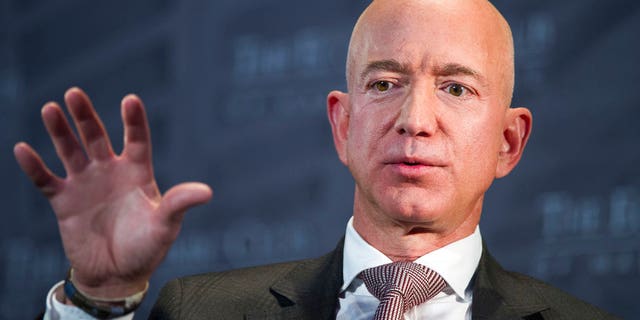
Jeff Bezos, Amazon founder and CEO, speaks at The Economic Club of Washington's Milestone Celebration in Washington.
(Associated Press)
While the USPS has
lost money for 11 years, Trump's critics have claimed that package
delivery -- which has been a relative bright spot for the service as it
competes in that space with UPS and FedEx -- is not the main reason.
Boosted by e-commerce, the Postal Service has experienced double-digit
increases in revenue from delivering packages despite offering discounts
to retailers, even as the agency is hit with significantly increased
mandatory pension and health care costs, as well as precipitous declines
in first-class letters and marketing mail.
But it could be that
the USPS is undercharging Amazon for its services. Although federal law
ostensibly requires that the USPS' deals with Amazon be at least a
break-even proposition for the government, the agency's profits from
parcel deliveries are difficult to accurately calculate, owing to
its complicated hybrid-monopoly structure and accountingdocuments that raise questions as to its actual costs.
Schiff
also raised the possibility that the Trump administration's opposition
to AT&T's $85 billion takeover of Time Warner on antitrust grounds
may have been motivated by the president's animus toward CNN, whose
parent company is Time Warner. Trump frequently claims that CNN speads
"fake news" and that when it does so, it is acting as the "enemy of the
people."
"We don't know, for example, whether the effort to hold
up the merger of the parent of CNN was a concern over antitrust, or
whether this was an effort merely to punish CNN," Schiff said, without
offering evidence. WHAT ARE THE MAJOR LEGISLATIVE BATTLEGROUNDS BETWEEN DEMS, GOP IN 2019?
"It
is very squarely within our responsibility to find out," Schiff said.
Along with incoming House Oversight Committee Chairman Rep. Elijah
Cummings, D-Md., and other top Democrats, Schiff will have a mandate to
serve a slew of subpoenas on the Trump administration.
But former
GOP Judiciary Committee Chairman Jason Chaffetz, who is now a Fox News
contributor, told Politico in October that Cummings and Schiff shouldn't
get their hopes up.
“If [North Carolina Rep.] Mark Meadows and
[Ohio Rep.] Jim Jordan can’t get documents out of the White House, I
don’t know why Elijah Cummings and the Democrats think they’ll do any
better,” Chaffetz said.
Still, Democrats had signaled even before
last week's midterm elections that they would aggressively investigate
the Trump administration if they took power in Congress. Bogging down
the White House with burdensome document requests and subpoenas could
indeed backfire, political analysts tell Fox News, but there is little
doubt that the strategy -- made more viable by heightened partisanship
and loosened congressional norms -- would impair Republicans' messaging
and even policy goals for the next two years.
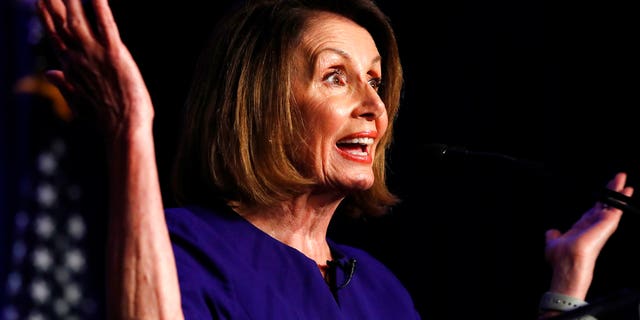
House Democratic Leader Nancy Pelosi of Calif., speaks to a crowd
of volunteers and supporters of the Democratic party at an election
night returns event at the Hyatt Regency Hotel, on Tuesday, Nov. 6,
2018, in Washington. (AP Photo/Jacquelyn Martin)
"Well, we are responsible," House Minority leader
Nancy Pelosi, who is campaigning to reclaim her role as House
speaker, said Sunday on CBS' "Face the Nation." "We are not scattershot.
We are not doing any investigation for a political purpose, but to seek
the truth. So I think a word that you could describe about how
Democrats will go forward in this regard is we will be very strategic."
But Pelosi has previously suggested that she would, indeed, use the threat of subpoenea for political gain. MAXINE WATERS, SCHIFF TO TAKE HIGH-PROFILE COMMITTEE POSTS IN NEW HOUSE
“Subpoena
power is interesting, to use it or not to use it,” Pelosi said at a
conference in October, referring to the authority of House committees to
summon individuals and organizations to testify or provide documents
under penalty of perjury. “It is a great arrow to have in your quiver in
terms of negotiating on other subjects." She added that she would use
the power "strategically." (Trump has flatly called Pelosi's
plan "illegal.")
Pelosi's approach would mark the continuation of a
trend. Research conducted by Cornell University political science
professor Douglas Kriner, who co-wrote the 2016 book "Investigating the
President: Congressional Checks on Presidential Power," underscores the
increasingly political nature of House investigations.
"We
examined every congressional investigation from 1898 to 2014 – more than
11,900 days of investigative hearings," Kriner told Fox News. "What we
found is that divided government is a major driver of investigations in
the House. This is particularly true in periods of intense partisan
polarization. For example, from 1981-2014, the House averaged holding 67
days of investigative hearings per year in divided government, versus
only 18 per year in unified government."
Kriner added that modern
congressional probes seem geared toward "maximiz[ing] the political
damage on the White House," rather than producing more substantive
results. "Investigations are less likely to trigger new legislation than
in previous, less polarized eras," Kriner told Fox News.
On
Election Day, Pelosi vowed to “restor[e] the Constitution’s checks and
balances to the Trump administration" by enhancing transparency and
accountability. But Trump last week signaled he had no patience for that
approach, which he characterized as an expensive folly.
"If the
Democrats think they are going to waste Taxpayer Money investigating us
at the House level, then we will likewise be forced to consider
investigating them for all of the leaks of Classified Information, and
much else, at the Senate level. Two can play that game!" Trump tweeted.
The supervisor of elections in Florida's heavily Democratic Palm
Beach County said Sunday that she did not believe her department would
meet a Thursday deadline to complete recounts in the Sunshine State's
historically tight gubernatorial and Senate races, threatening to
further confuse an increasingly chaotic and politically fraught process.
The
supervisor, Susan Bucher, told reporters that she did not expect to
meet the deadline due to aging equipment. Florida Department of State
spokeswoman Sarah Revell told Fox News that under state law, if a county
does not submit their results by the deadline, then the results on file
at the time take their place. Revell added that Florida's Secretary of
State has no authority to grant extensions.
"Supervisors of
Elections are independent officials and they are responsible for
deciding when to upgrade or modernize their equipment," Revell added.
The
recount in most other major population centers, including Miami-Dade
and Pinellas and Hillsborough counties in the Tampa Bay area, were
taking place without incident on Sunday. Smaller counties are expected
to begin their reviews Monday, Tuesday or Wednesday.
Bucher spoke
hours after the campaign of Republican Senate candidate Rick Scott --
which secured an early legal victory against Democratic-leaning Broward
County officials over the weekend -- went back to court with a fresh
salvo of emergency complaints against both Broward and Palm Beach
counties. One complaint requests that state sheriff's officers "impound
and secure all voting machines, tallying devices and ballots when they
are not in use until the conclusion of the recount."
In a separate
lawsuit, Scott's team is asking a judge to throw out votes tallied by
the Broward County Canvassing Board after Saturday's noon deadline, in
apparent violation of state law, which requires that "[t]he canvassing
board shall submit ... unofficial returns to the Department of State for
each federal, statewide, state, or multicounty office or ballot measure
no later than ... noon on the fourth day after any general or other
election."
“The Broward and Palm Beach County Supervisors of
Elections has already demonstrated a blatant disregard for Florida’s
elections laws, making it more important than ever that we continue to
do everything possible to prevent fraud and ensure this recount is
operated responsibly," Chris Hartline, a Scott spokesman, said in a
statement.
Lawyer Marc Elias, who is representing the campaign of Democratic incumbent Sen. Bill Nelson, fired back on Twitter.
"Lets [sic]
be clear about what we are witnessing in Florida," Elias wrote. "The
sitting Governor is seeking to throw out lawful votes and seize the
voting equipment in order to win an election."
"Somebody needs to
cut down on the Red Bull," a Scott spokesperson wrote on Twitter, in
response to a statement by Florida Democrats Executive Director Juan
Penalosa that compared Scott to a Latin American dictator. "We requested
that ballots and voting machines be protected when not in use. The only
reason not to protect the integrity of the ballots and the voting
machines is if you are actively promoting or hoping for fraud."
But
Democrats continued to bash the Republican's effort. "If Rick Scott
wanted to make sure every legal ballot is counted, he would not be suing
to try and stop voters from having their legal ballot counted as
intended," Nelson said in a statement. "He's doing this for the same
reason he's been making false and panicked claims about voter fraud --
he's worried that when all the votes are counted he'll lose this
election. We will not allow him to undermine the democratic process and
will use every legal tool available to protect the rights of Florida
voters."
Unofficial results show that Republican former Rep. Ron
DeSantis led Democratic Tallahassee Mayor Andrew Gillum by 0.41
percentage points in the election for governor. In the Senate race,
Scott's lead over Nelson is 0.14 percentage points. State law requires a
machine recount in races where the margin is less than 0.5 percentage
points. Once completed, if the differences in any of the races are 0.25
percentage points or below, a hand recount will be ordered.
The
litigation threw yet another wrench in an increasingly chaotic process
reminiscent of the 2000 presidential election recount fiasco. In Broward
County, the scheduled start of the recount was delayed Sunday because
of a problem with one of the tabulation machines. The Republican Party
accused Broward's supervisor of elections, Brenda Snipes, of continuing
to compromise the process with "incompetence and gross mismanagement"
following the delay, which was resolved within two hours.
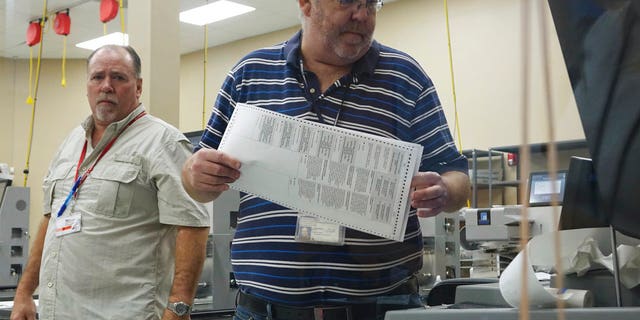
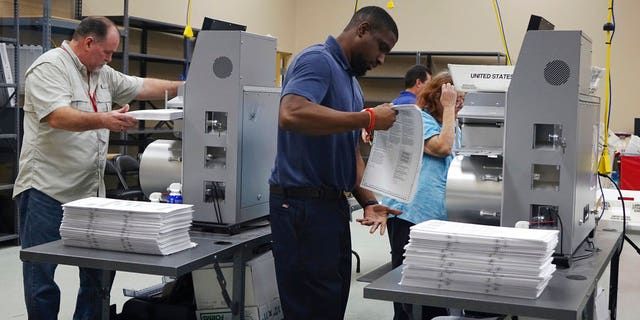
Election workers place ballots into electronic counting machines,
Sunday, Nov. 11, 2018, at the Broward Supervisor of Elections office in
Lauderhill, Fla. The Florida recount began Sunday morning in Broward
County. (Joe Cavaretta/South Florida Sun-Sentinel via AP)
Broward County election planning director Joe D'Alessandro told Fox News
that machines in Broward are currently resorting some 3.5 million pages
of ballots, and officials said that process could take more than 30
hours alone before any actual counting begins.
Broward County, the
state's second-most populous, is emerging as the epicenter of
controversy in the recount. Broward officials said they mistakenly
counted 22 absentee ballots that had been rejected, mostly because the
signature on the return envelope did not match the one on file.
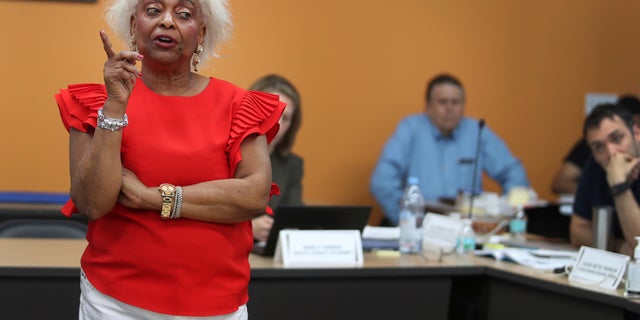
Brenda Snipes, Broward County supervisor of elections, speaks with
officials before a canvassing board meeting Friday, Nov. 9, 2018, in
Lauderhill, Fla. (AP Photo/Joe Skipper)
It is a problem that appears impossible to fix
because the ballots were mixed in with 205 legal ballots. Snipes, who
has long been accused of mismanaging county elections and has been
sanctioned by a judge for destroying ballots in a 2016 congressional
race, said it would be unfair to throw out all the ballots.
"#BrowardElections
office admits the vote count they submitted to state includes 22
illegal votes," Florida GOP Senator Marco Rubio wrote on Twitter
Sunday. "We know about these 22 because they got caught breaking law in
reviewing 202 ballots. How can anyone trust more illegal votes aren’t in
their final count?"
Election workers place ballots into electronic counting machines,
Sunday, Nov. 11, 2018, at the Broward Supervisor of Elections office in
Lauderhill, Fla. The Florida recount began Sunday morning in Broward
County. (Joe Cavaretta /South Florida Sun-Sentinel via AP)
Undervoting -- a phenomenon in which voters don't
cast votes in all the races on the ballot -- has become a prominent
issue in the race. Rubio pointed out that Broward County
is showing that approximately 25,000 fewer votes were cast in the
Senate race than the gubernatorial contest -- a significant
undervote that could be explained by Snipes' ballot design, which placed
the Senate contest directly below the ballot's instructions, out of
line with other races.
In 2006, the last time Nelson was on the
ballot alongside a gubernatorial race, only 4,100 fewer people in
Broward voted in the Senate race than in the election for governor.
(However, at the statewide level this year, 34,051 fewer people voted in
the Senate race than the gubernatorial race, a lower figure than the
35,736 undervote in 2006 -- even though 3 million more votes were cast
in 2018 compared to 2006.)
"How ironic would it be if those who
are now bashing our criticism of Snipes in the end wind up arguing that a
ballot design error made by her is the reason the Democrats lost?"
Rubio said Sunday.
Other Republicans suggested that Democrats shouldn't get their hopes up as the recounts get underway.
A crowd protests outside the Broward County Supervisor of
Elections office Friday, Nov. 9, 2018, in Lauderhill, Fla. A possible
recount looms in a tight Florida governor, Senate and agriculture
commission race. (AP Photo/Joe Skipper)
"Scott trails DeSantis by 10,754 votes in Broward,
and Nelson trails Gillum by 10,343," a Scott campaign source told Fox
News. "The idea that the undervotes in Broward County is an opportunity
for Nelson to significantly close the gap is not and has never been
based on anything but fantasy."
The recount in most other major
population centers, including Miami-Dade and Pinellas and Hillsborough
counties in the Tampa Bay area, was ongoing without incident on Sunday.
Smaller counties are expected to begin their reviews Monday, Tuesday or
Wednesday.
Republicans have repeatedly cried foul throughout the
process, both in court and outside Florida election offices. On
Saturday, GOP Rep. Matt Gaetz compared Broward County to a "banana
republic" and posted video apparently showing him being denied access to
election facilities on "safety" grounds.
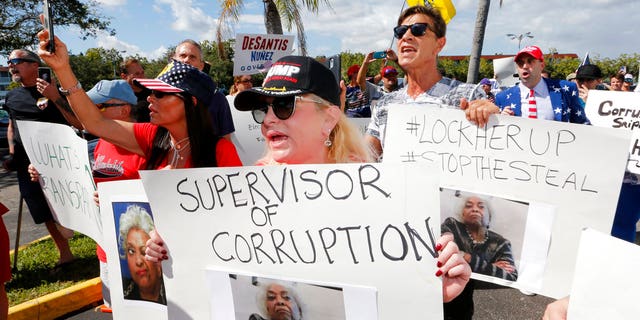
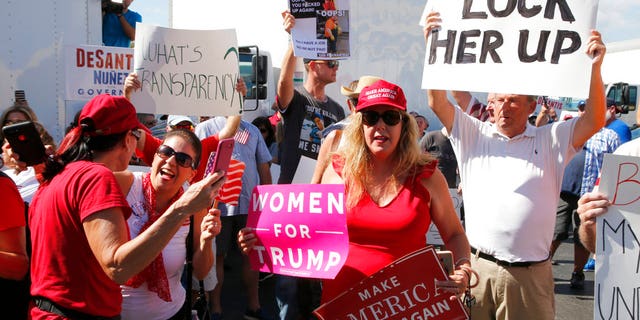
Protesters chanted, "Lock her up" outside the building earlier in the day, referring to Snipes.
Rubio
and other Florida officials have posted numerous videos and images on
social media apparently showing boxes of ballots being left behind in
public spaces or improperly loaded onto private trucks.
At an
emergency court hearing on Friday, state Judge Carol-Lisa Phillips ruled
there has “been a violation of the Florida Constitution,” as well as
the state’s public records act, by Broward officials who had not turned
over requested records about the number of votes to be counted. But,
Gaetz said, Florida officials were still blocking Republicans from
monitoring how they were handling boxes of ballots.
"We have very
specific laws in the state to try to prevent fraud," Scott, the
incumbent Florida governor, told "Fox News Sunday" host Chris
Wallace. "We had to go to court to force the supervisor of elections in
Palm Beach County and Broward County to comply with the law, which is
there to prevent fraud."
Scott added: "Sen. Nelson is clearly
trying to commit fraud to win this election, that’s all this is." Asked
to elaborate on his accusation, he replied, "Well, it's his team."
"Sen. Nelson is clearly trying to commit fraud to win this election." — GOP Senate candidate Rick Scott
"His
lawyers said that a noncitizen should vote, that’s one," Scott
continued. "Two, he’s gone to trial and said that fraudulent ballots
should be counted, ballots have already been thrown out because they
were not done properly. He said those should be counted." JUDGE SIDES WITH RICK SCOTT, REPUBLICANS, ORDERS FLORIDA ELECTION OFFICIALS TO COMPLY WITH LAW
Lawyers
for Nelson and Gillum on Friday had objected to the rejection of a
provisional ballot cast by a noncitizen, according to a transcript
obtained by Fox News.
The incident occurred during a canvassing
meeting in Palm Beach County, where provisional ballots were being
examined. According to the draft transcript of the meeting, taken by a
court reporter hired by the Florida Republican Party, a provisional
ballot was ordered excluded from the count, as it came from a non-U.S.
citizen.
The Nelson campaign distanced itself from the objections, which it said that it had not authorized.
The
recount reviews are an unprecedented step in Florida, a state that's
notorious for election results decided by the thinnest of margins. State
officials said they weren't aware of any other time either a race for
governor or U.S. Senate in Florida required a recount, let alone both in
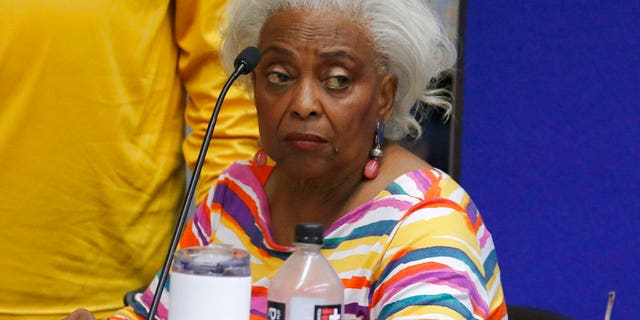
the same election.
Broward County Supervisor of Elections Dr. Brenda Snipes, gives an
update on the progress of ballots that are being counted from the
midterm election Thursday, Nov. 8, 2018. (Carline Jean/South Florida
Sun-Sentinel via AP)
Snipes, the Broward County election supervisor who
has held her office since 2003, is no stranger to controversy. Earlier
this year, Scott's administration said it was monitoring her office
after a judge ruled in May the county broke federal law by destroying
ballots in Rep. Debbie Wasserman Schultz's 2016 Democratic primary race
against Tim Canova, Politico reported.
Snipes claimed the issue had been "blown out of proportion."
In
August, a judge sided with the Florida GOP in its challenge of how the
county handled absentee ballots. Republicans claimed Snipes' office was
opening ballots in private, preventing people from challenging if they
were properly cast, according to Politico.
And then in 2016,
Broward County violated the law when it posted early voting results
online before polls even closed, the Miami Herald reported.
A crowd protests outside the Broward County Supervisor of
Elections office Friday, Nov. 9, 2018, in Lauderhill, Fla. Florida is
once again at the center of election controversy, but this year there
are no hanging chads or butterfly ballots like in 2000. And no angry
mobs in suits, at least not yet. (AP Photo/Joe Skipper)
TRUMP 'WATCHING CLOSELY' WHAT HAPPENS IN FLORIDA, SAYS DEMS TRYING TO STEAL ELECTIONS
As the recount unfolded, Republicans urged their Democratic opponents to give up and allow the state to move on.
Both
the state elections division, which Scott runs, and the Florida
Department of Law Enforcement have said they have found no evidence of
voter fraud. Gillum and Nelson have argued each vote should be counted
and the process allowed to take its course.
Florida is also
conducting a recount in a third statewide race. Democrat Nikki Fried had
a 0.07 percentage point lead over Republican state Rep. Matt Caldwell
in the race for agriculture commissioner, one of Florida's three Cabinet
seats.
From a distant glance, the recounts might dredge up
memories of the 2000 presidential recount, when it took more than five
weeks for Florida to declare George W. Bush the winner over Al Gore by
537 votes, thus giving Bush the presidency.
But much has changed
since then. In 2000, each county had a separate voting system. Many used
punch cards — voters poked out chads, leaving tiny holes in their
ballots representing their candidates. Some voters, however, didn't
fully punch out the presidential chad or gave it just a little push.
Those hanging and dimpled chads had to be examined by the canvassing
boards, a lengthy, tiresome and often subjective process that became
fodder for late-night comedians.
Now the state requires that all
Florida counties use ballots where voters use a pen to fill in a circle
next to their candidate's name, much like a student does when taking a
multiple-choice test. It also now clearly mandates how the recount will
proceed.
Those ballots are now being run through scanning machines
in each county for a second time under the watchful eye of
representatives of both parties and the campaigns. Any ballot that
cannot be read for any of the recounted races will be put aside.
If
a race's statewide margin falls below 0.25 percentage points after the
machine count, the state will order a manual recount in each county. At
that point, only the rejected ballots for that race will be examined by
counting teams to determine if the voters' intentions were obvious. For
example, some voters circle the candidate's name instead of filling in
the ballot correctly and some cross out their vote and then mark another
candidate.
If either side objects to a counting team's decision
or the team can't make one, the ballot will be forwarded to the county's
canvassing board, with the three members voting on the final decision.
The members are usually the county supervisor of elections, a judge and
the chair of the county commissioners.
Get ready for Hillary Clinton 4.0. More than 30 years in the making,
this new version of Mrs. Clinton, when she runs for president in 2020,
will come full circle—back to the universal-health-care-promoting
progressive firebrand of 1994. True to her name, Mrs. Clinton will fight
this out until the last dog dies. She won’t let a little thing like two
stunning defeats stand in the way of her claim to the White House.
It’s
been quite a journey. In July 1999, Mrs. Clinton began her independent
political career on retiring Sen. Daniel Patrick Moynihan’s farm in
upstate New York. Her Senate platform included support for a balanced
budget, the death penalty, and incremental health care reform. It was a
decisive break from her early-1990s self. Hillary Clinton 2.0 was a
moderate, building on the success of her communitarian “It Takes a
Village” appeals and pledging to bring home the bacon for New York. She
emphasized her religious background, voiced strong support for Israel,
voted for the Iraq war, and took a hard line against Iran.
This
was arguably the most successful version of Hillary Clinton. She
captured the hearts and minds of New York’s voters and soared to an easy
re-election in 2006, leaving Bill and all his controversies behind.
But
Hillary 2.0 could not overcome Barack Obama, the instant press
sensation. During the 2008 presidential campaign, Mrs. Clinton held fast
to centrist positions that would have assured her victory in the
general election. But progressive leaders and donors abandoned her for
the antiwar Mr. Obama. Black voters who had been strong Clinton
supporters in New York and Arkansas left her column to elect the first
African-American president. History was made, but not by Mrs. Clinton.
Though she won more delegates from Democratic primaries, activists in
caucus states gave Mr. Obama, who had called her “likable enough,” the
heartbreaking win.