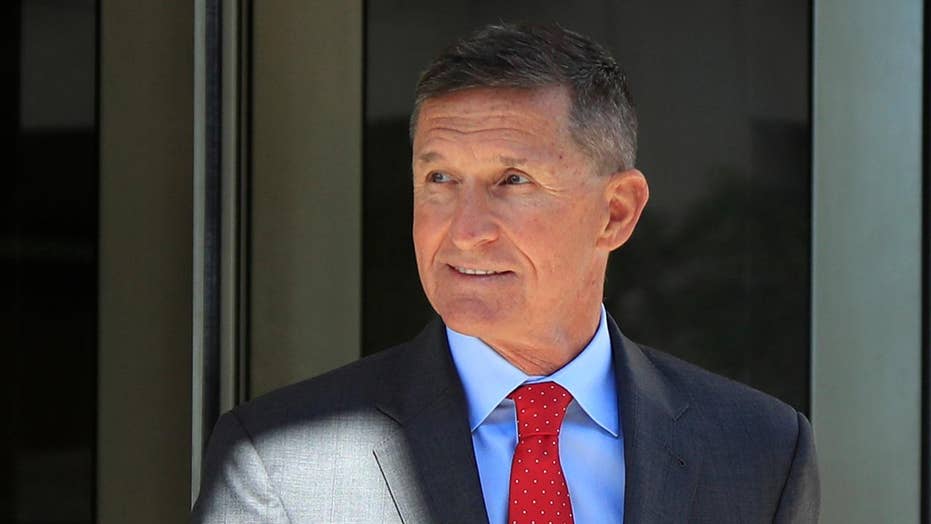
In a lengthy court filing Tuesday, attorneys for former National
Security Adviser Michael Flynn alleged that then-FBI Deputy Director
Andrew McCabe pushed Flynn not to have an attorney present during the
questioning that ultimately led to his guilty plea on a single charge of
lying to federal authorities.
The
document outlines,
with striking new details, the rapid sequence of events that led to
Flynn's sudden fall from the Trump administration. The filing also
seemingly demonstrates that the FBI took a significantly more aggressive
and subversive tack in handling the Flynn interview than it did during
other similar matters, including the agency's sit-downs with Hillary
Clinton and ex-Trump adviser George Papadopoulos.
According to
Flynn's legal team, FBI agents deliberately refused to instruct Flynn
that any false statements he made could constitute a crime, and decided
not to "confront" him directly about anything he said that contradicted
their knowledge of his wiretapped communications with former Russian
ambassador Sergey Kislyak.
FBI AGENT STRZOK, WHO INTERVIEWED FLYNN, DISCUSSED 'MEDIA LEAK STRATEGY'
If
“Flynn said he did not remember something they knew he said, they would
use the exact words Flynn used, . . . to try to refresh his
recollection," FBI agents wrote in a so-called "302" witness interview
report cited by the filing. "If Flynn still would not confirm what he
said, . . . they would not confront him or talk him through it.”
McCabe -- who was
fired earlier this year
for making unauthorized media leaks and violating FBI policy -- wrote
in a memorandum that shortly after noon on Jan. 24, 2017, he called
Flynn on his secure line at the White House, and the two briefly
discussed an unrelated FBI training session at the White House. Quickly,
the conversation turned to a potential interview, according to an
account provided by McCabe that was also cited in the Tuesday filing.
McCabe
said that he told Flynn he “felt that we needed to have two of our
agents sit down” to discuss his contacts with Russian officials.
“I
explained that I thought the quickest way to get this done was to have a
conversation between [Flynn] and the agents only," McCabe wrote. "I
further stated that if LTG Flynn wished to include anyone else in the
meeting, like the White House Counsel for instance, that I would need to
involve the Department of Justice. [General Flynn] stated that this
would not be necessary and agreed to meet with the agents without any
additional participants."
Explaining why Flynn was not warned
about the possible consequences of making false statements, one of the
agents wrote in the 302 that FBI brass had "decided the agents would not
warn Flynn that it was a crime to lie during an FBI interview because
they wanted Flynn to be relaxed, and they were concerned that giving the
warnings might adversely affect the rapport."
FBI
INCORRECTLY SUGGESTED TO FISA COURT IN WARRANT TO SURVEIL TRUMP AIDE
THAT YAHOO STORY WASN'T BASED ON DISCREDITED SPY'S REPORT
That
tactics were apparently in sharp contrast to the FBI's approach to
interviewing former Trump aide George Papadopoulos, who also pleaded
guilty to making false statements and
was recently released from prison. In a
court filing last year,
Special Counsel Mueller's team took pains to note that FBI agents who
interviewed Papadopoulos on January 27, 2017 -- just days after the
Flynn interview -- had advised Papadopoulos that "lying to them 'is a
federal offense'" and that he could get "in trouble" if he did not tell
the truth.
The revelations in the court filing, if accurate, would
also sharply differ from the FBI's handling of its interview with
then-presidential candidate Hillary Clinton in 2016, during the height
of the presidential campaign. Clinton brought a total of nine lawyers to
her interview -- a number that fired FBI Director James Comey said
was "unusual ... but not unprecedented" in House testimony in September.
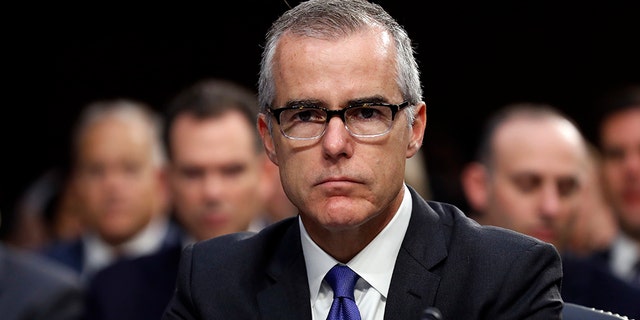
FILE - In this June 7, 2017 file photo, acting FBI Director Andrew
McCabe appears before a Senate Intelligence Committee hearing about the
Foreign Intelligence Surveillance Act on Capitol Hill in Washington.
(AP Photo/Alex Brandon, File)
A scathing report released earlier this year
by the Department of Justice's Inspector General (IG) found that the
FBI had taken actions "inconsistent with typical investigative strategy"
by allowing former Clinton chief of staff Cheryl Mills and ex-campaign
staffer Heather Samuelson to sit in on the Clinton interview -- even
though "they had also both served as lawyers for Clinton after they left
the State Department."
In fact, the IG wrote, FBI
officials fretted about how many FBI representatives should be at the
interview, for fear of prejudicing Clinton against the agency if, as
expected, she went on to become president.
“[S]he might be our
next president," FBI attorney Lisa Page wrote, in urging that the number
of people at the interview be limited to four or six. "The last thing
you need us going in there loaded for bear. You think she’s going to
remember or care that it was more doj than fbi?”
The IG report
further noted: “Witnesses told us, and contemporaneous emails show, that
the FBI and Department officials who attended Clinton’s interview found
that her claim that she did not understand the significance of the
‘(C)’ marking strained credulity. (FBI) Agent 1 stated, ‘I filed that in
the bucket of hard to impossible to believe.’"
In
his fateful interview at the White House with since-fired anti-Trump
FBI agent Peter Strzok and another FBI agent, Flynn "clearly saw the FBI
agents as allies," according to the 302, which was dated Aug. 22, 2017
-- nearly seven months after the actual interview.
It was unclear why the document, with is ostensibly a contemporaneous account of the interview, was dated in August.
According
to the 302, Flynn was “relaxed and jocular” as he gave the agents a
"little tour" of his West Wing office. (McCabe reportedly testified
later that the agents, after speaking with Flynn, “didn’t think he was
lying" at the time.)
In his report on FBI and DOJ misconduct
during the Russia and Clinton probes, the IG additionally noted that
Strzok, who was one of the two agents who interviewed Flynn and who was
later also fired for violating FBI policies, had compromised the FBI's
appearance of impartiality by sending a slew of anti-Trump texts on his
government-issued phone.
“In particular, we were concerned about
text messages exchanged by FBI Deputy Assistant Director Peter Strzok
and Lisa Page, Special Counsel to the Deputy Director, that potentially
indicated or created the appearance that investigative decisions were
impacted by bias or improper considerations,” the IG report said.
In
one of those texts, Strzok wrote to Page in 2016 that Trump would not
become president because "we'll stop" it from happening.
Flynn was
fired as national security adviser in February 2017 or misleading Vice
President Mike Pence and other White House officials about his contacts
with Russian officials. In arguing that Flynn should receive no more
than a year of probation and 200 hours of community service for making
false statements to federal investigators, his lawyers Tuesday
emphasized his service in the United States Army and lack of criminal
record.
In a sentencing memo earlier this month,
Special Counsel Robert Mueller recommended a lenient sentence -- with
the possibility of no prison time -- for Flynn, stating he has offered
"substantial" help to investigators about "several ongoing
investigations."
Meanwhile, Comey revealed in closed-door testimony
with House Republicans on Friday that he deliberately concealed an
explosive memorandum about his one-on-one Oval Office meeting with
President Trump in February 2017 from top Department of Justice
officials.
The former FBI head also acknowledged that when the
agency initiated its counterintelligence probe into possible collusion
between Trump campaign officials and the Russian government in July
2016, investigators "didn't know whether we had anything" and that "in
fact, when I was fired as director [in May 2017], I still didn't know
whether there was anything to it."
His remarks square with
testimony this summer from former FBI lawyer Lisa Page, whose anti-Trump
texts became a focus of House GOP oversight efforts. Page told
Congress in a closed-door deposition that "even as far as May 2017" --
more than nine months after the counterintelligence probe commenced
-- "we still couldn't answer the question" as to whether Trump staff had
improperly colluded with Russia.