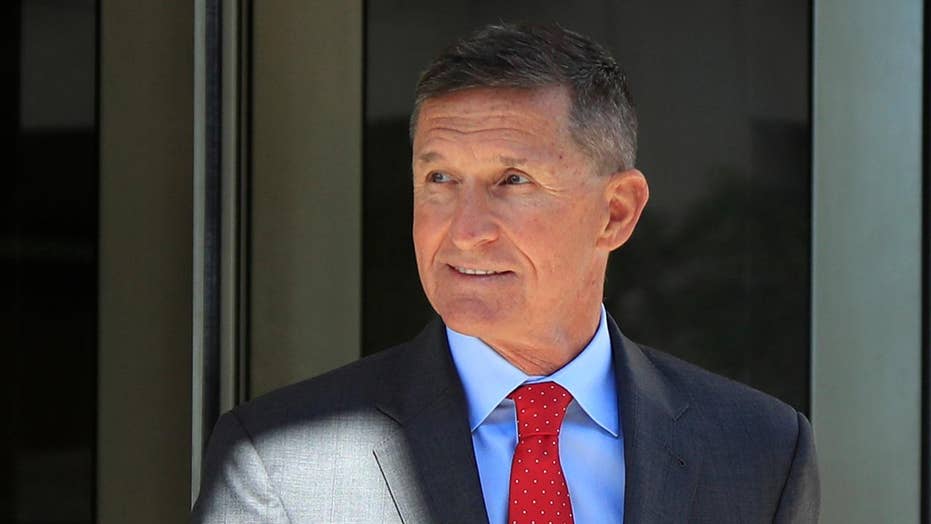
One day after former National Security Adviser Michael Flynn's legal team made the bombshell allegation that the FBI had pushed him not to bring a lawyer
to his fateful Jan. 24, 2017 interview with agents at the White House,
the federal judge overseeing Flynn's criminal case late Wednesday
ordered Special Counsel Robert Mueller to turn over all of the
government's documents and "memoranda" related to the questioning.
U.S. District Judge Emmet Sullivan -- who overturned the 2008 conviction
of former U.S. Sen. Ted Stevens after government misconduct came to
light -- is weighing how to sentence Flynn, who pleaded guilty to one
count of lying to federal authorities in the Russia probe during that
interview in the West Wing. Flynn faced mounting legal bills that forced him to sell his home amid the prosecution, and Mueller has already recommended he receive no prison time.
Sullivan's
extraordinary demand puts Mueller under the microscope and sets a 3:00
p.m. EST Friday deadline for the special counsel's office to turn over
the sensitive FBI documents. Sullivan's brief order states that Mueller
can choose to file the materials under seal.
Sullivan also ordered
the Flynn team to turn over the documents backing up its assertions.
The judge could determine why the FBI apparently took a significantly
more aggressive tack in handling the Flynn interview than it did during
other similar matters, including the agency's sit-downs with Hillary
Clinton and ex-Trump adviser George Papadopoulos.
Flynn is set to
be sentenced next Tuesday -- but Sullivan's move might delay that date,
or lead to other dramatic and unexpected changes in the case. Sullivan
even has the authority to toss Flynn's guilty plea and the charge
against him if he concludes that the FBI interfered with Flynn's
constitutional right to counsel, although he has given no indications
that he intends to do so.
Federal authorities undertaking a
national security probe are ordinarily under no obligation to
inform interviewees of their right to an attorney unless they are in
custody, as long as agents do not act coercively. Flynn's lawyers
claimed in Tuesday's filing that FBI brass had threatened to escalate
the matter to involve the Justice Department if Flynn sought the advice
of the White House Counsel before talking with agents.
Sullivan,
first appointed a judge by President Ronald Reagan in 1984 and then to
the D.C. federal bench by Bill Clinton in 1994, could also assess why
the two FBI agents who interviewed Flynn -- including fired anti-Trump
agent Peter Strzok -- would have provided an Aug. 22, 2017 date on their
so-called "302" report documenting what Flynn told them during their
conversation at the White House.
The August date on the FBI
302 cited by the Flynn team is nearly seven months after the Flynn
interview took place, and about a week after reports surfaced that
Strzok had been summarily removed from Mueller's Russia probe because
his persistent anti-Trump communications had surfaced.
So-called 302
reports are ostensibly contemporaneous accounts by agents of what is
said during their interviews with witnesses and subjects, as well as
other critical details like interviewees' demeanor and descriptions of
where the interview took place. They are often critical pieces of
evidence in false statements cases where, as in the Flynn case, the FBI
typically does not audio- or video-record interviews. FEDERAL JUDGE 'SHOCKED' AND 'DUMBFOUNDED' BY FBI ACTIONS IN HILLARY PROBE, SAYS STATE DEPT LIED TO COVER FOR CLINTONS
In
June, Freedom Caucus Chair Rep. Mark Meadows, R-N.C, charged that the
FBI may have "edited and changed" key witness reports in the Hillary
Clinton and Russia investigations. Meadows also raised the possibility
that the FBI misled the Department of Justice watchdog in an attempt to
hide the identities of FBI employees who were caught sending anti-Trump
messages along with Strzok.
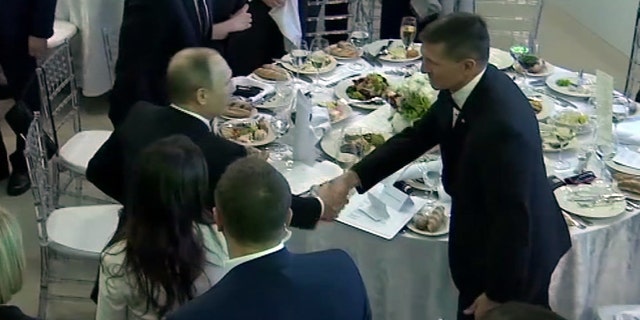
In this image made from a video taken on Dec. 10, 2015 and made
available on Tuesday, Feb. 14, 2017, US President Donald Trump's former
National Security Advisor Michael Flynn, right, shakes hands with
Russian President Vladimir Putin, in Moscow.
(The Associated Press)
Flynn "clearly saw the FBI agents as allies," according to the 302 prepared by Strzok and another agent.
In a lengthy court filing
Tuesday, Flynn's attorneys alleged that then-FBI Deputy Director Andrew
McCabe pushed Flynn not to have an attorney present during the
questioning that ultimately led to his guilty plea on a single charge of
lying to federal authorities.
The document outlines, with
striking new details, the rapid sequence of events that led to Flynn's
sudden fall from the Trump administration.
While Flynn is among
several Trump associates to have been charged with making false
statements as part of the Russia probe, no one interviewed during the
FBI’s Clinton email investigation was hit with false statement charges –
though investigators believed some witnesses, including Clinton
herself, were untruthful. FALSE STATEMENT CHARGES ABOUND IN MUELLER PROBE, IN CONTRAST TO CLINTON CASE
According
to Flynn's legal team, FBI agents in his case deliberately did not
instruct Flynn that any false statements he made could constitute a
crime, and decided not to "confront" him directly about anything he said
that contradicted their knowledge of his wiretapped communications with
former Russian ambassador Sergey Kislyak.
If “Flynn said he did
not remember something they knew he said, they would use the exact words
Flynn used, ... to try to refresh his recollection," FBI agents wrote
in the 302 report cited by the filing, which Sullivan has ordered both
the Flynn team and the FBI to produce by Friday. "If Flynn still would
not confirm what he said, ... they would not confront him or talk him
through it.”
According to the 302 as described in the filing,
Flynn was “relaxed and jocular” as he gave the agents a "little tour" of
his West Wing office.
McCabe -- who was fired earlier this
year for making unauthorized media leaks and violating FBI policy --
wrote in a memorandum that shortly after noon on Jan. 24, 2017, he
called Flynn on his secure line at the White House, and the two briefly
discussed an unrelated FBI training session at the White House. Quickly,
the conversation turned to a potential interview, according to an
account provided by McCabe cited in the Tuesday filing.
McCabe reportedly testified later that the agents, after speaking with Flynn, “didn’t think he was lying" at the time. HOW THE FBI MADE INCORRECT ASSURANCES TO THE FISA COURT TO OBTAIN A SECRET WARRANT TO SURVEIL TRUMP AIDE CARTER PAGE
In
his order, Sullivan requested Mueller turn over not only the Flynn 302,
but also a memo written by McCabe and any similar documents in the
FBI's possession. Sullivan similarly demanded that Flynn's lawyers
produce the McCabe memorandum and 302 they used to make their
assertions.
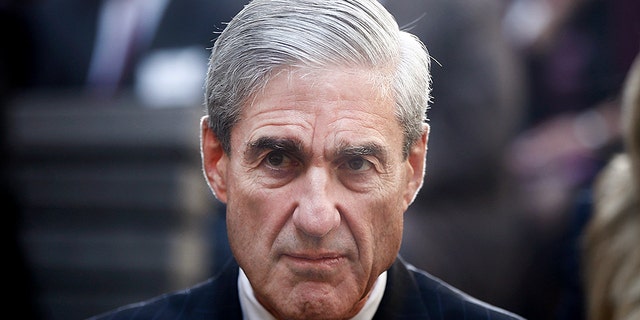
Mueller has signaled he is wrapping up his probe into the Trump
campaign's communications with Russians. (AP Photo/Charles Dharapak,
File)
(Separately, Sullivan ruled last month that Clinton
must answer more questions under oath about her use of a private email
server to store classified documents. But the hard-charging judge has
not been easy on the Trump administration: In August, he threatened to
hold then-Attorney General Jeff Sessions in contempt of court when he
learned that authorities were in the process of deporting a woman and
her child while a court heard her legal appeal, calling immigration
officials' actions "pretty outrageous.") JEROME CORSI: MUELLER WANTED ME TO LIE
McCabe
purportedly said in the memo that he told Flynn he “felt that we needed
to have two of our agents sit down” to discuss his contacts with
Russian officials.
“I explained that I thought the quickest way to
get this done was to have a conversation between [Flynn] and the agents
only," McCabe wrote, according to the Flynn filing. "I further stated
that if LTG Flynn wished to include anyone else in the meeting, like the
White House Counsel for instance, that I would need to involve the
Department of Justice. [General Flynn] stated that this would not be
necessary and agreed to meet with the agents without any additional
participants."
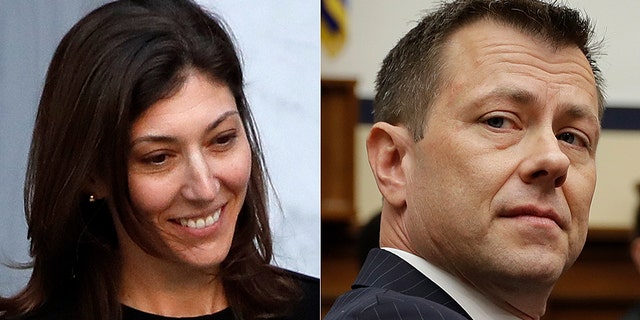
Former FBI Lawyer Lisa Page and fired FBI Special Agent Peter
Strzok exchanged anti-Trump text messages during their time at the
bureau.
(AP, File)
Explaining why Flynn was not
warned about the possible consequences of making false statements, one
of the agents wrote in the 302 cited by Flynn's lawyers that FBI brass
had "decided the agents would not warn Flynn that it was a crime to lie
during an FBI interview because they wanted Flynn to be relaxed, and
they were concerned that giving the warnings might adversely affect the
rapport." FBI OFFICIALS IMPROPERLY RECEIVED SPORTS TICKETS FROM REPORTERS, DOJ WATCHDOG FINDS
The
tactics were apparently in sharp contrast to the FBI's approach to
interviewing former Trump aide George Papadopoulos, who also pleaded
guilty to making false statements and was recently released from prison.
In a court filing last year, Special Counsel Mueller's team took pains
to note that FBI agents who interviewed Papadopoulos on Jan. 27, 2017 --
just days after the Flynn interview -- had advised Papadopoulos that
"lying to them 'is a federal offense'" and that he could get "in
trouble" if he did not tell the truth.
The revelations in the
court filing, if accurate, would also sharply differ from the FBI's
handling of its interview with then-presidential candidate Clinton in
2016, during the height of the presidential campaign. Clinton brought a
total of nine lawyers to her interview -- a number that fired FBI
Director James Comey said was "unusual ... but not unprecedented" in
House testimony in September.
A scathing report released earlier this year by
the Department of Justice's inspector general (IG) found that the FBI
had taken actions "inconsistent with typical investigative strategy" by
allowing former Clinton chief of staff Cheryl Mills and ex-campaign
staffer Heather Samuelson to sit in on the Clinton interview -- even
though "they had also both served as lawyers for Clinton after they left
the State Department." FLYNN HAS PROVIDED 'SUBSTANTIAL ASSISTANCE' ON CRIMINAL PROBE, MUELLER WRITES
In
fact, the IG wrote, FBI officials fretted about how many FBI
representatives should be at the interview, for fear of prejudicing
Clinton against the agency if, as expected, she went on to become
president.
“[S]he might be our next president," FBI attorney Lisa
Page wrote, in urging that the number of people at the interview be
limited to four or six. "The last thing you need us going in there
loaded for bear. You think she’s going to remember or care that it was
more doj than fbi?”
The IG report further noted: “Witnesses told
us, and contemporaneous emails show, that the FBI and Department
officials who attended Clinton’s interview found that her claim that she
did not understand the significance of the ‘(C)’ marking strained
credulity. (FBI) Agent 1 stated, ‘I filed that in the bucket of hard to
impossible to believe.’" FBI MAY HAVE MODIFIED 302 REPORTS AFTER-THE-FACT, GOP REP SAYS
Strzok,
who was one of the two agents who interviewed Flynn and who was later
also fired for violating FBI policies, had compromised the FBI's
appearance of impartiality by sending a slew of anti-Trump texts on his
government-issued phone, the IG concluded.
“In particular, we were
concerned about text messages exchanged by FBI Deputy Assistant
Director Peter Strzok and Lisa Page, Special Counsel to the Deputy
Director, that potentially indicated or created the appearance that
investigative decisions were impacted by bias or improper
considerations,” the IG report said.
In one of those texts, Strzok
wrote to Page in 2016 that Trump would not become president because
"we'll stop" it from happening. SEVEN BOMBSHELL REVELATIONS IN SCATHING IG REPORT INTO FBI, DOJ MISCONDUCT DURING CLINTON, RUSSIA PROBES
"Even
when circumstances later came to light that prompted extensive public
debate about the investigation of General Flynn, including revelations
that certain FBI officials involved in the January 24 interview of
General Flynn were themselves being investigated for misconduct, General
Flynn did not back away from accepting responsibility for his actions,"
Flynn's lawyers wrote in the filing Tuesday.
FILE - In this Jan. 28, 2017 file photo, President Donald Trump
accompanied by, from second from left, Chief of Staff Reince Priebus,
Vice President Mike Pence, White House press secretary Sean Spicer and
then-National Security Adviser Michael Flynn speaks on the phone with
Russian President Vladimir Putin, in the Oval Office at the White House
in Washington.
(The Associated Press)
Flynn was fired as
national security adviser in February 2017 for misleading Vice
President Mike Pence and other White House officials about his contacts
with Russian officials. In arguing that Flynn should receive no more
than a year of probation and 200 hours of community service for making
false statements to federal investigators, his lawyers Tuesday
emphasized his service in the U.S. Army and lack of criminal record.
In
a sentencing memo earlier this month, Mueller recommended a lenient
sentence -- with the possibility of no prison time -- for Flynn, stating
he has offered "substantial" help to investigators about "several
ongoing investigations."
Meanwhile, Comey revealed in closed-door
testimony with House Republicans on Friday that he deliberately
concealed an explosive memorandum about his one-on-one Oval Office
meeting with President Trump in February 2017 from top Department of
Justice officials.
The former FBI head also acknowledged that when
the agency initiated its counterintelligence probe into possible
collusion between Trump campaign officials and the Russian government in
July 2016, investigators "didn't know whether we had anything" and that
"in fact, when I was fired as director [in May 2017], I still didn't
know whether there was anything to it."
His remarks square with
testimony this summer from former FBI lawyer Page, whose anti-Trump
texts became a focus of House GOP oversight efforts. Page told
Congress in a closed-door deposition that "even as far as May 2017" --
more than nine months after the counterintelligence probe commenced
-- "we still couldn't answer the question" as to whether Trump staff had
improperly colluded with Russia.
'MediaBuzz'
host Howard Kurtz weighs in on the large amount of wishful thinking
going on in the media where too many people have convinced themselves of
the outcomes they want to see, such as Donald Trump resigning and Beto
O'Rourke's potential political future.
There's a whole lot of wishful thinking going on these days.
Too
many people, perhaps living in their own bubbles, have convinced
themselves of the outcomes they want to see. And the phenomenon cuts
across political and cultural lines.
Their instinct is that they must be right because it just seems so obvious to all thinking persons.
Doris
Kearns Goodwin, the celebrated historian, writes terrific books about
past presidents. But Goodwin, who was close to LBJ, went off on Donald
Trump yesterday in a rather odd way.
On "Morning Joe," Goodwin
said the situation in America "hasn't been this bad since the 1850s, and
that didn't end up too well, with a Civil War that 600,000 people died
in."
Okay, that's quite a comparison.
She did have a
reasonable point in talking about "the miserableness of these people —
there's no joy in that White House." Many have had to lawyer up, and
there's been a record level of turnover, with some being trashed after
their departure. And, said Goodwin, "the top guy doesn't have any joy."
Then came the wish-upon-a-star: "I think at some point he might resign. If this thing gets so bad."
Anyone
who believes that Donald Trump is going to voluntarily give up the job
that almost nobody thought he could win simply doesn't understand the
man.
Then there are some of the Democrats who see an involuntary
exit for Trump. I wrote yesterday about how some of them are now talking
up indictment, rather than impeachment, as the media shift their focus
from Russia to paying off alleged paramours. But some senior Democratic
lawmakers are still talking up impeachment.
The Federalist
puts it bluntly: "Why Democrats Would Be Insane to Impeach Donald
Trump." Writer David Marcus notes that after Bill Clinton was acquitted
by the Senate, his approval rating hit 73 percent:
"The
thrice-married Trump, who has been known to boast about adultery like a
suburban dad who won the best lawn in the neighborhood award, apparently
had sex with a porn star and a Playboy playmate. That seems about par
for his course. But wait! He lied about it! Well, yeah, also pretty much
behavior we knew about and expected. But there's more! He might have
violated campaign finance law! Okay, but so do a lot of campaigns.
Usually they pay a fine and we all move along."
The piece argues
that House Democrats, knowing there was no chance of a Republican Senate
convicting Trump, "would presumably bring up articles of impeachment to
hurt the president politically." But, he says, "Counterpunching Trump
would like nothing more than to tell crowd after crowd at rally after
rally that the angry Democrats on the elitist coasts and their friends
in the deep state are attempting a coup."
Unless more evidence emerges in the Mueller probe, it remains a liberal fantasy.
Another
object of fantasy is Beto O'Rourke. The media are so in love with this
guy that they provide breathless updates about his 2020 prospects: He
met with Al Sharpton! He spoke to Elizabeth Warren's former campaign
manager. He "appears to have frozen the Dem field," says NBC.
The
New York Times the other day pronounced him the "wild card" of the
presidential campaign, "rousing activists" in early-voting states and
drawing the interest of former Obama aides.
Now I get that
O'Rourke raised record-shattering amounts of money in his 3-point loss
to Ted Cruz. But he still lost — not exactly the usual launching pad for
a White House bid. But some of his media boosters were talking him up
during the campaign as a strong contender even if he lost the Senate
race — because, well, he's Beto.
The Times does point out the downside:
"Mr.
O’Rourke would surely have vulnerabilities in a primary, including an
absence of signature policy feats or a centerpiece issue to date. In his
Senate race, he was often disinclined to go negative, frustrating some
Democrats who believe he wasted a chance to defeat Mr. Cruz, and he
struggled at times in some traditional formats like televised debates.
He is, by admission and design, not the political brawler some Democrats
might crave against a president they loathe. And his candidacy would
not be history-making like Mr. Obama's nor many of his likely peers' in
the field, in an election when many activists may want a female or
nonwhite nominee."
O'Rourke could always catch fire and win the nomination, I suppose. But for now, it's wishful thinking.
Finally,
it pains me to write this because I'm a huge admirer of Steph Curry,
the Golden State Warriors star who has a fabulous work ethic and whose
three-point shooting transformed the game.
I don't expect athletes to be well informed on anything other than the mechanics of their sport. But Curry is buying into the fantasy that the American moon landings were faked.
This, a half-century since Neil Armstrong first walked on the moon, apparently remains a popular conspiracy theory.
And when two hosts on a podcast said the landings never happened, Curry responded: "I don't think so either."
"You don't think so?" he was asked.
"Nuh
uh," Curry replied. One of the hosts then brought up the theory that
the government hired Stanley Kubrick to produce the phony show.
NASA
has now invited Curry to visit its lunar lab at the Johnson Space
Center and examine the lunar rocks brought back by Apollo 11.
Maybe Curry will be too busy nailing threes to go. Wishful thinking can be much more fun.
In a lengthy court filing Tuesday, attorneys for former National
Security Adviser Michael Flynn alleged that then-FBI Deputy Director
Andrew McCabe pushed Flynn not to have an attorney present during the
questioning that ultimately led to his guilty plea on a single charge of
lying to federal authorities.
The document outlines,
with striking new details, the rapid sequence of events that led to
Flynn's sudden fall from the Trump administration. The filing also
seemingly demonstrates that the FBI took a significantly more aggressive
and subversive tack in handling the Flynn interview than it did during
other similar matters, including the agency's sit-downs with Hillary
Clinton and ex-Trump adviser George Papadopoulos.
According to
Flynn's legal team, FBI agents deliberately refused to instruct Flynn
that any false statements he made could constitute a crime, and decided
not to "confront" him directly about anything he said that contradicted
their knowledge of his wiretapped communications with former Russian
ambassador Sergey Kislyak. FBI AGENT STRZOK, WHO INTERVIEWED FLYNN, DISCUSSED 'MEDIA LEAK STRATEGY'
If
“Flynn said he did not remember something they knew he said, they would
use the exact words Flynn used, . . . to try to refresh his
recollection," FBI agents wrote in a so-called "302" witness interview
report cited by the filing. "If Flynn still would not confirm what he
said, . . . they would not confront him or talk him through it.”
McCabe -- who was fired earlier this year
for making unauthorized media leaks and violating FBI policy -- wrote
in a memorandum that shortly after noon on Jan. 24, 2017, he called
Flynn on his secure line at the White House, and the two briefly
discussed an unrelated FBI training session at the White House. Quickly,
the conversation turned to a potential interview, according to an
account provided by McCabe that was also cited in the Tuesday filing.
McCabe
said that he told Flynn he “felt that we needed to have two of our
agents sit down” to discuss his contacts with Russian officials.
“I
explained that I thought the quickest way to get this done was to have a
conversation between [Flynn] and the agents only," McCabe wrote. "I
further stated that if LTG Flynn wished to include anyone else in the
meeting, like the White House Counsel for instance, that I would need to
involve the Department of Justice. [General Flynn] stated that this
would not be necessary and agreed to meet with the agents without any
additional participants."
Explaining why Flynn was not warned
about the possible consequences of making false statements, one of the
agents wrote in the 302 that FBI brass had "decided the agents would not
warn Flynn that it was a crime to lie during an FBI interview because
they wanted Flynn to be relaxed, and they were concerned that giving the
warnings might adversely affect the rapport." FBI
INCORRECTLY SUGGESTED TO FISA COURT IN WARRANT TO SURVEIL TRUMP AIDE
THAT YAHOO STORY WASN'T BASED ON DISCREDITED SPY'S REPORT
That
tactics were apparently in sharp contrast to the FBI's approach to
interviewing former Trump aide George Papadopoulos, who also pleaded
guilty to making false statements and was recently released from prison. In a court filing last year,
Special Counsel Mueller's team took pains to note that FBI agents who
interviewed Papadopoulos on January 27, 2017 -- just days after the
Flynn interview -- had advised Papadopoulos that "lying to them 'is a
federal offense'" and that he could get "in trouble" if he did not tell
the truth.
The revelations in the court filing, if accurate, would
also sharply differ from the FBI's handling of its interview with
then-presidential candidate Hillary Clinton in 2016, during the height
of the presidential campaign. Clinton brought a total of nine lawyers to
her interview -- a number that fired FBI Director James Comey said
was "unusual ... but not unprecedented" in House testimony in September.
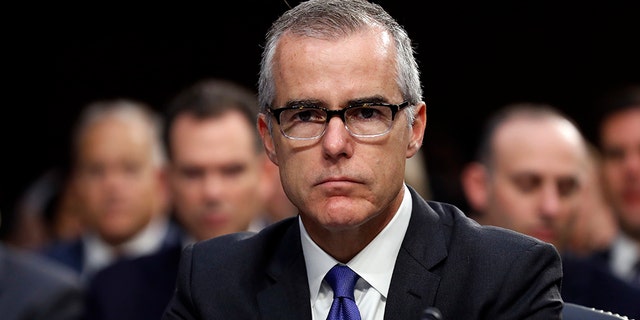
FILE - In this June 7, 2017 file photo, acting FBI Director Andrew
McCabe appears before a Senate Intelligence Committee hearing about the
Foreign Intelligence Surveillance Act on Capitol Hill in Washington.
(AP Photo/Alex Brandon, File)
A scathing report released earlier this year
by the Department of Justice's Inspector General (IG) found that the
FBI had taken actions "inconsistent with typical investigative strategy"
by allowing former Clinton chief of staff Cheryl Mills and ex-campaign
staffer Heather Samuelson to sit in on the Clinton interview -- even
though "they had also both served as lawyers for Clinton after they left
the State Department."
In fact, the IG wrote, FBI
officials fretted about how many FBI representatives should be at the
interview, for fear of prejudicing Clinton against the agency if, as
expected, she went on to become president.
“[S]he might be our
next president," FBI attorney Lisa Page wrote, in urging that the number
of people at the interview be limited to four or six. "The last thing
you need us going in there loaded for bear. You think she’s going to
remember or care that it was more doj than fbi?”
The IG report
further noted: “Witnesses told us, and contemporaneous emails show, that
the FBI and Department officials who attended Clinton’s interview found
that her claim that she did not understand the significance of the
‘(C)’ marking strained credulity. (FBI) Agent 1 stated, ‘I filed that in
the bucket of hard to impossible to believe.’"
In
his fateful interview at the White House with since-fired anti-Trump
FBI agent Peter Strzok and another FBI agent, Flynn "clearly saw the FBI
agents as allies," according to the 302, which was dated Aug. 22, 2017
-- nearly seven months after the actual interview.
It was unclear why the document, with is ostensibly a contemporaneous account of the interview, was dated in August.
According
to the 302, Flynn was “relaxed and jocular” as he gave the agents a
"little tour" of his West Wing office. (McCabe reportedly testified
later that the agents, after speaking with Flynn, “didn’t think he was
lying" at the time.)
In his report on FBI and DOJ misconduct
during the Russia and Clinton probes, the IG additionally noted that
Strzok, who was one of the two agents who interviewed Flynn and who was
later also fired for violating FBI policies, had compromised the FBI's
appearance of impartiality by sending a slew of anti-Trump texts on his
government-issued phone.
“In particular, we were concerned about
text messages exchanged by FBI Deputy Assistant Director Peter Strzok
and Lisa Page, Special Counsel to the Deputy Director, that potentially
indicated or created the appearance that investigative decisions were
impacted by bias or improper considerations,” the IG report said.
In
one of those texts, Strzok wrote to Page in 2016 that Trump would not
become president because "we'll stop" it from happening.
Flynn was
fired as national security adviser in February 2017 or misleading Vice
President Mike Pence and other White House officials about his contacts
with Russian officials. In arguing that Flynn should receive no more
than a year of probation and 200 hours of community service for making
false statements to federal investigators, his lawyers Tuesday
emphasized his service in the United States Army and lack of criminal
record.
In a sentencing memo earlier this month,
Special Counsel Robert Mueller recommended a lenient sentence -- with
the possibility of no prison time -- for Flynn, stating he has offered
"substantial" help to investigators about "several ongoing
investigations."
Meanwhile, Comey revealed in closed-door testimony
with House Republicans on Friday that he deliberately concealed an
explosive memorandum about his one-on-one Oval Office meeting with
President Trump in February 2017 from top Department of Justice
officials.
The former FBI head also acknowledged that when the
agency initiated its counterintelligence probe into possible collusion
between Trump campaign officials and the Russian government in July
2016, investigators "didn't know whether we had anything" and that "in
fact, when I was fired as director [in May 2017], I still didn't know
whether there was anything to it."
His remarks square with
testimony this summer from former FBI lawyer Lisa Page, whose anti-Trump
texts became a focus of House GOP oversight efforts. Page told
Congress in a closed-door deposition that "even as far as May 2017" --
more than nine months after the counterintelligence probe commenced
-- "we still couldn't answer the question" as to whether Trump staff had
improperly colluded with Russia.
White
House press secretary Sarah Sanders on Tuesday defended President
Trump's often combative style with the press, saying the president is a
“fighter” who “hits back” at unfair criticism.
“I don’t always find the behavior of the press to be appropriate, either,” Sanders said during a conversation with Politico at
the sixth annual Women Rule Summit. “I think that the president is
somebody who’s a fighter. When he gets hit, he always hits back.”
"I think that the president is somebody who’s a fighter. When he gets hit, he always hits back." — Sarah Sanders, White House press secretary
Her
answer came after she was asked whether Trump’s behavior
toward reporters, in general, has been appropriate. Sanders said she
hopes that both the journalists and the president will tone down their
rhetoric during future exchanges.
She said that when she's no
longer press secretary she hopes she will be known for her transparency
and honesty -- and for making America a better country.
“I hope
that it will be that I showed up every day and I did the very best job
that I could to put forward the president’s message, to do the best job
that I could to answer questions, to be transparent and honest
throughout that process and do everything I could to make America a
little better that day than it was the day before,” she said.
"I
hope that it will be that I showed up every day and I did the very best
job that I could to put forward the president’s message, to do the best
job that I could to answer questions, to be transparent and honest
throughout that process and do everything I could to make America a
little better that day than it was the day before." — Sarah Sanders, White House press secretary
Sanders
also rebuffed the suggestion that Trump targets female reporters with
his criticism, saying the president clashes with male journalists on a
frequent basis as well.
“The president’s had an equal number of
contentious conversations with your male colleagues,” told interviewer
Eliana Johnson. “Women wanted to be treated equally, and we have a
president that certainly does that.”
In recent months, Trump was
criticized after he made several disparaging remarks toward female
reporters, including ABC’s Cecilia Vega, whom he said was “not
thinking,” and April Ryan, a White House correspondent for American
Urban Radio Networks, whom he said was a “loser” who “doesn’t know what
the hell she’s doing.”
At the same time, Trump clashed with CNN’s
Jim Acosta, prompting the White House to temporarily remove the
reporter’s access. Acosta's press credentials were reinstated following a
lawsuit that was supported by all major news organizations.
Finally, Sanders denied reports that she will be leaving the administration.
“Not that I know about,” she said.
“I take things one day at a time. As long as I feel like I’ve been
called to the place that I am and I feel I’m an effective messenger for
the president — and frankly, he feels like I’m an effective messenger
for him — I’d like to continue doing what I do. I love my job.”
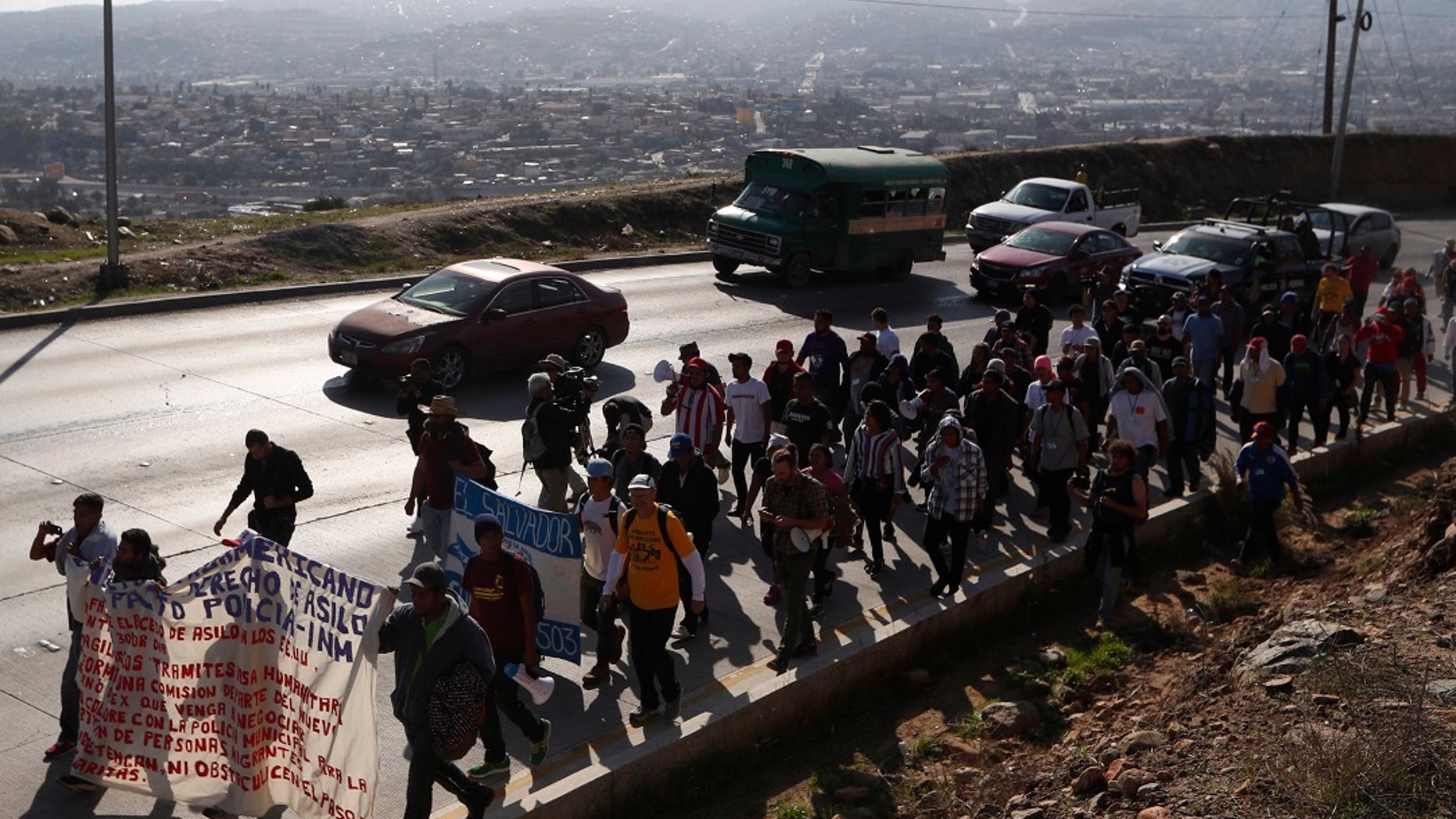
Central American migrants march to the U.S. consulate in
Tijuana, Mexico, Tuesday, Dec. 11, 2018. (AP Photo/Moises Castillo)
(AP)
Two groups of Central
American migrants marched to the U.S. Consulate in Tijuana on Tuesday
with a list of demands, with one group delivering an ultimatum to the
Trump administration: either let them in the U.S. or pay them $50,000
each to go home, a report said.
Among other demands were that deportations be halted and that asylum seekers be processed faster and in greater numbers, the San Diego Union-Tribune reported.
The
first group of caravan members, that included about 100 migrants,
arrived at the consulate around 11 a.m. Alfonso Guerreo Ulloa, an
organizer from Honduras, said the $50,000 figure was chosen as a group.
“It
may seem like a lot of money to you,” Ulloa told the paper. “But it is a
small sum compared to everything the United States has stolen from
Honduras.”
He said the money would allow the migrants to return home and start a small business.
A
letter from the group criticized U.S. intervention in Central America
and asked the U.S. to remove Honduran President Orlando Hernandez from
office. They gave the consulate 72 hours to respond.
A letter from
the second group of about 50 migrants arrived at the consulate around
1:20 p.m. asking the U.S. to speed up the asylum process and to admit up
to 300 asylum seekers each day at the San Ysidro Port of Entry in San
Diego. Currently, around 40 to 100 are admitted.
“In
the meantime, families, women and children who have fled our countries
continue to suffer and the civil society of Tijuana continue to be
forced to confront this humanitarian crisis, a refugee crisis caused in
great part by decades of U.S. intervention in Central America,” the
letter states.
Of the roughly 6,000 migrants who’ve traveled from
Central America to Tijuana, around 700 have returned home, 300 have been
deported and 2,500 have applied for humanitarian visas in Mexico,
according to Xochtil Castillo, a caravan member who met with Mexican
officials Tuesday.
Others
have either crossed into the U.S. illegally, moved to other parts of
Mexico or have fallen through the cracks, the Union-Tribune said.
“A
lot of people are leaving because there is no solution here,” said
Douglas Matute, 38, of Tijuana. “We thought they would let us in. But
Trump sent the military instead of social workers.”
Two
decades ago, liberals argued that Bill Clinton should not be impeached
for his tawdry affair with Monica Lewinsky because, well, his lies were
just about sex.
Today, some liberals are arguing that Donald Trump
should be impeached because of Stormy Daniels and Karen McDougal
because, well, it's not the sex, it's the hush money.
For well
over a year, Trump's critics have been banking on Robert Mueller to come
up with evidence of Russian collusion, and there have been only
disconnected fragments. So now —never mind! — it's about women and
money.
The old argument from the left: Trump has committed crimes and should be impeached!
The new argument from the left: Trump has committed crimes and should be indicted!
I'm in no way excusing what went on with the two women from his past. But here's some perspective.
To
be sure, Mueller's sentencing memos last week provided some leads on
the Russia matter. Michael Cohen, for instance, admitted lying to
Congress about the time period that the president's company was pursuing
a real estate deal in Moscow, and the memo says Cohen discussed his
testimony with people in the White House.
But in the blink of an
eye, the media focus seems to be switching to the Stormy narrative — the
case being pursued not by Mueller but by the U.S. attorney's office in
Manhattan.
Here's a key difference between Trump and Clinton. The
42nd president had his dalliance with Lewinsky while he was in office,
in the White House itself, with a subordinate who was a lowly intern.
Trump's alleged affairs with a porn star and a Playboy model took place
12 years ago when he was a celebrity businessman.
That's why most
people don't care about what Trump did as a private citizen, and I get
it. I got a lot of flak when I started reporting on the Stormy case —
first broken by the Wall Street Journal days before the election — and
always stressed that it was the financial paper trail that might come
back to haunt the president.
And that's why the Southern
District's probe of Cohen — who was reimbursed for making the $130,000
payment to Daniels and brokered the National Enquirer's $150,000 payment
to McDougal — is troublesome for Cohen's former boss.
Yes, it's a campaign finance violation, and yes, those are usually punished by fines or even a slap of the wrist.
But the argument that prosecutors could make is that it was an attempt to subvert the election.
National
Review contributor Andrew McCarthy, who worked in the Manhattan U.S.
attorney's office and is a sharp critic of the Mueller probe, doesn't mince words in a piece for Fox:
"The president is very likely to be indicted on a charge of violating federal campaign finance laws."
McCarthy's
argument is that when Cohen pleaded guilty in August, "prosecutors
induced him to make an extraordinary statement in open court: the
payments to the women were made 'in coordination with and at the
direction of' the candidate for federal office – Donald Trump.
"Prosecutors
would not have done this if the president was not on their radar
screen. Indeed, if the president was not implicated, I suspect they
would not have prosecuted Cohen for campaign finance violations at all.
Those charges had a negligible impact on the jail time Cohen faces,
which is driven by the more serious offenses of tax and financial
institution fraud, involving millions of dollars."
There is, of
course, the not-insignificant matter of the Justice Department practice
that a sitting president can't be indicted. That's why Democrats like
Adam Schiff are now saying Trump could face jail time after he leaves
office (if he's not reelected). And MSNBC's Joe Scarborough says the
Supreme Court will have to decide whether the president can be indicted
for a crime "which helped him get elected."
Trump — proving that
no one proofreads his tweets — said: "Democrats can't find a Smocking
Gun tying the Trump campaign to Russia." So now, he says, "the Dems go
to a simple private transaction, wrongly call it a campaign contribution
which it was not (but even if it was, it is only a CIVIL CASE, like
Obama's - but it was done correctly by a lawyer and there would not even
be a fine. Lawyer's liability if he made a mistake, not me). Cohen just
trying to get his sentence reduced. WITCH HUNT!"
All Michael Cohen's fault, according to the president.
I
don't minimize the importance of the payments to Daniels and McDougal
to suppress their stories before the election. If a Democrat had done
that, the right would be up in arms.
But I still think it's a
stretch that it leads to indictment or impeachment, especially if the
much-ballyhooed Russian collusion probe comes up dry.
And the
reason is that the underlying offense (if there is one) was to keep
embarrassing sexual disclosures from coming out. The point was to win an
election, of course — and the president's pal at the Enquirer's parent
company rolled over for him — but also spare Trump pain in his marriage.
My
assumption is that much of the public won't see that as sufficient
grounds to overturn an election or imprison a president — just as they
didn't when Bill Clinton repeatedly lied about a similar subject.
OAN Newsroom
UPDATED 11:49 AM PT — Monday, Dec. 10, 2018
Former
FBI Director James Comey speaks to reporters after testifying under
subpoena behind closed doors before the House Judiciary and Oversight
Committee on Capitol Hill in Washington, Friday, Dec. 7, 2018. (AP
Photo/Manuel Balce Ceneta)
Fired FBI Director James Comey’s testimony is calling into question his credibility and decision making.
Republican lawmakers have been highlighting the big takeaways from last week’s questioning.
Congressman Jim Jordan outlined how Comey said “I don’t recall” eight
times, “I don’t remember” 71 times, and “I don’t know” 166 times.
This comes as Comey is now accused of using a dubious Russian document to influence his decision in the Clinton email case.
According to a report last year, Comey used that information to
announce last July that the Clinton email probe was over. However, the
report suggested many close to the matter believed that information was
bad intelligence and possibly even fake.
Comey is scheduled to return to Capitol Hill later this month for more questioning.
A recent reported meeting is sparking more speculation Texas Congressman Beto O’Rourke is set to launch a presidential bid.
Buzz Feed News is reported Monday that O’Rourke and Reverend Al
Sharpton had a sit down last week. While details are limited, a
spokesperson for Sharpton told the outlet the two had a great
conversation and set up a future meeting.
This comes as O’Rourke has flip-flopped on his stance of running for president.
FILE
– In this Nov. 6, 2018, file photo, Rep. Beto O’Rourke, D-Texas, the
2018 Democratic candidate for U.S. Senate in Texas, made his concession
speech at his election night party in El Paso, Texas. (AP Photo/Eric
Gay, File)
When asked during his failed senatorial campaign if he would run in 2020, he responded with:
“I don’t want to do it, I will not do it –Amy and I are raising an
11-year-old, a 10-year-old, and a seven-year-old and we spent the better
part of the last two-years not with each other, missing birthdays and
anniversaries and time together, and our family could not survive more
of that.”
However, O’Rourke has since said he made the decision not to rule anything out.


 In this image made from a video taken on Dec. 10, 2015 and made
available on Tuesday, Feb. 14, 2017, US President Donald Trump's former
National Security Advisor Michael Flynn, right, shakes hands with
Russian President Vladimir Putin, in Moscow.
(The Associated Press)
In this image made from a video taken on Dec. 10, 2015 and made
available on Tuesday, Feb. 14, 2017, US President Donald Trump's former
National Security Advisor Michael Flynn, right, shakes hands with
Russian President Vladimir Putin, in Moscow.
(The Associated Press)
 Mueller has signaled he is wrapping up his probe into the Trump
campaign's communications with Russians. (AP Photo/Charles Dharapak,
File)
Mueller has signaled he is wrapping up his probe into the Trump
campaign's communications with Russians. (AP Photo/Charles Dharapak,
File)
 Former FBI Lawyer Lisa Page and fired FBI Special Agent Peter
Strzok exchanged anti-Trump text messages during their time at the
bureau.
(AP, File)
Former FBI Lawyer Lisa Page and fired FBI Special Agent Peter
Strzok exchanged anti-Trump text messages during their time at the
bureau.
(AP, File)
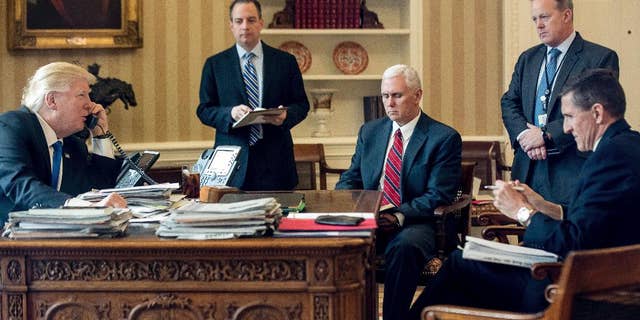 FILE - In this Jan. 28, 2017 file photo, President Donald Trump
accompanied by, from second from left, Chief of Staff Reince Priebus,
Vice President Mike Pence, White House press secretary Sean Spicer and
then-National Security Adviser Michael Flynn speaks on the phone with
Russian President Vladimir Putin, in the Oval Office at the White House
in Washington.
(The Associated Press)
FILE - In this Jan. 28, 2017 file photo, President Donald Trump
accompanied by, from second from left, Chief of Staff Reince Priebus,
Vice President Mike Pence, White House press secretary Sean Spicer and
then-National Security Adviser Michael Flynn speaks on the phone with
Russian President Vladimir Putin, in the Oval Office at the White House
in Washington.
(The Associated Press)