The salacious and unverified opposition research dossier
cited by the FBI as its main justification to surveil a top Trump
aide contains many claims that are "likely false," according to the
Yahoo News reporter who was among the first to break the news of the
dossier's existence.
Michael Isikoff's statements on John Ziegler's Free Speech Broadcasting podcast came
a day before Michael Cohen adviser Lanny Davis reiterated that Cohen
has never been to Prague -- where, according to the dossier, he traveled
to arrange a payment to Russian hackers during the 2016 presidential
campaign.
The dossier was created by British ex-spy Christopher
Steele and funded by the firm Fusion GPS -- which was retained by the
Democratic National Committee (DNC) and the Hillary Clinton presidential
campaign.
"In broad strokes, Christopher Steele was clearly onto
something, that there was a major Kremlin effort to interfere in our
elections, that they were trying to help Trump's campaign, and that
there was multiple contacts between various Russian figures close to the
government and various people in Trump's campaign,” Isikoff said.
But
he added: “When you actually get into the details of the Steele
dossier, the specific allegations, we have not seen the evidence to
support them, and, in fact, there's good grounds to think that some of
the more sensational allegations will never be proven and are likely
false."
On four occasions, the FBI told the Foreign Intelligence
Surveillance (FISA) court that it "did not believe" Steele was the
direct source for Isikoff's Sept. 23, 2016 Yahoo News article implicating former Trump aide Carter Page in Russian collusion.
Instead,
the FBI suggested to the court, the article by Michael Isikoff was
independent corroboration of the salacious, unverified allegations
against Trump in the infamous Steele dossier. Federal authorities used
both the Steele dossier and Yahoo News article to convince the FISA
court to authorize a surveillance warrant for Page.
But London court records show
that contrary to the FBI's assessments, Steele briefed Yahoo News and
other reporters in the fall of 2016 at the direction of Fusion GPS --
the opposition research firm behind the dossier. The revelations were
contained heavily-redacted documents released earlier this year after a
Freedom of Information Act lawsuit by the organization Judicial Watch.
"The
FBI does not believe that Source #1 [Steele] directly provided this
information to the identified news organization that published the
September 23rd News Article," the FBI stated in one of the released FISA
documents. "Source #1 told the FBI that he/she only provided this
information to the business associate and the FBI."
The documents
describe Source #1 as someone "hired by a business associate to conduct
research" into Trump's Russia ties -- but do not mention that Fusion GPS
was funded by the DNC and Clinton campaign.
Instead, the
documents say only: "The FBI speculates that the identified U.S. person
was likely looking for information that could be used to discredit
[Trump's] campaign." Fox News believes that the U.S. person is Glenn
Simpson, co-founder of Fusion GPS.
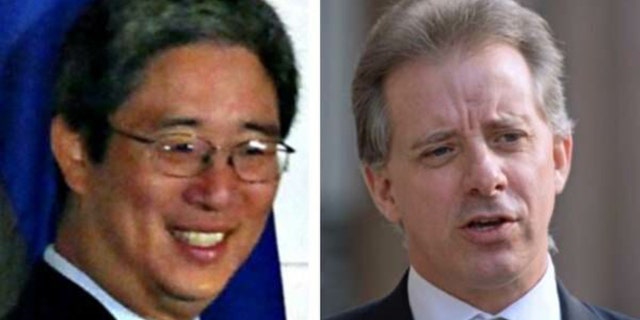
Senior Justice Department official Bruce Ohr, left, continued to
communicate with former British spy Christopher Steele, right, even
after the FBI cut ties with him.
(AP)
Page announced in October
he is filing a defamation lawsuit against the DNC over the dossier's
claims. He is also suing Perkins Coie and its partners, the law firm
that represented Clinton’s campaign and hired Fusion GPS.
Page told Fox News’ “Hannity” at the time that his lawsuit goes “beyond any damages or any financial aspects."
“There
have been so many lies as you’re alluding to and you look at the damage
it did to our Democratic systems and our institutions of government
back in 2016. And I’m just trying to get some justice,” he said.
Meanwhile,
ex-Cohen attorney Lanny Davis laughed off a suggestion during an MSNBC
interview on Sunday that his former client had ever made a trip to
Prague to pay Russian hackers.
“No, no Prague, ever, never,” Davis said.
While Cohen's team has long denied he made the trip, the latest denial comes after Cohen pleaded guilty in two separate prosecutions
linked to his work for President Trump. Cohen has pledged to cooperate
with federal authorities, and Special Counsel Robert Mueller's team has
said he has largely done so. ANTI-TRUMP EX-FBI AGENT STRZOK'S PHONE WIPED AFTER HE WAS FIRED FROM MUELLER'S TEAM
Fox
News reported in August that embattled Justice Department official
Bruce Ohr had contact in 2016 with then-colleague Andrew Weissmann, who
is now a top Mueller deputy, as well as other senior FBI officials about
the controversial anti-Trump dossier and the individuals behind it.
The
sources said Ohr's outreach about the dossier – as well as Steele; the
opposition research firm behind it, Glenn Simpson’s Fusion GPS; and his
wife Nellie Ohr's work for Fusion – occurred before and after the FBI
fired Steele as a source over his media contacts. Ohr's network of
contacts on the dossier included: anti-Trump former FBI agent Peter
Strzok; former FBI lawyer Lisa Page; former deputy director Andrew
McCabe; Weissmann and at least one other DOJ official; and a current FBI
agent who worked with Strzok on the Russia case.
Weissmann was
kept "in the loop" on the dossier, a source said, while he was chief of
the criminal fraud division. He is now assigned to Mueller’s team.
Ohr's
broad circle of contacts indicates members of FBI leadership knew about
his backchannel activities regarding the dossier and Steele.
Congressional
Republicans are still trying to get to the bottom of Ohr's role in
circulating the unverified dossier, which became a critical piece of
evidence in obtaining a surveillance warrant for Page in October 2016.
Canadian
Prime Minister Justin Trudeau addresses the premiers of the ten
provinces and Indigenous Leaders in Montreal, Quebec, Canada, December
7, 2018. REUTERS/Christinne Muschi
December 16, 2018
OTTAWA (Reuters) – Canadian Prime Minister Justin Trudeau, speaking
in an interview that aired on Sunday, said for the first time that his
Liberal government was looking for a way out of a multibillion-dollar
arms deal with Saudi Arabia.
The comments represented a notable hardening in tone from Trudeau,
who previously said there would be huge penalties for scrapping the $13
billion agreement for armored vehicles made by the Canadian unit of
General Dynamics Corp.
Last month, Trudeau said Canada could freeze the relevant export permits if it concluded the weapons had been misused.
“We are engaged with the export permits to try and see if there is a
way of no longer exporting these vehicles to Saudi Arabia,” Trudeau told
CTV. He did not give further details.
Political opponents, citing the killing of journalist Jamal Khashoggi
and Saudi Arabia’s involvement in the Yemen war, insist Trudeau should
end the General Dynamics deal, which was negotiated by the previous
Conservative government.
Relations between Ottawa and Riyadh have been tense since a
diplomatic dispute over human rights earlier this year. Ottawa says it
has been consulting allies on what steps to take after Khashoggi was
killed inside the Saudi consulate in Istanbul.
“The murder of a journalist is absolutely unacceptable and that’s why
Canada from the very beginning had been demanding answers and solutions
on that,” said Trudeau.
It was quiet late Friday afternoon on Capitol Hill.
Too quiet.
Precisely
zero TV network cameras jutted out into the narrow “Will Rogers”
corridor near the House chamber. Not a single reporter was squeezed
between the columns in Statuary Hall, ready to do a live shot. A lone TV
crew was set up in the Rotunda of the Russell Senate Office Building.
When one correspondent went on the air, the anchor in New York even
remarked about how pronounced the echo sounded in the near-abandoned
arcade, reverberating off the arches above.
One wonders if it will
be as quiet next Friday night on Capitol Hill, as nine of 15 cabinet
departments face a government shutdown at 11:59:59 p.m. ET.
What’s
surprising about this potential government shutdown crisis is the
silence. The dearth of information. The lack of panic and anxiety.
It’s peculiar to have everyone tiptoeing around Capitol Hill with Washington about to lurch into a holiday calamity.
Perhaps there is only one logical explanation: everyone is concerned about disturbing the Yellies.
The
Yellies are a new toy taking Christmas by storm — and driving parents
to their liquor cabinets. The Yellies are tiny, fuzzy arachnids. If
people talk quietly, the Yellies move about slowly. But the louder
people are, the faster they go.
And as you can imagine, kids love
yelling and screaming, sending grown-ups into convulsions as the Yellies
dart about the house, hitting Mach 2.
This is kind of what’s
happening on Capitol Hill. Everyone saw the conclave with President
Trump, House Democratic Leader Nancy Pelosi of California and Senate
Democratic Leader Chuck Schumer of New York in the Oval Office on
Tuesday. They understand the volatility of a government shutdown at
Christmastime. So everyone is trying to keep quiet, lest they disturb
the Yellies.
There are muted conversations. Not even major
exchanges of offers between Capitol Hill and the administration. So
everyone is trying to keep quiet, lest they disturb the Yellies.
There
has been some chatter that the Trump Administration and Congress may
consider a short-term, interim spending bill (known as a Continuing
Resolution, or CR), to simply renew all funding through early January
and send everyone home for Christmas.
That would fund everything through the new Congress.
A
senior Democratic congressional aide tells Fox News that “the only
thing a two-week CR would accomplish is that President Trump will lose
twice.”
In other words, no wall on December 21. And certainly no wall in January when Democrats control the House. DEMS, TRUMP REFUSE TO BUDGE OVER BORDER WALL AS FRIDAY SHUTDOWN LOOMS
But
a CR would avoid shut down and ensure that federal workers are paid
over Christmas. Democrats could be hard-pressed to oppose such an
alternative. There aren’t a lot of options available. This is like going
into a diner late at night and finding a sign which says “limited menu
available.” There is only a limited menu of fare which they can cook up
on the Congressional griddle:
1) Congress approves a CR for
the entire fiscal year covering all seven of the outstanding spending
bills. That means there is no wall money.
2) Congress passes
brand-new bills for six of the spending areas and does a CR for only the
Homeland Security Appropriations bill. This scenario also lacks wall
money.
3) Congress okays all seven bills and includes wall money in the Homeland Security measure.
4) Congress approves a stopgap measure which runs until January or so.
5) Congress and the president agree on nothing and the government shuts down on December 22.
Something
has to give. Either Democrats cave and agree to a package with wall
money or Trump caves and accepts measures lacking wall money. It may all
be about semantics, too. Can the sides draft a proposal where it
appears Democrats didn’t give in on the wall, yet Trump can tout the
fact that he in fact did get funding for the wall?
Such a
political duckbilled platypus isn’t rare in Washington — especially if
everyone can leave the compromise open to interpretation and tell the
public they got what they wanted and stood their ground.
Trump has a lot to lose here.
There
was much introspection two weeks ago when President George H.W. Bush
died and lay in state in the Capitol Rotunda. Historians noted how Bush
reneged on his storied campaign promise of “no new taxes.” The
government shut down for a few days in early October 1990. To reopen the
government and stimulate the struggling economy, Bush backtracked on
his “no new taxes” pledge. The tax increase bolstered the economy. But
giving in on the campaign promise forever damaged the president and hurt
his chances in the 1992 presidential election.
No other campaign
promise endears Trump to his loyalists more than the pledge to build the
wall. On one hand, failing to go to the mat and not secure the wall
could damage Trump. But as one senior Republican observed to Fox News,
it doesn’t matter to Trump. His approval rating will always lag in the
30-40 percent range. Anything Trump does won’t move the meter much one
way or the other.
“He simply doesn’t care,” observed the lawmaker. LIBERAL RADIO HOST: DEMS SHOULDN'T TRY TO IMPEACH TRUMP
By
the same token, Republicans have tried to say that Pelosi needs to go
toe-to-toe with Trump to secure the support of her base. That’s an old
argument now. Not long after the election, Trump declared that he’d be
willing to help Pelosi secure the necessary votes to become speaker.
Well, Trump in fact did help Pelosi in that quest — perhaps unwittingly
— during that extraordinary council in the Oval Office Tuesday. Pelosi
appeared strong and in control. The exchange certainly bolstered Pelosi
standing among House Democrats who were skeptical of her returning to
the speaker’s suite. Meantime, the president said he’d take credit for a
shutdown.
On Friday night, the President tapped Budget Director
and House Freedom Caucus founder Mick Mulvaney to serve as “acting”
Chief of Staff. Mulvaney came to Congress in 2010 amid the tea party
wave of 2010. Mulvaney backed the push for the two-and-a-half week
government shutdown over funding ObamaCare in 2013. He opposed a budget
compromise later that year authored by current House Speaker Paul Ryan,
R-Wis., On Capitol Hill, Mulvaney long advocated slashing federal
spending and opposed lifting the debt ceiling. Mulvaney detractors
bequeathed him the chairman of the “shutdown caucus” on Capitol Hill.
Bipartisan
Congressional sources signaled that the appointment of Mulvaney could
increase the chances of a government shutdown because of his hardline
stances on spending. In Mulvaney, the president has a loyal warrior to
wage his battles on Capitol Hill. The president also scored the best of
both worlds: Mulvaney at his side at the White House and Rep. Mark
Meadows, R-N.C., who was considered for the Chief of Staff position,
remaining on Capitol Hill, influencing the Freedom Caucus.
How a
potential shutdown goes could be an audition for Mulvaney. “Acting”
could be stripped from Mulvaney’s title if Trump likes what he sees.
Meantime,
things are quiet on Capitol Hill. The House of Representatives doesn’t
even meet again for legislative business until late in the day
Wednesday. No Yellies there. Congressional leaders sometimes squeeze
rank-and-file members close to the holidays, threatening to keep them in
Washington over Christmas unless they vote for whatever is the subject
du jour. However, the tactic of reducing the time available to solve a
deal may not be directed at lawmakers this year. The president may be
the target of that gambit — an effort to force Trump to take-it-or-leave
it, whatever the “it” may ultimately be.
And that’s partly why
things are so quiet now on Capitol Hill. No one wants to disturb the
Yellies. And expect things to remain quiet until mid-week when the
government shutdown is just a few days away.
A day before fired FBI Director James Comey is set to again testify
behind closed doors with House Republicans, a party leader is predicting
that Special Counsel Robert Mueller's case against ex-National Security
Adviser Michael Flynn will soon be thrown out of court.
California Republican Rep. Darrell Issa told Fox News' "Sunday Morning Futures"
that the FBI had "tricked" Flynn into not having a lawyer and had
improperly "post-dated" documents to "morph" them into critical evidence
against him. He promised Comey would face tough questioning about the
episode.
"Tomorrow is going to be a very different day for Comey,
particularly in light of what we've learned -- the misconduct during the
Flynn investigation was all about, thanks to a judge that demanded to
understand what had happened," Issa told host Maria Bartiromo, referring
to U.S. District Judge Emmet G. Sullivan's order last week that led Mueller to turn over key documents in the case.
He
continued: "I would not be surprised a bit if the conviction of Flynn
is overturned, because of the Justice Department and FBI's misconduct --
and that in fact, we go potentially all the way to the Supreme Court,
with new protections -- when the FBI and the Department of Justice lies
to someone and tricks them into making statements, and then charges them
with a lie they entrapped them in. ... This kind of conduct we haven't
seen in a long time."
In explosive court documents filed last week by Flynn's legal team,
it was revealed that FBI agents in his case deliberately did not
instruct Flynn that any false statements he made could constitute a
crime, and decided not to "confront" him directly about anything he said
that contradicted their knowledge of his wiretapped communications with
former Russian ambassador Sergey Kislyak.
A memo written by
then-FBI Deputy Director Andrew McCabe stated that he called Flynn
and “explained that I thought the quickest way to get this done was to
have a conversation between [Flynn] and the agents only. ... I further
stated that if LTG Flynn wished to include anyone else in the meeting,
like the White House Counsel for instance, that I would need to involve
the Department of Justice."
The court documents also showed that
the FBI's interview report documenting Flynn's statements -- known as an
"FD-302" -- was dated August 22, 2017, nearly seven months after the
actual Flynn interview took place in the White House. Additionally, the
302 that Mueller filed apparently describes an interview conducted by
federal authorities on July 19, 2017 not with Flynn, but with Peter
Strzok, the agent who led the Flynn interview and said he did not feel
Flynn was lying at the time.
Strzok was fired from the Russia
probe in late July 2017 -- just days after he apparently gave the
interview that formed the basis for the 302 -- for his apparent anti-Trump bias. No audio recording or other transcription of Flynn's comments to the FBI has been produced, and none appears to exist.
It
was not clear from Mueller's heavily redacted Friday filing whether
a written 302 report of Flynn's interview, which FBI policy dictates
should have been written soon after the interview was conducted, ever
existed. Mueller was required to turn over all Flynn-related memoranda
and documents to the court. ANTI-TRUMP FBI AGENT'S PHONE WIPED AFTER MUELLER FIRES HIM FOR BIAS -- RECORDS OFFICER CAN'T RECALL IF PHONE HAD TEXTS
Additional documents released by the Mueller team on Friday in
response to Judge Sullivan's order reveal that the decision to
interview Flynn about his contacts with the Russian ambassador was
controversial within the Justice Department. One FBI document said
then-Acting Attorney General Sally Yates “was not happy” when Comey
informed her that the FBI planned to talk to Flynn.
The report
also said several unnamed people back at FBI headquarters “later argued
about the FBI’s decision to interview Flynn.” On Jan. 23, 2017 -- just
one day before the Flynn interview -- The Washington Post, citing FBI sources, reported that the FBI had wiretapped Flynn's conversations with Russian officials and cleared him of any wrongdoing.
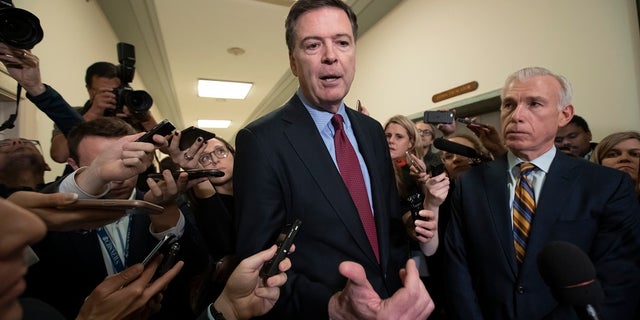
Former FBI Director James Comey, with his attorney, David Kelley,
right, speaking to reporters after a day of testimony before the House
Judiciary and Oversight committees, on Capitol Hill in Washington on
Dec. 7.
(AP Photo/J. Scott Applewhite)
Comey admitted last week that he personally directed two FBI agents to break normal protocol by interviewing
Flynn at the White House because he felt the FBI could get "away with"
it, early on in the Trump administration, which he characterized as
disorganized.
Judge Sullivan technically has the authority to void
Flynn's guilty plea and dismiss the case against him if he unearths
government misconduct, or finds that the plea would constitute a
miscarriage of justice that the court should not accept.
Sullivan
-- who overturned the 2008 conviction of former U.S. Sen. Ted Stevens
after government misconduct came to light -- could take that drastic
step if he finds that the FBI withheld exculpatory witness reports from
the Flynn team, lacks evidentiary basis for its charge, or improperly
coerced Flynn into not bringing a lawyer to his fateful January 2017
interview. GREGG JARRETT: MICHAEL FLYNN IS INNOCENT
Speaking to "Fox News Sunday" earlier in the day,
Trump attorney Rudy Giuliani said Flynn had been "railroaded" and
"framed" -- and even though Giuliani acknowledged Flynn had lied to Vice
President Pence about his communications with Russia, he said the FBI's
conduct was still reprehensible.
"What they did to General Flynn should result in discipline," Giuliani charged. "They’re the ones who are violating the law." HOW FLYNN WAS PUSHED NOT TO HAVE A LAWYER
In
a tweet Sunday, Comey showed no signs of backing down, forcefully
condemning President Trump as a "liar" for criticizing federal
authorities' raid on his former attorney Michael Cohen.
"Remember,
Michael Cohen only became a 'Rat' after the FBI did something which was
absolutely unthinkable & unheard of until the Witch Hunt was
illegally started," Trump wrote on Twitter early Sunday. "They BROKE
INTO AN ATTORNEY’S OFFICE! Why didn’t they break into the DNC to get the
Server, or Crooked’s office?"
In April, federal agents raided
Cohen's home, office and hotel room as part of their investigation into
bank fraud and campaign finance charges he later admitted he had
committed. At the time, Trump characterized the move as an "attack on
our country" and remarked that "attorney-client privilege is dead."
But
later Sunday, Comey emphasized that agents had acted pursuant to a
lawful search warrant, and that attorneys are not immune from searches
-- especially when they are suspected of engaging in wrongdoing on
behalf of clients. FBI COMPLETELY MISSES JUDICIARY COMMITTEE DEADLINE TO EXPLAIN MYSTERIOUS RAID ON CLINTON WHISTLEBLOWER
"This
is from the President of our country, lying about the lawful execution
of a search warrant issued by a federal judge," Comey wrote on
Twitter. "Shame on Republicans who don’t speak up at this moment — for
the FBI, the rule of law, and the truth."
Any communications with attorneys in furtherance of a new crime are not usually protected by any privilege. A special master was appointed in the case by a federal court judge to ensure that Trump's privileged communications were separated from non-privileged ones.
Cohen,
who as Trump's attorney also had the ability to compromise Trump's
attorney-client privilege by disclosing their communications himself, was sentenced this week to 36 months in prison.
The
former Trump loyalist had earlier claimed in court that he had
committed a campaign finance violation "at the direction" of Trump --
although top legal experts and a former Federal Election Commission chairman have said that obtaining a criminal conviction for such alleged violations is often extremely difficult.
Comey
testified earlier this month behind closed doors with House Republicans
probing his oversight of the Hillary Clinton email probes and the early
days of the Russia investigation. He is expected back on Monday for
more testimony.
After he was questioned by House Republicans the
first time on Dec. 7, Comey derided the GOP -- which will lose the
majority in the House in January, and with it their subpoena power -- as
hopeless partisans.
"Today wasn’t a search for truth, but a
desperate attempt to find anything that can be used to attack the
institutions of justice investigating this president," Comey said. "They
came up empty today, but will try again. In the long run, it'll make no
difference because facts are stubborn things." COMEY ADMITS FBI AGENTS BROKE PROTOCOL, GOT 'AWAY WITH' FLYNN INTERVIEW WITHOUT INVOLVING LAWYERS
A
key focus of questioning from lawmakers was Comey's decision to draft
the 2016 statement recommending against filing criminal charges in the
Clinton email probe before the former secretary of state was even
interviewed, as well as the alleged political bias demonstrated in a
slew of text messages and leaks by top FBI officials.
"What they did to General Flynn should result in discipline." — Trump attorney Rudy Giuliani
But a Justice Department lawyer prevented Comey -- who had briefly sued to avoid testifying behind closed doors, before dropping that effort -- from answering all of the Republicans' questions, according to lawmakers at the hearing.
A 235-page transcript of Comey's remarks and the questions posed to him was later released,
pursuant to an agreement between Comey and House Judiciary Committee
Chairman Bob Goodlatte, R-Va., and House Oversight and Government Reform
Committee Chairman Trey Gowdy, R-S.C.
It showed that Comey
claimed “I don’t know” or “I don’t remember” in response to dozens of
questions concerning key details about his time as FBI chief.
Asked
if he recalled who drafted the FBI’s “initiation document” for the July
2016 Russia investigation, Comey said, “I do not.” He again claimed not
to know when asked about the involvement in that initiation of Strzok,
whose anti-Trump texts later got him removed from the special counsel’s
probe.
When asked if the FBI had any evidence that anyone in the
Trump campaign conspired to hack the DNC server, Comey gave a lengthy
answer referring to Special Counsel Robert Mueller’s investigation as to
why he couldn’t answer.
“Did we have evidence in July of (2016)
that anyone in the Trump campaign conspired to hack the DNC server?”
Comey asked rhetorically. “I don't think that the FBI and special
counsel want me answering questions that may relate to their
investigation of Russian interference during 2016. And I worry that that
would cross that line.”
When pressed further by Gowdy about what
“factual predicate” the bureau had to launch a counterintelligence
investigation, Comey again claimed that answering that question would be
a “slope” that would ask him to reveal what the FBI “did or didn’t know
about Russia activity” as it related to the 2016 election.
“You can't tell us, or you won't tell us?” Gowdy asks.
“Probably
a combination of both ... To the extent I recall facts developed during
our investigation of Russian interference and the potential connection
of Americans, I think that's a question that the FBI doesn't want me
answering. So it's both a can't and a won't,” Comey replied. MORE DETAILS: COMEY ROUND-ONE TRANSCRIPT RELEASED
The
former FBI director went on to say that anything related to Mueller’s
investigation, to his understanding, would be “off limits" as it is an
ongoing investigation.
Comey was also fuzzy on the eventual
Democratic funding of the research that went into the controversial and
unverified anti-Trump dossier.
Asked when he learned that the firm
behind the dossier, Fusion GPS, was hired by law firm Perkins Coie –
and when he learned that law firm was hired by the Democratic National
Committee – Comey said, “I never learned that” while director.
Comey
also claimed not to know key details surrounding the involvement of
Christopher Steele, the former British spy who authored the dossier.
Asked when Steele was “terminated” as an FBI source, Comey said he didn’t know.
Asked
about Steele’s subsequent contact with Justice Department official
Bruce Ohr, Comey said, “I don’t know anything about that.”
The Trump administration Sunday reaffirmed the president's insistence
that he would allow a partial shutdown of the federal government if
Congress does not provide $5 billion to build a wall along the
U.S.-Mexico border, with senior adviser Stephen Miller calling it a
"fundamental issue."
"At stake is the question of whether or not
the United States remains a sovereign country," Miller told CBS News'
"Face The Nation." "The Democrat Party has a simple choice. They can
either choose to fight for America's working class or to promote illegal
immigration. You can't do both."
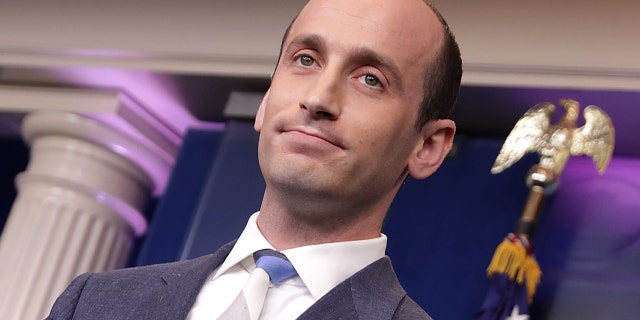
Stephen Miller, a senior adviser to President Trump, talks to reporters at the White House, Aug. 2, 2017. (Getty Images)
"At stake is the question of whether or
not the United States remains a sovereign country. The Democrat Party
has a simple choice. They can either choose to fight for America's
working class or to promote illegal immigration. You can't do both." — Stephen Miller, senior adviser to President Trump
When
asked if the administration was willing to allow parts of the
government to cease operation at midnight Friday if the wall is not
funded, Miller answered: "If it comes to it, absolutely."
On NBC
News' "Meet The Press," Senate Minority Leader Chuck Schumer, D-N.Y.,
insisted that President Trump "is not going to get the wall in any
form."
"President Trump should understand, there are not the votes
for the wall in the House or the Senate," Schumer said. "Even the
House, which is a majority Republican, they don't have the votes for his
$5 billion wall plan ... And we should not let a temper tantrum,
threats, push us in the direction of doing something that everybody,
even our Republican colleagues, know is wrong."
Trump said last
week he would be "proud" to have a shutdown to get Congress to approve a
$5 billion down payment to fulfill his campaign promise to build a wall
on the U.S.-Mexico border. Still, the president doesn't have the votes
from the Republican-controlled Congress to support funding for the wall
at that level.
Schumer and House Minority Leader Nancy Pelosi,
D-Calif., have proposed no more than $1.6 billion for border fencing
upgrades and other security measures -- but not a wall -- as outlined in
a bipartisan Senate bill. Democrats also offered to keep funding at its
current level, $1.3 billion.
"[Republicans] should join us in one
of these two proposals, which would get more than enough votes passed
and avoid a shutdown," Schumer said. "Then, if the president wants to
debate the wall next year, he can. I don't think he'll get it. But he
shouldn't use innocent workers as hostage for his temper tantrum to sort
of throw a bone to his base."
Both parties in Congress have
suggested that Trump would need to make the next move to resolve the
impasse. The House is taking an extended weekend break, returning
Wednesday night. The Senate returns Monday after a three-day absence.
Trump
neither accepted nor rejected the Democrats' proposal as of Friday,
according to the Democrats, telling them he would take a look. Trump
would need Democratic votes either now or in the new year, for passage.
Sen.
John Barrasso, R-Wyo., told "Face The Nation" that Republicans remained
hopeful they could come up with a proposal that would be acceptable to
Trump and pass both chambers. He suggested that could take the form of a
stopgap bill extending funding until January or a longer-term bill
including money for border security.
"There are a lot of things
you need to do with border security," he said. "One is a physical
barrier but also the technology, the manpower, the enforcement, all of
those things, and our current laws are in some ways an incentive for
people to come to this country illegally, and they go through great risk
and possibly great harm."
Appearing on ABC News' "This Week,"
Sen. Susan Collins, R-Maine, urged senators to revisit a bill she helped
push earlier this year that would provide $2.5 billion for border
security, including physical barriers as well as technology and border
patrol agents.
"There's
absolutely no excuse to shut down government on this issue or any other
issue," said Collins, who added of her proposal: "I hope it would be
good enough for the president ... There's a compromise and people will
come to the table in good faith on both sides. We have to prevent a
government shutdown."
North Carolina Gov. Roy Cooper vetoed voter ID legislation
that more than 55 percent of the state’s voters had approved in a
referendum.
(Chris Seward/The News & Observer via AP)
Republican
leaders in North Carolina’s GOP-dominated General Assembly vowed late
Friday to override Democratic Gov. Roy Cooper’s veto of a state voter
identification bill.
Earlier Friday, Cooper said no to the
legislation, which more than 55 percent of the state’s voters had
approved in a recent referendum.
The referendum called for the state’s constitution to add an amendment requiring in-person voter photo ID.
“Requiring photo IDs for in-person voting is a solution in search of a problem,” Cooper said in a statement.
But state Republicans saw the governor’s action as a rejection of the will of state residents.
“We
are disappointed that Gov. Cooper chose to ignore the will of the
people and reject a commonsense election integrity measure that is
common in most states, but the North Carolina House will override his
veto as soon as possible,” state House Speaker Tim Moore said in a
statement.
"We are disappointed that Gov. Cooper chose
to ignore the will of the people and reject a commonsense election
integrity measure that is common in most states." — North Carolina House Speaker Tim Moore
“Despite
the governor's personal feelings on voter ID, the fact remains that the
constitutional amendment passed with a broad mandate from North
Carolinians," GOP Senate leader Phil Berger added, calling Cooper's
arguments a “tired rehash of unconvincing talking points rejected by the
voters.”
Republicans hold veto-proof majorities in both the House
and Senate in North Carolina, so an override would succeed if GOP
lawmakers remain united on the issue. Votes could occur next week. GOP
lawmakers are acting now because, come January, they will no longer have
supermajorities because of Democratic gains made on Election Day.
The
bill would expand the number of qualifying forms of ID and exceptions
compared to legislation blocked earlier this decade. Republicans say the
changes will ensure that everyone lawfully registered to vote can cast a
ballot.
Permitted IDs would include traditional driver's licenses
and military identification, student IDs from colleges and
universities, and employee ID cards for state and local governments.
Those IDs must meet certain security thresholds.
There also would
be a new, free, photo voter identification card produced by county
election boards. People having trouble obtaining an ID could fill out
forms at the polling site, and their ballots likely would be counted
too.
Democratic legislators acknowledge that voter ID rules are
necessary because of the referendum, but they say the details are being
rushed, are complex and will prevent some minorities and poor people
from voting.
Cooper’s veto came at the urging of groups such as
the American Civil Liberties Union, Common Cause NC, Equality NC and the
Washington-based Campus Vote Project of the Fair Elections Center, the
News & Observer of Raleigh reported.
The governor suggested that the integrity of absentee ballots was a greater concern for the state.
"Instead,
the real election problem is votes harvested illegally through absentee
ballots, which this proposal fails to fix," he said, referencing an
investigation of alleged absentee ballot fraud in the state's 9th
Congressional District in November's election.
He added that the
bill's fundamental flaw was a "sinister and cynical" attempt to suppress
the voting rights of minorities, the poor, and the elderly.
Federal
judges struck down a 2013 state law that included photo ID and other
voting restrictions, ruling they were approved with intentional racial
discrimination in mind. Republicans strongly disagreed and put a
constitutional amendment on the November ballot to give them more legal
and popular standing to require voter ID.
Hillary
Clinton surprised an 8-year-old girl with a letter earlier this month
after the elementary school student lost an election for class president
to a boy by a single vote.
Martha Kennedy Morales, a third-grader
at a private Quaker school in College Park, Md., decided to run for the
top office as part of a lesson on government in which elections for
class president and Congress were held, the Washington Post reported. Morales told the paper she lost to a “popular” fourth-grade boy and was affirmed as vice president.
“As
I know too well, it’s not easy when you stand up and put yourself in
contention for a role that’s only been sought by boys,” Clinton wrote in
a consoling letter obtained by the Post.
“As I know too well, it’s not easy when you stand up and put yourself in contention for a role that’s only been sought by boys.” — Hillary Clinton
Clinton
went on to praise the student by relating her own experience losing to
now-President Donald Trump in the 2016 presidential election. The
Democratic nominee won the popular vote by a few million but lost in the
Electoral College. TOP HILLARY CLINTON SUPPORTERS IN NH DON'T BUY THE IDEA OF ANOTHER WHITE HOUSE RUN
“The most important thing is that you fought for what you believed in, and that is always worth it,” Clinton wrote.
Morales is now working on writing the former secretary of state a thank-you note, according to the Post.
President Trump's Saturday tweet suggsted that he was not a
fan of the Weekly Standard or editor-at-large William Kristol.
Many conservatives may have been saddened
by Friday’s news that the Weekly Standard, a publication that has
existed for 23 years, will be ceasing operations this month. But don’t
count President Trump among them.
In a Twitter message Saturday,
Trump blasted the magazine as “pathetic and dishonest,” and slammed its
editor-at-large, William Kristol, as a “failed prognosticator.” THE WEEKLY STANDARD ANNOUNCES IT WILL FOLD AFTER 23 YEARS
Kristol had written in July:
“Donald Trump is in many ways a bad president — bad for the country,
bad for conservatism, bad for the Republican party. His sway over party
and policy should be limited as much as is feasible and his dominance of
our politics not extended any longer than necessary.”
“May it rest in peace!” the president wrote of the magazine Kristol co-founded.
Kristol appeared concerned that the president's Twitter message wasn't sent to him directly.
Parent
company Clarity Media’s CEO Ryan McKibben told staffers Friday morning
that the magazine would print its final issue Monday.
McKibben
said the publication “has been hampered by many of the same challenges
that countless other magazines and newspapers across the country have
been wrestling with,” and ultimately it needed to make the tough
decision to close.
Others reported that McKibben and associates at
Clarity preferred to shutter the Standard rather than sell it, in order
to bolster a weekly launched by the Washington Examiner, which, like
the Standard, is owned by Colorado billionaire Philip Anschutz.


 Senior Justice Department official Bruce Ohr, left, continued to
communicate with former British spy Christopher Steele, right, even
after the FBI cut ties with him.
(AP)
Senior Justice Department official Bruce Ohr, left, continued to
communicate with former British spy Christopher Steele, right, even
after the FBI cut ties with him.
(AP)