The
last remaining Republican congressman in New England filed an appeal
Tuesday that seeks to undo the election of his Democratic opponent under
Maine's new voting system, asking the court to act quickly as the
swearing-in of new U.S. House members nears.
A federal judge last
week rejected U.S. Rep. Bruce Poliquin's concerns over the
constitutionality of ranked voting, a system used in November for the
first time in a congressional race.
Poliquin lost his re-election
bid to Democrat Jared Golden. His appeal asks the 1st U.S. Circuit Court
of Appeals in Boston to reconsider his request to nullify the
election's outcome and either declare him the winner or order another
election.
Poliquin claims he should be the winner because he had
the most first-place votes on Election Day. But Golden won the race in
an extra round of voting in which two trailing independents were
eliminated and their votes were reallocated.
In his appeal,
Poliquin claims that ranked-choice voting "violated all voters'"
constitutional rights. Poliquin says the judge's rejection of his
requests "sidestepped the explicit questions presented, often casting
the questions at a more superficial level of analysis."
Meanwhile,
Golden's chief of staff, Aisha Woodward, said the judge's decision was
"crystal clear" and called it the "best response" to Poliquin's appeal.
Poliquin's appeal comes just weeks before Golden is set to be sworn in Jan. 3.
But
Congress doesn't have to wait for the litigation to wrap up before
deciding whether to swear Golden in, said Edward Foley, constitutional
law professor at Ohio State University's law school. That decision is in
the hands of the newly Democratic controlled House, where House
Democratic leader Nancy Pelosi earlier this month chided Republicans'
fight against ranked-choice voting and Golden's win.
"Congress
doesn't have to be controlled by the litigation in terms of deciding
whether to seat the elected member," Foley said. "That's a decision
Congress ultimately makes itself."
Another fight over a House race
has been brewing in North Carolina , where Republicans want their
candidate to take his seat in Congress in a still-undecided race marred
by ballot fraud allegations.
But the fight there differs from Poliquin's lawsuit, which is about concerns over the system Maine used to tabulate winners.
Under
ranked-choice voting, a system Maine voters approved in 2016, all
candidates are ranked on the ballot, and a candidate who collects a
majority of first-place votes is the winner. If there's no majority
winner, then the last-place candidates are eliminated, and their
second-choice votes are reassigned to the remaining field. The process
is sometimes referred to as an instant runoff.
Poliquin has lambasted ranked-choice voting as being so "confusing" that it effectively disenfranchises voters.
Last
week, U.S. District Judge Lance Walker said that critics can question
the wisdom of ranked-choice voting, but that such criticism "falls short
of constitutional impropriety." The judge rejected several of
Poliquin's constitutional concerns and said the Constitution gives
states leeway in deciding how to elect federal representatives.
Poliquin
has also abandoned his request for a recount of Maine's election. The
secretary of state's office said he is responsible for the "actual cost"
of recount efforts.
Maine's top state court last year warned that
ranked voting conflicts with the state's constitution, which says the
winners of state-level races are whomever gets the most votes, or a
"plurality." And so Maine uses ranked voting only in federal elections
and state primary races, but not for general elections for governor or
the Legislature.
Democratic Gov.-elect Janet Mills has vowed to seek to amend the state constitution so the system can be used in all elections.
There is no one else to blame but President Trump if there’s a partial government shutdown later this week.
The
president said he would take the recriminations if there’s a shutdown.
The question now is whether Trump will sign a spending bill that doesn’t
fund his border wall.
“A lot of us are trying to help him,”
Senate Appropriations Committee Chairman Richard Shelby, R-Ala.,
lamented when asked about the effort to secure dollars for the border
wall. “It didn’t work out.”
And so in the coming days, the House
and Senate will likely approve some form of a short-term spending
measure to avert a partial government shutdown in the wee hours of
Saturday morning. If there's no action, then nine federal departments
would close just days before Christmas. Instead, a tentative, stopgap
package simply re-ups the remaining seven spending bills at current
levels through Feb. 8.
“If we do go to February, what happens then?” asked Shelby, not so rhetorically.
Not much changes. Except Democrats will control the House next year.
Senate
Majority Leader Mitch McConnell, R-Ky., seemed mystified as to why
House Minority Leader Nancy Pelosi, D-Calif., would want to wrestle with
government funding issues when she matriculates to the speaker’s suite
in January.
“I believe that incoming Speaker Pelosi has little
latitude to make a deal,” McConnell observed. “I would assume her
preference would be to roll out the new Democratic agenda with the
fresh, new Democratic Congress.”
“I believe that
incoming Speaker Pelosi has little latitude to make a deal. I would
assume her preference would be to roll out the new Democratic agenda
with the fresh, new Democratic Congress.” — Senate Majority Leader Mitch McConnell, R-Ky.
McConnell added that he thought punting to February “would be the least desirable outcome from the speaker’s point of view.”
Au contraire.
To quote McConnell, this is “the new Democratic agenda with the fresh, new Democratic Congress.”
Democrats
flipped the House in part because Trump proved virulent in key
districts. Pelosi is more than happy to tangle with the president over
an issue like the border wall. The wall may energize Trump’s core
supporters and enrapture red states. But the wall is utterly toxic in
swing districts and suburbia.
That scenario helps Pelosi on two
fronts. It presents the California Democrat a fulcrum to use for
leverage against the president and simultaneously on behalf of liberal
Democrats in her caucus.
Moreover, an elongated wall fight would
potentially help Pelosi temper the narrative that all her side will do
is investigate Trump.
To be sure, there will be plenty of
investigating of the Trump administration by a Democratic House. But
there are only so many cubic centimeters of available news oxygen.
A
February fight over the wall means news outlets will have to devote
some time to the wall brawl and not just focus on alleged misdeeds by
the president.
Is there any question who prevailed here? If this
were a boxing match, you could hear the bell clanging at ringside.
Ding-ding-ding. Round one is over. The judges would award a unanimous
decision to Pelosi.
The looming question now is will Trump sign a bill – sans wall – to avert a government shutdown this weekend?
Trump
has been unpredictable on this issue before. In March, members of the
president’s administration negotiated an omnibus spending package to
avoid a government shutdown. Budget Director and now Acting White House
Chief of Staff Mick Mulvaney ballyhooed the merits of the deal. The
House and Senate approved the plan.
But just hours before the
deadline, the president almost sparked a government shutdown when he
threatened to veto the measure. He ultimately signed the accord.
Trump
faced a revolt from his base when details leaked out about the size and
scope of the omnibus spending package. One wonders if the president may
reject anything Congress passes -- especially if his partisans threaten
mutiny.
That’s the quintessence of the problem stemming from the
Oval Office meeting Trump conducted last week with Pelosi and Senate
Minority Leader Chuck Schumer, D-N.Y. Trump threatened a shutdown and
took responsibility. The bravado invigorated the president’s loyalists.
But Trump’s bluster could backfire if he retreats now.
White House
spokeswoman Sarah Sanders indicated on multiple occasions Tuesday that
the administration could still build the wall – even without a
congressional appropriation.
“There’s certainly a number of
different funding sources that we’ve identified that we can use to
couple with the money that would be given to us through congressional
appropriations that would help us get to that $5 billion,” Sanders said.
“There’s
certainly a number of different funding sources that we’ve identified
that we can use to couple with the money that would be given to us
through congressional appropriations that would help us get to that $5
billion.” — White House press secretary Sarah Sanders
Such
a maneuver is called “reprogramming,” in congressional-ese: Take money
Congress already passed and “reprogram” it for a purpose other than the
original intent. Trump signed into law the Military Construction/VA
appropriations bill. The Army Corps of Engineers budget falls under the
“MilCon/VA” bill. It’s possible the Trump administration could request a
“reprogramming” of Army Corps of Engineers money for the wall. But that
gambit requires sign-off by key members of the House and Senate
appropriations Committees.
“They have to have congressional blessing for most reprogramming,” Pelosi said
That
said, an administration can shift a little bit of money for purposes
not sanctioned by Congress. But we’re only talking about a few million
dollars here. That’s million with a “M.” Pocket lint in Washington.
The
Trump administration says it’s seeking potential routes to bypass
Congress. That’s a problem because Article I, Section 9 of the
Constitution grants Congress the power of the purse.
“They should
read the Constitution,” said one person familiar with the congressional
appropriations process. Another source said “It would create a
sh--storm” if the White House tried to circumvent Capitol Hill.
Don’t
congressional Republicans have the back of the president? As Shelby
said, they tried to help. But the political street couldn’t accommodate
what Trump requested. Remember that many GOPers fear voters could blame
them for a shutdown. So they were willing to cash it in.
A
scenario like this one seems to unfold in much the same way every
Christmas in Washington. There’s a crisis du jour. The sides appear
steeled in their resolve. And then, almost at the last minute, somebody
buckles not long before Santa slides down the chimney.
In truth,
the outcome of this impasse was likely determined by the most
influential people in Washington. Not the lawmakers, but the lawmakers
spouses and their families. After all, they want to get everyone home
for Christmas.
Some
remarks by the federal judge overseeing the guilty plea of former
National Security Adviser Gen. Michael Flynn were “pretty reckless,”
Townhall editor Katie Pavlich said Tuesday on the “Special Report”
All-Star panel.
U.S. District Judge Emmet G. Sullivan unleashed on
Flynn, the former Trump administration official who had admitted lying
to the FBI about his communications with Russian Ambassador Sergey
Kislyak.
“Arguably, you sold your country out!” Sullivan said to Flynn before suggesting that his wrongdoings were treasonous.
Pavlich
insisted that the judge “knows” that the case before him is “one of the
most high-profile cases that has been in the public atmosphere in a
very long time.”
“For him to state things publically when the room
is packed full of reporters and everybody is watching for things that
aren’t true and then he has to walk them back, insinuating treason is
pretty reckless,” Pavlich told the panel -- which also
included Washington Examiner chief political correspondent Byron York
and NPR national political correspondent Mara Liasson.
York felt similarly, calling Sullivan’s invoking of treason in the Flynn case “outrageous.”
“Before
it was over, the judge had raised this question over whether Flynn had
committed treason, which is outrageous especially coming from a federal
judge on the bench, had suggested that maybe Flynn sold out his country
and that he was an unregistered foreign agent inside the White House,
which he was not,” York said. “A judge can bring up uncharged conduct in
a sentencing case, but really to suggest that he was an unregistered
foreign agent in the White House was false because even the prosecutor I
believe corrected the judge to say that it had ended before. “
York
added that it became “this weird situation” that was "almost like the
craziness of the whole Trump debate moved into the courtroom for a day"
and that Flynn’s future was “completely uncertain now” because his
sentencing has been delayed until March.
Liasson agreed, calling
some of Sullivan’s remarks “very confusing” since it seemed that he was
“concerned” that Flynn was “pleading guilty to something he wasn’t
guilty of” and then “suggested” that Flynn was “guilty of things he
hadn’t been charged with yet.”
Pavlich also noted that White House
officials seemed to be “distancing themselves” from Flynn “for the
first time,” but asked whether President Trump “still stands by” his
decision to ask for Flynn’s resignation after the revelation that
Flynn lied to Vice President Mike Pence.
U.S.
District Judge Emmet G. Sullivan’s handling of former National Security
Adviser Michael Flynn’s sentencing hearing Tuesday on Flynn’s guilty
plea to lying to the FBI was anything but exemplary. The judge – who has
a well-deserved reputation as both tough and fair – made several
fundamental errors right at the outset.
First, Sullivan suggested
that Flynn might be guilty of treason. This reflects an abysmal
ignorance of the governing case law. Nothing Flynn did comes even close
to satisfying the strict definition of treason.
The U.S.
Constitution states: “Treason against the United States shall consist
only in levying War against them, or in adhering to their Enemies,
giving them Aid and Comfort. No Person shall be convicted of Treason
unless on the Testimony of two Witnesses to the same Overt Act, or on
Confession in open Court.”
Flynn admitted he represented Turkey –
America’s NATO ally – before he became a federal employee as President
Trump’s national security adviser, but said he failed to register until
later under the Foreign Agents Registration Act.
Special Counsel
Robert Mueller did not charge Flynn for failing to register – let alone
with the far more serious crime of treason.
But Sullivan blundered
by accusing Flynn of having been an unregistered foreign agent while he
was serving in the White House, thereby having “sold your country out.”
This was flat out wrong, since Flynn stopped working for any foreign
government before he became President Trump’s national security adviser
when Trump took office on Jan. 20, 2017.
During a recess, in the
sentencing hearing, Judge Sullivan’s law clerks obviously set him
straight on the law and the facts and the judge walked back his
erroneous statements. But these statements reflect a kind of abiding
bias that might well result in reversible error if Flynn’s lawyers
appeal a sentence he eventually receives from Sullivan.
It
is obvious that Judge Sullivan regards Flynn as guilty of far more
serious crimes than he pleaded to or was even charged with committing.
The
judge delayed sentencing for Flynn – a retired Army lieutenant general –
until next year and gave each side until March 13 to file a status
report with the court.
I had a case much like this several years
ago and the appellate court reversed the sentence and remanded it for
resentencing before a different and unprejudiced judge. Walking back
erroneous statements cannot unring the bell of a judge’s prejudice.
It
is obvious that Judge Sullivan regards Flynn as guilty of far more
serious crimes than he pleaded to or was even charged with committing.
Sullivan
probably came into the courtroom before the recess with his mind made
up about the sentence he intended to impose based on his erroneous views
regarding treason and Flynn’s supposed role as an agent for a foreign
government while serving in the White House. The judge may even have
written out the sentence in advance, as many judges do.
Sullivan
deliberately telegraphed his intention to impose a prison sentence in
defiance of the joint recommendation of the Mueller and Flynn’s defense
attorney, who agreed that Flynn should not serve any prison time.
The
Constitution limits the role of federal judges to actual “cases and
controversies,” and there was no controversy regarding the appropriate
sentence of probation for Flynn.
To be sure, the courts have
carved out an exception – erroneously in my view – to this
constitutional restriction on the jurisdiction of judges when it comes
to sentencing. But most judges abide by the spirit of the constitutional
restriction by rarely, if ever, imposing their own view when the
parties have agreed.
Not Judge Sullivan, who knows far less about
the facts and the defendant than do the parties, as evidenced by his
serious misstatements.
Now the sentencing has been postponed, giving members of Flynn’s legal team an opportunity to reconsider their strategy.
There
were serious issues surrounding the circumstances of Flynn’s
questioning by the FBI and of the guilty plea he submitted. But Flynn’s
lawyers understandably declined to raise challenges on these issues,
because they expected a sentence of probation for their client – for
which Flynn needed to show remorse, not contentiousness.
But now that the judge has signaled his willingness to consider a prison sentence, Flynn has three options – none of them good.
Flynn’s
first option is to ask the judge to throw out his questionable guilty
plea – but it will be difficult to do so in light of his statement at
the sentencing hearing that he accepts his guilty plea and knew he was
doing wrong when he lied to the FBI.
Flynn’s second option is to
cooperate even more, but there may not be much more he can say or do. If
he admits he withheld some cooperation that would hurt him.
The
former national security adviser’s third option – a nuclear one – would
be to seek to recuse Judge Sullivan because of the judge’s prejudicial
misstatements about treason and about Flynn being a foreign agent while
working in the White House. But this, too, may backfire, because judges
often punish defendants for “judge shopping”.
So the sentencing
will go forward after a delay. In the meantime, President Trump has the
power to pardon Flynn or commute his sentence, either now or after the
sentence is imposed.
Flynn can’t count on such executive action. But he also can’t count on Judge Sullivan to do what both parties recommended.
Flynn shouldn’t have lied to the FBI. He has already paid a heavy price and will probably pay an even heavier one.
Conservatives who have long despised ObamaCare might be expected to
rejoice now that a federal judge in Texas has ruled the law
unconstitutional.
But few of them are popping champagne corks, at least in the media.
"No
one opposes ObamaCare more than we do," says The Wall Street Journal's
editorial page, but the ruling "is likely to be overturned on appeal and
may boomerang politically on Republicans."
ObamaCare was a "misbegotten law," says National Review. "Yet
we cannot applaud Judge Reed O'Connor's decision. Indeed, we deplore
it. It will not lead to the replacement of Obamacare, as much as we
desire that outcome. It will instead give Republicans another
opportunity to dodge their responsibility to advance legislation toward
that end ... it is very likely to be overturned on appeal because it
deserves to be."
ObamaCare was flawed legislation, to say the
least, that drove up premiums for some people and, despite the former
president's promises, caused others to lose their doctors and their
plans.
But there's a reason that a Republican Congress, with
President Trump's backing, failed in three attempts to repeal and
replace the law. Much of the GOP didn't want to take the political heat
for causing millions of Americans to lose their health insurance.
The
law has become more popular now that its namesake is out of office, and
especially the provision that bars insurance companies from rejecting
people with preexisting conditions. Many Republicans spent the campaign
vowing to preserve that part of the law (even some who had voted to
abolish ObamaCare or moved to weaken it at the state level).
Not everyone on the right agrees. The Federalist says
the judge's ruling is overdue because "the blunt reality that Obamacare
was always at heart a bad-faith proposition. The basic operation of the
law, never stated or acknowledged by its authors, was to force younger,
healthier people to subsidize health insurance for older, sicker
people. It was a redistribution scheme, plain and simple."
By the
way, it's no coincidence that the decision came from O'Connor, a
controversial and conservative Bush appointee who frequently ruled
against the Obama administration. Nor is it happenstance that the states
that filed the suit did so in Texas, where the courts are more
conservative — the flip side of Trump complaining about lawsuits in the
liberal 9th District in San Francisco.
When the John Roberts court
upheld the law in 2012, it said Congress couldn't force people to buy
insurance through the individual mandate, but that was okay because it
could tax people for not buying coverage.
Last year, as part of
tax reform, Congress set the penalty tax at zero, effectively
eliminating the mandate. O'Connor ruled that the whole law must be
tossed out because it's based on a tax-slash-mandate that no longer
exists.
It's doubtful that the Supreme Court will buy this
argument, but the political impact, in the short term, is clear.
Democrats see a boost in their effort to pass some version of Medicare
for All, although the ruling should freeze things and the GOP Senate
won't go along in any event. Republicans have to navigate a path between
rhetorical opposition to ObamaCare and not taking steps that would
cause a health care crisis and blow up the preexisting conditions ban.
Trump,
while tweeting that the law is an "UNCONSTITUTIONAL DISASTER," was
quick to add: "Now Congress must pass a STRONG law that provides GREAT
healthcare and protects pre-existing conditions. Mitch and Nancy, get it
done!"
But getting it done would have been easier when Nancy was
minority leader. Ultimately, a divided Congress, not the courts, must
figure out a way out of this mess.
Then-National
Security Adviser Michael Flynn told FBI agents at the White House on
January 24, 2017 "not really" when asked if he had sought to convince
Russian ambassador not to escalate a brewing fight with the U.S.
over sanctions imposed by the Obama administration, according to an
explosive new FD-302 witness report released just hours before Flynn is set to be sentenced.
Flynn
issued other apparently equivocal responses to FBI agents' questions,
and at various points suggested that such conversations might have
happened or that he could not recall them if they did, according to the
302. The heavily redacted document
contained few definitive statements from Flynn, who later pleaded
guilty to making false statements about his contacts with Russia's
ambassador, in connection with the White House meeting.
Flynn was not charged with wrongdoing as a result of the substance of his calls with the Russian ambassador -- and a Washington Post article published one day before his White House interview
with the agents, citing FBI sources, publicly revealed that the FBI had
wiretapped Flynn's calls and cleared him of any criminal conduct. ANTI-TRUMP FBI AGENT PETER STRZOK, WHO INTERVIEWED FLYNN, HAD 'MEDIA LEAK STRATEGY'
The 302
indicates that Flynn was apparently aware his communications had been
monitored, and at several points he thanks the FBI agents for reminding
him of some of his conversations with Russian officials.
Separately, a newly unsealed indictment
Monday revealed that two Flynn associates had been charged with
illegally lobbying for Turkey without properly registering under the
Foreign Agent Registration Act (FARA), and Mueller has claimed Flynn
also lied about his lobbying projects there. Flynn's guilty plea and cooperation with the Mueller probe helped him avoid similar FARA-related charges, legal analysts have said.
The
newly released 302 was finalized on Feb. 15, 2017 after it was reviewed
by top FBI brass, just two days following Flynn's resignation after he
misled Vice President Pence about his communications with then-Russian
ambassador Sergey Kislyak.
The document stated that Flynn told
agents "not really" and "I don't remember" when they asked if he had
requested Kislyak and the Russians not engage in a "tit-for-tat" with
the U.S. government over the Obama administration's sanctions in
December 2016, or whether he had asked the Russians not to "escalate"
the matter and to keep their response "reciprocal." (Trump, at the time,
publicly said he wanted the U.S. to "move on" and not engage in a
bitter dispute with Russia.)
Flynn -- who sold his home
in Virginia this year as his legal bills mounted -- declared in his
guilty plea nearly 11 months later that his comments on the issue were a
knowing lie to the FBI agents.
"It wasn't, 'Don't do anything,'"
Flynn told the agents when they asked him if he had requested that the
Russian ambassador not retaliate against the U.S., according to the 302.
Flynn intimated that the U.S. government's harsh sanctions came as a
"total surprise" to him, the document states.
Separately, agents
asked Flynn whether Kislyak had promised that Russia would "modulate"
its response to the sanctions, which were imposed by the Obama
administration in its final days in power in response to Russian
election meddling. TOP REPUBLICAN PREDICTS FLYNN GUILTY PLEA WILL BE TOSSED, CITING FBI 'MISCONDUCT'
"Flynn
stated it was possible that he talked to Kislyak on the issue," the 302
stated, "but if he did, he did not remember doing so. Flynn stated he
was attempting to start a good relationship with Kislyak moving
forward."
The 302 continued: "Flynn remembered making four to five
calls that day about this issue, but that the Dominican Republic [where
he was vacationing] was a difficult place to make a call as he kept
having connectivity issues. Flynn reflected and stated that he did not
think he would have had a conversation with Kislyak about the matter, as
he did not know the expulsions [of 35 Russian diplomats from the
U.S. as part of the Obama administration's sanctions] were coming."
An
entire paragraph of the 302 concerning a "closed-door meeting" between
Flynn and Kislyak after the presidential election was redacted.
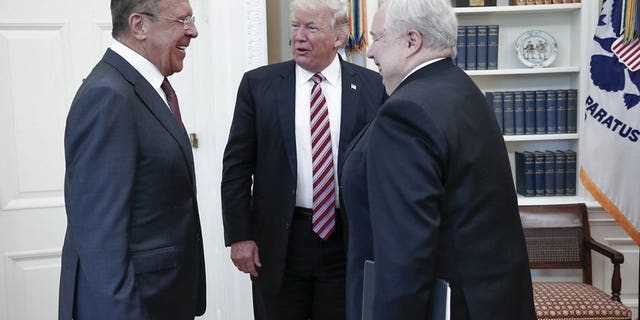
Russian ambassador Sergey Kislyak, at right, meets with President
Trump and Russian Foreign Minister Sergey Lavrov. The May 10, 2017
meeting took place the same day Trump fired James Comey as FBI Director.
Trump was widely criticized during the meeting for revealing
information to the Russians about intelligence obtained from Israel
about an ISIS terror plot involving laptop bombs. Although the president
has the authority to disclose classified information, critics charged
the move was reckless and endangered Israeli sources. (AP)
The document concluded by noting that "Flynn stated
he did not have a long drawn out discussion with Kislyak where he would
have asked him to 'don't do something.'"
Flynn, in fact, had asked
Kislyak to "refrain from escalating the situation in response to
sanctions that the United States had imposed on Russia that same day,"
according to prosecutors, who said Kislyak "had chosen to moderate its
response to those sanctions as a result of his request."
Flynn
also denied to investigators that he had asked Russia to vote in any
particular way at the United Nations, saying his only calls to countries
were requests for information as to how they planned to vote. But
prosecutors said that Flynn had sought to convince Russia to veto a U.N.
Security Council resolution that condemned Israel’s settlements in the
West Bank. (The Obama administration abstained in that vote, which Republicans characterized as a betrayal of a close U.S. ally.) EX-SENATE INTEL STAFFER PLEADS GUILTY TO LYING TO FBI -- BUT DID HE LEAK FISA APPLICATION DAMAGING TO TRUMP?
Prosecutors addititonally
charged that a "very senior member” of the Trump transition team
directed Flynn to contact foreign governments including Russia over the
U.N. vote. The Associated Press reported the “very senior” official was
Trump son-in-law Jared Kushner.
During the interview at the White
House, Flynn twice thanked agents for reminding him about his contacts
with Kislyak concerning the U.N. -- an apparent indication that he was
well aware that the FBI, as The Post reported, had listened to his
conversations. ("Yes, good reminder," he said at one point, according to
the 302.)
Special Counsel Robert Mueller filed the witness report
documenting FBI agents' fateful conversation with Flynn late
Monday, shortly after U.S. District Judge Emmet G. Sullivan issued an
order Monday requiring that prosecutors publicly turn over the document.
Sullivan
had ordered the special counsel to turn over all government documents
and “memoranda” related to the questioning of Flynn last week, after
Flynn's attorneys, in a bombshell filing,
claimed the FBI had discouraged him from bringing a lawyer to the White
House interview and intentionally decided not to warn him of the
consequences if he lied to agents.
Fired FBI Director James Comey admitted last week
that the FBI's end-run around the White House Counsel -- which the FBI
usually involves in any of its interviews with senior White House
officials -- was not normal protocol, and that the FBI felt it could get
"away with" the tactic in the early days of the Trump administration. COMEY: WE GOT 'AWAY WITH' FLYNN INTERVIEW, BROKE PROTOCOL
Last
Friday, Mueller met Sullivan’s deadline and provided some documents,
some of which were heavily redacted. One memorandum produced by Mueller
substantiated the claims by Flynn's lawyers that the FBI had cautioned
Flynn against involving a lawyer in the interview because doing so would
necessitate the Justice Department's involvement.
The memorandum,
written by then-Deputy FBI Director Andrew McCabe, also confirmed that
agents did not want to affect their "rapport" with Flynn by suggesting
he would be exposed to criminal liability if he lied.
"I explained
that I thought the quickest way to get this done was to have a
conversation between [Flynn] and the agents only," McCabe wrote. "I
further stated that if LTG Flynn wished to include anyone else in the
meeting, like the White House Counsel for instance, that I would need to
involve the Department of Justice. [General Flynn] stated that this
would not be necessary and agreed to meet with the agents without any
additional participants."
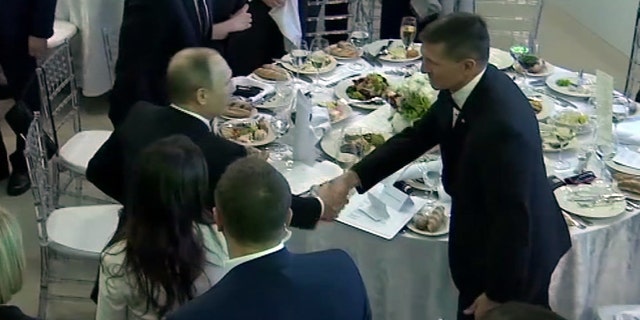
In this image made from a video taken on Dec. 10, 2015 and made
available on Tuesday, Feb. 14, 2017, US President Donald Trump's former
National Security Advisor Michael Flynn, right, shakes hands with
Russian President Vladimir Putin, in Moscow. (Ruptly via AP)
(The Associated Press)
However, the
special counsel did not publicly provide the January 302 witness report
that FBI policy dictated should have been written immediately after the
Flynn interview, leading to speculation as to whether one was drafted.
Sullivan's
order on Monday stated that Mueller's team had made confidential
arguments under seal as to redactions it would need to make to the 302.
Sullivan ruled that the redactions were appropriate and that due
to "strong presumption in favor of public access to judicial records,"
the 302 could be made public Monday. STRZOK'S PHONE COMPLETELY WIPED AFTER HE WAS FIRED BY MUELLER FOR ANTI-TRUMP BIAS
The Flynn 302 released Monday further claimed Flynn was advised about the "nature of the interview" before it began.
However,
the McCabe memorandum released Friday apparently showed that the FBI
nudged Flynn not to have an attorney present during the questioning. And
FBI agents deliberately did not instruct Flynn that any false
statements he made could constitute a crime, and decided not to
"confront" him directly about anything he said that contradicted their
knowledge of his wiretapped communications with Kislyak.
One of
the agents who conducted the Flynn interview, Peter Strzok, was fired
from the Russia probe in late July 2017 over his apparent anti-Trump
bias.
Other portions of the document described apparently routine calls between Flynn and Kislyak about other matters.
On Sunday, GOP Rep. Devin Nunes told Fox News' "Sunday Morning Futures" it was likely Flynn pleaded guilty only because of overwhelming financial pressure and because "he was just out of money."
California Republican Rep. Darrell Issa, for his part, told host Maria Bartiromo
that he "would not be surprised a bit if the conviction of Flynn is
overturned, because of the Justice Department and FBI's misconduct."
In
June, Freedom Caucus Chair Rep. Mark Meadows, R-N.C, charged that the
FBI may have "edited and changed" key witness reports in the Hillary
Clinton and Russia investigations. Meadows also raised the possibility
that the FBI misled the Department of Justice watchdog in an attempt to
hide the identities of FBI employees who were caught sending anti-Trump
messages along with Strzok.
Speaking separately to "Fox News Sunday," Trump attorney Rudy Giuliani flatly charged that Flynn had been "railroaded" and "framed."
"What
they did to General Flynn should result in discipline," Giuliani told
host Chris Wallace. "They’re the ones who are violating the law.
Giuliani
acknowledged that Flynn had misled Pence regarding his conversations
with the then-Russian ambassador, but added, "that was a lie, but that’s
not a crime."
Congresswoman-elect Alexandria Ocasio-Cortez hasn’t yet started her new job, but she’s already taking a break.
The
Democratic Socialist said Monday that she’s taking time a week off for
“self-care” after feeling burned out and lamented that her political
activity changed her lifestyle.
“I am starting a week of self-care
where I am taking the week off and taking care of me. I don't know how
to do that though, so I would appreciate any and all self-care tips,”
she said in an Instagram video.
“For
working people, immigrants, & the poor, self-care is political —
not because we want it to be, but bc of the inevitable shaming of
someone doing a face mask while financially stressed. So I’ve decided to
take others along with me on IG as I learn what self-care even means
and why it’s important,” she added on Twitter.
Ocasio-Cortez,
who unseated powerful New York Democrat Joe Crowley earlier this year
during the primary election and easily cruised to victory in general
election as she had no real opposition, went on to say that since her
entry into politics and activism, she had to give up her more
comfortable lifestyle.
“Before the campaign, I used to practice
yoga 3-4x/week, eat nutritiously, read and write for leisure,”
Ocasio-Cortez wrote on Instagram. “As soon as everything kicked up, that
all went out the window. I went from doing yoga and making wild rice
and salmon dinners to eating fast food for dinner and falling asleep in
my jeans and makeup.”
"Before the campaign, I used to
practice yoga 3-4x/week, eat nutritiously, read and write for leisure.
As soon as everything kicked up, that all went out the window. I went
from doing yoga and making wild rice and salmon dinners to eating fast
food for dinner and falling asleep in my jeans and makeup." — Congresswoman-elect Alexandria Ocasio-Cortez
“I
keep things raw and honest on here since I believe public servants do a
disservice to our communities by pretending to be perfect,” she added.
“It makes things harder for others who aspire to run someday if they
think they have to be superhuman before they even try.”
The New York Democrat revealed that she decided to spend “a few days in the middle of nowhere” in upstate New York.
Ocasio-Cortez, together with other newly-elected lawmakers, will start her term on Jan. 3.
The salacious and unverified opposition research dossier
cited by the FBI as its main justification to surveil a top Trump
aide contains many claims that are "likely false," according to the
Yahoo News reporter who was among the first to break the news of the
dossier's existence.
Michael Isikoff's statements on John Ziegler's Free Speech Broadcasting podcast came
a day before Michael Cohen adviser Lanny Davis reiterated that Cohen
has never been to Prague -- where, according to the dossier, he traveled
to arrange a payment to Russian hackers during the 2016 presidential
campaign.
The dossier was created by British ex-spy Christopher
Steele and funded by the firm Fusion GPS -- which was retained by the
Democratic National Committee (DNC) and the Hillary Clinton presidential
campaign.
"In broad strokes, Christopher Steele was clearly onto
something, that there was a major Kremlin effort to interfere in our
elections, that they were trying to help Trump's campaign, and that
there was multiple contacts between various Russian figures close to the
government and various people in Trump's campaign,” Isikoff said.
But
he added: “When you actually get into the details of the Steele
dossier, the specific allegations, we have not seen the evidence to
support them, and, in fact, there's good grounds to think that some of
the more sensational allegations will never be proven and are likely
false."
On four occasions, the FBI told the Foreign Intelligence
Surveillance (FISA) court that it "did not believe" Steele was the
direct source for Isikoff's Sept. 23, 2016 Yahoo News article implicating former Trump aide Carter Page in Russian collusion.
Instead,
the FBI suggested to the court, the article by Michael Isikoff was
independent corroboration of the salacious, unverified allegations
against Trump in the infamous Steele dossier. Federal authorities used
both the Steele dossier and Yahoo News article to convince the FISA
court to authorize a surveillance warrant for Page.
But London court records show
that contrary to the FBI's assessments, Steele briefed Yahoo News and
other reporters in the fall of 2016 at the direction of Fusion GPS --
the opposition research firm behind the dossier. The revelations were
contained heavily-redacted documents released earlier this year after a
Freedom of Information Act lawsuit by the organization Judicial Watch.
"The
FBI does not believe that Source #1 [Steele] directly provided this
information to the identified news organization that published the
September 23rd News Article," the FBI stated in one of the released FISA
documents. "Source #1 told the FBI that he/she only provided this
information to the business associate and the FBI."
The documents
describe Source #1 as someone "hired by a business associate to conduct
research" into Trump's Russia ties -- but do not mention that Fusion GPS
was funded by the DNC and Clinton campaign.
Instead, the
documents say only: "The FBI speculates that the identified U.S. person
was likely looking for information that could be used to discredit
[Trump's] campaign." Fox News believes that the U.S. person is Glenn
Simpson, co-founder of Fusion GPS.
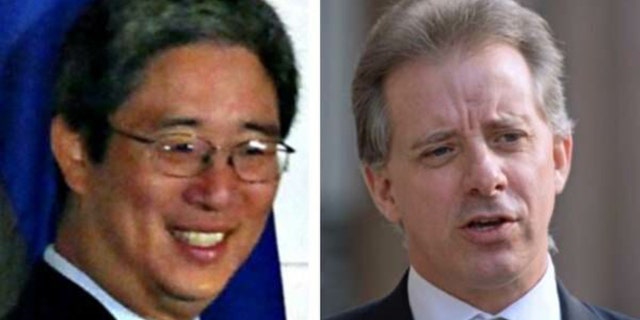
Senior Justice Department official Bruce Ohr, left, continued to
communicate with former British spy Christopher Steele, right, even
after the FBI cut ties with him.
(AP)
Page announced in October
he is filing a defamation lawsuit against the DNC over the dossier's
claims. He is also suing Perkins Coie and its partners, the law firm
that represented Clinton’s campaign and hired Fusion GPS.
Page told Fox News’ “Hannity” at the time that his lawsuit goes “beyond any damages or any financial aspects."
“There
have been so many lies as you’re alluding to and you look at the damage
it did to our Democratic systems and our institutions of government
back in 2016. And I’m just trying to get some justice,” he said.
Meanwhile,
ex-Cohen attorney Lanny Davis laughed off a suggestion during an MSNBC
interview on Sunday that his former client had ever made a trip to
Prague to pay Russian hackers.
“No, no Prague, ever, never,” Davis said.
While Cohen's team has long denied he made the trip, the latest denial comes after Cohen pleaded guilty in two separate prosecutions
linked to his work for President Trump. Cohen has pledged to cooperate
with federal authorities, and Special Counsel Robert Mueller's team has
said he has largely done so. ANTI-TRUMP EX-FBI AGENT STRZOK'S PHONE WIPED AFTER HE WAS FIRED FROM MUELLER'S TEAM
Fox
News reported in August that embattled Justice Department official
Bruce Ohr had contact in 2016 with then-colleague Andrew Weissmann, who
is now a top Mueller deputy, as well as other senior FBI officials about
the controversial anti-Trump dossier and the individuals behind it.
The
sources said Ohr's outreach about the dossier – as well as Steele; the
opposition research firm behind it, Glenn Simpson’s Fusion GPS; and his
wife Nellie Ohr's work for Fusion – occurred before and after the FBI
fired Steele as a source over his media contacts. Ohr's network of
contacts on the dossier included: anti-Trump former FBI agent Peter
Strzok; former FBI lawyer Lisa Page; former deputy director Andrew
McCabe; Weissmann and at least one other DOJ official; and a current FBI
agent who worked with Strzok on the Russia case.
Weissmann was
kept "in the loop" on the dossier, a source said, while he was chief of
the criminal fraud division. He is now assigned to Mueller’s team.
Ohr's
broad circle of contacts indicates members of FBI leadership knew about
his backchannel activities regarding the dossier and Steele.
Congressional
Republicans are still trying to get to the bottom of Ohr's role in
circulating the unverified dossier, which became a critical piece of
evidence in obtaining a surveillance warrant for Page in October 2016.