Self-described
socialist Alexandria Ocasio-Cortez announced on Twitter late Tuesday
that she will join California Democratic Rep. Maxine Waters on the
influential House Financial Services Committee, which oversees Wall
Street and the housing industry.
California Rep. Katie Porter,
Michigan's Rashida Tlaib, Hawaii Rep. Tulsi Gabbard, and Massachusetts
Rep. Ayanna Pressley have also reportedly been tapped for the committee by Democratic House leaders, and a vote finalizing their appointments is expected within days.
"I
am very grateful for the opportunity to sit on this committee as a
freshman, and look forward to working under the leadership of
@RepMaxineWaters!" Ocasio-Cortez wrote on Twitter late Tuesday.
"Financial Services is one of just four exclusive committees in the
House. It oversees big banks, lending, & the financial sector."
She
added: "Personally, I’m looking forward to digging into the student
loan crisis, examining for-profit prisons/ICE detention, and exploring
the development of public & postal banking. To start."
The
roles would afford the rising far-left Democrats a powerful platform to
pursue the sweeping reforms they campaigned on, even as some moderate
liberals voiced concerns that intra-party clashes would be inevitable.
Ocasio-Cortez, 29, has suggested that the nation's largest banks should
be broken up, and she shunned corporate donations during her House run
last year.
Waters, the chair of the financial services committee, has vowed to counteract the Trump administration's 2018 rollback of the Dodd-Frank legislation, which the White House called "disastrous" and overbroad.
"Make
no mistake, come January, in this committee, the days of this committee
weakening regulations and putting our economy once again at risk of
another financial crisis will come to an end," Waters said last year.
But
other Democrats have sounded notes of caution about Ocasio-Cortez in
particular, given her willingness to spar with Democratic leaders and
her relatively radical agenda.
House Committee on Financial Services Ranking Member Rep. Maxine
Waters, D-Calif., left, listens during a hearing, Wednesday, July 18,
2018, on Capitol Hill in Washington.
(AP)
“I don’t know enough about her to be
able to determine if she’s going to be a good member or what,” Missouri
Democratic Rep. Lacy Clay, who sits on the financial services committee
and who was challenged in 2018 by a Democratic candidate backed by
Ocasio-Cortez, told Politico. “Time will tell, and this one term will tell us a lot about her abilities as a legislator.”
Another
financial services committee member, New York Democratic Rep. Gregory
Meeks, backed Ocasio-Cortez's appointment to the committee but told the
paper that he had some reservations. HARRY REID SWIPES AT OCASIO-CORTEZ TAX PROPOSAL
"I
don't want a scenario like they had on the Republican side — I don't
think we're going to get there — where you had a Freedom Caucus that
ends up just trying to break and stop everything and any kind of
progress," Meeks said. The conservative House Freedom Caucus frequently sparred with more moderate House Republicans, particularly on immigration, last year.
Ocasio-Cortez,
29, has made no secret of her progressive approach to the financial
industry. She has called for "taxing Wall Street to support tuition-free
public universities and trade schools," and has argued that the banks
she will soon oversee have long held undue influence in American
politics.
But she has struggled to explain how she would fund her proposals to provide Medicare for all and guarantee housing and education, and has falsely claimed that wasteful military spending could be reappropriated to pay for her laundry list of policy goals.
The
news of the progressives' appointment to the financial services
committee was a win for progressive groups, who just last week voiced
their disapproval when House Democratic leaders passed
over Ocasio-Cortez and Tlaib for membership on other powerful
committees. The Steering and Policy Committee, chaired by House Speaker
Nancy Pelosi, formally assigns members to committees.
Tlaib, 42,
apologized earlier in the month for causing a "distraction" by calling
President Trump a "motherf---er" and promising to impeach him. Just days
later, she attracted negative press attention again by suggesting that
some Republicans have a "dual loyalty" to the U.S. and Israel.
Tlaib
was photographed this month wearing Palestinian robes with Sarsour, a
proponent of Louis Farrakhan and the Nation of Islam. Farrakhan has
compared Jews to termites and praised Hitler.
"They forgot what
country they represent," Tlaib, a Palestinian-American who made history
by becoming one of the first two Muslim women to ever serve in
Congress, wrote on Twitter, referring to Senate Republicans pushing a
pro-Israel bill during the ongoing partial federal government shutdown.
In
the wake of those comments, Democratic Massachusetts Rep. Richard Neal,
who chairs the House Ways and Means Committee, announced last week that
Tlaib and Ocasio-Cortez had not been selected to join that panel. The
Ways and Means Committee has vast authority over taxation, as well as
Social Security and Medicare. New York Democratic Rep. Tom Suozzi was
named to the panel instead of Ocasio-Cortez.
Rep. Alexandria Ocasio-Cortez, D-N.Y., left, talks with Rep. Ilhan
Omar, D-Minn., center, and Rep. Haley Stevens, D-Mich., right, as they
head to a group photo with the women of the 116th Congress on Capitol
Hill in Washington, Friday, Jan. 4, 2019. (AP Photo/Susan Walsh)
The far-left advocacy group Justice Democrats had
called for Ocasio-Cortez, as well as California Rep. Ro Khanna, to be
seated on Ways and Means. Responding to the snub by the committee,
Ocasio-Cortez spokesman Corbin Trent said that "she hoped to be on it,
but we're excited to see what committees she does get." GROWING NUMBER OF 2020 DEMOCRATS SUPPORTING RADICAL 'GREEN NEW DEAL'
Khanna
had also personally sought membership on that panel, and advocated for
more freshmen representatives to be seated on powerful committees in
general.
"Progressive representation on key House committees will
decide whether or not we get Medicare For All, free college, a Green New
Deal, and end to mass deportation and mass incarceration," Jusice
Democrats said in a statement on their website.
The statement
continued: "Nancy Pelosi and the Democratic leaders of the most powerful
Congressional Committees are going to decide whether progressives or
corporate-backed centrists will represent us in the fight for economic,
racial, social and environmental justice."
Earlier this month,
over the last-minute objections of Ocasio-Cortez and Khanna, House
Democrats overwhelmingly approved most of a sweeping new rules package
that effectively placed restrictions on some new spending. Progressive
groups said the limitation would hinder them from realizing some of
their more aggressive goals.
Ocasio-Cortez had voted with
Khanna to oppose the so-called "pay-go" rule included in the rules
package, supported by Pelosi. That rule requires that any new mandatory
spending for entitlements or tax cuts be offset by other separate
revenue increases (such as tax hikes) or budget-cutting measures so that
the new spending does not expand the federal deficit.
The pay-go principle,
Ocasio-Cortez charged in a tweet Wednesday, was a "dark political
maneuver designed to hamstring progress on healthcare" and other
legislation.
House Speaker Nancy Pelosi of Calif., administers the House oath
of office to Rep. Katie Porter, D-Calif., during ceremonial swearing-in
on Capitol Hill in Washington, Thursday, Jan. 3, 2019, during the
opening session of the 116th Congress. (AP Photo/Jose Luis Magana)
Also shot down was Justice Democrats' bid to
have Tlaib placed on the Appropriations Committee, which announced a
list of new members on Thursday that did not include Tlaib. The critical
committee handles government expenditures.
“In my 12 years here, I
don’t think there’s ever been a freshman on Approps, Ways and Means or
Energy and Commerce," Kentucky Democratic Rep. John Yarmuth, who chairs
the Budget committee, told Politico. Democratic Reps. Ed Case and Ann
Kirkpatrick are expected to join Appropriations instead.
But
Justice Democrats has also campaigned for progressive California Rep.
Katie Porter to join the financial services committee, a goal that was
achieved on Tuesday.
Porter, a law professor, has repeatedly said
she does not take money from corporate political action committees,
which she characterizes as a corrupting influence.
Former Texas Senate candidate Beto O'Rourke faced across-the-board criticism on Tuesday after an unflattering interview in The Washington Post portrayed him as equivocal and unsure on a variety of substantive policy issues.
O'Rourke,
46, is widely considered a possible 2020 presidential contender, after
falling only a few percentage points shy of dethroning incumbent Texas
GOP Sen. Ted Cruz in the 2018 midterm elections. But his relative lack
of experience and expertise has emerged as a central objection to his
prospective candidacy.
Speaking to Johnson in El Paso, Texas,
O'Rourke added fuel to those concerns by repeatedly demurring when asked
for a direct answer on his positions on everything from visa overstays
to whether President Trump should withdraw military forces from Syria.
At
one point in the two-hour chat with The Post's Jenna Johnson, O'Rourke
openly wondered whether the U.S. can "still be managed by the same
principles that were set down 230-plus years ago" in the Constitution.
The
article even included an apparent shot by at O'Rourke from former
Illinois Democratic Rep. Luis Gutierrez, who told The Post he was “very
pleasantly surprised” that O'Rourke -- who represented a mostly Hispanic
district during his three terms in the House of Representatives -- was
"suddenly interested" in immigration reform efforts last year.
Asked what could be done about illegal immigrants who overstayed their visas, O'Rourke told Johnson simply, “I don’t know." MSNBC'S BRIAN WILLIAMS MOCKS O'ROURKE FOR INSTAGRAMMING TRIP TO THE DENTIST
Asked
about the planned Syria pullout, he responded that there should be "a
debate, a discussion, a national conversation about why we’re there, why
we fight, why we sacrifice the lives of American service members, why
we’re willing to take the lives of others. ... There may be a very good
reason to do it. I don’t necessarily understand — and I’ve been a member
of Congress for six years. ... We haven’t had a meaningful discussion
about these wars since 2003.”
Asked whether the U.S. is capable of
change, O'Rourke was again equivocal: "I’m hesitant to answer it," he
said, "because I really feel like it deserves its due, and I don’t want
to give you a — actually, just selfishly, I don’t want a sound bite of
it reported, but, yeah, I think that’s the question of the moment: Does
this still work? Can an empire like ours with military presence in over
170 countries around the globe, with trading relationships . . . and
security agreements in every continent, can it still be managed by the
same principles that were set down 230-plus years ago?”
Johnson,
who said she spent two hours in all with O'Rourke on a tour of the
border, said her interview revealed that the potential 2020 contender
has an apparent preference for questioning rather than answering.
"When
it comes to immigration policy and changing the way things are, he has
few solutions — and would rather debate and discuss the topic," Johnson
wrote on Twitter.
Other commentators were less forgiving,
"This
last bit – where he suggests we might need to ditch the Constitution? –
is wild," wrote senior Huffington Post political reporter Kevin
Robillard.
"In WaPo interview, Beto O'Rourke displays striking
lack of knowledge about immigration. Just knows one thing: He's against a
wall," Washington Examiner chief political correspondent and Fox News
contributor Byron York wrote on Twitter.
"Beto might have to
figure out what he thinks about Syria before the first debate,"
commented CNN political reporter Rebecca Buck.
O'Rourke will have
another opportunity for a major interview on the national stage in just a
matter of weeks -- with talk show host Oprah Winfrey, as part
of "Oprah's SuperSoul Conversations from Times Square" on Feb. 5.
He'll speak to Winfrey one-on-one as part of an event featuring others, including actors Bradley Cooper and Michael B. Jordan.
In the meantime, O'Rourke has been visible --- and some critics say, perhaps too visible -- on Instagram Live.
"So,
I'm here at the dentist," the former Democrat congressman said with a
giggle during a teeth-cleaning seen live on the service last week,
before quizzing the dental hygienist about life along the U.S.-Mexico
border. ( "Thank God this wasn’t Beto’s day to see the proctologist," MSNBC anchor Brian Williams joked, quoting online reactions to O'Rourke's stream.)
Influential
activists in Iowa and elsewhere are clamoring for Beto to get in the
presidential race, and The Post's article noted that numerous onlookers
interrupted their interview with him to urge him to run.
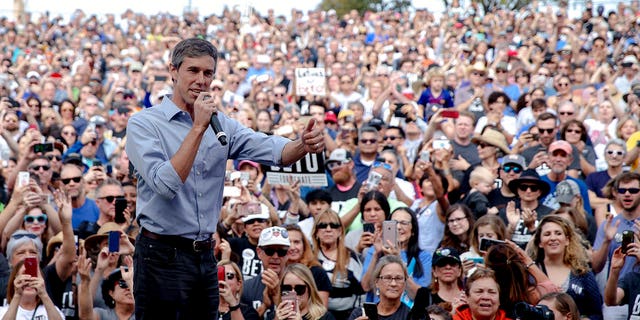
FILE - In this Nov. 4, 2018, file photo, Beto O'Rourke, the 2018
Democratic candidate for U.S. Senate in Texas, gives the thumbs up as he
takes the stage to speak at the Pan American Neighborhood Park in
Austin, Texas. O'Rourke didn't turn Texas blue, but for the first time
in decades, it's looking much less red. Texas has long been a laboratory
of conservatism. But cracks in the GOP's supremacy are emerging. The
results could reverberate nationally. (Nick Wagner/Austin
American-Statesman via AP, File)
"They're not going to wait forever," Mark Jones, a
political science professor at Rice University in Houston, said of
Democratic campaign operatives, donors, activists and fellow politicians
looking to pick sides or offer endorsements. "The more candidates who
start to formally launch their candidacies, the greater the pressure
will rise on Beto."
Massachusetts Elizabeth Warren announced on
New Year's Eve that she'd formed a presidential exploratory committee,
hoping to get an early jump on people such as O'Rourke, former Vice
President Joe Biden and Sens. Corey Booker of New Jersey, Bernie Sanders
of Vermont and Kamala Harris of California.
Although
O'Rourke has not yet entered the 2020 fray, his influence on the race
so far has been apparent. In a move that channeled O'Rourke and New York
Democratic Rep. Alexandria Ocasio-Cortez, Warren broadcast herself in her kitchen on New Year's Eve using Instagram Live, drinking a beer and thanking her husband for his presence.
But
O'Rourke's appeal proved difficult to properly emulate. On Sunday,
following a range of negative reactions to Warren's broadcast on social
media, President Trump dubbed the stilted encounter "Elizabeth Warren's
beer catastrophe."
Susan Rice, Hillary Clinton, Ben Rhodes
(Getty Images)
A federal judge ruled Tuesday that former national security adviser Susan Rice and former deputy national security adviser Ben Rhodes
must answer written questions about the State Department's response to
the deadly 2012 terror attack in Benghazi, Libya, as part of an ongoing
legal battle over whether Hillary Clinton sought to deliberately evade
public record laws by using a private email server while secretary of
state.
U.S. District Judge Royce C. Lamberth denied a request by
the conservative group Judicial Watch to make Rice and Rhodes sit for
depositions, but agreed to have them answer written questions. He also
agreed to Judicial Watch's request to depose the State Department about
the preparation of talking points for Rice, then President Barack
Obama's ambassador to the United Nations, ahead of appearances on
political talk shows the Sunday following the attack. That deposition is
part of Judicial Watch's inquiry into whether the State Department
acted in bad faith by not telling a court for months that they had asked
in mid-2014 for missing emails to be returned. CLINTON'S USE OF PRIVATE EMAIL SERVER AMONG 'GRAVEST' OFFENSES TO TRANSPARENCY, JUDGE SAYS
Rice
initially claimed on several talk shows that the attack on the U.S.
Consulate in Benghazi was triggered by protests over an anti-Islam
video. The attack resulted in the deaths of four Americans, including
U.S. Ambassador to Libya Chris Stevens.
"Rice's talking points and
State's understanding of the attack play an unavoidably central role in
this case," Lamberth wrote in a 16-page order.
Lamberth added
that "State's role in the [talking] points' content and development
could shed light on Clinton's motives for shielding her emails from
[Freedom of Information Act] requesters or on State's reluctance to
search her emails."
Lamberth also allowed Judicial Watch to seek
written answers from Bill Priestap, the former assistant director of the
FBI's Counterintelligence Division. Priestap, who supervised the
bureau's investigation into Clinton's use of a private email server,
retired from government service at the end of last year.
“In
a major victory for accountability, Judge Lamberth today authorized
Judicial Watch to take discovery on whether the Clinton email system
evaded FOIA and whether the Benghazi scandal was one reason for keeping
Mrs. Clinton’s email secret,” said Judicial Watch President Tom Fitton.
“Today, Judicial Watch issued document requests and other discovery to
the State Department about the Clinton email scandal. Next up, we will
begin questioning key witnesses under oath.”
The judge's order
amounts to approval of a discovery plan he ordered last month. In that
ruling, Lamberth wrote that Clinton's use of a private email account was
"one of the gravest modern offenses to government transparency" and
said the response of the State and Justice Departments "smacks of
outrageous misconduct."
As
part of the discovery, Judicial Watch can depose Jacob Sullivan,
Clinton's former senior adviser and deputy chief of staff, and Justin
Cooper, a longtime Bill Clinton aide who helped arrange the setup of
Hillary Clinton's private email address and server.
Judicial Watch
said the discovery period will conclude within 120 days. A
post-discovery hearing will then be held to determine whether additional
witnesses, including Clinton and her former Chief of Staff Cheryl
Mills, may be deposed.
President Trump’s nominee for attorney general William Barr told
senators during his confirmation hearing on Tuesday that he supports
the president’s call for new barriers along the U.S.-Mexico border,
while departing from the president’s public stances on the Russia probe.
The
hearing ended Tuesday evening with few fireworks, and Barr appeared
likely to sail to confirmation in the Republican-controlled Senate. Even
so, some Democrats sounded the alarm, with Connecticut Democratic Sen.
Richard Blumenthal charging that Barr had indicated he would exploit
legal "loopholes" to hide Special Counsel Robert Mueller's final report
from the public and to resist subpoenas against the White House.
"I
will commit to providing as much information as I can, consistent with
the regulations," Barr had told Blumenthal, when asked if he would
ensure that Mueller's full report was publicly released.
South
Carolina Republican Sen. Lindsey Graham, who chairs the Judiciary
Committee, said afterwards that he was satisfied that Barr was the
"right man for the job." He added that Democrats had asked appropriate
questions -- in stark contrast to what he called the "sham" that occured during the confirmation hearings of now-Associate Justice Brett Kavanaugh.
"I
voted for Eric Holder and Loretta Lynch — not because I agreed with
their political philosophy or policy positions — but because I thought
they were qualified," Graham said in a statement Tuesday evening,
referring to the two Obama-appointed attorneys general. "I’m asking no
more of Democrats than I asked of myself. I am hopeful Democrats will
support this fine man."
Barr faced an array of questions on topics
ranging from criminal justice to immigration. Asked about the ongoing
partial federal government shutdown, Barr said, "I would like to see a
deal reached whereby Congress recognizes that it's imperative to have
border security, and part of border security, as a common sense
matter, involves barriers.”
Barr said a “barrier system across the border” is needed for stopping illegal immigration and the “influx of drugs."
Attorney General nominee William Barr thanks his grandson Liam
Daly, right, for a mint as he returns from a break in testimony at a
Senate Judiciary Committee hearing on Capitol Hill in Washington,
Tuesday, Jan. 15, 2019. As he did almost 30 years ago, Barr is appearing
before the Senate Judiciary Committee to make the case he's qualified
to serve as attorney general. (AP Photo/Andrew Harnik)
But Barr – who pledged during Tuesday’s confirmation
hearing to not interfere with Mueller's Russia investigation – also
asserted his independence from Trump on statements related to the probe.
Under
questioning, Barr said he doesn’t believe “Mueller would be involved in
a witch hunt” – something the president has repeatedly argued. Barr
said he has known Mueller “personally and professionally for 30 years,”
having worked together at the Justice Department.
“That’s why I
said… I don’t subscribe to this ‘lock her up’ stuff,” Barr said at one
point, referring to a common chant at Trump's campaign rallies that
refers usually to Hillary Clinton.
He also said former Attorney
General Jeff Sessions was right to recuse himself from the Russia
investigation because of his role in the 2016 campaign, something that
infuriated the president and helped lead to Sessions' removal last year.
Barr
also unequivocally said he believes Russia attempted to interfere with
the election and said he supports an investigation "to get to bottom of
it."
“I will follow the Special Counsel regulations scrupulously
and in good faith, and on my watch, Bob will be allowed to complete his
work,” Barr told the Senate Judiciary Committee.
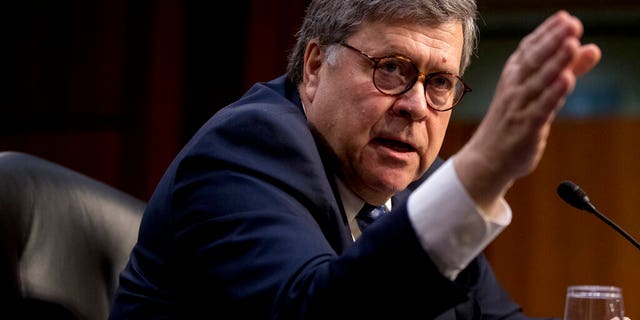
Attorney General nominee William Barr testifies during a Senate
Judiciary Committee hearing on Capitol Hill in Washington, Tuesday, Jan.
15, 2019. As he did almost 30 years ago, Barr is appearing before the
Senate Judiciary Committee to make the case he's qualified to serve as
attorney general. (AP Photo/Andrew Harnik)
But Barr also staked out positions that will be
welcomed by Trump, including his commitment to look into anti-Trump bias
at the FBI during the 2016 campaign. The nominee said he was “shocked”
by the anti-Trump texts that were famously sent between FBI employees Peter Strzok and Lisa Page.
The
White House expressed its support for Barr in a statement Tuesday, with
press secretary Sarah Sanders telling Fox News, "He is a very honorable
man, doing what he believes – and the president respects that. The
president thinks he will be a great Attorney General.”
Graham
kicked off Tuesday’s confirmation hearing for Barr by saying the Justice
Department needs a new leader to “right the ship over there.”
“We’ve
got a lot of problems at the Department of Justice,” Graham said.
“Morale is low and we need to change that. I look forward to this
hearing. You will be challenged. You should be challenged.”
Barr, 68, was nominated by the president to lead the Justice Department in December, after Sessions resigned at Trump’s request in November.
Barr
previously served as attorney general from 1991 to 1993, and his
confirmation hearings nearly 30 years ago went off largely without
incident.
During the hearing, Barr's past comments about the Mueller investigation attracted scrutiny, including an unsolicited memo
he sent the Justice Department last year criticizing the special
counsel's inquiry into whether Trump had sought to obstruct
justice. Barr, as head of the Justice Department, would take over from
acting attorney general Matthew Whitaker and oversee Mueller's work.
“The memo, there will be a lot of talk about it, as there should be,” Graham said.
Ranking member Dianne Feinstein, D-Calif., said the memo raises questions about Barr's approach to the Russia probe.
“Importantly,
the attorney general must be willing to resist political pressure and
be committed to protecting this investigation,” Feinstein said.
Barr sought to explain the memo, telling lawmakers he distributed it so “other lawyers would have the benefit of my views.”
“The
memo did not address – or in any way question – the special counsel’s
core investigation into Russian interference in the 2016 election,” Barr
said. “Nor did it address other potential obstruction-of-justice
theories or argue, as some have erroneously suggested, that a president
can never obstruct justice.”
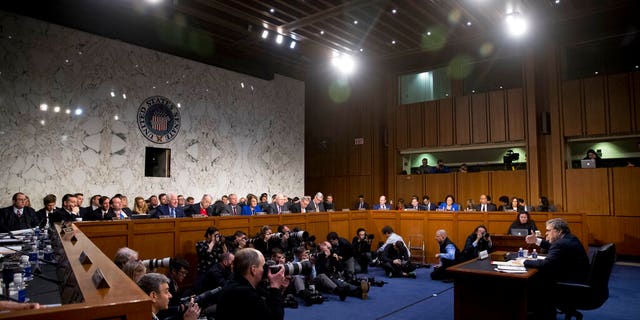
Attorney General nominee William Barr, right, testifies during a
Senate Judiciary Committee hearing on Capitol Hill in Washington,
Tuesday, Jan. 15, 2019. Barr will face questions from the Senate
Judiciary Committee on Tuesday about his relationship with Trump, his
views on executive powers and whether he can fairly oversee the special
counsel's Russia investigation. Barr served as attorney general under
George H.W. Bush. (AP Photo/Andrew Harnik)
Democrats on the committee asked questions about his
past relationship with the president. Barr acknowledged meeting Trump
once in 2017, saying he made clear his disinterest at the time in
joining Trump’s legal private legal team because “I didn’t want to stick
my head into that meat grinder."
Asked by Illinois Sen. Dick
Durbin about the hypothetical of being pressured into doing something he
disagreed with, Barr replied, “I will not be bullied into doing
anything that is wrong by anybody, whether it be editorial boards,
Congress or the president. I’m going to do what I think is right.”
Barr
was introduced Tuesday by former Utah Sen. Orrin Hatch, a former
longtime member of the committee who retired and was replaced by Sen.
Mitt Romney this year.
It’s
the first major Judiciary Committee hearing since the dramatic
testimony last year during the confirmation of Supreme Court Justice
Brett Kavanaugh. Several Democratic senators thought to be potential presidential contenders in 2020 -- including Kamala Harris, Cory Booker, and Amy Klobuchar -- are among those questioning Barr.
To
be confirmed, Barr will need to garner a simple majority of votes in
the Senate. Republicans currently hold 53 of the Senate's 100 seats.
As a new caravan that began in Honduras
and quickly swelled to an estimated 2,000 people made its way toward
Mexico on Tuesday, Mexicans who live along the border towns that will
likely be most affected took to the Internet to lash out against another
wave of migrants.
“Work? Yes, there might be work for people who
actually want to work, not for the lazy bums looking for entitlements,”
said one commenter, with the screen name Azucena Santos, in Spanish on a
YouTube page belonging to Shialeweb, who was recording the caravan. “Poor Mexicans, what’s in store for you!”
Juan
Palomina remarked: “Now look, let’s see if whacko [Mexican President}
Lopez Obrador mobilizes the Marines and keeps these idiots from coming
to Mexico. Give them enough to eat, at least.”
Some urged the migrants not to be blindly optimistic.
“People
of Honduras, all of you who are spinning these grand illusions and
getting ready to come on this caravan and in any future others, before
you leave your country, please inform yourself about how people who’ve
already come on previous caravans are faring in Tijuana,” said Belem
Gonzales.
“Mexico is just like your country,” Gonzales added.
“There are many problems and needs, and you’re not going to be much
better off than you were in Honduras. Please don’t trust these
manipulative agitators who are encouraging you to risk everything for
nothing.”
Luis Mendez was far more unwelcoming. “We do not want
caravans of (emojis of rats). Fight conditions in your own country. You
are not welcome here.”
By Tuesday afternoon, a caravan that
started with about 500 people grew to about 2,000, according to a
representative from the Honduras National Commission of Human Rights,
which travels with the caravan.
Word of the caravan’s departure was out at least as far back as last week. The newspaper La Prensa, of Honduras, reported on Jan. 9 that a caravan was scheduled to leave from San Pedro Sula on Tuesday - though the first group left the evening before.
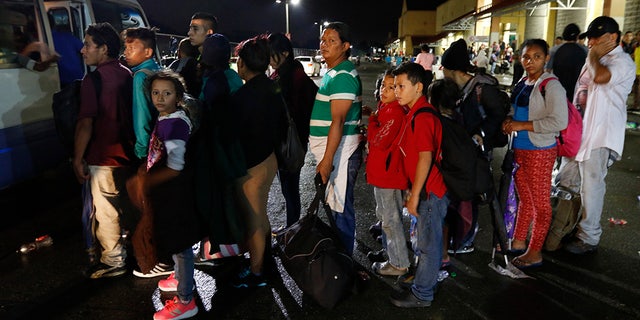
Migrants hoping to reach the U.S. wait in line to board a bus
toward Honduras' border with Guatemala, as hundreds of migrants set off
by bus or on foot from a main bus station in San Pedro Sula, Honduras,
late Monday, Jan. 14, 2019. Yet another caravan of Central American
migrants set out Monday from Honduras, seeking to reach the U.S. border
following the same route followed by thousands on at least three
caravans last year. (AP Photo/Delmer Martinez)
The newspaper attributed the information to the
immigration advocacy group “Pueblos Sin Fronteras,” or “Communities
Without Borders,” as well as to “Dignificacion Humana,” or “Dignifying
Humans.” Both groups said that some 4,000 migrants in all would end up
being part of the caravan.
The hostile social media comments on
Tuesday are the latest reflection of tensions that have simmered since
the caravans began last year. The tension is particularly prevalent in
Mexican cities like Tijuana, where many of the migrants are being held
in overcrowded shelters.
Some say the concerns by people in
receiving communities are, even if pointed, understandable. But others
say the migrants deserve compassion for trying to flee conditions –
often life-threatening – they did not create, and cannot control.
The
mix of exasperated migrants in overtaxed shelters and Mexican residents
growing increasingly concerned about strains on communities has led to a
number of clashes. In November, for instance, about 300 Tijuana
residents held an anti-caravan demonstration at the same time Central
American migrants were holding a protest. The dueling demonstrations
ended in a huge fight, with police stepping in and escorting the
migrants to various shelters.
On its website, the immigrant
advocacy group “Consejo Noruego para los Refugiados,” which is based in
Colombia and has various offices in Latin America, decried the backlash
against the caravan on “growing xenophobia in the U.S., as well as in
Mexico.”
“The journey north will be extremely dangerous and taxing
for thousands of families from Honduras, El Salvador and Guatemala that
will be part of the trips in 2019," the group said. "Probably the
obstacles will increase along the journey, given that there’s fatigue
and frustration in the communities that have until now supported the
caravans.”
Several migrants told U.S. and Latin American news
outlets they were determined to flee the poverty and violence in their
homeland - no matter how tough U.S. immigration policy had become. Some
said they were deported after having taken part in the first caravan
last year, and were trying their luck again.
Hondurans take part in a new caravan of migrants, set to head to
the United States, as they leave San Pedro Sula, Honduras January 14,
2019. REUTERS/Jorge Cabrera - RC1E08C0C6A0
Meanwhile, on Tuesday, Honduran authorities arrested and detained Juan Carlos Molina, identified by La Prensa, the Honduran newspaper, as a coordinator of the latest caravan.
Ira
Mehlman, spokesman for the Federation for American Immigration Reform,
which supports tighter enforcement, said the departure of another
caravan was not surprising, considering indications there are
individuals or organizations coordinating them. “Probably there are
multiple parties involved, who have an interest in challenging the
sovereign right of the United States to determine who can enter the
country and under what circumstances,” he said.
“You have
opportunists and you have people who, understandably, want to come to
the United States,” he said, “It’s a situation that’s getting out of
hand, and no one is doing anything about it other than an administration
that trying to solve things through executive action.”
Mehlman
said the backlash the caravans were getting from Mexicans who live in
Tijuana and other areas affected by the large crowds of migrants was a
logical reaction to the feeling of being overrun. “It does have an
impact on people who live in the affected towns, just as it has impact
on people in our country,” he said, adding that at the same time that
understanding is extended to people who seek a better life, there needs
to be understanding for “the motivations of people who want to set
limits and enforce laws.”
Frank Bruni is tortured.
The liberal New York Times columnist says it in print: "Trump tortures us."
And
he's got an elaborate plan for journalists to prevent Donald Trump from
being reelected — to "redeem ourselves," he says — because obviously
"we" never should have allowed him to win the White House in the first
place.
Bruni is a good writer, but he seems to fundamentally
misunderstand the role of the press and the president's use of the
press. He’s an opinion guy but comes from the camp that Trump is such a
monumental threat that the news business must drop its usual standards
and expose him.
His piece comes at a time when the president is
under fire on several fronts, including the longest government shutdown
in history. The Times just dropped a piece that the FBI opened a counterintelligence probe of Trump after the Jim Comey firing, and CNN now has transcripts of the internal debate. The Washington Post just reported
that Trump shielded details of his conversations with Vladimir Putin
from top aides, in one case grabbing an interpreter's notes.
Trump,
for his part, tweeted yesterday that "the Fake News gets crazier and
more dishonest every single day," that "certain people" have "truly gone
MAD" and should take two weeks off and "chill!"
In his lengthy
piece, Bruni rails against the president's "talent for using us as
vessels for propaganda," making us "Trump's accomplice," as if no other
president or politician has done that.
He
says Trump was a "perverse gift" to the media, which would just
"present him as the high-wire act and car crash that he is; the audience
gorges on it."
Let me stop right there. While the media lavished
endless attention on candidate Trump, much of it was negative attention,
which helped him anyway. He also generated coverage by doing hundreds
of interviews, even when he was on the defensive, in stark contrast to
his GOP opponents and to Hillary Clinton.
Bruni contends that
Trump's tweets and theatrics get so much attention that voters are
"starved of information about the fraudulence of his supposed populism
and the toll of his incompetence."
Really? The papers, the TV, and
the web are filled with that stuff every day. While covering style over
substance has been a media shortcoming for decades, especially on the
tube, no sentient human being can be unaware of all the arguments
against Trump on the shutdown, the wall, the Mueller probe, Syria, White
House chaos, and on and on.
In another 2016 lament, Bruni says
"we interpreted fairness as a similarly apportioned mix of complimentary
and derogatory stories about each contender, no matter how different
one contender's qualifications." In short, why did the press spend so
much time on Hillary's private e-mail server (which by the way was under
FBI investigation) when Trump was clearly the morally deficient one?
He
quotes ex-Times editor Jill Abramson as saying the email scandal
(broken by the Times) now seems like a "small thing" and that she didn't
turn the full investigative machinery against Trump because she assumed
Clinton would win.
Bruni
somehow didn't have room for Abramson's conclusion in her forthcoming
book, "Merchants of Truth" (as I reported), that she finds the Times'
news coverage to be "unmistakably anti-Trump." Guess that was an
inconvenient fact.
Still, Bruni does give a nod to the central
flaw in his argument: "I'm not certain that more firepower would have
made a difference. For one thing, there were many exposes of Trump's
shady history. For another, he appealed to voters who largely disregard
the mainstream media and who thrilled to his exhortations that they
disregard it further."
And he retreats to this: "The real story of
Trump isn't his amorality and outrageousness. It’s Americans'
receptiveness to that." In other words, the Trump phenomenon is the
fault of those gullible voters who just aren't as smart as members of
the media elite.
Finally,
Bruni says the media must give a full introduction to Trump's
Democratic challengers, which makes sense, as long as he doesn't mean an
uncritical one. But he disputes the notion that these candidates must
be vivid enough "to steal some of his spotlight," because we — the
mighty media — "can direct that spotlight where we want."
And
that's troubling. It's actually the job of the Democratic candidates to
make the case against Trump, and find ways to drive media coverage, and
our job to cover both sides fairly and aggressively. Unless, of course,
you believe that the incumbent is so terrible that it’s the media's
mission to ensure he doesn't win again.
President Donald Trump talks to the media about the table full
of fast food in the State Dining Room of the White House in Washington,
Monday, Jan. 14, 2019, for the reception for the Clemson Tigers. (AP
Photo/Susan Walsh)
What do you feed a pack of victorious
Tigers? If you're President Trump and the Tigers in question are the
college football playoff champion Clemson Tigers, the answer is obvious.
"We
ordered American fast food, paid for by me. Lots of hamburgers, lots of
pizza," Trump told reporters Monday evening after returning to the
White House from New Orleans. "We have some very large people that like
eating, so I think we're going to have a little fun."
Clemson, led by head coach Dabo Swinney,
won their second national championship in three seasons on Jan. 7 by
blowing out the top-ranked Alabama Crimson Tide 44-16 in Santa Clara,
Calif. With the win, Clemson completed the first 15-0 colege football
season since the 1897 Penn Quakers.
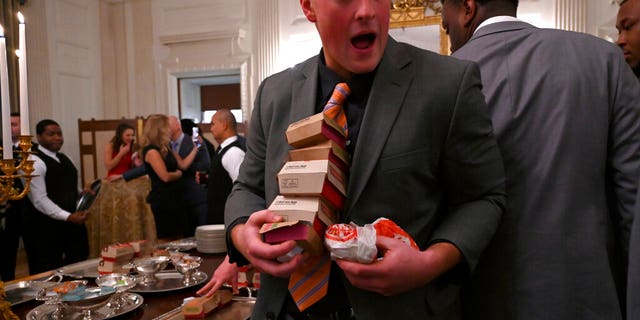
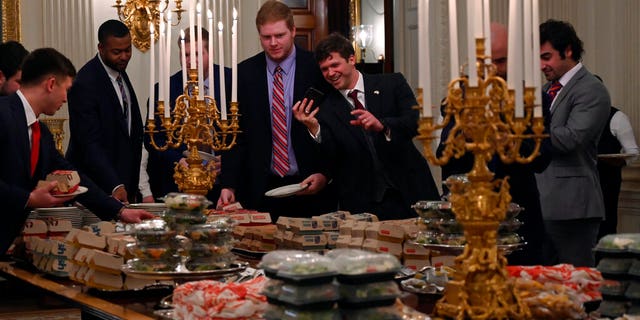
Guests attending a reception for the Clemson Tigers grab fast food
sandwiches in the State Dining Room of the White House in Washington,
Monday, Jan. 14, 2019. (AP Photo/Susan Walsh)
The players were greeted by a White House smorgasbord
unlike any other. Silver trays held stacks of wrapped burgers from
Wendy's. Also on offer were boxed burgers from McDonald's, including Big
Macs. White House cups bearing the presidential seal held French fries
White
House Press Secretary Sarah Sanders said much of the White House
residence staff has been furloughed due to the ongoing partial
government shutdown, ""so the president is personally paying for the
event to be catered with some of everyone's favorite fast foods."
Guests attending a reception for the Clemson Tigers grab fast food
sandwiches in the State Dining Room of the White House in Washington,
Monday, Jan. 14, 2019. (AP Photo/Susan Walsh)
Pizzas, some topped with olives and tomatoes, also
were on the menu. Silver bowls held the condiments, and stacks of white
plates sat nearby. Several young men were spotted eating multiple
burgers at the standup tables dotting the East Room.
The president is a noted fast food fan, particularly McDonald's and Wendy's.
“I’m
a very clean person. I like cleanliness, and I think you’re better off
going there than maybe someplace that you have no idea where the food’s
coming from. It’s a certain standard,” he said in a 2016 interview.
“I think the food’s good,” he added.
The
Clemson team's visit is its second since Trump took office. The Tigers
last visited in June 2017 after their championship run the previous
season.
Swinney has nominated this season's undefeated Tigers as
the best college team ever. Trump called them a "great team, an
unbelievable team."
Guests attending a reception for the Clemson Tigers grab fast food
sandwiches in the State Dining Room of the White House in Washington,
Monday, Jan. 14, 2019. (AP Photo/Susan Walsh)
Trump has routinely sparred with professional
athletes during his two years in office. College football has managed to
avoid such political controversies, with last year's champion Alabama
also visiting the White House.
Amid the longest government shutdown in
the country’s history, President Donald Trump may not win the battle
over who’s to blame, argued The Federalist publisher Ben Domenech.
Last
month, President Trump told Speaker Nancy Pelosi, D-Calif., and Senate
Minority Leader Chuck Schumer, D-N.Y., that he’d be “proud” to shut down
the government over border security. On Monday, he took to Twitter and
claimed that it was the Democrats fault.
However, in a recent ABC
News/Washington Post poll, 53 percent of Americans blame Trump and
Republicans for the partial government shutdown while 29 percent blame
Democrats. Only 13 percent say both are equally responsible.
On
the Special Report “All-Star” panel Monday night, Domenech, along with
Fox News politics editor Chris Stirewalt, and Georgetown Institute of
Politics executive director Mo Elleithee all weighed on who the current
state of the political showdown.
“I think the
president needs to lean more into the argument about what the Democrats’
position really is, which is that they believe this wall is immoral
because they now believe that borders are immoral or at least a
significant portion of their base does. Put them in that position and
lean into that argument more because I think this internal conventional
wisdom question about who’s to blame for the shutdown he’s not going to
win.” — Ben Domenech, publisher of The Federalist
Domenech began by expressing that the “Who’s to blame?” question regarding the shutdown is the “wrong question to be asking.”
“This
is not about the money. This is about sending a message, a message in
this case by the president to his base that ‘Yes, I am after two years
of sort of not dealing with this promise, the biggest promise that I
made, going to deal with this’ and the message from Democratic
leadership to their base that they’re not going to show up in Washington
and have their first act to be to bend over to this president on his
signature issue,” Domenech told the panel.
“I think the president
needs to lean more into the argument about what the Democrats’ position
really is, which is that they believe this wall is immoral because they
now believe that borders are immoral or at least a significant portion
of their base does. Put them in that position and lean into that
argument more because I think this internal conventional wisdom question
about who’s to blame for the shutdown he’s not going to win.”
The
Federalist publisher later added that there’s “no incentive” for the
president to back down in this political battle and that it will take “a
lot more time and a lot more pain” before both sides can compromise.
Mo
Elleithee noted that Democrats are currently winning in the “PR wars”
since most Americans are blaming Trump and the GOP that they’re sticking
to their stance that the government must be reopened in order to move
on with talks over the border.
Meanwhile, Chris Stirewalt told the
panel that Republicans should have had a “tailor-made” response to
Democrats who were vacationing in Puerto Rico last week amid the
shutdown but that never happened and that their argument is getting
repetitive.
“There are great avenues that Republicans could be
following to keep the pressure on Democrats, but they do not. We hear
the same thing over and over again. ‘There’s a crisis at the border.
There’s a crisis at the border.’ And everybody agrees, but we’re still
talking about the same thing,” Stirewalt said. “Democrats are at $1.6
billion, Republicans are at $5.7 billion, and no one has budged in
either direction. The Republicans haven’t gone down, the Democrats
haven’t gone up, and here we sit.”


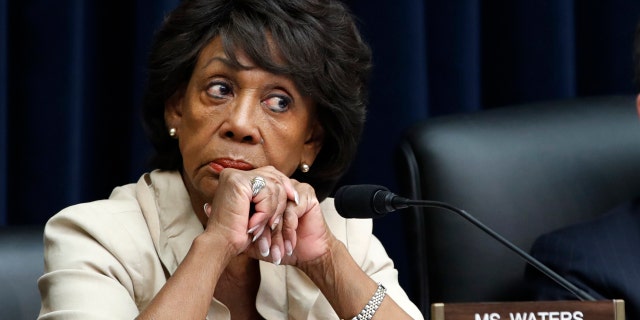 House Committee on Financial Services Ranking Member Rep. Maxine
Waters, D-Calif., left, listens during a hearing, Wednesday, July 18,
2018, on Capitol Hill in Washington.
(AP)
House Committee on Financial Services Ranking Member Rep. Maxine
Waters, D-Calif., left, listens during a hearing, Wednesday, July 18,
2018, on Capitol Hill in Washington.
(AP)
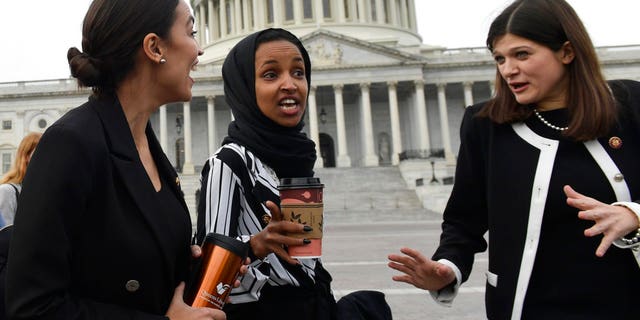 Rep. Alexandria Ocasio-Cortez, D-N.Y., left, talks with Rep. Ilhan
Omar, D-Minn., center, and Rep. Haley Stevens, D-Mich., right, as they
head to a group photo with the women of the 116th Congress on Capitol
Hill in Washington, Friday, Jan. 4, 2019. (AP Photo/Susan Walsh)
Rep. Alexandria Ocasio-Cortez, D-N.Y., left, talks with Rep. Ilhan
Omar, D-Minn., center, and Rep. Haley Stevens, D-Mich., right, as they
head to a group photo with the women of the 116th Congress on Capitol
Hill in Washington, Friday, Jan. 4, 2019. (AP Photo/Susan Walsh)
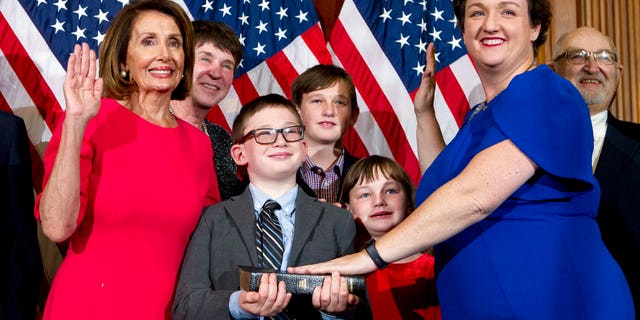 House Speaker Nancy Pelosi of Calif., administers the House oath
of office to Rep. Katie Porter, D-Calif., during ceremonial swearing-in
on Capitol Hill in Washington, Thursday, Jan. 3, 2019, during the
opening session of the 116th Congress. (AP Photo/Jose Luis Magana)
House Speaker Nancy Pelosi of Calif., administers the House oath
of office to Rep. Katie Porter, D-Calif., during ceremonial swearing-in
on Capitol Hill in Washington, Thursday, Jan. 3, 2019, during the
opening session of the 116th Congress. (AP Photo/Jose Luis Magana)