Sen. Kamala Harris, D-Calif., who recently announced a 2020
presidential bid, has not softened her position to eliminate all private
health insurance despite a report that claimed that she is opened to
moderating her stance.
A source at the Harris campaign told Fox
News late Tuesday denied a report on CNN that cited an unnamed adviser
who "signaled" that Harris would be open to other, moderate health plans
being pitched by other Democrats.
Kamala Harris “supports Medicare for all. Period,” the source told Fox News.
Harris, 54, made the remarks on Monday during a town hall event
with CNN’s Jake Tapper. When asked whether people could keep their
current health insurance under Harris’ plan, the California senator
indicated they could not. KAMALA HARRIS UNDER FIRE AFTER CALLING FOR ABOLITION OF PRIVATE HEALTH CARE PLANS: 'THAT'S NOT AMERICAN'
“Who
among us has not had that situation?” she said at the town hall. “Where
you got to wait for approval, and the doctor says, ‘Well I don’t know
if your insurance company is going to cover this.’ Let’s eliminate all
of that. Let’s move on.”
Amid
backlash, CNN reported that Harris would be open to reforming rather
than eliminating private health insurance, a proposal shared by
more-centrist Democrats.
With the shutdown over (at least for now), the State of the Union address is back “on.” When President Donald Trump takes the House podium on Feb. 5, you can count on him to take the opportunity to celebrate one of his greatest achievements: the economy.
It is booming by nearly every meaningful measure, and the president has every right to take a large measure of credit for it.
In
November, unemployment dropped to its lowest rate in a half century.
African-Americans, Latinos and women are thriving. Black unemployment
was at 5.9 percent in May, the lowest ever recorded. Women’s
unemployment recently reached its lowest rate in 65 years. ANDY PUZDER: PRESIDENT TRUMP DESERVES ALL THE CREDIT FOR OUR SOARING LABOR MARKET
And, no Congresswoman Alexandria Ocasio-Cortez, it is not because
people are working two jobs and a zillion hours a week. Employment
statistics don’t work that way. It’s because more people have jobs. And
more people are encouraged about their prospects of finding a job.
Labor
force participation continues to rise because strong wage growth is
causing Americans who were once too hopeless to even look for work to
pour back into the job market. In fact, unemployment ticked up slightly
to 3.9 percent (still historically very low) in December despite adding
312,000 jobs because nearly 100,000 formerly “discouraged workers”
decided to start looking for jobs.
For good reason. America has
created more than five million jobs since Trump entered office. And for
the first time there are more job openings in America than there are
unemployed people.
Industries that some said were dead and never
coming back – like manufacturing – are booming. Manufacturing added
284,000 jobs in 2018, the most in a year for more than a decade.
America
has created more than five million jobs since Trump entered office. And
for the first time there are more job openings in America than there
are unemployed people.
A large part of these
successes can be traced to the Trump-backed Tax Cuts and Jobs Act. In
addition to sparking business investment and expansion by reducing
corporate taxes, it also included a big tax cut for middle-class American families.
The
average individual saw a tax cut of $1,400 while the average family
with two children saw their taxes reduced by $2,917. In fact, Americans
in every congressional district got a tax cut. While mega-millionaire
House Speaker Nancy Pelosi dismissed a couple thousand extra dollars as
mere “crumbs,” those tax-cut tidbits have been a big deal for the
average working American and the economy overall.
President Obama –
who presided over an average GDP growth of 1.65 percent – proved
himself no economic Nostradamus when he said: “Two percent real GDP
growth is the new normal for the U.S. economy.” Really? It shouldn’t be
and under this administration, it’s not. GDP growth during the Trump
administration has been nearly twice the Obama average, and was more
than four percent in the second quarter of 2018.
And this is just
scratching the surface: With consumer confidence rising, more pro-growth
deregulation on the way, new trade deals being negotiated, and an
energy boom on our horizon, we may be in for a much better “new normal.”
All
this economic success is not just something the administration and the
millions of Americans with good new jobs have noticed. The world has
noticed. After a long decline beginning during Obama’s tenure, America,
in just one year, has moved up six places in the Heritage Foundation’s 2019 Index of Economic Freedom because of the strong economic and deregulatory policies the Trump administration has enacted.
The
president’s political opponents and the media can gaslight and uproot
goalposts all they want – and they will. But the success of the Trump
economy is plain to the millions and millions of Americans whose lives
are measurably better than they were two years ago.
So when
President Trump enters the well of the House next week, he can stand
confidently before America and the world and say that, when it comes to
the economy, “the state of the union is tremendous.”
Rep. Mark Meadows, R-N.C., reportedly butted heads with
freshman Rep. Alexandria Ocasio-Cortez, D-N.Y., a bit on Tuesday.
(AP/Getty)
Rep. Mark Meadows, R-N.C., reportedly butted heads with freshman Rep. Alexandria Ocasio-Cortez, D-N.Y., on Tuesday.
The
clash came at the first gathering of the House Committee on Oversight
and Reform in the 116th Congress, which is led by Chairman Rep. Elijah
Cummings, D-Md., Bloomberg reported.
Meadows and fellow GOP lawmakers were trying to persuade Cummings to provide upward of three days' notice -- ideally, five days -- for Democratic lawyers' questioning of witnesses so members could sit in, the outlet said.
Five
days' notice was reportedly seen by some as more ideal, to
better accommodate members who don’t reside near the nation’s capital.
Ocasio-Cortez
chimed in to say she didn’t “believe we need five days” as long as
members were effectively carrying out their jobs, Bloomberg said.
Meadows reportedly addressed Cummings in his reply.
“Mr.
Chairman, I can tell you on all of this at this particular point, we’re
all wanting to cooperate,” Meadows said. “Sometimes our schedules, you
know, we’re not just sitting around eating bonbons, waiting for the call
of anybody.”
The freshman lawmaker went on to wonder if
Republicans previously allowed for similar notice when they sat at the
helm of the committee, to which Cummings replied, “No,” Bloomberg
reported.
The committee chairman reportedly said he’d do what he
could to give lawmakers the notice Meadows sought, while noting that
this might not always be feasible.
On
another matter, during a recess of the House Oversight Committee
Hearing on Tuesday, Fox News Correspondent Peter Doocy asked
Ocasio-Cortez whether she supported the proposal from California Democratic Sen. Kamala Harris
-- who recently announced her 2020 bid for the White House -- to
eliminate private insurance companies. While speaking at a town hall
Monday night, Harris vowed to scrap all private health care
insurance for approximately 150 million Americans if she was elected
president.
"I think that's the direction that we absolutely need
to go in," Ocasio-Cortez said. "I think one of the things that we're
hearing right here in our, that we're really discovering in our hearings
is that we -- the real issue with our health care system is that we're
trying to have it both ways. We're trying to have half a free market
system, half a more public system. And it is in the half-commitments
that our systems are breaking down."
House Minority Whip Steve Scalise told Fox News' "Your World with Neil Cavuto" on Tuesday that House Speaker Nancy Pelosi needs to change her tone and start making "credible" compromises to avert another government shutdown over border wall funding.
Pelosi, D-Calif., on Monday invited President Trump to
deliver the State of the Union address on Feb. 5, after refusing to
allow him to appear in House chambers during the partial government
shutdown. On Friday, both chambers of Congress passed a short-term spending bill to reopen the government through Feb. 15 -- but it includes no funding for a border wall.
"Nancy
Pelosi said she wouldn't negotiate during the shutdown. OK, now the
shutdown is over for the time being," Scalise told Cavuto. "Will she
finally start be willing to put a dollar amount on the table, to say how
much is she willing to put together to support securing the border?"
Scalise
said that experts have called for more than $5 billion in wall funding,
and that Democrats are playing politics. Earlier this month, U.S.
Border Patrol chief Carla Provost told "Your World" that "we certainly do need a wall," and the president has touted the support for one from the national border patrol union at White House press briefings.
FILE - In this Jan. 3 photo, a woman at the border fence between
San Diego and Tijuana, as seen from Mexico. The top House Republican
says a bipartisan border security compromise that Congress hopes to
produce doesn't have to include the word "wall." (AP Photo/Daniel Ochoa
de Olza, File)
"It's going to take at least 5 and a half billion
dollars -- our experts who risk their lives have said that's what it
will take to secure our border," Scalise said. "What's Nancy Pelosi
willing to put on the table now that we're out of the shutdown?
Asked
by Cavuto what specifically he was looking for from Pelosi, Scalise
responded: "Well, it's got to be a serious, credible offer. Let's talk
serious. What is your offer? If it's not $5.7 billion -- which is what
the experts said -- then what is your number, and how do you back it
up?"
Pelosi has rejected
the White House's attempts at compromise to secure wall funding,
including various immigration-related concessions for Deferred Action
for Childhood Arrivals (DACA) recipients and extensions for emergency
refugees.
"I don't think that's a tenable position for most
Democrats," Scalise said. "We started seeing over the last few weeks
more and more Democrats coming to our side -- even Steny Hoyer, the
[Democratic] majority leader -- said physical barriers ought to be part
of the solution."
Earlier this month, Hoyer, D-Md., told Fox News that border walls "obviously" work in some instances, and rejected Pelosi's suggestion that walls are necessarily immoral.
And House
Homeland Security Committee Chairman Bennie Thompson, D-Miss., told ABC
News' "This Week" that he "would not rule out a wall in certain
instances," although he cautioned that the White House needed a better
"plan" than simply using a wall as a "talking point."
Democratic
leaders previously have supported building border walls. Senate Minority
Leader Chuck Schumer, D-N.Y., and other Democrats, including then-Sens.
Barack Obama and Hillary Clinton, supported the Secure Fence Act of
2006, which authorized the construction of some 700 miles of fencing at
the border. As of 2015, virtually all of that fencing had been
completed, according to government figures.
FILE - In this Nov. 16, 2018, file photo, members of the U.S.
military install multiple tiers of concertina wire along the banks of
the Rio Grande near the Juarez-Lincoln Bridge at the U.S.-Mexico border
in Laredo, Texas. Acting Defense Secretary Pat Shanahan says the U.S.
will be sending "several thousand" more American troops to the southern
border to provide additional support to Homeland Security. He says the
troops will mainly be used to install additional wire barriers and
provide increased surveillance of the area. (AP Photo/Eric Gay, File)
"The president said: 'I don't need a
sea-to-shining-sea wall," Scalise said. "But there's about 550 miles of
completely unprotected area where we know bad things -- drugs, human
trafficking, even murderers come across the border. Let's start focusing
on those areas."
He continued: "And if Nancy Pelosi really
doesn't want a wall, President Trump has said, 'Hey, I'll be willing to
let you put in language that bans cement wall.' But have some form of
physical barriers. The steel slat barriers right now are what the
experts say work the best. Let the experts figure that out."
The president's best chance to break the ongoing logjam with Pelosi, Scalise said, is the upcoming State of the Union address.
"They're
going to see President Trump laying out the case for securing America's
border," Scalise said, referring to the large audience expected to
watch the president's speech. "What it's going to take. There are bad
things that happen every day that most Americans never hear about. So
let's actually lay that case out. And then we'll see where everybody is
going to be."
Howard Schultz,
the self-made billionaire and former CEO of Starbucks, was heckled
Monday during an event at a New York City Barnes & Noble over fears
that an independent run in 2020 would all but guarantee President Trump’s second term.
Schultz,
who grew up in subsidized housing in Canarsie, Brooklyn, said in an
interview that aired Sunday that he is "seriously considering running
for president." His life story is compelling and different from Trump's.
Schultz said he had to "fight his way out" from his humble beginnings
whereas Trump benefited from his father's real estate business and
connections in New York.
Many Democrats have been vocal about the
dangers of a Schultz presidential run. One heckler in the audience on
Monday summed up their concern, "Don't help elect Trump you egotistical
billionaire a—hole," according to video that captured the exchange.
The
crowd booed, but the heckler continued, "Go back to Davos with the
other billionaire elite who think they know how to run the work."
Trump on Monday said Schultz doesn’t have the "guts" to run for president.
"Watched
him on @60Minutes last night and I agree with him that he is not the
‘smartest person.’ Besides, America already has that! I only hope that
Starbucks is still paying me their rent in Trump Tower!” Trump tweeted
Monday morning.
President Trump took aim at Sen. Richard Blumenthal, D-Conn., in a tweet Monday.
(AP, File)
President Trump attacked Sen. Richard Blumenthal, D-Conn., on Twitter Monday night, mockingly referring to him as "Da Nang Dick"
and questioning his fitness to serve on the Senate Judiciary Committee
in the wake of decade-old allegations of stolen valor related to
Blumenthal's false claim that he fought in the Vietnam War.
"How
does Da Nang Dick (Blumenthal) serve on the Senate Judiciary Committee
when he defrauded the American people about his so called War Hero
status in Vietnam, only to later admit, with tears pouring down his
face, that he was never in Vietnam," wrote Trump, who added that
Blumenthal was, "An embarrassment to our Country!"
It's unclear
exactly what prompted the president's tweet. Earlier Monday, Blumenthal
and Sen. Chuck Grassley, R-Iowa, introduced legislation that would
require Special Counsel Robert Mueller to submit a report to Congress
and the public when his investigation into alleged collusion between
Russian officials and the Trump campaign concludes. The legislation also
would require a report within two weeks if a special counsel is fired,
transferred or resigns.
Blumenthal, who was elected to the Senate
in 2010, regularly referenced his supposed Vietnam service in the 2000s,
when he was Connecticut attorney general.
“I served during the
Vietnam era,” Blumenthal reportedly said at a Vietnam War memorial in
2008. “I remember the taunts, the insults, sometimes even the physical
abuse.”
Blumenthal reportedly obtained at least five military
deferments between 1965 and 1970. He eventually served in the U.S.
Marine Corps Reserve, but did not deploy to Vietnam.
In 2010, Blumenthal admitted that he had "misspoken about my service, and I regret that and I take full responsibility."
Grassley
and Blumenthal are both members of the Senate Judiciary Committee and
Grassley is a former chairman of the panel. Both men
supported legislation last year to protect Mueller's job. The bill,
approved by the Judiciary Committee in April, would allow any fired
special counsel to seek a judicial review within 10 days of removal and
put into law existing Justice Department regulations that a special
counsel can be fired only for good cause.
"A
special counsel is appointed only in very rare serious circumstances
involving grave violations of public trust," Blumenthal said. "The
public has a right and need to know the facts of such betrayals of
public trust."
Senate Majority Leader Mitch McConnell, R-Ky., declined to hold a vote on the bill, however, saying it was unnecessary.
California Democratic Sen. Kamala Harris,
speaking during a town hall Monday night, vowed to eliminate all
private health care insurance for approximately 150 million Americans if
she is elected president.
Asked by CNN host Jake Tapper if
people who like their current health care insurance could keep it under
Harris' "Medicare for All" plan, Harris indicated they could not -- but
that, in turn, they would experience health care without any delays.
Her
statements appeared to be a full-throated call for single-payer health
insurance, as opposed to merely expanding Medicare, and a dramatic
embrace of the kind of proposals advocated by Vermont Independent Sen.
Bernie Sanders.
"Well, listen, the idea is that everyone gets
access to medical care. And you don't have to go through the process of
going through an insurance company, having them give you approval, going
through the paperwork, all of the delay that may require," Harris told
Tapper.
"Who among us has not had that situation?" she continued.
"Where you got to wait for approval, and the doctor says, 'Well I don't
know if your insurance company is going to cover this.' Let's eliminate
all of that. Let's move on." President Barack Obama famously
repeated several times throughout his presidency, in seeking to promote
the Affordable Care Act (known as "ObamaCare"), that "If you like your
health care plan, you can keep it." SF MAYOR SAYS HE HAD AFFAIR WITH HARRIS, HELPED HER CAREER The fact-checking website Politifact eventually named that statement its "Lie of the Year," noting
that several million Americans received cancellation notices from their
providers because of ObamaCare. Politifact also said the Obama
administration was aware from the outset that its promise was
unsustainable.
"Let's eliminate all of that. Let's move on." — California Democratic Sen. Kamala Harris
Harris
appeared unwilling to follow Obama's example on Monday night, and
instead stuck to her answer as she jokingly told Tapper to move onto the
next question.
During a speech to officially launch her 2020 run
earlier this month, Harris declared that "health care is a fundamental
right" and vowed to serve her constituents by supporting "Medicare for
All."
In August 2017, Harris became the first Senate Democrat to
support Sanders' "Medicare for All" bill. The program, if implemented,
would cost tens of trillions of dollars over a decade, experts say.
Several independent studies
have specifically estimated that government spending on health care
would surge by $25 trillion to $35 trillion or more in a 10-year period.
A study released over the summer by the Mercatus Center at George Mason
University, for example, estimated that Sanders' program would
cost $32.6 trillion — $3.26 trillion per year — over a decade.
By comparison, the federal budget proposal for the fiscal year 2019 was
$4.4 trillion, the Congressional Budget Office states.
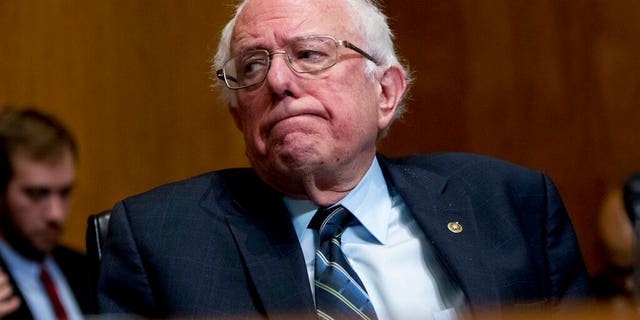
FILE - In this Jan. 16, 2019, photo, Sen. Bernie Sanders, I-Vt.,
reacts during a hearing on Capitol Hill in Washington.
“Medicare-for-all” makes a good first impression, but support plunges
when people are asked if they’d pay higher taxes or put up with
treatment delays to get it. AP
Analysis by The New York Times in
2017 showed at least 74 million Americans who currently benefit from
Medicaid would potentially face higher taxes under "Medicare for All."
Sanders
and New York Democratic Rep. Ocasio-Cortez have countered that while
spending would necessarily increase in the short-term, fundamentally
restructuring Medicare would ultimately yield sustained economic
benefits by reducing administrative inefficiencies, cutting perscription
drug costs, and encouraging young people to put more money into the
economy.
But Charles Blahous, a senior strategist at the Mercatus Center and an author of the study, has said Ocasio-Cortez and Sanders would need to make unrealistic assumptions to come to that conclusion, because increased demand for healthcare would potentially offset any such administrative gains.
He
criticized the two for making comments that "appear to reflect a
misunderstanding of my study" after they cited his work as proof that
'Medicare for All' would, in fact, necessarily save money. Numerous
fact-checkers, including The Washington Post and FactCheck, concluded that both liberal politicians had misread the paper's conclusions.
Speaking
separately in response to a gun rights question at Monday's town hall,
Harris urged a ban on "assault weapons," without defining the term.
"There
is no reason in a civil society that we have assault weapons around
communities that can kill babies and police officers," Harris said to
applause. "Something like universal background checks -- it makes
perfect sense that you might want to know before someone can buy a
weapon that can kill another human being, you might want to know have
they been convicted of a felony where they committed violence? That's
just reasonable. You might want to know before they can buy that gun if a
court has found them to be a danger to themselves or others. You just
might want to know. That's reasonable."
Harris also defended her
record as attorney general in California, saying she enforced the death
penalty in the state despite opposing the practice. Likewise, she said
she chose not to take a public position in 2015 on legislation to
require her office to investigate all police-related fatal shootings
because her office would write the law and enforce it.
The town hall event marked Harris' first public appearance in Iowa since announcing her candidacy last week.
New details contained in congressional transcripts and emails about a July 2016 meeting involving the author of the anti-Trump “dossier,” Justice Department
official Bruce Ohr, and his wife, Nellie, appear to conflict with
claims from Democrats -- and the co-founder of the firm behind the
dossier -- that significant contacts did not occur until after the
election.
According to the records, the little-known breakfast meeting was held on July 30, 2016 at Washington, D.C.’s Mayflower Hotel.
Congressional
transcripts, confirmed by Fox News, showed Nellie Ohr told House
investigators last year that Christopher Steele, the British ex-spy who
compiled the dossier, wanted to get word to the FBI at the time.
“My
understanding was that Chris Steele was hoping that Bruce (Ohr) could
put in a word with the FBI to follow-up in some way,” Nellie Ohr
testified in response to a Republican line of questioning, regarding the
purpose of the meeting. Bruce Ohr did just that, almost immediately
contacting then-FBI Deputy Director Andrew McCabe and FBI lawyer Lisa
Page.
Asked by House investigators what they talked about at the
breakfast meeting, Nellie Ohr said: “[Steele’s] suspicions that Russian
Government figures were supporting the candidacy of Donald Trump.”
The
transcripts came from closed-door interviews conducted last year by the
House Oversight and Judiciary Committees when they were under
Republican control. The transcripts are undergoing an FBI and DOJ
review and are not public.
Nellie Ohr was of interest to
investigators since she conducted opposition research on then-candidate
Donald Trump for the firm Fusion GPS – the same company that
commissioned the dossier. Her husband, meanwhile, is a senior official
at the Justice Department who became a back channel between Steele and
the FBI, after Steele was fired by the bureau on the eve of the 2016
presidential election over his contacts with the media.
In her
testimony, Nellie Ohr also said that pieces of the unverified dossier –
which later would be used to secure a surveillance warrant for Trump
campaign aide Carter Page – may have been shared during the meal.
In
response to a committee Democrat's line of questioning, Ohr stated, "At
the breakfast, I – if I recall correctly, they may have shown pieces
..." of the document.
Ohr said she never saw the entire body of
opposition research, later dubbed the "dossier," until it was published
by BuzzFeed in January 2017. Question: "Okay. And you hadn't seen it or its portions during the time that you were employed, correct?" Ohr: "I -- if I recall correctly, I may have seen a -- maybe a page or something of it at the breakfast."
Email
traffic, reviewed by Fox News, indicated that Steele broached the
possibility of a meeting with Bruce Ohr as early as July 1, 2016.
He
emailed Ohr at the time: "I am seeing [redacted] in London next week to
discuss ongoing business but there is something separate I wanted to
discuss with you informally and separately. It concerns our favourite
business tycoon!"
Subsequent emails between Ohr and Steele also confirmed the July 30 meeting in Washington.
Nellie Ohr’s testimony regarding Steele and the FBI would appear to align with her husband’s.
Fox
News recently reported that Bruce Ohr told House investigators as part
of the Republican-led probe that shortly after the July 30, 2016
meeting, his “first move” was to reach out to senior FBI officials.
Fox
News recently confirmed the Bruce Ohr transcript said: “Andy McCabe,
yes and met with him and Lisa Page and provided information to him. I
subsequently met with Lisa Page, Peter Strzok, and eventually [an FBI
agent]. And I also provided this information to people in the criminal
division specifically Bruce Swartz, Zainab Ahmad, Andrew Weissmann.”
(Strzok and Page left the bureau last year after their anti-Trump texts
emerged. Swartz was a deputy assistant attorney general. Weissmann was
chief of the DOJ Criminal Division’s Fraud Section before becoming a
senior prosecutor on Special Counsel Robert Mueller’s team. Ahmad worked
at the DOJ and is also now assigned to Mueller’s team.)
However, congressional Democrats have asserted many of the contacts occurred later in the year.
In
February, in response to a Republican report on the
surveillance-warrant process, Democrats on the House Intelligence
Committee accused Republicans of overstating Bruce Ohr’s role.
"The
Majority mischaracterizes Bruce Ohr's role, overstates the significance
of his interactions with Steele, and misleads about the time frame of
Ohr's communication with the FBI. In late November, Ohr informed the FBI
of his prior professional relationship with Steele and information that
Steele shared with him (including Steele's concern about Trump being
compromised by Russia)," the Democrats' statement said. “He also
described his wife’s contract work with Fusion GPS, the firm that hired
Steele separately. This occurred weeks after the election and more than a
month after the Court approved the initial FISA application.”
There appeared to be another discrepancy.
The
emails showed Fusion GPS co-founder Glenn Simpson was in contact with
Ohr in August 2016. However, Simpson's November 2017 transcribed
interview before the House Intelligence Committee showed him saying he
worked through Bruce Ohr "sometime after Thanksgiving."
Fox News
recently asked the FBI, Justice Department and special counsel's office
whether the meetings with Ohr over Steele and the dossier were
consistent with -- or in conflict with -- existing DOJ or FBI rules,
including chain-of-custody procedures for handling evidence. In
addition, the special counsel's office was asked whether Weissmann and
Ahmad had fully disclosed their contacts with Bruce Ohr and others over
the dossier.
The FBI and special counsel declined to comment; the DOJ did not immediately respond.
An attorney for Nellie Ohr did not respond to a request for comment. An attorney for McCabe did not respond.
Fox
News also reached out to the office of Rep. Adam Schiff, D-Calif., the
current chairman of the House Intelligence Committee, for comment.