A federal judge grilled Special Counsel Robert Mueller's team earlier this week on its claims that former Trump campaign manager Paul Manafort intentionally lied to investigators, according to a newly released, partially redacted court transcript released Thursday.
Manafort,
who avoided a second trial in Washington, D.C., last year by agreeing
to cooperate with investigators, allegedly lied to prosecutors about
five separate topics, including Manafort’s contact with administration
officials; information “pertinent to another Department of Justice
investigation,” and a $125,000 wire transfer to a firm working for
Manafort.
But at the closed-door hearing on Monday, U.S. District
Judge Amy Berman Jackson repeatedly and bluntly pressed prosecutors to
explain why Manafort's misstatements, including some that he corrected
voluntarily, should affect his upcoming sentencing.
The judge, who is also handling the ongoing criminal case
against Trump associate Roger Stone, openly wondered whether
prosecutors had bombarded Manafort with a series of difficult and
irrelevant questions during the roughly 50 hours of interviews that
followed his plea deal.
"Putting
aside whether it has to be established and whether we have to establish
all the elements of [a criminal false statements statute], why is this
important?" Jackson asked prosecutors, referring to the their claim that
Manafort misled authorities about the nature of the $125,000 wire
transfer.
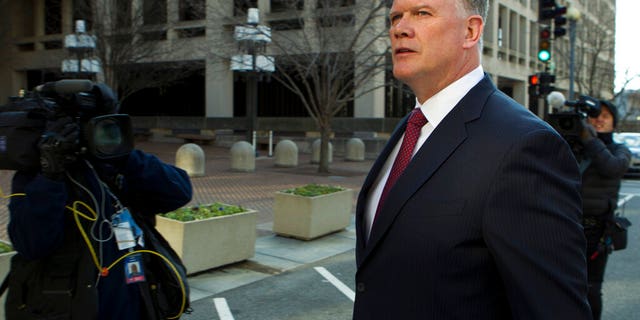
Kevin Downing, attorney for Paul Manafort leaves Federal District
Court after a court hearing for Manafort in Washington, Friday, Jan. 25,
2019. Judge Amy Berman Jackson has scheduled a sealed proceeding to
determine whether the former Trump campaign chairman intentionally lied
to investigators. (AP Photo/Jose Luis Magana)
Manafort has denied intentionally misleading
Mueller's team and said he is under stress and physically ill. The
former Trump campaign chairman claimed variously that the money was owed
to him as a loan repayment, income and reimbursement.
The funds were sent in 2017 through a political action committee that spent millions to help Trump's candidacy.
"I
mean, basically what you're saying is, you were just asking about
something and it turned -- it snowballed into a series of false
statements," Jackson said. "But was there something about his -- if I
agree with you that he was lying about that, that was material to what
you were doing? What was the importance of asking him about the payment
in the first place?"
Jackson later told Manafort's lawyers she
wasn't entirely convinced by their argument that his "succession of
inconsistent explanations" could be chalked up to confusion caused by
accounting practices, adding that "there's some aspects of the evidence
I'm going to need to re-review."
At the hearing, prosecutors
maintained that Manafort also lied about his interactions
with Russian-Ukrainian political consultant Konstantin Kilimnik, who has
ties to Russian intelligence. Prosecutors said Manafort made false
statements about sharing polling data during the 2016 presidential
election with Kilimnik.
Top Mueller deputy Andrew Weissmann told
Jackson that Manafort's connections to Kilimnik "goes, I think, very
much to the heart of what the Special Counsel's Office is investigating.
... In [August] 2016 there is an in-person meeting with someone who
... is understood by the FBI, assessed to be -- have a relationship with
Russian intelligence."
Jackson acknowledged that Manafort, after
pleading guilty to conspiring with Kilimnik, offered an "exculpatory
version of Kilimnik's state of mind" that "isn't necessarily consistent
with what one would call full and forthright cooperation."
But,
she added, Manafort quickly corrected some of his statements on the
matter, undercutting prosecutors' claims that Manafort had acted
intentionally to mislead them.
FLASHBACK: MANAFORT JUDGE SAYS MUELLER PROSECUTOR NEEDS TO STOP CRYING IN COURT
"Given
[Manafort's] correction after consultation with counsel, why would this
be something that we would characterize as the crime of making an
intentionally false statement to the FBI, or even just a law of
significance for acceptance of responsibility in sentencing purposes?"
Jackson asked.
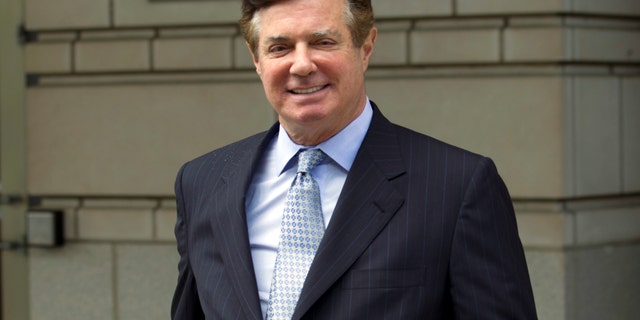
FILE - In this May 23, 2018, photo, Paul Manafort, Presiden
Trump's former campaign chairman, leaves Federal District Court after a
hearing in Washington. ( AP Photo/Jose Luis Magana)
After Weissman underscored the extraordinary nature
of Manafort's in-person meeting with Kilimnik, Jackson again said it was
unclear why that would be a focus of Mueller's inquiry.
"So, I'm
trying to figure out what the importance is of his ongoing work for a
potential candidate in the Ukraine at that time is, and the importance
of any lies about that, or lies about Kilimnik's knowledge about that,"
Jackson said.
Although
much of Weissman's response is redacted, Jackson said she found his
response "helpful" -- but the judge went on to question prosecutors
further, after the defense team slammed the government's theories about
the relevance of Manafort's shifting statements on Kilimnik as mere
"conjecture."
"So, I don't think the Court needs to reach that
issue, and I don't know that we've presented evidence on the -- that
issue," Weissman says, after a partially redacted question from Jackson.
That reply drew a curt response from the judge.
"You
didn't. So you just don't want me to think about it, that's okay,"
Jackson said, prompting Weissman to quickly embark on a longer
explanation.
Again, at the end of his partially redacted reply,
Jackson sounded a note of overt doubt as to the relevance of Manafort's
alleged misrepresentation.
"So, this is an important falsehood
because it was false?" Jackson asked. "Or is there some larger reason
why this is important?"
Toward the
end of the proceeding, Jackson took particular umbrage at prosecutors'
contention that Manafort had lied about his contacts with the Trump
administration.
"And of all of them, this is the one where I have
the most difficulty figuring out where the real contradiction is of
moment to the investigation," Jackson said.
Manafort's "outreach
appears to have been two people outside the administration who
themselves would have contacts within," Jackson said. "So, again, I want
you to point to the specific statement in a 302 [FBI witness report] or
a grand jury statement that is the precise question and answer you
think I should denote as false. And, you know, it does seem to be that
there are indications that he may have bragged that he still had sway or
offered to assist people or to lobby. But do we have direct evidence of
contacts that contradict a denial of a contact?"
Special Counsel Robert Mueller's team has aggressively pursued
criminal charges against several former top Trump aides, but none of the
charges have involved criminal collusion with Russia. (AP)
At
that point, a member of Mueller's team replied that Manafort had lied
by denying having any direct or "indirect" contacts with the
administration -- and that the "indirect" statement was a lie.
But the prosecutor, Greg Andres, began his response by acknowledging the judge's critical tone.
"Given that you have issues with it, I drew the short straw," Andres said.
The
Mueller deputy is no stranger to harsh criticisms from the bench. Last
August, during Manafort's first trial in Virginia, Judge T.S. Ellis
accused Andres of crying.
“I understand how frustrated you are. In
fact, there’s tears in your eyes right now,” Ellis said. (When Andres
denied Ellis’ claim, the judge said, “Well, they’re watery.”)
Manafort's
sentencing on two felony charges related to his Ukrainian lobbying is
set for March, when Jackson will determine whether his punishment should
be affected by his alleged false statements. Manafort faces up to ten
years in prison in the separate case in Virginia, where he was convicted
on tax and fraud charges.
Before adjourning, Jackson said she
appreciated Manafort's attendance, having denied his attempt to skip the
hearing because of logistical concerns and what he says are health
challenges.
"I believe it was very helpful, very useful and very
important for you to have been here, Mr. Manafort," Jackson said. "I
know that we've had hearings where counsel sought to minimize the burden
on you and not have you be here, but this is about you, it's not about
them. And I think it's very important that they have you available to
ask questions to."
Earlier this month, Iowa Republican Sen. Chuck
Grassley said he expects the Mueller probe to produce its final report
"within a month."