As
President Trump prepares to meet
North Korean leader Kim Jong Un for their second one-on-one summit, in Hanoi, Vietnam, on Wednesday and Thursday, Secretary of State
Mike Pompeo
told Fox News the administration will abandon what he called the Obama
administration's policy of "praying" and "cowering" before the rogue
regime.
At the same time, both Pompeo and Trump sought to tamp
down expectations that the meeting would produce a breakthrough, or lead
to major concessions by either party.
Trump has predicted a
"continuation of the progress" made during his first meeting with Kim
in Singapore last June. During the Singapore summit, Kim said he was
committed to the "complete denuclearization of the Korean Peninsula,"
which previously has meant the North would denuclearize only when the
United States withdraws all its troops from South Korea and stops
military drills with the ally.
In December, though, North Korea's
state media said it would never abandon its nuclear program unilaterally
unless Washington first removes its nuclear threat.
Heading into
this week's summit, Trump has said that North Korea has not tested any
nuclear weapons in months and that as long as that testing has ceased,
he's in no rush.
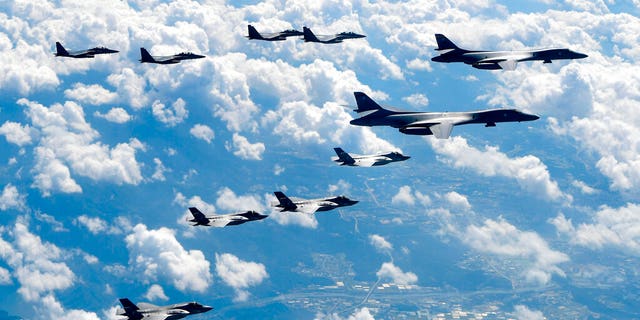
U.S. and South Korean fighter jets flying over the Korean
Peninsula during joint drills. (South Korea Defense Ministry via AP,
File)
At a black-tie gathering of governors at the White
House on Sunday evening, Trump said that he and Kim had "developed a
very, very good relationship."
"We see eye-to-eye, I believe, but
you’ll be seeing it more and more over the next couple of days," the
president said. "I don’t want to rush anybody, I just don’t want
testing. As long as there’s no testing, we’re happy."
Trump
tweeted Sunday that he was leaving early the next day for the meeting in
Hanoi, adding a tantalizing nod to "Denuclearization?" He also said Kim
knew that "without nuclear weapons, his country could fast become one
of the great economic powers anywhere in the World."
And, speaking to
"Fox News Sunday," Pompeo said he was hoping for a "substantive step forward." He cautioned, "it may not happen, but I hope that it will."
The
broader U.S.-South Korean alliance, sealed during the bloodshed of the
1950-53 Korean War, apparently won't be on the negotiating table during
the summit in Hanoi on Feb. 27-28. But, some observers said its
long-term future could be in doubt and Trump eventually may withdraw
some of the 28,500 U.S. troops deployed in South Korea.
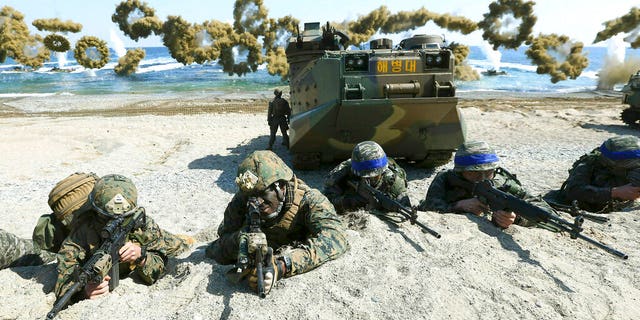
Marines of the U.S., left, and South Korea, wearing blue headbands
on their helmets, taking positions after landing on a beach during a
joint military exercise in 2016. (Kim Jun-bum/Yonhap via AP, File)
Trump repeated Friday that drawing down American
forces was not on the table for his talks with Kim, but he previously
had threatened to pull them from South Korea and Japan if those nations
refused to pay more for their joint military activities. After the
Singapore summit, Trump also told reporters, "I want to bring our
soldiers [in South Korea] back home." While announcing the suspension of
a major summertime military drill, Trump called the exercises "very
provocative" and "tremendously expensive."
Pompeo said he hoped to
put a "road map" in place but would not discuss the possibility of
declaring a formal end to the Korean War or pulling some American troops
from South Korea, in keeping with his stand against publicly discussing
issues that could arise during the negotiations.
U.S. defense
officials did not appear to be planning any troop reductions but some
have indicated they would not be surprised if Trump puts reductions on
the table as part of his negotiations with Kim.
"President
Trump has also said this is going to take time. There may have to be
another summit. We may not get everything done this week," Pompeo told
"Fox News Sunday" anchor Chris Wallace.
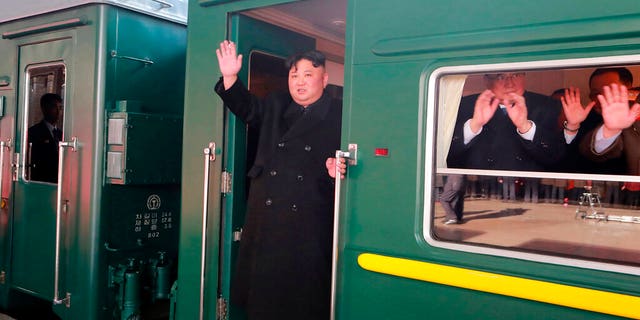
North Korean leader Kim Jong Un waving from a train Saturday
before leaving Pyongyang Station, North Korea, for Vietnam. (Korean
Central News Agency/Korea News Service via AP)
Kim was on a train Sunday to Vietnam, according to
state media, and it could take over two days for the train to travel
through China to Vietnam.
"There’s been no change in U.S. policy
since the time I’ve been secretary of state and, frankly, even before
that when I was CIA Director," Pompeo, who was also set to depart for
Hanoi, told Wallace. "Our objectives are clear, our mission is clear.
President Trump’s also said this is going to take time. There may have
to be another summit. We may not get everything done this week. We hope
we’ll make a substantial step along the way."
Pompeo added: "I've
spent a lot of time with Chairman Kim. My time is on the ground today,
continuing to flesh out paths forward, developing a roadmap for a path
forward between the two countries. We're determined to achieve that.
It's important for the world's security."
Pompeo said the summit "might be one day, might be two days" or even longer.
Asked
whether North Korea has given concrete indications that it's willing to
provide an inventory of its nuclear arsenal or surrender its weapons,
Pompeo acknowledged some progress has stalled.
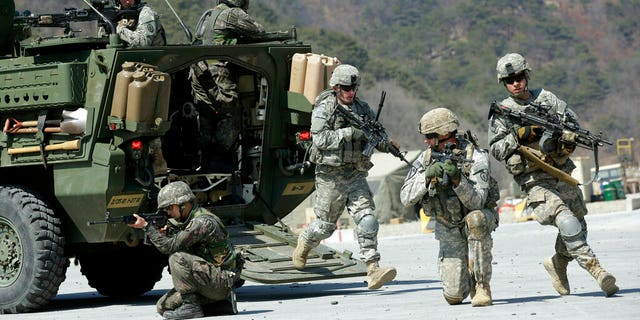
U.S. Army and South Korean soldiers during an annual joint military exercise. (AP Photo/Lee Jin-man, File)
"In June of last year, in Singapore, Chairman Kim
unequivocally stated he would denuclearize his country. There were other
pillars that we committed to as well. We've made progress on some, less
so on others. This is a complicated process. I was CIA director at one
point. The history is difficult. The previous administration's policy
was to allow the North Koreans to test [nuclear weapons], pray they'd
stop, and then cower when they threatened us. Test, pray, and cower.
That's been upended by President Trump."
Former President Obama
asked the military in 2010
to prepare with South Korea in order to be “ready” to deter any
aggression from North Korea – after North Korea sank its southern
neighbor’s naval ship. And, throughout much of his presidency, Obama
warned and criticized North Korea for testing nuclear bombs and implored
the Chinese government to help alleviate the aggression.
"This is a complicated process."
— Secretary of State Mike Pompeo
North
Korean nuclear testing, which continued throughout the Obama
administration, has dramatically slowed since Trump's inauguration.
According to Pompeo, the White House effectively has forced Kim's hand.
"We've
put real economic pressure on the North Koreans," Pompeo said. "We've
built out ... the world's coalition to communicate to Chairman Kim that
now is the time, now is the moment -- and I hope we'll make real
progress on that this week."
Trump
tweeted after the Singapore summit that there "no longer" was a nuclear
threat with North Korea, and said repeatedly at rallies that "we fell
in love" and "he wrote me beautiful letters." On Sunday, Pompeo
suggested Trump's rhetoric was strategic.
"Relationships matter,"
Pompeo said. "They affect everything in our lives. Whether it's grand
strategy and denuclearization, or simpler things. Relationships
absolutely matter. It's important that the two leaders are able to
effectively communicate."
On Twitter earlier Sunday, Trump wrote
that he had a "great relationship with Chairman Kim," and added that
"President Xi of China has been very helpful in his support of my
meeting with Kim Jong Un. The last thing China wants are large scale
nuclear weapons right next door. Sanctions placed on the border by China
and Russia have been very helpful."
But, Sen. Ed Markey, a
Massachusetts Democrat who serves on the Senate Foreign Relations
Committee, expressed concerns about Trump's negotiating efforts Sunday,
saying the president must be "careful" with what he offers.
"Nothing
is clear, and I think as a result we could run the risk that Kim is
given concessions which are not accompanied by real concessions that the
United States is receiving in return from Kim and his regime," Markey
told CBS News' "Face the Nation."
Separately on Sunday, Pompeo
told CNN's "State of the Union" that the commitment Kim made "had
substantially taken down the risk to the American people."
He also
said "verifiable denuclearization" remained the administration's goal,
and he insisted the administration has not changed the conditions for
sanctions relief.
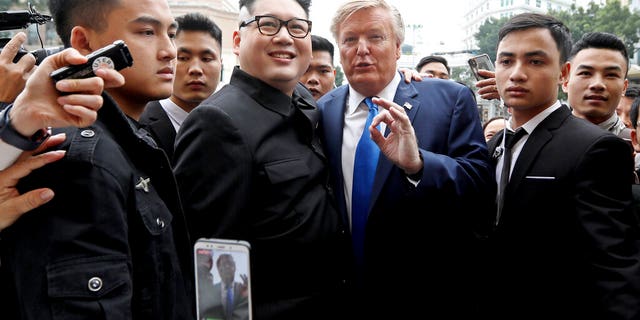
Donald Trump impersonator Russell White and Kim Jong Un
impersonator Howard X in Hanoi, Vietnam, on Friday. (AP Photo/Minh
Hoang)
Meanwhile, in a bizarre episode that recalled similar antics from last year's
Olympic Games, Vietnamese officials said they were not amused by the antics of two impersonators of Kim and Trump.
The
duo has been making rounds of Hanoi, taking pictures with curious
onlookers this weekend. However, on late Friday, a Kim lookalike, the
Hong Kong-based impersonator who uses the name Howard X, posted on
Facebook that about 15 police or immigration officers demanded a
mandatory "interview" with them following a talk they gave at the
state-run VTC station.
"They then said that this was a very
sensitive time in the city due to the Trump/Kim summit and that our
impersonation was causing a 'disturbance' and ... suggested that we do
not do the impersonation in public for the duration of our stay as these
presidents have many enemies and that it was for our own safety."