Michael Cohen came to Capitol Hill with a double-barreled message: He is "ashamed" of what he did for Donald Trump and here are all the terrible things the president has done.
With
his words being carried by the broadcast networks as well as cable
outlets, Cohen repeatedly clashed with Republicans who assailed him as a
liar and crook, while Democrats tried to draw out his allegations for
maximum impact.
The president's former lawyer mostly maintained
his composure, though he angrily pushed back at a couple of GOP members
of the House Oversight Committee who aggressively attacked him. At one
point he emotionally denounced the critical lawmakers for using the same
untruthful tactics that he employed for a decade in protecting Trump.
The
bottom line: the daylong extravaganza probably did little to change the
minds of Trump supporters who view him as a pathetic convicted
criminal, or Trump opponents who view him as a reformed sinner now
shining a light on the president's dark deeds. He
said he had no evidence of Russian collusion, but did paint the
president as a con man who made racist statements, approved hush money
payments and was told in advance by Roger Stone about the Wikileaks dump
of Democratic emails (quickly denied by Stone).
Among the
surprises: Cohen says he has been offered book deals, TV deals, and a
movie option, but hasn't taken any of them, since he's headed off for
prison. Some also aimed their firepower at Clinton loyalist Lanny Davis
for representing Cohen, who said Davis is not being paid for his
services. Cohen also lashed out at Trump for tweets about his family,
saying the president was trying to "intimidate" him in the hope that
"something bad will happen" to him, his wife or his children.
To
say this was a highly negative portrait of the man he loyally served as
"fixer" is an understatement. But it's also fair to say that with the
exception of the disputed call from Stone, Cohen brought no bombshell
charge.
The
president's role in reimbursing Cohen for paying Stormy Daniels is
significant, but that had already come out. His recollection of Trump
disparaging "s---hole" countries run by black leaders was reported in a
different context.
Cohen said he assumed that Don Jr. was
referring to the infamous Trump Tower session when he whispered to his
dad that an unspecified meeting was on, but had no proof.
Then
there was the other Trump Tower, the one that was to be built in Moscow.
Cohen said the president kept asking him about it and lied about his
lack of knowledge. But that story, too, has been reported.
Cohen's
assertion that Trump had him threaten schools not to release the boss's
grades may be embarrassing, but is hardly high crimes and misdemeanors.
And
then there was the question of whether the president told him to lie to
Congress, as reported by BuzzFeed in a story that prompted a denial
from Robert Mueller's office.
"Mr. Trump did not directly tell me
to lie to Congress. That's not how he operates," Cohen said. Instead, he
said, "Mr. Trump had made clear to me, through his personal statements
to me that we both knew were false and through his lies to the country,
that he wanted me to lie."
Ranking member Jim Jordan, the most
aggressive Republican, asked why Cohen didn't have Lanny Davis deny the
BuzzFeed account when he appeared on television that day.
"Because I didn't think it was his responsibility to do that," Cohen said. "We are not the fact checkers for Buzzfeed."
When
Cohen felt that Jordan was unfairly disputing his account of the charge
to which he had pleaded guilty, the witness briefly looked unnerved and
declared, "Shame on you!"
The GOP denunciations of Cohen and the
hearing itself grew repetitive as the day wore on. At one point, Chris
Christie said on ABC, "There hasn't been one Republican yet who's tried
to defend the president on the substance."
In one of the more
surreal moments, there was even a Democratic question about the mythical
pee tape, with Cohen saying he has no reason to believe it exists.
Before
Cohen's testimony began, the president weighed in from Vietnam, saying
"he was just disbarred by the state Supreme Court for lying & fraud.
He did bad things unrelated to Trump. He is lying in order to reduce
his prison time."
The bottom line: Trump's image definitely got
scuffed up yesterday, but by a guy who had soiled his own reputation. I
don't think the ball moved very much.
President Trump abruptly walked away
from negotiations with North Korean leader Kim Jong Un in Vietnam and
headed back to Washington on Thursday afternoon, saying the U.S. is
unwilling to meet Kim's demand of lifting all sanctions on the rogue
regime without first securing its meaningful commitment to
denuclearization.
Trump, speaking in Hanoi, Vietnam, told reporters he had asked Kim to do more regarding his intentions to denuclearize, and “he was unprepared to do that.”
“Sometimes you have to walk,” Trump said at a solo press conference following the summit.
Trump
specifically said negotiations fell through after the North demanded a
full removal of U.S.-led international sanctions in exchange for the
shuttering of the North's Yongbyon nuclear facility. Trump and Secretary
of State Mike Pompeo told reporters that the United States wasn't
willing to make a deal without the North committing to giving up its
secretive nuclear facilities outside Yongbyon, as well as its missile
and warheads program.
“It was about the sanctions,” Trump said.
“Basically, they wanted the sanctions lifted in their entirety, and we
couldn’t do that. They were willing to denuke a large portion of the
areas that we wanted, but we couldn’t give up all of the sanctions for
that.”
"I'd much rather do it right than do it fast," Trump added,
echoing his remarks from earlier in the day, when he insisted that
"speed" was not important. "We're in position to do something very
special."
Both leaders motorcades roared away from the downtown
Hanoi summit site within minutes of each other after both a lunch and
the signing ceremony were scuttled. Trump's closing news conference was
moved up, and he departed for Washington on Air Force One several hours
ahead of schedule.
"Sometimes you have to walk." — President Trump on his dealings with North Korea
The
president said he trusted Kim's promise that he would not resume
nuclear and missile testing, but that the current U.S. sanctions would
stay in place.
President Trump and Kim Jong Un failed to reach an agreement on denuclearization. (Associated Press)
“No agreement was reached at this time, but their
respective teams look forward to meeting in the future,” White House
press secretary Sarah Sanders said in a statement prior to Trump's press
conference.
Regardless, Sanders described the meetings between Trump and Kim as “very good and constructive.”
As for a potential third summit, Trump remained noncommittal.
Kim
had signaled during an earlier, unprecedented question-and-answer
session with reporters that he is "ready to denuclearize," reaffirming a
commitment long sought by the Trump administration and the
international community.
“If I’m not willing to do that, I won’t be here right now,” Kim said through an interpreter.
"That's a good answer," Trump replied.
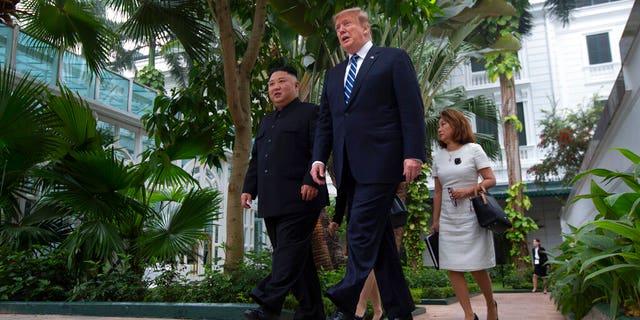
President Donald Trump and North Korean leader Kim Jong Un take a
walk after their first meeting at the Sofitel Legend Metropole Hanoi
hotel, Thursday, Feb. 28, 2019, in Hanoi. (AP Photo/Evan Vucci)
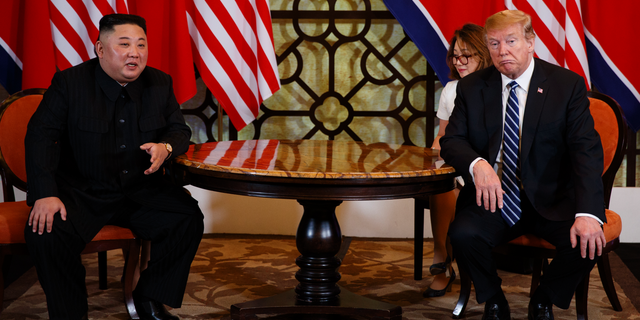
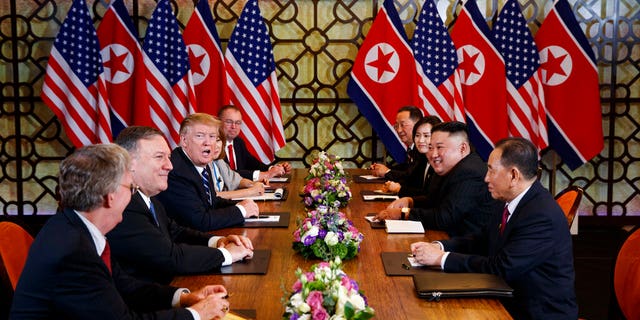
President Donald Trump speaks during a meeting with North Korean
leader Kim Jong Un Thursday, Feb. 28, 2019, in Hanoi. At front right is
Kim Yong Chol, a North Korean senior ruling party official and former
intelligence chief. At left is national security adviser John Bolton and
Secretary of State Mike Pompeo, second from left. (AP Photo/ Evan
Vucci)
Trump and Kim signed a document during last year's summit
in Singapore agreeing to work toward the "complete denuclearization of
the Korean Peninsula," but tensions have since flared between the two
nations, and North Korea later said it would not remove its nuclear
weapons unless the U.S. first reduced its own nuclear threat.
A
working lunch was supposed to get underway between the two leaders in
Vietnam on Thursday afternoon, after a whirlwind day on Capitol Hill
that threatened to steal the spotlight from the second major summit
between the two leaders. But neither Trump nor Kim showed up.
Earlier,
history appeared to have been made when Kim answered questions from a
foreign journalist -- almost certainly for the first time ever.
Asked
by a member of the White House press pool about his outlook for
Thursday's summit, Kim said: "It's too early to say. I won't make
predictions. But I instinctively feel that a good outcome will be
produced."
South Korea's Unification Ministry, which deals in
affairs with North Korea, couldn't confirm whether it was the first time
Kim answered a question from a foreign journalist.
Asked if he
was willing to allow the U.S. to open an office in Pyongyang, Kim said
through a translator, "I think that is something which is welcomable."
Reporters
didn't get opportunities to ask questions of Kim during his three
summits with South Korean President Moon Jae-in and his four meetings
with Chinese President Xi Jinping. Kim ignored questions shouted at him
during his first summit with Trump last June in Singapore.
Trump,
speaking next to Kim at the Sofitel Legend Metropole Hanoi hotel, said
that "a lot of great ideas" are "being thrown about." He asserted that
"when you have a good relationship, a lot of good things happen."
"I
just want to say: I have great respect for Chairman Kim, and I have
great respect for his country," Trump told reporters as he sat at a
table across from Kim in Hanoi. "And I believe it will be something --
hard to compete with for other countries. It has such potential."
Kim,
meanwhile, said the "whole world" was watching the talks and suggested
that, for some, the image of the two "sitting side by side" must
resemble "a fantasy movie."
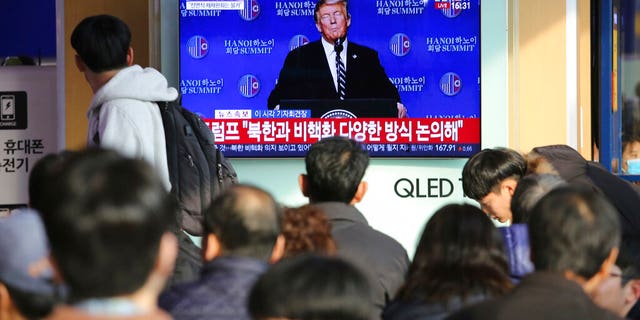
People watch a TV screen showing U.S. President Donald Trump's
press conference, during a news program at the Seoul Railway Station in
Seoul, South Korea, Thursday, Feb. 28, 2019. The nuclear summit between
President Donald Trump and North Korea's Kim Jong Un collapsed Thursday
after the two sides failed to reach a deal due to a standoff over U.S.
sanctions on the reclusive nation, a stunning end to high-stakes
meetings meant to disarm a global threat. The signs read: " Trump talks
with North Korea about denuclearization." (AP Photo/Ahn Young-joon)
Trump added that while reaching a lasting agreement
was critical, "speed is not important." The two leaders then retired to
begin their negotiations privately, but were photographed shortly
afterward walking on the Metropole hotel's pool patio, where they were
joined by Secretary of State Mike Pompeo and North Korean official Kim
Yong Chol.
The group then went into a glass-enclosed area and sat down around a table for more talks.
Last
year, at the Singapore summit, Trump caught U.S. ally South Korea off
guard by announcing the suspension of major U.S. military exercises with
the South. Trump critics said he squandered critical U.S. leverage
before the North had taken any concrete steps toward denuclearization.
For
his part, Moon Jae-in said he plans to offer new proposals for
inter-Korean engagement following the high-stakes nuclear summit. Moon's
announcement is planned for a Friday ceremony marking the 100th
anniversary of a 1919 uprising by Koreans against Japan's colonial rule
and will likely include plans for economic cooperation between the rival
Koreas.
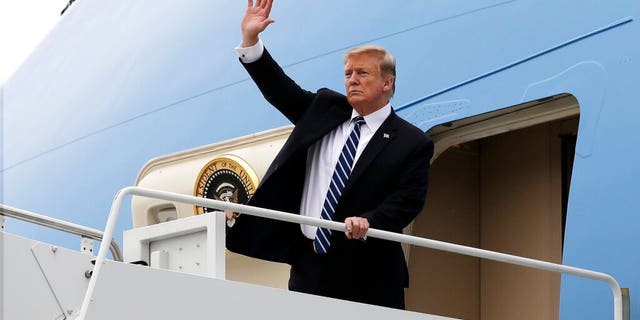
President Donald Trump waves as he boards Air Force One after a
summit with North Korean leader Kim Jong Un, Thursday, Feb. 28, 2019, in
Hanoi. (AP Photo/ Evan Vucci)
It was widely presumed that Trump made the decision
during his private talks with Kim — his description of the war games as
"very provocative" seemed to be in line with North Korea's view of the
drills as rehearsals for invasions. Both Washington and Seoul have
insisted for years that the exercises were routine and defensive in
nature.
Bong Young-shik, an analyst at Seoul's Yonsei University,
was less worried, saying that the criticism Trump faced in Singapore
could make him less likely to make huge, impulsive decisions during his
private meetings with Kim this time around.
"There's always a
certain level of risk in this kind of meeting, but it's hard to say
Trump will be dragged into a decision by Kim just because of what
happened in Singapore," Bong said.
Former President Barack Obama
was known to occasionally hold impromptu chats with leaders on the
sidelines of major global summits with only their interpreters at their
sides.
At
former President Ronald Reagan's first meeting with then-Soviet leader
Mikhail Gorbachev in Geneva in November 1985, the two men met alone with
only trusted interpreters. Only 15 minutes had been allotted for the
discussion, but it went on for an hour. The Associated Press contributed to this report.
Democratic presidential candidate Sen. Kamala Harris,
D-Calif., listens to a question at a campaign event in Portsmouth, N.H.,
Monday, Feb. 18, 2019. (Associated Press)
U.S. Sen. Kamala Harris “mischaracterized” a 2008 San Francisco policy regarding undocumented minors when she participated in a CNN podcast earlier this week, the network asserted Wednesday.
Harris
-- a California Democrat who is seeking the party's 2020 presidential
nomination -- made the comments while speaking to an audience in Iowa on
Sunday on “Political Party Live,” the network reported.
According
to CNN, host Misty Rebik asked Harris about a past report by the
network that claimed Harris backed a San Francisco policy of reporting
arrests of undocumented juveniles to U.S. Immigration and Customs
Enforcement.
Harris responded by saying the notification of ICE
was an “unintended consequence” of the city policy, enacted by
then-Mayor Gavin Newsom. (Newsom is now governor of California, while
Harris is a U.S. senator after being the district attorney of San
Francisco from 2004-2011 and then attorney general of California from
2011-2017.)
CNN reported Wednesday, however, that the ICE-notification component was part of the policy itself, not an “unintended consequence.”
Ian Sams, a spokesman for Harris, responded to the network’s assertion that Harris had “mischaracterized” the matter.
"As
Governor Newsom has said, the initial policy was intended to protect
the sanctuary status of San Francisco, which Senator Harris has always
supported and defended," Sams said in a statement. "We have said this
policy should have been done differently, but as Senator, Harris is
focused on protecting Dreamers, fighting this president's attempts to
build a vanity project on the southern border, exercising more oversight
of ICE, reforming our immigration system with a path to citizenship,
and reuniting families separated by this administration. Those will be
her priorities should she be elected president."
The
question of whether city police departments will alert federal
immigration authorities about undocumented immigrants who are charged
with crimes has been a focus of the “sanctuary cities” debate between
liberal-leaning cities and the Trump administration.
Last March,
Harris contended that ICE officials were potentially overstepping their
authority by pursuing illegal immigrants who pose no safety threat to
the public.
Thomas Homan, who was then acting director of ICE,
responded by saying, “We're not abusing our authority, we are enforcing
the law."
After Newsom left the mayor's job in 2011, his successor
changed the policy so that police would report to ICE
only unaccompanied juvenile undocumented immigrants who were arrested,
the report said. Then two years later San Francisco passed an ordinance
that blocked ICE from receiving any information about people under
arrest, except in limited circumstances.
President Trump, speaking in Vietnam on Thursday after the abrupt end of his summit with North Korea’s Kim Jong Un, said he was actually “impressed” with his former lawyer Michael Cohen,
who told a U.S. House panel grilling him Wednesday that there was no
collusion between Trump's presidential campaign and Russia.
But
Cohen told members of the House Oversight and Reform Committee that
while he didn't know of "direct evidence" of improper collusion between
the Trump campaign and Russia, he had his “suspicions.”
Trump,
responding to a question about Cohen’s hearing from ABC News’ Jonathan
Karl, said that he thought the Cohen hearing could have been held a few
days after his second summit with Kim and that Cohen “lied a lot” but
didn’t “lie about one thing.”
“I was actually impressed that he
didn’t say, ‘Well, I think there was collusion,’” Trump said. "He said
‘no collusion.’ I was impressed by that.”
Other than that, Trump said Cohen’s performance at the hearing was “pretty shameful.”
Cohen
told the committee members he was aware of a Trump adviser’s talks with
WikiLeaks about stolen Democratic National Committee emails during the
2016 campaign and alleged that as Trump's personal attorney for 10 years
he oversaw an array of illicit schemes.
“He
is a racist. He is a conman. And he is a cheat,” Cohen testified,
setting the tone for the hearing. After outlining numerous alleged
misdeeds by Trump, Cohen expressed regret and repeated the refrain, “yet
I continued to work for him.” Fox News’ Alex Pappas contributed to this report.
OAN Newsroom
UPDATED 1:08 PM PT — Tuesday, February 26, 2019
A Democrat attempt to block President Trump’s national emergency is
virtually dead in the water after the White House issued a preemptive
veto threat.
In a statement from the White House, the administration laid out why
the declaration is a matter of national security, and said efforts to
block it undermine the president’s ability to respond effectively to
security threats.
This comes as a resolution makes its way through Congress, and is
expected to pass the House and Senate Tuesday. This would be the first
veto President Trump has issued since taking office.
Meanwhile, Republican lawmakers are blasting Democrats over their efforts to block the national emergency declaration.
On Tuesday, Utah Congressman Chris Stewart vowed to vote against the
bill, because it denies there is an emergency at the border. Stewart
said while he doesn’t support President Trump curtailing Congress, he
does believe the border crisis does constitute a national emergency. He
added, the declaration could have been avoided entirely if Democrats had
come to the table beforehand.
“It’s really too bad because there’s a wasted opportunity here.,
there is a lot of conservatives that have been uncomfortable with this
emergency power precedence,” he stated. “If the Democrats had been
willing to work with us on something more broad and something that would
have applied in future situations, I think they would have had a much
more bipartisan response to that.”
However, the congressman did voice the concern future presidents
could weaponize national emergencies if Congress doesn’t approve certain
legislation.
Donald Trump Jr. lashed out at the left, the media and social media platforms for positioning themselves against conservatives and censoring free speech, in a “Tucker Carlson Tonight” interview Tuesday.
“Why is the press standing by as the First Amendment erodes?” Tucker Carlson asked Trump Jr.
“The
majority of the press are now left-wing activists,” Trump Jr. told
Carlson. “They are not on the side that is being stymied, they’re not on
the side that is being oppressed.”
Trump Jr. began the interview
by talking about his troubles with Instagram and how many of his
followers informed him that social media platforms were censoring their
content because of their conservative nature.
“I can do this
because I have a big platform. I have a big soapbox, I can get it out
there, but some of the little guys, they can’t,” Trump Jr. said. “They
don’t have the ability. They end up just taking it.”
Trump Jr. went after “Big Tech” in an op-ed last Friday claiming some companies have been acting in a partisan manner to try preventing President Trump’s reelection.
“Unfortunately,
Silicon Valley is showing us that tech companies, too, can manipulate
information for partisan ends. Their censorship is increasing at an
alarming rate, just in time for them to try to spoil my father’s
re-election bid, but we won’t let them get away with it.,” Trump Jr.
wrote.
He called the alleged social-media manipulation a “one-way systematic attack on free speech” while talking to Carlson.
“To
me, it reads like it’s a trial run for 2020,” Trump Jr. said. “I’m not
saying every account is suppressed, but you do it enough. You take off
‘x’ percent of the top. You cut the message in half.”
“I think we
have to start pushing back and I think we have to start pushing back
hard,” Trump Jr. said. “If we don’t, we’ll never get the chance again.”
It was a classic split-screen moment for the media.
Actually, it called for triple screens.
President Trump had landed in Vietnam for his summit with Kim Jong Un.
This second meeting will put to the test whether North Korea actually
plans to take any concrete steps toward giving up nuclear weapons, or
whether its dictator is merely pursuing a strategy of deflection and
delay. At stake: the potential elimination of one of the world's premier
nuclear threats, and a possible peace treaty more than six decades
after the Korean War armistice.
But that was no match for Michael Cohen.
The
president's onetime lawyer had arrived in the Senate yesterday to
testify behind closed doors, a prelude to his televised House hearing
today.
MSNBC literally had a split-screen shot of Trump getting off the plane in Hanoi and Cohen walking down a Capitol Hill hallway.
CNN had a countdown clock up, 23 hours before his public testimony.
Cohen
was already making news as the gist of his planned testimony was
provided in advance to major news organizations. And that gave his
story, well, a nuclear boost.
Cohen, The New York Times said,
"is planning on portraying his onetime client in starkly negative terms
when he testifies Wednesday before a House committee, and on describing
what he says was Mr. Trump's use of racist language, lies about his
wealth and possible criminal conduct."
Cohen, The Washington Post said,
"is expected to describe to lawmakers what he views as Trump's 'lies,
racism and cheating,' both as president and in private business, and
will describe 'personal, behind-the-scenes' interactions he witnessed, a
person familiar with the matter said."
And even while the
president was halfway around the world, his White House was playing
defense on the other story with a statement from Sarah Sanders:
"Disgraced
felon Michael Cohen is going to prison for lying to Congress and making
other false statements. Sadly, he will go before Congress this week and
we can expect more of the same. It's laughable that anyone would take a
convicted liar like Cohen at his word, and pathetic to see him given
yet another opportunity to spread his lies."
What's fascinating
about that statement is that it's the Republican chairman of the Senate
Intel committee, Richard Burr, who summoned Cohen. And Robert Mueller is
relying on Cohen's accounts as well.
Of course, Cohen's
credibility will come under withering assault, since he pleaded guilty
to lying to Congress. That's part of the reason that Cohen will begin a
three-year prison term in May, though he may hope his testimony prompts
prosecutors to ask for a sentence reduction.
Cohen's effort at
rehabilitating his image is simple: I lied before to protect my client,
but I deeply regret it and am so upset by Trump's conduct as president
that I'm going to tell all now.
Among
his topics, according to the advance leaks: the infamous Trump Tower
meeting with a Russian lawyer, and the president's involvement in
hush-money payments to Stormy Daniels and Karen McDougal.
His lawyer, Lanny Davis, told the Times that he will "back it up with documents."
But
Cohen does not plan to answer questions about other aspects of the
Russia investigation to avoid interfering with the Mueller probe.
What
the Post described as the hope of Cohen's allies — that "he could
become this generation's John Dean" — very much remains to be seen.
Dean, unlike Cohen, worked in the White House and was an integral part
of Richard Nixon's Watergate coverup.
The third story unfolding on
our screens yesterday was Nancy Pelosi's plan for the House to vote on
blocking Trump's declaration of a national emergency at the border. So
while he's performing on the world stage, he could get whacked here at
home for supposedly flouting the Constitution.
By
the time the House voted to block Trump 245-182, with 13 Republicans
joining the Dems, the party-line tally was a foregone conclusion. There
is a chance that the Senate will go along with four Republicans
defecting (Thom Tillis said in a Post op-ed yesterday
that he'd oppose the national emergency because "conservatives
rightfully cried foul when President Barack Obama used executive action
to completely bypass Congress"). Still, there undoubtedly wouldn't be
enough votes to overturn a veto.
Of course, the summit meeting
with Kim hadn't actually begun when these other stories were grabbing
ink and airtime. But I can't help thinking that most of the media are
more interested in Trump's former fixer and a potential Democratic
slapdown than in this president's diplomacy.
The Senate on Tuesday confirmed President Trump's nominee to be a judge on the liberal 9th Circuit Court of Appeals
in a party-line vote -- and, in a historic snub, the White
House ignored the input of the judge's two Democratic home-state
senators in the process.
The aggressive and unprecedented move to
bypass the traditional "blue slip" consultation process and plow ahead
with the confirmation comes as the Trump administration seeks to
systematically erode left-wing dominance on the key appellate court,
which Trump has called "disgraceful" and politically biased.
With a
sprawling purview representing nine Western states, the appellate court
has long been a thorn in the side of the Trump White House, with
rulings against his travel ban policy and limits on funding to
"sanctuary cities." A lawsuit is currently pending before the 9th Circuit concerning Trump's emergency declaration over border security -- and Trump had sarcastically predicted that Democrats would purposefully file suit in the San Francisco-based appellate court to improve their odds.
The
new 9th Circuit judge, Seattle attorney Eric Miller, was confirmed
53-46. Miller was one the 51 federal judicial nominees left over from
the previous Congress whom the White House re-nominated last month.
Miller, currently the appellate chairman of the high-powered law firm Perkins Coie,
will replace Judge Richard Tallman, a Bill Clinton appointee who
assumed senior status March 2018. Miller is the fifth former clerk to
Associate Justice Clarence Thomas to be nominated by Trump to a federal
appellate court, including embattled D.C. Circuit Court of Appeals nominee Neomi Rao.
Miller
represented the government before the Supreme Court when he served from
2007 to 2012 as an Assistant to the Solicitor General of the United
States. He was also Deputy General Counsel of the Federal Communications
Commission.
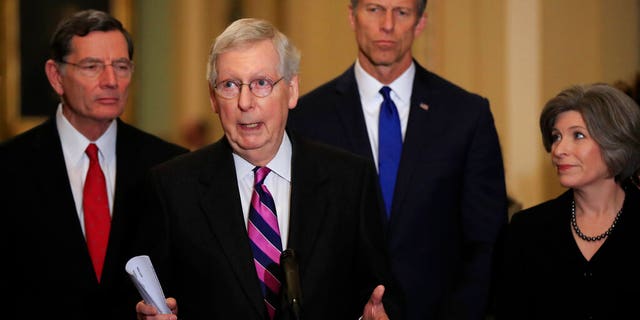
Senate Majority Leader Mitch McConnell, R-Ky., with, from left,
Sens. John Barrasso, R-Wyo., McConnell, John Thune, R-S.D., and Joni
Ernst, R-Iowa, speakING to reporters on Capitol Hill in Washington,
Tuesday. (AP Photo/Manuel Balce Ceneta)
Among those objecting to Miller's nomination were
Washington State's two Democratic senators, Maria Cantwell and Patty
Murray. Aides say Miller's confirmation marks the first time the Senate
has strayed from tradition and confirmed a judicial nominee over the
dissent of both home-state senators.
“This is wrong. It is a
dangerous road for the Senate to go down,” Murray said Tuesday on the
Senate floor. “Confirming this 9th Circuit court nominee without the
consent or true input of both home-state senators, and after a sham
hearing, would be a dangerous first for this Senate.”
Miller was nominated last year but faced opposition from Democrats, in part over his views on issues of tribal sovereignty.
The
White House has previously signaled it will also plow ahead with other
9th Circuit nominations in other states without using the "blue slip"
consultation process. The Sacramento Bee reported
last year that White House officials had been negotiating with
California Sens. Dianne Feinstein and Kamala Harris about 9th Circuit
appointments, but the dialogue collapsed, and the White House proceeded
to announce three nominees over their objections.
Those nominees
-- Patrick Bumatay, Daniel Collins and Kenneth Kiyul Lee (all from the
Golden State, and reportedly all members of the conservative Federalist
Society) -- have yet to be confirmed.
GOP critics have branded the
court the “Nutty 9th,” in part because many of its rulings have been
overturned by the Supreme Court.
Last November, Chief Justice John
Roberts openly disputed Trump's comments that the nation has "Obama
judges" and partisan hacks on the courts. The move marked a highly
unusual challenge to the White House from a sitting Supreme Court
justice, and prompted some observers to accuse Roberts of naivete.
“What
we have is an extraordinary group of dedicated judges doing their level
best to do equal right to those appearing before them,” Roberts said in
the head-turning statement.
But Trump, invoking the 9th Circuit, fired back immediately.
“Sorry
Chief Justice John Roberts, but you do indeed have ‘Obama judges,’ and
they have a much different point of view than the people who are charged
with the safety of our country,” Trump tweeted.
“It would be
great if the 9th Circuit was indeed an ‘independent judiciary,’ but if
it is why are so many opposing view (on Border and Safety) cases filed
there, and why are a vast number of those cases overturned,” Trump
continued. “Please study the numbers, they are shocking. We need
protection and security - these rulings are making our country unsafe!
Very dangerous and unwise!”