The husband of White House counselor Kellyanne Conway blasted President Trump on Wednesday, claiming Trump has a problem with "pathological” lying.
George
Conway, an attorney who has become an outspoken critic of the president
via Twitter messages, posted a thread that began when he called out
Trump for claiming that Judge Amy Berman Jackson's sentencing of former Trump campaign chairman Paul Manafort earlier in the day had exonerated the president from the Russian collusion narrative.
“Have
we ever seen this degree of brazen, pathological mendacity in American
public life?" Conway asked in a tweet. "One day he makes a harmless slip
of the tongue, something any mentally balanced person would laugh off.
But instead he lies about it. He denies what the world can see on
videotape. Even his donors and supporters wonder, what is wrong with
him? Why would he feel compelled to tell such an absurd lie?"
Conway then invoked Trump’s recent meeting with Apple CEO Tim Cook, whom the president referred to as “Tim Apple.”
Trump reportedly later told RNC donors that he had really said “Tim
Cook Apple,” uttering Cook's last name softly, but then reversed course
on Twitter when he claimed he called the CEO “Tim Apple” to “save time
and words.”
Conway also mocked the president’s two-hour-long CPAC speech, which he called “incoherent.”
“The
judge says, in open court, that Manafort’s lawyers’ ‘no collusion’
‘mantra’ was patently ridiculous because it was irrelevant to the
charges at hand- not that there was no proof of collusion, just that
whether there was or wasn’t was irrelevant to the proceedings at hand,”
Conway wrote. “And yet he lies again – a blatant lie – about what the
judge said in open court.”
Conway
later suggested that the president has a “disorder” and that an inquiry
needs to be made regarding his “condition of mind.”
“It’s not
rational, because it’s a lie that no reasonable person would believe. It
undermines his credibility. It’s self-defeating. But these are just two
of… how many examples? Hundreds? Thousands? Is it possible to count?”
he asked. “At any level of government in this country, in any party,
have we ever seen anything like this? It’s beyond politics. It’s nuts.
It’s a disorder. Whether or not impeachment is in order, a serious
inquiry needs to be made about this man’s condition of mind.”
Instances
of the president or members of the Trump family publicly criticizing
George Conway have been relatively rare. But one sharply worded Twitter
message came in December from Eric Trump. "Of all the ugliness in
politics, the utter disrespect George Conway shows toward his wife, her
career, place of work, and everything she has fought SO hard to achieve,
might top them all," Eric Trump wrote. "@KellyannePolls is great person
and frankly his actions are horrible."
If
former Trump campaign chairman Paul Manafort is being held accountable
for the laws he has broken, he’s got plenty of company in Washington,
D.C., Real Clear Politics founder Tom Bevan argued Wednesday evening.
Manafort
is now facing more than seven years in prison for crimes he committed
before joining Donald Trump’s presidential campaign as well as for
crimes he committed during the Russia investigation. His legal troubles
are far from over as he has now been indicted on an additional 16 counts
in New York state.
During Thursday's "Special Report" All-Star
panel, Bevan -- along with national security analyst Morgan Ortagus and
Georgetown Institute of Politic executive director Mo Elleithee --
weighed in on the Manafort sentencing as well as the latest developments
from former FBI lawyer Lisa Page’s congressional testimony. CLICK HERE TO VIEW THE FULL SHOW
Bevan
began by making it clear that “nobody is going to shed a tear” for a
“corrupt guy” like Manafort. That being said, he insisted that if
Manafort was being punished for his crimes, then plenty of others should
be as well.
“If the standard is now, ‘We’re going to prosecute
for FERA violations and we’re going to drain the swamp,’ let’s do it
because there are another fifty or a hundred Paul Manaforts doing the
exact same thing. So if that’s the standard, let’s go ahead and drain
the swamp,” Bevan told the panel.
Elleithee warned about the
consequences of President Trump possibly pardoning Manafort, saying that
at minimum the “optics look bad” and noting that Trump cannot shield
Manafort from the state-level charges against him.
Meanwhile,
Ortagus noted Lisa Page’s significant role in revealing what happened
in the Department of Justice during its handling of the Clinton email
investigation as well as the early stages of the Russia probe. Testimony
shared by the House Judiciary Committee shows that Page confirmed to
lawmakers that the Justice Department instructed the FBI not to pursue
charges of “gross negligence” against former Secretary of State Hillary
Clinton.
“When the story, the history is written about all of
this, Lisa Page is going to be such a fascinating and integral character
in this,” Ortagus said. “I mean, look at all the number of people --
Comey, McCabe, Strzok -- all of these people she’s given congressional
testimony to counter them, to contradict them and they are all in
trouble, multiple times over. ... So pay attention to Lisa Page. She’s
taking down some of the biggest names in the FBI.”
Lori Loughlin's
daughter Olivia Jade was spending spring break on a University of
Southern California official's yacht when her mother was accused Tuesday
of involvement in a college admissions scheme, reports said.
Jade,
19, was on Rick Caruso's luxury yacht Invictus in the Bahamas, a report
said. Caruso is chairman of USC's Board of Trustees.
Jade, who currently attends USC, was with Caruso's daughter Gianna and several other friends, the outlet reported.
"My daughter and a group of students left for spring break prior to the government's announcement yesterday," Caruso told TMZ. "Once we became aware of the investigation, the young woman decided it would be in her best interests to return home."
"Once we became aware of the investigation, the young woman decided it would be in her best interests to return home." — Rick Caruso, chairman of USC's Board of Trustees
Loughlin's
daughter has since returned to Los Angeles to face the allegations that
could result in her getting expelled from USC, the Daily Mail reported.
USC's
Board of Trustees will not decide the status of Jade and the other
students involved in the case, but rather, the university's president
will make the decisions, according to TMZ.
Lori Loughlin and daughter Olivia Jade Giannulli attend Women's
Cancer Research Fund's An Unforgettable Evening Benefit Gala at the
Beverly Wilshire Four Seasons Hotel on Feb. 27, 2018, in Beverly Hills,
California.
(Getty)
An
internal chart prepared by federal investigators working on the
so-called "Midyear Exam" probe into Hillary Clinton's emails,
exclusively reviewed by Fox News, contained the words "NOTE: DOJ not
willing to charge this" next to a key statute on the mishandling of
classified information. The notation appeared to contradict former FBI
Director James Comey's repeated claims that his team made its decision that Clinton should not face criminal charges independently.
Fox News has confirmed the chart served as a critical tip that provided the basis for Texas Republican Rep. John Ratcliffe's explosive questioning
of former FBI lawyer Lisa Page last year, in which Page agreed with
Ratcliffe's characterization that the DOJ had told the FBI that "you're
not going to charge gross negligence." A transcript of Page's remarks
was published Tuesday as part of a major document release by the ranking Republican on the House Judiciary Committee, Georgia Rep. Doug Collins.
The
document, entitled "Espionage Act Charges - Retention/Mishandling,"
contained a list of several criminal statutes related to the mishandling
of classified information, as well as a list of all the elements that
prosecutors would need to prove in order to successfully prosecute a
case.
Among the statutes listed are 18 U.S.C. 793(d), which covers the “willfull” retention of national defense information that could harm the U.S.; 18 U.S.C. 793(f),
which pertains to "gross negligence" in the handling of classified
information by permitting the information to be "removed from its proper
place of custody"; and 18 U.S.C. 1924, listed as a misdemeanor related to retaining classified materials at an "unauthorized location."
Listed
directly below to the elements of 18 U.S.C. 793(f) were the words:
"NOTE: DOJ not willing to charge this; only known cases are Military,
cases when accused lost the information (e.g. thumb drive sent to
unknown recipient at wrong address.)"
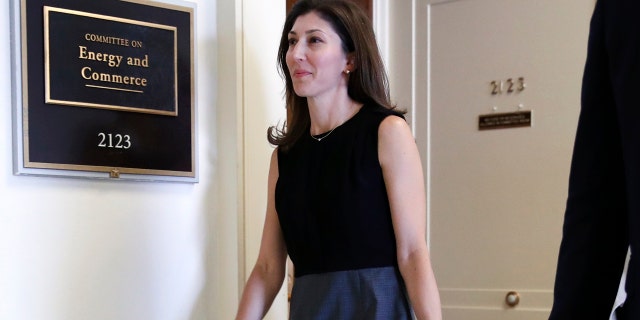
Former FBI lawyer Lisa Page arriving for a closed-door interview
with the House Judiciary and House Oversight Committees on Capitol Hill
in July 2018.
(Associated Press, File)
None of the other descriptions of the statutes had a similar notation. FBI
GENERAL COUNSEL THOUGHT HILLARY CLINTON SHOULD HAVE BEEN CRIMINALLY
CHARGED UNTIL CONVINCED OTHERWISE 'PRETTY LATE' IN THE PROCESS
In
July 2016, Comey took the unusual step of making a public statement
about the Clinton email investigation findings and his decision to
recommend against criminal charges. He said Clinton had been "extremely
careless" in handling classified information but insisted that "no
reasonable prosecutor" would bring a case against her.
Comey
stated: "What I can assure the American people is that this
investigation was done competently, honestly, and independently. No
outside influence of any kind was brought to bear."
He later
explained that he took the unusual step of announcing the FBI's
conclusions because then-Obama administration Attorney General Loretta
Lynch was spotted meeting secretly with former President Bill Clinton on an airport tarmac as the probe into Hillary Clinton, which Lynch was overseeing, continued.
Federal
law states "gross negligence" in handling the nation’s intelligence can
be punished criminally with prison time or fines, and there is no
requirement that defendants act intentionally. Nevertheless, Comey said
at the news conference, "Prosecutors necessarily weigh a number of
factors before bringing charges," including "the strength of the
evidence, especially regarding intent."
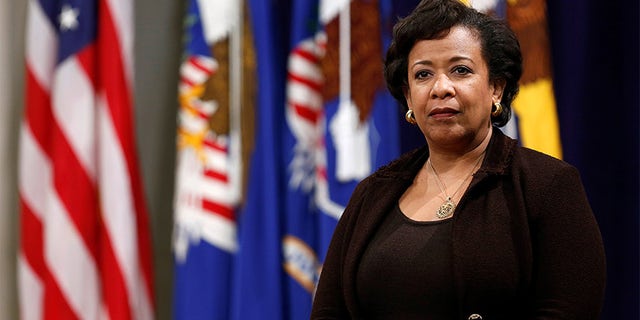
Loretta Lynch in Washington in November 2016.
(REUTERS/Gary Cameron, File)
Originally
Comey accused the former secretary of state of being “grossly negligent”
in handling classified information in a draft dated May 2, 2016, but
that was modified to claim that Clinton had merely been “extremely
careless” in a draft dated June 10, 2016.
Page
and since-fired FBI Special Agent Peter Strzok, who were romantically
involved, exchanged numerous anti-Trump text messages in the lead-up to
the 2016 presidential election, and Republicans have long accused the
bureau of political bias.
However, Page's testimony and the
internal "Midyear Exam" chart constituted perhaps the most salient
evidence yet that the Justice Department may have interfered improperly
with the FBI's supposedly independent conclusions on Clinton's criminal
culpability.
"So let me if I can, I know I’m testing your memory,"
Ratcliffe began as he questioned Page under oath, according to
a transcript excerpt he posted on Twitter. "But when you say advice you
got from the Department, you’re making it sound like it was the
Department that told you: You’re not going to charge gross negligence
because we’re the prosecutors and we’re telling you we’re not going to
—"
Page interrupted: "That is correct," as Ratcliffe finished his sentence, " -- bring a case based on that."
Responding
to the transcript revelations, Trump on Wednesday tweeted: "The just
revealed FBI Agent Lisa Page transcripts make the Obama Justice
Department look exactly like it was, a broken and corrupt machine.
Hopefully, justice will finally be served. Much more to come!" Fox News' Cyd Upson contributed to this report.
Fall River, Mass., Mayor Jasiel Correia, 27, was re-elected
and recalled in a stunning turn of events Tuesday. (Associated Press)
An embattled Democratic mayor from Massachusetts was re-elected on Tuesday, the same night that voters recalled him from duty amid federal indictments.
Mayor
Jasiel Correia, 27, faced a recall vote after refusing to step down
last year when he was charged with filing false tax returns and stealing
$231,447 from investors to fund a lavish lifestyle.
The
recall ballot contained two questions: whether Correia should be
recalled and who among five candidates, including the embattled
Democrat, should become the new mayor of Fall River. Voters were able to
choose any mayoral candidate regardless of how they voted on the recall
question.
Correia was recalled with 61 percent of the vote on the first question, WPRI-TV of
Providence reported, citing uncertified results. But 35 percent of
voters then chose to re-elect Correia on the second question, with the
incumbent narrowly beating out runner-up Paul Coogan by about 1 percent,
the station reported.
Following the results, Correia vowed to earn back the trust of Fall River's roughly 85,000 residents.
Prosecutors
allege that Correia persuaded seven people to invest $363,690 in the
development of an app, SnoOwl, meant to connect businesses with
customers.
Correia
allegedly stole $231,447 from investors to bankroll a lavish lifestyle
and advance his political career. He allegedly spent the money on
designer clothes, a Mercedes-Benz automobile, jewelry, his mayoral
campaign, travel, student loan and credit card payments, casinos and
adult entertainment.
The mayor, who was first elected in 2015,
pleaded not guilty in U.S. District Court to charges of wire fraud and
filing false tax returns. When he refused to step down, about 4,500 Fall
River voters signed a petition to force a recall vote.
It
marked the second time in five years that Fall River residents were
deciding on the early ouster of a sitting mayor. William Flanagan was
recalled in 2014 by voters angry over trash collection fees, fire
department layoffs, and his alleged use of a gun to intimidate Correia,
WPRI reported. Fox News' Louis Casiano and the Associated Press contributed to this report.
Wells Fargo
CEO Tim Sloan fired back at New York Rep. Alexandria Ocasio-Cortez at a
contentious hearing in Washington, D.C., on Tuesday, after the freshman
legislator accused the bank of "financing the caging of children" and
suggested it should bear financial liability for everything from oil
spills to climate change.
Ocasio-Cortez's inquiries come as activists increasingly seek to "deplatform" political opponents by cutting off their funding from banks and other financial services providers -- a concerted effort that conservatives and libertarians have said threatens free speech.
House
Financial Services Committee Chairman Maxine Waters, D-Calif., brought
Sloan before the panel Tuesday as part of a broad, four-hour inquiry
into widely reported fraudulent misconduct
in recent years by Wells Fargo employees. But in questioning Sloan, who
faced bipartisan criticism during the hearing, Ocasio-Cortez, a
self-described Democratic socialist, quickly went much further.
"Why
was the bank involved in the caging of children and financing the
caging of children to begin with?" Ocasio-Cortez asked at one point, in
an apparent reference to the Trump administration's zero-tolerance
immigration policy, which resulted in increased separations of parents
suspected of criminal activity from the minors who accompanied them.
The White House has pointed out that
images widely circulated on social media showing migrant children in
large, fenced-off detention rooms were taken during the Obama
administration.
Sloan responded simply, "I don't know how to answer that question, because we weren't."
"You
were financing, involved in debt financing in CoreCivic and GEO Group,
correct?" Ocasio-Cortez pressed, referring to two companies that manage
private detention and rehabilitation facilities, on her way to implying
that tort liability should be drastically expanded.
In a statement
to Fox News, a CoreCivic spokesperson rejected Ocasio-Cortez's
insinuations: "We don’t provide housing for any children who aren’t
under the supervision of a parent," the spokesperson said. "We also
don’t operate shelters for unaccompanied minors, nor do we operate
border patrol facilities. Any assertions to the contrary are patently
false and misinformed."
"For
a period of time, we were involved in financing one of the firms, we
are not anymore. I'm not familiar with the specific assertion you are
making. We were not involved in that," Sloan said.
Ocasio-Cortez
went on to ask whether the bank was "responsible for the damages
incurred by climate change" because of its financing of fossil fuel
companies, such as reinvestment costs.
"I don't know how you'd calculate that," Sloan retorted.
The
progressive firebrand from New York, pressing on, raised the prospect
that Wells Fargo could face liability from any environmental disaster
involving the Dakota Access pipeline, which runs 1,200 miles through the
Dakotas, Iowa and Illinois.
Wells Fargo was one of more than a
dozen financial institutions to contribute financing to the project,
which has been attacked by its critics as environmentally unsafe and an
encroachment upon Native American lands. Conservatives have maintained that the project has significant economic benefits.
"Hypothetically,
if there was a leak from the Dakota Access pipeline, why shouldn't
Wells Fargo pay for the cleanup of it, since they paid for the
construction of the pipeline itself?" Ocasio-Cortez asked. (In 2017, the
Dakota Access pipeline and a feeder line leaked more than 100 gallons of oil in North Dakota in separate incidents in March as crews prepared the disputed $3.8 billion pipeline for operation.)
"Because
we don't operate the pipeline," Sloan responded, apparently surprised
by the question. "We provide financing to the company that's operating
the pipeline. "Our responsibility is to ensure that at the time that we
make that loan, that that customer -- we have a group of people in Wells
Fargo, including an environmental oversight group."
Ocasio-Cortez
interrupted to ask why Wells Fargo would consider lending money to a
project criticized widely on environmental grounds.
"Again, the
reason that we were one of the 17 or 19 banks that financed that, was
because our team reviewed the environmental impact," Sloan said. "And we
concluded it was a risk we were willing to take."
Democrats have called on Wells Fargo to be broken up amid a slew of scandals.
(AP Photo/Rogelio V. Solis, File)
Concluding
the hearing, Waters suggested that Wells Fargo should be broken up.
Waters also asked Sloan if the bank had become "too big to manage."
“This
hearing has revealed Wells Fargo has failed to clean up its act, it’s
too big to manage and the steps regulators have taken to date are wholly
inadequate,” Waters said.
Republicans, too, laid into Sloan, although they did not go as far as Waters or Ocasio-Cortez.
“Each
time a new scandal breaks, Wells Fargo promises to get to the bottom of
it. It promises to make sure it doesn’t happen again, but then a few
months later, we hear about another case of dishonest sales practices or
gross mismanagement,” said North Carolina Rep. Patrick T. McHenry, a
Republican.
“Every single member of this committee has
constituents in their state who were impacted by Wells Fargo,” he added.
“Our constituents should be able to trust their own bank.” Fox News' Brooke Singman contributed to this report.
Nancy Pelosi is trying to shut down any talk of impeachment.
And since she happens to be speaker of the House, that means it won't happen for the foreseeable future, if ever.
There’s
a reason that President Trump's only nickname for Pelosi is "Nancy."
She's a shrewd politician, and she understands that an incendiary and
ill-fated impeachment drive would mainly hurt the Democrats.
For
the Dems to go down the impeachment road would utterly energize the
Trump base and allow the president to accuse his partisan opponents of
trying to overturn the election of 2016.
Impeachment proceedings
would utterly dominate the next year, essentially wiping out the
Democrats' attempt to define an agenda or to actually pass legislation
that would help the country. They would be defined as the anti-Trump
party, given power in the House only to launch a crusade against the
incumbent.
In
the end, it would be virtually impossible for the Republican-controlled
Senate to reach the two-thirds vote needed to evict Trump from the
White House. And that denouement would come just as the primaries were
getting under way, giving Pelosi's party a chance to beat Trump through
the usual electoral process.
The California congresswoman's words, in a Washington Post Magazine interview, immediately changed the nature of the debate:
"I'm
not for impeachment," she said. "This is news. I'm going to give you
some news right now because I haven't said this to any press person
before. But since you asked, and I've been thinking about this:
Impeachment is so divisive to the country that unless there's something
so compelling and overwhelming and bipartisan, I don't think we should
go down that path, because it divides the country. And he's just not
worth it."
Pelosi is obviously right that impeachment is
incredibly divisive. And she may be recalling that the Democrats picked
up five seats after House Republicans impeached Bill Clinton in 1998 on a
party-line vote. The only other modern impeachment effort — which drove
Richard Nixon from office in 1974 — succeeded because several
Republicans joined the Democrats when the Judiciary Committee voted on
the Watergate-related articles. (Both efforts came during their second
terms, when there was no other way to remove them.)
Pelosi's
dilemma is that some of her own caucus, especially the younger liberal
members, as well as left-wing pundits are hot to trot on impeachment.
Many Democratic voters also strongly favor the move. Even before Bob
Mueller delivers his findings, she's trying to find a way to defuse the
movement without alienating a significant chunk of the party.
So she subtly disses the president — "he's just not worth it" — while dismissing impeachment.
At
another point in the Post Magazine interview, Pelosi calls Trump
"ethically unfit. Intellectually unfit. Curiosity-wise unfit. No, I
don't think he's fit to be president of the United States. And that’s up
to us to make the contrast to show that this president — while he may
be appealing to you on your insecurity and therefore your xenophobia,
whether it's globalization or immigrants — is fighting clean air for
your children to breathe, clean water for them to drink, food safety,
every good thing that we should be doing that people can't do for
themselves."
A nod to one side, a nod to the other side. He's
unfit for office, but impeachment isn't worth it. He's bad on
immigration and the environment, but we have to make that case outside
of the Constitution's last-resort remedy.
The question for Trump's
critics, who despise his policies, his persona and his associates, some
of whom have been convicted, the question remains: What exactly has
Trump done that would qualify as high crimes and misdemeanors?
Adam
Schiff, the House Intel chairman and cable-TV fixture, told reporters
that Pelosi is "absolutely right." But House Budget Chairman John
Yarmuth told CNN, "To me it's not a question of 'whether,' it's a
question of 'when,' and probably right now is not the right time, but I
think at some point it's going to be inevitable."
The calculation
could change once Mueller delivers his findings. But without evidence of
Russian collusion that still hasn't emerged, Pelosi knows that her
party's best bet for defeating Trump is in November of 2020.
Former FBI lawyer Lisa Page
admitted under questioning from Texas Republican Rep. John Ratcliffe
last summer that "the FBI was ordered by the Obama DOJ not to consider
charging Hillary Clinton for gross negligence
in the handling of classified information," the congressman alleged in a
social media post late Tuesday, citing a newly unearthed transcript of Page's closed-door testimony.
Page and since-fired FBI Special Agent Peter Strzok exchanged numerous anti-Trump text messages
in the lead-up to the 2016 presidential election, and Republicans have
long accused the bureau of political bias. But Page's testimony was
perhaps the most salient evidence yet that the Justice Department
improperly interfered with the FBI's supposedly independent conclusions
on Clinton's criminal culpability, Ratcliffe alleged.
"So let me if I can, I know I’m testing your memory," Ratcliffe began as he questioned Page under oath, according to a transcript excerpt he posted on Twitter. "But
when you say advice you got from the Department, you’re making it sound
like it was the Department that told you: You’re not going to charge
gross negligence because we’re the prosecutors and we’re telling you
we’re not going to —"
Page interrupted: "That is correct," as Ratcliffe finished his sentence, " -- bring a case based on that."
The
document dump was part of a major release by House Judiciary Committee
Republicans, who on Tuesday released hundreds of pages of transcripts
from last year's closed-door interview with Page, revealing new details
about the bureau's controversial internal discussions regarding an
“insurance policy” against then-candidate Donald Trump. Fox News has
previously reviewed portions of Page's testimony.
Page
also testified that the DOJ and FBI had "multiple conversations ...
about charging gross negligence," and the DOJ decided that the term was
"constitutionally vague" and "had either never been done or had only
been done once like 99 years ago," and so "they did not feel they could
sustain a charge."
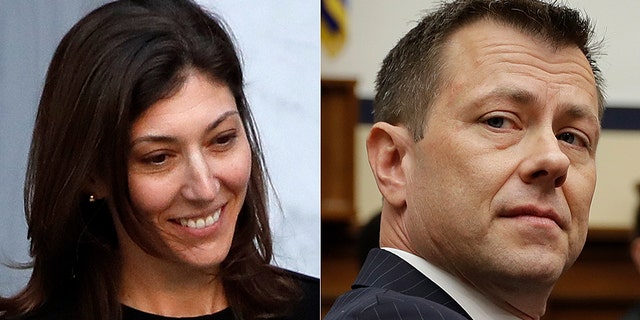
Former FBI Lawyer Lisa Page and fired FBI Special Agent Peter
Strzok exchanged anti-Trump text messages during their time at the
bureau.
(AP, File)
In July 2016, then-FBI
Director James Comey publicly announced at a bombshell press conference
that Clinton had been "extremely careless" in handling classified
information, but insisted that "no reasonable prosecutor" would bring a
case against her.
Federal
law states that "gross negligence" in handling the nation’s
intelligence can be punished criminally with prison time or fines, and
there is no requirement that defendants act intentionally or recklessly.
Originally
Comey accused the former secretary of state of being “grossly
negligent” in handling classified information in a draft dated May 2,
2016, but that was modified to claim that Clinton had merely been “extremely careless” in a draft dated June 10, 2016.
Comey
also said that "although there is evidence of potential violations of
the statutes regarding the handling of classified information, our
judgment is that no reasonable prosecutor would bring such a case."
He
added that "prosecutors necessarily weigh a number of factors before
bringing charges," including "the strength of the evidence, especially
regarding intent."
Comey
took the unusual step of holding a press conference and announcing the
FBI's purportedly independent conclusions because then-Obama Attorney
General Loretta Lynch was spotted meeting secretly with former President Bill Clinton on an airport tarmac as the probe into Hillary Clinton, which Lynch was overseeing, continued.
Comey's
conclusion that "no reasonable prosecutor" would bring a case against
Clinton has become the subject of significant debate in recent weeks. It
was revealed last month that FBI's top lawyer in 2016 thought Hillary
Clinton and her team should have immediately realized they were
mishandling "highly classified" information based on the obviously
sensitive nature of the emails' contents sent through her private
server.
And he believed she should have been prosecuted until "pretty late" in the investigation, according to a transcript of his closed-door testimony before congressional committees last October.
Strzok
and Page were involved in the FBI’s initial counterintelligence
investigation into Russian meddling and potential collusion with Trump
campaign associates during the 2016 election, and later served on
Special Counsel Robert Mueller’s team.
Among the texts between the
two was one concerning the so-called "insurance policy." During her
interview with the Judiciary Committee in July 2018, Page was questioned at length about that text
-- and essentially confirmed this referred to the Russia investigation
while explaining that officials were proceeding with caution, concerned
about the implications of the case while not wanting to go at "total
breakneck speed" and risk burning sources as they presumed Trump
wouldn't be elected anyway.
Further, she confirmed investigators
only had a "paucity" of evidence at the start. Comey, last December,
similarly acknowledged that when the FBI initiated its
counterintelligence probe into possible collusion between Trump campaign
officials and the Russian government in July 2016, investigators
"didn't know whether we had anything" and that "in fact, when I was
fired as director [in May 2017], I still didn't know whether there was
anything to it."
Then-Rep. Trey Gowdy, R-S.C., kicked off that
section of questioning by asking about the text sent from Strzok to Page
in August 2016 which read: “I want to believe the path you threw out in
Andy’s [McCabe's] office—that there’s no way he gets elected—but I’m
afraid we can’t take the risk. It’s like an insurance policy in the
unlikely event you die before you’re 40.”
The former FBI lawyer
explained how the FBI was trying to strike a balance with the
investigation into the Trump campaign—which agents called “Crossfire Hurricane," in a nod to a Rolling Stones song.
“So,
upon the opening of the Crossfire Hurricane investigation, we had a
number of discussions up through and including the Director regularly in
which we were trying to find an answer to the question, right, which
is, is there someone associated with the [Trump] campaign who is working
with the Russians in order to obtain damaging information about Hillary
Clinton,” Page said. “And given that it is August, we were very aware
of the speed and sensitivity that we needed to operate under.”
Page
continued that, “if the answer is this is a guy just being puffery at a
meeting with other people, great, then we don’t need to worry about
this, and we can all move on with our lives; if this is, in fact, the
Russians have coopted an individual with, you know, maybe wittingly or
unwittingly, that’s incredibly grave, and we need to know that as
quickly as possible.”
Page explained that the text message reflected their “continuing check-in” as to “how quickly to operate.”
“[W]e
don’t need to go at a total breakneck speed because so long as he
doesn’t become President, there isn’t the same threat to national
security, right,” Page explained, while saying that if Trump were not
elected president, the bureau would still investigate.
“But if he
becomes president, that totally changes the game because now he is the
President of the United States,” Page told lawmakers. “He’s going to
immediately start receiving classified briefings. He’s going to be
exposed to the most sensitive secrets imaginable. And if there is
somebody on his team who wittingly or unwittingly is working with the
Russians, that is super serious.” Fox News' Brooke Singman contributed to this report.