Fall River, Mass., Mayor Jasiel Correia, 27, was re-elected
and recalled in a stunning turn of events Tuesday. (Associated Press)
An embattled Democratic mayor from Massachusetts was re-elected on Tuesday, the same night that voters recalled him from duty amid federal indictments.
Mayor
Jasiel Correia, 27, faced a recall vote after refusing to step down
last year when he was charged with filing false tax returns and stealing
$231,447 from investors to fund a lavish lifestyle.
The
recall ballot contained two questions: whether Correia should be
recalled and who among five candidates, including the embattled
Democrat, should become the new mayor of Fall River. Voters were able to
choose any mayoral candidate regardless of how they voted on the recall
question.
Correia was recalled with 61 percent of the vote on the first question, WPRI-TV of
Providence reported, citing uncertified results. But 35 percent of
voters then chose to re-elect Correia on the second question, with the
incumbent narrowly beating out runner-up Paul Coogan by about 1 percent,
the station reported.
Following the results, Correia vowed to earn back the trust of Fall River's roughly 85,000 residents.
Prosecutors
allege that Correia persuaded seven people to invest $363,690 in the
development of an app, SnoOwl, meant to connect businesses with
customers.
Correia
allegedly stole $231,447 from investors to bankroll a lavish lifestyle
and advance his political career. He allegedly spent the money on
designer clothes, a Mercedes-Benz automobile, jewelry, his mayoral
campaign, travel, student loan and credit card payments, casinos and
adult entertainment.
The mayor, who was first elected in 2015,
pleaded not guilty in U.S. District Court to charges of wire fraud and
filing false tax returns. When he refused to step down, about 4,500 Fall
River voters signed a petition to force a recall vote.
It
marked the second time in five years that Fall River residents were
deciding on the early ouster of a sitting mayor. William Flanagan was
recalled in 2014 by voters angry over trash collection fees, fire
department layoffs, and his alleged use of a gun to intimidate Correia,
WPRI reported. Fox News' Louis Casiano and the Associated Press contributed to this report.
Wells Fargo
CEO Tim Sloan fired back at New York Rep. Alexandria Ocasio-Cortez at a
contentious hearing in Washington, D.C., on Tuesday, after the freshman
legislator accused the bank of "financing the caging of children" and
suggested it should bear financial liability for everything from oil
spills to climate change.
Ocasio-Cortez's inquiries come as activists increasingly seek to "deplatform" political opponents by cutting off their funding from banks and other financial services providers -- a concerted effort that conservatives and libertarians have said threatens free speech.
House
Financial Services Committee Chairman Maxine Waters, D-Calif., brought
Sloan before the panel Tuesday as part of a broad, four-hour inquiry
into widely reported fraudulent misconduct
in recent years by Wells Fargo employees. But in questioning Sloan, who
faced bipartisan criticism during the hearing, Ocasio-Cortez, a
self-described Democratic socialist, quickly went much further.
"Why
was the bank involved in the caging of children and financing the
caging of children to begin with?" Ocasio-Cortez asked at one point, in
an apparent reference to the Trump administration's zero-tolerance
immigration policy, which resulted in increased separations of parents
suspected of criminal activity from the minors who accompanied them.
The White House has pointed out that
images widely circulated on social media showing migrant children in
large, fenced-off detention rooms were taken during the Obama
administration.
Sloan responded simply, "I don't know how to answer that question, because we weren't."
"You
were financing, involved in debt financing in CoreCivic and GEO Group,
correct?" Ocasio-Cortez pressed, referring to two companies that manage
private detention and rehabilitation facilities, on her way to implying
that tort liability should be drastically expanded.
In a statement
to Fox News, a CoreCivic spokesperson rejected Ocasio-Cortez's
insinuations: "We don’t provide housing for any children who aren’t
under the supervision of a parent," the spokesperson said. "We also
don’t operate shelters for unaccompanied minors, nor do we operate
border patrol facilities. Any assertions to the contrary are patently
false and misinformed."
"For
a period of time, we were involved in financing one of the firms, we
are not anymore. I'm not familiar with the specific assertion you are
making. We were not involved in that," Sloan said.
Ocasio-Cortez
went on to ask whether the bank was "responsible for the damages
incurred by climate change" because of its financing of fossil fuel
companies, such as reinvestment costs.
"I don't know how you'd calculate that," Sloan retorted.
The
progressive firebrand from New York, pressing on, raised the prospect
that Wells Fargo could face liability from any environmental disaster
involving the Dakota Access pipeline, which runs 1,200 miles through the
Dakotas, Iowa and Illinois.
Wells Fargo was one of more than a
dozen financial institutions to contribute financing to the project,
which has been attacked by its critics as environmentally unsafe and an
encroachment upon Native American lands. Conservatives have maintained that the project has significant economic benefits.
"Hypothetically,
if there was a leak from the Dakota Access pipeline, why shouldn't
Wells Fargo pay for the cleanup of it, since they paid for the
construction of the pipeline itself?" Ocasio-Cortez asked. (In 2017, the
Dakota Access pipeline and a feeder line leaked more than 100 gallons of oil in North Dakota in separate incidents in March as crews prepared the disputed $3.8 billion pipeline for operation.)
"Because
we don't operate the pipeline," Sloan responded, apparently surprised
by the question. "We provide financing to the company that's operating
the pipeline. "Our responsibility is to ensure that at the time that we
make that loan, that that customer -- we have a group of people in Wells
Fargo, including an environmental oversight group."
Ocasio-Cortez
interrupted to ask why Wells Fargo would consider lending money to a
project criticized widely on environmental grounds.
"Again, the
reason that we were one of the 17 or 19 banks that financed that, was
because our team reviewed the environmental impact," Sloan said. "And we
concluded it was a risk we were willing to take."
Democrats have called on Wells Fargo to be broken up amid a slew of scandals.
(AP Photo/Rogelio V. Solis, File)
Concluding
the hearing, Waters suggested that Wells Fargo should be broken up.
Waters also asked Sloan if the bank had become "too big to manage."
“This
hearing has revealed Wells Fargo has failed to clean up its act, it’s
too big to manage and the steps regulators have taken to date are wholly
inadequate,” Waters said.
Republicans, too, laid into Sloan, although they did not go as far as Waters or Ocasio-Cortez.
“Each
time a new scandal breaks, Wells Fargo promises to get to the bottom of
it. It promises to make sure it doesn’t happen again, but then a few
months later, we hear about another case of dishonest sales practices or
gross mismanagement,” said North Carolina Rep. Patrick T. McHenry, a
Republican.
“Every single member of this committee has
constituents in their state who were impacted by Wells Fargo,” he added.
“Our constituents should be able to trust their own bank.” Fox News' Brooke Singman contributed to this report.
Nancy Pelosi is trying to shut down any talk of impeachment.
And since she happens to be speaker of the House, that means it won't happen for the foreseeable future, if ever.
There’s
a reason that President Trump's only nickname for Pelosi is "Nancy."
She's a shrewd politician, and she understands that an incendiary and
ill-fated impeachment drive would mainly hurt the Democrats.
For
the Dems to go down the impeachment road would utterly energize the
Trump base and allow the president to accuse his partisan opponents of
trying to overturn the election of 2016.
Impeachment proceedings
would utterly dominate the next year, essentially wiping out the
Democrats' attempt to define an agenda or to actually pass legislation
that would help the country. They would be defined as the anti-Trump
party, given power in the House only to launch a crusade against the
incumbent.
In
the end, it would be virtually impossible for the Republican-controlled
Senate to reach the two-thirds vote needed to evict Trump from the
White House. And that denouement would come just as the primaries were
getting under way, giving Pelosi's party a chance to beat Trump through
the usual electoral process.
The California congresswoman's words, in a Washington Post Magazine interview, immediately changed the nature of the debate:
"I'm
not for impeachment," she said. "This is news. I'm going to give you
some news right now because I haven't said this to any press person
before. But since you asked, and I've been thinking about this:
Impeachment is so divisive to the country that unless there's something
so compelling and overwhelming and bipartisan, I don't think we should
go down that path, because it divides the country. And he's just not
worth it."
Pelosi is obviously right that impeachment is
incredibly divisive. And she may be recalling that the Democrats picked
up five seats after House Republicans impeached Bill Clinton in 1998 on a
party-line vote. The only other modern impeachment effort — which drove
Richard Nixon from office in 1974 — succeeded because several
Republicans joined the Democrats when the Judiciary Committee voted on
the Watergate-related articles. (Both efforts came during their second
terms, when there was no other way to remove them.)
Pelosi's
dilemma is that some of her own caucus, especially the younger liberal
members, as well as left-wing pundits are hot to trot on impeachment.
Many Democratic voters also strongly favor the move. Even before Bob
Mueller delivers his findings, she's trying to find a way to defuse the
movement without alienating a significant chunk of the party.
So she subtly disses the president — "he's just not worth it" — while dismissing impeachment.
At
another point in the Post Magazine interview, Pelosi calls Trump
"ethically unfit. Intellectually unfit. Curiosity-wise unfit. No, I
don't think he's fit to be president of the United States. And that’s up
to us to make the contrast to show that this president — while he may
be appealing to you on your insecurity and therefore your xenophobia,
whether it's globalization or immigrants — is fighting clean air for
your children to breathe, clean water for them to drink, food safety,
every good thing that we should be doing that people can't do for
themselves."
A nod to one side, a nod to the other side. He's
unfit for office, but impeachment isn't worth it. He's bad on
immigration and the environment, but we have to make that case outside
of the Constitution's last-resort remedy.
The question for Trump's
critics, who despise his policies, his persona and his associates, some
of whom have been convicted, the question remains: What exactly has
Trump done that would qualify as high crimes and misdemeanors?
Adam
Schiff, the House Intel chairman and cable-TV fixture, told reporters
that Pelosi is "absolutely right." But House Budget Chairman John
Yarmuth told CNN, "To me it's not a question of 'whether,' it's a
question of 'when,' and probably right now is not the right time, but I
think at some point it's going to be inevitable."
The calculation
could change once Mueller delivers his findings. But without evidence of
Russian collusion that still hasn't emerged, Pelosi knows that her
party's best bet for defeating Trump is in November of 2020.
Former FBI lawyer Lisa Page
admitted under questioning from Texas Republican Rep. John Ratcliffe
last summer that "the FBI was ordered by the Obama DOJ not to consider
charging Hillary Clinton for gross negligence
in the handling of classified information," the congressman alleged in a
social media post late Tuesday, citing a newly unearthed transcript of Page's closed-door testimony.
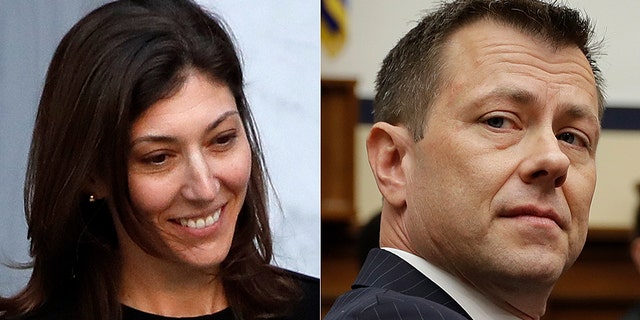
Page and since-fired FBI Special Agent Peter Strzok exchanged numerous anti-Trump text messages
in the lead-up to the 2016 presidential election, and Republicans have
long accused the bureau of political bias. But Page's testimony was
perhaps the most salient evidence yet that the Justice Department
improperly interfered with the FBI's supposedly independent conclusions
on Clinton's criminal culpability, Ratcliffe alleged.
"So let me if I can, I know I’m testing your memory," Ratcliffe began as he questioned Page under oath, according to a transcript excerpt he posted on Twitter. "But
when you say advice you got from the Department, you’re making it sound
like it was the Department that told you: You’re not going to charge
gross negligence because we’re the prosecutors and we’re telling you
we’re not going to —"
Page interrupted: "That is correct," as Ratcliffe finished his sentence, " -- bring a case based on that."
The
document dump was part of a major release by House Judiciary Committee
Republicans, who on Tuesday released hundreds of pages of transcripts
from last year's closed-door interview with Page, revealing new details
about the bureau's controversial internal discussions regarding an
“insurance policy” against then-candidate Donald Trump. Fox News has
previously reviewed portions of Page's testimony.
Page
also testified that the DOJ and FBI had "multiple conversations ...
about charging gross negligence," and the DOJ decided that the term was
"constitutionally vague" and "had either never been done or had only
been done once like 99 years ago," and so "they did not feel they could
sustain a charge."
Former FBI Lawyer Lisa Page and fired FBI Special Agent Peter
Strzok exchanged anti-Trump text messages during their time at the
bureau.
(AP, File)
In July 2016, then-FBI
Director James Comey publicly announced at a bombshell press conference
that Clinton had been "extremely careless" in handling classified
information, but insisted that "no reasonable prosecutor" would bring a
case against her.
Federal
law states that "gross negligence" in handling the nation’s
intelligence can be punished criminally with prison time or fines, and
there is no requirement that defendants act intentionally or recklessly.
Originally
Comey accused the former secretary of state of being “grossly
negligent” in handling classified information in a draft dated May 2,
2016, but that was modified to claim that Clinton had merely been “extremely careless” in a draft dated June 10, 2016.
Comey
also said that "although there is evidence of potential violations of
the statutes regarding the handling of classified information, our
judgment is that no reasonable prosecutor would bring such a case."
He
added that "prosecutors necessarily weigh a number of factors before
bringing charges," including "the strength of the evidence, especially
regarding intent."
Comey
took the unusual step of holding a press conference and announcing the
FBI's purportedly independent conclusions because then-Obama Attorney
General Loretta Lynch was spotted meeting secretly with former President Bill Clinton on an airport tarmac as the probe into Hillary Clinton, which Lynch was overseeing, continued.
Comey's
conclusion that "no reasonable prosecutor" would bring a case against
Clinton has become the subject of significant debate in recent weeks. It
was revealed last month that FBI's top lawyer in 2016 thought Hillary
Clinton and her team should have immediately realized they were
mishandling "highly classified" information based on the obviously
sensitive nature of the emails' contents sent through her private
server.
And he believed she should have been prosecuted until "pretty late" in the investigation, according to a transcript of his closed-door testimony before congressional committees last October.
Strzok
and Page were involved in the FBI’s initial counterintelligence
investigation into Russian meddling and potential collusion with Trump
campaign associates during the 2016 election, and later served on
Special Counsel Robert Mueller’s team.
Among the texts between the
two was one concerning the so-called "insurance policy." During her
interview with the Judiciary Committee in July 2018, Page was questioned at length about that text
-- and essentially confirmed this referred to the Russia investigation
while explaining that officials were proceeding with caution, concerned
about the implications of the case while not wanting to go at "total
breakneck speed" and risk burning sources as they presumed Trump
wouldn't be elected anyway.
Further, she confirmed investigators
only had a "paucity" of evidence at the start. Comey, last December,
similarly acknowledged that when the FBI initiated its
counterintelligence probe into possible collusion between Trump campaign
officials and the Russian government in July 2016, investigators
"didn't know whether we had anything" and that "in fact, when I was
fired as director [in May 2017], I still didn't know whether there was
anything to it."
Then-Rep. Trey Gowdy, R-S.C., kicked off that
section of questioning by asking about the text sent from Strzok to Page
in August 2016 which read: “I want to believe the path you threw out in
Andy’s [McCabe's] office—that there’s no way he gets elected—but I’m
afraid we can’t take the risk. It’s like an insurance policy in the
unlikely event you die before you’re 40.”
The former FBI lawyer
explained how the FBI was trying to strike a balance with the
investigation into the Trump campaign—which agents called “Crossfire Hurricane," in a nod to a Rolling Stones song.
“So,
upon the opening of the Crossfire Hurricane investigation, we had a
number of discussions up through and including the Director regularly in
which we were trying to find an answer to the question, right, which
is, is there someone associated with the [Trump] campaign who is working
with the Russians in order to obtain damaging information about Hillary
Clinton,” Page said. “And given that it is August, we were very aware
of the speed and sensitivity that we needed to operate under.”
Page
continued that, “if the answer is this is a guy just being puffery at a
meeting with other people, great, then we don’t need to worry about
this, and we can all move on with our lives; if this is, in fact, the
Russians have coopted an individual with, you know, maybe wittingly or
unwittingly, that’s incredibly grave, and we need to know that as
quickly as possible.”
Page explained that the text message reflected their “continuing check-in” as to “how quickly to operate.”
“[W]e
don’t need to go at a total breakneck speed because so long as he
doesn’t become President, there isn’t the same threat to national
security, right,” Page explained, while saying that if Trump were not
elected president, the bureau would still investigate.
“But if he
becomes president, that totally changes the game because now he is the
President of the United States,” Page told lawmakers. “He’s going to
immediately start receiving classified briefings. He’s going to be
exposed to the most sensitive secrets imaginable. And if there is
somebody on his team who wittingly or unwittingly is working with the
Russians, that is super serious.” Fox News' Brooke Singman contributed to this report.
Beto O’Rourke
has been slammed for his male privilege in a recent newspaper column
that pointed out that no female politician could get away with
O’Rourke’s style of exploring a presidential campaign bid.
The former Texas Rep. has been rumored to run for president
in 2020 ever since his loss to Sen. Ted Cruz last year in a big-money
Senate race, prompting him to go on a road trip across the country and
stay in the public’s eye. He is also set to travel to Iowa this weekend
in what appears to be a sign that his entry into the White House race is
imminent.
But
O’Rourke is already facing criticism over the way he tried to raise his
profile across the country, which included less talk about policies and
more about publishing odd diary entries, visiting college campuses and
listening to Metallica.
“Imagine, they say, if Beto were Betsy,” Lisa Lerer, a reporter, wrote in The New York Times.
“What would the reception have been if a female candidate left her
three small children home and spent several weeks traveling the country,
posting stream-of-consciousness diary entries? Or if she chose to forgo
a Senate race that would provide a greater opportunity for victory?”
“What
would the reception have been if a female candidate left her three
small children home and spent several weeks traveling the country,
posting stream-of-consciousness diary entries? Or if she chose to forgo a
Senate race that would provide a greater opportunity for victory?” — The New York Times
The
paper noted that female Democrats are growing increasingly frustrated
with O’Rourke’s unorthodox approach and says the fact that his profile
increasing is a sign of double standard that women face.
O’Rourke
particularly irked others after he ruled out a second Senate run last
month, this time for Sen. John Cornyn's (R-Texas) seat, which given his
prominence in the state he would have a good chance to win, as it was
seen as a move serving purely his own interests.
“If a woman was
presented with a similar choice: Do that less ambitious but better for
the party thing, versus more ambitious but longer shot thing, I don’t
see people being super understanding when she takes the latter,” Jess
McIntosh, a Democratic strategist and former Hillary Clinton aide, told
the Times.
Democrats aren’t the only ones attacking the likely
2020 candidate. A group that boosts GOP candidates across the country
will air a two-minute commercial in Iowa that paints O’Rourke as the
prime example of “white male privilege” and compares to former President
Barack Obama, Politico reported.
“With
a charmed life like his, you can never really lose,” the ad by Club for
Growth states. “That’s why Beto’s running for president — because he
can.”
House
Majority Leader Steny Hoyer of Maryland hit back at some of the most
visible new Democrats in Congress when asked Monday by Fox News about
the push to impeach President Trump: “We’ve got 62 new (Democratic) members. Not three.”
Hoyer
apparently was referring to Reps. Alexandria Ocasio-Cortez of New York,
Rashida Tlaib of Michigan and Ilhan Omar of Minnesota, who regularly
have fought the Trump administration's policies since entering Congress.
Earlier Monday, House
Speaker Nancy Pelosi, D-Calif., revealed she’s opposed to impeachment
in the absence of evidence that is “compelling and overwhelming and
bipartisan.”
“I’m not for impeachment,” Pelosi told The
Washington Post in an interview published Monday. “Impeachment is so
divisive to the country that unless there’s something so compelling and
overwhelming and bipartisan, I don’t think we should go down that path,
because it divides the country. And he’s just not worth it.”
Ocasio-Cortez replied in
a Washington Examiner interview: “I happen to disagree with that take.”
The congresswoman added, “But you know, she’s the speaker. … I think
we’ll see.”
Hoyer also said about Pelosi’s words: “It seems to me that she said what we’ve been saying. Maybe a little stronger.”
He
also said he thought anything the House might attempt would die in the
Senate, which requires 67 yeas to convict and remove the president:
“Nobody thinks there is going to be a conviction in the Senate.”
Tlaib said she would introduce articles of impeachment against Trump later this month. She and Omar last month signed a “pledge” to impeach Trump. Fox News’ Chad Pergram contributed to this report.
Rahm is right.
The Democrats are in a leftward lurch that could ruin their chances of retaking the White House.
Rahm Emanuel,
now stepping down after two terms as mayor of Chicago, knows something
about winning elections. He was a key White House operative for Bill
Clinton and chief of staff for Barack Obama.
It
was Rahm, as chairman of the Democratic campaign committee, who
engineered the party's takeover of the House in 2006 — and is known for
his hardball brand of politics, with all the subtlety of his frequent
F-bombs.
If Mayor Emanuel believes the Democrats are in danger of self-destructing, as he argues in a piece for the Atlantic, his party might want to pay attention.
I've
been arguing that the Democrats, who regained control of the House in
November mainly on the strength of more moderate candidates, are
increasingly being defined by their most extreme members.
Just
look at the last few weeks, and the stances embraced by some of its
presidential contenders and younger members: Slavery reparations. Green
New Deal. Medicare for All. Free college tuition. A 70 percent tax rate
on income over $10 million. Break up Amazon, Facebook and Google.
Is that how they win back Trump Democrats in Michigan, Pennsylvania and Wisconsin?
Add
to that various self-inflicted wounds, such as delaying and then
watering down a resolution to denounce Rep. Ilhan Omar after her latest
anti-Semitic comments, and you've got a party with a problem. (President
Trump went way overboard in saying the Democrats have become "an
anti-Jewish party" and telling donors that "the Democrats hate Jewish
people," given that perhaps three-quarters of Jews vote Democratic. But
he was seizing on an opening.)
At the South by Southwest
conference, Alexandria Ocasio-Cortez offered the standard left-wing
critique of capitalism by saying that "we're reckoning with the
consequences of putting profit above everything else in society." But
she added that "to me capitalism is irredeemable," the kind of sound
bite that goes viral, given the enormous media attention she attracts.
And
on "Morning Joe" the other day, 2020 contender John Hickenlooper, the
former Colorado governor, repeatedly refused to call himself a
capitalist. When did that become a dirty Democratic word?
In the Atlantic, Emanuel says Trump could win over swing voters by constantly branding the Democrats as socialists.
"The
last thing we should do is serve him slow pitches over the plate that
allow him to define us on his terms. Unfortunately, that’s exactly what
Democrats have been doing since he went before Congress in early
February. It’s almost as if we've been duped into reading from his
ready-made script.
"Earth to Democrats: Republicans are telling
you something when they gleefully schedule votes on proposals like the
Green New Deal, Medicare for all, and a 70 percent marginal tax rate.
When they're more eager to vote on the Democratic agenda than we are, we
should take a step back and ask ourselves whether we're inadvertently
letting the political battle play out on their turf rather than our own.
If Trump's only hope for winning a second term turns on his ability to
paint us as socialists, we shouldn't play to type."
He's not pulling punches.
While
saying the party shouldn't abandon its core priorities, Rahm says
Democrats and independents are so desperate to win that they'll support a
candidate who doesn't agree with them on everything, as long as that
person is seen as able to win.
"So the ideological debates often
shroud what voters really want — a nominee capable of standing steady
and strong as Trump tries to bully his way into an Election Night
victory. The president's low approval ratings suggest that, if he wins a
second term, Democrats will have no one to blame but ourselves."
What
began as a broadside from the right has now gone decidedly mainstream
as the stumbles continue. The argument even made the front page of Sunday's New York Times:
"The
sharp left turn in the Democratic Party and the rise of progressive
presidential candidates are unnerving moderate Democrats who
increasingly fear that the party could fritter away its chances of
beating President Trump in 2020 by careening over a liberal cliff."
The
challenge for Pelosi is to rein in her more lefty members who are
sharply changing the public face of the party. But she can't control the
Bernie-style presidential candidates who seem to believe that a hard
left turn is the way to win the nomination. Fox News Chastises Pirro
Jeanine Pirro, the Fox weekend host who is friendly with President Trump, has drawn a strong rebuke from the network.
She took on Omar, one of the first two Muslim women elected to Congress, in remarks that crossed a line.
Judge
Jeanine said Saturday night that Omar is "Sharia-compliant" and engages
in "Sharia-adherence behavior." Why? Because the freshman Democrat
wears a hijab.
She asked: "Is her adherence to this Islamic
doctrine indicative of her adherence to Sharia law, which is
antithetical to the U.S. Constitution?"
In a statement, Fox News
said: "We strongly condemn Jeanine Pirro's comments about Rep. Ilhan
Omar. They do not reflect those of the network and we have addressed the
matter with her directly."
I've been critical of Omar for making
anti-Semitic comments about money, then apologizing, then making more
remarks about pro-Israel advocates having "dual loyalty" — an old
anti-Semitic canard that is one of the worst things you can say about
Americans.
But
the congresswoman should be able to wear whatever she wants in
accordance with her religious beliefs. That shouldn't result in her
loyalty to the Constitution being questioned. And the comments were in
Pirro's scripted opening remarks, not something uttered off the cuff.
Omar
thanked Fox for the statement, tweeting: "No one's commitment to our
constitution should be questioned because of their faith or country of
birth."
Pirro, a former prosecutor, is not backing off, however.
In a statement Sunday, she said, "I did not call Rep. Omar un-American.
My intention was to ask a question and start a debate, but of course
because one is Muslim does not mean you don't support the Constitution."
She invited Omar to appear on her show.
As the Hollywood Reporter
noted, Pirro's slam drew criticism from a staffer for "Special Report
with Bret Baier." Associate producer Hufsa Kamal tweeted: "@JudgeJeanine
can you stop spreading this false narrative that somehow Muslims hate
America or women who wear a hijab aren't American enough? You have
Muslims working at the same network you do, including myself. K thx."
Pirro hosts an opinion show, but her comments were out of bounds.
Several Democratic 2020 presidential hopefuls -- including Bernie Sanders, Kamala Harris and now Kirsten Gillibrand -- are defending their self-professed commitment to the ideals of the #MeToo movement against a series of accusations they recently mismanaged sexual-misconduct claims against their subordinates.
As
the three prominent senators each have sought to draw a sharp contrast
with President Trump, who has faced his own misconduct allegations, the
claims highlighted vulnerabilities that could become major liabilities
not only in a heated Democrat Party primary, but also in the general
election.
Back in 2017, Gillibrand and others ramped up the pressure for then-Sen. Al Franken, D-Minn., to resign amid sexual misconduct allegations. He ultimately stepped down.
Gillibrand, who has been described by GQ Magazine as "the face of the MeToo movement," said at the time
that Franken's alleged conduct had "shocked and disappointed her" and
that he should "step aside" because "enough is enough." But, it emerged
on Monday that last summer, an aide in her mid-20’s who was working in
Gillibrand’s Senate office also apparently decided that enough was
enough, as she resigned in protest over the office’s handling of her
sexual-harassment complaint against a senior male adviser to Gillibrand.
“I
have offered my resignation because of how poorly the investigation and
post-investigation was handled,” the woman, who resigned less than
three weeks after reporting the purported harassment, wrote to
Gillibrand in a letter obtained by Politico. Gillibrand,
responding to the allegations on Monday, said an appropriate
investigation was launched -- and her office later said the male staffer
had been fired after other unreported, "deeply disturbing" comments
surfaced.
The woman was granted anonymity because of fears of retaliation.
Gillibrand faced immediate friendly fire
after calling for Franken's resignation -- in 2018, liberal billionaire
megadonor George Soros argued that Gillibrand turned on Franken to
"improve her chances" in the 2020 presidential race -- and some of those
hard feelings among her fellow progressives have not subsided.
For Sanders, the Vermont Independent who caucuses with Democrats, looming resentment from establishment progressives also has posed a major challenge. A January report in The New York Times outlining what
one former Sanders delegate called an "entire wave of rotten sexual
harassment that seemingly was never dealt with" during his 2016
presidential run seemed only to bolster on-the-record claims from Democrats that Sanders was too impersonal and arrogant to lead the party.
Asked by
CNN anchor Anderson Cooper earlier this year whether he was unaware of
the sexual harassment allegations, Sanders replied: "Uh, yes. I was a
little bit busy running around the country, trying to make the case." He
then appeared to smile.
The
next week, after reports surfaced that a top aide was accused of
sexually assaulting a female subordinate during Sanders' campaign, he
issued a strong apology and a vow to change.
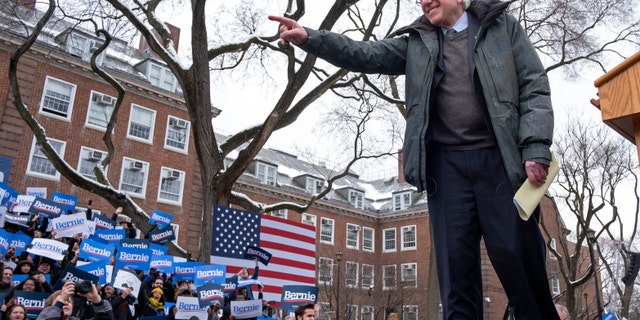
Bernie Sanders kicking off his 2020 presidential campaign earlier
this month in Brooklyn, N.Y. (AP Photo/Craig Ruttle, File)
"To the women in that campaign who were harassed or
mistreated I apologize," Sanders said in a statement. "Our standards and
safeguards were inadequate."
Allegations of sexism also briefly
surfaced contemporaneously during Sanders’ 2016 bid, as some of his
young, white male supporters -- known as "Bernie Bros" -- attacked
Hillary Clinton and her followers online, contributing to a hostile
atmosphere between the campaigns. In her book, the election
retrospective "What Happened," Clinton slammed Sanders for
using “innuendo and impugning my character” such that she
suffered “lasting damage" into the general election, although Clinton
did not accuse Sanders of orchestrating the gender-based attacks.
The
back-and-forth has continued into 2019. Late last month, after former
members of Clinton's team leaked details concerning Sanders' expensive
travel on behalf of the Clinton campaign after she secured the
Democratic nomination, Sanders 2016 campaign spokesman Michael Briggs
returned fire. "You can see why she’s one of the most disliked
politicians in America," Briggs said, referring to Clinton. "She’s not
nice. Her people are not nice." Briggs went on to call Clinton and her
team among the "biggest a--holes in American politics."
But,
although Gillibrand and Sanders have made public overtures to the
alleged victims who worked for them, California Democratic Sen. Kamala
Harris acknowledged earlier this month
that she still had not spoken to a woman who sued her former top
adviser for sexual harassment, leading to a $400,000 settlement.
A
spokeswoman for Harris insisted last December the team was “unaware” of
the harassment allegations while Harris was California’s attorney
general, but the agency that she oversaw, California's Department of
Justice, reportedly was informed about the complaint three months before she exited in early 2017.
The
lawsuit, filed by Danielle Hartley, accused Larry Wallace of demeaning
her based on her gender while she worked for him as his assistant.
Hartley said Wallace placed his computer printer under his desk and
often asked her to crawl under and refill it with paper as he sat and
watched, sometimes with other men in the room.
"In this specific
case, I have not talked to the victim," Harris told Univision. "That
case is being handled by the Attorney General's Office and I've left it
up to that office to handle the case as they've seen fit, which included
a settlement."
In an uncomfortable twist,
Harris' autobiography, “The Truths We Hold: An American Journey,” which
was released in January, praised Wallace's "leadership" in
orchestrating a bias training program. Wallace, the former director of
the Division of Law Enforcement in California, resigned last December.
Republicans, meanwhile, have previewed a possible line of attack against Harris on the episode as primary season approaches.
“No
one is buying Kamala Harris’s claim she didn’t know her top aide of 14
yrs was accused of sexual harassment, resulting in a $400K settlement,”
GOP Chairwoman Ronna McDaniel tweeted. Fox News' Paul Steinhauser, Louis Casiano and Lukas Mikelionis contributed to this report.