OAN Newsroom
UPDATED 11:06 AM PT — Friday, March 15, 2019
Secretary of State Mike Pompeo recently announced new restrictions regarding probes from the International Criminal Court (ICC).
On Friday at the State Department, Pompeo said he would revoke visas
for anyone responsible for for an ICC investigation of U.S. personnel.
The U.S. secretary of state said, “if you are requesting an ICC
investigation of U.S. personnel in connection with a situation in
Afghanistan, you cannot assume you will get a visa to enter the U.S.”
Secretary
of State Mike Pompeo speaks during a news conference at the State
Department, Friday, March 15, 2019 in Washington. (AP Photo/Carolyn
Kaster)
Pompeo went on to say, “this includes persons who take or have taken
action to request or further section an investigation — these visa
restrictions may also be used to deter ICC efforts to pursue ally
personnel, including Israelis , without ally’s consent.
The head of State said he hopes to convince the ICC to change course
in Afghanistan from taking action inconsistent with U.S. views.
Former
British spy Christopher Steele confessed that he used an unverified
report submitted to a CNN website, where “random individuals” can post
information, for his salacious anti-Trump dossier.
Steele
made the awkward revelation during a deposition last year in a case
involving Russian entrepreneur Aleksej Gubarev, who claims his companies
Webzilla and XBT Holdings were defamed by Steele after the dossier was
published by BuzzFeed.
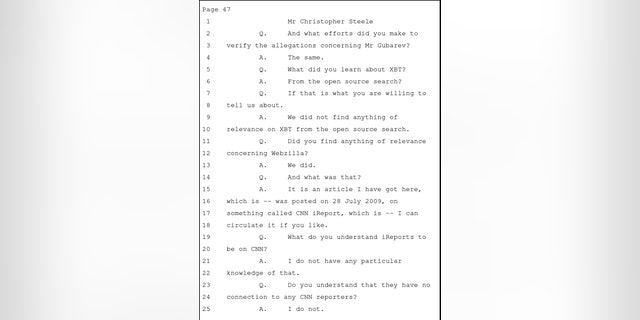
Steele
was asked during the deposition how he verified allegations about
Gubarev's companies and whether he found “anything of relevance
concerning Webzilla,” according to the newly released transcripts of the
deposition.
“We did. It was an article I have got here which was posted on July 28, 2009, on something called CNN iReport,” Steele said.
But CNN iReport, which appears to be no longer active -- though archives remain accessible online -- states that
it’s a “user-generated site” and warns that “the stories submitted by
users are not edited, fact-checked or screened before they post.”
“The stories submitted by users are not edited, fact-checked or screened before they post.” — CNN iReport disclaimer
Even the site’s banner included the slogan “Unedited. Unfiltered. News.”
Former British spy Christopher Steele confessed that he used an
unverified report submitted to a CNN website, where “random individuals”
can post information, for his salacious anti-Trump dossier.
When asked whether the former British spy understood
how the website actually worked, he confessed that “I do not have any
particular knowledge of that” and noted he didn’t understand at the time
that the site has “no connection to any CNN reporters.”
“Do you
understand that CNN iReports are or were nothing more than any random
individuals’ assertions on the Internet?” an examiner asked Steele.
He
replied: “No, I obviously presume that if it is on a CNN site that it
may has [sic] some kind of CNN status. Albeit that it may be an
independent person posting on the site.”
“No, I
obviously presume that if it is on a CNN site that it may has [sic] some
kind of CNN status. Albeit that it may be an independent person posting
on the site.” — Christopher Steele
According to the archive copy
of the iReports site, the website specifically notes that none of the
users who submit content can be described as working for CNN.
“Being
an iReport.com user and creating and uploading content to iReport.com
does not mean that you work for CNN, and you should never represent
yourself as working for CNN,” the site’s FAQ section read.
The
dossier authored by Steele alleged that Gubarev's companies “used
botnets and porn traffic to transmit viruses, plant bugs, steal data and
conduct 'alerting operations' against the Democratic Party leadership”
and that Gubarev himself played a “significant” part in the operation
while “under duress” from the Russian security agency FSB.
The
latest revelation of using unconfirmed sources put the dossier’s
legitimacy further into question, especially since the FBI extensively
relied on the dossier in its warrant applications to the Foreign
Intelligence Surveillance Act (FISA) court in seeking to surveil Trump
aide Carter Page.
Steele
and his company, Orbis Business Intelligence, were hired by Glenn
Simpson's U.S. based company, Fusion GPS, to work on the dossier and
promote its contents to journalists. Fusion GPS received $1.8 million
via the law firm Perkins Coie, with the money paid by the Democratic
National Committee and the Hillary Clinton campaign. Fox News' Catherine Herridge and Adam Shaw contributed to this report.
The latest college cheating scandal
has already caught more than 50 adults red-handed, including coaches,
test administrators, CEOs and Hollywood celebrities – not to mention
embarrassing the heck out of elite universities like Yale, Stanford, Georgetown, USC and UCLA.
That academic cheating goes on
isn’t exactly breaking news. Awhile back The Educational Testing
Service and Ad Council even launched a campaign to discourage it with
the tagline, “Cheating is a personal foul.” With “increased
competitiveness for admission into universities and graduate schools,”
The Academic Cheating Fact Sheet said, cheating is “seen by many
students as a means to a profitable end.”
But what if your parents
are wealthy and do the cheating for you by paying for higher test
scores like “Desperate Housewives” actress Felicity Huffman – who paid
$15,000 disguised as a charitable donation so their daughter could take
part in the college entrance-exam cheating scam, according to court
documents.
Or
what if they scheme to invent athletic achievements to get you into a
top school, like “Fuller House” actress Lori Loughlin, who is accused of
agreeing to pay $500,000 in bribes to have her two daughters designated
as recruits for the University of Southern California crew team despite
that fact that neither child participated in the sport.
You don’t
even have to work to get that top SAT score or the position of crew
captain. It’s purchased for you, like a new iPhone. Just ring it up on
Mastercard…ka-ching.
All looks “profitable” – until you get caught by the Department of Justice.
But
would your kids really want you to do that for them? Why not ask them
and use this as a natural “teachable moment” to highlight the importance
of true self-worth and the value of hard work?
Just throw this
out at the dinner table: “I’d love your opinion on something. I just saw
a shocking news story about some really rich people who paid a lot of
money to get their kids into the right college. We’re not rich, but I’m
wondering: If we were and I did that for the two of you, how would you
feel about it?”
Wait for it. If you have two kids, their responses will predictably be as different as night and day.
Kid
1: “I’d be upset and hurt. You don’t believe in me very much, do you? I
mean, you paid somebody because you didn’t think I could get in myself
by studying and working hard.”
Kid 2 shrugs: “If I could get into a
big school like that as a done deal, without sweating over an
application or a test, cool! What’s bad about that?”
Kid 1 fires
back: “You didn’t get into the school, Dumbo. Mom got you into it by
paying somebody. You telling me you’d feel good about that?”
Kid 2: (Silence).
Kid
1: “And you’d get caught, because you’re stupid. Even if you didn’t,
you could never keep up with the work at a college you didn’t deserve to
get in.”
Look at that. With no lecture from you, your older son
has just solidified his belief in the self-reward of working hard, and
your younger daughter got a wake-up call about the real world.
No
one feels truly good about undeserved rewards being handed to them
(especially if lies are involved). That’s why I always tell parents,
“You never do your kids any favor by snow-plowing their roads in
life.” No one can buy you self-respect. You have to earn it yourself.
Simply
stated, no one feels truly good about undeserved rewards being handed
to them (especially if lies are involved). That’s why I always tell
parents, “You never do your kids any favor by snow-plowing their roads
in life.”
No one can buy you self-respect. You have to earn it yourself.
If
you were one of those two actress moms, imagine explaining what you did
to your daughter(s) over the dinner table: “Honey, I thought you
weren’t smart enough/talented enough to get into that school, so I was
just trying to help…”
Then imagine your daughter’s expression as
she realizes: Not only will I be denied admission to the school I
bragged about getting in to my friends, but my academic track record is
ruined for life.
As I wrote in a previous op-ed,
parents if you think you’re doing those things for your kid, take a
good look in the mirror. You’re selfish. All those things you’re
doing…well, you’re not really doing them for your kid. You’re doing them
for you, because the thought of your kid being unhappy, struggling,
failing, and not being able to compete with their peers drives you
crazy.
But
here’s the irony. Doing anything for your kid that he could do for
himself actually accomplishes the opposite of what you truly want. It
ruins your child’s chance for success in life because it weakens their
resolve, kills their resilience, tears down their self-concept, and
diminishes their desire to do anything in life on their own.
Now that’ll put a major cramp in a parent-child relationship.
U.S. Rep. Alexandria Ocasio-Cortez’s
unfavorable rating has spiked after just months in Congress, with most
of the public viewing her negatively rather than favorably, a new poll
shows.
The New York Democrat shot to fame amid the party’s lurch to the left and embracement of socialist policies such as the Green New Deal, yet the more people learned about the 29-year-old freshman congresswoman, the more they were turned off by her.
A Gallup poll
released Friday shows that Ocasio-Cortez's unfavorable rating has risen
by 15 points since last September, when she had yet to win the general
election, increasing from 26 percent to 41 percent of the American
adults polled.
She has also managed to increase her favorability
rating, but only by 7 points. About 31 percent of surveyed people view
her favorably, compared to 24 percent in September.
Since
September, Ocasio-Cortez became more widely recognized across the
country, with half of the respondents saying they have never heard of
her before. Now only a fifth of surveyed people says they aren’t
familiar with the self-described Democratic socialist.
The
poll notes that Ocasio-Cortez’s name recognition is growing compared to
that of other politicians at the same point in their careers in
Congress. More surveyed people know the New York Democrat than they knew
Sens. Elizabeth Warren, Marco Rubio or Ted Cruz as freshmen.
Overall,
the results suggest that Ocasio-Cortez may be a polarizing figure. Most
of her support is galvanized around younger, more diverse
Democrat-leaning groups, while most of her opposition is composed of
Republicans and more conservative Democrat-leaning groups.
Nearly
three-quarters of Republican respondents say they view her negatively,
with only 5 percent having a positive view. Among the Democrats, 56
percent of respondents had a favorable view of Ocasio-Cortez, compared
to only 15 percent of the Democrats polled who don’t support her.
She’s
also favored by adults 18 to 34, people of color and women. Yet she’s
facing a favorability deficit among men (-24), whites (-24), and
adults 55 or older (-22).
Among self-described independents, she has a negative net rating of 5 percent.
Documents newly unsealed Thursday in a case involving a Russian entrepreneur and anti-Trump dossier author Christopher Steele reveal that a tech company owned by the Russian was used to hack Democratic Party leaders.
Aleksej
Gubarev, a businessman who runs companies across the world, claims his
organizations Webzilla and XBT Holdings were defamed by Steele after the
unverified dossier was published by BuzzFeed on Jan. 10, 2017.
The
dossier alleged that Gubarev's companies “used botnets and porn traffic
to transmit viruses, plant bugs, steal data and conduct 'alerting
operations' against the Democratic Party leadership.” The dossier also
suggested that Gubarev played a “significant” part in the operation
while “under duress” from the Russian security agency FSB.
But
the unsealed documents on Thursday include a forensic analysis
report by a former top cyber expert in the FBI’s cybercrime division
that concludes that Gubarev’s companies were indeed used by Russian
operatives in an effort to hack Democratic Party leaders, the New York Times reported.
The
report notes that the businessman’s companies were often used by
criminal groups and Russian agents to carry out various operations,
including an attack on Ukraine’s power grid in 2015.
Yet while the
report links Gubarev’s companies to Russia’s larger efforts to
interfere in the 2016 presidential election, it doesn’t claim that the
businessman or his executives actually participated in the hacking
operations.
“I have no evidence of them actually sitting behind a
keyboard,” Anthony Ferrante, the report’s lead author, said in a
deposition, according to the Times.
Gubarev denied the involvement
in the hack, while his lawyers tried to ensure the report would be kept
under seal and inaccessible to the public and the media, but the judge
last December refused the request and ordered the documents unsealed.
Steele
and his company, Orbis Business Intelligence, were hired by Glenn
Simpson's U.S. based company, Fusion GPS, to work on the dossier and
promote its contents to journalists. Fusion GPS received $1.8 million
via the law firm Perkins Coie, with the money paid by the Democratic
National Committee and the Hillary Clinton campaign.
A transcript
of a court deposition unsealed Thursday also reveals that an associate
of the late U.S. Sen. John McCain, R-Ariz., was in contact with multiple
journalists and government officials in an effort to disseminate the
dossier.
David Kramer, a former State Department official, said in
a Dec. 13, 2017, deposition that the dossier was provided to
journalists at McClatchy, NPR, the Washington Post, the Wall Street
Journal and BuzzFeed and CNN’s Carl Bernstein, according to the Daily Caller.
The
report by Steele was also shared with State Department official
Victoria Nuland, Obama National Security Counsel official Celeste
Wallander and Illinois GOP Rep. Adam Kinzinger.
Kramer said that Fusion GPS founder Glenn Simpson suggested he would use McCain to pass the dossier around.
“I
think they felt a senior Republican was better to be the recipient of
this rather than a Democrat because if it were a Democrat, I think that
the view was that it would have been dismissed as a political attack,”
Kramer said, according to the outlet.
Ambulance staff take a man from outside a mosque in central
Christchurch, New Zealand, Friday, March 15, 2019. A witness says many
people have been killed in a mass shooting at a mosque in the New
Zealand city of Christchurch.(AP Photo/Mark Baker)
One person has been charged in connection
with a “well-planned” terrorist attack that killed 49 people and injured
dozens more in two mosques in New Zealand on Friday, authorities said.
The
New Zealand police said four people -- three men and one woman -- were
in custody in connection with the attack. Investigators later defused a
number of improvised explosive devices that were found inside vehicles.
Prime Minister Jacinda Arden described the suspects as one principal,
two associates and one person not directly connected to the attacks. She
said the suspects were not on any security watch lists.
"These are people who I would describe as having extremist views, that have absolutely no place in New Zealand." Arden said.
Thirty
people were killed at the Masjid Al Noor mosque in central Christchurch
and seven were slain inside the Linwood Masjid Mosque. Another three
died outside the Linwood mosque.
Australian Prime Minister Scott
Morrison confirmed that one of the detainees was a 28-year-old white
Australian-born citizen. He described the suspect as “an extremist,
right-wing, violent terrorist.”
The suspects were apprehended by
local police following Friday's attack, Mike Bush, New Zealand's police
commissioner, told reporters at a news conference. No motive for the
attack has been determined.
Investigators did not rule out that more gunmen could be involved, he said.
Police were also working to remove an unconfirmed video that circulated online
showing the Australian suspect entering a mosque and firing multiple
shots at people inside. He claimed responsibility for the shooting and
reportedly published a 74-page anti-immigrant manifesto prior to the
killings. He wrote that he traveled to the island nation to train and
commit the attack.
In one video frame, the suspect is seen driving
to the mosque with what appeared to be several semi-automatic weapons
inside his vehicle.
Officers responded to a shooting at the Masjid
Al Noor in Christchurch on Friday afternoon and also responded to a
second shooting at the nearby Linwood Masjid mosque.
Authorities
were not sure if any other locations were under threat and urged
worshipers to refrain from visiting any mosque in the country, Bush
said. A brief lockdown of Christchurch schools was lifted Friday
evening. AOC DRAWS IRE RIPPING ‘YOUR THOUGHTS AND PRAYERS’ AFTER CHRISTCHURCH MOSQUE SHOOTINGS
Ardern said Friday's events represented "one of New Zealand's darkest days."
Witnesses
said the Masjid Al Noor mosque was full for Friday afternoon prayers
when the shooting occurred. Len Peneha told the Associated Press that he
saw a man dressed in black enter the mosque and then heard dozens of
gunshots. That was followed by terrified mosque-goers running from the
terror. A suspect was seen outside, fleeing after dropping what appeared
to be a semi-automatic weapon, witnesses said.
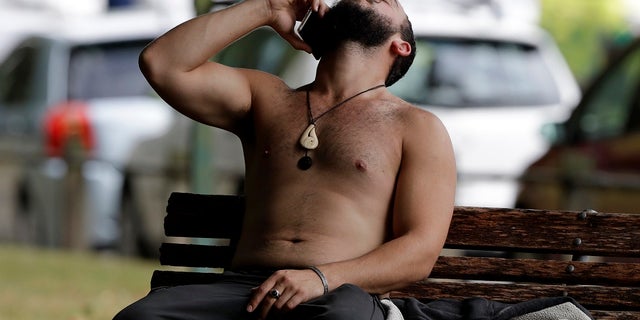
A man reacts as he speaks on a mobile phone outside a mosque in
central Christchurch, New Zealand, Friday, March 15, 2019. A witness
says many people have been killed in a mass shooting at a mosque in the
New Zealand city of Christchurch.(AP Photo/Mark Baker)
"I saw dead people everywhere," one nearby resident said.
Another
witness told TVNZ he saw three women shot and bleeding outside the
mosque. A third witness said a suspect fired more than 50 shots,
Stuff.co.NZ reported.
"He had a big gun and a lot of bullets and
he came through and started shooting, like, everyone in the mosque,
like, everywhere, and they have to smash the door and the glass from the
window and from the small door to try and get out," he said. WITNESSES SAY MANY DEAD, INJURED IN SHOOTING AT NEW ZEALAND MOSQUE
Retno
Marsudi, Indonesia's foreign minister, said six Indonesians were inside
the Al Noor Mosque when the shooting occurred and three escaped.
“We are looking for three other Indonesian citizens," Marsudi said.
Members
of the Bangladesh cricket team said they narrowly escaped the shooting
at the Masjid Al Noor mosque. Players and coaching staff were reportedly
getting off a bus when the shooting broke out. Tamim Iqbal, a batsman
on the team, tweeted: “Entire team got saved from active shooters.
Frightening experience and please keep us in your prayers.”
Mario
Villavarayen, a strength and conditioning coach with the team, told New
Zealand media the players did not see the suspect but heard shots. He
said the group was shaken but unhurt.
“I
spoke to one of them shortly after,” Vllavarayen said. They didn’t see
anything but heard gunshots. They were at the ground and just started
running. The coaching staff were all at the hotel.”
The team reportedly fled the scene on foot to Hagley Oval where it was scheduled to play New Zealand on Saturday. The Associated Press contributed to this report.
The
Justice Department "negotiated" an agreement with Hillary Clinton's
legal team that ensured the FBI did not have access to emails on her
private servers relating to the Clinton Foundation, former FBI special agent Peter Strzok testified during a closed-door appearance before the House Judiciary Committee last summer, according to a newly released transcript.
Republicans late last year renewed their efforts to
probe the Clinton Foundation, after tax documents showed a plunge in
its incoming donations after Clinton’s 2016 presidential election. The
numbers fueled longstanding allegations of possible “pay-to-play” transactions at the organization, amid a Justice Department probe covering foundation issues.
Under
questioning from Judiciary Committee General Counsel Zachary Somers,
Strzok acknowledged that Clinton's private personal email servers
contained a mixture of emails related to the Clinton Foundation, her
work as secretary of state and other matters.
"Were you given access to [Clinton Foundation-related] emails as part of the investigation?" Somers asked
"We
were not. We did not have access," Strzok responded. "My recollection
is that the access to those emails were based on consent that was
negotiated between the Department of Justice attorneys and counsel for
Clinton."
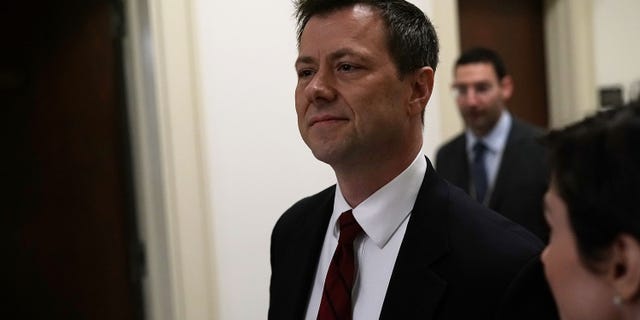
Peter Strzok arrives at a closed-door interview before the House
Judiciary Committee in June. (Photo by Alex Wong/Getty Images)
(Photo by Alex Wong/Getty Images)
Although
the FBI eventually took possession of the servers, Strzok continued,
the possession was "based upon the negotiation of Department of Justice
attorneys for consent."
"A significant filter team" was employed
at the FBI, Strzok said, to "work through the various terms of the
various consent agreements." Limitations imposed on agents' searches
included date ranges, and names of domains and people, Strzok said,
among other categories.
The agreement was reached, Strzok said,
because “according to the attorneys, we lacked probable cause to get a
search warrant for those servers and projected that either it would take
a very long time and/or it would be impossible to get to the point
where we could obtain probable cause to get a warrant.”
Strzok
did not elaborate on whether prosecutors made any effort to secure a
search warrant, which could have delineated precisely what agents could
and could not search.
But Strzok later said that agents had access
to the "entire universe" of information on the servers when using
search terms to probe their contents. He also told Somers that "we had
it voluntarily," although it was unclear if he meant all emails on the
servers -- including ones related to the Clinton Foundation.
Former
Utah Rep. Jason Chaffetz, who chaired the House Oversight and
Government Reform Committee until 2017 and is now a Fox News
contributor, said the arrangement signaled that agents wanted willful
blindness.
"They had no interest in pursuing the truth." — Former Oversight committee chair Rep. Jason Chaffetz
"What's
bizarre about this, is in any other situation, there's no possible way
they would allow the potential perpetrator to self-select what the FBI
gets to see," Chaffetz said, noting that the FBI was aware that the
servers contained classified information in unclassified settings.
"The FBI should be the one to sort through those emails -- not the
Clinton attorneys."
The DOJ's goal, Chaffetz said, was to "make sure they hear no evil, see no evil -- they had no interest in pursuing the truth."
Chaffetz
added that the DOJ's behavior, including its award of immunity to top
Clinton aides early on in the investigation, signaled a clear double
standard: "They didn't go make a deal with anyone in Trump's orbit. They
seized it. They used guns and agents -- and just went in there and took
it."
"The Clinton Foundation isn't supposed to be communicating
with the State Department anyway," Chaffetz continued. "The foundation
-- with her name on it -- is not supposed to be communicating with the
senior officials at the State Department."
The Clinton Foundation did not respond to Fox News' request for comment.
Republican-led
concerns that the DOJ, under the Obama administration, was too cozy
with the Clinton team during the 2016 presidential campaign have grown
louder in recent days. Earlier this week, Fox News exclusively reviewed
an internal chart prepared by federal investigators working on the
so-called "Midyear Exam" probe into Clinton's emails. The chart
contained the words "NOTE: DOJ not willing to charge this" next to a key
statute on the mishandling of classified information.
The
notation appeared to contradict former FBI Director James
Comey's repeated claims that his team made its decision that Clinton
should not face criminal charges independently.
But Strzok, in his
closed-door interview, denied that the DOJ exercised undue influence
over the FBI, and insisted that lawyers at the DOJ were involved in an
advisory capacity working with agents.
Fox News also confirmed the chart served as a critical tip
that provided the basis for Texas Republican Rep. John
Ratcliffe's explosive questioning of former FBI lawyer Lisa Page last
year, in which Page agreed with Ratcliffe's characterization that the
DOJ had told the FBI that "you're not going to charge gross negligence."
A
transcript of Page's remarks was published Tuesday as part of a major
document release by the ranking Republican on the House Judiciary
Committee, Georgia Rep. Doug Collins.
Separately in the
closed-door session, Strzok defended his affair with Page, repeatedly
denying that the relationship presented a security risk when challenged
by GOP aides.
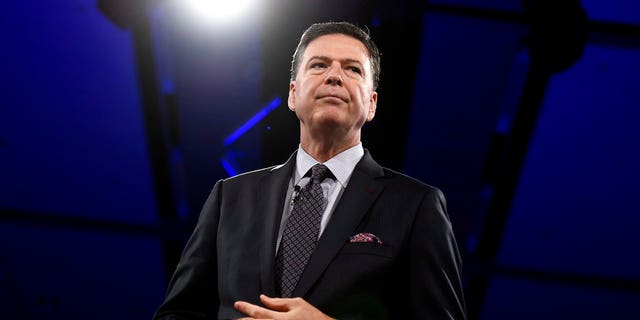
Former FBI director James Comey speaks during the Canada 2020
Conference in Ottawa on Tuesday, June 5, 2018. (Justin Tang/The Canadian
Press via AP)
Strzok, who was fired from the bureau after months of
scrutiny regarding anti-Trump text messages between him and Page,
confirmed he was involved in an extramarital affair when asked about it
during his interview before the committee on June 27, 2018. But Strzok
was also asked by Art Baker, the GOP investigative counsel for the
committee, whether that affair could have made him "vulnerable to
potential recruitment" by "hostile intelligence service[s]."
“Yeah,
I don’t think I would characterize it that way,” Strzok said. “I think
it is not so much any particular action as it is the way that action
might be used to coerce or otherwise get somebody to do something. I can
tell you that in no way would that extramarital affair have any power
in coercing me to do anything other than obeying the law and doing
honest, competent investigation." Fox News' Brooke Singman and Catherine Herridge contributed to this report.
U.S. Rep. Alexandria Ocasio-Cortez, D-N.Y.,
slammed those expressing thoughts and prayers for the victims of
Friday's mass shooting that killed 49 people in Christchurch, New
Zealand.
Reacting to remarks made by New Zealand Prime Minister Jacinda Ardern, Ocasio-Cortez took to Twitter and invoked other mass shootings that took place in houses of worship. WHAT YOU SHOULD KNOW ABOUT ALEXANDRIA OCASIO-CORTEZ'S SOCIALIST VISION FOR AMERICA
“At
1st I thought of saying, ‘Imagine being told your house of faith isn’t
safe anymore.’ But I couldn’t say ‘imagine.’ Because of Charleston.
Pittsburgh. Sutherland Springs,’” Ocasio-Cortez wrote.
The
congresswoman was referencing the 2015 Charleston shooting at the
Emmanuel A.M.E. Church that left nine dead, the 2017 Sutherland Springs
shooting at the First Baptist Church that left 27 dead, and the 2018
Pittsburgh shooting at the Tree of Life Synagogue that left 11 dead.
“What good are your thoughts & prayers when they don’t even keep the pews safe?” she asked.
That sparked plenty of backlash on social media.