Donald
Trump Jr. will testify Wednesday behind closed doors before the
Republican-led Senate Intelligence Committee, Fox News has learned, as
part of what the president has called an "unfair" effort to subject his
son to yet another interview on Russia-related matters.
Fox News
is told that the interview will likely be relatively brief. “It’s not
going to go on for three hours," a source familiar with the matter said.
Trump
Jr. has already provided more than two dozen hours of testimony before
Congress. He previously spoke with the intelligence committee staff in
2017, when he also sat for an interview with the Senate Judiciary
Committee.
The latest meeting comes after the committee's Republican chairman, North Carolina Sen. Richard Burr, subpoenaed him
as part of the panel's Russia investigation. Burr received considerable
blowback from some of his GOP colleagues for the move, but he told
fellow senators that Trump Jr. had backed out of an interview twice,
forcing the committee to act.
Fox News reported last month
that Trump Jr. was prepared to make the committee hold him in contempt
and had a defiant letter drafted and ready to send -- but at the last
minute, the committee reached out to resolve the dispute. The draft
letter cited Trump Jr.'s 20-plus hours of testimony under oath, and the
thousands of documents that he has already given to congressional
committees -- as well as Special Counsel Robert Mueller's exhaustive
analysis of that testimony. Mueller found no evidence Trump Jr.
committed a crime.
Senate Intelligence Committee Chairman. Sen. Richard Burr, R-N.C.,
right, joined by Vice Chairman Sen. Mark Warner, D-Va., left, at a
Senate Intelligence Committee hearing on Capitol Hill in Washington,
Thursday, March 30, 2017. (AP Photo/Susan Walsh) (The Associated Press)
Trump Jr. had been concerned about an open-ended time
and subject commitment, sources told Fox News in May. Ultimately, the
panel agreed to limit questioning to one to two hours, with narrow room
for followups. A source familiar with the discussions told Fox News the
panel would not agree to limit topics.
Several
Russia-related matters are expected to be on the agenda. Trump's former
lawyer, Michael Cohen, told a House committee in February that he had
briefed Trump Jr. some 10 times about a plan to build a Trump Tower in
Moscow before the presidential election. Trump Jr. told the Judiciary
Committee in 2017 he was only "peripherally aware" of the real estate
proposal.
The panel is also interested in talking to Trump Jr.
about that and other topics, including a campaign meeting in Trump Tower
with a Russian lawyer that captured the interest of Special Counsel
Robert Mueller. Mueller's report, released in April, examined the
meeting but found insufficient evidence to charge anyone with a crime.
Trump said in May he believed that his son was being treated poorly.
"It's
really a tough situation because my son spent, I guess, over 20 hours
testifying about something that Mueller said was 100 percent OK and now
they want him to testify again," Trump told reporters at the White
House. "I don't know why. I have no idea why. But it seems very unfair
to me."
Some Republicans have said Trump Jr. should not comply
with the subpoena, which is believed to be the first subpoena targeting a
member of the president's family.
Burr's home state colleague,
Sen. Thom Tillis, R-N.C., tweeted, "It's time to move on & start
focusing on issues that matter to Americans." Sen. John Cornyn of Texas,
a GOP member of the panel, said he understood Trump Jr.'s frustration.
Cornyn's Texas colleague, Republican Sen. Ted Cruz, said there was "no
need" for the subpoena.
Senate Majority Leader Mitch McConnell,
R-Ky., has defended Burr, saying "none of us tell Chairman Burr how to
run his committee."
Still, McConnell made it clear that he is eager to be finished with the probe, which has gone on for more than two years.
It
remains uncertain when the intelligence panel will issue a final
report. Burr said last month that he hopes to be finished with the
investigation by the end of the year. Fox News' Jason Donner, John Roberts and The Associated Press contributed to this report.
Sean Hannity decried NBC Tuesday over the decision to have Rachel Maddow moderate part of the Democratic debates this month.
“It
literally includes the chief conspiracy theorist,” he said of the MSNBC
host who will join Lester Holt, Savannah Guthrie, Jose Diaz-Balart and
Chuck Todd for the June 26 and 27 debates.
“Didn’t
we tell you this would happen, that the media would refuse to hold any
of their ‘fake news’ fanatics accountable?” Hannity mused.
He
said NBC is rewarding Maddow’s “fake news” by giving her more air time
and wondered how “real” reporters feel about being passed over by
“Tinfoil hat-Maddow, the single biggest liar, conspiracy theorist in
the country, the person that pushed the Russiagate lies night after
night.”
Maddow will co-host the second hour of both nights alongside Holt and Todd. Holt will host the entirety of the debate.
“Here’s
what we’re going to do,” Hannity joked to guests Sean Spicer and Jesse
Watters. “We’ll have a debate moderated by me, the Great One [Mark
Levin], Rush Limbaugh, Jesse can join us, and Laura [Ingraham]
and Tucker [Carlson]. How’s that?”
Spicer
said he was “excited” to see Maddow at the debate because she’s “so
extreme” that she will drag all of the candidates farther to the
“extreme left.”
The New York Times even pointed out that opinion journalists are rarely chosen as debate moderators.
A Virginia Democrat,
who was accused in 2014 of having sex with his teenage secretary he
later married, won the Democratic primary on Tuesday for the state’s
16th Senate District.
Joe Morrissey, a former state legislator, defeated incumbent senator Rosalyn Dance by over 10 points despite Gov. Ralph Northam endorsing her in the final weekend of the campaign.
His
victory in the primary comes even though he was sentenced four years
ago and jailed over a scandal involving a minor. He was in his fifties
at the time while the minor was 17 years old. She worked at his law
office.
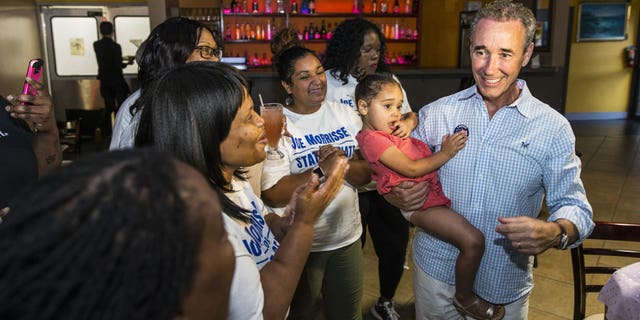
Joe Morrissey, right, with his daughter Bella, 3, celebrates his
Democratic primary win in 16th District State Senate race with his
supporters at the election party of Plaza Mexico in Petersburg, Va.,
Tuesday, June 11, 2019.
(Daniel Sangjib Min/Richmond Times-Dispatch via AP)
Despite
denying the wrongdoing, he pleaded guilty in 2015 to a misdemeanor,
contributing to the delinquency of a minor and admitted that prosecutors
had enough evidence for a conviction.
The Democrat spent six
months in jail for the crime but managed to continue serving in the
state legislature during the sentence.
Republicans
immediately jumped on Morrissey’s victory in the primary, tweeting a
mock congratulatory note and adding “You’ll fit right in with [Virginia
Lt. Gov.] Justin Fairfax,” referring to sexual misconduct allegations
against Fairfax by two separate women.
But despite the past legal
problems, voter strongly endorsed Morrissey’s platform that consists of a
number of progressive measures, including higher minimum wage and
marijuana decriminalization.
“People
try to blow things up more than what it is,” Voter Melvin Washington
told the Associated Press. “Ain’t none of us perfect.”
Morrissey is posed to easily cruise to victory as the seat has long been held by Democrats and is considered a safe seat. The Associated Press contributed to this report.
Texas Governor Greg Abbott on Monday signed the so-called “Save Chick-fil-A”
bill into law, a new provision that supporters say defends the
fast-food restaurant and protects religious freedoms. Opponents have
argued it discriminates against the LGBT community.
Abbott, a Republican, did not hold a public signing ceremony, but he had signaled his support through a tweet a few weeks ago, DallasNews.com reported.
On May 20, Abbott tweeted
a picture of a Chick-fil-A soft drink in front of a laptop showing a
news article with the headline “'Save Chick-fil-A' bill heads to Texas
Gov. Greg Abbott’s desk” and wrote, “So. What are the odds I’ll sign the
Chick-fil-A bill? I’ll let you know after dinner. @ChickfilA #txlege” The new law stops the government from taking unfavorable action against a business or person for contributions to religious organizations.
The
bill was fast-tracked in the GOP-controlled legislature and originally
was introduced after the San Antonio City Council blocked Chick-fil-A
from opening a location in the city’s airport because of reported
donations to organizations that protest gay marriage and other LGBT
issues.
Some council members said they were taking a stand over
Chick-fil-A’s values and the fact that the owners have donated to
anti-LGBT causes.
In
March, councilmember Roberto Trevino reportedly said the city did “not
have room in our public facilities for a business with a legacy of
anti-LGBTQ behavior.”
Republicans responded with a bill that
would not allow cities to take “adverse action” against an individual
based on contributions to religious organizations.
The bill
rekindled battles over divisive social issues. The legislature was riled
over a “bathroom bill” targeting transgender people two years ago. LGBT
lawmakers reportedly said during emotional floor speeches that they'd
had enough.
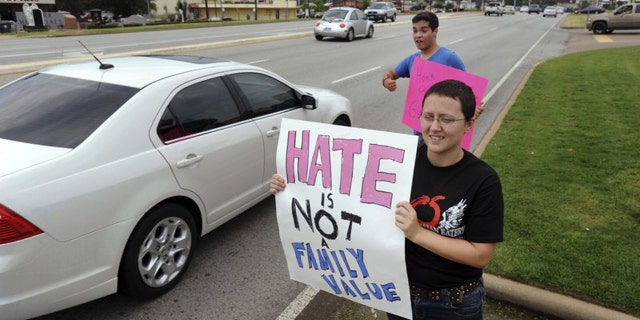
Texans holding signs supporting gay marriage outside of a Chick-fil-A in Tyler, in 2012.
(Sarah A. Miller/Tyler Morning Telegraph via AP, File)
State Rep. Jessica Gonzalez, a Democrat, said the bill was a personal insult given she is openly gay, DallasNews.com reported.
"Of
course this bill is aimed at me," she said. "It's about reminding those
of us who have never belonged not to get too comfortable."
Fort
Worth Republican Rep. Matt Krause, the House sponsor, defended the bill
as a way to protect the rights of religious Texans, DallasNews.com
reported.
Gov. Greg Abbott signed the "Save Chick-fil-A" bill into law Monday.
(Getty, iStock)
The media outlet reported
that Krause said Chick-fil-A was unfairly labeled as anti-LGBT because
of its donations to organizations such as the Salvation Army and the
Fellowship of Christian Athletes, which also reportedly receive
donations from other big companies.
The lawmakers involved did not immediately return Fox News' requests for comment.
The new law is set to go into effect on September 1. The Associated Press contributed to this report.
Fox News' Laura Ingraham addressed politicians who are putting America's health and well-being "at risk," specifically the government of California.
"Over
the weekend, we learned that California has gone from sanctuary state
for dreamers to just being a sucker state for Americans. They just
announced state budget deal will now give health care benefits to many
adult illegals too. Those between the ages of 19 and 25 will now be
eligible for California's 'Medicaid' program known as 'Medi-Cal,'"
Ingraham said Monday night on "The Ingraham Angle."
Democratic Gov. Gavin Newsom proposed $98 million a year to cover low-income illegal immigrants
between the ages of 19 and 25, but the state Assembly’s bill would
cover all illegal immigrants over the age of 19 living in California – a
proposal that would cost an estimated $3.4 billion.
The state Senate, meanwhile, wants to cover adults ages 19 to 25, plus seniors 65 and older.
Ingraham
argued California is ignoring their homeless problem and homeless vets
and instead helping in favor of illegal immigrants.
"Think those homeless people including homeless vets might be able to use that money?" Ingraham said.
Ingraham
also pointed out that Californians will tax citizens who don't have
health insurance, essentially reviving the penalty part of the
Affordable Care Act.
"How they're going to pay for this by the
way, by taxing citizens who don't have health insurance. In other words,
reviving the penalty of Obamacare," Ingraham said.
The Fox News host also brought up the 500 migrants from African nations
-- including the Republic of Congo -- that have been apprehended in
Texas, at the Del Rio Border Patrol sector of the U.S.-Mexico border,
since May 30, according to U.S. Customs and Border Protection.
The
African migrants were recently sent to San Antonio, Texas while eastern
Congo is experiencing an Ebola outbreak with over 2,000 cases reported.
Ingraham raised concerns for the health of San Antonio citizens.
"One
wonders where is the concern for the health of the San Antonio
citizenry? Frankly citizens across the United States. Who's going to
translate their concerns to federal officials? And why is no one
questioning the pressure that this will place on communities across the
country that are now obligated to house, educate, and feed people from
other continents when we seem incapable in some cases of caring for our
own citizens," Ingraham said. Fox News' Danielle Wallace, David Montanaro and The Associated Press contributed to this report.
Gov. Janet Mills delivers her State of the Budget address to the
Legislature, Monday, Feb. 11, 2019, at the State House in Augusta,
Maine.
(AP Photo/Robert F. Bukaty)
Maine’s Democratic governor signed an abortion bill into law on Monday that allows medical professionals who are not doctors to perform the procedure.
Gov. Janet Mills signed the bill expanding abortion access which she introduced herself. It will formally go into effect 90 days after the Legislature adjourns, around September.
But the law is facing criticism for expanding the list of
professionals who could perform an abortion. Critics say it could
potentially make the procedure less safe.
“Expanding who is
allowed to perform an abortion does not expand the safety of the
procedure,” Republican state Sen. Stacey Guerin has said.
“Expanding who is allowed to perform an abortion does not expand the safety of the procedure.” — Republican state Sen. Stacey Guerin
Carroll Conley, executive director of the Christian Civic League of Maine, also echoed the safety concerns and told the New York Times
that it’s unclear whether nurses and other health care professionals
will receive enough training to administer abortion by the time the law
takes effect.
She added that the legislation is more about
politics as there’s no evidence that women in Maine are experiencing
problems in getting abortion services due to proximity.
In most
states, only physicians perform abortions, but Maine is now set to allow
nurse practitioners, physician assistants and certified nurse-midwives
to provide abortion medication and perform in-clinic abortions.
Maine
will be the second state after California with a law allowing
non-doctors to perform in-clinic abortions, according to Maine’s Office
of Policy and Legal Analysis. Nearly two dozen states, including Vermont
and New Hampshire, have expanded their list of abortion-medication
providers following court or agency rulings.
Supporters of the
bill say abortion is one of the safest medical procedure and the
restrictions on who can perform the procedure are outdated.
“States
across the country, including Vermont and New Hampshire, have already
eliminated this outdated restriction on abortion care,” said Sara
Gideon, the speaker of the Maine House of Representatives. “This law
will allow women to receive the care they need from a provider they
trust and eliminate the financial and logistical hurdles they face
today.”
The law in Maine comes after other Democrat-led states
moved to protect or expand abortions access in their states following a
series of pro-life measures in red states, most notably in Alabama where
abortion was banned after six weeks.
“Maine
is defending the rights of women and taking a step toward equalizing
access to care as other states are seeking to undermine, rollback, or
outright eliminate these services,” the state governor said.
The
law also came in the wake of lawsuits from advocacy groups and abortion
clinic suing Maine over its abortion provider restrictions and ban on
state Medicaid funds for abortions.
The Associated Press contributed to this report.
House Democrats on Monday evening abruptly halted an effort to increase congressional
pay for the first time since 2009, saying the proposal would be
reviewed carefully after several freshman Democrats made overt efforts
to block it.
Members of Congress generally make $174,000 per year,
with senior leaders earning more, and no cost-of-living adjustments
have been made in the past nine years. However, vulnerable swing-state
Democrats, concerned how the proposed $4,500 pay hike would look if it
didn't also have Republican support, had signed onto amendments
rejecting the measure.
“It needs more discussion,” House Appropriations Committee Chairwoman Nita Lowey, D-N.Y., told Fox News.
New
York Democrat Rep. Alexandria Ocasio-Cortez, meanwhile, told Fox News
Monday that the planned $4,500 bonus was simply a cost-of-living
adjustment.
"“It’s not even like a raise," Ocasio-Cortez said. She
called opposition to the pay increase "superficial. ... This is why
there's so much pressure to turn to lobbying firms and to cash in on
member service after people leave, because precisely of this issue."
Ocasio-Cortez added that both members of Congress and people making minimum wage deserve more money.
“It’s not even like a raise." — New York Democrat Rep. Alexandria Ocasio-Cortez
"It
may be politically convenient, and it may make you look good in the
short term for saying, 'Oh we're not voting for pay increases,' but we
should be fighting for pay increases for every American worker," she
said. "We should be fighting for a $15 minimum wage pegged to inflation
so that everybody in the United States with a salary with a wage gets a
cost of living increase. Members of Congress, retail workers, everybody
should get cost of living increases to accommodate for the changes in
our economy. And then when we don't do that, it only increases the
pressure on members to exploit loopholes like insider-trading loopholes,
to make it on the back end."
The Congressional Research Service (CRS) found in May
that, adjusted for inflation, salaries for members of Congress "have
decreased 15 percent since the last pay adjustment in 2009." Following
a cost-of-living adjustment formula established in 2009, members of
Congress should currently be making $210,900, the CRS found.
The
turnaround on congressional pay was one in a series of dramatic
developments during a whirlwind day on Capitol Hill, with many more
potentially still to come. In the evening, the Democrat-led House Rules
Committee conducted a hearing in which it prepared a resolution for
debate Tuesday that would enforce a subpoena via contempt for both
Attorney General William Barr and former White House Counsel Don McGahn.
The
resolution does not mention contempt by name. But it is, for all
intents and purposes, a civil contempt resolution. The full House is
expected to vote on the resolution Tuesday.
"I wish we didn’t have
to be here today," Rules Committee Chairman Jim McGovern, D-Mass., said
at the hearing. "I wish Donald Trump acted more like a president and
less like a king. But this resolution is necessary because of his
actions and those of his administration."
The Judiciary Committee, led by chairman Jerry Nadler, D-N.Y., earlier in the day backed off its own effort to
hold Barr in criminal contempt. Nadler reached a deal with the Justice
Department for access to evidence related to former Special Counsel
Robert Mueller’s Russia report, although the precise contours of the
arrangement remained unclear.
In a statement, Nadler announced the agreement with the Justice Department to
turn over key evidence from Mueller’s investigation pertaining to the
review of whether President Trump obstructed justice. Nadler asserted
only that the "most important files" would be revealed to members of the
committee from both parties.
As of 8 p.m. ET, Democrats said they expected to receive the files shortly.
Nadler's deal with the DOJ came moments before the Judiciary Committee opened a fireworks-laden hearing with Nixon Watergate counsel John Dean. House
Republicans lined up to hammer Dean, saying he deliberately obstructed
their questioning of former Trump lawyer Michael Cohen earlier this year
and pointing out how he's accused numerous Republican presidents of
Watergate-like misconduct over the years.
At one point, the
hearing room broke out into laughter, as Florida Republican Rep. Matt
Gaetz grilled Dean for turning Nixon comparisons into a
profitable "cottage industry" for himself.
"Mr. Dean, how many American presidents have you accused of being Richard Nixon?" Gaetz asked.
"I
actually wrote a book about Mr. Bush and Mr. Cheney with the title,
'Worse than Watergate,' Dean responded, prompting loud laughter from the
audience.
The
House Oversight Committee, meanwhile, said it will prepare a
separate contempt resolution for Barr and Commerce Secretary William
Ross over documents and information related to the citizenship question
in the 2020 census. That vote is expected Wednesday and relates to
Democrats' concerns that the Trump administration included a citizenship
question to deter illegal immigrants from filling out their census
forms.
Legal experts generally have concurred that under the 14th
Amendment, the census constitutionally must count all people in the
U.S., including illegal immigrants. Census figures, in turn, are used to
calculate how many members of Congress each state is afforded.
Democrats, by many accounts, would lose representation in Congress if
illegal immigrants were undercounted.
The Supreme Court is
currently weighing the legality of the Trump administration's decision
to include the census question, following a lawsuit by 18 states against
the addition. Justice Ruth Bader Ginsburg, speaking to a meeting of
lawyers and judges earlier this week, remarked that "the event of
greatest consequence for the current term, and perhaps for many terms
ahead" was the resignation of Justice Anthony Kennedy, who was replaced
by Brett Kavanaugh.
That comment prompted speculation that the high court would uphold the census question by a 5-4 margin.
The
citizenship question was last asked on the census in 1950, but
beginning in 1970, a citizenship question was asked in a long-form
questionnaire sent to a relatively small number of households, alongside
the main census. In 2010, there was no long-form questionnaire.
"There
is no credible argument to be made that asking about citizenship
subverts the Constitution and federal law," Chapman University law
professor and constitutional law expert John Eastman told Fox News. "The
recent move is simply to restore what had long been the case."
And
yet, more drama remains possible this week concerning the Democrats'
spending bills, which were to contain the pay hike for legislators. The
rest of the amalgamated spending bill is still expected to be on the
floor later this week, funding four of the 12 federal spending
areas. The combination measure would fund State and Defense Department
operations, Energy and Water programs, as well as the Departments of
Labor and Health and Human Services.
The so-called Hyde
Amendment, which blocks federal funding for abortion, is customarily a
part of the Labor Department-Health and Human Services
(HHS) appropriations bill.
A
recent furor over the Democrats' position on abortion -- and votes that
former Vice President Joe Biden took over the years supporting the Hyde
Amendment -- could derail the bill. Biden last week suddenly changed
his decades-long support for the once-bipartisan Hyde Amendment amid
pressure from the party's progressive wing.
Biden's communications director, in a testy interview with CNN, struggled to explain why Biden had changed his mind, if not for political expediency. Fox News' Chad Pergram and Brooke Singman contributed to this report.
Michigan
Repubican Rep. Justin Amash announced Monday evening he was leaving the
influential conservative House Freedom Caucus, just weeks after he
attracted the ire of his colleagues by arguing in Twitter posts that President Trump had committed impeachable offenses, Fox News has learned.
Amash,
speaking at a Freedom Caucus board meeting, insisted his departure was
voluntary. Amash said he did not want to continue to be a "further
distraction" for the caucus, which is chaired by North Carolina GOP Rep.
Mark Meadows.
Ohio Rep. Jim Jordan, a member of the Freedom
Caucus, told Fox News' "Ingraham Angle" Monday evening that Meadows and
Amash mutually came to the decision after several conversations.
Jordan
said the Republican members of the group still consider Amash a friend,
but that their disagreements were "sharp" and significant.
"Some
of the president's actions were inherently corrupt," Amash, who said
Trump had "engaged in impeachable conduct," tweeted in May. "Other
actions were corrupt -- and therefore impeachable -- because the
president took them to serve his own interests."
Amash also
accused Attorney General Bill Barr of intentionally misrepresenting
Mueller's report through lawyerly sleights of hand.
President Trump responded by writing that Amash was a "loser" and a "lightweight" seeking to gain national name recognition.
At a town hall in Grand Rapids, Mich.,
late last month, some of Amash's constituents excoriated him for
pushing for impeachment, while several others commended him for breaking
ranks with his party and standing on principle.
"You talk about
the Constitution and how important that is, but yet nothing that Mueller
came out within this report, nothing that has been said about him and
President Trump is constitutional and has been a smear tactic because
that's how the Democrats work," one Trump supporter told Amash. "How can
you become a Democrat when we voted for you as a Republican because
you've just drank the same Kool-Aid as all the Democrats."
Amash
then defended his record in Congress, telling the town hall attendees he
has "one of the most constitutionally conservative and fiscally
conservative" voting records of all sitting lawmakers and that he's at
the top "of nearly all the scorecards" of conservative groups.
Amash had a high 88 rating from the American Conservative Union (ACU) in
2018, up from 78 in 2017. Jordan scored 100 for both years, while
Meadows notched 91 and 100, respectively. The group's Federal
Legislative Ratings scores members of Congress based on how they vote in
line with conservative principles. Speaker of the House Nancy Pelosi,
D-Calif., by contrast, had a 4 rating in 2018.
Another woman at
the town hall, Anna Timmer, criticized Amash for "grandstanding" and
trying to raise his "national profile," while arguing that an
impeachment inquiry would "tear this country apart."
She later told Fox News the town hall was "packed with Democrats" who were "shaking their fists" at her.
In May, another caucus member, House Minority Leader Kevin McCarthy, echoed Timmer's complaints. (McCarthy's ACU rating was 80 in 2018.)
"This
is exactly what he wants, he wants to have attention," McCarthy said on
"Sunday Morning Futures." He went on to express doubt over Amash's
Republican leanings in general.
"You've got to understand Justin
Amash. He's been in Congress quite some time. I think he's asked one
question in all the committees that he's been in. He votes more with
Nancy Pelosi than he ever votes with me. It's a question whether he's
even in our Republican conference as a whole."
Amash criticized
Republicans and Democrats for rushing to judgment over Special Counsel
Robert Mueller's report, accusing his colleagues of speaking out based
on which side of the political aisle they are on, and not the facts.
"Few
members of Congress even read Mueller’s report; their minds were made
up based on partisan affiliation," Amash tweeted, "and it showed, with
representatives and senators from both parties issuing definitive
statements on the 448-page report’s conclusions within just hours of its
release."
McCarthy,
meanwhile, accused Amash of simply being contrarian, saying, "You could
have a bill with 400 votes all supporting it, there will always be one
opposed and that is Justin Amash."
Amash stated earlier this year that he was considering running against Trump in 2020 as a third-party candidate. Fox News' Chad Pergram and Mike Emanuel contributed to this report.