Democratic presidential candidate Beto O’Rourke revealed on Twitter Sunday that he and his wife Amy are both descended from slave owners.
“Something
that we’ve been talking about in town hall meetings – the legacy of
slavery in the United States – now has a much more personal connection,”
O’Rourke said. “I was recently given documents showing that both Amy
and I are descended from people who owned slaves.”
O’Rourke included a link to a medium.com article he wrote titled “Rose and Eliza,” in reference to two slaves one his distance relatives owned.
“A paternal great-great-great grandfather of mine, Andrew Cowan Jasper, owned these two women in the 1850s,” O’Rourke wrote.
Democratic presidential candidate, former U.S. Rep. Beto O'Rourke
speaks at the Manchester Democrats annual Potluck Picnic at Oak Park in
Manchester, N.H.
(AP)
He added that records also showed
that an ancestor of his wife, Amy, owned slaves while another was part
of the Confederate Army.
O’Rourke noted that he’s spoken about the
legacy of slavery in the U.S. while campaigning, but that such
discussions now have “a much more personal connection.”
O’Rourke’s
disclosure comes as discussions of reparations for slavery have become a
hot-button issue among Democratic candidates for the 2020 presidential
election.
Last month House Democrats held a hearing
on reparations for slavery for the first time in more than a decade.
The panel’s aim was to “examine, through open and constructive
discourse, the legacy of the Trans-Atlantic Slave Trade.” Fox News Gerren Keith Gaynor and The Associated Press contributed to this report.
After triggering backlash over tweets urging progressive congresswomen to go back to their "broken and crime infested" home countries, President Trump appeared unbowed Sunday night, suggesting it was "so sad" to see Democrats sticking up for the lawmakers.
"So
sad to see the Democrats sticking up for people who speak so badly of
our Country and who, in addition, hate Israel with a true and unbridled
passion. Whenever confronted, they call their adversaries, including
Nancy Pelosi, 'RACIST,'" Trump tweeted.
"Their disgusting language... and the many terrible things they say
about the United States must not be allowed to go unchallenged."
He
continued, "If the Democrat Party wants to continue to condone such
disgraceful behavior, then we look even more forward to seeing you at
the ballot box in 2020!"
Trump’s earlier attack
drew a searing condemnation from Democrats who labeled the remarks
racist and breathtakingly divisive. The president’s tweets led Democrats
in large part to set aside their internal rifts to rise up in a united
chorus against the president. Republicans remained largely silent.
Trump's tweets did not name any specific congresswomen. However,
among his frequent targets is Rep. Ilhan Omar, D-Minn., the first
Somali native elected to Congress and one of its first Muslim women. She
was born in Somalia but spent much of her childhood in a Kenyan refugee
camp as civil war tore apart her home country.
New York Rep.
Alexandria Ocasio-Cortez, who is of Puerto Rican descent, was born in
the Bronx, N.Y., and raised in suburban Westchester County. Trump's
latest tweets appeared to reference Ocasio-Cortez; she had accused House
Speaker Nancy Pelosi, D-Calif., of "singling out" women of color last
week, although she later denied she was accusing Pelosi of racism.
Ocasio-Cortez
had fired back at Trump's initial tweets. "You are angry because you
can’t conceive of an America that includes us. You rely on a frightened
America for your plunder," she tweeted, later adding: "But you know
what’s the rub of it all, Mr. President? On top of not accepting an
America that elected us, you cannot accept that we don’t fear you,
either. You can’t accept that we will call your bluff & offer a
positive vision for this country. And that’s what makes you seethe."
Omar, for her part, responded to Trump's latest tweets by quoting
author James Baldwin: "There are few things more dreadful than dealing
with a man who knows he is going under, in his own eyes, and in the eyes
of others. Nothing can help that man. What is left of that man flees
from what is left of human attention."
Pelosi tweeted,
"When @realDonaldTrump tells four American Congresswomen to go back to
their countries, he reaffirms his plan to 'Make America Great Again' has
always been about making America white again. Our diversity is our
strength and our unity is our power."
Billionaire tech investor Peter Thiel on Sunday called for the FBI and CIA to investigate whether Chinese intelligence had infiltrated Google, according to a report.
Thiel,
who supported Trump in 2016 and Facebook board member, made the
comments during a speech at the National Conservatism Conference in
Washington. He said the FBI and CIA needed to ask Google three questions
to determine if the tech giant had been compromised by Chinese
intelligence, Axios reported.
FILE: A Google Home Hub is displayed in New York.
(AP)
“Number one: How many foreign
intelligence agencies have infiltrated your Manhattan Project for AI
(artificial intelligence)?” Thiel reportedly asked. “Number two: Does
Google’s senior management consider itself to have been thoroughly
infiltrated by Chinese intelligence?”
Thiel then slammed Google
for its decision to work with the Chinese military while refusing to
renew a contract with the U.S. Department of Defense.
“Number
three: Is it because they consider themselves to be so thoroughly
infiltrated that they have engaged in the seemingly treasonous decision
to work with the Chinese military and not with the US military,” Thiel
said.
Google has faced criticism over its work on a censored search engine – “Project Dragonfly”
– that would allow it to return to China after leaving in 2010 over
human rights concerns. The company dropped the project after members of
the company's privacy team raised complaints.
Other reports said that Google decided not to renew its contract for Project Maven
– a controversial military program that uses artificial intelligence to
improve drone targeting – which expired earlier this year.
Google did not immediately respond to Fox News’ request for comment. Fox News' Louis Casiano contributed to this report.
The Speaker of the House doesn’t talk to the Treasury Secretary on a Saturday night, then send him a letter, and, then blast out a press release, unless it’s urgent. But that’s what happened Saturday night. This
is all about Washington’s second favorite, semi-annual acrobatic
regimen: a fight over increasing the debt ceiling. Washington’s favorite
exploit is a battle over funding the government. The latter will come
in less than two months. But the former is here now – a little sooner
than everyone thought. House Speaker Nancy Pelosi (D-CA) and
Treasury Secretary Steve Mnuchin have become phone friends of late.
They’ve burned up the lines more than teenyboppers singing “Telephone Hour” in Bye Bye Birdie. Pelosi appears to prefer to work with Mnuchin on this issue – and do it telephonically. The House Speaker has little use for acting White House Chief of Staff Mick Mulvaney.
Multiple Congressional sources tell Fox that Mulvaney infuriated
Democrats during the last set of bicameral, bipartisan meetings on the
debt ceiling on Capitol Hill. Three weeks ago, a clearly agitated Pelosi
told reporters she refused to “waste time” on Mulvaney’s
characterization of her remarks in the session. She also said that
Mulvaney “has no credibility” on the debt ceiling “whatsoever.” That said, Mulvaney appears to be the administration official most in tune with the id of President Trump. So, lawmakers ignore Mulvaney - and Mr. Trump’s impulses - at their peril. Still,
Pelosi apparently prefers to use the phone to engage Mnuchin. And
perhaps, the same is the case for Mnuchin when it comes to discourse
with Pelosi. There’s a reason why Ambrose Bierce described the telephone
as “an invention of the devil which abrogates some of the advantages of
making a disagreeable keep his distance.” To wit, regarding communications between Pelosi and Mnuchin: The duo spoke last Wednesday night about an urgent need to raise the debt limit. Pelosi and Mnuchin talked twice last Thursday. They spoke midday on Friday. Then the duo chatted for 12 minutes Saturday night. Mnuchin
sent Pelosi a letter underscoring the need hike the debt ceiling in the
next couple of weeks. The Speaker responded with her own missive to the
Treasury Secretary Saturday night. The nation’s top political
leaders don’t chat this often and volley communiques between one another
- especially on a Saturday night – unless there’s a problem. The problem is that a vote to increase the debt limit is one of the most onerous ballots lawmakers can cast. The problem is that no one wants to vote to authorize more debt. But the problem
is that Congress must lift the debt threshold soon or risk a downgrade
in the nation’s credit rating, rattle the stock market or send a shock
through the bond market. The problem is that Mnuchin is
imploring Congress to raise the debt ceiling right away – before
lawmakers abandon Washington for most of August and the traditional
summer recess. That’s because few in Washington paid close attention to
this issue until a few days ago. That’s when Mnuchin suggested the
government could “run out of cash in early September, before Congress
reconvenes.” Government reserves will soon dwindle to about $250
billion. The accelerated timetable is partly due to diminished revenues,
attributable to the new tax law. One could spot a signal that
government coffers are going dry the other day: the yield of short-term
Treasury bill yields. The return on a Treasury bill maturing in
mid-September is now higher than those ripening in mid-August. People
are also not investing in shorter-term government securities - another
sign of possible trouble. If Congress and the Trump Administration
don’t act soon, federal cash reserves could wane and the government
could scuffle to meet liquidity needs. By sending out a letter on a
Saturday night, Pelosi is trying to sound an alarm, emphasizing to
lawmakers the need to expeditiously raise the debt ceiling. Official
Washington has long known about the need to raise the debt ceiling. The
sides were talking months ago about marshaling a two-year agreement on
the spending caps and mixing it with the debt limit. Back in May, Senate
Majority Leader Mitch McConnell (R-KY) suggested they were so close
that an accord could just be hours away. But then talks melted. In
her Saturday night epistle to Mnuchin, Pelosi insisted the sides cut a
deal on “spending priorities.” This is a reference to stalled efforts to
lift mandatory spending caps Congress imposed in a 2011 package to
boost the debt ceiling. In Washington, the caps are commonly referred to
as “sequestration.” Sequestration hits defense especially hard because
the Pentagon commands the largest chunk of money doled out by Congress
each year. President Trump wants more for defense. Democrats are willing
to bend a little. But that’s why Pelosi is pushing for “parity.” In
other words, Pelosi is requesting a parallel increase in funding for all
non-defense programs, too. Just a few days ago, a senior
Congressional source told Fox that it looked like the sides may have to
agree to a short-term extension of the debt limit. Technically, the
spending cap issue doesn’t need to be resolved until mid-January. But
Pelosi is coupling these issues now. Meantime, many Congressional
Republicans don’t want to just increase the debt limit unless it’s
attached to something . Even if failing to address the debt ceiling
issue threatens the market or the ability of the federal government to
borrow. That’s why some on the GOP side have hoped for an imminent caps
deal. A failure to latch the debt ceiling increase to a caps agreement
could be an issue for some Senate Republicans. This prompted some
chatter about hooking the debt ceiling increase to the bill to fund the
health coverage of sick 9/11 first responders. The House approved the
plan 402-12 on Friday. McConnell promised to tackle the issue in the
next couple of weeks. As he left the Capitol Friday afternoon, 9/11
first responder advocate Jon Stewart specifically spoke against Scotch
taping the 9/11 bill to another measure or vice versa. But, when it
comes to legislating, you don’t get style points. And so,
everyone in Washington has a problem without a lot of time to solve it.
It’s possible Congress could nuke part of the August recess if something
doesn’t come together quickly. Expect more phone calls between Pelosi and Mnuchin. Raising
the debt ceiling is a monumental Congressional task. And while
policymakers may negotiate this over the phone, hiking the debt ceiling
is a subject so significant that you can’t just phone it in.
OAN Newsroom
UPDATED 4:25 PM PT – Sat. July 13, 2019
One California sheriff said she supports ICE, as they prepare for mass deportations. In an interview Friday, Fresno County Sheriff Margaret Mims noted
that ICE is doing their job, and complying with law to remove illegal
immigrants who have evaded deportation. She reiterates that these immigrants received due process and went
through the court system, but chose to ignore the law and stay in the
country illegally.
Several California mayors and the state’s governor have reached-out
to illegal immigrants, informing them they don’t have to comply with ice
officers if they come knocking on their doors. Meanwhile, the former acting director of Immigration and Customs
Enforcement slams a Virginia Democrat, following a heated exchange on
Capitol Hill. In an interview Friday, Thomas Homan recapped his testimony before
Congress on detention centers at the border, calling out Congressman
Gerry Connolly. Homan said the congressman threw out dirt and wouldn’t let him
respond, calling it political theater, and calling Connolly a coward. Connolly and Homan shared some heated exchanges during the hearing,
one in which the Democrat lawmaker yelled at the former border agent. Homan said the Democrat’s actions are about resisting the president and support for open borders, and not about the truth.
Figures in government and media are trying to secularize American culture, which will lead the country away from its founding Judeo-Christian principles, according to Pastor John Hagee. When
the Pilgrims landed in today's New England, they made a promise to God
that what became the United States would be a righteous nation based on
morality, Hagee said in an interview airing Sunday on "Life, Liberty and Levin." The
relative lack of focus on Evangelicals by the media is, "indicative of
the fact that America is slipping from its moral foundations of faith
and Bible principles into secularism," the pastor said. "The further
into secularism you go, the further away from the Word of God you go." "And
when you're away from the Word of God, you are away from God," Hagee
went on. "So, they're out there swimming in an ocean of their own ego --
their opinions, their secular humanist concepts." Hagee, founder
and senior pastor at Cornerstone Church in San Antonio, Texas, claimed
that what he sees as the shift from righteous leadership toward
secularism will destroy the vision of the Founding Fathers. "It
will produce nothing but heartache and chaos because the real principles
of society -- the real principles of this nation -- are still in the
Word of God," he said. "It's rarely taught, I guess, in our
government public schools these days: When our Pilgrims landed, they
made a covenant with God that this nation would be a nation that served
the Lord. "And our Founding Fathers, when they put the Constitution together, remembered the principles of the Word of God." Hagee claimed the United States has strayed from that form and must return to a righteous path in order to continue to prosper. "Our
nation today is getting away from anything that looks like
righteousness," he said. "... Our country is going the other direction
full-speed and it is paying an awesome price -- and that price has just
begun."
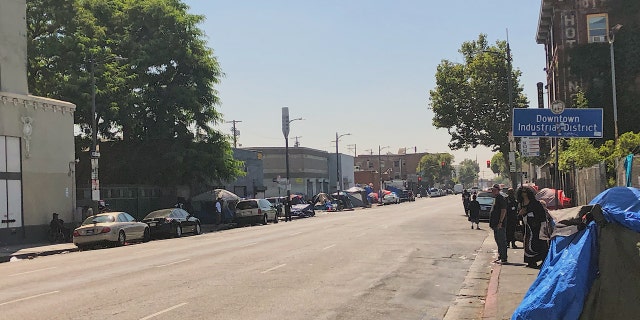
The intersection of 6th St. and San Pedro St. in Los Angeles is the center of Skid Row. (Andrew O'Reilly/Fox News)
City officials, developers and restaurateurs in Los Angeles
are touting the renaissance of the city’s once-blighted downtown thanks
to an explosion of trendy eateries, chic hotels and luxury apartments
that have attracted thousands of new – and generally financially
well-off – residents to the neighborhood in recent years.
But just
a few blocks south of the area where a set-course sushi meal costs
around $200 per person – wine or sake not included – is perhaps the country's most notorious tent city and a neighborhood that has been labeled the epicenter of homelessness in America: Skid Row.
The
area -- which has been plagued by vagrancy, high crime rates and
unsanitary conditions almost since its development in the 1880s -- is an
unorganized collection of warehouses, wholesale storefronts
and decaying low-rent hotels. Its trash-strewn streets are lined with
the blue tarps and fraying tents of those residents unable to afford a
solid roof over their heads.
But as development in Downtown Los
Angeles steams forward unimpeded, city officials and developers are
eyeing Skid Row as possibly the next “up-and-coming” neighborhood – a
move causing tensions with advocates and community outreach workers who
wonder what this means for the thousands of homeless and itinerant
people who currently call the rundown area home.
Advocates and community outreach workers worry what housing
development will mean for the thousands of homeless and itinerant people
who currently call the rundown neighborhood home. (Andrew O'Reilly/Fox
News)
“Most
of Skid Row is already being carved up,” Jerry Jones, the director of
public policy at the Inner City Law Center in Los Angeles, told Fox
News. “We need to help those who live on Skid Row right now.”
The
population of Downtown Los Angeles, which encompasses Skid Row and a
number of other smaller neighborhoods, has seen its population skyrocket
from just 18,000 people two decades ago to currently 76,000. There are
also development plans bouncing around city hall that could bring
176,000 new residents to downtown by 2040.
Activists were enraged
last June by a city proposal to rezone an industrial section of Skid Row
to residential and open it up for market-rate development – a plan that
supporters said would continue to the growth of downtown and create
much-needed mixed office and living spaces in a city dealing with a
major housing shortage.
While the proposal did call for putting
social service agencies and permanent supportive housing in other parts
of Skid Row, advocates for the neighborhood worried that it would drive
up rents and displace some 4,000 people who currently live in the area’s
single-room occupancy hotels and other modest lodgings.
In a
concession to activists, a new rezoning plan released earlier this month
calls for the conversion of parts of Skid Row into housing for
residents earning between $10,000 and $58,000 annually. The plan also
calls for any new development in bordering neighborhoods like the Arts
District and Little Tokyo to include units for low-income residents.
Craig Weber, principal planner for the city of Los Angeles, told the Los Angeles Times that the new rezoning initiative is meant to create "housing opportunities for all."
“The
plan seeks to expand the opportunity for affordable housing through
policies, zoning and the community benefits program," he said.
Unlike
cities like New York and nearby Santa Monica, Los Angeles currently
does not have any laws on the books that require developers to mark off a
certain percentage of new units for affordable housing.
Skid Row
advocates like Jones say that the new rezoning plan is a start, but it
doesn’t address the area’s homeless crisis and will most likely still
displace the itinerant population of Skid Row into adjoining
neighborhoods like Boyle Heights and University Park.
“It’s a huge
opportunity that has been lost,” he said. “Any proposal to build in the
area should benefit the current residents of Skid Row first.”
Los
Angeles Mayor Eric Garcetti and other city lawmakers appear fully aware
that Skid Row has become the epicenter of a homeless crisis flaring
across major California cities – specifically prioritizing the
neighborhood in the mayor’s plan to tackle homelessness and allocating
$7 million from the $124 million the state recently approved for
improving the health and safety of city residents. This comes after the
city already spent $20 million last year to expand hygiene
infrastructure and street cleanups in the community.
Some 4,000 people currently live in Skid Row's single-room
occupancy hotels and other modest lodgings, with many more living in
tent encampments . (Andrew O'Reilly/Fox News)
“We
all know the epicenter of this crisis is Skid Row,” Garcetti said
during a press conference on Monday. “It’s where the extreme poverty
cuts the deepest, it’s where the racialized elements of this
homelessness crisis are most seen.”
He added: “The days of writing off this community are over.”
Besides
the hygiene initiative, the city also has plans to build a bin facility
for Skid Row residents to store their belongings, start a cleaning
initiative that would hire residents to clean the streets and construct
crisis beds for women in Skid Row at Downtown Women’s Center.
Activists
say that the city’s initiatives are a good start, but to really remedy
the dire situation that many on Skid Row find themselves in, a real roof
over their heads is the most important thing.
ICLC’s Jones
argues that different types of housing are needed to address the
complexities of the homeless crisis in Los Angeles – from permanent
supportive housing with on-site health professionals to deal with issues
like mental illness and drug addiction to transitional housing for
homeless youth and families trying to get back on their feet.
“Different people need different housing, but one thing they all need is a house,” he said.
The tent encampment on San Pedro St. in Skid Row borders a parking
lot that is slated to become a supportive housing complex with 298
residential units. (Andrew O'Reilly/Fox News)
Most housing development that has been constructed on
Skid Row over the last decade has been supportive housing, and a
nonprofit organization, the Weingart Center, recently proposed building a
19-story affordable housing tower in the neighborhood on what is
currently a parking lot.
The apartment complex would include 298
residential units – all studio apartments – as well as office space for
the Inner City Law Center and Chrysalis, a job training and placement
services nonprofit. The Weingart Center also has plans to build an
18-story and a 12-story supportive housing building on Skid Row that
would have 382 apartments for homeless individuals.
One
consequence of New York City's Saturday night blackout: It shined a
bright spotlight on the tensions between two prominent Democrats, the
city's mayor and the state's governor. As more than 70,000
customers -- plus countless tourists and other visitors -- dealt with
the loss of electricity attributed to a transformer fire, New York Gov. Andrew Cuomo blasted New York City Mayor Bill de Blasio, who was in Iowa campaigning for president when the massive blackout hit Manhattan. “I
can count the number of times I leave the state basically on my
fingers,” Cuomo told CNN, responding to a question about the importance
of the mayor being in New York during an emergency. "Mayors
are important. And situations like this come up, you know. And you have
to be on-site,” he said. "I think it’s important to be in a place where
you can always respond. But look, everybody makes their own political
judgment and I’m not going to second-guess anyone either. I do my job
the way I think I should do my job and I leave it to others to do the
same."
"Mayors are important. And situations like this come up, you know. And you have to be on-site." — New York Gov. Andrew Cuomo
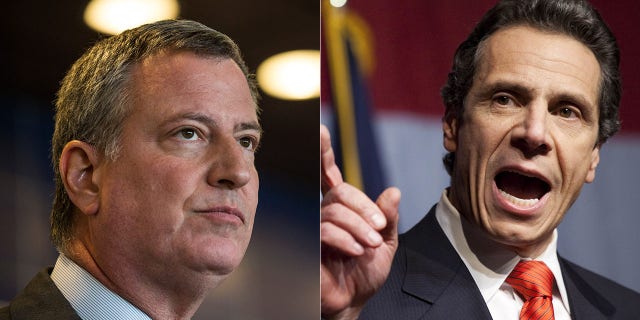
Although both are Democrats, New York City Mayor Bill de Blasio,
left and New York Gov. Andrew Cuomo have had a strained relationship.
De Blasio was at a campaign stop in Waterloo, Iowa,
when an equipment failure at a transformer substation shut off power for
tens of thousands of people in his city. The mayor first told CNN he was mulling whether to return to New York, but later decided he would, according to the Washington Examiner. He plans to fly back to the city Sunday morning, a spokesperson said. Late Saturday, the mayor issued several Twitter messages, indicating he was monitoring the situation back home. "With
the power back on, I’ve directed City agencies to investigate this
evening’s blackout," he wrote. "They’ll work with ConEd to get to the
bottom of what happened tonight and prevent another widespread outage
like this." Meanwhile, the
governor was in New York City, speaking to reporters just before
midnight. He confirmed that power had been restored to all affected
customers. “This could have been much worse,” Cuomo added,
commending emergency responders. “When things are at their worst New
Yorkers are at their best.” The governor said he would be working
with utility company Con Edison to make sure a blackout of Saturday’s
magnitude doesn’t happen again.