House Republican Leader Kevin McCarthy, D-Calif., speaks to reporters at
his weekly news conference at the Capitol in Washington, Thursday, July
25, 2019. (AP Photo/J. Scott Applewhite)
House Minority Leader Kevin McCarthy blasted congressional Democrats
after a majority of left-leaning lawmakers said they support an
impeachment inquiry into President Trump. In an interview Wednesday, the representative said “Democrats are
trying to push impeachment without saying the word.” This comes after
more lawmakers switched sides to support an inquiry, bringing the total
number of lawmakers who support it to 114 with only four more needed to
push an inquiry forward. Impeachment has been a hot button issue since special counsel Robert
Mueller’s testimony on Capitol Hill last week, where McCarthy criticized
Democrats for pushing it. He had this to say during his weekly news conference following Mueller’s testimony:
“Why would you ever even bring up
impeachment after yesterday’s hearing? …That should be put to bed. That
is over. We watched it. We heard it. We’ve read it. What more can they
make up? The only people that want impeachment are the ones sitting
inside this chamber on the democratic side. The American public have
made their decision. Poll after poll you see it.”
McCarthy says even if House Democrats get support for an impeachment
inquiry in their chamber, the Republican-controlled Senate will reject
it right away.
Senate Judiciary Committee chairman Lindsey Graham pushed through his
asylum bill by waiving committee rules. The legislation narrowly moved
out of committee Thursday in a 12-to-10 vote, which means it can now be
taken up by the full Senate for consideration. Graham’s decision allowed Republicans to act alone in making the bill
eligible for Thursday’s vote after Democrats skipped last week’s
business meeting on the bill. The South Carolina lawmaker defended his
actions by saying “the Judiciary Committee can’t be a place where
nothing happens.”
“We have a right to vote. You don’t
want the committee to be ignored by the majority leader of either party,
and just take a bill out of our committee and bring it to the floor
because we can’t do our business. I’m not changing the rules. I’m making
a motion in response to what you did last week.” — Senator Lindsey
Graham, (R-S.C.)
His asylum proposal would increase the number of days migrant
children can be held in custody, and it would require asylum seekers to
file their claims from outside the U.S.
I will no longer allow our asylum laws to be exploited by human traffickers and cartels.
Unless we change our laws we are aiding and abetting the horrific practices we now see taking place at the southern border. My bill fixes these problems. WATCH:https://t.co/5eiMegJEKU — Lindsey Graham (@LindseyGrahamSC) August 1, 2019
Richard Trumka, president of the AFL-CIO, addresses members during
the union's quadrennial convention in Los Angeles, Sept. 9, 2013.
(Associated Press)
Big Labor warned Democratic presidential contenders Wednesday against taking union support for granted, adding that Dems would need to be more honest about the party’s record on workers’ rights, reports said. The president of the AFL-CIO labor union,
which represents 12.5 million union workers, addressed a closed-door
meeting with representatives from each campaign in attendance before the
second round of debates Wednesday in Detroit. AFL-CIO President
Richard Trumka argued that “both parties” needed to take
responsibility for U.S. labor laws that benefit corporations to the
detriment of the middle class. IN LETTER TO AOC, BIG LABOR SAYS GREEN NEW DEAL COULD CAUSE 'IMMEDIATE HARM' TO UNION WORKERS “More
often than not, the Republican Party is bad for workers. This president
is bad for workers. But let’s be honest about the Democratic Party’s
record,” Trumka said. “We are caught in a web of century-old
labor laws that prioritize unchecked corporate greed over all else,”
Trumka said, according to the Huffington Post. “We can blame this White
House all we want. But this isn’t new.”
“We are caught
in a web of century-old labor laws that prioritize unchecked corporate
greed over all else. We can blame this White House all we want. But this
isn’t new.” — AFL-CIO President Richard Trumka
Richard Trumka, president of the AFL-CIO, addresses members during
the union's quadrennial convention in Los Angeles, Sept. 9, 2013.
(Associated Press)
It wasn't the first time the AFL-CIO has criticized Democrats this year. In March, the union implored Rep. Alexandria Ocasio-Cortez, D-N.Y., and other lawmakers to not go through with the Green New Deal,
claiming the plan to combat the effects of climate change would cause
“immediate harm” to millions of union employees and threaten their
livelihoods. As the Democratic Party shifts toward a more
progressive identity, Trumka reminded 2020 candidates that unions would
no longer support candidates simply because of their party affiliation.
Unions historically played influential roles in getting Democrats
elected through get-out-the-vote efforts, canvassing and other
campaigning methods. “It’s time to do better,” Trumka said. “I
believe you can. I believe you will. And working people are hungry for
it. But you can’t offer campaign rhetoric or count on workers’ votes
simply because you have a ‘D’ next to your name.”
"You can’t ... count on workers’ votes simply because you have a ‘D’ next to your name.” — AFL-CIO President Richard Trumka
“You
need to prove that this party is the one and only party for working
people,” he said. “And recognize that unions and collective bargaining
are the single best way to make this economy work for
everyone.” “Convince our members, and you’ll have the country’s largest
and most effective movement for working people on your side,” Trumka
added. Trumka argued that Democrat-backed trade deals, including NAFTA (North American Free Trade Agreement) and TPP (Trans-Pacific Partnership), hurt the middle class, the Huffington Post reported. The
TPP, an Obama-era global trade deal that was never submitted to the
Senate for approval, was signed by 11 nations: Australia, Brunei,
Canada, Chile, Japan, Malaysia, Mexico, New Zealand, Peru, Singapore and
Vietnam. President Trump pulled support from the deal soon after his
inauguration in January 2017, arguing it gave up American power.
Supporters argued the agreement would benefit the American middle class
by making it easier for small business owners to sell American-made
goods abroad, Politico reported. The AFL-CIO has yet to endorse a candidate ahead of the 2020 election. Fox News' Louis Casiano contributed to this report.
A
historic arms-control treaty signed three decades ago by President
Ronald Reagan and Soviet leader Mikhail Gorbachev was scrapped after President Trump decided to withdraw Friday.
The move to scrap the Intermediate-range Nuclear Forces (INF) treaty comes amid the administration’s assessment that Russia was
in “material breach of the treaty” and made no effort to “come back
into compliance” with the agreement, a senior White House official said.
This undated file photo provided Tuesday, Sept. 19, 2017, by
Russian Defense Ministry official web site shows a Russian Iskander-K
missile launched during a military exercise at a training ground at the
Luzhsky Range, near St. Petersburg, Russia. (Associated Press)
Russia was given a six-month period, in accordance
with the treaty, as a “final opportunity to come back into compliance”
with the agreement, but the government headed by President Vladimir
Putin “has made no efforts to do that,” the official added.
The
end of the treaty sparks of a new global arms race between the two
countries, which possess the world's largest nuclear arsenals.
The
Trump administration stressed it was Russia’s fault the treaty came to
an end, pointing out that Moscow has been developing and fielding
weapons that violate the treaty and threaten the U.S. and its allies,
particularly in Europe.
“Russia alone is to blame for this
situation,” the senior official said. “We have taken every opportunity
-- dozens and dozens of opportunities across two administrations – to
bring Russia back into compliance.”
“Russia alone is
to blame for this situation. We have taken every opportunity -- dozens
and dozens of opportunities across two administrations – to bring Russia
back into compliance.” — A senior administration official
“It
is clear that they are in material breach of the INF Treaty, which is,
of course, not its only arms control violation. They are a serial
violator of arms control agreements,” the official added, noting that
“This violation, however, represents a direct security threat to the
United States and our allies.”
The U.S. has long complained that
the treaty was no longer fair and actually doesn’t stop the arms race as
intended as Russia was openly violating it, while China, which is a
non-signatory, is free develop weapons that would otherwise be
prohibited.
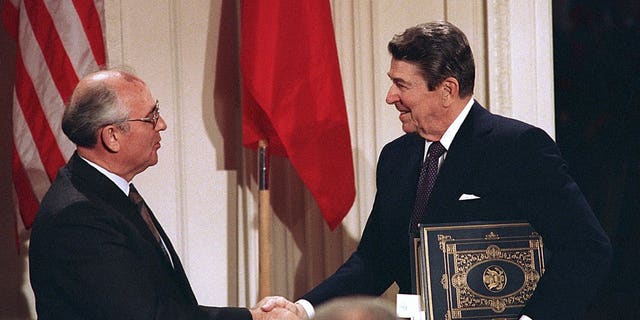
President Ronald Reagan, right, shakes hands with Soviet leader
Mikhail Gorbachev after the two leaders signed the Intermediate-Range
Nuclear Forces (INF) Treaty to eliminate intermediate-range missiles
during a ceremony in the White House East Room in Washington, Dec. 8,
1987. (Associated Press)
The Trump administration said, for example, Russia
has produced and fielded multiple battalions of the 9M729
ground-launched cruise missile throughout Russia, which is a violation
of the treaty. Some of the missiles have “the ability to strike critical
European targets.”
“This violation, which has been underway for
many years, is a critical threat to American and Allied security now.
That is why this action has become unavoidable,” a senior official said.
Another
White House official pointed out that Russia has been deceptive about
its military buildup, particularly denying the development of a
ground-launched cruise missile in 2014 that is now fielded and poses a
security risk to Europe.
“Throughout
the process, they lied about the existence of the missiles at both the
expert level and, finally when confronted with the evidence, came clean
for this in the past several months,” the official said.
European
powers came out to criticize Russia for not complying with the INF
treaty amid the U.S. announcement of withdrawing from the agreement.
“We
regret the fact that Russia has not done what was necessary to save the
INF treaty,” German Foreign Minister Heiko Maas said.
“Now we
call all the more on Russia and the U.S. to preserve the New START
treaty as a cornerstone of worldwide arms control,” he added. “Nuclear
powers such as China must also face up to their responsibility on arms
control — they have more weight in the world than at the time of the
Cold War.”
“We regret the fact that Russia has not done what was necessary to save the INF treaty.” — German Foreign Minister Heiko Maas.
Both
the U.S. and Russia will have to decide whether to extend or replace
the larger New START treaty when it expires in early 2021, a treaty that
imposed limits starting in 2018 on the number of U.S. and Russian
long-range nuclear warheads and launchers.
Trump hasn’t committed
to extending the treaty and even once calling it as “just another bad
deal” concocted by the predecessor, the Obama administration.
The
1987 INF treaty was responsible for the elimination of 2,692 U.S. and
Soviet Union nuclear and conventional ground-launched ballistic and
cruise missiles. The treaty also banned land-based missiles with a range
between 500 and 5,500 kilometers (310 to 3,410 miles). Fox News' John Roberts and The Associated Press contributed to this report.
A New York City Police (NYPD) officer stands guard in Central Park in
the Manhattan borough of New York City, U.S. (REUTERS/Mike Segar/Photo)
OAN Newsroom
UPDATED 12:47 PM PT — Wednesday, July 31, 2019
Following the latest water attack on the NYPD, GOP lawmakers in New
York say enough is enough. They have introduced a bill which would make
it an Class E felony to douse water or any other substance on an on-duty
officer. Assembly members Michael Reilly and Mike LaPetri held a press
conference alongside police officers Wednesday about the new proposal.
Several people have been charged with misdemeanors in connection to
water-dousing attacks in the Bronx and Manhattan, but Republican
lawmakers believe the charges should be upgraded. They say the attacks
have reached a tipping point, and they must be stopped before a
life-threatening attack. This time it’s water. What’s next? Gasoline? Acid? What will it take
for radical left-wing politicians to abandon their hostile police
rhetoric to law enforcement? The GOP lawmakers claim the attacks have been fueled by the radical
left. President Trump recently called the incidents “a total disgrace”
on Twitter, and said Mayor Bill de Blasio needs to “stand up for those
who protect our lives and serve us all so well.”
We love our Law Enforcement Officers all around
this great Country. What took place in NYC with water being tossed on
NYPD officers was a total disgrace. It is time for @NYCMayor@BilldeBlasio to STAND UP for those who protect our lives and serve us all so well…
President Trump late Wednesday tweeted a response to CNN’s Democratic debate and said none of the candidates would keep up what he sees as momentum in the country. “The
people on the stage tonight, and last, were not those that will either
Make America Great Again or Keep America Great!” Trump began in a series
of tweets around midnight. “Our Country now is breaking records in
almost every category, from Stock Market to Military to Unemployment. We
have prosperity & success like never before..” the president
continued. “...It will soon be time to choose to keep and build
upon that prosperity and success, or let it go. We are respected again
all around the world. Keep it that way! I said I will never let you
down, and I haven’t. We will only grow bigger, better and stronger
TOGETHER!,” Trump said. Earlier Wednesday, Trump also said
Democratic 2020 hopefuls, specifically former vice president Joe Biden
and Sen. Kamala Harris, D-Calif., will lead the U.S. into an “economic
sinkhole” if elected. He also claimed America would have experienced a
"Great Recession/Depression" if he had not been elected in 2016. "The
people I saw on stage last night, & you can add in Sleepy Joe,
Harris, & the rest, will lead us into an economic sinkhole the likes
of which we have never seen before. With me, only up!" Trump said
before the second debate Wednesday night.
Jared Kushner met with the leaders of Jordan and Israel on Wednesday to outline the administration's Mideast peace plan on the first day of a five-country tour through the region. Kushner
first discussed the “Deal of the Century,” a plan for
Israeli-Palestinian peace, with King Abdullah II in Jordan before
heading to Israel for a meeting with Prime Minister Benjamin Netanyahu,
The Jerusalem Post reported. The administration has been working on the plan for two years.
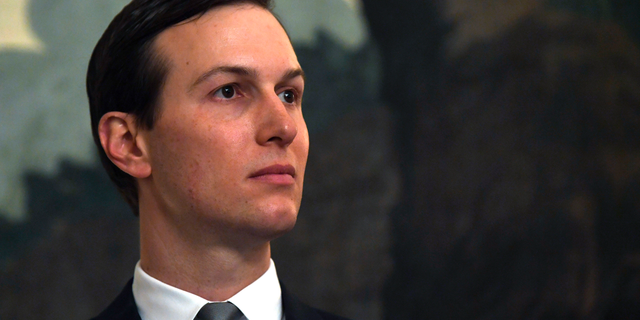
White House adviser Jared Kushner listens during a
proclamation signing with President Donald Trump and Israeli Prime
Minister Benjamin Netanyahu in the Diplomatic Reception Room at the
White House in Washington, March 25, 2019. (Associated Press)
After the meeting in Jordan, Abdullah reiterated “the
need to achieve just, comprehensive and lasting peace on the basis of
the two-state solution," Jordan's state news service said, according to
Al Arabiya. It’s not clear if the plan calls for a two-state solution, and it fails to address Israeli occupation, according to Al Arabiya. U.S.
Ambassador David Friedman, who attended the Kushner-Netanyahu meeting,
said the U.S. believes in “Palestinian autonomy,” according to The Post. Kushner will leave on Thursday for Egypt, Morocco and Saudi Arabia. The Trump administration has invited Arab leaders to a peace summit at Camp David in September to further discuss the plan. Israeli officials were involved in planning the summit but Netanyahu does not plan to attend.
Former Vice President Joe Biden
dominated the debate stage and weathered the attacks of nine opponents
for the Democratic presidential nomination Wednesday night, emerging the
clear winner and standing by his promise not be “overly polite.” In possibly the most contentious Democratic primary debate thus far, frontrunners Biden and Sen. Kamala Harris
of California sparred with each other and the other candidates over the
issues of health care, immigration, race relations and climate change. Following Harris’ and
Biden’s heated exchange over busing to achieve school integration in
the first debate, Biden was far more aggressive than in his previous
debate performance in responding to attacks from every candidate on
stage. The
former vice president delivered his message compellingly and
convincingly. Even during his less strong moments, Biden remained the
focal point of the conversation, speaking for over 21 minutes – more
than any other candidate on stage. On health care, in particular,
Biden displaying his in-depth policy knowledge while also rebutting
repeated attacks from Harris. Biden gave a strong defense of his
pragmatic plan to strengthen ObamaCare, while the confusion and lack of
clarity around Harris’ plan hindered her position.
More from Opinion
Biden also successfully took aim at what he has called Harris’ “have it every which way approach.” Health
care “is the single most important issue facing the public,” Biden said
to Harris. “To be very blunt ... you can't beat President Trump with
doubletalk on this plan.” Darkhorse candidate New York City Mayor
Bill de Blasio focused his efforts on attacking Biden directly,
particularly during the discussions over immigration and race relations.
But the attacks failed to create the searing moment that de Blasio had
hoped for and did not seem to damage Biden in any meaningful way. On
another front, Rep. Tulsi Gabbard of Hawaii scored points against
Harris while addressing criminal justice reform and race. Gabbard took
aim at the racial implications of Harris’ tough-on-crime record as a
California attorney general, leaving Harris without a rebuttal on an
issue that the senator commanded during the last debate.
Despite
Biden’s strong performance and solid frontrunner status, it is clear
that the party has seismically shifted away from the centrist Democratic
Party of the 1990’s, making his path to the nomination far from
certain.
Gabbard told Harris: “When you were in a
position to make a difference and an impact in these people's lives, you
did not and worse yet in the case of those who are on death row, you
blocked evidence from being revealed that would have freed them until
you were forced to do so.” “There's no excuse for that and the people who suffered under your reign as prosecutor, you owe them an apology,” Gabbard added. At best, Harris met expectations but fell short of being the focal point of the night as she was at the debate last month. The
only substantive losers were minor candidates such as Sen. Kirsten
Gillibrand of New York and Washington Gov. Jay Inslee. Both have
consistently polled at or below the 2 percent threshold and did not get
the debate moment that they likely needed to enhance their candidacies
in order to qualify for the next round of debates. Although
businessman Andrew Yang did not have a resounding debate moment, the
universal-basic-income advocate will likely still secure a spot in the
fall debates due to the strength of his grassroots support. Moreover,
despite Biden’s strong performance and solid frontrunner status, it is
clear that the party has seismically shifted away from the centrist
Democratic Party of the 1990’s, making his path to the nomination far
from certain. Though Biden controlled this debate in many ways,
his two leading opponents were absent from the stage of the CNN debate
in Detroit. Sen. Bernie Sanders of Vermont and Sen. Elizabeth Warren of
Massachusetts, both competing for the support of the far left, debated
Tuesday night. Under
attack for being too moderate, Biden delivered a powerful response when
asked how he can appeal to progressives in the Democratic Party. He
drew on his past success in winning elections and scoring major
achievements in governing during his long career and emphasized his
clear appeal to Midwest and working-class voters. “I was asked to
manage an $87 billion plan that would be spent in a total of 18 months
that revived this state and many others … and it kept us out of a
depression,” Biden said, referring to his work as vice president to help
the auto industry and the country as a whole climb out of the Great
Recession shortly after he took office with former President Barack
Obama. Biden
said he led the economic recovery effort with just a fraction of 1
percent waste or fraud, “and our administration pushed bailing General
Motors out saving tens of thousands of jobs here in this state.” Ultimately,
the strength of Biden’s performance made it clear that he is prepared
to combine the policy knowledge and experience necessary to take on
President Trump and potentially win in November 2020. He clearly remains
the candidate who will be tough to beat for the Democratic presidential
nomination.