Democrats may have just clobbered their chances of victory in 2020.
While all eyes were trained on President Donald Trump’s furious
confrontation with China last week, Democrat officials at their party’s
convention in San Francisco again voted down a resolution calling for a
candidate debate on climate change. That could prove a dire error.
The decision to prevent a climate debate
will almost certainly encourage a third-party candidate. And that
candidate could sabotage Democrats’ chances of retaking the White House.
Who
might it be? It could be former Washington Gov. Jay Inslee, who ran to
highlight climate change but recently withdrew from the Democratic
nomination race. Or maybe a billionaire like Tom Steyer
or Michael Bloomberg, who both similarly want to press Democrats to
focus on global warming. They might not expect to win, but their
campaigns could elevate the climate discussion.
Remember
that the Green Party put Jill Stein forward in 2016. Though few took
Stein’s candidacy seriously, in the end she attracted 1.4 million votes.
In the aftermath of the election, some blamed her for Hillary Clinton’s
loss, pointing out that in the critical swing states of Michigan and
Wisconsin, Trump’s margin of victory was less than the number of votes
won by Stein.
Since
2016, the climate issue has taken center stage in Democrats’ platforms,
becoming especially important to young voters who are playing a growing
role in our elections. A Pew Center survey reports that voters under
the age of 53 cast 62.2 million votes in the 2018 midterm elections,
more than the 60.1 million recorded by people 53 and older. In the
midterm contest, Gen Z and millennials made up 25 percent of the total
votes cast; their share will increase in 2020.
Young voters are
energized, and especially about global warming. A Harvard Kennedy School
survey found climate change to be the third most important issue to
voters under 30, behind immigration and the economy.
The
decision to prevent a climate debate will almost certainly encourage a
third-party candidate. And that candidate could sabotage Democrats’
chances of retaking the White House.
For proof of the
importance of young climate enthusiasts, look no further than the
Sunrise Movement, an activist group begun only two years ago that has
attracted tens of thousands of followers and staged protests in 250
cities around the country. It also takes credit for launching the Green
New Deal, which, though widely mocked on the right, has been embraced by
nearly every Democratic senator running for 2020.
Sunrise
representatives in attendance at the San Francisco convention erupted
after the DNC vote to block a climate debate, chanting “Failure of
leadership” and “we can’t wait” to protest the complicity of DNC Chair
Tom Perez in the decision; many stormed out of the meeting.
Their anger was echoed on social media.
Elizabeth
Warren tweeted: “Climate change is an existential threat that threatens
(sic) all of us….That’s why we need to have a #ClimateDebate.”
Al
Gore chimed in, tweeting: “The Democrats’ decision to sabotage a
#ClimateDebate is extremely disappointing. Voters all over the U.S. are
demanding we focus on the biggest threat to our nation and humanity’s
future and prioritize solving the climate crisis instead of continuing
business as usual.”
The hashtag #ClimateDebate trended on twitter
in the wake of the vote, with nearly every Democrat hopeful weighing in.
Climate warriors Greenpeace participated, tweeting “We just got word
that the DNC voted to block a #climatedebate. We can’t begin to tell you
how outraged we are… Our political system is failing us, and it’s
failing a whole generation of people fighting for a better world.”
Blocking
a climate debate was risky for Perez and other Democratic
Party officials. They must have known the decision would infuriate young
voters, but they also recognized that such a forum could trip up their
candidates. They knew that their over-the-top remedies to stem global
warming might turn off much-needed independents, guaranteeing Trump’s
reelection.
Consider
Bernie Sanders’ most recent plan to combat rising emissions, which is
projected to cost $16 trillion. In a recent interview, even MSNBC’s
liberal Chris Hayes sounded anxious about the scope of Sanders’
proposal, which he described as “really large.” He asked how Sanders
would pay for such a mammoth overhaul, which includes “replacing every
old diesel school bus, replacing old mobile homes in the country,” in
addition to “a federal takeover of the whole thing, that's essentially a
Tennessee Valley Authority extension for the whole country…”
In a
rambling response, Sanders explained that his program will be paid for
with the money the federal government will make producing sustainable
energy (though wind and power production still require subsidies), the
elimination of “massive” tax breaks now given to fossil fuel companies,
the taxes received from the 20 million new “good-paying union jobs” sure
to be created, cuts to military spending, and higher taxes on
corporations and the wealthy.
Time
does not allow a thorough debunking of this proposal, except to note
that green activist group Oil Change International estimates the
“subsidies” given to oil and coal producers at $20 billion annually,
that the taxes that might be collected on 20 million union workers
earning $100,000 apiece would be about $340 million, and that a 50
percent hike in the individual income taxes paid by every American would
yield only about $1 trillion. In other words, the numbers don’t add up.
Bernie
is not alone, of course. Beto O’Rourke has laid out a $5 trillion plan,
and Elizabeth Warren has not one but five climate proposals in the
hopper. Joe Biden has put forward a plan that only costs $1.7 trillion,
earning him a “C+” grade from the liberal scolds at Mother Jones. And
let’s not forget the Green New Deal, estimated to cost north of $50
trillion.
Perez
and the Democrat machine are in a tight spot. Either allow Sanders and
his rivals to alienate moderate voters by pushing programs that cost the
moon, or risk providing a platform for a third party “green” candidate
who can mobilize young voters.
On the other hand, the debate could
prove illuminating. In the MSNBC interview, Bernie starts off
admitting, “Well, the first thing is we cannot not afford it.” Bernie is
confused and confusing.
Insurance. You have it and hope you never use it. But, just in case, it’s always there.
Joe Biden is insurance for Democrats in 2020.
Yes, Biden is the frontrunner in the polls. Yes, many people think
Biden will be the nominee. But if Biden doesn’t perform then Democrats
will pick another candidate to challenge Donald Trump. In the meantime,
Democrats will keep supporting Biden to make sure he’s in the strongest
position, if he is the nominee, to take on the president.
So just how strong is Biden? Let’s go to the numbers.
In
the latest Fox News Poll, published on Aug. 15, Biden leads the
Democratic field with 31 percent. That’s an 11-point lead over Elizabeth Warren,
in second place with 20 percent, and third-place Bernie Sanders at
10 percent. At first blush that looks like a strong position for Biden.
However, Biden was at 31 percent in the March Fox News Poll … five
months ago. Biden had a four-point bump to 35 percent in May, dropped in
June to 32 percent, gained one point in July, and then back to 31
percent in August. Steady but hardly the numbers of a strong
frontrunner.
Let’s look at the general election matchup with Trump.
Today,
Biden beats Trump 50 percent to 38 percent. A 12-point lead looks
strong … until you see Biden had a similar lead against Trump in the
October 2015 Fox News Poll. Favorability rating? Biden is currently at
50 percent. Yet, it was 56 percent in 2016, 2017 and 2018.
While
Biden may seem like a relatively steady frontrunner, when you look
under the hood it becomes clear that one group of voters is keeping
Biden in first place: African Americans.
In the latest Fox News
Poll a staggering 84 percent of African Americans support Biden.
Furthermore, 71 percent of nonwhite women support him. The good news for
Biden is that African American voters are keeping his support at 50
percent. The bad news? If African Americans change their minds, then the
bottom falls out for the former vice president.
In
the latest Fox News Poll a staggering 84 percent of African Americans
support Biden. If they change their minds, then the bottom falls out for
the former vice president.
Biden's campaign is based
on the “electability” argument. Democrats badly want to beat Trump and
will back anyone who can do it. Today, that candidate is Joe Biden. The
problem for Biden is the first two primary contests, Iowa and New
Hampshire, have very few African American voters. It is not until South
Carolina, the third contest, that African American are a sizable voting
block.
If Biden loses either Iowa or New Hampshire, or both, then
he may not make it to South Carolina. One or two losses in early
February would pierce his argument of electability, costing him the
support African American voters ... and the nomination. For example, if
Warren won in Iowa and New Hampshire, she could run the table and win
the nomination with African American support moving to her.
That
scenario may explain why Biden was in Iowa and New Hampshire over the
last five days rather than at the Democratic National Committee meeting
in San Francisco, where virtually every other presidential candidate
appeared. Biden knows he has to win the first two contests, or at least
one, to be the nominee.
In the latest Des Moines Register poll
conducted in June, the gold standard for Iowa polling, Biden was leading
with 24 percent of caucus-goers. Sanders, Warren and Pete Buttigieg
were in a dead heat for second with, respectively, 16, 15 and 14
percent. But Warren leads in the second choice and under active
consideration categories, key indicators of support in the caucus
system. So if Biden, or any other candidate, faltered, then Warren would
be the likely beneficiary. In fact, many believe the Massachusetts
senator is in an excellent position to capitalize on such a scenario
because she has the best organization in Iowa.
In New Hampshire,
an August poll conducted by Suffolk University has Biden in the lead
with 21 percent, followed by Sanders at 17 percent and Warren with 14
percent. The margin over Sanders and Warren is hardly a comfortable
place for Biden. Of course, New Hampshire is also a must-win for
Sanders. He won that state's primary by 22 points over Hillary Clinton
in 2016, but eventually lost the nomination to her.
If Sanders
loses New Hampshire in 2020 it is virtually impossible for him to win
the nomination. Once again, Warren leads the second-choice category at
21 percent, and 58 percent of voters said they could change their
mind before the Feb. 11 contest.
In Iowa and New Hampshire, Biden is looking over his shoulder at Warren.
In South Carolina, he is African Americans' insurance policy and they are his.
And that means Biden is the Democrats’ insurance policy too … for now.
President Trump on Monday said the U.S. is not seeking regime change in Iran and told reporters at the G7 summit in Biarritz, France, that he hopes to see a strong Iran.
Trump’s comments came after a day of tense meetings with his European counterparts about
how best to approach Iran and the recent tensions in the region. On
Sunday, Iran’s Foreign Minister Mohammad Javad Zarif made a surprise
visit at the summit at the behest of French President Emmanuel Macron.
Trump insisted that he knew about Zarif’s appearance but did not meet
with him.
“I knew he was coming in and I respected the fact that
he was coming in. And we’re looking to make Iran rich again, let them be
rich, let them do well, if they want,” Trump said, according to Reuters. “Or
they can be poor as can be. And I tell you what, I don’t think it’s
acceptable the way they are being forced to live in Iran,”
Trump
has said in the past that the U.S. is not interested in a Tehran regime
change. He told Japanese Prime Minister Shinzo Abe that the U.S. is
“looking for no nuclear weapons.”
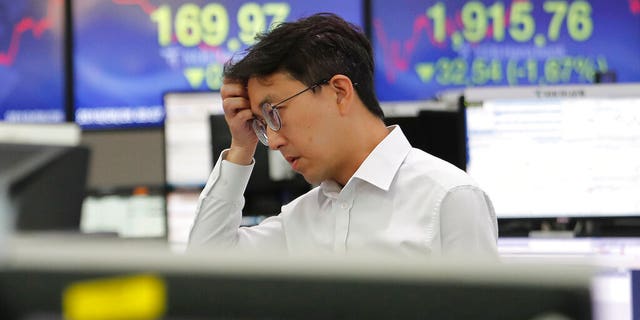
China signaled on Monday it was now seeking a "calm" end to its ongoing trade war with the U.S., as Asian markets crumbled and China's currency plummeted to an 11-year low following the latest tariffs on $550 billion in Chinese goods announced last Friday by the Trump administration.
Trump
said Monday that officials from China called U.S. officials and
expressed interest to "get back to the table,” The Wall Street Journal
reported. He called the discussions a “very positive development.”
“They want to make a deal. That’s a great thing,” he said.
News of the possible opening in negotiations came shortly after President Trump threatened
to declare a national emergency that would result in American
businesses freezing their relationships with China. Trump's tariff
barrage on Friday was a response to China imposing its own retaliatory
tariffs on $75 billion in U.S. goods.
At the Group of Seven summit
in France on Sunday, White House officials rejected suggestions the
president was wavering and insisted that his only regret was not implementing even more tariffs
on China. Trump wrote on Twitter that world leaders at the G-7 were
"laughing" at all the inaccurate media coverage of the gathering.
In
response, Chinese Vice Premier Liu He told a state-controlled newspaper
on Monday that "China is willing to resolve its trade dispute with the
United States through calm negotiations and resolutely opposes the
escalation of the conflict," Reuters first reported, citing a transcript of his remarks provided by the Chinese government. Liu is China's top trade negotiator.
A currency trader watches monitors at the foreign exchange dealing
room of the KEB Hana Bank headquarters in Seoul, South Korea, Monday,
Aug. 26, 2019. (AP Photo/Ahn Young-joon)
Speaking at a technology conference in China, Liu
added: “We believe that the escalation of the trade war is not
beneficial for China, the United States, nor to the interests of the
people of the world."
“We
welcome enterprises from all over the world, including the United
States, to invest and operate in China,” Liu said. “We will continue to
create a good investment environment, protect intellectual property
rights, promote the development of smart intelligent industries with our
market open, resolutely oppose technological blockades and
protectionism, and strive to protect the completeness of the supply
chain.”
Asian shares tumbled early Monday, with Japan's benchmark
Nikkei 225 started plummeting as soon as trading began and stood at
20,234.87 in the morning session, down 2.3 percent. Australia's
S&P/ASX 200 slipped 1.5 percent to 6,427.20. South Korea's Kospi
lost 1.7 percent to 1,916.14. Hong Kong's Hang Seng dropped 3.3
percent to 25,309.37, while the Shanghai Composite was down 1.2
percent at 2,862.87.
The yuan also slipped to 7.1487 to the dollar, weeks after the Treasury Department formally designated China a currency manipulator. The
Treasury Department said it will work with the International Monetary
Fund to try to rectify the “unfair competitive advantage created by
China’s latest actions.”
"The gloves are coming off on both sides
and as such yuan depreciation is an obvious cushion against US tariffs,"
Mitul Kotecha, an economist at Toronto-Dominion Bank, told Bloomberg
News.
There are several reasons why China's central bank would
want to allow the yuan to drop, including to help struggling local
exporters who want their products to be less expensive for international
purchasers. People’s Bank of China Governor Yi Gang, however, has
insisted China does not "engage in competitive devaluation."
On
Sunday, Treasury Secretary Steven Mnuchin told reporters that if "China
would agree to a fair and balanced relationship, we would sign that deal
in a second."
Stephen Innes, managing partner at Valour Markets
in Singapore, compared the difficulty of assessing the volatile market
situation to reading tea leaves.
"Nobody understands where the
president is coming from," he said, adding that the best thing Trump can
do for market stability is to "keep quiet."
"The problem that we're faced right now is that we are making a lot of assumptions ahead of the economic realities."
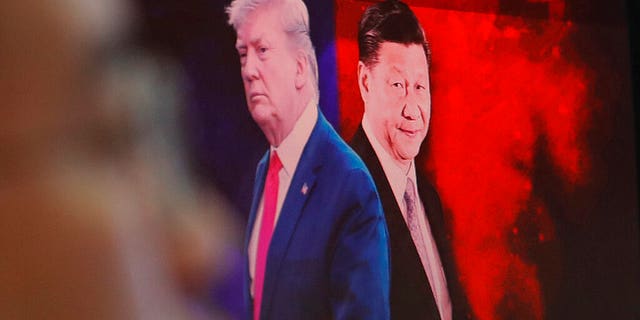
A computer screen shows images of Chinese President Xi Jinping,
right, and U.S. President Donald Trump as a currency trader works at the
foreign exchange dealing room of the KEB Hana Bank headquarters in
Seoul. (AP Photo/Ahn Young-joon)
The market is now dominated by fears of a portending
U.S. recession, although the American economy is actually holding up,
and much of the U.S. economy is made up of consumption, Innes said. If
interest rates come down, he added, consumer spending is likely to go
up, working as a buffer for the economy.
"What the market's really
waiting for is for them to drop interest rates," Innes said. "Right
now, we are still sitting on that uncertainty."
Meanwhile, Sen. Lindsey Graham, R-S.C., said on Sunday that Democrats should not criticize Trump for taking on China over trade as they have complained for years about Beijing’s policies but done nothing. Senate Minority Leader Chuck Schumer, D-N.Y, for example, has urged Trump to fight China aggressively.
“Every
Democrat and every Republican of note has said China cheats,” Graham
said on CBS News’ “Face the Nation.” “The Democrats for years have been
claiming that China should be stood up to, now Trump is and we’ve just
got to accept the pain that comes with standing up to China.”
U.S.
markets have also taken something of a beating. The Dow Jones
Industrial Average plunged more than 600 points Friday after the latest
escalation in the trade war between the U.S. and China rattled
investors. The broad sell-off sent the S&P 500 to its fourth
straight weekly loss.
The tumbling began after Trump responded
angrily on Twitter following China's announcement of new tariffs on $75
billion in U.S. goods. In one of his tweets he "hereby ordered" U.S.
companies with operations in China to consider moving them to other
countries — including the U.S.
Trump
also said he'd respond directly to the tariffs — and after the market
closed he delivered, announcing that the U.S. would increase existing
tariffs on $250 billion in Chinese goods to 30 percent from 25 percent,
and that new tariffs on another $300 billion of imports would be 15
percent instead of 10 percent.
"Starting on October 1st, the 250
BILLION DOLLARS of goods and products from China, currently being taxed
at 25 percent, will be taxed at 30 percent," Trump wrote on Twitter.
"Additionally, the remaining 300 BILLION DOLLARS of goods and products
from China, that was being taxed from September 1st at 10 percent, will
now be taxed at 15 percent. Thank you for your attention to this
matter!".
Zhu Huani of Mizuho Bank in Singapore said what he
called Trump's "tariff tantrum" was setting off "the sense that tariffs
could continue to rise," with the "the unpredictability of timing and
extent of these trade actions risk accentuating the paralysis of
business decisions and big-ticket business spending."
"No matter
which way you cut the cake, it is nearly impossible to construct a
bullish, or even neutral scenario for equity markets today," said
Jeffrey Halley, senior market analyst at Oanda.
Trump also said
Friday morning that he was "ordering" UPS, Federal Express and Amazon to
block any deliveries from China of the powerful opioid drug fentanyl.
The stocks of all three companies fell as traders tried to assess the
possible implications.
The president has also raged against Federal Reserve chairman Jerome Powell for
his continued refusal to cut interest rates, at one point saying: "My
only question is, who is our bigger enemy, Jay Powel (sic) or [China's]
Chairman Xi [Jinping]?"
That outburst came after Powell, speaking
to central bankers in Jackson Hole, Wyo., gave vague assurances that the
Fed "will act as appropriate" to sustain the nation's economic
expansion. While the phrasing was widely seen as meaning interest rate
cuts, he offered no hint of whether or how many reductions might be
coming the rest of the year.
Some analysts, however, are confident the Federal Reserve will lower interest rates this year.
A quarter-point rate cut reduction in September is considered all but certain. Fox News' Ronn Blitzer, Joseph Wulfsohn, and The Associated Press contributed to this report.
OAN Newsroom
UPDATED 9:58 AM PT — Tuesday, August 20, 2019
Representatives Rashida Tlaib and Ilhan Omar recently held a press
conference to address ties with an anti-Semitic group as well as recent
travel restrictions imposed on the two lawmakers.
On Monday, the congresswomen discussed Miftah, the anti-Israel group
that promised to sponsor Tlaib’s trip. Miftah reportedly has a long
history of anti-Israel and pro-terrorist sentiments similar to those
held by Tlaib and company.
“All I can do as my city’s granddaughter, as the granddaughter of a
woman who lives in occupied territories, is to elevate her voice by
exposing the truth the only way I know how, as my Detroit Public Schools
teacher taught me, by humanizing the pain of oppression congresswoman,”
stated Tlaib.
The so-called “truth” she touts, however, seems to align with
rhetoric of the organization, which has downplayed suicide bombings of
Israeli citizens and has described the actions of terrorists as
“sacrificing their lives for the cause.”
Rep.
Ilhan Omar, D-Minn., right, consoles and Rep. Rashida Tlaib, D-Mich.,
as Tlaib talked about Israel’s refusal to allow them to visit the
country during a news conference Monday, Aug. 19, 2019 at the State
Capitol in St. Paul, Minn. (AP Photo/Jim Mone)
Tlaib claims she did not chose the organization to sponsor her trip,
and that Miftah has sponsored trips made by five other Congress members.
Omar and Tlaib argued the scrutiny over the organization are
distractions that have nothing to do with their agenda. During the press
conference, Omar seemed to instigate anti-Israel sentiments by
questioning the lifesaving aid Israel receives from the U.S.
Tlaib and Omar were barred from visiting Israel due to their public
support of the Boycott, Divestment and Sanction movement, who’s
objective is to eliminate Israel as a nation. The Israeli government
defended their decision to block the members of Congress by pointing to
pro-terrorist activist group Miftah sponsoring the trip. Tlaib was later
allowed to visit her grandmother on the West Bank, but rejected the
invitation.
Joe
Biden's claim that he was a civils rights leader could be the biggest
problem for the Democratic presidential candidate, says Alana Goodman,
investigative political reporter at the Washington Examiner.
They say if you can remember the 1960s, you probably weren’t there.
Well, Joe Biden
missed by about a decade Tuesday evening when he mentioned two
significant events of the 1960s: the assassinations of Dr. Martin Luther
King Jr. and Sen. Robert F. Kennedy.
The gaffe came during a speech in Iowa, while the 76-year-old Biden was comparing the years of his young adulthood to the current day.
“Just
like in my generation, when I got out of school, when Bobby Kennedy and
Dr. King had been assassinated in the ’70s, the late ’70s when I got
engaged … ,” Biden recalled.
But King and Kennedy were murdered in 1968, about two months apart.
It was just the latest in a series of slip-ups for the Democratic Party’s 2020 presidential frontrunner.
Last
Friday at a fundraiser in his home state of Delaware, Biden confused
Burlington, Iowa, and Burlington, Vt., while trying to remember where he
had given a campaign speech. The towns are about 1,100 miles apart.
Earlier
this month, Biden said “poor kids” are just as smart as “white kids,”
and last weekend he mistakenly said he met with survivors of the
February 2018 Parkland, Fla., school shooting while vice president --
even though he had left office more than a year before the attack.
He has also confused former British Prime Minister Margaret Thatcher for Theresa May twice since May.
Biden’s press secretary told CNN the focus on Biden's blunders is a “press narrative, not a voter narrative." Fox News' Brie Stimson contributed to this story.
Sen. Ed Markey, D-Mass., found himself apologizing Tuesday after a top campaign aide retweeted a message about "mental health issues" in the family of Rep. Joe Kennedy, a potenial challenger for Markey's Senate seat.
The
retweet -- which Markey termed "unacceptable" -- came just three weeks
after Kennedy's young cousin, Saoirse Kennedy Hill, 22, died of
an apparent drug overdose.
The Markey aide, Paul Tencher,
retweeted a post by attorney James S. Henry, who asserted that Markey
"is a great Senator," while Kennedy "should focus on his family's
considerable mental health issues" -- seeming to reference the cousin's
death.
After Markey learned of the retweet, he issued the following statement:
"To
show such insensitivity for those experiencing mental health issues is
extremely offensive to me. This action by a member of my campaign is
unacceptable,” Markey said, according to the Washington Examiner. “It
in no way reflects my commitment to the issue of mental health treatment
and the eradication of stigma that so many families suffer. I deeply
apologize to Congressman Kennedy and his entire family.”
"To
show such insensitivity for those experiencing mental health issues is
extremely offensive to me. ... I deeply apologize to Congressman Kennedy
and his entire family.” — Sen. Ed Markey, D-Mass.
Markey added that he had spoken with the congressman directly about the matter.
The
38-year-old Kennedy -- a grandson of Robert F. Kennedy -- is
considering a primary challenge in 2020 against the 73-year-old Markey,
the New York Times
reported Saturday. The paper cited an unnamed Democratic official who
said Kennedy would decide on a candidacy in the coming weeks.
Kennedy previously stated he planned to seek a fifth term in the House, representing Massachusetts’ 4th Congressional District, Boston.com reported.
Saoirse
Kennedy Hill died Aug. 1 at the Kennedy compound in Hyannis Port,
Mass. In 2016, she wrote a column in the Deerfield Scroll, a student-run
newspaper, discussing her quiet mental health struggles. Her
grandfather was the late Sen. Robert F. Kennedy.
On
Sunday, Tencher apologized for disseminating tweet amid backlash. The
tweet’s author, attorney Henry, deleted the original message, the Washington Examiner reported.
"I
absolutely take it back. It was a mistake. My apologies," Tencher said
on Twitter. "That tweet was despicable and abhorrent. This person should
be banned from twitter." Fox News' Alex Pappas contributed to this report.
State Auditor Elaine Howle discusses the audit her office released
that found the California State University system did not disclose $1.5
billion in discretionary reserves while it raised tuition and cut
employees' pay, during a joint legislative committee hearing in
Sacramento, Calif., Monday, Aug. 12, 2019. (Associated Press)
California county fair employees squandered hundreds of thousands of taxpayers’ dollars on unofficial travel, extravagant meals and alcohol, an audit report shows.
The
State Auditor’s Office released a report titled "Gross Mismanagement
Led to the Misuse of State Resources and Multiple Violations of State
Laws” that details how employees of a district agricultural association,
funded by the California Department of Food and Agriculture, wasted the state funds.
The wasteful district agricultural association wasn’t named in the report in an effort to protect whistleblowers, the Sacramento Bee reported.
“We
can’t provide the specific district agricultural association because
doing so, would essentially disclose the identity of some of individuals
we discuss,” spokeswoman Margarita Fernandez told the outlet.
There are 54 district agricultural associations in
California that organize fairs and other events, all of which are
overseen by the state Department of Food and Agriculture. The
associations used to be supported by the state general fund, though that
ended in 2011, yet the associations have continued to use state’s
equipment and other resources.
“We found that the association’s
chief executive officer and maintenance supervisor grossly mismanaged
state resources and neglected their duties to ensure that employees
comply with state laws governing supervision and time and attendance
reporting,” California State Auditor Elaine Howle wrote in the report.
“Examples
of the improper acts we found include employees taking home state
property and misusing state resources, drinking alcohol on state
grounds, a lack of critical internal controls to prevent inappropriate
and excessive travel-related purchases, unnecessary charges for interest
and late fees, and a waste of state funds.”
“Examples
of the improper acts we found include employees taking home state
property and misusing state resources, drinking alcohol on state
grounds, a lack of critical internal controls to prevent inappropriate
and excessive travel-related purchases, unnecessary charges for interest
and late fees, and a waste of state funds.” — Audit report
The
audit found that between 2016 and 2018 there were over $318,000 in
financial discrepancies, including more than $132,000 worth of credit
card purchases without receipts, over $30,000 for excessive and
unauthorized travel expenses, about $2,000 in “wasteful tips that far
exceeded the maximum allowable reimbursement rate,” and more than $1,200
in “inappropriate purchases of alcohol.”
The employees were
especially keen to use credit cards to pay for lavish dinners, with one
receipt showing the association paying $400 for five butcher’s cuts,
$125 for a lobster surf dinner, $95 for a lobster tail, and more than
$600 in alcohol, including one $96 bottle of wine, the newspaper
reported.
The unnamed association also allowed several association
maintenance employees to work side jobs during their regular shift work
– all while collecting pay from the association.
The
report also found that the maintenance supervisor routinely used a
state-owned vehicle to commute from home to work, and for personal
business. When asked about it, the supervisor said that he took the
truck home “at most two times a week” to pick up work materials.
The
association defended itself by claiming that a 2011 staff reduction
left the workplace and employees “stretched” and resulted in inadequate
training for the remaining staffers.