China signaled on Monday it was now seeking a "calm" end to its ongoing trade war with the U.S., as Asian markets crumbled and China's currency plummeted to an 11-year low following the latest tariffs on $550 billion in Chinese goods announced last Friday by the Trump administration.
Trump
said Monday that officials from China called U.S. officials and
expressed interest to "get back to the table,” The Wall Street Journal
reported. He called the discussions a “very positive development.”
“They want to make a deal. That’s a great thing,” he said.
News of the possible opening in negotiations came shortly after President Trump threatened
to declare a national emergency that would result in American
businesses freezing their relationships with China. Trump's tariff
barrage on Friday was a response to China imposing its own retaliatory
tariffs on $75 billion in U.S. goods.
At the Group of Seven summit
in France on Sunday, White House officials rejected suggestions the
president was wavering and insisted that his only regret was not implementing even more tariffs
on China. Trump wrote on Twitter that world leaders at the G-7 were
"laughing" at all the inaccurate media coverage of the gathering.
In
response, Chinese Vice Premier Liu He told a state-controlled newspaper
on Monday that "China is willing to resolve its trade dispute with the
United States through calm negotiations and resolutely opposes the
escalation of the conflict," Reuters first reported, citing a transcript of his remarks provided by the Chinese government. Liu is China's top trade negotiator.
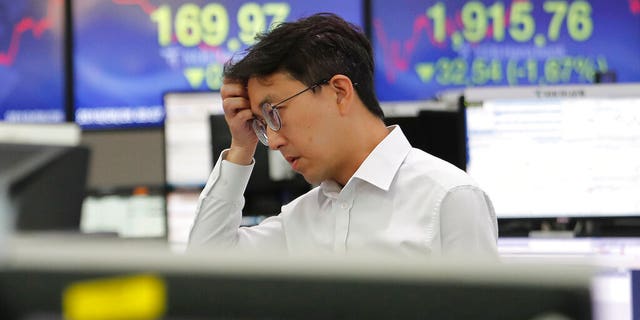
A currency trader watches monitors at the foreign exchange dealing
room of the KEB Hana Bank headquarters in Seoul, South Korea, Monday,
Aug. 26, 2019. (AP Photo/Ahn Young-joon)
Speaking at a technology conference in China, Liu
added: “We believe that the escalation of the trade war is not
beneficial for China, the United States, nor to the interests of the
people of the world."
“We
welcome enterprises from all over the world, including the United
States, to invest and operate in China,” Liu said. “We will continue to
create a good investment environment, protect intellectual property
rights, promote the development of smart intelligent industries with our
market open, resolutely oppose technological blockades and
protectionism, and strive to protect the completeness of the supply
chain.”
Asian shares tumbled early Monday, with Japan's benchmark
Nikkei 225 started plummeting as soon as trading began and stood at
20,234.87 in the morning session, down 2.3 percent. Australia's
S&P/ASX 200 slipped 1.5 percent to 6,427.20. South Korea's Kospi
lost 1.7 percent to 1,916.14. Hong Kong's Hang Seng dropped 3.3
percent to 25,309.37, while the Shanghai Composite was down 1.2
percent at 2,862.87.
The yuan also slipped to 7.1487 to the dollar, weeks after the Treasury Department formally designated China a currency manipulator. The
Treasury Department said it will work with the International Monetary
Fund to try to rectify the “unfair competitive advantage created by
China’s latest actions.”
"The gloves are coming off on both sides
and as such yuan depreciation is an obvious cushion against US tariffs,"
Mitul Kotecha, an economist at Toronto-Dominion Bank, told Bloomberg
News.
There are several reasons why China's central bank would
want to allow the yuan to drop, including to help struggling local
exporters who want their products to be less expensive for international
purchasers. People’s Bank of China Governor Yi Gang, however, has
insisted China does not "engage in competitive devaluation."
On
Sunday, Treasury Secretary Steven Mnuchin told reporters that if "China
would agree to a fair and balanced relationship, we would sign that deal
in a second."
Stephen Innes, managing partner at Valour Markets
in Singapore, compared the difficulty of assessing the volatile market
situation to reading tea leaves.
"Nobody understands where the
president is coming from," he said, adding that the best thing Trump can
do for market stability is to "keep quiet."
"The problem that we're faced right now is that we are making a lot of assumptions ahead of the economic realities."
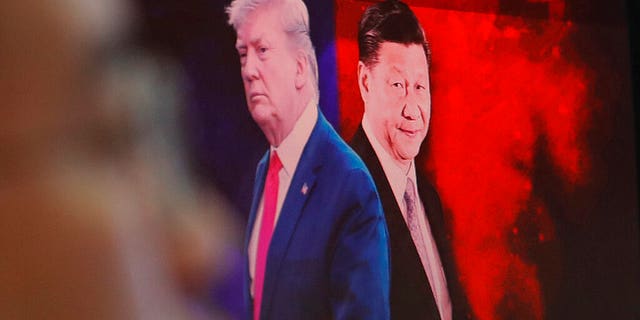
A computer screen shows images of Chinese President Xi Jinping,
right, and U.S. President Donald Trump as a currency trader works at the
foreign exchange dealing room of the KEB Hana Bank headquarters in
Seoul. (AP Photo/Ahn Young-joon)
The market is now dominated by fears of a portending
U.S. recession, although the American economy is actually holding up,
and much of the U.S. economy is made up of consumption, Innes said. If
interest rates come down, he added, consumer spending is likely to go
up, working as a buffer for the economy.
"What the market's really
waiting for is for them to drop interest rates," Innes said. "Right
now, we are still sitting on that uncertainty."
Meanwhile, Sen. Lindsey Graham, R-S.C., said on Sunday that Democrats should not criticize Trump for taking on China over trade as they have complained for years about Beijing’s policies but done nothing. Senate Minority Leader Chuck Schumer, D-N.Y, for example, has urged Trump to fight China aggressively.
“Every
Democrat and every Republican of note has said China cheats,” Graham
said on CBS News’ “Face the Nation.” “The Democrats for years have been
claiming that China should be stood up to, now Trump is and we’ve just
got to accept the pain that comes with standing up to China.”
U.S.
markets have also taken something of a beating. The Dow Jones
Industrial Average plunged more than 600 points Friday after the latest
escalation in the trade war between the U.S. and China rattled
investors. The broad sell-off sent the S&P 500 to its fourth
straight weekly loss.
The tumbling began after Trump responded
angrily on Twitter following China's announcement of new tariffs on $75
billion in U.S. goods. In one of his tweets he "hereby ordered" U.S.
companies with operations in China to consider moving them to other
countries — including the U.S.
Trump
also said he'd respond directly to the tariffs — and after the market
closed he delivered, announcing that the U.S. would increase existing
tariffs on $250 billion in Chinese goods to 30 percent from 25 percent,
and that new tariffs on another $300 billion of imports would be 15
percent instead of 10 percent.
"Starting on October 1st, the 250
BILLION DOLLARS of goods and products from China, currently being taxed
at 25 percent, will be taxed at 30 percent," Trump wrote on Twitter.
"Additionally, the remaining 300 BILLION DOLLARS of goods and products
from China, that was being taxed from September 1st at 10 percent, will
now be taxed at 15 percent. Thank you for your attention to this
matter!".
Zhu Huani of Mizuho Bank in Singapore said what he
called Trump's "tariff tantrum" was setting off "the sense that tariffs
could continue to rise," with the "the unpredictability of timing and
extent of these trade actions risk accentuating the paralysis of
business decisions and big-ticket business spending."
"No matter
which way you cut the cake, it is nearly impossible to construct a
bullish, or even neutral scenario for equity markets today," said
Jeffrey Halley, senior market analyst at Oanda.
Trump also said
Friday morning that he was "ordering" UPS, Federal Express and Amazon to
block any deliveries from China of the powerful opioid drug fentanyl.
The stocks of all three companies fell as traders tried to assess the
possible implications.
The president has also raged against Federal Reserve chairman Jerome Powell for
his continued refusal to cut interest rates, at one point saying: "My
only question is, who is our bigger enemy, Jay Powel (sic) or [China's]
Chairman Xi [Jinping]?"
That outburst came after Powell, speaking
to central bankers in Jackson Hole, Wyo., gave vague assurances that the
Fed "will act as appropriate" to sustain the nation's economic
expansion. While the phrasing was widely seen as meaning interest rate
cuts, he offered no hint of whether or how many reductions might be
coming the rest of the year.
Some analysts, however, are confident the Federal Reserve will lower interest rates this year.
A quarter-point rate cut reduction in September is considered all but certain.
Fox News' Ronn Blitzer, Joseph Wulfsohn, and The Associated Press contributed to this report.