OAN Newsroom
UPDATED 1:35 PM PT — Monday, August 26, 2019
A deal struck by international leaders at the G7 summit to develop a
$20 million Amazon fund is met with lackluster support from Brazil.
Shortly after French President Emmanuel Macron outlined the plan Monday,
his Brazilian counterpart accused him of treating the country like a
“colony.”
President Jair Bolsonaro, who’s been locked in a public dispute with
Macron, said any joint plan about the region’s future should be made by
the countries directly affected in order to protect their “sovereignty
and natural wealth.”
“Do you think someone helps someone else to not be poor without
something in return?” questioned the Brazilian leader. “Why do they have
their eye on the Amazon, what do they want there?”
While Bolsonaro did not immediately clarify if he would cooperate
with the plan, his environmental minister said the funding is “welcome.”
A large amount of that money will go toward firefighting planes and
military support on the ground.
French
President Emmanuel Macron, right, and Chile’s President Sebastian
Pinera attend a joint press conference that focused on climate during
the G7 summit Monday, Aug. 26, 2019 in Biarritz. G-7 countries have
agreed to an immediate $20 million fund to help Amazon countries fight
wildfires. (AP Photo/Francois Mori, Pool)
“We think that we have to protect these real lungs of our world (the
Amazon rainforest), and that’s why I’m very happy that we have been able
to reach an agreement and go in support of those countries
immediately,” stated Chilean President Sebastian Pinera.
While President Trump was unable to make the meeting in person due to
a scheduling issue, Macron said the U.S. is completely on board with
the Amazon deal.
“We had a discussion with President Trump, a long and very positive
one, about the situation in the Amazon,” said Macron. “He shares the
objectives that we are following and that have been reflected in this G7
summit initiative, so that is the first point.”
The second part of the agreement calls for a long-term plan for
reforestation that would replenish biodiversity in areas destroyed by
the fires. If the framework proves successful, the leaders expressed
interest in applying it to Africa’s rainforests, which are also under
threat from fires.
Firefighters
work to put out fires in the Vila Nova Samuel region, along the road to
the National Forest of Jacunda, near to the city of Porto Velho,
Rondonia state, part of Brazil’s Amazon, Sunday, Aug. 25, 2019. Leaders
of the Group of Seven nations said Sunday they were preparing to help
Brazil fight the fires burning across the Amazon rainforest and repair
the damage even as tens of thousands of soldiers were being deployed to
fight the blazes that have caused global alarm. (AP Photo/Eraldo Peres)
In
the summer of 2019, Fox News embarked on an ambitious project to
chronicle the toll progressive policies has had on the homeless crisis
in four west coast cities: Seattle, San Francisco, Los Angeles and
Portland, Ore. In each city, we saw a lack of safety, sanitation, and
civility. Residents, the homeless and advocates say they've lost faith
in their elected officials' ability to solve the issue. Most of the
cities have thrown hundreds of millions of dollars at the problem only
to watch it get worse. This is what we saw in San Francisco.
San Francisco,
a city described in song for its natural beauty, is descending into an
abyss of homelessness, the use of sidewalks as toilets and a place you
might not want to visit, much less live.
The latest, but surely
not the last demonstration of insanity, is San Francisco’s Board of
Supervisors' adoption of new “person first” language guidelines meant to
“change the public’s perception of criminals.”
The words “convicted felon,” “offender,” “convict,” “addict” and
“juvenile delinquent” are out. These individuals will henceforth be
referred to as a “justice-involved person.” Someone previously called a
“criminal” will now be referred to as “a returning resident,” or “a
formerly incarcerated person.”
Supervisor Matt Haney told the San Francisco Chronicle
the intent is to keep people from being “forever labeled for the worst
things that they have done. We want them, ultimately to become
contributing citizens, and referring to them as felons is like a scarlet
letter that they can never get away from.”
A
noble objective, to be sure, but language has — or used to have — a
purpose beyond interpersonal communication. Like so much else today,
language has now been appropriated to advance political agendas.
The
encroachment of euphemisms on common sense is everywhere. Illegal
immigrants have become “undocumented workers.” Babies in the womb lose
their humanity when they are labeled “fetuses.”
Euphemisms
are most used to hide a more accurate description of behavior or status
in order to avoid conflict, or not injure someone who might be offended
or hurt. It fails to communicate anything meaningful, while claiming to
do so. George Orwell called it “Newspeak,” or “doublespeak.”
Too
often, euphemisms are used to make bad behavior appear good, or at
least tolerable, and to allow one to avoid responsibility and
accountability. They are interpreted according to one’s personal wishes.
As Humpty Dumpty told Alice in the Lewis Carroll classic: “When I use a
word, it means just what I choose it to mean — neither more nor less.”
The
English language once conveyed meaning. Properly written and spoken, it
suggested one was educated and capable of conversing in polite company.
Today, it is often used to cover up true intentions. Consider how often
“racism” is misapplied.
The proper use of language can also be
redemptive. That used to be a major goal, along with punishment, of
penitentiaries — the word being derived from “penitent,” suggesting the
possibility of changing one’s life after admitting wrongdoing and
repenting so as not to repeat bad behavior. Is anything “bad” today, or
has that also become subjective?
In our muddled language and
culture, one dare not suggest anyone has done anything wrong lest
negative labels be attached to them. Such labels are unevenly applied.
The political left often retains them to attack the right, but should
the right seek to use words that accurately describe the conduct or
status of another they are condemned as old-fashioned, rigid,
judgmental, or worse.
“Wardrobe malfunction,” has been a recent favorite, a euphemism for showing off what were once considered “private” body parts.
If
you are unemployed, you are “between jobs” or a “consultant.”
“Underserved community” means the politicians aren’t getting all the
money they want. A corollary: you are no longer poor, you are
“economically disadvantaged.” The list is endless.
Instead
of applying euphemisms, San Francisco should be seeing to the homeless
("previously housed individuals"?) and the filthy streets that now
require maps so people can avoid stepping in human waste.
Tony Bennett may have left his heart in San Francisco, but the city seems to have lost its mind there too.
The owner of a San Francisco restaurant famous for hosting politicians claimed Sen. Bernie Sanders lost his vote in the 2020 presidential election after the Vermont Democrat was “rude and cranky” to his servers, a report said.
John Konstin, who owns the 111-year-old John’s Grill, told Politico many Democrats
dined at his bistro while the Democratic National Committee was in town
for a three-day event over the weekend. Sanders arrived for dinner
with about 15 members of his campaign team and was not nice to any of
the staff and didn’t want to shake hands or have his picture taken, he
added.
“It was all very nice, except for cranky Bernie,” Konstin told Politico. "I think he was just hungry and didn't want to be a politician. He lost my vote."
Sanders’
campaign did not respond to a request for comment from Fox News. Lee
Housekeeper, the media contact for John's Grill, told SFGATE.com that
it’s uncharacteristic for Konstin to speak ill of his restaurant
patrons.
"Bernie had to be in a terrible mood," Housekeeper said.
"Anyone in the public eye needs to understand when it's time to order
room service."
Konstin told Politico that staff waiting on other
Democrats, including one large party with the Secretary of State of
California Alex Padilla, Lieutenant Governor of California Eleni
Kounalakis, and House Speaker Nancy Pelosi, had a more pleasant
experience. He described Pelosi as “pure class.”
John's Grill opened its doors in 1908 and was famously featured in Dashiell Hammett's 1930 noir film "The Maltese Falcon," SFGATE.com reported.
The restaurant is popular among politicos and has pictures of
politicians who’ve visited the establishment hanging on its wooden
walls.
Thirteen
presidential candidates attended the DNC meeting in San Francisco over
the weekend. Sen. Elizabeth Warren, D-Mass., dined out with her staff at
San Francisco’s Ayala restaurant in the Union Square Hotel when she
visited the city in June, SFGate.com reported.
"She was
absolutely wonderful and came into our kitchen," Ayala General Manager
Alexandra Loulias told the website. "So complimentary of our staff. She
took individual photos with everyone. Just the nicest lady."
Michelle
and Barack Obama’s bid to purchase a nearly $15-million dollar property
appears to have been accepted. The Martha’s Vineyard estate sits close
to a beach, has two guest wings, seven guest rooms, and measures out to
be 6,900 square feet. They’ve rented the property over the summer and
now seem ready to make it their own.
Former President Obama
and the former first lady have reportedly made a bid of approximately
$15 million on a home in Martha’s Vineyard. The 7,000 square-foot house
comes with 29 acres and would likely be a summer home. The family is
known to have spent quite a bit of time on the island over past summers.
Unlike President Trump,
who earned his money before taking office, the Obamas have benefited
handsomely from their time in the White House. President Obama only
earned the standard $400,000 salary when he was in office, but after
leaving, he and his wife Michelle acquired a joint book deal worth $65
million, high-priced speaking engagements and a deal with Netflix. Now
they are rolling in dough.
As a capitalist,
I am all in favor of people making as much money as they want and
spending it how they please. However, this lavish new abode is quite a
statement in hypocrisy from the former president, who spent his
presidency demonizing everyone else's success.
From
telling small-business owners they “didn’t build that” to the 2018
speech in which he said, "There’s only so much you can eat. There’s only
so big a house you can have. There’s only so many nice trips you can
take. I mean, it’s enough," the former president has spent his life
spreading messages that disparage success.
As many of my Twitter
followers have pointed out, he must not believe in the climate change
his Democratic peers are pushing. If he did, he would believe his $15
million investment on the small island will be underwater — quite
literally — in just over a decade.
Politicians need to
stop saying one thing while doing another. Living in a fancy house is
admirable, but living in a glass house is contemptible.
The
spending is perfectly aligned with the hypocrisy and envy that
continues to permeate the Democratic party. Whether it is Sen. Bernie
Sanders, I-Vt., with his multi-million dollar net worth and three homes
or Sen. Elizabeth Warren, D-Mass., who earned well into the six-figures
teaching at Ivy League institutions, their definition of “too rich”
seems to be one dollar more than whatever they happen to be worth at a
given point in time.
Therein
lies the rub. Too many in Democratic leadership peddle the politics of
envy and victimhood to grab power, wealth and success for themselves.
They indulge their followers in the lie that someone getting wealthy
comes at someone else’s expense. While this is offensive, it is made
worse by the fact that they do it specifically for their own gain,
making the political class more powerful and the government more bloated
all while damaging the concept of the American Dream.
I don’t
begrudge the Obamas for getting a nice house — even though they "didn’t
build that." But politicians need to stop saying one thing while doing
another. Living in a fancy house is admirable, but living in a glass
house is contemptible.
Democrats may have just clobbered their chances of victory in 2020.
While all eyes were trained on President Donald Trump’s furious
confrontation with China last week, Democrat officials at their party’s
convention in San Francisco again voted down a resolution calling for a
candidate debate on climate change. That could prove a dire error.
The decision to prevent a climate debate
will almost certainly encourage a third-party candidate. And that
candidate could sabotage Democrats’ chances of retaking the White House.
Who
might it be? It could be former Washington Gov. Jay Inslee, who ran to
highlight climate change but recently withdrew from the Democratic
nomination race. Or maybe a billionaire like Tom Steyer
or Michael Bloomberg, who both similarly want to press Democrats to
focus on global warming. They might not expect to win, but their
campaigns could elevate the climate discussion.
Remember
that the Green Party put Jill Stein forward in 2016. Though few took
Stein’s candidacy seriously, in the end she attracted 1.4 million votes.
In the aftermath of the election, some blamed her for Hillary Clinton’s
loss, pointing out that in the critical swing states of Michigan and
Wisconsin, Trump’s margin of victory was less than the number of votes
won by Stein.
Since
2016, the climate issue has taken center stage in Democrats’ platforms,
becoming especially important to young voters who are playing a growing
role in our elections. A Pew Center survey reports that voters under
the age of 53 cast 62.2 million votes in the 2018 midterm elections,
more than the 60.1 million recorded by people 53 and older. In the
midterm contest, Gen Z and millennials made up 25 percent of the total
votes cast; their share will increase in 2020.
Young voters are
energized, and especially about global warming. A Harvard Kennedy School
survey found climate change to be the third most important issue to
voters under 30, behind immigration and the economy.
The
decision to prevent a climate debate will almost certainly encourage a
third-party candidate. And that candidate could sabotage Democrats’
chances of retaking the White House.
For proof of the
importance of young climate enthusiasts, look no further than the
Sunrise Movement, an activist group begun only two years ago that has
attracted tens of thousands of followers and staged protests in 250
cities around the country. It also takes credit for launching the Green
New Deal, which, though widely mocked on the right, has been embraced by
nearly every Democratic senator running for 2020.
Sunrise
representatives in attendance at the San Francisco convention erupted
after the DNC vote to block a climate debate, chanting “Failure of
leadership” and “we can’t wait” to protest the complicity of DNC Chair
Tom Perez in the decision; many stormed out of the meeting.
Their anger was echoed on social media.
Elizabeth
Warren tweeted: “Climate change is an existential threat that threatens
(sic) all of us….That’s why we need to have a #ClimateDebate.”
Al
Gore chimed in, tweeting: “The Democrats’ decision to sabotage a
#ClimateDebate is extremely disappointing. Voters all over the U.S. are
demanding we focus on the biggest threat to our nation and humanity’s
future and prioritize solving the climate crisis instead of continuing
business as usual.”
The hashtag #ClimateDebate trended on twitter
in the wake of the vote, with nearly every Democrat hopeful weighing in.
Climate warriors Greenpeace participated, tweeting “We just got word
that the DNC voted to block a #climatedebate. We can’t begin to tell you
how outraged we are… Our political system is failing us, and it’s
failing a whole generation of people fighting for a better world.”
Blocking
a climate debate was risky for Perez and other Democratic
Party officials. They must have known the decision would infuriate young
voters, but they also recognized that such a forum could trip up their
candidates. They knew that their over-the-top remedies to stem global
warming might turn off much-needed independents, guaranteeing Trump’s
reelection.
Consider
Bernie Sanders’ most recent plan to combat rising emissions, which is
projected to cost $16 trillion. In a recent interview, even MSNBC’s
liberal Chris Hayes sounded anxious about the scope of Sanders’
proposal, which he described as “really large.” He asked how Sanders
would pay for such a mammoth overhaul, which includes “replacing every
old diesel school bus, replacing old mobile homes in the country,” in
addition to “a federal takeover of the whole thing, that's essentially a
Tennessee Valley Authority extension for the whole country…”
In a
rambling response, Sanders explained that his program will be paid for
with the money the federal government will make producing sustainable
energy (though wind and power production still require subsidies), the
elimination of “massive” tax breaks now given to fossil fuel companies,
the taxes received from the 20 million new “good-paying union jobs” sure
to be created, cuts to military spending, and higher taxes on
corporations and the wealthy.
Time
does not allow a thorough debunking of this proposal, except to note
that green activist group Oil Change International estimates the
“subsidies” given to oil and coal producers at $20 billion annually,
that the taxes that might be collected on 20 million union workers
earning $100,000 apiece would be about $340 million, and that a 50
percent hike in the individual income taxes paid by every American would
yield only about $1 trillion. In other words, the numbers don’t add up.
Bernie
is not alone, of course. Beto O’Rourke has laid out a $5 trillion plan,
and Elizabeth Warren has not one but five climate proposals in the
hopper. Joe Biden has put forward a plan that only costs $1.7 trillion,
earning him a “C+” grade from the liberal scolds at Mother Jones. And
let’s not forget the Green New Deal, estimated to cost north of $50
trillion.
Perez
and the Democrat machine are in a tight spot. Either allow Sanders and
his rivals to alienate moderate voters by pushing programs that cost the
moon, or risk providing a platform for a third party “green” candidate
who can mobilize young voters.
On the other hand, the debate could
prove illuminating. In the MSNBC interview, Bernie starts off
admitting, “Well, the first thing is we cannot not afford it.” Bernie is
confused and confusing.
Insurance. You have it and hope you never use it. But, just in case, it’s always there.
Joe Biden is insurance for Democrats in 2020.
Yes, Biden is the frontrunner in the polls. Yes, many people think
Biden will be the nominee. But if Biden doesn’t perform then Democrats
will pick another candidate to challenge Donald Trump. In the meantime,
Democrats will keep supporting Biden to make sure he’s in the strongest
position, if he is the nominee, to take on the president.
So just how strong is Biden? Let’s go to the numbers.
In
the latest Fox News Poll, published on Aug. 15, Biden leads the
Democratic field with 31 percent. That’s an 11-point lead over Elizabeth Warren,
in second place with 20 percent, and third-place Bernie Sanders at
10 percent. At first blush that looks like a strong position for Biden.
However, Biden was at 31 percent in the March Fox News Poll … five
months ago. Biden had a four-point bump to 35 percent in May, dropped in
June to 32 percent, gained one point in July, and then back to 31
percent in August. Steady but hardly the numbers of a strong
frontrunner.
Let’s look at the general election matchup with Trump.
Today,
Biden beats Trump 50 percent to 38 percent. A 12-point lead looks
strong … until you see Biden had a similar lead against Trump in the
October 2015 Fox News Poll. Favorability rating? Biden is currently at
50 percent. Yet, it was 56 percent in 2016, 2017 and 2018.
While
Biden may seem like a relatively steady frontrunner, when you look
under the hood it becomes clear that one group of voters is keeping
Biden in first place: African Americans.
In the latest Fox News
Poll a staggering 84 percent of African Americans support Biden.
Furthermore, 71 percent of nonwhite women support him. The good news for
Biden is that African American voters are keeping his support at 50
percent. The bad news? If African Americans change their minds, then the
bottom falls out for the former vice president.
In
the latest Fox News Poll a staggering 84 percent of African Americans
support Biden. If they change their minds, then the bottom falls out for
the former vice president.
Biden's campaign is based
on the “electability” argument. Democrats badly want to beat Trump and
will back anyone who can do it. Today, that candidate is Joe Biden. The
problem for Biden is the first two primary contests, Iowa and New
Hampshire, have very few African American voters. It is not until South
Carolina, the third contest, that African American are a sizable voting
block.
If Biden loses either Iowa or New Hampshire, or both, then
he may not make it to South Carolina. One or two losses in early
February would pierce his argument of electability, costing him the
support African American voters ... and the nomination. For example, if
Warren won in Iowa and New Hampshire, she could run the table and win
the nomination with African American support moving to her.
That
scenario may explain why Biden was in Iowa and New Hampshire over the
last five days rather than at the Democratic National Committee meeting
in San Francisco, where virtually every other presidential candidate
appeared. Biden knows he has to win the first two contests, or at least
one, to be the nominee.
In the latest Des Moines Register poll
conducted in June, the gold standard for Iowa polling, Biden was leading
with 24 percent of caucus-goers. Sanders, Warren and Pete Buttigieg
were in a dead heat for second with, respectively, 16, 15 and 14
percent. But Warren leads in the second choice and under active
consideration categories, key indicators of support in the caucus
system. So if Biden, or any other candidate, faltered, then Warren would
be the likely beneficiary. In fact, many believe the Massachusetts
senator is in an excellent position to capitalize on such a scenario
because she has the best organization in Iowa.
In New Hampshire,
an August poll conducted by Suffolk University has Biden in the lead
with 21 percent, followed by Sanders at 17 percent and Warren with 14
percent. The margin over Sanders and Warren is hardly a comfortable
place for Biden. Of course, New Hampshire is also a must-win for
Sanders. He won that state's primary by 22 points over Hillary Clinton
in 2016, but eventually lost the nomination to her.
If Sanders
loses New Hampshire in 2020 it is virtually impossible for him to win
the nomination. Once again, Warren leads the second-choice category at
21 percent, and 58 percent of voters said they could change their
mind before the Feb. 11 contest.
In Iowa and New Hampshire, Biden is looking over his shoulder at Warren.
In South Carolina, he is African Americans' insurance policy and they are his.
And that means Biden is the Democrats’ insurance policy too … for now.
President Trump on Monday said the U.S. is not seeking regime change in Iran and told reporters at the G7 summit in Biarritz, France, that he hopes to see a strong Iran.
Trump’s comments came after a day of tense meetings with his European counterparts about
how best to approach Iran and the recent tensions in the region. On
Sunday, Iran’s Foreign Minister Mohammad Javad Zarif made a surprise
visit at the summit at the behest of French President Emmanuel Macron.
Trump insisted that he knew about Zarif’s appearance but did not meet
with him.
“I knew he was coming in and I respected the fact that
he was coming in. And we’re looking to make Iran rich again, let them be
rich, let them do well, if they want,” Trump said, according to Reuters. “Or
they can be poor as can be. And I tell you what, I don’t think it’s
acceptable the way they are being forced to live in Iran,”
Trump
has said in the past that the U.S. is not interested in a Tehran regime
change. He told Japanese Prime Minister Shinzo Abe that the U.S. is
“looking for no nuclear weapons.”
China signaled on Monday it was now seeking a "calm" end to its ongoing trade war with the U.S., as Asian markets crumbled and China's currency plummeted to an 11-year low following the latest tariffs on $550 billion in Chinese goods announced last Friday by the Trump administration.
Trump
said Monday that officials from China called U.S. officials and
expressed interest to "get back to the table,” The Wall Street Journal
reported. He called the discussions a “very positive development.”
“They want to make a deal. That’s a great thing,” he said.
News of the possible opening in negotiations came shortly after President Trump threatened
to declare a national emergency that would result in American
businesses freezing their relationships with China. Trump's tariff
barrage on Friday was a response to China imposing its own retaliatory
tariffs on $75 billion in U.S. goods.
At the Group of Seven summit
in France on Sunday, White House officials rejected suggestions the
president was wavering and insisted that his only regret was not implementing even more tariffs
on China. Trump wrote on Twitter that world leaders at the G-7 were
"laughing" at all the inaccurate media coverage of the gathering.
In
response, Chinese Vice Premier Liu He told a state-controlled newspaper
on Monday that "China is willing to resolve its trade dispute with the
United States through calm negotiations and resolutely opposes the
escalation of the conflict," Reuters first reported, citing a transcript of his remarks provided by the Chinese government. Liu is China's top trade negotiator.
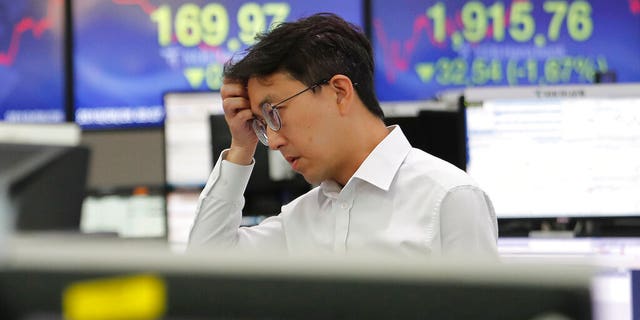
A currency trader watches monitors at the foreign exchange dealing
room of the KEB Hana Bank headquarters in Seoul, South Korea, Monday,
Aug. 26, 2019. (AP Photo/Ahn Young-joon)
Speaking at a technology conference in China, Liu
added: “We believe that the escalation of the trade war is not
beneficial for China, the United States, nor to the interests of the
people of the world."
“We
welcome enterprises from all over the world, including the United
States, to invest and operate in China,” Liu said. “We will continue to
create a good investment environment, protect intellectual property
rights, promote the development of smart intelligent industries with our
market open, resolutely oppose technological blockades and
protectionism, and strive to protect the completeness of the supply
chain.”
Asian shares tumbled early Monday, with Japan's benchmark
Nikkei 225 started plummeting as soon as trading began and stood at
20,234.87 in the morning session, down 2.3 percent. Australia's
S&P/ASX 200 slipped 1.5 percent to 6,427.20. South Korea's Kospi
lost 1.7 percent to 1,916.14. Hong Kong's Hang Seng dropped 3.3
percent to 25,309.37, while the Shanghai Composite was down 1.2
percent at 2,862.87.
The yuan also slipped to 7.1487 to the dollar, weeks after the Treasury Department formally designated China a currency manipulator. The
Treasury Department said it will work with the International Monetary
Fund to try to rectify the “unfair competitive advantage created by
China’s latest actions.”
"The gloves are coming off on both sides
and as such yuan depreciation is an obvious cushion against US tariffs,"
Mitul Kotecha, an economist at Toronto-Dominion Bank, told Bloomberg
News.
There are several reasons why China's central bank would
want to allow the yuan to drop, including to help struggling local
exporters who want their products to be less expensive for international
purchasers. People’s Bank of China Governor Yi Gang, however, has
insisted China does not "engage in competitive devaluation."
On
Sunday, Treasury Secretary Steven Mnuchin told reporters that if "China
would agree to a fair and balanced relationship, we would sign that deal
in a second."
Stephen Innes, managing partner at Valour Markets
in Singapore, compared the difficulty of assessing the volatile market
situation to reading tea leaves.
"Nobody understands where the
president is coming from," he said, adding that the best thing Trump can
do for market stability is to "keep quiet."
"The problem that we're faced right now is that we are making a lot of assumptions ahead of the economic realities."
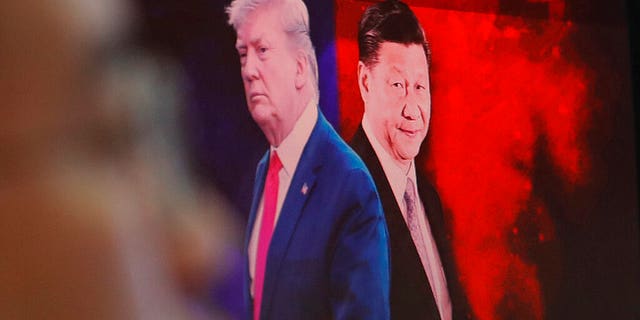
A computer screen shows images of Chinese President Xi Jinping,
right, and U.S. President Donald Trump as a currency trader works at the
foreign exchange dealing room of the KEB Hana Bank headquarters in
Seoul. (AP Photo/Ahn Young-joon)
The market is now dominated by fears of a portending
U.S. recession, although the American economy is actually holding up,
and much of the U.S. economy is made up of consumption, Innes said. If
interest rates come down, he added, consumer spending is likely to go
up, working as a buffer for the economy.
"What the market's really
waiting for is for them to drop interest rates," Innes said. "Right
now, we are still sitting on that uncertainty."
Meanwhile, Sen. Lindsey Graham, R-S.C., said on Sunday that Democrats should not criticize Trump for taking on China over trade as they have complained for years about Beijing’s policies but done nothing. Senate Minority Leader Chuck Schumer, D-N.Y, for example, has urged Trump to fight China aggressively.
“Every
Democrat and every Republican of note has said China cheats,” Graham
said on CBS News’ “Face the Nation.” “The Democrats for years have been
claiming that China should be stood up to, now Trump is and we’ve just
got to accept the pain that comes with standing up to China.”
U.S.
markets have also taken something of a beating. The Dow Jones
Industrial Average plunged more than 600 points Friday after the latest
escalation in the trade war between the U.S. and China rattled
investors. The broad sell-off sent the S&P 500 to its fourth
straight weekly loss.
The tumbling began after Trump responded
angrily on Twitter following China's announcement of new tariffs on $75
billion in U.S. goods. In one of his tweets he "hereby ordered" U.S.
companies with operations in China to consider moving them to other
countries — including the U.S.
Trump
also said he'd respond directly to the tariffs — and after the market
closed he delivered, announcing that the U.S. would increase existing
tariffs on $250 billion in Chinese goods to 30 percent from 25 percent,
and that new tariffs on another $300 billion of imports would be 15
percent instead of 10 percent.
"Starting on October 1st, the 250
BILLION DOLLARS of goods and products from China, currently being taxed
at 25 percent, will be taxed at 30 percent," Trump wrote on Twitter.
"Additionally, the remaining 300 BILLION DOLLARS of goods and products
from China, that was being taxed from September 1st at 10 percent, will
now be taxed at 15 percent. Thank you for your attention to this
matter!".
Zhu Huani of Mizuho Bank in Singapore said what he
called Trump's "tariff tantrum" was setting off "the sense that tariffs
could continue to rise," with the "the unpredictability of timing and
extent of these trade actions risk accentuating the paralysis of
business decisions and big-ticket business spending."
"No matter
which way you cut the cake, it is nearly impossible to construct a
bullish, or even neutral scenario for equity markets today," said
Jeffrey Halley, senior market analyst at Oanda.
Trump also said
Friday morning that he was "ordering" UPS, Federal Express and Amazon to
block any deliveries from China of the powerful opioid drug fentanyl.
The stocks of all three companies fell as traders tried to assess the
possible implications.
The president has also raged against Federal Reserve chairman Jerome Powell for
his continued refusal to cut interest rates, at one point saying: "My
only question is, who is our bigger enemy, Jay Powel (sic) or [China's]
Chairman Xi [Jinping]?"
That outburst came after Powell, speaking
to central bankers in Jackson Hole, Wyo., gave vague assurances that the
Fed "will act as appropriate" to sustain the nation's economic
expansion. While the phrasing was widely seen as meaning interest rate
cuts, he offered no hint of whether or how many reductions might be
coming the rest of the year.
Some analysts, however, are confident the Federal Reserve will lower interest rates this year.
A quarter-point rate cut reduction in September is considered all but certain. Fox News' Ronn Blitzer, Joseph Wulfsohn, and The Associated Press contributed to this report.