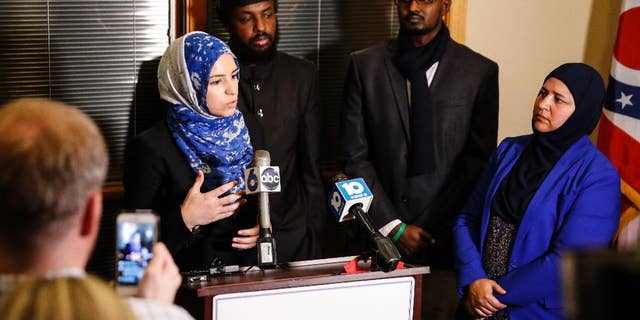
Rep. Ilhan Omar,
D-Minn., who is accused of improperly using political campaign funds to
reimburse her alleged lover for travel expenses, doesn’t need to worry
for now about a complaint filed against her with the Federal Election
Commission. Vacancies on the FEC make it impossible for the commission
to take any action.
The FEC,
where I served as a commissioner over a decade ago, is supposed to act
as a government watchdog against election law violations. But unless it
has four members, the watchdog is effectively muzzled and chained,
helpless to act. Right now there are three members and three vacancies
on the commission.
That’s good news for Omar, who refused
Wednesday to answer questions about the allegations filed against her
this week by a nonprofit group called the National Legal and Policy
Center, which describes itself as “a charitable and educational
organization” that seeks to “foster and promote ethics in government and
public life.”
Asked
by a reporter in Minneapolis why she is refusing to answer questions,
Omar said: “Because they’re stupid questions.” Later in the day the
married congresswoman told reporters: “I will just say I have no
interest in commenting on anything that you are about to ask about my
personal life, so you can chase me all you want.”
The
FEC will send Omar a copy of the complaint filed against her and she
will have 15 days to send a response. But the question of whether to
open an investigation of the congresswoman – who has been accused by
President Trump and others of anti-Semitism and hatred of the Jewish
state of Israel – will have to wait until there are four confirmed FEC
commissioners. No one knows when that will happen.
With at least
four members, the FEC could levy a fine against Omar if it finds she
committed a civil violation of campaign finance law. The commission has
the power to determine the amount of such a fine, based on whatever
commissioners believe is appropriate.
The complaint
filed with the FEC against Omar alleges that her election campaign paid
a consultant – Tim Mynett and his E. Street Group, LLC – $230,000 for
fundraising consulting, digital communications, Internet advertising and
travel expenses.
However, in a divorce case filed by Tim Mynett’s
wife, Beth Mynett, she alleges that her husband told her “he was
romantically involved with” Omar – a claim Omar denies.
Beth
Mynett’s divorce complaint alleges that her husband’s “recent travel and
long work hours now appear to be more related to his affair with Rep.
Omar than with his actual work commitments.”
The complaint filed
with the FEC points out that the payment of Tim Mynett’s travel expenses
started the same month that Mynett reportedly told his wife he was
having an extramarital affair with Omar.
Thus, according to the
complaint filed with the FEC, the travel expenses for Tim Mynett made
with funds collected as political campaign contributions “may have been
unrelated, or only partially related, to Omar’s campaign” and instead
may have been “so that Rep. Omar would have the benefit of Mynett’s
romantic companionship.”
If that is the case, then payments by
Omar to Tim Mynett were “personal in nature” and not related to the
campaign, according to the complaint.
If these allegations are
true, Omar may have run afoul of a federal law – specifically, 52 U.S.C.
§30114. This law bars the use of campaign funds “to fulfill any
commitment, obligation, or expense of a person that would exist
irrespective of the candidate’s election campaign.”
Examples of
what is prohibited for funding with campaign donations include such
items as a personal mortgage, clothing purchases, non-campaign-related
car expenses, and vacations and other non-campaign-related trips.
In
other words, if Mynett’s travel expense were unrelated to his actual
work for the campaign but in furtherance of an affair with Omar, those
would be personal expenses. Campaign funds couldn’t be used to pay them.
Omar’s attorneys have dismissed the complaint filed with the FEC as a “political ploy.”
But until the FEC gets another commissioner, neither this complaint nor
any others will be investigated by the commission to see if there is
actually any substance – and any credibility – to the allegations being
made.
So while the complaint against Omar is making headlines –
both because of the nature of the allegations and her prominence as one
of four far-left Democratic freshman congresswomen known as the “Squad”
– all political candidates are getting a free pass on any complaints
filed against them with the FEC as long as the commission has three
vacancies.
The resignation
of Commissioner Matt Petersen (who replaced me) from the FEC earlier
this month left the commission in its current state of paralysis, with
three vacancies.
The six FEC commissioners are nominated by the
president and confirmed by the Senate. There is a long tradition that
whenever a seat held by the political party not in control of the White
House opens up, the president asks the leader of that political party in
the Senate for his choice to fill the seat.
There are currently two empty Republicans seats and one empty Democratic seat on the commission.
The names of FEC nominees are sent to the Senate in pairs – one Republican and one Democrat.
President
Trump nominated a Texas lawyer, Trey Trainor, in 2017 to fill an open
Republican seat. But there has been no public report that Senate
Minority Leader Chuck Schumer, D-N.Y., has given Trump a nominee for the
Democratic seat that has been empty since 2017.
Without a quorum –
four commissioners on the six-member FEC – the commission can’t hold
meetings, initiate audits, vote on enforcement matters, issue advisory
opinions, or engage in rulemaking.
As a result, as the 2020
presidential election cycle heats up, the FEC remains unable to carry
out the most important duties it was created to perform.
The FEC
regulates all of the contributions and expenditures of federal
candidates for the presidency and Congress. When it has at least four
members, the commission is empowered to go after candidates, political
parties, political action committees and others who violate the law,
imposing civil penalties consisting of fines.
The
vast majority of campaign finance violations are civil matters because
they are usually inadvertent violations of the law. The Federal Election
Campaign Act is byzantine in its complexity and often ambiguous. Even
the commissioners sometime disagree on the proper interpretation and
application of the law.
The U.S. Justice Department retains
jurisdiction over criminal campaign finance violations, which are
“knowing and willful” violations of the law. However, criminal
prosecutions are very rare.
As an example, missing the deadline
for filing a required campaign finance report on contributions received
by a candidate is a civil violation, while knowingly spending campaign
funds on personal expenses unrelated to a campaign would be a criminal
violation.
That’s
why former Rep. Jesse L. Jackson Jr., D-Ill., went to jail in 2013. He
pleaded guilty to spending $750,000 in campaign funds on everything from
personal travel and restaurant expenses to a Rolex watch, fur coats for
his wife, and memorabilia from Bruce Lee, Eddie Van Halen and Jimi
Hendrix, along with mounted elk heads for his office.
Right now
the ball is in Sen. Schumer’s court to nominate a Democratic FEC
commissioner, and for the Senate to then confirm a Democrat and a
Republican to the commission. Until that happens, Ilhan Omar has nothing
to worry about from the FEC.