HONG KONG (AP) — Hong Kong police fired blue-colored water from water
cannons and tear gas on Saturday in a standoff with protesters outside
government headquarters.
While
other protesters marched back and forth elsewhere in the city, a large
crowd wearing helmets and gas masks gathered outside the city government
building. Some approached barriers that had been set up to keep
protesters away and appeared to throw objects at the police on the other
side. Others shone laser lights at the officers.
Police fired
tear gas from the other side of the barriers, then brought out a water
cannon truck that fired regular water and then colored water at the
protesters, staining them and nearby journalists and leaving blue
puddles in the street.
Earlier, large crowds of protesters
gathered in central Hong Kong as police readied for possible
confrontations near the Chinese government’s main office and elsewhere
in the semiautonomous territory.
A march to mark the fifth
anniversary of China’s decision against fully democratic elections in
Hong Kong was not permitted by police, but protesters took to the
streets anyway in the 13th straight weekend of demonstrations.
The
mostly young, black-shirted protesters took over roads and major
intersections in shopping districts as they rallied and marched. Police
erected additional barriers and brought out two water cannon trucks near
the Chinese government office and deployed at various locations in riot
gear.
Democratic
Party lawmaker Lam Cheuk-ting said Hong Kong citizens would keep
fighting for their rights and freedoms despite the arrests of several
prominent activists and lawmakers in the past two days, including
activist Joshua Wong.
The protests were sparked by a now-shelved
extradition bill. Protesters are demanding its full withdrawal,
democratic elections and an investigation into alleged police brutality
in what have been pitched battles with hard-line demonstrators.
“I
do believe the government deliberately arrested several leaders of the
democratic camp to try to threaten Hong Kong people not to come out to
fight against the evil law,” Lam said at what was advertised as a
Christian march earlier in the day.
About 1,000 people marched to a
Methodist church and police headquarters. They alternated between
singing hymns and chanting the slogans of the pro-democracy movement. An
online flyer for the demonstration called it a “prayer for sinners” and
featured images of a Christian cross and embattled Hong Kong leader
Carrie Lam, who had proposed the extradition bill.
Authorities
rejected an application from the Civil Human Rights Front, the organizer
of pro-democracy marches that have drawn upward of a million people
this summer, for a march to the Chinese government office. Police said
that while previous marches have started peacefully, they have
increasingly degenerated into violence in the end.
The standing
committee of China’s legislature ruled on Aug. 31, 2014, that Hong Kong
residents could elect their leader directly, but that the candidates
would have to be approved by a nominating committee.
The decision
failed to satisfy democracy advocates in the city and led to the 79-day
long Occupy Central protests that fall, in which demonstrators camped
out on major streets in the financial district and other parts of Hong
Kong.
The participants in the religious march Saturday were peaceful and
mostly older than the younger protesters who have led this summer’s
movement and, in some cases, blocked streets and battled police with
bricks, sticks and gasoline bombs
Religious meetings do not
require police approval, though authorities said late Friday that
organizers of a procession with more than 30 people must notify police.
The
government shut down streets and subway service near the Chinese
government’s office, about 5 kilometers (3 miles) west of the religious
march.
“A public event is expected on Hong Kong Island this
afternoon which may cause severe disruptions,” police said. “Text
messages have been sent to alert members of the public to mind their
personal safety.”
___
Associated Press videojournalists Alice Fung and Johnson Lai contributed to this report.
FILE – In this April 24, 2015, file photo, pumpjacks work in a field
near Lovington, N.M. Oil industry and environmental groups say they
expect the Environmental Protection Agency to release a proposed rule
over the next few days that will roll back requirements on detecting and
plugging methane leaks at oil and gas facilities. (AP Photo/Charlie
Riedel, File)
The Environmental Protection Agency is cutting back on energy
regulations created by the Obama administration, some of which are just
copies of other rules.
The latest decision by President Trump’s administration is expected
to help oil and gas companies, possibly boosting profits by hundreds of
millions of dollars into the next decade.
This includes changing how methane is regulated. Small companies have
argued against the installation of technology designed to look for and
fix leaks because they say it costs them too much. The president is also
planning a rollback of ethanol regulations that are expected to help
American farmers.
The Farmers are going to be so happy when they
see what we are doing for Ethanol, not even including the E-15, year
around, which is already done. It will be a giant package, get ready! At
the same time I was able to save the small refineries from certain
closing. Great for all!
President Trump talked about what his policies are doing for the
future of the industry during a joint news conference with France at the
G7 summit.
“We are now the number one energy producer in the world,” he stated.
“Soon it will be, by far, the number one — it’s tremendous wealth.”
A few weeks before that speech, the president told a crowd in
Pennsylvania his administration was clearing a path for energy and
manufacturing companies to grow.
A public comment period will be implemented before the EPA’s new
methane policy can take effect. This is just the latest effort by the
president to cut regulations. He has opened the door for drilling in
Alaska and for mining on public land. Additionally, there are reported
plans by the EPA in regards to the Endangered Species Act as well as
cutting regulations related to streams and wetlands.
One America News Network received a shout from one of the most
outspoken anti-Trump talk show hosts on TV. Earlier this week on CNN,
anchor Don Lemon held a panel on the president’s anti-Fox News tweets.
During the discussion, a Daily Beast columnist brought up the
president’s new favorite news channel — One America News.
While some critics on the panel tried to downplay One America’s rise,
others gave the channel some free publicity. One America News CEO
Robert Herring took to Twitter in response to the discussion:
Workers break ground on new border wall construction about 20 miles west
of Santa Teresa, New Mexico, Aug. 23, 2019. The wall visible on the
left was built in 2018 with money allocated by Congress, while the new
construction is funded by money reallocated from Department of Defense
funding. (AP Photo/Cedar Attanasio)
According to California Border Patrol agents, new infrastructure in
an area known as “smuggler’s gulch” is making a difference. On Thursday,
the agent in charge — Justin De La Torre — stated a steep, open canyon
between Tijuana and San Diego has been used for decades by immigrants
attempting to smuggle drugs into the U.S. from Mexico.
The agent said when he first started working in “smuggler’s gulch”
there needed to be at least five agents on patrol. He also noted that
effective infrastructure there was lacking. However, De La Torre now
says the wall’s formidable features have successfully bolstered Customs
and Border Protection’s (CBP) security efforts.
“It has an anti-climb feature, it’s made of steel, it also has a
concrete base that prevents digging from underneath, and now we’re able
to control this area with the new infrastructure,” he stated.
De La Torre added, the agents who patrolled “smugglers gulch” in the
past only had a fence made out of landing mat to aid security efforts.
He said the fence helped, but it was easy to climb.
President Trump moved to replace the fencing along the San Diego
border earlier this year as his administration sped up moves to build
taller, stronger border reinforcement. During the State of the Union
address, the president stated CBP agents are the ones who see how the
wall is helping mitigate the crisis at the border first-hand.
“This is a smart, strategic, see-through steel barrier — not just a
simple concrete wall,” said the president. “It will be deployed in the
areas identified by border agents as having the greatest need, and as
these agents will tell you, where walls go up, illegal crossings go way
down.”
Border officials stated they are continuing their efforts to
construct several miles of wall along the southwest border. The CBP
confirmed several wall construction projects are underway in California,
Arizona, New Mexico, and Texas.
Numerous wall construction projects are underway
across the Southwest border, including projects in California, Arizona,
New Mexico and Texas. pic.twitter.com/43OrCdw8J2
EXCLUSIVE: The
Commerce Department on Thursday terminated its just-announced planned
partnership with the nation's largest Muslim advocacy group, the Council on American-Islamic Relations,
after Fox News' "Tucker Carlson Tonight" asked about the arrangement --
given CAIR's reported ties to the terrorist group Hamas, and its
repeated attacks on the president.
"Based on further review, the Census Bureau is no longer partnering with CAIR," the Commerce Department said in a statement to "Tucker."
The
plan, according to the group, was to enhance outreach efforts to
Muslims using CAIR's network of local offices. The census, conducted
once a decade, has been used not only to determine congressional
apportionment, but also as a critical planning tool for state, local and
federal agencies.
However, CAIR and the Trump administration
would have been strange bedfellows -- and tension in the relationship
was evident earlier Thursday. Reached by Fox News prior to the Census
Bureau's decision, CAIR openly derided the Trump administration as
"white supremacist" despite the partnership.
"The Census Bureau,
like CAIR, is nonpartisan," the organization said. "CAIR is not
receiving any government funding as part of this project to promote
Muslim participation in the U.S. census. We continue to believe that
President Trump and his administration promote a white supremacist,
anti-immigrant and Islamophobic agenda."
In its official statement on Wednesday announcing the partnership, however, CAIR sounded a more positive note.
"CAIR
is proud to partner with the U.S. Census Bureau to ensure American
Muslims are fairly and accurately counted in the 2020 Census," Nihad
Awad, CAIR’s national executive director, said in a news release earlier on Thursday. "Full
participation in the census ensures that American Muslims will be
better represented in Congress and that their communities receive an
equal share in state and federal programs."
The organization
added: "CAIR wants to ensure that not only are American Muslim
communities being fairly counted, but that their neighbors are getting a
fair share in federal and state funding."
In 2009, the FBI severed its once-close ties to CAIR amid mounting evidence that the group had links to a support network for Hamas.
Local
chapters of CAIR were shunned in the wake of a 15-year FBI
investigation that culminated in the conviction of Hamas fundraisers at a
trial in which CAIR itself was listed as an unindicted co-conspirator.
The U.S. government has designated Hamas as a terrorist organization.
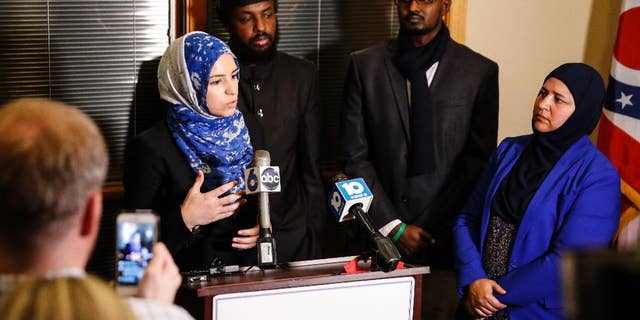
Roula Allouch, the board chairwoman of the Council on American-Islamic Relations, left, seen speaking in 2016.
(AP Photo/John Minchillo, File)
The FBI
previously had invited CAIR to give training sessions for agents and
used it as a liaison with the American Muslim community.
CAIR's executive director, Nihad Awad, attended a post-Sept. 11 meeting with then-FBI Director Robert Mueller, and he met with other top brass as
recently as 2006. That was before Awad was shown to have participated
in planning meetings with the Holy Land Foundation, five officials of
which were convicted in December of funneling $12.4 million to Hamas.
Prosecutors
identified CAIR's chairman emeritus, Omar Ahmad, as an unindicted
co-conspirator in that trial, and Special Agent Lara Burns testified
that CAIR was a front group for radical organizations operating in the
U.S.
CAIR denied it conspired in the case and has sued
unsuccessfully to have its name removed from the list of
co-conspirators. It also has protested the FBI's decision to sever
relations.
"This is an unfortunate legacy of the Bush
administration's misguided and counterproductive efforts to marginalize
mainstream American Muslim organizations," CAIR's national office said
in a statement to Fox News at the time. "It is not surprising that we
would be singled out by those in the previous administration who sought
to prevent us from defending the civil rights of American Muslims."
In a statement on its website in May 2013, CAIR similarly rejected suggestions it had links to terrorism.
"CAIR
is not is [sic] 'the Wahhabi lobby,' a 'front group for Hamas,' a
'fundraising arm for Hezbollah,' '...part of a wider conspiracy overseen
by the Muslim Brotherhood...' or any of the other false and misleading
associations our detractors seek to smear us with," the organization
said. "That we stand accused of being both a 'fundraising arm of
Hezbollah' and the 'Wahhabi lobby' is a significant point in
demonstrating that our detractors are hurling slander, not fact.
Hezbollah and the Salafi (Wahhabi) movement represent diametrically
opposed ideologies." "Tucker Carlson Tonight" investigative producer Alex Pfeiffer contributed to this report.
Rep. Ilhan Omar,
D-Minn., who is accused of improperly using political campaign funds to
reimburse her alleged lover for travel expenses, doesn’t need to worry
for now about a complaint filed against her with the Federal Election
Commission. Vacancies on the FEC make it impossible for the commission
to take any action.
The FEC,
where I served as a commissioner over a decade ago, is supposed to act
as a government watchdog against election law violations. But unless it
has four members, the watchdog is effectively muzzled and chained,
helpless to act. Right now there are three members and three vacancies
on the commission.
That’s good news for Omar, who refused
Wednesday to answer questions about the allegations filed against her
this week by a nonprofit group called the National Legal and Policy
Center, which describes itself as “a charitable and educational
organization” that seeks to “foster and promote ethics in government and
public life.”
Asked
by a reporter in Minneapolis why she is refusing to answer questions,
Omar said: “Because they’re stupid questions.” Later in the day the
married congresswoman told reporters: “I will just say I have no
interest in commenting on anything that you are about to ask about my
personal life, so you can chase me all you want.”
The
FEC will send Omar a copy of the complaint filed against her and she
will have 15 days to send a response. But the question of whether to
open an investigation of the congresswoman – who has been accused by
President Trump and others of anti-Semitism and hatred of the Jewish
state of Israel – will have to wait until there are four confirmed FEC
commissioners. No one knows when that will happen.
With at least
four members, the FEC could levy a fine against Omar if it finds she
committed a civil violation of campaign finance law. The commission has
the power to determine the amount of such a fine, based on whatever
commissioners believe is appropriate.
The complaint
filed with the FEC against Omar alleges that her election campaign paid
a consultant – Tim Mynett and his E. Street Group, LLC – $230,000 for
fundraising consulting, digital communications, Internet advertising and
travel expenses.
However, in a divorce case filed by Tim Mynett’s
wife, Beth Mynett, she alleges that her husband told her “he was
romantically involved with” Omar – a claim Omar denies.
Beth
Mynett’s divorce complaint alleges that her husband’s “recent travel and
long work hours now appear to be more related to his affair with Rep.
Omar than with his actual work commitments.”
The complaint filed
with the FEC points out that the payment of Tim Mynett’s travel expenses
started the same month that Mynett reportedly told his wife he was
having an extramarital affair with Omar.
Thus, according to the
complaint filed with the FEC, the travel expenses for Tim Mynett made
with funds collected as political campaign contributions “may have been
unrelated, or only partially related, to Omar’s campaign” and instead
may have been “so that Rep. Omar would have the benefit of Mynett’s
romantic companionship.”
If that is the case, then payments by
Omar to Tim Mynett were “personal in nature” and not related to the
campaign, according to the complaint.
If these allegations are
true, Omar may have run afoul of a federal law – specifically, 52 U.S.C.
§30114. This law bars the use of campaign funds “to fulfill any
commitment, obligation, or expense of a person that would exist
irrespective of the candidate’s election campaign.”
Examples of
what is prohibited for funding with campaign donations include such
items as a personal mortgage, clothing purchases, non-campaign-related
car expenses, and vacations and other non-campaign-related trips.
In
other words, if Mynett’s travel expense were unrelated to his actual
work for the campaign but in furtherance of an affair with Omar, those
would be personal expenses. Campaign funds couldn’t be used to pay them.
Omar’s attorneys have dismissed the complaint filed with the FEC as a “political ploy.”
But until the FEC gets another commissioner, neither this complaint nor
any others will be investigated by the commission to see if there is
actually any substance – and any credibility – to the allegations being
made.
So while the complaint against Omar is making headlines –
both because of the nature of the allegations and her prominence as one
of four far-left Democratic freshman congresswomen known as the “Squad”
– all political candidates are getting a free pass on any complaints
filed against them with the FEC as long as the commission has three
vacancies.
The resignation
of Commissioner Matt Petersen (who replaced me) from the FEC earlier
this month left the commission in its current state of paralysis, with
three vacancies.
The six FEC commissioners are nominated by the
president and confirmed by the Senate. There is a long tradition that
whenever a seat held by the political party not in control of the White
House opens up, the president asks the leader of that political party in
the Senate for his choice to fill the seat.
There are currently two empty Republicans seats and one empty Democratic seat on the commission.
The names of FEC nominees are sent to the Senate in pairs – one Republican and one Democrat.
President
Trump nominated a Texas lawyer, Trey Trainor, in 2017 to fill an open
Republican seat. But there has been no public report that Senate
Minority Leader Chuck Schumer, D-N.Y., has given Trump a nominee for the
Democratic seat that has been empty since 2017.
Without a quorum –
four commissioners on the six-member FEC – the commission can’t hold
meetings, initiate audits, vote on enforcement matters, issue advisory
opinions, or engage in rulemaking.
As a result, as the 2020
presidential election cycle heats up, the FEC remains unable to carry
out the most important duties it was created to perform.
The FEC
regulates all of the contributions and expenditures of federal
candidates for the presidency and Congress. When it has at least four
members, the commission is empowered to go after candidates, political
parties, political action committees and others who violate the law,
imposing civil penalties consisting of fines.
The
vast majority of campaign finance violations are civil matters because
they are usually inadvertent violations of the law. The Federal Election
Campaign Act is byzantine in its complexity and often ambiguous. Even
the commissioners sometime disagree on the proper interpretation and
application of the law.
The U.S. Justice Department retains
jurisdiction over criminal campaign finance violations, which are
“knowing and willful” violations of the law. However, criminal
prosecutions are very rare.
As an example, missing the deadline
for filing a required campaign finance report on contributions received
by a candidate is a civil violation, while knowingly spending campaign
funds on personal expenses unrelated to a campaign would be a criminal
violation.
That’s
why former Rep. Jesse L. Jackson Jr., D-Ill., went to jail in 2013. He
pleaded guilty to spending $750,000 in campaign funds on everything from
personal travel and restaurant expenses to a Rolex watch, fur coats for
his wife, and memorabilia from Bruce Lee, Eddie Van Halen and Jimi
Hendrix, along with mounted elk heads for his office.
Right now
the ball is in Sen. Schumer’s court to nominate a Democratic FEC
commissioner, and for the Senate to then confirm a Democrat and a
Republican to the commission. Until that happens, Ilhan Omar has nothing
to worry about from the FEC.
Kirsten Gillibrand and other candidates are essentially being forced out of the race by Democratic leaders.
And that’s not necessarily a bad thing.
The
field has been too swollen in a way that creates overcrowded debate
stages and muffles the message of all but the top few contenders. A
party would be insane not to try to winnow the competition to those who
actually have a shot at the nomination.
Gillibrand was upfront in
saying she’s dropping out because she didn’t make the cut for what will
now be next month’s single ABC debate in Houston. Losing that visibility
makes a viable candidacy all but impossible.
The field, which once numbered two dozen, has already lost Eric Swalwell, Seth Moulton, Jay Inslee and John Hickenlooper.
Others
who didn’t make the debate cut—such as Colorado Sen. Michael Bennet,
Montana Gov. Steve Bullock, New York Mayor Bill de Blasio and Hawaii
Rep. Tulsi Gabbard—are still hanging on. By a thread, I’d say.
As former DNC official Mo Elleithee, a Fox News contributor, told the New York Times:
“If
you are a few months before the Iowa caucuses and you can’t get 130,000
donors and can’t crack 2 percent in a couple of polls, that’s on you.
There is an appetite to start being able to focus on the candidates who
have demonstrated the most movement in this race.”
Some of those
beyond the 10 candidates who will be on the Houston stage are grumbling
about the Democratic Party pushing out credible politicians before they
have a chance to get traction in, say, Iowa or New Hampshire. But if
after several months you’re behind Andrew Yang (who did make the cut),
you’re going nowhere fast.
Some people in both parties run for
president as a branding exercise, to get a book deal or a cable gig,
knowing they have no real prospect of winning. Look how many profiles of
Marianne Williamson you’ve had to read.
But
Gillibrand is an incumbent senator who hoped she might catch fire by
putting women’s issues at the top of her agenda. It didn’t work. The New
York lawmaker never broke through the static.
Some, like Rachel
Maddow, hailed her mere presence in the race, along with that of
Elizabeth Warren, Kamala Harris, and the other female candidates, as a
gender breakthrough. And it’s good that a single woman no longer has to
carry that burden.
But Gillibrand herself blamed her low poll
numbers on sexism, telling CNN a few months ago: “I think people are
generally biased against women.”
How then to explain Warren’s
surge in the polls? Gillibrand also said in that interview that there’s
bias against “younger women.”
The Washington Post Magazine
recently assessed her struggling candidacy with this headline: “In 2019
It’s Unforgivable for a Presidential Candidate to be Boring.”
I’m
not saying Gillibrand was deadly dull, but she never quite had a
moment, on the stump or in the first two debates, where she said
something that was noteworthy or controversial enough to get voters to
take a closer look. I mean, she never even got a Trump nickname,
although he did tweet sarcastically about her exit.
The Post piece
put it this way: “Maybe it’s that her recalibration on guns and
immigration is often framed as pandering. Maybe it’s because her role in
Al Franken’s Senate resignation has been cast as inconvenient for
Democrats and convenient for her. Maybe it’s sexism: The careful,
methodical journey to the presidency seems to read as a natural
expression of ambition for the charismatics sweating through oxfords
under stadium lights, but somehow feels forced when paired with a
blowout.”
Maybe.
But look at how Pete Buttigieg managed to
catapult himself into serious contention with a series of provocative
interviews and speeches. When you think of the woman who was first
appointed to Hillary Clinton’s Senate seat, no personal quality comes to
mind, no issue beyond her crusade against sexual harassment, and that
wasn’t enough.
Now that the DNC is forcibly shrinking the field,
voters—and the media—can focus more intently on those who might actually
win the nomination. Gillibrand told the Times that a woman nominee
would be “exciting and inspiring,” but didn’t rule out endorsing anyone
who could beat Donald Trump.
Former Canadian Prime Minister Kim Campbell said Thursday that she wished for Hurricane Dorian to make a "direct hit" on President Trump's Mar-a-Lago club in Florida.
The
strengthening storm churned over the warm, open waters of the Atlantic
on Thursday, upgrading to Category 2 strength late in the day, with
maximum sustained winds of 105 mph, the National Hurricane Center
reported.
Forecasts showed Dorian tracking toward Florida's east coast — prompting Trump to warn Dorian "will be BIG!"
Forecasters
believe the storm will strengthen into a Category 3 hurricane by
Friday, and stay well east of the southern and central Bahamas before
making a turn toward Florida by Sunday afternoon.
At that time, the latest NHC forecast is for the storm to make landfall Monday as a Category 4 storm.
However, Campbell saw a silver lining in the potential damage that could be caused by the massive storm.
"I'm rooting for a direct hit on Mar a Lago!" she tweeted on Thursday.
The
president often makes visits to Mar-a-Lago when he's not in Washington
D.C. It has been reported that the resort is the hurricane's path.
Campbell,
who served fewer than five months as Canada's prime minister following
the resignation of Brian Mulroney in 1993, faced backlash for the tweet,
many calling it "embarrassing" and "disgusting."
Campbell doubled down amid the criticism, telling her critics to "get a grip."
"As there are in Puerto Rico- sorry you don’t get snark- but Trump’s indifference to suffering is intolerable!" Campbell said
to a critic who pointed out "real people" live and work in and
around Mar-a-Lago. "We'd also help if he tackled climate change which is
making hurricanes more destructive! Instead, he will remove limits on
methane! Get a grip!" Fox News' Travis Fedschun contributed to this report.