The Central Intelligence Agency on Monday evening slammed what it called CNN's "misguided" and "simply false" reporting, after the cable channel's chief national security correspondent authored a hole-filled piece claiming
that the CIA had pulled a high-level spy out of Russia because
President Trump had "repeatedly mishandled classified intelligence and
could contribute to exposing the covert source as a spy."
The extraordinary CIA rebuke came as The New York Times published a bombshell piece late in the evening,
which largely contradicted CNN's reporting. According to the Times, CIA
officials "made the arduous decision in late 2016 to offer to extract
the source from Russia" -- weeks before Trump even took office.
Concerns
about media reporting on Russian election interference drove the
decision, according to the Times, which described the source as "the
American government’s best insight into the thinking of and orders” from
Russian President Vladimir Putin.
"Former intelligence officials
said there was no public evidence that Mr. Trump directly endangered the
source, and other current American officials insisted that media
scrutiny of the agency’s sources alone was the impetus for the
extraction," the Times wrote.
The
purported spy refused the 2016 offer of extraction, the Times reported,
citing family concerns. But the CIA "pressed again months later after
more media inquiries" threatened the source, and he relented, according
to the paper.
The whirlwind developments continued into the night on Monday, when NBC News exclusively reported that a possible Russia spy was now living under apparent U.S. protection,
using his true identity, in Washington, D.C. -- and that his life could
be in danger. Sources told NBC News that the Russian living in
Washington was the same individual who was referenced in the reporting
by CNN and the Times, and NBC said he "fits the profile of someone who
may have had access to information about Putin’s activities."
An
NBC reporter who knocked at the Russian's door was confronted by
unidentified men in an SUV, presumed to be security personnel, within
minutes. Speculation about the purported spy's identity, using publicly available records, quickly circulated on social media after NBC News' report revealed identifiable details about his living situation.
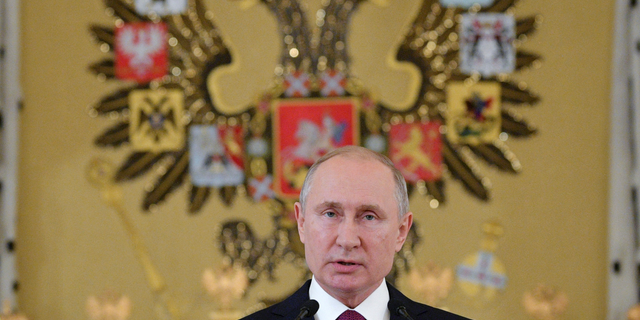
Russian President Vladimir Putin speaks during a reception for
graduates of Russian military education institutions in the Kremlin in
Moscow, Russia, on Thursday, June 27, 2019. (Alexei Druzhinin, Sputnik,
Kremlin Pool Photo via AP)
"CNN's narrative that the Central Intelligence Agency
makes life-or-death decisions based on anything other than objective
analysis and sound collection is simply false," CIA Director for Public
Affairs Brittany Bramell said in a statement.
Bramwell continued:
"Misguided speculation that the President's handling of our nation's
most sensitive intelligence — which he has access to each and every day —
drove an alleged exfiltration operation is inaccurate."
According
to the report by CNN chief national correspondent and former Obama
administration official Jim Sciutto, the decision to carry out the
extraction "occurred soon after a May 2017 meeting in the Oval Office in
which Trump discussed highly classified intelligence with
Russian Foreign Minister Sergey Lavrov and then-Russian Ambassador to
the US Sergey Kislyak. The intelligence, concerning ISIS in Syria, had
been provided by Israel."
The disclosure "prompted intelligence
officials to renew earlier discussions about the potential risk of
exposure," CNN reported.
Sciutto later posted on Twitter,
after the Times report was published, that the double agent in
jeopardy had the "remarkable ability to take photos of presidential
documents," as well as "direct access" to Putin.
"CNN's
narrative that the Central Intelligence Agency makes life-or-death
decisions based on anything other than objective analysis and sound
collection is simply false." — CIA Director for Public Affairs Brittany Bramell
It
was not clear from the CNN piece how exactly Trump's comments in the
Oval Office would have further compromised the Russian source.
Numerous other holes quickly surfaced in CNN's reporting. Commentator Aaron Mate pointed out in a Twitter thread
that several major news organizations had previously cited a high-level
official in the Russian government as a source -- suggesting that the
intelligence community itself, not Trump, had compromised the spy.
For example, The Washington Post reported in June 2017
of "'sourcing deep inside the Russian government' -- so deep that it
purportedly 'captured Putin’s specific instructions' to launch a
pro-Trump influence campaign," Matte noted.
And the Times reported in August 2018 of
"anonymous intel officials complaining that their 'vital Kremlin
informants have largely gone silent.'" But "if these Kremlin informants
are so vital, why are US intel officials talking about them?" Matte
asked.
The source resurfaced in May 2019, when the Times "reported on intel fears of this source being exposed."
"Again,
the irony is lost that it's the ones who are complaining who are the
ones revealing this supposed source," Matte wrote. "So there's a pattern
here of intel leaks in order to: create a false link between
Trump-Russia; to reveal supposed high-level Russian sources that advance
the Russiagate narrative & then falsely blame Trump for these
sources' supposed vulnerability."
Fox News understands that the
CIA typically makes the decision to withdraw an asset only after a long
deliberative process, and that the move would not ordinarily be taken
based on a single event involving classified information, as CNN
implied.
CNN has been faulted for its inaccurate intelligence reporting
in the past. In December 2017, CNN falsely reported that Donald Trump,
Jr. had advance access to hacked WikiLeaks emails, in what Glenn
Greenwald called "one of the most humiliating spectacles in the history of the U.S. media." Several of the organization's much-touted journalists were forced out earlier that year for a separate false Russia bombshell.
CNN did not immediately reply to Fox News' request for comment. Sciutto claimed on CNN's "Anderson Cooper 360" late Monday that the Times had "confirmed" his reporting. Numerous other news organizations, including Vox, The Hill, and the Guardian, picked up CNN's original story uncritically.
The developments led to speculation as to who had leaked the information to CNN -- especially in light of previous anti-Trump leaks that found their way from the intelligence community to CNN's airwaves -- and led commentators to again fault the accuracy of CNN's initial reporting.
"In
their fervor to blame President Trump for mishandling classified
information, CNN potentially risked lives," a source familiar with the
matter told The Daily Wire. "They
had multiple on-the-record quotes from Administration officials telling
them. Their story was not only wrong, but irresponsible and dangerous,
and CNN decided to run with it anyway." Fox News' Catherine Herridge contributed to this report.
DUBAI,
United Arab Emirates (AP) — Kuwait’s 90-year-old ruling emir has
cancelled a visit Thursday with President Donald Trump at the White
House after being admitted to a U.S. hospital following an earlier
health scare last month.
Sheikh Sabah Al
Ahmad Al Sabah will undergo unspecified tests during his
hospitalization, the state-run KUNA news agency reported late Sunday. It
did not elaborate.
It quoted Sheikh Ali
Jarrah Al Sabah, the minister of the emir’s diwan council, as saying
Sheikh Sabah would reschedule his visit with Trump.
“Sheikh Ali prayed to Allah the Almighty to bestow His Highness the Emir with good health,” KUNA said.
A White House statement said Trump was aware of the emir being hospitalized.
“The
president wishes his friend, the Emir, a speedy recovery and looks
forward to welcoming him back to Washington as soon as he is feeling
better,” the statement said. “The Emir is a well-respected leader and
has been a tremendous partner of the United States in tackling
challenges in the region.”
On Aug. 18, Kuwait acknowledged the emir suffered an unspecified medical “setback.”
That
came after visiting Iranian Foreign Minister Mohammad Javad Zarif wrote
on Twitter that he was “praying for emir’s speedy recovery,” without
elaborating.
Sheikh Sabah has ruled Kuwait
since January 2006. A longtime diplomat, he pushed for diplomacy to
solve regional issues, such as the ongoing boycott of Qatar by four Arab
nations, and hosted major donor conferences for war-torn nations like
Iraq and Syria.
SAN
FRANCISCO (AP) — A group of states led by Texas is expected to announce
an investigation into Google on Monday to examine whether the Silicon
Valley tech giant has gotten too big and effective at stomping or
acquiring rivals.
The probe is the latest
blow against big tech companies as antitrust investigations ramp up in
the U.S. and around the world. A separate group of states announced an investigation into Facebook’s dominance on Friday. The Department of Justice , the Federal Trade Commission and Congress are also conducting probes.
Texas
Attorney General Ken Paxton has said only that the investigation will
look at “whether large tech companies have engaged in anticompetitive
behavior that stifled competition, restricted access, and harmed
consumers.” Reports in The Washington Post and The Wall Street Journal
say Google will be the primary target.
Google
expects state attorneys general will ask it about past similar
investigations in the U.S. and internationally, senior vice president of
global affairs Kent Walker wrote in a blog post Friday .
Google’s
parent company, Alphabet, has a market value of more than $820 billion
and controls so many aspects of the internet that it’s hard to imagine
surfing the web for long without running into at least one of its
services. Experts believe the antitrust probe could focus on at least
one of three aspects of Google’s business that have caught regulators’
eyes.
An obvious first place to look could
be online advertising. Google will control 31.1% of global digital ad
dollars in 2019, according to eMarketer estimates, crushing a distant
second place Facebook. And many smaller advertisers have argued that
Google has such a stranglehold on the market that it becomes a system of
whatever Google says, goes — because the alternative could be not
reaching customers.
“There’s definitely
concern on the part of the advertisers themselves that Google wields way
too much power in setting rates and favoring their own services over
others,” said Jen King, the director of privacy at Stanford’s Center for
Internet and Society.
Critics often point
to Google’s 2007 acquisition of online advertising company DoubleClick
as pivotal to its advertising dominance.
Europe’s
antitrust regulators slapped Google with a $1.7 billion fine in March
unfairly inserting exclusivity clauses into contracts with advertisers, disadvantaging rivals in the online advertising business.
Another
visibly huge piece of Google’s business is its search platform, often
the starting point for millions of people when they go online. Google
dwarfs other search competitors and has faced harsh criticism in the
past for favoring its own products over competitors at the top of search
results. European regulators have also investigated here — ultimately
fining Google for promoting its own shopping service. Google is
appealing the fine.
Google has long argued
that although its businesses are large, they are useful and beneficial
to consumers. But it appears regulators are growing more concerned not
just with the effects on regular internet users, but on smaller
companies as well.
“On the one hand, you
could just say, ‘well Google is dominant because they’re good,’” King
said. “But at the same time, it’s created an ecosystem where people’s
whole internet experience is mediated through Google’s home page and
Google’s other products.”
One outcome antitrust regulators might explore is forcing Google to spin off search as a separate company, she said.
Then
there’s Google’s smartphone operating system, Android. Another
acquisition of Google’s, the system is the most widely used in the
world.
European regulators have also fined
Google to the tune of $5 billion for tactics involving Android, finding
that Google forced handset makers to install Google apps, thereby
increasing its reach. Google has since allowed more options for
alternative browser and search apps to European Android phones.
It’s
also possible U.S. states won’t follow in Europe’s footsteps. They
could, for instance, focus on areas such as Google’s popular video site
YouTube, yet another acquisition Google made, that time in 2006.
Google executive Walker emphasized that the company’s products help people every day.
“Google
is one of America’s top spenders on research and development, making
investments that spur innovation: Things that were science fiction a few
years ago are now free for everyone_translating any language
instantaneously, learning about objects by pointing your phone, getting
an answer to pretty much any question you might have,” he wrote.
PROVIDENCE,
R.I. (AP) — He has taken his baby to ribbon cuttings and held the child
on his lap while testifying at the Statehouse. He balanced the boy at
his side at news conferences and rolled him into a closed-door meeting
with the governor in a stroller. He installed a bassinet and toy box in
his office at City Hall.
Providence Mayor
Jorge Elorza has not been shy about bringing his baby to work, and in
doing so has ignited a debate about the role of children in the
workplace and cast a spotlight on the struggles of balancing a career
and child care.
To some, Elorza’s workday
appearances with 1-year-old Omar set an example for how to juggle jobs
and parenting at a time when many people are working long hours away
from their children and paying skyrocketing costs for day care. His
detractors say Elorza is using the child as a prop and benefiting from a
double standard that would make it impossible for a working mother to
do what the mayor is doing.
“I
do think that if a female elected official was doing the same thing,
the amount of pushback that we would be getting would be huge,” said
City Council President Sabina Matos, a fellow Democrat and mom with two
school-aged children, adding: “People would say that we’re not capable
of doing both jobs.”
Elorza is not the first
politician to bring their child to work. New Zealand Prime Minister
Jacinda Ardern last year attended a meeting of the United Nations
General Assembly with her infant daughter , who was still young enough to be breastfeeding. In Washington, D.C., Mayor Muriel Bowser occasionally brings her daughter to events. Illinois Sen. Tammy Duckworth brought her 10-day-old baby to the Senate floor to cast a vote last year — but the chamber had to change its rules to allow it.
What’s
new in Elorza’s case is that he has incorporated child care into his
job in a way rarely seen in the American public sphere.
His
tenure as mayor of Rhode Island’s largest city comes amid a growing
movement to let parents bring their babies to work as an alternative to
leaving infants at day care for long stretches while they’re still
nursing. At least 250 employers have baby programs, including government
offices in more than half a dozen states such as Arizona , Washington and Vermont
, according to the Parenting in the Workplace Institute, which helps
develop and track baby-friendly policies. California is considering a similar policy for state workers.
In
an interview with The Associated Press, Elorza said bringing his child
to work was a decision that he and his wife, Stephanie Gonzalez, made
after assessing their busy, unpredictable schedules. He wants time with
his son. And, he says, the cost of day care is too high for their
budget.
He and Gonzalez, a law student, were floored by the $350 per week price tag for a day care they toured before Omar was born.
“We
can’t afford that,” said the mayor, whose annual salary is $118,000. “I
don’t see how most families in our city can afford that.”
Instead, they do what many parents do: Split up child care duties and lean on the baby’s grandmother to help out.
The
mayor’s calendars for 2019, disclosed to the AP after a public records
request, show that Elorza often spent his Wednesdays out of the office,
dialing in to meetings or on Skype calls with department heads, such as
the schools superintendent or public safety commissioner.
The
mayor confirmed he had been home with the baby on Wednesdays but that
now that his son is older and more mobile, working has become more
difficult. Now, he spends one morning a week with Omar before handing
him off to the boy’s grandmother.
The decision has put Elorza in the hot seat. The head of the teachers union — who is frequently at odds with the mayor — went after him on Twitter, pointing out that teachers don’t get the same opportunity.
Critics
also have accused the mayor of being unprofessional and sometimes even
inappropriate. It happened when Elorza testified about legislation to
strengthen the right to an abortion while holding Omar in his lap. And
again, when he brought Omar to a news conference about a shooting and
the boy made goo goo noises and a fuss as the public safety commissioner spoke.
Elorza brushes off criticism that he can’t perform his mayoral duties and care for a child as “ridiculous.”
During a meeting with the governor
and other mayors on high-stakes legislation one of Elorza’s senior
staffers, Director of Communications Emily Crowell, left the room for a
phone call, then ended up helping care for the baby outside. Crowell
told the AP it was her choice and that she has never been asked to take
the baby.
Elorza acknowledged his staff
sometimes cares for the child while he works. He said no one had ever
lost out on professional opportunities or had to put aside work
obligations to do so. He said some staffers have become “like extensions
of my family.”
As workplaces around the
country try to accommodate working parents without going too far, the
Parenting in the Workplace Institute suggests that “babies at work”
policies end at six months of age, around the time when babies start to
crawl.
Brad Harrington, who leads the Boston
College Center for Work and Family and studies the changing role of
fathers, said co-workers like to see children in the workplace, but it
starts to wear thin if it becomes an everyday event.
Harrington
said fathers are often praised more than mothers for being involved
parents, but studies have shown that if men do “conspicuous caregiving,”
such as saying they are leaving every day at 4:30 to pick up a child,
they are marginalized at work.
Harrington,
whose center works with Fortune 500 companies, added that depending on
co-workers to care for a child is inappropriate.
Elorza
said he has tried to support working parents, both in city policy and
in his own office. He has put in place a program that offers $5 per week
toward summer camps for Providence kids and says he allows people in
his office to bring in a child “in a pinch.”
“It’s really brought home how difficult it is to raise a child and not sacrifice your career,” he said.
WASHINGTON
(AP) — President Donald Trump’s weekend tweet canceling secret meetings
at Camp David with the Taliban and Afghan leaders just days before the
anniversary of the Sept. 11 attacks is the latest example of a commander
in chief willing to take a big risk in pursuit of a foreign policy
victory only to see it dashed.
What had
seemed like an imminent deal to end the war has unraveled, with Trump
and the Taliban blaming each other for the collapse of nearly a year of
U.S.-Taliban negotiations in Doha, Qatar.
The
insurgents are promising more bloodshed. The Afghan government remains
mostly on the sidelines of the U.S. effort to end America’s longest war.
And as Trump’s reelection campaign heats up, his quest to withdraw the
remaining 14,000 U.S. troops from Afghanistan remains unfulfilled — so
far.
Trump
said he axed the Camp David meetings and called off negotiations
because of a recent Taliban bombing near the U.S. Embassy in Kabul that
killed a U.S. service member, even though nine other Americans have died
since June 25 in Taliban-orchestrated violence. But the deal started
unraveling days earlier after Afghan President Ashraf Ghani postponed
his trip to Washington and the Taliban refused to travel to the U.S.
before a deal was actually signed, according to a former senior Afghan
official.
Trump’s secret plan for high-level
meetings at the presidential retreat in Maryland resembled other bold,
unorthodox foreign policy initiatives — with North Korea, China and Iran
— that the president has pursued that have yet to bear fruit.
“When
the Taliban tried to gain negotiating advantage by conducting terror
attacks inside of the country, President Trump made the right decision
to say that’s not going to work,” said Secretary of State Mike Pompeo,
who appeared Sunday on five TV news shows.
Trump’s
three high-profile meetings with North Korea’s Kim Jong Un — including
the president’s recent brief footsteps onto North Korean soil — prompted
deep unease from many quarters, including his conservative base in
Congress.
And while the meetings produced
the ready-for-television visuals that Trump is known to relish,
negotiations between Washington and Pyongyang have been stalled for
months with no tangible progress in getting the North to abandon its
nuclear weapons.
Trump’s offers to hold
talks with the Iranian leadership have similarly met with no result and
Iran has moved ahead with actions that violate the 2015 nuclear deal
that the president withdrew from last year.
With
China, Trump has vigorously pursued a trade war, imposing billions of
dollars in tariffs on Chinese imports that have yet to force a retreat
by Beijing. So far, the discussions have unsettled financial markets and
have resulted in retaliatory steps by both Beijing and Washington.
Pompeo defended Trump’s foreign policy, depicting it as tough diplomacy, rather than naivete or inexperience.
“He
walked away in Hanoi from the North Koreans where they wouldn’t do a
deal that made sense for America,” Pompeo said. “He’ll do that with the
Iranians. When the Chinese moved away from the trade agreement that they
had promised us they would make, he broke up those conversations, too.”
Democrats
said Trump’s decision to nix a deal with the Taliban was evidence that
he was moving too quickly to get one. Far from guaranteeing a
cease-fire, the deal only included Taliban commitments to reduce
violence in Kabul and neighboring Parwan province, where the U.S. has a
military base.
New Jersey Sen. Bob Menendez,
the ranking Democrat on the Foreign Relations Committee, said the talks
were ill-conceived from the start because they haven’t yet involved the
Afghan government.
The Taliban have refused
to negotiate with the government its sees as illegitimate and a puppet
of the West so the Trump administration tried another approach,
negotiating with the Taliban first to get a deal that would lead to
Taliban talks with Afghans inside and outside the government.
“It’s
another example of the Trump administration’s foreign policy, which is a
high-wire act that ultimately is focused on Trump as a persona but not
in the strategic, methodical effort of creating peace,” Menendez said.
Criticism of the Camp David plan was not limited to Democrats or “Never Trump” Republicans.
“Camp
David is where America’s leaders met to plan our response after al
Qaeda, supported by the Taliban, killed 3000 Americans on 9/11,” tweeted
Rep. Liz Cheney, R-Wyo. “No member of the Taliban should set foot
there. Ever.”
A U.S. official familiar with
the Taliban negotiations said the “very closely held” idea of a Camp
David meeting was first discussed up to a week and a half ago when Trump
huddled with his national security team and other top advisers to talk
about Afghanistan. The official spoke on condition of anonymity to
discuss private deliberations.
Some
administration officials, including national security adviser John
Bolton, did not back the agreement with the Taliban as it was written,
the official said. They didn’t think the Taliban can be trusted. Bolton
advised the president to draw down the U.S. force to 8,600 — enough to
counter terror threats — and “let it be” until a better deal could be
hammered out, the official said. Pompeo said he didn’t know if Trump
will follow through on his pledge to reduce the number of U.S. troops
there from 14,000 to 8,600.
U.S. envoy
Zalmay Khalilzad had recently announced that he had reached an agreement
in principle with the Taliban. Under the deal, the U.S. would withdraw
about 5,000 U.S. troops within 135 days of signing. In exchange, the
insurgents agreed to reduce violence and prevent Afghanistan from being
used as a launch pad for global terror attacks, including from local
Islamic State affiliate and al-Qaida.
Pompeo
said the Taliban agreed to break with al-Qaida — something that past
administrations have failed to get the Taliban to do. The insurgent
group had hosted al-Qaida leader Osama bin Laden as he masterminded the
9/11 attacks. After the attacks, the U.S. ousted the Taliban, which had
ruled Afghanistan with a harsh version of Islamic law from 1996 to 2000.
But
problems quickly emerged. Even as Khalilzad explained the deal to the
Afghan people during a nationally televised interview, the Taliban
detonated a car bomb targeting a compound in Kabul where many foreign
contactors lived. Then on Thursday, a second Taliban car bomb exploded
near the U.S. Embassy in Kabul, killing 12 people including a U.S.
service member. Khalilzad abruptly returned to Doha, Qatar for at least
two days of negotiations with the Taliban, but has since been recalled
to Washington.
It’s unclear if the talks
will resume because the Taliban won’t trust future deals they negotiate
with the U.S. if they think Trump might abruptly change course,
according to the former senior Afghan official, who was not authorized
to discuss the issue and spoke only on condition of anonymity. The
official, who has had many discussions about the peace process with both
U.S. and Afghan officials, said Khalilzad’s team was not aware of
Trump’s plans to tweet the end of the talks Saturday evening.
Trump’s
suspension of the negotiations “will harm America more than anyone
else,” the Taliban said in a statement. “It will damage its reputation,
unmask its anti-peace policy to the world even more, increase its loss
of life and treasure and present its political interactions as erratic.”
The
former official said the deal fell apart for two main reasons. First,
the Taliban refused to sign an agreement that didn’t state the end date
for a complete withdrawal of American forces. That date was to be either
November 2020, the same month of the U.S. presidential election, or
January 2021, he said.
The U.S.-Taliban
agreement was to be followed by Taliban talks with Afghans inside and
outside the government to chart a political future for the country.
Ghani told Khalilzad that putting a withdrawal date in the agreement
would undermine the all-Afghan discourse before it began; the Taliban
would have leverage in those negotiations from the get-go because the
U.S. troops would be on a timeline to permanently withdraw.
Secondly,
the U.S. was unsuccessful in convincing Ghani to postpone the Afghan
presidential election set for Sept. 28, the official said. The U.S.
argued that if the elections were held and Ghani won, his opponents and
other anti-Ghani factions would protest the results, creating a
political crisis that would make the all-Afghan talks untenable. Other
disagreements included why the deal did not address the Taliban’s
linkages to Pakistan and prisoner-hostage exchanges, the official said.
___
Associated
Press writers Cara Anna and Rahim Faiez in Kabul; Robert Burns and
Jonathan Lemire in Washington; and Julie Walker with AP Radio
contributed to this report.
FILE – In this April 28, 2018 file photo, President Donald Trump, left,
watches as Corey Lewandowski, right, his former campaign manager for
Trump’s presidential campaign, speaks during a campaign rally in
Washington Township, Mich. Trump is throwing his support behind his
former campaign manager, Corey Lewandowski, who is considering a run for
Senate in his home state of New Hampshire. (AP Photo/Paul Sancya, File)
OAN Newsroom
UPDATED 2:30 PM PST – Sat. September 7, 2019
The president’s former campaign manager Corey Lewandowski is set to
testify before the House Judiciary Committee in the coming weeks.
Reports Saturday said Lewandowski will appear before the panel to
answer questions related to their probe into possible obstruction of
justice by President Trump.
Specifically, lawmakers are looking into findings outlined in the
special counsel’s report, which claims the president instructed
Lewandowski to pressure former Attorney General Jeff Sessions, to curb
the Russia probe.
The former campaign head has maintained that Democrats are on a
political witch hunt. In an interview with OAN, lewandowski slammed
Hillary Clinton and her so-called “cohorts,” who he claims kick-started
the Russian collusion narrative.
Lewandowski’s upcoming testimony comes after the panel’s chairman
Jerry Nadler issued subpoenas to two other administration officials to
testify the same day.
However, only Lewandowski is expected to appear before the committee on the 17th.
Trump 2020 campaign manager Brad Parscale insisted Saturday that the GOP hasn’t given up on California despite setbacks at the polls there in 2018.
“We have the potential to win back eight congressional seats, back to Republicans, here in California,” Parscale said at the state Republican Party’s fall convention in Indian Wells.
“We have the potential to win back eight congressional seats, back to Republicans, here in California.” — Brad Parscale, Trump 2020 campaign manager
But
Parscale acknowledged the job won’t be easy – and said the work would
ultimately have to be done by the Golden State's Republicans, not
national party leaders.
“You’re the California GOP,” he said, according to Politico. “There’s
no trick I can do on my laptop that you can’t do yourselves. It takes
hard work, and talking to your neighbors. And with a strong leader with
President Trump at the helm, the sky’s the limit.”
"It
takes hard work, and talking to your neighbors. And with a strong
leader with President Trump at the helm, the sky’s the limit." — Brad Parscale, Trump 2020 campaign manager
Democrats
hammered California’s GOP at the polls last year, leaving Republicans
with only seven of the state’s 53 seats in the U.S. House. Both
California seats in the Senate also belong to Democrats.
The
state’s Republicans were dealt another harsh blow just last month when
the registrar of voters in Orange County – long a GOP stronghold in
Southern California – reported that registered Democrats there now
outnumbered registered Republicans for the first time since the
Watergate era.
Nevertheless, Parscale told conventioneers Saturday
that the Trump reelection campaign was planning a big effort in
California, with as many as 50 paid staffers, making it one of “the
largest Election Day operations” in state history, Politico reported.
In
addition, the campaign plans to leverage artificial intelligence and
other high-tech tools, in a bid to learn “who the voters are, where they
live, how they consume information – and how to contact them,” he said.
“Many
of you are worried that we have written you guys off – that California
doesn’t matter,” Parscale said. To the contrary, he said, the Trump
campaign views the nation’s most populous state as a key battleground in
“the fight for the future of this country.”
Later
this month, President Trump is scheduled to visit California, with
events planned in the San Francisco Bay Area and San Diego, Sacramento’s FOX 40 reported.
Trump previously visited California in April, making stops in Los Angeles and at the state’s border with Mexico. Fox News’ Andrew O’Reilly contributed to this story.
President Trump and his family represent a political movement with the potential of transforming the Republican Party, according to Brad Parscale, manager of the president’s 2020 reelection campaign.
“I just think they’re a dynasty,” Parscale told reporters after delivering a speech Saturday at the fall convention of the California Republican Party.
“I
think they’re all amazing people … with amazing capabilities,” he said,
according to the Associated Press. “I think you see that from Don Jr. I
think you see that from Ivanka. You see it from Jared. You see it from
all.”
“I
think they’re all amazing people … with amazing capabilities. I think
you see that from Don Jr. I think you see that from Ivanka. You see it
from Jared. You see it from all.” — Brad Parscale, manager of President Trump’s 2020 reelection campaign.
Parscale
was speaking at the end of a week that saw Ivanka Trump embark on a
trip to Argentina, Colombia and Paraguay to promote the Women's Global
Development and Prosperity Initiative; saw Republican political
strategist Rick Wilson predict in a Daily Beast column
that Donald Trump Jr. will seek and likely win the 2024 GOP
presidential nomination; and saw Jared Kushner appoint a lieutenant in
his role of crafting the president's Middle East policy, according to Politico.
Earlier
Saturday, Parscale told the convention crowd in Indian Wells that the
Trump family’s influence would likely “last for decades,” and propel the
GOP “into a new party – one that will adapt to changing cultures.
“One
must continue to adapt while keeping the conservative values that we
believe in,” he added, though when speaking later with reporters he
declined to speculate on whether any of the president’s family members
would seek elected office, the AP reported.
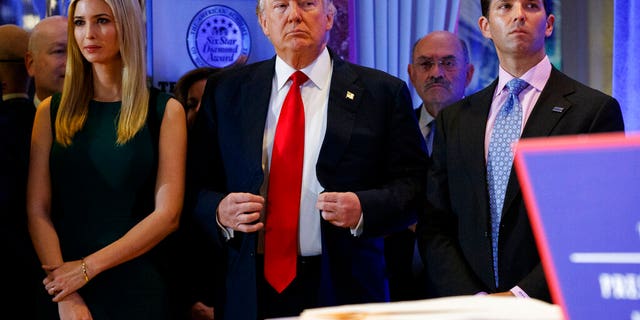
Then-President-elect Donald Trump, center, is flanked by daughter
Ivanka Trump and son Donald Trump Jr., at a news conference in the lobby
of Trump Tower in New York City, Jan. 11, 2017. (Associated Press)
At the California GOP convention, party delegates
sought to develop an election strategy in a heavily Democratic state
that Trump lost by more than 4 million votes in 2016. Polls show the
president remains widely unpopular there.
Parscale acknowledged
that California was not a key focus of Trump's reelection plans. "This
is not a swing state," he said, drawing laughs from the crowd.
But he noted California was the biggest source of the president's campaign donations.
The
party's struggles in California are well known. Democrats control every
statewide office and both chambers of the Legislature, while holding an
edge of nearly 4 million in voter registrations. Both U.S. Senate seats
are in Democratic hands, and the party has a 46-7 edge over Republicans
in U.S. House seats in the state.
The last significant push by a
Republican presidential candidate to win California was in 2000, when
George W. Bush was backed by more than $15 million, then lost to
Democrat Al Gore by 12 points. The Associated Press contributed to this story.


 Russian President Vladimir Putin speaks during a reception for
graduates of Russian military education institutions in the Kremlin in
Moscow, Russia, on Thursday, June 27, 2019. (Alexei Druzhinin, Sputnik,
Kremlin Pool Photo via AP)
Russian President Vladimir Putin speaks during a reception for
graduates of Russian military education institutions in the Kremlin in
Moscow, Russia, on Thursday, June 27, 2019. (Alexei Druzhinin, Sputnik,
Kremlin Pool Photo via AP)