In a major victory for both President Trump and national Republicans, North Carolina GOP state Sen. Dan Bishop was projected to win a fiercely contested special U.S. House election for the 9th District that was widely seen as a bellwether for the president's chances in the 2020 election.
And
another Republican House candidate, Greg Murphy, decisively won a
separate special election in North Carolina's more solidly GOP-leaning
3rd District earlier Tuesday evening -- frustrating Democrats who spent
millions trying to make a splash in the state.
Even Democratic
Congressional Campaign Committee (DCCC) Chairwoman Cheri Bustos
acknowledged that the president contributed to Bishop's win, writing in a
statement that "we fell an inch short tonight, but it took more than $6
million in outside Republican spending and a last-minute Trump rally"
to seal Democratic candidate Dan McCready's fate in the 9th District.
McCready's
campaign spent approximately $4.7 million on the race, while Bishop's
spent only $1.9 million. Outside spending primarily from national party
committees helped Bishop to the tune of $5.8 million, though, compared
to McCready's roughly $1.4 million.
The clean sweep heartened the president, who has long emphasized the national implications at stake. Trump unloaded on McCready in the fiery rally on Monday night, telling attendees that "to stop the far-left, you must vote in tomorrow's special election."
That effort, Trump said late Tuesday, had clearly paid dividends.
"Dan
Bishop was down 17 points 3 weeks ago," Trump wrote on Twitter. "He
then asked me for help, we changed his strategy together, and he ran a
great race. Big Rally last night. Now it looks like he is going to win. @CNN &@MSNBC are moving their big studio equipment and talent out. Stay tuned!"
He added: "BIG NIGHT FOR THE REPUBLICAN PARTY. CONGRATULATIONS TO ALL!"
“The voters said no to radical, liberal polices pushed by today’s Democratic Party,” Bishop said in a victory speech.
GOP chairwoman Ronna McDaniel said the wins spelled trouble for Democrats in 2020,
and highlighted the importance of Republican National Committee (RNC)
efforts in North Carolina -- where the party will hold its national
nominating convention in 2020.
"Despite being massively outspent by Democrats, @realDonaldTrump
rallied voters and put Bishop over the top," McDaniel said. "A huge win
for the president and our grassroots field program that's working hard
to elect Republicans in 2020!"
The RNC had been active on the
ground in North Carolina working on the special elections since June.
The party has brought on nearly two-dozen full-time staffers and
invested more than $1.5 million in the state, while also making nearly a
half-million voter contacts through phone-bank work and door-to-door
canvassing.
With 100 percent of precincts reporting, Bishop led
McCready by 3,937 votes, 96,081 to 92,144, in the race to represent
the 9th District. Bishop ran up substantial numbers in outlying areas
and McCready eroded GOP advantages in suburban areas.
In 2018, the
Republican candidate, Mark Harris, defeated McCready by a much smaller
margin -- just 905 votes, 139,246 to 138,341. State officials ordered
the unusual special election earlier this year, invalidating Harris' win
after uncovering ballot fraud efforts.
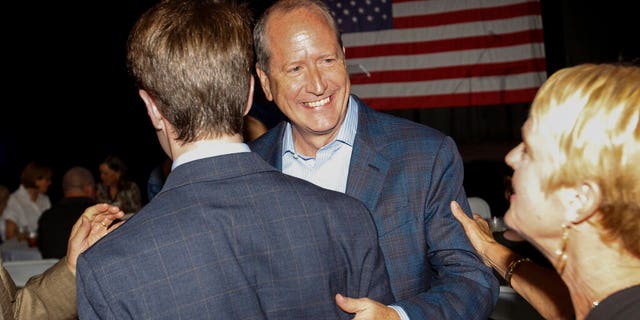
North Carolina 9th district Republican congressional candidate Dan
Bishop greets supporters in Monroe, N.C., Tuesday, Sept. 10, 2019. (AP
Photo/Nell Redmond)
Republicans cheered Bishop's even-higher margin of victory than Harris achieved, briefly, in 2018.
“Congratulations to
Dan Bishop on his definitive victory tonight in North Carolina’s 9th
Congressional District," National Republican Congressional Committee
Chairman Tom Emmer said in a statement.
"North Carolinians
rejected the Democrats’ socialist agenda and elected a representative
who will defend North Carolina values, and will always fight for freedom
and against socialism," he added. "I look forward to working with Dan
in Congress to hold the Democrats accountable for their extreme agenda.”
Analysts
had warned that the cloud from the fraud scandal could have harmed
Bishop's prospects. Additionally, polls apparently showing Trump's
declining national popularity -- which the president has dismissed as
inaccurate -- gave Democrats some cause for optimism. The president said
Monday he did not consider Bishop's race to be a bellwether for 2020.
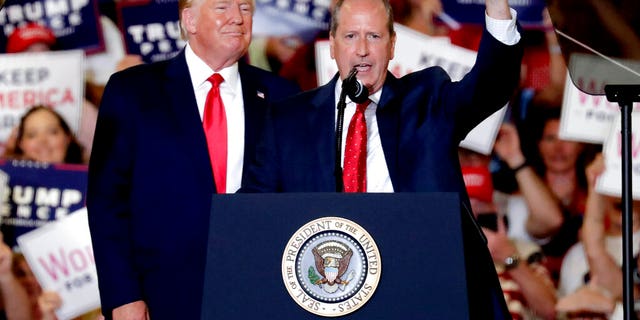
President Donald Trump, left, gives his support to Dan Bishop,
right, a Republican running for the special North Carolina 9th District
U.S. Congressional race as he speaks at a rally in Fayetteville, N.C.,
Monday, Sept. 9, 2019. (AP Photo/Chris Seward)
Nevertheless, Bishop and Murphy were evidently boosted by pair of visits to the district Monday by both Trump and Vice President Mike Pence.
At
the rally Monday, the president specifically called out McCready as a
dangerous proponent of "sanctuary cities" and rolling back gun rights.
"Just recently, Mecklenburg County set free an illegal alien charged with first-degree rape and crimes against a child,"
Trump said, his voice rising. "Support for sanctuary cities is
disloyalty to American cities -- and McCready wants sanctuary cities,
with all of their protections for people who are serious criminals.
Tomorrow is your chance to send a clear message to the America-hating
left."
Had McCready prevailed, it might have suggested GOP erosion
and raised questions about Trump's and his party's viability for 2020.
But
Trump projected confidence early Tuesday evening after Murphy was
projected to soundly defeat Democrat Allen Thomas in the separate
special election in the coastal 3rd District to succeed the late Rep.
Walter Jones Jr.
"One down, one to go," Trump wrote on Twitter.
Meanwhile,
McCready, a former Marine turned financier of solar energy projects,
had banked on the district's suburban moderates to carry him over the
top.
The 9th District, which stretches east from the prosperous
Charlotte suburbs into rural areas hugging the South Carolina
border, has been held by the GOP since 1963.
In 2016, Trump won the district by 11 percentage points.
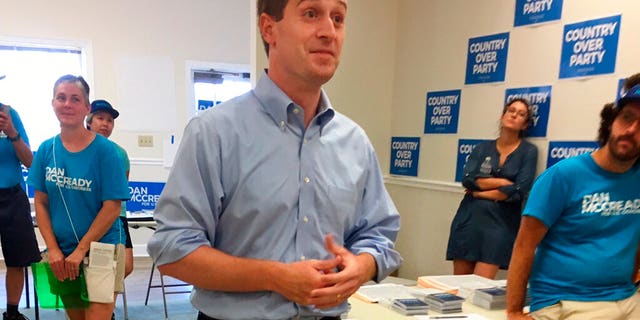
Democratic House candidate Dan McCready talks to volunteers at his
campaign office in Waxhaw, N.C., outside Charlotte, Saturday. (AP
Photo/Alan Fram)
As
voters headed to the polls Tuesday afternoon, a new balloting
controversy surfaced briefly when North Carolina election officials did
not act on a request by the state Republican Party to extend hours at a
single precinct.
A voter enters a precinct at the West Charlotte Recreation Center Tuesday. (John D. Simmons/The Charlotte Observer via AP)
The state GOP asked that the voting site stay open an
extra hour and 45 minutes because they said some voters were showing up
at an old voting location in Union County, a Republican-heavy area east
of Charlotte.
The State Board of Elections met and discussed the GOP request, but took no action.
However,
by a 5-0 vote of the state board, one polling site in Mecklenberg
County was kept open 25 minutes past the 7:30 p.m. ET closing time due
to a reported gas leak.
Attendees line up outside hours before President Donald Trump
speaks at a campaign rally in Fayetteville, N.C., Monday Sept. 9, 2019
(AP Photo/Chris Seward)
The 3rd District, where Murphy won easily early in
the night, was less closely watched because it was strongly expected to
stay Republican-controlled. Still, Republicans from the president on
down sounded the victory drums.
“Congratulations to Dr. Greg
Murphy on his decisive victory tonight in North Carolina’s 3rd
Congressional District," Emmer said in a statement.
"Dr. Murphy is
a selfless servant who is dedicated to conservative values," Emmer
continued. "Today, North Carolinians rejected the socialist agenda of
the Democrats and voted for freedom. I look forward to working with a
consistent conservative like Dr. Murphy in Congress.”
Greg Murphy was elected to Congress from North Carolina's 3rd
District Tuesday. (Molly Urbina/The Daily Reflector via AP, File)
The
3rd district extends from the Virginia border and Outer Banks to the
Marine Corps' Camp Lejeune, and inland to Greenville. Trump won the
district vote comfortably in 2016, and Murphy said at a Trump rally that
he would have the "president's back" if elected.
Thomas is a former Greenville mayor who questioned Murphy's "blind loyalty" to Trump. Fox News' David Lewkowictz and The Associated Press contributed to this report.
Jon Ossoff,
who was seen as the Democratic boy wonder in his failed Georgia
congressional bid in 2017 that was supposed to show President Trump's
weakness in historically red states, announced Monday night that he
will run for US Senate in Georgia, according to a report.
Ossoff,
32, will become the fourth Democrat to challenge U.S. Sen. David
Perdue, a first-term Republican and former Fortune 500 chief executive
who has long stood in support of President Trump. His decision to take
on Perdue instead of competing for soon-to-retire Republican Sen. Johnny
Isakson’s seat, is part of his effort to “mount a ruthless assault on
corruption in our political system,” according to a report in The Atlanta Journal-Constitution.
“We
have squandered trillions on endless war. We have squandered trillions
on bailouts for failed banks. We have squandered trillions on tax cuts
for wealthy donors. Then we’re told there’s nothing left over for the
people,” Ossoff said. “The corruption must be rooted out. And Sen. David
Perdue is a caricature of Washington corruption.”
Isakson
will step down at the end of this year due to health reasons. His
interim replacement will be selected by Gov. Brian Kemp until an
election in 2020 will determine his ultimate successor. Fox News’ Ron Blitzer contributed to this report.
The National Rifle Association filed a lawsuit against San Francisco Monday over the city's recent declaration that the gun-rights lobby is a "domestic terrorist organization."
The
lawsuit was filed in U.S. District Court for the Northern District of
California against the city and county of San Francisco and the San
Francisco Board of Supervisors. It accuses city officials of violating
the gun lobby's free speech rights for political reasons and claims the
city is trying to blacklist anyone associated with the NRA from doing
business there.
The
gun rights lobby asked the court to step in "to instruct elected
officials that freedom of speech means you cannot silence or punish
those with whom you disagree."
The San Francisco Board of Supervisors passed a resolution last week
that said the U.S. is “plagued by an epidemic of gun violence,” and
accused the NRA of using “its considerable wealth and organization
strength to promote gun ownership and incite gun owners to acts of
violence.” The resolution called on other cities, states and the federal
government to follow suit and also declare the NRA a “domestic
terrorist organization.”
San Francisco Supervisor
Catherine Stefani told the Associated Press she drafted the resolution
after a July 28 high profile shooting in Gilroy, Calif., where a gunman
entered a festival with an AK-style rifle and killed three people and
injured at least 17 more before turning the gun on himself. Gilroy is
located about 80 miles southeast of San Francisco.
At least three mass shootings — in El Paso, Texas; Dayton, Ohio; and in
the West Texas towns of Odessa and Midland—have occurred since then, and
Democrat leaders in Congress Monday urged President Trump to push
Republicans to support gun control legislation to expand background
checks.
Corporate
America has also taken a political stance on gun control in recent
years. Delta Airlines ceased discounts for NRA members, and Walmart,
CVS, Walgreens and Albertsons chains have all asked customers to not
openly carry firearms into their stores, even in states where it is
legal to do so. The Associated Press contributed to this report.
George Soros, the left-wing billionaire, offered partial praise for President Trump
in an op-ed published Monday night over his tough stance on China but
went on to urge Congress not to allow the president to use Huawei—the
second-largest smartphone maker in the world—as a bargaining chip in his
fight for reelection.
Soros, who famously shorted the British pound in 1992 and made a $1 billion profit, penned the op-ed
in the Wall Street Journal. He said perhaps Trump's only foreign policy
win during his presidency was "the development of a coherent and
genuinely bipartisan policy toward Xi Jinping ’s China," and his
administration's move to declare Beijing a "strategic rival."
Soros
also praised the administration's move to place Huawei on the Commerce
Department’s so-called "entity list," which prevents U.S. companies from
dealing the telecom giant.
Huawei has called the action by the Trump administration a violation of "free-market competition."
Soros
wrote about the tense competition in the 5G market and said the U.S.
has a commanding lead over China. But he warned that Trump "may soon
undermine his own China policy and cede the advantage to Beijing."
He said he believes Trump wants to free himself from any constraints by Congress and be able to remove Huawei from
the list at his own discretion. China has insisted that Huawei be
removed from the list as a prerequisite for any trade agreement.
"In
my view, he wants to arrange a meeting with President Xi Jinping as the
2020 election approaches and make a trade deal with him, and he wants
Huawei's status on the table as one of his bargaining chips," Soros
wrote.
Soros called on Congress to act and pointed to Rep. Mike
Gallagher, R-Wis., and Sen. Mitt Romney, R- Utah, for introducing
amendments that would require Congress’ blessing for removal.
"As
founder of the Open Society Foundations, my interest in defeating Xi
Jinping’s China goes beyond U.S. national interests," he wrote. "As I
explained in a speech in Davos earlier this year, I believe that the
social-credit system Beijing is building, if allowed to expand, could
sound the death knell of open societies not only in China but also
around the globe."
The Central Intelligence Agency on Monday evening slammed what it called CNN's "misguided" and "simply false" reporting, after the cable channel's chief national security correspondent authored a hole-filled piece claiming
that the CIA had pulled a high-level spy out of Russia because
President Trump had "repeatedly mishandled classified intelligence and
could contribute to exposing the covert source as a spy."
The extraordinary CIA rebuke came as The New York Times published a bombshell piece late in the evening,
which largely contradicted CNN's reporting. According to the Times, CIA
officials "made the arduous decision in late 2016 to offer to extract
the source from Russia" -- weeks before Trump even took office.
Concerns
about media reporting on Russian election interference drove the
decision, according to the Times, which described the source as "the
American government’s best insight into the thinking of and orders” from
Russian President Vladimir Putin.
"Former intelligence officials
said there was no public evidence that Mr. Trump directly endangered the
source, and other current American officials insisted that media
scrutiny of the agency’s sources alone was the impetus for the
extraction," the Times wrote.
The
purported spy refused the 2016 offer of extraction, the Times reported,
citing family concerns. But the CIA "pressed again months later after
more media inquiries" threatened the source, and he relented, according
to the paper.
The whirlwind developments continued into the night on Monday, when NBC News exclusively reported that a possible Russia spy was now living under apparent U.S. protection,
using his true identity, in Washington, D.C. -- and that his life could
be in danger. Sources told NBC News that the Russian living in
Washington was the same individual who was referenced in the reporting
by CNN and the Times, and NBC said he "fits the profile of someone who
may have had access to information about Putin’s activities."
An
NBC reporter who knocked at the Russian's door was confronted by
unidentified men in an SUV, presumed to be security personnel, within
minutes. Speculation about the purported spy's identity, using publicly available records, quickly circulated on social media after NBC News' report revealed identifiable details about his living situation.
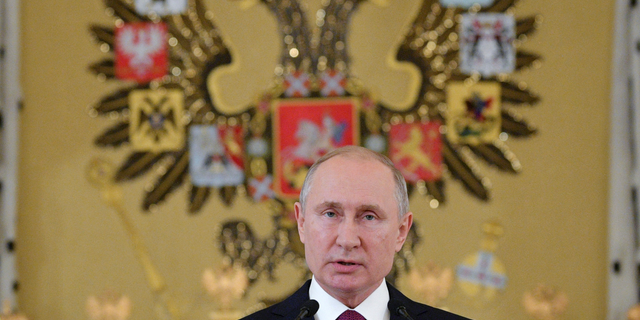
Russian President Vladimir Putin speaks during a reception for
graduates of Russian military education institutions in the Kremlin in
Moscow, Russia, on Thursday, June 27, 2019. (Alexei Druzhinin, Sputnik,
Kremlin Pool Photo via AP)
"CNN's narrative that the Central Intelligence Agency
makes life-or-death decisions based on anything other than objective
analysis and sound collection is simply false," CIA Director for Public
Affairs Brittany Bramell said in a statement.
Bramwell continued:
"Misguided speculation that the President's handling of our nation's
most sensitive intelligence — which he has access to each and every day —
drove an alleged exfiltration operation is inaccurate."
According
to the report by CNN chief national correspondent and former Obama
administration official Jim Sciutto, the decision to carry out the
extraction "occurred soon after a May 2017 meeting in the Oval Office in
which Trump discussed highly classified intelligence with
Russian Foreign Minister Sergey Lavrov and then-Russian Ambassador to
the US Sergey Kislyak. The intelligence, concerning ISIS in Syria, had
been provided by Israel."
The disclosure "prompted intelligence
officials to renew earlier discussions about the potential risk of
exposure," CNN reported.
Sciutto later posted on Twitter,
after the Times report was published, that the double agent in
jeopardy had the "remarkable ability to take photos of presidential
documents," as well as "direct access" to Putin.
"CNN's
narrative that the Central Intelligence Agency makes life-or-death
decisions based on anything other than objective analysis and sound
collection is simply false." — CIA Director for Public Affairs Brittany Bramell
It
was not clear from the CNN piece how exactly Trump's comments in the
Oval Office would have further compromised the Russian source.
Numerous other holes quickly surfaced in CNN's reporting. Commentator Aaron Mate pointed out in a Twitter thread
that several major news organizations had previously cited a high-level
official in the Russian government as a source -- suggesting that the
intelligence community itself, not Trump, had compromised the spy.
For example, The Washington Post reported in June 2017
of "'sourcing deep inside the Russian government' -- so deep that it
purportedly 'captured Putin’s specific instructions' to launch a
pro-Trump influence campaign," Matte noted.
And the Times reported in August 2018 of
"anonymous intel officials complaining that their 'vital Kremlin
informants have largely gone silent.'" But "if these Kremlin informants
are so vital, why are US intel officials talking about them?" Matte
asked.
The source resurfaced in May 2019, when the Times "reported on intel fears of this source being exposed."
"Again,
the irony is lost that it's the ones who are complaining who are the
ones revealing this supposed source," Matte wrote. "So there's a pattern
here of intel leaks in order to: create a false link between
Trump-Russia; to reveal supposed high-level Russian sources that advance
the Russiagate narrative & then falsely blame Trump for these
sources' supposed vulnerability."
Fox News understands that the
CIA typically makes the decision to withdraw an asset only after a long
deliberative process, and that the move would not ordinarily be taken
based on a single event involving classified information, as CNN
implied.
CNN has been faulted for its inaccurate intelligence reporting
in the past. In December 2017, CNN falsely reported that Donald Trump,
Jr. had advance access to hacked WikiLeaks emails, in what Glenn
Greenwald called "one of the most humiliating spectacles in the history of the U.S. media." Several of the organization's much-touted journalists were forced out earlier that year for a separate false Russia bombshell.
CNN did not immediately reply to Fox News' request for comment. Sciutto claimed on CNN's "Anderson Cooper 360" late Monday that the Times had "confirmed" his reporting. Numerous other news organizations, including Vox, The Hill, and the Guardian, picked up CNN's original story uncritically.
The developments led to speculation as to who had leaked the information to CNN -- especially in light of previous anti-Trump leaks that found their way from the intelligence community to CNN's airwaves -- and led commentators to again fault the accuracy of CNN's initial reporting.
"In
their fervor to blame President Trump for mishandling classified
information, CNN potentially risked lives," a source familiar with the
matter told The Daily Wire. "They
had multiple on-the-record quotes from Administration officials telling
them. Their story was not only wrong, but irresponsible and dangerous,
and CNN decided to run with it anyway." Fox News' Catherine Herridge contributed to this report.
DUBAI,
United Arab Emirates (AP) — Kuwait’s 90-year-old ruling emir has
cancelled a visit Thursday with President Donald Trump at the White
House after being admitted to a U.S. hospital following an earlier
health scare last month.
Sheikh Sabah Al
Ahmad Al Sabah will undergo unspecified tests during his
hospitalization, the state-run KUNA news agency reported late Sunday. It
did not elaborate.
It quoted Sheikh Ali
Jarrah Al Sabah, the minister of the emir’s diwan council, as saying
Sheikh Sabah would reschedule his visit with Trump.
“Sheikh Ali prayed to Allah the Almighty to bestow His Highness the Emir with good health,” KUNA said.
A White House statement said Trump was aware of the emir being hospitalized.
“The
president wishes his friend, the Emir, a speedy recovery and looks
forward to welcoming him back to Washington as soon as he is feeling
better,” the statement said. “The Emir is a well-respected leader and
has been a tremendous partner of the United States in tackling
challenges in the region.”
On Aug. 18, Kuwait acknowledged the emir suffered an unspecified medical “setback.”
That
came after visiting Iranian Foreign Minister Mohammad Javad Zarif wrote
on Twitter that he was “praying for emir’s speedy recovery,” without
elaborating.
Sheikh Sabah has ruled Kuwait
since January 2006. A longtime diplomat, he pushed for diplomacy to
solve regional issues, such as the ongoing boycott of Qatar by four Arab
nations, and hosted major donor conferences for war-torn nations like
Iraq and Syria.
SAN
FRANCISCO (AP) — A group of states led by Texas is expected to announce
an investigation into Google on Monday to examine whether the Silicon
Valley tech giant has gotten too big and effective at stomping or
acquiring rivals.
The probe is the latest
blow against big tech companies as antitrust investigations ramp up in
the U.S. and around the world. A separate group of states announced an investigation into Facebook’s dominance on Friday. The Department of Justice , the Federal Trade Commission and Congress are also conducting probes.
Texas
Attorney General Ken Paxton has said only that the investigation will
look at “whether large tech companies have engaged in anticompetitive
behavior that stifled competition, restricted access, and harmed
consumers.” Reports in The Washington Post and The Wall Street Journal
say Google will be the primary target.
Google
expects state attorneys general will ask it about past similar
investigations in the U.S. and internationally, senior vice president of
global affairs Kent Walker wrote in a blog post Friday .
Google’s
parent company, Alphabet, has a market value of more than $820 billion
and controls so many aspects of the internet that it’s hard to imagine
surfing the web for long without running into at least one of its
services. Experts believe the antitrust probe could focus on at least
one of three aspects of Google’s business that have caught regulators’
eyes.
An obvious first place to look could
be online advertising. Google will control 31.1% of global digital ad
dollars in 2019, according to eMarketer estimates, crushing a distant
second place Facebook. And many smaller advertisers have argued that
Google has such a stranglehold on the market that it becomes a system of
whatever Google says, goes — because the alternative could be not
reaching customers.
“There’s definitely
concern on the part of the advertisers themselves that Google wields way
too much power in setting rates and favoring their own services over
others,” said Jen King, the director of privacy at Stanford’s Center for
Internet and Society.
Critics often point
to Google’s 2007 acquisition of online advertising company DoubleClick
as pivotal to its advertising dominance.
Europe’s
antitrust regulators slapped Google with a $1.7 billion fine in March
unfairly inserting exclusivity clauses into contracts with advertisers, disadvantaging rivals in the online advertising business.
Another
visibly huge piece of Google’s business is its search platform, often
the starting point for millions of people when they go online. Google
dwarfs other search competitors and has faced harsh criticism in the
past for favoring its own products over competitors at the top of search
results. European regulators have also investigated here — ultimately
fining Google for promoting its own shopping service. Google is
appealing the fine.
Google has long argued
that although its businesses are large, they are useful and beneficial
to consumers. But it appears regulators are growing more concerned not
just with the effects on regular internet users, but on smaller
companies as well.
“On the one hand, you
could just say, ‘well Google is dominant because they’re good,’” King
said. “But at the same time, it’s created an ecosystem where people’s
whole internet experience is mediated through Google’s home page and
Google’s other products.”
One outcome antitrust regulators might explore is forcing Google to spin off search as a separate company, she said.
Then
there’s Google’s smartphone operating system, Android. Another
acquisition of Google’s, the system is the most widely used in the
world.
European regulators have also fined
Google to the tune of $5 billion for tactics involving Android, finding
that Google forced handset makers to install Google apps, thereby
increasing its reach. Google has since allowed more options for
alternative browser and search apps to European Android phones.
It’s
also possible U.S. states won’t follow in Europe’s footsteps. They
could, for instance, focus on areas such as Google’s popular video site
YouTube, yet another acquisition Google made, that time in 2006.
Google executive Walker emphasized that the company’s products help people every day.
“Google
is one of America’s top spenders on research and development, making
investments that spur innovation: Things that were science fiction a few
years ago are now free for everyone_translating any language
instantaneously, learning about objects by pointing your phone, getting
an answer to pretty much any question you might have,” he wrote.
PROVIDENCE,
R.I. (AP) — He has taken his baby to ribbon cuttings and held the child
on his lap while testifying at the Statehouse. He balanced the boy at
his side at news conferences and rolled him into a closed-door meeting
with the governor in a stroller. He installed a bassinet and toy box in
his office at City Hall.
Providence Mayor
Jorge Elorza has not been shy about bringing his baby to work, and in
doing so has ignited a debate about the role of children in the
workplace and cast a spotlight on the struggles of balancing a career
and child care.
To some, Elorza’s workday
appearances with 1-year-old Omar set an example for how to juggle jobs
and parenting at a time when many people are working long hours away
from their children and paying skyrocketing costs for day care. His
detractors say Elorza is using the child as a prop and benefiting from a
double standard that would make it impossible for a working mother to
do what the mayor is doing.
“I
do think that if a female elected official was doing the same thing,
the amount of pushback that we would be getting would be huge,” said
City Council President Sabina Matos, a fellow Democrat and mom with two
school-aged children, adding: “People would say that we’re not capable
of doing both jobs.”
Elorza is not the first
politician to bring their child to work. New Zealand Prime Minister
Jacinda Ardern last year attended a meeting of the United Nations
General Assembly with her infant daughter , who was still young enough to be breastfeeding. In Washington, D.C., Mayor Muriel Bowser occasionally brings her daughter to events. Illinois Sen. Tammy Duckworth brought her 10-day-old baby to the Senate floor to cast a vote last year — but the chamber had to change its rules to allow it.
What’s
new in Elorza’s case is that he has incorporated child care into his
job in a way rarely seen in the American public sphere.
His
tenure as mayor of Rhode Island’s largest city comes amid a growing
movement to let parents bring their babies to work as an alternative to
leaving infants at day care for long stretches while they’re still
nursing. At least 250 employers have baby programs, including government
offices in more than half a dozen states such as Arizona , Washington and Vermont
, according to the Parenting in the Workplace Institute, which helps
develop and track baby-friendly policies. California is considering a similar policy for state workers.
In
an interview with The Associated Press, Elorza said bringing his child
to work was a decision that he and his wife, Stephanie Gonzalez, made
after assessing their busy, unpredictable schedules. He wants time with
his son. And, he says, the cost of day care is too high for their
budget.
He and Gonzalez, a law student, were floored by the $350 per week price tag for a day care they toured before Omar was born.
“We
can’t afford that,” said the mayor, whose annual salary is $118,000. “I
don’t see how most families in our city can afford that.”
Instead, they do what many parents do: Split up child care duties and lean on the baby’s grandmother to help out.
The
mayor’s calendars for 2019, disclosed to the AP after a public records
request, show that Elorza often spent his Wednesdays out of the office,
dialing in to meetings or on Skype calls with department heads, such as
the schools superintendent or public safety commissioner.
The
mayor confirmed he had been home with the baby on Wednesdays but that
now that his son is older and more mobile, working has become more
difficult. Now, he spends one morning a week with Omar before handing
him off to the boy’s grandmother.
The decision has put Elorza in the hot seat. The head of the teachers union — who is frequently at odds with the mayor — went after him on Twitter, pointing out that teachers don’t get the same opportunity.
Critics
also have accused the mayor of being unprofessional and sometimes even
inappropriate. It happened when Elorza testified about legislation to
strengthen the right to an abortion while holding Omar in his lap. And
again, when he brought Omar to a news conference about a shooting and
the boy made goo goo noises and a fuss as the public safety commissioner spoke.
Elorza brushes off criticism that he can’t perform his mayoral duties and care for a child as “ridiculous.”
During a meeting with the governor
and other mayors on high-stakes legislation one of Elorza’s senior
staffers, Director of Communications Emily Crowell, left the room for a
phone call, then ended up helping care for the baby outside. Crowell
told the AP it was her choice and that she has never been asked to take
the baby.
Elorza acknowledged his staff
sometimes cares for the child while he works. He said no one had ever
lost out on professional opportunities or had to put aside work
obligations to do so. He said some staffers have become “like extensions
of my family.”
As workplaces around the
country try to accommodate working parents without going too far, the
Parenting in the Workplace Institute suggests that “babies at work”
policies end at six months of age, around the time when babies start to
crawl.
Brad Harrington, who leads the Boston
College Center for Work and Family and studies the changing role of
fathers, said co-workers like to see children in the workplace, but it
starts to wear thin if it becomes an everyday event.
Harrington
said fathers are often praised more than mothers for being involved
parents, but studies have shown that if men do “conspicuous caregiving,”
such as saying they are leaving every day at 4:30 to pick up a child,
they are marginalized at work.
Harrington,
whose center works with Fortune 500 companies, added that depending on
co-workers to care for a child is inappropriate.
Elorza
said he has tried to support working parents, both in city policy and
in his own office. He has put in place a program that offers $5 per week
toward summer camps for Providence kids and says he allows people in
his office to bring in a child “in a pinch.”
“It’s really brought home how difficult it is to raise a child and not sacrifice your career,” he said.


 North Carolina 9th district Republican congressional candidate Dan
Bishop greets supporters in Monroe, N.C., Tuesday, Sept. 10, 2019. (AP
Photo/Nell Redmond)
North Carolina 9th district Republican congressional candidate Dan
Bishop greets supporters in Monroe, N.C., Tuesday, Sept. 10, 2019. (AP
Photo/Nell Redmond)
 President Donald Trump, left, gives his support to Dan Bishop,
right, a Republican running for the special North Carolina 9th District
U.S. Congressional race as he speaks at a rally in Fayetteville, N.C.,
Monday, Sept. 9, 2019. (AP Photo/Chris Seward)
President Donald Trump, left, gives his support to Dan Bishop,
right, a Republican running for the special North Carolina 9th District
U.S. Congressional race as he speaks at a rally in Fayetteville, N.C.,
Monday, Sept. 9, 2019. (AP Photo/Chris Seward)
 Democratic House candidate Dan McCready talks to volunteers at his
campaign office in Waxhaw, N.C., outside Charlotte, Saturday. (AP
Photo/Alan Fram)
Democratic House candidate Dan McCready talks to volunteers at his
campaign office in Waxhaw, N.C., outside Charlotte, Saturday. (AP
Photo/Alan Fram)
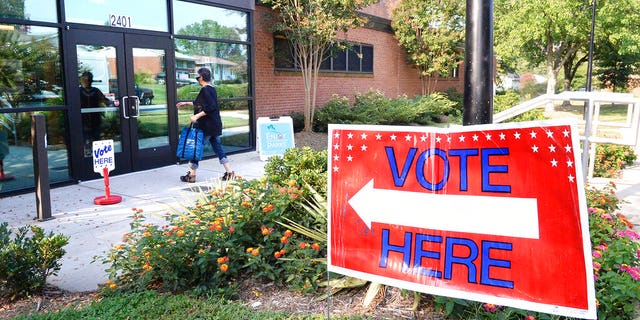 A voter enters a precinct at the West Charlotte Recreation Center Tuesday. (John D. Simmons/The Charlotte Observer via AP)
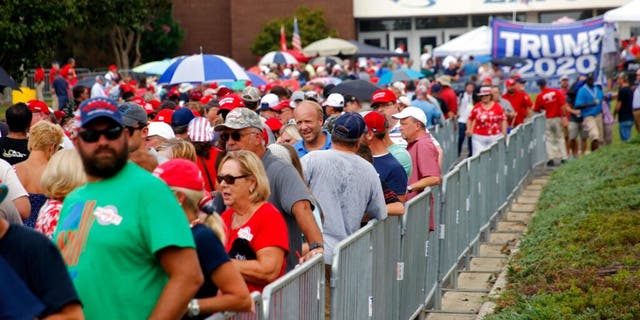 Attendees line up outside hours before President Donald Trump
speaks at a campaign rally in Fayetteville, N.C., Monday Sept. 9, 2019
(AP Photo/Chris Seward)
Attendees line up outside hours before President Donald Trump
speaks at a campaign rally in Fayetteville, N.C., Monday Sept. 9, 2019
(AP Photo/Chris Seward)
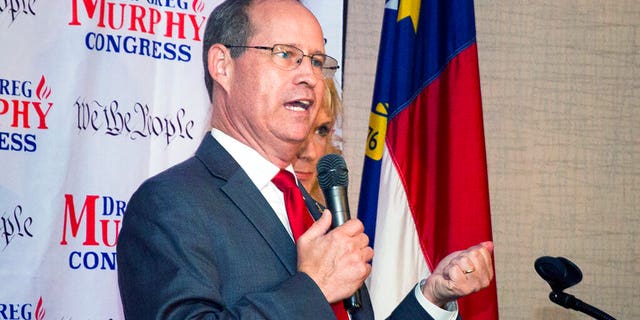 Greg Murphy was elected to Congress from North Carolina's 3rd
District Tuesday. (Molly Urbina/The Daily Reflector via AP, File)
Greg Murphy was elected to Congress from North Carolina's 3rd
District Tuesday. (Molly Urbina/The Daily Reflector via AP, File)