DETROIT
(AP) — The four-year contract between General Motors and the United
Auto Workers has expired as negotiations on a new deal continue.
Union
officials told GM they would let the contract lapse just before
midnight Saturday, increasing the risk of a strike as early as Sunday
night. Union members working Sunday were to report as scheduled.
But
there was a wrinkle. About 850 UAW-represented janitors who work for
Aramark, a separate company, went on strike Sunday after working under
an extended contract since March of 2018, the union said.
The
strike covered eight GM facilities in Ohio and Michigan. Although UAW
workers at GM are supposed to work, it wasn’t clear early Sunday whether
the rank-and-file would cross their own union’s picket lines. GM said
in a statement that it has contingency plans for any disruptions from
the Aramark strike.
UAW
Vice President Terry Dittes said in a letter to members that, after
months of bargaining, both the union and GM are far apart on issues such
as wages, health care, temporary employees, job security and
profit-sharing.
The union’s executive
leaders and a larger group of plant-level officials will meet Sunday
morning to decide the union’s next steps.
The letter to members and another one to GM were aimed at turning up the pressure on GM negotiators.
“While
we are fighting for better wages, affordable quality health care, and
job security, GM refuses to put hard working Americans ahead of their
record profits,” Dittes, the union’s chief bargainer with GM, said in a
statement Saturday night.
Kristin Dziczek,
vice president of the Center for Automotive Research, an industry think
tank, said the union could strike at GM after the contract expires.
“If they’re not extending the agreement, then that would leave them open to strike,” she said.
But GM, in a statement Saturday night, still held out hope for an agreement, saying it continues to work on solutions.
“We
are prepared to negotiate around the clock because there are thousands
of GM families and their communities - and many thousands more at our
dealerships and suppliers - counting on us for their livelihood. Our
goal remains on building a strong future for our employees and our
business,” the GM statement said.
A strike
by 49,200 union workers would bring to a halt GM’s U.S. production, and
would likely stop the company from making vehicles in Canada and Mexico
as well. That would mean fewer vehicles for consumers to choose from on
dealer lots, and it would make it impossible to build specially ordered
cars and trucks.
The
union’s executive board was to meet early Sunday to talk about the
union’s next steps, followed by a meeting in Detroit of plant-level
union leaders from all over the country. An announcement was scheduled
for after the meetings end.
If there is a strike, it would be the union’s first since a two-day work stoppage at GM in 2007.
The
move by the union also comes as it faces an internal struggle over a
federal corruption investigation that has touched its president, Gary
Jones. Some union members are calling for Jones to step down while the
investigation continues. But Friday night, union leaders did not remove
Jones.
Union officials surely will face
questions about the expanding investigation that snared a top official
on Thursday. Vance Pearson, head of a regional office based near St.
Louis, was charged with corruption in an alleged scheme to embezzle
union money and spend cash on premium booze, golf clubs, cigars and
swanky stays in California. It’s the same region that Jones led before
taking the union’s top office last year. Jones has not been charged.
On
Friday, union leaders extended contracts with Ford and Fiat Chrysler
indefinitely, but the pact with General Motors was still set to expire
Saturday night.
The union has picked GM,
which is more profitable than Ford and Fiat Chrysler, as the target
company, meaning it’s the focus of bargaining and would be the first
company to face a walkout. Picket line schedules already have been
posted near the entrance to one local UAW office in Detroit.
Talks
between the union and GM were tense from the start, largely because GM
plans to close four U.S. factories. The union has promised to fight the
closures.
Here are the main areas of disagreement:
—
GM is making big money, $8 billion last year alone, and workers want a
bigger slice. The union wants annual pay raises to guard against an
economic downturn, but the company wants to pay lump sums tied to
earnings. Automakers don’t want higher fixed costs.
—
The union also wants new products for the four factories GM wants to
close. The factory plans have irked some workers, although most of those
who were laid off will get jobs at other GM factories. GM currently has
too much U.S. factory capacity.
— The
companies want to close the labor cost gap with workers at plants run by
foreign automakers. GM’s gap is the largest at $13 per hour, followed
by Ford at $11 and Fiat Chrysler at $5, according to figures from the
Center for Automotive Research. GM pays $63 per hour in wages and
benefits compared with $50 at the foreign-owned factories.
—
Union members have great health insurance plans but workers pay about
4% of the cost. Employees of large firms nationwide pay about 34%,
according to the Kaiser Family Foundation. The companies would like to
cut costs.
YUMA, Ariz. (AP) — On a dirt road past rows of
date trees, just feet from a dry section of Colorado River, a small
construction crew is putting up a towering border wall that the
government hopes will reduce — for good — the flow of immigrants who
cross the U.S.-Mexico border illegally.
Cicadas
buzz and heavy equipment rumbles and beeps before it lowers
30-foot-tall (9-meters-tall) sections of fence into the dirt. “Ahí
está!” — “There it is!” — a Spanish-speaking member of the crew says as
the men straighten the sections into the ground. Nearby, workers pull
dates from palm trees, not far from the cotton fields that cars pass on
the drive to the border.
South
of Yuma, Arizona, the tall brown bollards rising against a cloudless
desert sky will replace much shorter barriers that are meant to keep out
cars, but not people.
This 5-mile
(8-kilometer) section of fencing is where President Donald Trump’s most
salient campaign promise — to build a wall along the entire southern
border — is taking shape.
The president and
his administration said this week that they plan on building between 450
and 500 miles (724 and 806 kilometers) of fencing along the nearly
2,000-mile (3,218-kilometer) border by the end of 2020, an ambitious
undertaking funded by billions of defense dollars that had been
earmarked for things like military base schools, target ranges and
maintenance facilities.
Two other Pentagon-funded construction projects
in New Mexico and Arizona are underway, but some are skeptical that so
many miles of wall can be built in such a short amount of time. The
government is up against last-minute construction hiccups, funding
issues and legal challenges from environmentalists and property owners
whose land sits on the border.
The Trump
administration says the wall — along with more surveillance technology,
agents and lighting — is key to keeping out people who cross illegally.
Critics
say a wall is useless when most of those apprehended turn themselves in
to Border Patrol agents in the hope they can be eventually released
while their cases play out in immigration court.
In Yuma, the defense-funded section of tall fencing is replacing shorter barriers that U.S. officials say are less efficient.
It
comes amid a steep increase since last year in the number of migrant
families who cross the border illegally in the Yuma area, often turning
themselves in to Border Patrol agents. Many are fleeing extreme poverty
and violence, and some are seeking asylum.
So
far this year, Border Patrol agents in the Yuma sector have apprehended
over 51,000 family units. That’s compared with just over 14,500 the
year before — about a 250% increase.
The
Yuma sector is the third busiest along the southern border, with
officials building a temporary, 500-person tent facility in the parking
lot of the Border Patrol’s Yuma headquarters in June.
It
spent just under $15 million for the setup and services for four
months, including meals, laundry and security, but officials are
evaluating whether to keep it running past next month as the number of
arrivals in Yuma and across the southern border have fallen sharply in recent months.
The
drop is largely due to the Mexican government’s efforts to stop
migrants from heading north after Trump threatened tariffs earlier this
year to force Mexico to act.
The number of
people apprehended along the southern border fell by 61 percent between
this year’s high point in May and the end of August. In Yuma, it fell by
86 percent, according to government figures. Most people apprehended
are either traveling as families or are unaccompanied children.
“Historically
this has been a huge crossing point for both vehicles as well as family
units and unaccompanied alien children during the crisis that we’ve
seen in the past couple of months,” Border Patrol spokesman Jose Garibay
said. “They’ve just been pouring over the border due to the fact that
we’ve only ever had vehicle bollards and barriers that by design only
stop vehicles.”
Victor Manjarrez Jr., a
former Border Patrol chief who’s now a professor at the University of
Texas, El Paso, was an agent when the government put up the first
stretch of barriers along the southern border — in San Diego.
He’s
seen barriers evolve from easily collapsible landing mats installed by
agents and the National Guard to the sophisticated, multibillion-dollar
projects now being done by private contractors.
Manjarrez
says tall border fencing is crucial in some areas and less helpful in
others, like remote stretches of desert where shorter barriers and more
technology like ground sensors would suffice.
“One
form doesn’t fit in all areas, and so the fence itself is not the one
solution. It’s a combination of many things,” Manjarrez said.
The
ease of construction varies by place and depends on things like water,
Manjarrez said, adding that just because a plot of land is flat “doesn’t
mean it’s not complex.”
He said building
450 to 500 miles (724 and 806 kilometers) of fence by the end of next
year would be tough if that figure doesn’t include sections of the wall
that have been built recently.
“As it stands
now, contractors are building pretty fast,” Manjarrez said. The real
question is whether the government needs to build that much fencing, he
said.
The Trump administration may face
those issues along with lawsuits from landowners who aren’t giving up
their property so easily and environmentalists who say the barriers stop
animals from migrating and can cut off water resources.
The
Tohono O’odham tribe in Arizona also has expressed opposition to more
border fencing on its land, which stretches for nearly 75 miles (120
kilometers) along the border with Mexico.
Near
Yuma, the Cocopah Indian Tribe’s reservation is near the latest fencing
project, and leaders are concerned it will block the view to its sacred
sites, spokesman Jonathan Athens said.
___
This story has been corrected to say that the section of fence installed near Yuma, Arizona, is 30 feet, or 9 meters, tall.
ROSH HAAYIN, Israel (AP) — As former army chief
of staff Benny Gantz campaigns to be Israel’s next leader, he is
relying less on policy specifics than on the archetypal image of a
military man who can rise above the political fray and defend a country
that feels perpetually under siege.
With
piercing blue eyes and the reserved manner of a lifelong soldier, Gantz
has vowed to unify the country and restore national institutions after
Prime Minister Benjamin Netanyahu’s decade-long rule, which has deepened
Israel’s religious and political divides and been roiled by corruption
allegations.
Gantz
failed to unseat Netanyahu in April’s elections, but will have another
shot in Tuesday’s unprecedented do-over, which was prompted by
Netanyahu’s inability to form a government.
In
contrast to Netanyahu, whose political career spans three decades, the
60-year-old Gantz is a newcomer who only burst onto the scene over the
last year. The towering former general heads the Blue and White, a
centrist coalition that includes the popular politician Yair Lapid as
well as other former senior military officers.
While
Netanyahu’s campaign has been marked by dramatic announcements on
everything from alleged Iranian nuclear sites to promises to annex parts
of the occupied West Bank, Gantz has offered a low-key alternative,
betting that voters are hungry for change. He may also hope to tap into
nostalgia for past generals-turned-statesmen, like Moshe Dayan, Yitzhak
Rabin and Ariel Sharon.
Gantz slammed the prime minister’s announcement
about an alleged Iranian nuclear weapons site, saying “Netanyahu’s use
of sensitive security information for the purposes of his campaign
attests to bad judgment.”
“Even in his last days as prime minister, Netanyahu is only looking out for Netanyahu,” he added.
When Netanyahu called for activists to be allowed to film polling stations
in Arab districts — alleging fraud without providing any evidence —
Gantz charged him with laying the groundwork for rejecting the election
results. When Netanyahu announced his intention to annex the heart of the West Bank if re-elected, Gantz dismissed it as a political stunt.
Gantz
has promised to take a much harsher stance toward Palestinian rocket
fire from the Gaza Strip, accusing Netanyahu of appeasing Hamas, the
Islamic militant group that rules the coastal territory. He has drawn on
his time as army chief, when he oversaw the 2014 Gaza war. Before
April’s elections, his campaign boasted about the number of militants
that were killed, saying parts of Gaza were sent back to the “stone
age,” but he has been more muted this time around.
He
has also hinted at reviving the peace process with the Palestinians,
but he has provided few details, apparently wary of alienating Israel’s
increasingly nationalist voters.
Oded
Balilty, a Pulitzer Prize-winning photographer for The Associated Press,
was recently granted exclusive access to photograph Gantz at his home
in Rosh Haayin, in central Israel, and his party headquarters in Tel
Aviv.
DUBAI,
United Arab Emirates (AP) — Iran denied on Sunday it was involved in
Yemen rebel drone attacks the previous day that hit the world’s biggest
oil processing facility and an oil field in Saudi Arabia, just hours
after America’s top diplomat alleged that Tehran was behind the
“unprecedented attack on the world’s energy supply.”
The
attacks Saturday claimed by Yemen’s Houthi rebels resulted in “the
temporary suspension of production operations” at the Abqaiq processing
facility and the Khurais oil field, Riyadh said.
That
led to the interruption of an estimated 5.7 million barrels in crude
supplies, authorities said while pledging the kingdom’s stockpiles would
make up the difference. The amount Saudi Arabia is cutting back is
equivalent to over 5% of the world’s daily production.
While
markets remained closed Sunday, the attack could shock world energy
prices. They also increased overall tensions in the region amid an
escalating crisis between the U.S. and Iran over Tehran’s unraveling
nuclear deal with world powers.
Late
Saturday, U.S. Secretary of State Mike Pompeo directly blamed Iran for
the attack on Twitter, without offering evidence to support his claim.
“Amid
all the calls for de-escalation, Iran has now launched an unprecedented
attack on the world’s energy supply,” Pompeo wrote. “There is no
evidence the attacks came from Yemen.”
The
U.S., Western nations, their Gulf Arab allies and U.N. experts say Iran
supplies the Houthis with weapons and drones — a charge that Tehran
denies.
U.S. officials previously alleged at
least one recent drone attack on Saudi Arabia came from Iraq, where
Iran backs Shiite militias. Those militias in recent weeks have been
targeted themselves by mysterious airstrikes, with at least one believed
to have been carried out by Israel.
Iranian Foreign Ministry spokesman Abbas Mousavi on Sunday dismissed Pompeo’s remarks as “blind and futile comments.”
“The
Americans adopted the ‘maximum pressure’ policy against Iran, which,
due to its failure, is leaning towards ‘maximum lies’,” Mousavi said in a
statement.
Separately, Iraqi Prime Minister
Adel Abdul-Mahdi’s office issued a statement on Sunday denying the
drone attack came from there.
Iraq “abides
by its constitutions that prevents the use of its lands to launch
aggressions against neighboring countries,” the statement said.
First
word of Saturday’s assault came in online videos of giant fires at the
Abqaiq facility, some 330 kilometers (205 miles) northeast of the Saudi
capital, Riyadh.
Machine-gun fire could be
heard in several clips alongside the day’s first Muslim call to prayers,
suggesting security forces tried to bring down the drones just before
dawn. In daylight, Saudi state television aired a segment with its local
correspondent near a police checkpoint, a thick plume of smoke visible
behind him.
President Donald Trump called
Saudi Arabia’s Crown Prince Mohammed bin Salman to offer his support for
the kingdom’s defense, the White House said. The crown prince assured
Trump that Saudi Arabia is “willing and able to confront and deal with
this terrorist aggression,” according to a news release from the Saudi
Embassy in Washington.
Saudi Aramco describes its Abqaiq oil processing facility in Buqyaq as “the largest crude oil stabilization plant in the world.”
The
facility processes sour crude oil into sweet crude, then transports it
onto transshipment points on the Persian Gulf and the Red Sea or to
refineries for local production. Estimates suggest it can process up to 7
million barrels of crude oil a day. By comparison, Saudi Arabia
produced 9.65 million barrels of crude oil a day in July.
The
Khurais oil field is believed to produce over 1 million barrels of
crude oil a day. It has estimated reserves of over 20 billion barrels of
oil, according to Aramco.
There was no
immediate impact on global oil prices as markets were closed for the
weekend. Benchmark Brent crude had been trading at just above $60 a
barrel.
___
Associated
Press writers Amir Vahdat in Tehran, Iran, Aya Batrawy in Dubai, United
Arab Emirates, and Bassem Mroue in Beirut contributed to this report.
The
New York Times, under its “New York Times Opinion” Twitter banner,
issued an apology late Saturday, saying it had deleted an “offensive”
Twitter message promoting a Times article that makes allegations against
Supreme Court Justice Brett Kavanaugh.
“We deleted a previous tweet regarding this article,” the Times Opinion message said. “It was offensive, and we apologize.”
Previously,
the Times posted and then deleted a tweet without the word "apology,"
but saying that the original tweet had been deleted because it was
"poorly phrased."
The
original Times tweet graphically described an obscene act that
Kavanaugh is accused of having done during his college years. The tweet
then said the act “may seem like harmless fun.”
Regardless of
whether the claim against Kavanaugh is true or not, critics on social
media were simply furious that the Times would describe the alleged
behavior as “harmless fun.”
'Profound lapse in judgment'
“This
is…. Such a profound lapse in judgment and common sense. Sexual assault
isn’t harmless fun,” one Twitter user wrote. “What the hell is going on
at the NYT?”
But others also argued that the allegations against Kavanaugh in the article weren’t true.
'What are they thinking?'
“What
are they thinking at the New York Times?,” Fox News contributor Byron
York of the Washington Examiner wrote. “1) It’s a discredited
allegation. 2) If it happened, such things are ‘harmless fun’?”
'Smearing a distinguished jurist'
“You
may think that smearing a distinguished jurist based on the testimony
of a woman who said last year she wasn’t even certain about her story is
harmless fun…” wrote theater critic Kyle Smith.
The
new Times story gives the account of a male Yale classmate of Kavanaugh
named Max Stier, who alleges that Kavanaugh, at the urging of some
friends, performed an obscene act while mistreating a woman at a party.
The
Times reported Saturday that Stier told the FBI about the alleged
incident during Kavanaugh’s Supreme Court confirmation process but the
FBI did not investigate further.
Stier’s story appears to align
with allegations that Kavanaugh accuser Deborah Ramirez made last year
in an article in The New Yorker magazine. But that magazine noted at the time
that Ramiriez “was at first hesitant to speak publicly, partly because
her memories contained gaps because she had been drinking at the time of
the alleged incident.”
The magazine later noted that Ramirez
agreed to speak only after “six days of carefully assessing her memories
and consulting with her attorney.”
During his confirmation process, Kavanagh denied numerous allegations about his personal conduct.
Earlier this year, an attorney for Kavanaugh accuser Christine Blasey Ford said her client was motivated
to testify against Kavanaugh in part to attach an “asterisk” next to
his name in the event of Supreme Court rulings on abortion.
The Senate ultimately approved President Trump’s nomination of Kavanaugh in a 50-48 vote last October.
HONG
KONG (AP) — Skirmishes broke out Saturday between supporters of the
ongoing protests for democratic reforms in Hong Kong and supporters of
the central government at a shopping mall in the semiautonomous Chinese
territory.
Hundreds of pro-Beijing
demonstrators sang the Chinese national anthem, waved red flags and
chanted slogans at Amoy Plaza in the densely packed Kowloon district.
Opposing protesters quickly gathered there, sparking tensions as the two
camps heckled each other.
The situation
turned chaotic with groups of people trading blows and some using
umbrellas to hit their opponents. Police later moved in to defuse the
situation, with several people detained.
The
clashes amid the mid-autumn festival holiday came after several nights
of peaceful rallies that featured mass singing at shopping malls by
supporters of the months-long pro-democracy protests.
Thousands
of people also carried lanterns with pro-democracy messages in public
areas and formed illuminated human chains on two of the city’s peaks on
Friday night to mark the major Chinese festival.
Protesters
have refused to yield despite the government’s promise to withdraw an
extradition bill that triggered the protests. They have widened their
demands to include direct elections for their leaders and police
accountability.
Many saw the extradition
bill, which would have allowed some Hong Kong suspects to be sent to
mainland China for trial, as an example of Hong Kong’s autonomy eroding
since the former British colony returned to Chinese rule in 1997.
Shops
shuttered at Amoy Plaza after the brawls. The atmosphere remained tense
as pro-democracy protesters slammed police, some who were seen hitting
detainees with batons to subdue them. Local media showed minor scuffles
continuing outside the mall as people left.
In
the northwestern suburb of Tin Shui Wai, several hundred people marched
on the street, carrying pro-democracy posters and waving American
flags, in defiance of a police ban on a rally in the area. Riot police
intercepted them and prevented them from marching to a park.
Some
200 high school students also staged a sit-in Friday at a downtown
public square. Many students have formed human chains outside their
schools as classes resumed two weeks ago after the summer break.
“Many students feel angry and unhappy. Today’s gathering is a platform for us to vent our frustrations,” said Lia Ng, 14.
More
than 1,300 people have been arrested since the protests began in early
June. Clashes have become more violent in recent weeks, with riot police
firing tear gas as protesters vandalized subway stations, set fires and
blocked traffic.
The unrest has further
battered Hong Kong’s economy, which was already reeling from the
U.S.-China trade war. It is also seen as an embarrassment to China’s
ruling Communist Party ahead of Oct. 1 National Day celebrations.
At
a netizens news conference earlier Saturday, activists warned that
violence could escalate if the government continues to turn a deaf ear
to citizens’ demands. They wore face masks to shield their identity for
fear of reprisals from the government.
One
of the activists said it was “natural behavior that people escalate
their ways” if peaceful means failed to elicit any response.
Police
have banned a major rally planned in central Hong Kong on Sunday, but
protesters have vowed to turn up anyway. Some others are also planning
to march to the British Consulate.
___
Associated Press videojournalists Raf Wober and Phoebe Lai contributed to this report.
The Justice Department
told a judge Friday that the House Judiciary Committee shouldn't be
granted access to unreleased material from the former special counsel's Russia investigation as it weighs whether to move forward with impeachment proceedings against President Trump.
The
committee had filed a petition in federal court for lawmakers to obtain
the grand jury material to determine whether to recommend articles of
impeachment against Trump for his knowledge of any potential "criminal
acts" by him or his associates related to conspiring with Russia.
The department argued lawmakers have "come nowhere close to demonstrating a particularized need" for the information.
"What may come of this investigation — if anything — remains unknown and unpredictable," the court filing read.
"What may come of this investigation — if anything — remains unknown and unpredictable." — Justice Department court filing
A redacted version of former Special Counsel Robert Mueller's
448-page report was released to the public in April. A less-redacted
version, where only grand jury information was blacked out, was then
given to certain lawmakers, including the committee's chairman and
ranking member.
The committee asserted its need of the full,
unredacted version of Mueller's report as well as transcripts of the
grand jury testimony, and filed a lawsuit under Chairman Jerrold Nadler,
D-N.Y., in July. The Justice Department argued the blacked-out
information in the report comprised a "tiny percentage of the document,"
and that the committee hadn't provided a sufficient explanation as to
how the material would help their investigation of Trump.
The DOJ
also argued an impeachment proceeding carried out in Congress wouldn't
be considered a "judicial proceeding" under law, in which case the
information could have been disclosed.
The department went on to
argue that several investigations stemming from Mueller's probe remained
open, thus there is a "continuing need for secrecy" about grand jury
proceedings.
It's
not clear what new information the committee is seeking in the grand
jury transcripts. Many witnesses connected to the Trump administration
appeared for voluntary questioning before Mueller's team rather than the
grand jury.
The House Judiciary Committee approved ground rules
for impeachment hearings Thursday, but House Speaker Nancy Pelosi
maintained her cautious approach.
"If we have to go there, we'll go there," she said. "But we can't go there until we have all the facts."
Nadler
promised an "aggressive" fall schedule for impeachment investigations,
starting with a public session next week with former Trump campaign
manager Corey Lewandowski. The Associated Press contributed to this report.
A protester was taken into custody at the California Statehouse
in Sacramento on Friday evening after she allegedly threw a feminine
hygiene device containing "what appeared to be blood" onto the floor of
the state Senate from a public viewing area, splashing the liquid
onto lawmakers working below.
The Senate chamber was evacuated and lawmakers finished their work in a committee room on the final day of the legislative session.
The
woman, who was not identified, was detained on charges including
assault, vandalism and disrupting "the orderly conduct of official
business" at the Statehouse, the California Highway Patrol said in a
news release.
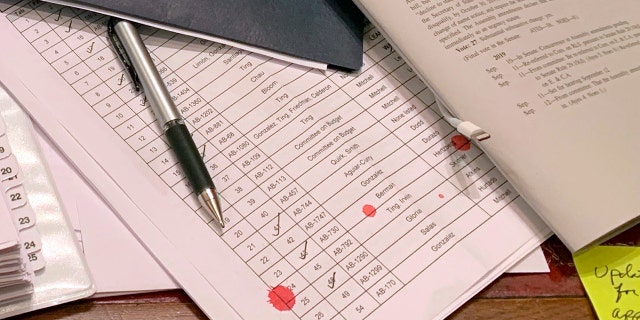
In this photo provided by state Senator Steven Glazer, red dots
are splattered on papers on Glazer's Senate desk, after a woman threw a
container with red liquid from the public gallery of the Senate chambers
during a legislative session, in Sacramento, Calif., Friday, Sept. 13,
2019. (Senator Steven Glazer via AP)
The disruption occurred as a group of protesters —
many holding signs promoting “Medical Freedom” -- were permitted into
the Senate chambers to overlook state Senate proceedings from the
upstairs balcony. They had been demonstrating against a recently signed
state measure intended to crack down on fraudulent medical exemptions
for vaccinations.
Around 5:15 p.m., a woman in the group leaned
over the railing and hurled the unidentified red liquid onto
the unsuspecting lawmakers. Someone reportedly called out: “That’s for
the dead babies.”
The Senate called a quick recess and law enforcement evacuated the chambers. A video posted to social media
shows a woman, who walked out of the gallery into the hallway, saying,
“My menstrual blood is all over the Senate floor… a representation of
the blood of the dead babies,” before she is then handcuffed.
State Sen. Scott Wiener, a Democrat, posted on Twitter after the ordeal.
“A
few minutes ago, the anti-vaxxer stalkers – who’ve engaged in a
harassment campaign all week – dropped a red substance onto the Senate
floor from the elevated public gallery, dousing several of my
colleagues,” Wiener wrote. “These anti-vaxxers are engaging in criminal
behavior. They’ve now repeatedly assaulted senators and are engaging in
harassing and intimidating behavior every single day, as we try to do
the people’s work. They’re a cancer on the body politic and are
attacking democracy.”
The incident comes after Gov. Gavin Newsom, a
Democrat, signed controversial legislation into law this week that
places restrictions on medical vaccine exemptions for children. State
Sen. Richard Pan, a Democrat representing Sacramento, authored the bill.
He was shoved by a protester last week outside the Capitol.
“This incident was incited by the violent rhetoric perpetuated by leaders of the antivaxx movement,” Pan said in a statement to FOX 40 Sacramento.
“As their rhetoric escalates, their incidents of violence does as well.
This is an attack on the democratic process and an assault on all
Californians and it must be met with strong condemnation by everyone.”
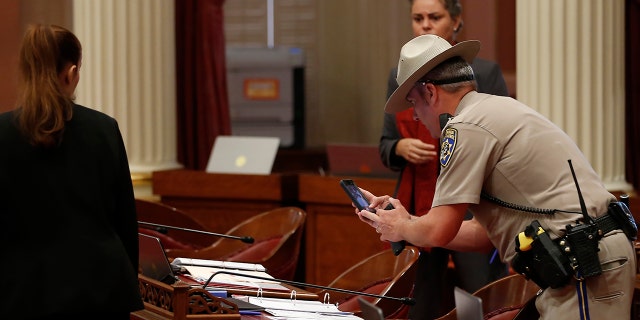
A California Highway Patrol Officer photographs a desk on the
Senate floor after a red liquid was thrown from the Senate Gallery
during the Senate session at the Capitol in Sacramento, Calif., Friday,
Sept. 13, 2019. (Associated Press)
Senate Bill 276 and SB 714 intend to increase oversight on California’s vaccine medical exemption system, according to the Sacramento Bee.
Doctors in the state will be required to submit a form to the state
Department of Public Health every time they issue a medical exemption.
Public health officials will be alerted when doctors issue more than
five exemptions a year and review each exemption case to evaluate if
fraud is being committed. The system will also flag schools that fall
below a 95 percent vaccination rate.
Supporters argue the new legislation would protect
children who are too sick or young to be vaccinated from being exposed
to preventable diseases while at school, according to the Bee. Those in
opposition to the new law say vaccines are not universally safe and that
the measure would infringe on the patient-doctor relationship.
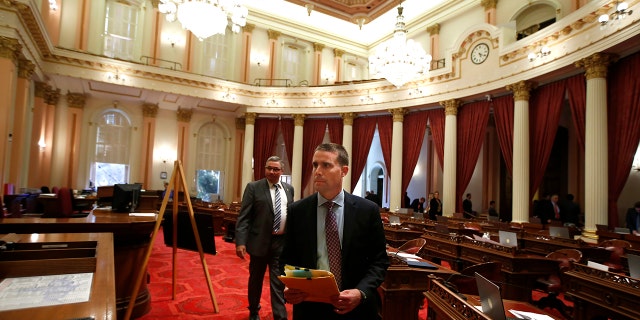
State Senator Mike McGuire, D-Healdsburg, right, leaves the Senate
Chambers after a red substance was thrown from the Senate Gallery
during the Senate session at the Capitol in Sacramento, Calif., Friday,
Sept. 13, 2019. (AP Photo/Rich Pedroncelli)
Protesters camped outside the governor’s office
this week as others in opposition to the legislation crowded hallways in
Sacramento’s Capitol building and attempted to disrupt hearings and
floor sessions, the Los Angeles Times reported. The group responsible for organizing the rally outside the Capitol denounced the woman’s behavior Friday.
“We strongly denounce this, it goes far beyond crossing a line,”
Jonathan Lockwood, executive director of Conscience Coalition, told the
Sacramento Bee.
Senate
President Pro Tempore Toni Atkins said in a statement: “California’s
legislative process, as well as our doors, should remain open to all who
wish to observe or speak out on a variety of issues, but we cannot
allow anyone to endanger others. The behavior that occurred in the
Senate Chamber is unacceptable and has been dealt with by Capitol law
enforcement. We will continue to do the people’s important business.” The Associated Press contributed to this report.