Just days after a shakeup in the New Hampshire leadership of Sen. Bernie Sanders’ 2020 presidential campaign comes word that the candidate’s Iowa political director has departed as well.
According
to reports, a Sanders aide on Wednesday confirmed that Jess Mazour, who
was named Sanders’ Iowa director in March, was let go from the campaign
in recent weeks.
The aide confirmed the departure on condition of
anonymity because the aide wasn’t authorized to discuss personnel
matters, The Associated Press reported.
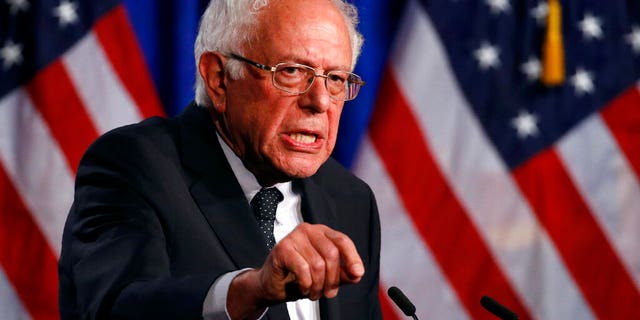
Democratic presidential candidate Sen. Bernie Sanders, I-Vt.,
speaks at George Washington University in Washington, July 17, 2019.
(Associated Press)
Prior to joining the sanders campaign, Mazour was an
organizer for the progressive group Iowa Citizens for Community
Improvement. The Washington Post was first to report that she had left the campaign.
On
Sunday, the Sanders campaign announced changes to its New Hampshire
leadership after backers of the campaign expressed concern that the
independent U.S. senator from neighboring Vermont could lose the
first-in-the-nation New Hampshire primary early next year.
The
campaign announced that Shannon Jackson, who ran Sanders’ Senate
reelection campaign in Vermont in 2018, would take over New Hampshire
leadersip duties from Joe Caiazzo, who was transferred to Sanders’
operation in Massachusetts, according to the Washington Times.
The Caiazzo-Jackson switch came one day after the Sanders campaign parted ways with senior New Hampshire adviser Kurt Ehrenberg.
The
changes in the Sanders campaign coincide with the loss of a key
endorsement for Sanders to rival 2020 progressive candidate Sen.
Elizabeth Warren, D-Mass., who this week attracted the backing of the Working Families Party -- a group that had supported Sanders in 2016.
“Seeing
the campaign not be able to outshine Warren with WFP progressives
doesn’t have me questioning WFP’s process,” Rafael Shimunov, a 2016
Sanders volunteer and past national creative director for WFP told Politico.
“It has me questioning where the Bernie campaign could have done
better, because I want to make sure the strongest candidate unmasks
Biden and unseats Trump.”
A Fox News Poll released Wednesday
shows that Warren has pulled virtually even with Sanders in second
place behind former Vice President Joe Biden, with Sanders attracting
support from 18 percent of respondents, Warren 16 percent, and Biden
leading with 29 percent. Fox News’ Paul Steinhauser and The Associated Press contributed to this report.
DUBAI,
United Arab Emirates (AP) — Saudi Arabia said Wednesday it joined a
U.S.-led coalition to secure the Mideast’s waterways amid threats from
Iran after an attack targeting its crucial oil industry, while Iran’s
president told the kingdom it should see the attack as a warning to end
its yearslong war in Yemen.
The kingdom’s
decision to enter the International Maritime Security Construct came
ahead of a planned visit by U.S. Secretary of State Mike Pompeo. Saudi
officials separately planned to share information about the weapons used
to attack a Saudi oil field and the world’s largest crude oil
processing plant Saturday.
Yemen’s
Iranian-backed Houthi rebels have claimed the attack. The U.S. accuses
Iran of being behind the assault, while Saudi Arabia already has said
“Iranian weaponry” was used. Iran denies that, though it comes amid a
summer of heightened tensions between Tehran and Washington over its
unraveling nuclear deal with world powers.
“Almost
certainly it’s Iranian-backed,” Prince Khalid bin Bandar, Saudi
Arabia’s ambassador to the United Kingdom, told the BBC. “We are trying
not to react too quickly because the last thing we need is more conflict
in the region.”
The state-run Saudi Press
Agency carried a statement Wednesday morning quoting an unnamed official
saying the kingdom had joined the International Maritime Security
Construct.
Australia, Bahrain and the United Kingdom already have joined the mission.
“The
kingdom’s accession to this international alliance comes in support of
regional and international efforts to deter and counter threats to
maritime navigation and global trade,” the news agency said.
Cmdr.
Joshua Frey, a spokesman for the U.S. Navy’s 5th Fleet, declined to
comment on the Saudi announcement, saying it “would be inappropriate to
comment on the status of individual nations and the nature of any
potential support.”
The coalition aims to
secure the broader Persian Gulf region. It includes surveillance of the
Strait of Hormuz, the narrow mouth of the Persian Gulf through which a
fifth of the world’s oil travels, and the Bab el-Mandeb, another narrow
strait that connects the Red Sea and the Gulf of Aden off Yemen and East
Africa. Smaller patrol boats and other craft will be available for
rapid response. The plan also allows for nations to escort their own
ships through the region.
The U.S. blames
Iran for the apparent limpet mine explosions on four vessels in May and
another two in June sailing in the Gulf of Oman near the Strait of
Hormuz, something Iran denies being behind. Iran also seized a
British-flagged oil tanker and another based in the United Arab
Emirates.
It’s
unclear what role the kingdom will play in the coalition. Bahrain
already serves at the headquarters of the U.S. Navy’s 5th Fleet.
In
Tehran, Iranian President Hassan Rouhani told his Cabinet that Saudi
Arabia should see the attack as a warning to end its war in Yemen, where
it has fought the Houthi rebels since 2015 and sought to restore the
internationally recognized government.
Rouhani
said Yemenis “did not hit hospitals, they did not hit schools or the
Sanaa bazaar,” mentioning the Saudi-led coalition’s widely criticized
airstrikes.
He added that Iran does not want
conflict in the region, but it was the Saudi-led coalition that “waged
the war in the region and ruined Yemen.”
“They
attacked an industrial center to warn you. Learn the lesson from the
warning,” he said, portraying the Houthis as responsible for the drone
strikes.
He did not address accusations Iran was behind the attacks in the video shown on state television.
Wednesday’s
announcements comes after Saudi Arabia’s energy minister said late
Tuesday that more than half of the country’s daily crude oil production
that was knocked out by an attack had been recovered and that production
capacity at its targeted plants would be fully restored by the end of
the month.
“Where would you find a company
in this whole world that went through such a devastating attack and came
out like a phoenix?” Energy minister Prince Abdulaziz bin Salman said
about state-owned Saudi Aramco, which was the target of the attacks. His
question to reporters, many of them Saudi, drew applause.
Prince
Abdulaziz said Aramco will honor its commitments to its customers this
month by drawing from its reserves of crude oil and offering additional
crude production from other oil fields. He said production capacity
would reach up to 11 million barrels a day by the end of September and
12 million barrels in November.
He said production at the Abqaiq processing facility is currently at 2 million barrels per day.
Oil
prices spiked Monday, with benchmark Brent crude having the biggest
percentage gain since the 1991 Gulf War. Prices dropped Tuesday around
the Saudi announcement. Brent traded Wednesday morning around the same
prices as the day before, with a barrel costing over $64.
Pompeo
was due to land in the Red Sea city of Jiddah, where he was scheduled
to meet with Saudi Crown Prince Mohammed bin Salman. Pompeo later will
travel to the United Arab Emirates on Thursday to meet with Abu Dhabi’s
powerful crown prince, Sheikh Mohammed bin Zayed Al Nahyan. Both nations
are U.S. allies and have been fighting against the Houthis in Yemen
since March 2015.
The Saudi military planned
to speak to journalists Wednesday in Riyadh to discuss the
investigation into Saturday’s attack “and present material evidence and
Iranian weapons proving the Iranian regime’s involvement.” It did not
elaborate.
Marine Gen. Joseph Dunford,
chairman of the Joint Chiefs of Staff, said Tuesday that U.S. military
experts were in Saudi Arabia working with their counterparts to “do the
forensics on the attack” — gleaning evidence that could help build a
convincing case for where the weapons originated.
On
Wednesday, French President Emmanuel Macron’s office announced experts
from his nation would be traveling to Saudi Arabia to help the kingdom
shed light ” on the origin and methods” of the attacks. France has been
trying to find a diplomatic solution to the tensions between Iran and
the U.S., so any conclusion they draw could be used to show what a
third-party assessed happened.
___
Associated
Press writers Aya Batrawy in Dubai, United Arab Emirates, Nasser Karimi
in Tehran, Iran, Robert Burns in Washington and Angela Charlton in
Paris contributed to this report.
JERUSALEM (AP) — Israel’s two main political
parties were deadlocked Wednesday after an unprecedented repeat
election, with Prime Minister Benjamin Netanyahu facing an uphill battle
to hold on to his job.
The election’s
seeming political kingmaker, Avigdor Lieberman, said he’ll insist upon a
secular unity government between Netanyahu’s Likud and Benny Gantz’s
Blue and White parties, who based on partial results are currently tied
at 32 seats each out of the 120 in parliament.
Without
Lieberman’s endorsement, both parties appear to have fallen well short
of securing a parliamentary majority with their prospective ideological
allies.
With
results still pouring in, Lieberman insisted the overall picture was
unlikely to change. He also demanded a secular “liberal” government
shorn of the religious and ultra-Orthodox allies the prime minister has
long relied upon.
“The conclusion is clear,
everything we said throughout the campaign is coming true,” he said
outside his home in the West Bank settlement of Nokdim. “There is one
and only option: a national unity government that is broad and liberal
and we will not join any other option.”
That could spell serious trouble for the continuation of Netanyahu’s lengthy rule.
Gantz,
a former military chief, has ruled out sitting with a Netanyahu-led
Likud at a time when the prime minister is expected to be indicted on
corruption charges in the coming weeks. It raised the specter of an
alternate Likud candidate rising to challenge Netanyahu, though most of
its senior officials have thus far pledged to stand solidly behind their
leader.
Netanyahu, the longest serving leader is
Israeli history, had desperately sought an outright majority with his
hard-line and ultra-Orthodox allies in hopes of passing legislation to
give him immunity from his expected indictment.
Israel’s
attorney general has recommended charging Netanyahu with bribery, fraud
and breach of trust in three scandals, pending a long-awaited hearing
scheduled in the coming weeks. A formal indictment would increase the
pressure on Netanyahu to step aside if he does not have immunity.
The
partial results released Wednesday by the Central Election Commission
were based on a tally of 56% of the potential electorate. Overall
turnout was 69.4%.
According to the partial
results, Likud with its natural allies of religious and
ultra-nationalist parties mustered just 56 seats — or five short of the
needed majority.
Gantz’s
Blue and White and its center-left allies garnered 55 seats, placing
Lieberman’s Yisrael Beiteinu and its nine seats in the middle as the
deciding factor.
The only precedent for a
unity government in Israel came after the 1984 election and saw a
rotating premiership between the heads of the two largest parties.
The
joint list of Arab parties, who have never sat in an Israeli
government, also finished strong, with results indicating they had
earned 12 seats to become the third-largest party in parliament. Should a
unity government be formed, its leader Ayman Odeh, would become the
country’s next opposition leader, an official state position that would
grant him an audience with visiting dignitaries, a state-funded
bodyguard, monthly consultations with the prime minister and a platform
to rebut his speeches in parliament.
Addressing
his supporters early Wednesday, Netanyahu refused to concede defeat and
vowed to form a new government that excludes Arab parties, continuing
his campaign rhetoric of questioning the loyalty of the country’s Arab
minority — a strategy that drew accusations of racism and incitement.
“There
neither will be nor can there be a government that relies on
anti-Zionist Arab parties. Parties that reject the very existence of
Israel as a Jewish and democratic state. Parties that vaunt and praise
bloodthirsty terrorists who murder our soldiers, citizens and children,”
he said.
In his first comments Wednesday
morning outside his home, Gantz said he had already begun working toward
forming a “unity government” but urged patience until the final results
were announced, likely on Thursday.
Focus
will then shift toward Israel’s president, Reuven Rivlin, who is tasked
with selecting the candidate he believes has the best chance of forming a
stable coalition. Rivlin is to consult with all parties in the coming
days before making his decision. Lieberman’s recommendation will carry a
lot of weight regarding who will be tapped as the prime minister
designate.
The candidate would then have up
to six weeks to form a coalition. If that fails, Rivlin could give
another candidate for prime minister 28 days to form a coalition. And if
that doesn’t work, new elections would be triggered yet again. Rivlin
has said he will do everything possible to avoid such a scenario and
Lieberman has ruled it out as well.
Lieberman’s
primary stated goal is to push out what he sees as the excessive power
of the ultra-Orthodox Jewish parties and have wide a coalition that can
effectively tackle Israel’s most pressing security and economic
challenges. But Netanyahu accused his former ally of plotting to oust
him from office out of personal spite.
Behind
the two is decades of a roller-coaster relationship. Lieberman, once
Netanyahu’s chief of staff, has held a series of senior Cabinet posts
and was often a staunch partner. But he’s has also been a rival, critic
and thorn in Netanyahu’s side.
The
Moldovan-born Lieberman started as a top Netanyahu aide in the 1990s
before embarking on a political career of his own as a nationalist
hard-liner and champion of immigrants like the former Soviet Union like
himself. But he resigned last year as defense minister because Netanyahu
kept blocking his plans to strike hard against Gaza militants.
Lieberman
passed up the chance to return to the post following April’s election,
refused to join Netanyahu’s emerging coalition and forcing the do-over
vote. Assuming he sticks to his guns this time as well, Netanyahu could
be done as Israel’s prime minister.
Liberman is now “the linchpin,” wrote Nahum Barnea, a prominent columnist in the Yediot Ahronot daily.
“I
don’t think that anyone is prepared to risk a third election, not even
for Netanyahu,” Barnea added. “Maybe the time has come to say goodbye.”
President Trump said Tuesday he cannot let California cities continue to “destroy themselves” by failing to adequately address homelessness, as state and local officials look reluctantly to the federal government for help in combating the ongoing housing crisis within the nation’s most populated state.
Talking
to reporters aboard Air Force One en route in San Francisco, Trump
addressed the state's problem with homelessness, saying, "We can't let
Los Angeles, San Francisco and numerous other cities destroy themselves
by allowing what's happening."
“We
have people living in our … best highways, our best streets, our best
entrances to buildings ... where people in those buildings pay
tremendous taxes, where they went to those locations because of the
prestige,” Trump continued. “In many cases, they came from other
countries and they moved to Los Angeles or they moved to San Francisco
because of the prestige of the city, and all of a sudden they have
tents. Hundreds and hundreds of tents and people living at the entrance
to their office building. And they want to leave. And the people of San
Francisco are fed up, and the people of Los Angeles are fed up.”
"The people of San Francisco are fed up, and the people of Los Angeles are fed up." — President Trump
Earlier
this week, Gov. Gavin Newsom, a Democrat, and several California mayors
and county and state officials asked the Trump administration for
50,000 additional vouchers for those most affected by the housing
crisis, the Los Angeles Times reported. In the letter signed Monday,
they also requested the federal government provide incentives for
landlords to accept the housing vouchers.
“That’s a pretty remarkable opportunity, if they’re sincere in their
desires,” Newsom said at a news conference. “If they’re insincere and
this is, God forbid, about something else — politics, not good policy —
then they’ll reject it outright. I hope that’s not the case.”
The
president’s two-day fundraising trip to California has been met with
protests and swift criticism from celebrities aiming to prevent him from
awakening Republican support in the Democrat stronghold state ahead of
2020. Meanwhile, officials spoke of putting political differences aside
briefly enough to welcome the president in a partnership in addressing
homeless in the state together.
Los Angeles Mayor Eric Garcetti, a Democrat, said in a Facebook video
post ahead of Trump's arrival that he hoped the president would work
with the city to end homelessness, but added he has not been invited to
meet with the president during his stay on Los Angeles.
Trump
said he would discuss possible solutions to California’s homelessness
crisis with U.S. Department of Housing and Urban Development Secretary
Ben Carson when he comes to join the president in the San Francisco Bay
Area and then Los Angeles. Carson requested to meet with Los Angeles
Police Department Chief Michel Moore to discuss housing issues,
including homelessness. They are expected to meet Wednesday.
As
Trump fails to announce possible policy proposals to address
homelessness on the West Coast during his California trip, local
officials are speculating that Trump plans to clear homeless encampments
he referenced to reporters on Air Force One and move people to
government operated shelters on federal land, the Los Angeles Times reported.
The
Department of Justice and Los Angeles law enforcement union officials
deliberated possible “workarounds” to circumvent court settlements,
rulings and lawsuits that hinder the Los Angeles Police Department’s
ability to clear homeless encampments from public property, according to
the newspaper. On Monday, the White House also considered the option of
deregulating the housing market to increase the supply of apartments,
condominiums and homes in California.
Trump
kicked off his two-day California fundraising trip Tuesday with a $3
million Bay Area luncheon at the home of Sun Microsystems co-founder
Scott McNealy, to be followed by a $5 million Beverly Hills dinner at
the home of real estate developer Geoffrey Palmer. He's expected to
bring in an additional $7 million on Wednesday with a breakfast in Los
Angeles and luncheon in San Diego. Trump’s tour is to raise money for
Trump Victory, a joint fundraising committee composed of the Trump
campaign and the Republican National Committee, according to the Los
Angeles Times. Fox News' Gregg Re contributed to this report.
While testy exchanges between Chairman Jerrod Nadler and former Trump campaign manager Corey Lewandowski
got most of the attention at Tuesday’s House Judiciary Committee
hearing on impeachment, one Republican on the panel thought the
proceedings should have taken an entirely different direction.
Rep. Jim Jordan,
R-Ohio, said Tuesday that if House Democrats wanted to explore whether
President Trump deserved impeachment, “a great place to start” would be
with testimony from Michael Horowitz, the Justice Department inspector
general tasked with investigating alleged abuses of the Foreign
Intelligence Surveillance Act (FISA).
“A great place to start
would be the inspector general's report that was issued just three weeks
ago, the scathing report about Jim Comey," Jordan told Nadler during
Tuesday’s hearing.
In
his report, Horowitz claimed that Comey, the former FBI director who
was fired by President Trump, violated bureau policies by drafting,
leaking and retaining his memos documenting private discussions with the
president.
Republicans have maintained that Comey’s actions were
part of an anti-Trump agenda within the FBI prior to the 2016
presidential election, with other alleged participants including former
FBI acting director Andrew McCabe and former FBI staffers Peter Strzok
and Lisa Page.
Jordan noted Tuesday that he had previously
requested that Horowitz appear before the Judiciary Committee, only to
be rebuffed by Nadler.
"When I asked the chairman when we might
have an opportunity to question Mr. Horowitz, he said, 'I don't know. I
haven't thought about that’,” Jordan said.
“Of
course you haven't thought about that," Jordan added. "Too busy trying
to impeach the president. Too busy slapping subpoenas on Corey
Lewandowski."
Jordan had said Monday that potential prosecutions of former FBI personnel could come from U.S. Attorney John Durham, who was tapped by Attorney General Bill Barr in May to probe the origins of the Trump-Russia investigation.
But it will be "a while" before Durham's probe is concluded, Jordan said. Fox News’ Catherine Herridge and Joshua Nelson contributed to this report.
TEHRAN,
Iran (AP) — Iran’s supreme leader announced on Tuesday that “there will
be no talks with the U.S. at any level” — remarks apparently meant to
end all speculation about a possible U.S.-Iran meeting between the two
countries’ presidents at the U.N. later this month.
Iranian
state TV quoted Ayatollah Ali Khamenei as saying this is the position
of the entire leadership of the country and that “all officials in the
Islamic Republic unanimously believe” this.
“There will be no talks with the U.S. at any level,” he said.
Khamenei said the U.S. wants to prove its “maximum pressure policy” against Iran is successful.
“In
return, we have to prove that the policy is not worth a penny for the
Iranian nation,” Khamenei said. “That’s why all Iranian officials, from
the president and the foreign minister to all others have announced that
we do not negotiate (with the U.S.) either bilaterally or
multilaterally.”
There had been reports
about a possible meeting between President Donald Trump and his Iranian
counterpart, Hassan Rouhani, during the upcoming U.N. General Assembly
this month in New York.
But
tensions roiling the Persian Gulf have escalated following a weekend
attack on major oil sites in Saudi Arabia that the U.S. alleged Iran was
responsible for — a charge Iran denies.
The
crisis between Washington and Tehran stems from Trump’s pullout last
year from the 2015 nuclear deal between Iran and world powers. He also
re-imposed and escalated sanctions on Iran that sent the country’s
economy into freefall.
The attack on Saudi
Arabia, which set ablaze a crucial Saudi oil processing plant and a key
oil field, was claimed by Yemen’s Iranian-allied Houthi rebels, who are
at war with a Saudi-led coalition that is trying to restore Yemen’s
internationally recognized government to power.
Trump
declared Monday it “looks” like Iran was behind the explosive attack on
the Saudi oil facilities. But he stressed that military retaliation was
not yet on the table in response to the strike against a key U.S.
Mideast ally.
Oil prices soared worldwide
amid the damage in Saudi Arabia and fresh Middle East war concerns. But
Trump put the brakes on any talk of quick military action — earlier he
had said the U.S. was “locked and loaded” — and he said the oil impact
would not be significant on the U.S., which is a net energy exporter.
The
Saudi government called the attack an “unprecedented act of aggression
and sabotage” but stopped short of directly pinning blame on Iran.
One
U.S. official, speaking on condition of anonymity to discuss internal
deliberations, said the U.S. was considering dispatching additional
military resources to the Gulf but that no decisions had been made. The
U.S. already has the USS Abraham Lincoln aircraft carrier battle group
in the area, as well as fighter jets, bombers, reconnaissance aircraft
and air defenses.
Trump, alternating between
aggressive and nonviolent reactions, said the U.S. could respond “with
an attack many, many times larger” but also “I’m not looking at options
right now.”
American officials released
satellite images of the damage at the heart of the kingdom’s Abqaiq
processing plant and a key oil field, and two U.S. officials said the
attackers used multiple cruise missiles and drone aircraft.
Private
experts said the satellite images show the attackers had detailed
knowledge of which tanks and machinery to hit within the sprawling Saudi
oil processing facility at Abqaiq to cripple production. But “satellite
imagery can’t show you where the attack originated from,” said Joe
Bermudez, an expert at the Center for Strategic and International
Studies who examined the images.
The U.S.
alleges the pattern of destruction suggested Saturday’s attack did not
come from neighboring Yemen, as claimed by the Houthis there. A Saudi
military alleged “Iranian weapons” had been used.
The Saudis invited the U.N. and other international experts to help investigate, suggesting there was no rush to retaliate.
For
his part, Khamenei on Tuesday also reiterated Iran’s stance that if the
U.S. returns to the nuclear deal, Tehran would consider negotiations.
“Otherwise, no talks will happen ... with the Americans,” he said. “Neither in New York nor anywhere” else.
___
Associated Press writer Robert Burns in Washington contributed to this report.
Iran was the staging ground for the weekend attacks on the massive Saudi Arabia oil field, according to U.S. intelligence that was shared with the kingdom, a report said.
The Wall Street Journal, citing unnamed sources, reported that
the intelligence report—that was not shared publicly—indicated that
Iran raided the massive oil field with at least a dozen missiles and 20
drones.
The State Department did not immediately respond to an
after-hours email from Fox News on Tuesday morning. The Journal's report
said that a Saudi official indicated that the U.S. intelligence was not
definitive. The official told the paper that the U.S. did not provide
enough evidence to prove without a doubt that Tehran’s hand was
involved.
President Trump has said the U.S. is “locked and loaded”
and able to respond to the threat but also said he wants to avoid war.
Iran has denied any involvement in the attack. Ahead of UN meeting,
Iran's Supreme Leader Ayatollah Ali Khamenei said "there will be no
talks with the US at any level," the Associated Press reported.
Yemen's
Iran-backed Houthi rebels claimed responsibility for the attack on
Saturday, sparking huge fires and halting about half of the supplies
from the world's largest exporter of oil. The attack was seen by some
analysts as a Pearl Harbor-like event.
The
fires led to the interruption of an estimated 5.7 million barrels in
crude supplies, as Saudi officials said part of that would be offset
with stockpiles. Fox News' Alex Pappas contributed to this report
Sen. Dick Durbin, D-Ill., was asked Monday about the prospects of Democrats taking up an effort to impeach Brett Kavanaugh from the Supreme Court and responded, “Get real,” according to a report.
Calls
to impeach Kavanaugh came after an essay in the New York Times brought
to light separate sexual misconduct allegations against him dating back
to his time at Yale. The Times reported that the FBI did not investigate
the claim.
The paper was forced to run an editor’s note and
revised the essay after it was revealed that it left out that the
accuser declined to be interviewed and her friends said she doesn’t
recall the incident.
The report prompted 2020 Democrats to call
for Kavanaugh's ouster. The new push to impeach Kavanaugh appeared to
divide Democrats still eyeing an effort to impeach President Trump.
“We’ve got to get beyond this ‘impeachment is the answer to every problem,” Durbin said, according to Politico.
“It’s not realistic. If that’s how we are identified in Congress, as
the impeachment Congress, we run the risk that people will feel we’re
ignoring the issues that mean a lot to them as families.”
Rep.
Jerry Nadler, the New York Democrat and chair of the House
Judiciary Committee, said the committee will ask Christopher Wray, the
FBI director, about the investigation during a later hearing. Nadler
stressed that his focus is on impeaching Trump.
A
Kavanaugh impeachment would require a majority vote in the
Democratic-controlled House, and two-thirds vote in the GOP-majority
Senate.
Rep. Ayanna Pressley, D-Mass., will reportedly file an
impeachment resolution on Tuesday. She said he must be "held accountable
for his actions." Fox News' Gregg Re contributed to this report

 Democratic presidential candidate Sen. Bernie Sanders, I-Vt.,
speaks at George Washington University in Washington, July 17, 2019.
(Associated Press)
Democratic presidential candidate Sen. Bernie Sanders, I-Vt.,
speaks at George Washington University in Washington, July 17, 2019.
(Associated Press)


