Saturday, September 21, 2019
The Latest: US to deploy more troops to Saudi Arabia, UAE
WASHINGTON (AP) — The Latest on the U.S. response to attacks on the Saudi oil industry (all times local):
6:45 p.m.
The
Pentagon says the U.S. will deploy additional troops and military
equipment to Saudi Arabia and the United Arab Emirates to beef up
security, as President Donald Trump has at least for now decided against
any immediate military strike on Iran in response to the attack on the
Saudi oil industry.
Defense Secretary Mark
Esper says this is a first step, and he is not ruling out additional
moves down the road. He says it’s a response to requests from the Saudis
and the UAE to help improve their air and missile defenses.
Esper
and Gen. Joseph Dunford, chairman of the Joint Chiefs of Staff, say
details of the deployments will be determined over the coming days.
__
1:20 p.m.
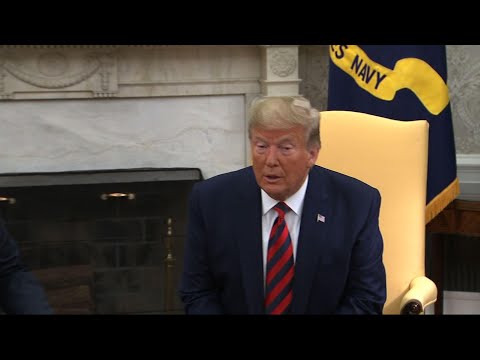
President
Donald Trump is signaling that he’s not inclined to authorize an
immediate military strike on Iran in response to the attacks on the
Saudi oil industry, saying he believes showing restraint “shows far more
strength” and he wants to avoid an all-out war.
Trump has laid out new sanctions on the Iranian central bank.
Trump
spoke just before he gathered his national security team at the White
House to discuss how to respond to the weekend drone and missile attack
on oil facilities in Saudi Arabia. He left the door open a bit for a later military response, saying people
thought he’d attack Iran “within two seconds.” But he says he has
“plenty of time.”
President Donald Trump gets heat for urging Ukraine probe
WASHINGTON (AP) — President Donald Trump urged
the new leader of Ukraine this summer to investigate the son of former
Vice President Joe Biden, a person familiar with the matter said.
Democrats condemned what they saw as a clear effort to damage a
political rival, now at the heart of an explosive whistleblower
complaint against Trump.
It was the latest
revelation in an escalating controversy that has created a showdown
between congressional Democrats and the Trump administration, which has
refused to turn over the formal complaint by a national security
official or even describe its contents.
Trump
defended himself Friday against the intelligence official’s complaint,
angrily declaring it came from a “partisan whistleblower,” though he
also said he didn’t know who had made it. The complaint was based on a
series of events, one of which was a July 25 call
between Trump and Ukrainian President Volodymyr Zelenskiy, according to
a two people familiar with the matter. The people were not authorized
to discuss the issue by name and were granted anonymity.
Trump,
in that call, urged Zelenskiy to probe the activities of potential
Democratic rival Biden’s son Hunter, who worked for a Ukrainian gas
company, according to one of the people, who was briefed on the call.
Trump did not raise the issue of U.S. aid to Ukraine, indicating there
was not an explicit quid pro quo, according to the person.

In
an interview with Ukrainian outlet Hromadske published Friday evening,
Ukrainian Foreign Minister Vadym Prystaiko said that his country is not
interested in taking sides in U.S. politics, but that Zelenskiy has the
right to keep the contents of his conversation with Trump secret. He
noted, however, that U.S. investigators have every right to uncover the
information at their end.
“I know what the
conversation was about and I do not think there was any pressure (from
Trump),” Prystaiko told Hromadske. “There was a conversation, different
conversation, leaders have the right to discuss any existing issues.
This was a long and friendly conversation that touched on a lot of
issues, sometimes requiring serious answers.”
Biden
reacted strongly late Friday, saying that if the reports are true,
“then there is truly no bottom to President Trump’s willingness to abuse
his power and abase our country.” He said Trump should release the
transcript of his July phone conversation with Zelenskiy “so that the
American people can judge for themselves.”
The
government’s intelligence inspector general has described the
whistleblower’s Aug. 12 complaint as “serious” and “urgent.” But Trump
dismissed it all Friday, insisting “it’s nothing.” He scolded reporters
for asking about it and said it was “just another political hack job.”
“I
have conversations with many leaders. It’s always appropriate. Always
appropriate,” Trump said. “At the highest level always appropriate. And
anything I do, I fight for this country.”
Trump, who took questions in the Oval Office alongside Australian Prime Minister Scott Morrison, whom he was hosting
for a state visit, was asked if he knew if the whistleblower’s
complaint centered on his July 25 phone call with Ukrainian President
Zelenskiy. The president responded, “I really don’t know,” but he
continued to insist any phone call he made with a head of state was
“perfectly fine and respectful.”
Trump
was asked Friday if he brought up Biden in the call with Zelenskiy, and
he answered, “It doesn’t matter what I discussed.” But then he used the
moment to urge the media “to look into” Biden’s background with
Ukraine.
There has yet to be any evidence of any wrongdoing by Biden or his son regarding Ukraine.
Trump
and Zelenskiy are to meet on the sidelines of the United Nations next
week. The Wall Street Journal first reported that Trump pressed
Zelenskiy about Biden.
The standoff with
Congress raises fresh questions about the extent to which Trump’s
appointees are protecting the Republican president from oversight and,
specifically, whether his new acting director of national intelligence,
Joseph Maguire, is working with the Justice Department to shield the
president.
Democrats say the administration
is legally required to give Congress access to the whistleblower’s
complaint, and Rep. Adam Schiff of California has said he will go to
court in an effort to get it if necessary.
The
intelligence community’s inspector general said the matter involves the
“most significant” responsibilities of intelligence leadership.
House Democrats also are fighting the administration for access to witnesses and documents in impeachment probes.
In the whistleblower
case, lawmakers are looking into whether Trump lawyer Rudy Giuliani
traveled to Ukraine to pressure the government to aid the president’s
reelection effort by investigating the activities of Biden’s son.
During
a rambling interview Thursday on CNN, Giuliani was asked whether he had
asked Ukraine to look into Biden. He initially said, “No, actually I
didn’t,” but seconds later he said, “Of course I did.”
Giuliani
has spent months trying to drum up potentially damaging evidence about
Biden’s ties to Ukraine. He told CNN that Trump was unaware of his
actions.
“I did what I did on my own,” he said. “I told him about it afterward.
Still
later, Giuliani tweeted, “A President telling a Pres-elect of a well
known corrupt country he better investigate corruption that affects US
is doing his job.” Democrats have contended that Trump, in the aftermath
of special counsel Robert Mueller’s Russia investigation, may have
asked for foreign assistance in his upcoming reelection bid.
Trump
further stoked those concerns earlier this year in an interview when he
suggested he would be open to receiving foreign help.
The
inspector general appeared before the House intelligence committee
behind closed doors Thursday but declined, under administration orders,
to reveal to members the substance of the complaint.
Schiff,
a California Democrat, said Trump’s attack on the whistleblower was
disturbing and raised concerns that it would have a chilling effect on
other potential exposers of wrongdoing. He also said it was “deeply
disturbing” that the White House appeared to know more about the
complaint than its intended recipient -- Congress.
The information “deserves a thorough investigation,” Schiff said. “Come hell or high water, that’s what we’re going to do.”
Among
the materials Democrats have sought is a transcript of Trump’s July 25
call with Zelenskiy. The call took place one day after Mueller’s
faltering testimony to Congress effectively ended the threat his probe
posed to the White House. A readout of the call released from the
Ukrainian government said Trump believed Kyiv could complete corruptions
investigations that have hampered relations between the two nations but
did not get into specifics.
Sen. Chris
Murphy of Connecticut, who in May called for a probe of Giuliani’s
effort in Ukraine, said in an interview on Friday it’s “outrageous” the
president has been sending his political operative to talk to Ukraine’s
new president. Murphy tweeted that during his own visit it was clear to
him that Ukraine officials were “worried about the consequences of
ignoring Giuliani’s demands.”
The senator
tweeted that he told Zelenskiy during their August visit it was “best to
ignore requests from Trump’s campaign operatives. He agreed.”
House
Speaker Nancy Pelosi said Trump faces “serious repercussions” if
reports about the complaint are accurate. She said it raises “grave,
urgent concerns for our national security.”
Letters
to Congress from the inspector general make clear that Maguire
consulted with the Justice Department in deciding not to transmit the
complaint to Congress in a further departure from standard procedure.
It’s unclear whether the White House was also involved, Schiff said.
Maguire
has refused to discuss details of the whistleblower complaint, but he
has been subpoenaed by the House panel and is expected to testify
publicly next Thursday. Maguire and the inspector general, Michael
Atkinson, also are expected next week at the Senate intelligence
committee.
Atkinson wrote in letters that
Schiff released that he and Maguire had hit an “impasse” over the acting
director’s decision not to share the complaint with Congress. Atkinson
said he was told by the legal counsel for the intelligence director that
the complaint did not actually meet the definition of an “urgent
concern.” And he said the Justice Department said it did not fall under
the director’s jurisdiction because it did not involve an intelligence
professional.
Atkinson said he disagreed
with that Justice Department view. The complaint “not only falls under
DNI’s jurisdiction,” Atkinson wrote, “but relates to one of the most
significant and important of DNI’s responsibilities to the American
people.”
___
Associated
Press writers Deb Riechmann, Eric Tucker, Alan Fram and Mary Clare
Jalonick in Washington, D.C., and Matthew Bodner in Moscow contributed
to this report.
Jim Jordan, Mark Meadows, others in GOP blast 'whistleblower' case as 'highly partisan'
Republicans in Congress defended President Trump on
Friday after a report said a "whistleblower" filed a complaint over an
apparent July phone call between the president and the leader of
Ukraine, blasting the allegations as "highly partisan."
“It’s not like we haven’t seen this movie before," U.S. Rep. Jim Jordan, R-Ohio, told the Washington Post. "Democrats come out, they’re all spun up, Adam Schiff makes all kinds of statements, and then when the facts come out -- Whoa, different story!
“This seems to be the same kind of deal," Jordan added.
U.S. Rep. Mark Meadows, R-N.C., echoed the idea that such complaints hamper the president in his work.
“It would have a real chilling effect on dialogue between important leaders if they think that every time someone who overhears a conversation that wasn’t even party to the conversation is going to file a whistleblower complaint and it’ll end up on the front page of periodicals across the country,” Meadows said, according to The Post.
Rep. Mike Gallagher, R-Wis., said private phone calls with foreign leaders are part of the president’s job.
“The fact is, the president, to quote John Marshall, is the ‘sole organ’ of U.S. external relations and has to have conversations in confidence with foreign leaders," he said. “There’s no practical way to conduct diplomacy without it.”
The administration is also taking flak for not sharing the complaint with Congress.
Most Republicans avoided commenting on the complaint, and while a few did express concerns, they were limited.
Rep. Patrick Toomey, R-Pa., said it would be “wildly inappropriate” for a president to ask a foreign government to get involved in a U.S. election, but added he isn’t accusing Trump of doing that.
Rep. Chris Stewart, R-Utah, a member of the House Intelligence Committee, broke with Republicans in saying some on his side of the aisle might join Rep. Adam Schiff, D-Calif., in subpoenaing the president's phone records.
“It’s certainly on the table,” he said. “When I say that I want to protect congressional oversight, I really mean that.”
Trump has denied any impropriety and in a Twitter message Friday, he called the unidentified whistleblower "highly partisan," The Post reported.
“It’s not like we haven’t seen this movie before," U.S. Rep. Jim Jordan, R-Ohio, told the Washington Post. "Democrats come out, they’re all spun up, Adam Schiff makes all kinds of statements, and then when the facts come out -- Whoa, different story!
“This seems to be the same kind of deal," Jordan added.
“It’s not like we haven’t seen this movie before. Democrats come out, they’re all spun up, Adam Schiff makes all kinds of statements, and then when the facts come out -- Whoa, different story!"The complaint made by an unnamed intelligence official, reportedly involved Trump asking Ukranian President Volodymyr Zelensky to investigate former Vice President Joe Biden’s son for alleged wrongdoing while the elder Biden was vice president.
— U.S. Rep. Jim Jordan, R-Ohio
U.S. Rep. Mark Meadows, R-N.C., echoed the idea that such complaints hamper the president in his work.
“It would have a real chilling effect on dialogue between important leaders if they think that every time someone who overhears a conversation that wasn’t even party to the conversation is going to file a whistleblower complaint and it’ll end up on the front page of periodicals across the country,” Meadows said, according to The Post.
Rep. Mike Gallagher, R-Wis., said private phone calls with foreign leaders are part of the president’s job.
“The fact is, the president, to quote John Marshall, is the ‘sole organ’ of U.S. external relations and has to have conversations in confidence with foreign leaders," he said. “There’s no practical way to conduct diplomacy without it.”
“The fact is, the president ... has to have conversations in confidence with foreign leaders. There’s no practical way to conduct diplomacy without it.”But he added he’s in favor of transparency.
— Rep. Mike Gallagher, R-Wis.
The administration is also taking flak for not sharing the complaint with Congress.
Most Republicans avoided commenting on the complaint, and while a few did express concerns, they were limited.
Rep. Patrick Toomey, R-Pa., said it would be “wildly inappropriate” for a president to ask a foreign government to get involved in a U.S. election, but added he isn’t accusing Trump of doing that.
Rep. Chris Stewart, R-Utah, a member of the House Intelligence Committee, broke with Republicans in saying some on his side of the aisle might join Rep. Adam Schiff, D-Calif., in subpoenaing the president's phone records.
“It’s certainly on the table,” he said. “When I say that I want to protect congressional oversight, I really mean that.”
Trump has denied any impropriety and in a Twitter message Friday, he called the unidentified whistleblower "highly partisan," The Post reported.
Kirstjen Nielsen cancels Atlantic Festival appearance after backlash from the left: reports
"Cancel culture" appears to have claimed another victim. Former Homeland Security Secretary Kirstjen Nielsen is no longer scheduled to participate in a three-day festival hosted by The Atlantic next week, the publication said Friday.
Several liberal groups are claiming victory, saying they pressured Nielsen to back out of the event.
“We previously announced that we would be interviewing former DHS Sec. Kirstjen Nielsen at @TheAtlanticFest next week. Nielsen's team has let us know that she is no longer able to participate in the interview,” The Atlantic Communications tweeted Friday afternoon.
The magazine maintains Nielsen was the one to cancel the scheduled appearance.
The announcement came following backlash from a progressive grassroots group called CREDO Action, which claimed "Public pressure from thousands of CREDO members and grassroots activists forced Kirstjen Nielsen to withdraw from the Atlantic Fest, which is a huge victory and should set a precedent for not putting profits over morals when it comes to Trump administration alumni."
Credo Action campaign director Nicole Regalado, told The Hill "No one from Trump's administration should get a soft landing to sanitize their actions while supporting and pushing forward a white nationalist, fascist agenda."
The Atlantic’s Tuesday news release also said House Speaker Nancy Pelosi, a Democrat, and Disney CEO Bob Iger would be interviewed onstage during the festival, set to be held in Washington, Tuesday through Thursday.
"Glad she's not getting this platform to rehabilitate her image, but she shouldn't have ever been invited," Bend the Arc: Jewish Action also tweeted.
In June 2018, an angry mob of socialists heckled Nielsen at a restaurant in Washington, forcing her to leave.
That same month, another group of protesters gathered outside Nielsen's home.
Several liberal groups are claiming victory, saying they pressured Nielsen to back out of the event.
“We previously announced that we would be interviewing former DHS Sec. Kirstjen Nielsen at @TheAtlanticFest next week. Nielsen's team has let us know that she is no longer able to participate in the interview,” The Atlantic Communications tweeted Friday afternoon.
The magazine maintains Nielsen was the one to cancel the scheduled appearance.
"I
wanted to let everyone know that Kirstjen Nielsen's team has let us
know that she is no longer able to participate in TAF [The Atlantic
Festival]," Margaret Low, president of AtlanticLive, wrote in an email
to staff obtained by The Hill.
Two sources familiar with the matter told The Hill that several Atlantic staffers protested the decision to include Nielsen in the festival, but a magazine spokesperson said Nielsen’s “invitation was not rescinded, so that is 100 percent inaccurate."
Liberals take credit
But liberal organizations took credit and also criticized The Atlantic for initially including the former Trump administration immigration official on the festival's set list.The announcement came following backlash from a progressive grassroots group called CREDO Action, which claimed "Public pressure from thousands of CREDO members and grassroots activists forced Kirstjen Nielsen to withdraw from the Atlantic Fest, which is a huge victory and should set a precedent for not putting profits over morals when it comes to Trump administration alumni."
Credo Action campaign director Nicole Regalado, told The Hill "No one from Trump's administration should get a soft landing to sanitize their actions while supporting and pushing forward a white nationalist, fascist agenda."
'Public backlash' threatened
The
group also threatened that the media and corporations should think
twice before giving a platform to “people who worked hand-in-hand with
Trump to separate families, lock babies up in cages, and terrorize
communities of color."
"Public backlash will be swift and powerful for anyone who tries to help rehabilitate the reputations of Trump's top henchmen," CREDO Action said in a statement, according to Common Dreams.
"Public backlash will be swift and powerful for anyone who tries to help rehabilitate the reputations of Trump's top henchmen."The Atlantic had announced earlier this week that Nielsen would be interviewed during the three-day The Atlantic Festival on “the Trump administration’s immigration policy, which she implemented as Secretary of the Department of Homeland Security.”
— CREDO Action statement
The Atlantic’s Tuesday news release also said House Speaker Nancy Pelosi, a Democrat, and Disney CEO Bob Iger would be interviewed onstage during the festival, set to be held in Washington, Tuesday through Thursday.
Other current and
former Trump administration officials remain on the guest list. Jim
Mattis, who served a tumultuous two years as Trump's defense secretary
before he was fired, is scheduled to speak, as is current Health and
Human Services Secretary Alex M. Azar II.
Liberal groups on Twitter also took aim at The Atlantic and pointed to Nielsen’s record of perceived offenses against immigrants.
"Kirstjen Nielsen, you don't get to separate families, cause long-lasting trauma to our kids, and think you can walk away scot-free," Vote Latino, a voter advocacy group, said on Twitter. "We will not forget the harm you've caused to our community. You don't get to rehabilitate your image."
"Good—but she never should have been invited in the first place," daily kos author Gabe Ortiz said.
"Nielsen's role in implementing the administration's inhumane family
separation policy will be remembered as one of the darkest times in
modern U.S. history."Liberal groups on Twitter also took aim at The Atlantic and pointed to Nielsen’s record of perceived offenses against immigrants.
"Kirstjen Nielsen, you don't get to separate families, cause long-lasting trauma to our kids, and think you can walk away scot-free," Vote Latino, a voter advocacy group, said on Twitter. "We will not forget the harm you've caused to our community. You don't get to rehabilitate your image."
"Glad she's not getting this platform to rehabilitate her image, but she shouldn't have ever been invited," Bend the Arc: Jewish Action also tweeted.
Past confrontations
Before she left the Trump administration in April, Nielsen was the target of several public confrontations waged by critics of President Trump's immigration policies.In June 2018, an angry mob of socialists heckled Nielsen at a restaurant in Washington, forcing her to leave.
That same month, another group of protesters gathered outside Nielsen's home.
Other Republicans who have been confronted in public include former White House press secretary Sarah Sanders and Senate Majority Mitch McConnell and his wife, Transportation Secretary Elaine Chao.
Also on the guest list at The Atlantic Festival: former Obama national security adviser Susan Rice; former California Gov. Arnold Schwarzenegger; YouTube CEO Susan Wojcicki; NBA Commissioner Adam Silver; Michele Roberts, executive director of the National Basketball Players Association; CEO and executive editor of Rappler Maria Ressa; and "Tonight Show" musician Questlove.
Friday, September 20, 2019
Kennedy mystique could factor into Massachusetts Senate race
BOSTON
(AP) — When Edward M. Kennedy was running for the U.S. Senate for the
first time in 1962, his Democratic primary opponent turned to him during
a debate and said if his last name was Moore — Kennedy’s middle name —
his “candidacy would be a joke.”
Fortunately
for Kennedy, he shared a last name with his brother John F. Kennedy —
then the U.S. president — and went on to win the Senate seat he held for
the next 47 years.
More than half a century
later another Kennedy — U.S. Rep. Joe Kennedy III — is testing the
staying power of his family’s political mystique in a state that’s
nearly synonymous with the Kennedy clan as he prepares to launch a
Democratic primary challenge against incumbent U.S. Sen. Edward Markey.
Kennedy is expected to formally announce his decision Saturday morning in Boston. If successful, he would be the fourth member of the Kennedy family to win a seat in the Senate.
It’s
a battle that assesses not only the post-Camelot strength of the
Kennedys but also whether the 38-year-old congressman can join the ranks
of a changing Democratic party that has rewarded younger politicians
like Alexandria Ocasio-Cortez of New York and Ayanna Pressley of
Massachusetts for successfully challenging incumbent Democratic members
of the U.S. House.
Last year, underscoring
how Kennedy’s star has been rising, he was tapped to deliver the
Democratic response to President Donald Trump’s State of the Union
address.
While his name is undoubtedly an
asset — he’s the grandson of Robert F. Kennedy and son of former U.S.
Rep. Joe Kennedy II — many of those watching the budding contest say
Kennedy, who has served in Congress since 2013, still needs to make a
convincing case to voters.
“Of course people
in Massachusetts know the Kennedy name, but it’s largely historical at
this point,” said Mary Anne Marsh, a Democratic strategist in
Massachusetts. Marsh noted that Edward Kennedy died a decade ago.
Marsh
credited the younger Kennedy for working hard to win his House seat —
shaking hands, traveling throughout the district and listening to voters
— and said that work appears to be paying off as he weighed a run for
Senate, noting two recent polls that showed Kennedy ahead of the
73-year-old Markey.
Marsh also said the
single biggest goal Democrats have in the coming election — defeating
Trump and undoing his legacy — may play to Kennedy’s perceived strengths
if he can bring a sense of urgency to the race. That message may be a
tougher sell from Markey, she said.
“This
election cycle is so different. The test isn’t what your name is and
where you come from but what you can do to stop Donald Trump,” Marsh
said. “For Markey, the good news is that he has a long record over 40
years, and the bad news is that he has a long record over 40 years and
he’s still working on some of those issues.”
Others see a tighter contest between the two, despite the Kennedy legacy.
Erin
O’Brien, an associate professor of political science at the University
of Massachusetts-Boston, cautions against counting Markey out, pointing
to what she said is a generational split among the electorate. Older
voters may have an emotional connection to the Kennedy clan that younger
voters don’t share.
“Younger Democrats care
more about the environment and climate change,” she said. “At least
initially they’re rallying around Ed Markey.”
O’Brien
said that Kennedy — unlike U.S. Reps. Seth Moulton and Pressley, who
also defeated Democratic incumbents in Massachusetts — has yet to come
up with a strong argument about why voters should dump Markey.
“He
is trying to capitalize on squad energy when he has no authenticity to
be a member of the squad,” she said, referring to a group of four
Democratic members of the U.S. House including Rashida Tlaib of
Michigan, Ilhan Omar of Minnesota, Pressley and Ocasio-Cortez.
By
challenging Markey directly rather than waiting for an open seat,
Kennedy also avoids having to run in a crowded primary, which could
include other members of the state’s congressional delegation.
Unlike
Kennedy, Markey didn’t inherit a famous political name. His father
drove a milk truck and he was the first in his family to get a college
degree.
He had been trying to shore up his
political support before Kennedy’s announcement. Markey has been quick
to point to the endorsement of his campaign by fellow Sen. Elizabeth
Warren. Warren, who taught Kennedy at Harvard Law School, endorsed
Markey in February. She’s spoken highly of both candidates.
Equally
important for Markey as he tries to woo younger and more liberal
Democrats may be his endorsement by Ocasio-Cortez, who teamed up with
Markey early on to push the “Green New Deal” climate change initiative.
It’s
unusual for an incumbent senator to have a serious primary challenge,
and most recently, it’s happened far more to Republicans.
Markey
already faces two lesser-known candidates: Shannon Liss-Riordan, a
workers’ rights lawyer, and Steve Pemberton, a former senior executive
at Walgreens.
Given that there are few
strong ideological divides between the two candidates, voters may end up
choosing sides quickly, said John Cluverius, associate director of the
UMass Lowell Center for Public Opinion.
“This
primary isn’t about substance or even style, really. It’s shaping up to
be a ‘Seinfeld’ primary: In most ways, it’s about nothing, but it’s
going to deeply divide people strongly attached to one side or the
other,” he said.
Google plans to invest 3 billion euros in Europe
COPENHAGEN,
Denmark (AP) — Google’s top boss said Friday the tech giant is planning
to invest 3 billion euros to expand its data centers across Europe in
the next two years.
Chief executive Sundar
Pichai says it will bring the company’s total investments in the
continent’s internet infrastructure to 15 billion euros since 2007.
Pichai
met with Finnish Prime Minister Antii Rinne on Friday in Helsinki and
said the investments will support 13,000 full-time jobs in the European
Union every year.
He also noted that Google
is investing heavily in renewable energy, an initiative announced ahead
of global rallies calling for action to guard against climate change.
Employees at Google and other big U.S. tech companies such as Amazon and
Microsoft planned to participate in the “global climate strike” Friday.
The
Google project will include the construction of more than 1 billion
euros in new energy infrastructure in the EU, among them a new offshore
wind project in Belgium, five solar energy projects in Denmark, and two
wind energy projects in each Sweden and Finland. There are also projects
in the U.S. and South America.
Pichai said
that once these projects come online, Google’s carbon-free energy
portfolio will produce more electricity than places like Washington D.C.
or entire countries like Lithuania or Uruguay use each year.
Iraq’s stability on the line as US, Iran tensions soar
BAGHDAD
(AP) — As the United States and Israel escalate their push to contain
Iranian influence in the Middle East, countries in Tehran’s orbit are
feeling the heat.
Pro-Iranian militias
across Lebanon, Syria and Iraq are being targeted, both with economic
sanctions and precision airstrikes hitting their bases and
infrastructure. This is putting the governments that host them in the
crosshairs of an escalating confrontation and raising the prospect of
open conflict.
Nowhere is that being felt
more than in Iraq. It is wedged between Saudi Arabia to the south and
Iran to the east and hosts thousands of U.S. troops on its soil. At the
same time, powerful Shiite paramilitary forces linked to Iran pose a
growing challenge to the authority of the central government.
As
the pressure mounts, divisions within Iraq’s pro-Iranian factions have
burst into the open, threatening to collapse a fragile government
coalition and end a rare reprieve from the violence that has plagued the
country for years.
“Regional challenges
facing Iraq will make it even more difficult for Adel Abdel-Mahdi to
bring the (militias) under control,” said Randa Slim, a senior fellow at
the Washington-based Middle East Institute, referring to Iraq’s prime
minister.
The divisions among Iran’s Shiite
allies in Iraq have been spurred by a spate of airstrikes blamed on
Israel that have hit weapons depots and bases belonging to the
Iran-backed militias, known collectively as the Popular Mobilization
Forces, or PMF.
There have been at least
nine strikes since July both inside Iraq and across the border in Syria,
sparking outrage among PMF leaders. They blame Israel and by extension
its U.S. ally, which maintains more than 5,000 troops in Iraq.
Israel
has not confirmed its involvement in the attacks, and U.S. officials
have said Israel was behind at least one strike inside Iraq.
The
attacks have fueled calls for a U.S. troop withdrawal by hard-line
anti-American groups in the country that have strong ties to Iran.
“The
Americans are hostage here ... If war breaks out, they will all be
hostages of the resistance factions,” said Abu Alaa al-Walae, secretary
general of the Sayyed al-Shuhada Brigades, one of the prominent militia
factions with strong ties to Iran. He spoke in a televised interview
this week.
Such bellicose talk is deeply
embarrassing for Iraq’s prime minister, who has struggled to balance his
country’s alliance with both the U.S., which was invited back by the
Baghdad government to help fight the Islamic State group, and Iran,
which is Iraq’s most important trading partner. As the crisis over
Tehran’s unraveling nuclear deal with world powers has escalated over
the past months, that position is becoming increasingly untenable.
This
week, there was a sense of foreboding following an attack by drones and
cruise missiles on key Saudi Arabian oil installations. Yemen’s Houthi
rebels claimed it was in response to the yearslong Saudi-led war there,
but U.S. and Saudi officials said it was launched from the north. Iran
and Iraq lie to the north of Saudi Arabia, while Yemen is in the south.
Iraq’s
government was quick to deny that the attack originated from Iraqi
territory, a claim that was later said to have been confirmed by
Secretary of State Mike Pompeo in a phone call with Abdel-Mahdi.
The
episode, however, demonstrated the Iraqi government’s tentative hold
over the militias and raised questions about what they might do if the
U.S. starts bombing Iran, for instance. Qassem Soleimani, head of Iran’s
elite Quds Force and the architect of its regional entrenchment, met
this week with Iraqi Shiite politicians and PMF leaders in Baghdad,
apparently to discuss scenarios.
A directive
issued by Iraq’s prime minister in July integrating and placing
Iranian-backed militias under the command of the state’s security
apparatus forces by July 31 has so far not been implemented.
Instead,
PMF billboards reading “Death to America” have popped up between lanes
of traffic in central Baghdad, following allegations of Israeli
involvement in the series of airstrikes. One poster bears a picture of
what looks like the ghost of the Statue of Liberty wearing a black hood.
“America is the reason for insecurity and instability in the region,”
it reads.
Meanwhile, divisions within the
PMF’s leadership have surfaced in public, which is likely to exacerbate
tensions. The head of the PMF, Faleh al-Fayyadh, has twice clashed with
his deputy, Abu Mahdi al-Muhandis, in the past month, including when he
walked back a statement by al-Muhandis in which he held the U.S.
responsible for the spate of attacks on PMF bases.
The
PMF is headed by al-Fayyadh but practically run by al-Muhandis, a
military commander who has been designated a terrorist by Washington.
Both men are firmly in Iran’s camp. Soleimani met with both men this
week, a senior politician told The Associated Press.
Earlier
this month, a document attributed to al-Muhandis was circulated in
which he ordered the formation of a PMF air force directorate and the
appointment of Salah Mahdi Hantous, who’s been on a U.S. sanctions list
since 2012, as its chief. In a statement published on its website, the
PMF later denied the report.
The document
nonetheless angered Shiite politicians including the powerful cleric
Moqtada al-Sadr, who tweeted that a PMF air force would spell the end of
the Iraqi government and turn Iraq into a “rogue state.” Days later, he
flew to Iran and held a meeting with Iran’s supreme leader Ayatollah
Ali Khamenei.
Iraq’s top Shiite cleric,
Grand Ayatollah Ali al-Sistani, whose 2014 religious decree calling for
volunteer fighters against the Islamic State gave rise to the PMF, views
these militias’ growing political and economic influence with suspicion
and has pushed for Abdel-Mahdi’s directive to be implemented.
In
surprisingly blunt comments, al-Sistani’s representative in Beirut,
Hamid al-Khafaf, said progress in Iraq hinges on bringing all arms under
state control.
Political analyst Hisham
al-Hashemi said the current power struggle among Iraq’s Shiite militias
is between PMF factions that support the state, and those whose loyalty
rests more with Iran.
He questioned the government’s ability to impose its authority on PMF factions.
Referring
to the removal earlier this year of blast walls that snaked through the
city to protect from suicide car bombs, he said: “The Iraqi government,
which removed the concrete blocks from around Baghdad, is unable to
remove the signs of ‘death to Israel and America.’”
___
Karam reported from Beirut.
US military to present Trump with several options on Iran
WASHINGTON
(AP) — The Pentagon will present a broad range of military options to
President Donald Trump on Friday as he considers how to respond to what
administration officials say was an unprecedented Iranian attack on
Saudi Arabia’s oil industry.
In a White
House meeting, the Republican president will be presented with a list of
potential airstrike targets inside Iran, among other possible
responses, and he will be warned that military action against the
Islamic Republic could escalate into war, according to U.S. officials
familiar with the discussions who spoke on the condition of anonymity.
The
national security meeting will likely be the first opportunity for a
decision on how the U.S. should respond to the attack on a key Middle
East ally. Any decision may depend on what kind of evidence the U.S. and
Saudi investigators are able to provide proving that the cruise missile
and drone strike was launched by Iran, as a number of officials, including Secretary of State Mike Pompeo, have asserted.
Iran has denied involvement and warned the U.S. that any attack will spark an “all-out war” with immediate retaliation from Tehran.
Pompeo
and Vice President Mike Pence have condemned the attack on Saudi oil
facilities as “an act of war.” Pence said Trump will “review the facts,
and he’ll make a decision about next steps. But the American people can
be confident that the United States of America is going to defend our
interest in the region, and we’re going to stand with our allies.”
The
U.S. response could involve military, political and economic actions,
and the military options could range from no action at all to airstrikes
or less visible moves such as cyberattacks. One likely move would be
for the U.S. to provide additional military support to help Saudi Arabia
defend itself from attacks from the north, since most of its defenses
have focused on threats from Houthis in Yemen to the south.
Gen.
Joseph Dunford, chairman of the Joint Chiefs of Staff, emphasized to a
small number of journalists traveling with him Monday that the question
of whether the U.S. responds is a “political judgment” and not for the
military.
“It is my job to provide military options to the president should he decide to respond with military force,” Dunford said.
Trump
will want “a full range of options,” he said. “In the Middle East, of
course, we have military forces there and we do a lot of planning and we
have a lot of options.”
U.S.
Rep. Elissa Slotkin, D-Mich., said in an interview Thursday that if
Trump “chooses an option that involves a significant military strike on
Iran that, given the current climate between the U.S. and Iran, there is
a possibility that it could escalate into a medium to large-scale war, I
believe the president should come to Congress.”
Slotkin,
a former top Middle East policy adviser for the Pentagon, said she
hopes Trump considers a broad range of options, including the most basic
choice, which would be to place more forces and defensive military
equipment in and around Saudi Arabia to help increase security.
A
forensic team from U.S. Central Command is pouring over evidence from
cruise missile and drone debris, but the Pentagon said the assessment is
not finished. Officials are trying to determine if they can get
navigational information from the debris that could provide hard
evidence that the strikes came from Iran.
Pentagon
spokesman Jonathan Hoffman said Thursday that the U.S. has a high level
of confidence that officials will be able to accurately determine
exactly who launched the attacks last weekend.
U.S.
officials were unwilling to predict what kind of response Trump will
choose. In June, after Iran shot down an American surveillance drone,
Trump initially endorsed a retaliatory military strike then abruptly
called it off because he said it would have killed dozens of Iranians.
The decision underscores the president’s long-held reluctance to embroil
the country in another war in the Middle East.
Instead,
Trump opted to have U.S. military cyber forces carry out a strike
against military computer systems used by Iran’s Revolutionary Guard to
control rocket and missile launchers, according to U.S. officials.
The
Pentagon said the U.S. military is working with Saudi Arabia to find
ways to provide more protection for the northern part of the country.
Air
Force Col. Pat Ryder, spokesman for the Joint Chiefs of Staff, told
Pentagon reporters Wednesday that U.S. Central Command is talking with
the Saudis about ways to mitigate future attacks. He would not speculate
on what types of support could be provided.
Other
U.S. officials have said adding Patriot missile batteries and enhanced
radar systems could be options, but no decisions have been made.
Subscribe to:
Comments (Atom)
-
How many times do we need to say this? If you’re here illegally and get caught, you’re going back. It’s the la...
-
The problem with the courts is the same as the problem with many of our other institutions. Called the Skins...
-
CNN’s Scott Jennings once again took liberals to the cleaners on the Abrego Garcia case, the ‘Maryland man...