Nearly 200 leaders from around the world are flocking to New York
City this week for the United Nations General Assembly. The annual
gathering, referred to as UNGA, takes place Monday through Friday at
United Nations headquarters.
While the event is themed around “poverty eradication, quality
education, climate action and inclusion,” many are expecting U.S. policy
to also take center stage.
Iranian President Hassan Rouhani, Ukrainian President Volodymyr
Zelensky, and Afghani President Ashraf Ghani are all expected to attend.
Their attendance means everything from rising tension in the Middle
East to concern about a so-called whistleblower complaint may be up for
discussion.
While speaking ahead of the event Sunday, President Trump said
“nothing is ever off the table” when asked whether he will be meeting
with Iran.
“Nothing’s ever off the table completely, but I have no intention of
meeting with Iran,” he stated. “That doesn’t mean it doesn’t happen…I’m a
very flexible person, but we have no intention.”
President
Donald Trump talks with reporters on the South Lawn of the White House
in Washington, Sunday, Sept. 22, 2019, as he prepares to board Marine
One for the short trip to Andrews Air Force Base. (AP Photo/Susan Walsh)
When asked about the whistleblower leak, President Trump said foreign leaders should have a right to privacy.
“The problem is when you’re speaking to foreign leaders, you don’t
want foreign leaders to feel that they shouldn’t be speaking openly and
you have to be talking to people, and the same thing for an American
president,” he explained. “You want them to be able to express
themselves without knowing that not every single word is going to be
going out and going out all over the world.”
This comes ahead of planned talks between President Trump and the
leader of Ukraine, which are expected to take place sometime on or
before Wednesday.
In regard to Afghanistan, President Trump will come face-to-face with
President Ashraf Ahani just weeks after the collapse of U.S.-Taliban
peace talks. Negotiations fell apart earlier this month due a surge in
violence from the insurgent group.
No official meetings between President Trump and Iran or Afghanistan
have been scheduled, however, all eyes are expected to remain on the
General Assembly as talks may unfold on the sidelines. Moving forward,
President Trump is only slated to attend Monday through Wednesday.
President Donald Trump speaks during a meeting with Polish President
Andrzej Duda at the InterContinental Barclay hotel during the United
Nations General Assembly, Monday, Sept. 23, 2019, in New York. (AP
Photo/Evan Vucci)
President Trump is calling out former Vice President Joe Biden, while
continuing to highlight alleged corruption by the Democrat regarding
Ukraine.
While speaking at the United Nations Monday, the president said he
had a perfect phone call with the president of Ukraine and called
Democrat speculation over it a “witch hunt.” He also said the one who
has the problem is Biden, and noted it’s very important to talk about
corruption.
..Breaking News: The Ukrainian Government just
said they weren’t pressured at all during the “nice” call. Sleepy Joe
Biden, on the other hand, forced a tough prosecutor out from
investigating his son’s company by threat of not giving big dollars to
Ukraine. That’s the real story!
“Biden did what they would like to
have me do except that one problem, I didn’t do it. What Biden did is a
disgrace. What his son did is a disgrace. The son took money from
Ukraine, the son took money from China. A lot of money from China. China
would love to see, they could think of nothing they’d rather see than
Biden get in because they will take this great deal that we’re about to
make and they would really have themselves a deal.”
— President Trump
The president also said he thinks we’re going to see much more honesty from Ukraine with the new president.
UNITED NATIONS (AP) — Navigating a troubled
era’s choppy waters, world leaders gather for their annual meeting at
the United Nations on Tuesday to grapple with climate change, regional
conflicts and a dispute in the Middle East that could ripple across the
entire planet.
U.N. Secretary-General
Antonio Guterres will open the General Assembly proceedings with a
“state of the world” speech. He’ll be followed immediately by the
traditional first speaker — Brazil, represented by its new president,
Jair Bolsonaro — and the United States, represented by President Donald
Trump.
The United Nations, designed to
promote a multilateral world, has struggled in the face of increasing
unilateralism by the United States and other nations that favor going it
alone over the brand of collaboration that the global body advocates.
The
event unfolds against the backdrop of flaring tensions between Iran and
Saudi Arabia, backed by its longtime supporter, the United States. The
Saudis say Iran was responsible for an attack earlier this month on two
oil facilities, which Iran denies.
The Trump
administration, no fan of the Iranian government, has been engaged in
an escalating series of harsh words and threats with Tehran. The U.S.
has imposed increasingly crippling sanctions.
Iranian President Hassan Rouhani, who is in New York, is scheduled to address world leaders on Wednesday.
This
year’s General Assembly session, which starts Tuesday and ends Sept.
30, has attracted world leaders from 136 of the 193 U.N. member nations.
That large turnout reflects a growing global focus on addressing
climate change and the perilous state of peace and security.
Other
countries will be represented by ministers and vice presidents — except
Afghanistan, whose leaders are in a hotly contested presidential
campaign ahead of Sept. 28 elections, and North Korea, which downgraded
its representation from a minister to, likely, its U.N. ambassador.
Saudi Arabian Crown Prince Mohammed bin Salman and Israeli Prime
Minister Benjamin Netanyahu canceled plans to attend and are sending
ministers.
Last week, Guterres repeated
warnings that “tensions are boiling over.” The world, he said, “is at a
critical moment on several fronts — the climate emergency, rising
inequality, an increase in hatred and intolerance as well as an alarming
number of peace and security challenges.”
UNITED
NATIONS (AP) — President Donald Trump goes before the U.N. General
Assembly on Tuesday to try to square his “America First” approach to
foreign policy with his administration’s hope for a multi-national
response to Iran’s escalating aggression.
While
Trump wants allies to join the U.S. in further isolating Iran, he also
seems to be holding to his go-it-alone strategy of using economic
sanctions to pressure Tehran to give up its nuclear program and stop
attacks that are rattling the Middle East.
On
Monday, the president praised British Prime Minister Boris Johnson’s
call for a new deal to replace the 2015 Iran nuclear pact from which
Trump walked away.
The
president also said he appreciated the efforts of French President
Emmanuel Macron, who has been trying to get Trump back in the deal and
has suggested the American president meet with Iranian President Hassan
Rouhani while both are in New York this week.
But
at the same time, Trump declared: “We’re not looking for any
mediators.” He said that if Iran wants to talk, “they know who to call.”
Both
Trump and Rouhani have said no meeting is on the agenda for this week,
although the U.S. leader left some wiggle room, adding, “I never rule
anything out.”
Trump was expected to use his
speech to blame Iran for recent strikes against oil facilities in Saudi
Arabia. Iran has denied orchestrating the attack, which Secretary of
State Mike Pompeo has deemed “an act of war.”
Britain,
France and Germany joined the United States on Monday in blaming Iran
for the attacks. Iranian Foreign Minister Mohammad Javad Zarif, for his
part, pointed to claims of responsibility by Yemeni rebels and insisted:
“If Iran were behind this attack, nothing would have been left of this
refinery.”
Trump also is expected to use his address to the General Assembly to address the ongoing standoff in Venezuela.
The
United States and more than a dozen Latin American countries agreed
Monday to investigate and arrest associates and senior officials of the
Venezuelan government of Nicolás Maduro who are suspected of crimes like
drug trafficking, money laundering and financing terrorism.
Trump
is expected to have kinder words for North Korean leader Kim Jong Un,
even though the autocrat continues to hold a tight grip on his nuclear
weapons. Trump has met Kim for summits in Singapore and Hanoi and
orchestrated a surprise encounter with him in June at the Demilitarized
Zone, where he became the first U.S. president to ever set foot in North
Korea.
Trump
said Monday that another meeting with the North Korean leader “could
happen soon.” He provided few details, and it wasn’t clear what
officials were doing behind the scenes to set up a meeting to break the
diplomatic impasse over the North’s development of nuclear-armed
missiles targeting the U.S. mainland.
Trump’s
comments, even with few specifics backing them up, are tantalizing
because there is extreme interest, especially in Japan and South Korea,
in whether Trump and Kim can strike a deal on one of the world’s most
pressing standoffs.
This is Trump’s third
speech to the world body. Senior administration officials, who briefed
reporters about the president’s trip to the U.N. on condition of
anonymity, said that he will use his speech to affirm America’s
leadership role in the international community. That’s something Trump’s
critics claim has been weakened by the president’s solo style and
mercurial rhetoric and actions.
The White
House said Trump will also talk about the need to work collectively
within the global community to address world challenges — although
apparently not climate change.
Trump stopped
in only briefly Monday at a summit where world leaders talked about
doing something to counter climate change. As they met, the globe hit
another mark indicating a warming climate. Arctic sea ice shrank to 1.6
million square miles (4.15 million square kilometers) for the annual
summer low, which tied the second lowest mark on record.
On
Monday night, Trump mocked a teenage activist who gave an impassioned
speech at the United Nations urging world leaders to do more to combat
climate change.
Swedish 16-year-old activist
Greta Thunberg scolded the audience at the U.N. Climate Action Summit
on Monday, repeatedly asking, “How dare you?” Thunberg said: “We are in
the beginning of a mass extinction and yet all you can talk about is
money. You are failing us.”
In a tweet late
Monday, Trump says: “She seems like a very happy young girl looking
forward to a bright and wonderful future. So nice to see!”
In
his speech to the U.N. General Assembly last year, Trump expressed
disdain for globalism and promoted his “America First” agenda. Like last
year, Trump is expected to showcase strong U.S. economic numbers and
talk about how he’s strengthened America’s military.
In
his 2018 speech to the assembly, his self-adulation prompted chuckles
from world leaders. That barely ruffled Trump, who shares a belief with
his supporters that the United States has been asked to do too much for
other countries and needs to focus on issues it faces at home.
NEW YORK (AP) — Faced with growing tumult at
home and abroad, President Donald Trump heads into his three-day visit
to the United Nations this week hoping to lean on strained alliances
while fending off questions about whether he sought foreign help to damage a political rival.
Trump’s
latest U.N. trip comes after nearly three years of an “America First”
foreign policy that has unsettled allies and shredded multinational
pacts.
A centerpiece of this year’s U.N. schedule will be a Monday session on climate change that Trump plans to skip.
Instead,
he will address a meeting about the persecution of religious
minorities, particularly Christians, an issue that resonates with
Trump’s evangelical supporters.
The
president arrived in New York on Sunday against a backdrop of swirling
international tensions, including questions about his relationship with Ukraine
, the uncertain future of Brexit, the U.S. trade war with China,
stalled nuclear negotiations with North Korea and a weakening global
economy.
The most immediate challenge may be Iran.
Trump
will try to convince skeptical global capitals to help build a
coalition to confront Tehran after the United States blamed it for last
week’s strike at a Saudi Arabia oil field.
“Well,
I always like a coalition,” Trump said Friday, before going on to
complain that under the old Iran nuclear deal, “everyone else is making
money and we’re not.”
Trump’s fulfillment of
a campaign promise to exit the Iran nuclear deal has had wide ripple
effects, leading Tehran to bolster its nuclear capabilities and
dismaying European capitals who worked to establish the original
agreement.
French President Emmanuel Macron,
in particular, has been trying to lead Trump back to a deal and has
suggested that the U.S. president meet with Iranian leader Hassan
Rouhani on the sidelines of the U.N. meetings.
Trump said Sunday that while “nothing is ever off the table completely” he had no intention of meeting with Rouhani.
Tensions
between Washington and Tehran spiked after a Saudi Arabia oil field was
partially destroyed in an attack that Secretary of State Mike Pompeo
blamed on Iran and deemed “an act of war.”
Now Trump will try to enlist wary world leaders in a collective effort to contain Iran.
“He
needs to win over traditional allies to do what traditional allies do,
to band together against common threats,” said Jon Alterman of the
Center for Strategic and International Studies. “The attacks last
weekend in Saudi Arabia are precisely the kind of thing that the U.N.
was intended to address, to create rules for international behavior and
opportunities for collective action.”
Ukraine
also looms large on Trump’s schedule. Even one week ago, a one-on-one
meeting with Ukrainian president Volodymyr Zelenskiy would have been
seen largely as an afterthought.
But Trump’s
meeting on Wednesday with Zelenskiy will come just days after
revelations that the president urged his Ukrainian counterpart in a July
phone call to investigate the activities of the son of former Vice
President Joe Biden. Trump said he was concerned about corruption;
Democrats frame his actions as an effort to pressure Zelenskiy to dig up
damaging material on a potential 2020 rival.
That
pressure is the subject of a whistleblower’s complaint that the
administration has refused to turn over to members of Congress, setting
up a showdown with Democrats.
Trump is
defending himself against the intelligence official’s complaint,
asserting that it comes from a “partisan whistleblower,” though the
president also said he doesn’t know the whistleblower’s identity.
He
insisted Sunday his conversation with Zelenskiy was “absolutely
perfect.” But Democrats believe it shows that Trump is emboldened to
seek foreign help for his reelection effort.
There are plenty of other concerns in the mix during Trump’s U.N. visit, including the U.S. trade war with China.
But
China’s Xi Jinping is not expected to attend, nor are several other
prominent world leaders, including Russia’s Vladimir Putin and Israeli
Prime Minister Benjamin Netanyahu.
Among the
nations whose leaders Trump plans to meet in New York: Iraq, Poland,
Egypt, Pakistan, South Korea and Japan. He will also meet with British
Prime Minister Boris Johnson, clinging to power after failed attempts to
steer his nation out of the European Union.
Trump’s
annual address to the General Assembly is scheduled for Tuesday. Two
years ago, he used the moment to deride North Korea’s Kim Jong Un as
“Little Rocket Man” and threaten to destroy North Korea.
A year ago, he drew laughter when he used his speech to recite his administration’s accomplishments.
His
theme this year, according to aides, will be to reassert America’s
determination to uphold its sovereignty and independence, especially on
issues of national security.
But others may push a different path.
“There’s
an attempt to push back against the unilateralism, against the
isolationism, against the populism that has affected not only the United
States but other countries as well,” said Jeffrey Feltman of the
Brookings Institution. “I don’t know how effective this will be, but
it’s an example of how some of our traditional allies are organizing
themselves in response to the feeling that the United States, the U.K.,
that other sort of major engines in the U.N. system no longer are
pressing the accelerator.”
California Rep. Devin Nunes predicted on Fox News' "Sunday Morning Futures" that Joe Biden's campaign is likely coming to an end -- all because of newly resurfaced reports about his possible misconduct in Ukraine that "first originated back when Hillary Clinton was trying to make sure Biden didn’t get in the race."
The top Republican on the House Intelligence Committee made the claim as The Des Moines Register/CNN/Mediacom poll showed Sen. Elizabeth Warren surging ahead of Biden
as the first choice of 22 percent of the voters surveyed, while Biden
was the first choice of 20 percent of the voters. Biden held a 9-point
lead over Warren in the poll as recently as June.
Nunes, speaking
to anchor Maria Bartiromo, said a whistleblower's allegation that
President Trump had acted inappropriately during a July 25 phone call
with Ukrainian President Volodymyr Zelensky will ultimately backfire, and shine a light on Biden's own possible misconduct. CNN later acknowledged that the whistleblower had no first-hand knowledge of the call, and a top Ukrainian official on Saturday defended Trump's actions.
"These
stories first originated back when Hillary Clinton was trying to make
sure Biden didn’t get in the race," Nunes said. "So now that these have
been resurrected, I don’t know who came up with the scheme -- maybe this
whistleblower really is not a partisan. We want to hear from that
whistleblower, but it sure looks like the scheme has backfired. And,
like I said, it looks like this is the end of Biden’s campaign. I really
do... his lead is basically down to zero."
Late Sunday, Trump echoed Nunes' comments, and emphasized that Biden recently bragged
about pressuring Ukraine to fire its top prosecutor when he was vice
president. At the time, the prosecutor was probing a company closely
linked to Biden's son, Hunter.
"Sleepy Joe Biden ... forced a
tough prosecutor out from investigating his son's company by threat of
not giving big dollars to Ukraine," Trump wrote on Twitter. "That's the
real story!"
Nunes said the ever-deepening schism in the
Democratic Party over whether to impeach the president -- highlighted
late Saturday when New York Rep. Alexandria Ocasio-Cortez called it a major "scandal" that Democrats hadn't yet voted to impeach -- would help Trump in 2020.
"The
more I think that they’re out there promoting this kind of craziness
and silliness, the more that the American people are put off, and the
more likely President Trump is reelected,” Nunes added.
There were
parallels, Nunes said, with Democrats' ultimately debunked claims that
the Trump campaign had colluded with Russia to influence the 2016
presidential election.
"This has all the hallmarks of the Russia
hoax," Nunes said. "Something leaks out. ... and then it's the same
reporters that report on it, the same reporters that reported on the
Russia hoax. Then you move forward, and what happens? Then supposedly
they come and testify -- and the night before they testify, the
whistleblower who supposedly doesn't want anybody to know who this
person is, or what information they have, well, it's spilled all over
the pages of the Washington Post" the day before Congress was briefed on
the matter.
"Whoever
came up with this scheme -- it looks like somebody was trying to
deflect what Biden did back in 2015," Nunes said. "This scheme seems to
have backfired on Biden. I mean, Biden's already dropping in the polls."
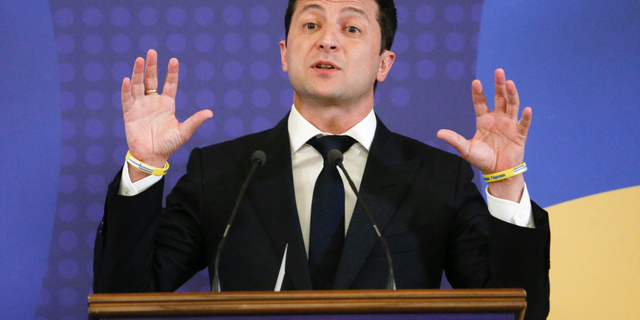
Ukrainian President Volodymyr Zelenskiy, speaks during the
EU-Ukraine summit press conference in Kiev, Ukraine, Monday, July 8,
2019. ( AP Photo/Efrem Lukatsky)
The Wall Street Journal reported Friday that Trump
had repeatedly asked Zelensky to investigate Hunter Biden, the former
vice president's son who had a key role in a natural gas firm that was
being investigated by a Ukrainian prosecutor as part of a corruption
probe.
At a conference two years after he left office, Joe Biden openly boasted about successfully pressuring Ukraine to fire that prosecutor when he was vice president.
Unverified reports circulated on left-leaning media outlets
claiming that Trump could have even promised something improper in
exchange for Ukraine's compliance, although the Journal reported there
was no "quid-pro-quo" involved.
Trump acknowledged Sunday
that he had communicated with Zelensky about Biden, and that the
conversation concerned "the corruption taking place and largely the fact
that we don't want our people like Vice President Biden and his son
[contributing] to the corruption already in the Ukraine." However, the
president and top officials maintained Sunday that nothing inappropriate
occurred on the call.
DNI
Inspector General Michael Atkinson said in a Sep. 9 letter to the House
Intelligence Committee that the whistleblower complaint "appeared
credible" and related to an "urgent" matter. But the DNI general counsel
said days later that, after consulting with the DOJ, the matter did not
meet the legal definition of an “urgent concern," and was not subject
to mandatory disclosure to Congress.
“Furthermore, because the
complaint involves confidential and potentially privileged
communications by persons outside the Intelligence Community, the DNI
lacks unilateral authority to transmit such materials to the
intelligence committees,” Jason Klitenic, the DNI general counsel,
wrote.
Acting Director of National Intelligence Joseph Maguire
will testify before the House Intelligence Committee at an open hearing
on Thursday.
"At that time, we expect him to obey the law and turn
over the whistleblower’s full complaint to the Committee," House
Speaker Nancy Pelosi, D-Calif., said in a statement Sunday
afternoon. "We also expect that he will establish a path for the
whistleblower to speak directly to the House and Senate Intelligence
Committees as required by law."
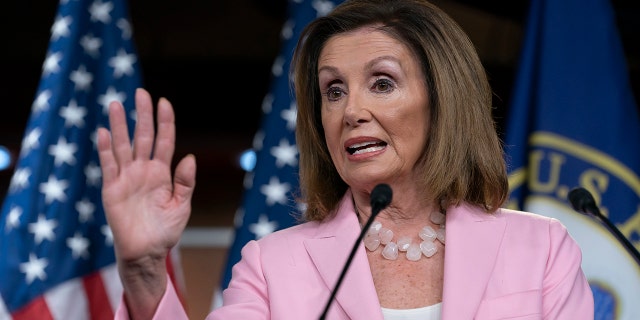
House Speaker Nancy Pelosi, D-Calif., suggested Sunday that
impeachment may be on the table, if certain demands are not met ahead of
Wednesday's whistleblower hearing. (AP Photo/J. Scott Applewhite)
Pelosi also seemingly threatened that she would back
impeachment if her demands were not met, in a potentially major shift to
her wait-and-see approach thus far: "If the Administration persists in
blocking this whistleblower from disclosing to Congress a serious
possible breach of constitutional duties by the President, they will be
entering a grave new chapter of lawlessness which will take us into a
whole new stage of investigation."
Trump's conversation came as
the White House was holding up $250 million in military aid for Ukraine.
The president has said he wants European countries to pay more for
their own defense, and denied delaying any military aid funding.
The
whistleblower's allegation could prompt scrutiny of the Obama
administration's Ukraine policy. Joe Biden has explained on camera that
in March 2016, he privately threatened then-Ukrainian President Petro Poroshenko that the U.S. would withhold $1 billion in loan guarantees from Ukraine if its top prosecutor was not fired.
“I
said, ‘You’re not getting the billion,'" Biden recounted telling
Poroshenko at a Council on Foreign Relations event. "I’m going to be
leaving here in, I think it was about six hours. I looked at them and
said: ‘I’m leaving in six hours. If the prosecutor is not fired, you’re
not getting the money.'"
“Well, son of a b-tch, he got fired,"
Biden continued, after assuring Poroshenko that Obama knew about the
arrangement. "And they put in place someone who was solid at the time.”
It
remained unclear if this was directly tied to the prosecutor's probe
into the company linked to Hunter Biden, as other countries reportedly
wanted the prosecutor out as well.
And earlier this year, The Hill reported
that the U.S. Embassy in Kiev, under the Obama administration, took the
unusual step of pressuring prosecutors there to drop a probe into a
group closely linked to liberal megadonor George Soros.
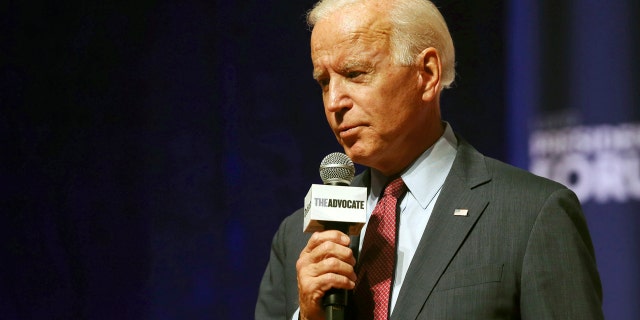
Democratic presidential candidate Joe Biden speaks at an LGBTQ
Presidential Forum in the Sinclair Auditorium on the Coe College campus
in Cedar Rapids, Iowa, Friday, Sept. 20, 2019. (Rebecca F. Miller/The
Gazette via AP)
Then, in April, Ukrainian law enforcement officials said they had a slew of evidence of collusion and wrongdoing by Democrats, and that they have been trying to share this information with U.S. officials in the Justice Department.
A 2017 investigation by Politico found
that Ukrainian officials not only publicly sought to undermine Trump by
questioning his fitness for office, but also worked behind the scenes
to secure a Clinton victory. Trump told Fox News that the allegations of possible Clinton-Ukraine collusion were "big" and vowed they would be reviewed by the DOJ.
Additionally, attention focused anew on President Obama's hot-mic comment to then-Russian President Dmitry Medvedev at
a nuclear disarmament summit in March 2012, in which Obama was
overheard saying he would have more "flexibility" to negotiate with
Russia after the November 2012 election.
"The longer we talk about
what the Bidens did in Ukraine, the better," said Barry Bennett, a
former Trump campaign adviser, who dismissed those who believe Trump
will pay a political price for the latest controversy.
Meanwhile, Biden on
Saturday denied he has ever spoken to Hunter about his business in
Ukraine and called Trump's actions an "overwhelming abuse of power."
“Trump’s
doing this because he knows I’ll beat him like a drum, and he’s using
the abuse of power and every element of the presidency to try to do
something to smear me,” Biden told reporters in Iowa.
But Trump, on Sunday, pointed out that Biden's claim was seemingly inaccurate. Hunter Biden told the New Yorker previously that he and his father had spoken “just once” about it.
“And now he made a lie when he said he never spoke to his son,” Trump said. “Of course you spoke to your son!”
Trump
added: "No quid pro quo, there was nothing. It was a perfect
conversation. ... The conversation I had was largely congratulatory,
with largely corruption, all of the corruption taking place and largely
the fact that we don't want our people like Vice President Biden and his
son creating the corruption already in the Ukraine and Ukraine has got a
lot of problems. The new president is saying that he's going to be able
to rid the country of corruption, and I said that would be a great
thing, we had a great conversation."
Trump went on to say the
latest allegations are "just as ridiculous as the others," branding it
"the Ukraine Witch Hunt" — a nod to former Special Counsel Robert
Mueller's Russia probe.
"Will fail again!" Trump tweeted. Fox News' Ronn Blitzer, Fox Business Network's Maria Bartiromo and The Associated Press contributed to this report.
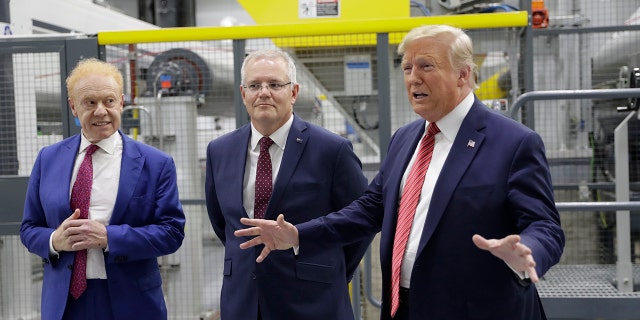
President Trump visited Ohio, a state essential to his 2020 reelection strategy, with Australia's Prime Minister Scott Morrison,
taking the stage at a recycled-paper factory Sunday evening to
highlight the United States’ investment partnership with the country.
Trump
and Morrison visited the new factory in Wapakoneta, which is being
opened by Anthony Pratt, an Australian businessman investing billions of
dollars in the United States to create thousands of manufacturing jobs.
Wapakoneta is about an hour north of Dayton.
"If it wasn't for
your presidency, this mill would not be here today," Pratt said,
praising the Trump administration's economic and tax policies.
“Today
we celebrate the extraordinary economic partnership between our nations
and we proudly declare that Pratt Industries and this great, great
state of Ohio is open for business,” Trump said as he addressed the
cheering crowd at the new Pratt Industries plant, which was still under
construction. He added, “Australia is one of our most important allies
and trading partners with more than 65 billion dollars in trade between
our nations last year.”
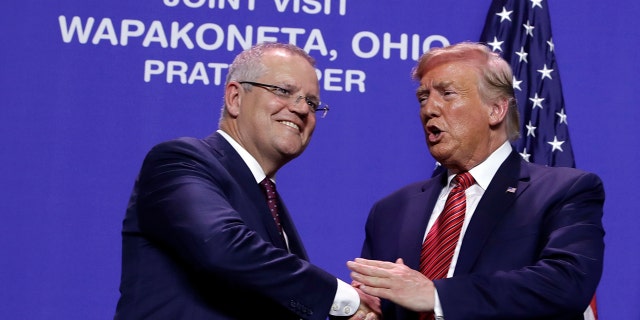
President Trump and Australian Prime Minister Scott Morrison
shaking hands at Pratt Industries on Sunday in Wapakoneta, Ohio.
(AP Photo/Evan Vucci)
He added, “Unlike so many other nations, Australia upholds the principles of fair and reciprocal trade.”
People
in Ohio crowded into the hot factory and chanted "USA" when the
president talked about products displaying the words "Made in America."
The plant is expected to open in a couple of weeks and has offered jobs
to veterans, which Trump highlighted as he addressed the crowd on
Sunday.
“I am especially excited to announce that one in four
workers at this plant is a veteran,” Trump said. The audience responded
with cheers.
Trump
said, “Over the next decade, Pratt Industries is creating 5000 new jobs
in the United States. This massive new investment is made possible by
the historic tax cuts and tax credits that we signed into law.”
Trump had nothing but praise for the Australian prime minister, who also praised the U.S. president.
President Trump speaking as Australian Prime Minister Scott
Morrison, center, and Pratt Industries chairman Anthony Pratt watched
during a factory tour Sunday.
(AP Photo/Evan Vucci)
“The president and I
are here today because we believe in jobs, we believe in the way jobs
transform lives,” Morrison said, adding, “What we are celebrating here
is jobs.”
He also pointed out America's 3.7-percent unemployment
rate, saying, “That is an amazing achievement, Mr. President, the lowest
unemployment rate we have seen in the United States for a very, very
long time.”
The president and first lady Melania Trump hosted Morrison and his wife, Jennifer, at a state dinner on Friday night, two days before the Ohio visit.
Earlier
Sunday, Trump visited Texas and met with Indian Prime Minister Narendra
Modi to highlight the growth of U.S. exports to India and billions of
dollars spent by India on U.S. defense equipment. Neither mentioned
trade tensions on Sunday.
Trump and Modi clasped hands as they
walked across the stage in a packed NRG Stadium in Houston, sending an
apparent message of unity between the world's two largest democracies.
The
president also discussed border security on Sunday, an important
campaign issue for Texas, which shares a border with Mexico. The Associated Press contributed to this report.
China already lost in the trade war
with the U.S. Although you will never hear Chinese authorities,
especially President Xi Jinping, admit it as such, the evidence is
everywhere and only becoming more compelling by the day.
Reuters
recently reported that based on the Chinese government's
own data, China's economic slowdown has worsened in August, with "growth
in industrial production is at its weakest in 17-1/2 years amid
spreading pain from a trade war with the United States and softening
domestic demand. Retail sales and investment gauges worsened too."
Despite such poor readings, Premier Li Keqiang insists that China is still on track to achieve 6 to 6.5 per cent growth rate this year.
Given the Chinese government's tendency to present a rosier economic picture
to satisfy political goals, most China watchers believe that Li's
statement was an about-face, and that the actual economic
situation is much worse.
Researchers
at the Brookings Institute estimated that China had inflated its GDP
growth rate by close to 2 percent every year between 2008-2016. So in
reality, China hasn't seen a 6 percent growth rate for nearly a decade
(someone should send a copy of this to Premier Li). Moreover, the actual
size of the Chinese economy was an estimated $10.9 trillion, 18 percent
lower than the officially stated $13.4 trillion, as of 2018.
More from Opinion
President
Donald Trump's trade tariffs struck the Chinese economy when it was
already declining and the effects have been devastating. The tariffs
have not only reduced imports from China , but also caused foreign
companies to shift their supply chain out of China. Beijing had hoped
that its stimulus measures, including tax cuts and easy credits to
local governments and big businesses, would reduce or even eliminate
anticipated negative impacts on the Chinese economy. However, the latest
data are a wakeup call that those stimulus measures were not sufficient
enough to absorb the blow from the trade war.
Beijing can't count
on Chinese consumers to stimulate economic growth either because of
rising pork prices. Pork is a staple food for Chinese households. Since
the trade war began, China had imposed higher tariffs on agricultural
products from the U.S., with the tariff on pork rising from 12 to 62
percent. China hoped that causing pain to U.S. farmers would pressure
Trump to back off his trade war. That strategy failed spectacularly in
two ways. First, while U.S. farmers are suffering and are critical of
the trade war, their support for the president is growing.
Bloomberg reports that, "about 67 percent of farmers are saying that
they’d back Trump for reelection in 2020."
President Trump's trade tariffs struck the Chinese economy when it was already declining and the effects have been devastating.
Second, China's
own hog industry is experiencing the worst African swine fever in
decades. The government has been criticized for its ineffective measures
to stamp out the epidemic. It is estimated that China could lose up to
50 percent of its pig population by the end of 2019. Pork prices
have spiked by more than 46 percent so far, and some experts predict the
price increase may be over 80 percent by next year. This spike has
pushed prices for other types of meat higher as well,
increasing inflation pressure to the overall economy. This has hindered
Chinese consumers' willingness and capacity to spend in other areas.
Given the pivotal role pork plays in the Chinese diet, the country could
potentially experience social unrest if the pork price continues to
skyrocket while the supply continues to be sparse.
China exempted
U.S. farm products, including soybean and pork, from additional
tariffs, effective Sept. 17. This announcement was seen widely as a
goodwill gesture ahead of the October trade talks between U.S.
and China. But this seems to be a desperate, self-serving measure,
because all the other pork exporting countries combined couldn't
fill China's supply shortage. Simply put, China has a need of pork from
the U.S., and its suspension from additional tariffs is, in essence, a
tactical and indirect acknowledgment that it won’t be able to sustain
this trade fight for much longer.
If China had hoped that it could
simply wait until Trump loses the 2020 presidential election to get out
of the trade war, it has to think again. At the most recent Democrat
presidential debate, not a single candidate proposed to remove the trade
tariffs Trump imposed on China. So even if Trump loses, China likely
would not get someone friendlier in the White House.
It
also doesn't help that, after Iran attacked Saudi oil facilities this
month, oil prices spiked and may stay elevated. Nathaniel Taplin of the
Wall Street Journal called China “the biggest loser of rising oil
prices,” because it is the world's largest crude oil importer. A
combination of higher oil and food prices will not only
increase pressure on an already slowing Chinese economy, but will also
make some of China's go-to stimulus measures, such as the devaluation of
its currency, more risky. Ironically, China has poured billions into
the Iranian economy through China's "One Road One Belt" initiative.
Chairman Xi probably didn't expect the Iranian regime to pay him back
this way.
The U.S. and China will resume trade talks in October
and China will continue to act tough in these negotiations, but its
rhetoric won't hide the fact that China has already lost the trade war.