Brad
Parscale, campaign manager to President Donald Trump, speaks to
supporters during a panel discussion, Tuesday, Oct. 15, 2019, in San
Antonio. (AP Photo/Eric Gay)
OAN Newsroom
UPDATED 6:27 PM PT — Friday, November 1, 2019
President Trump’s campaign is saying it raised millions of dollars on
the same day Democrats voted for an impeachment inquiry. In a Friday
tweet, campaign manager Brad Parscale said House Speaker Nancy Pelosi’s
impeachment resolution turned into a massive fundraising boom for the
president.
Nancy Pelosi’s impeachment resolution day turned into a MASSIVE fundraising day for @realDonaldTrump.
✅ $3 MILLION raised online alone in one day.
✅ That makes $19 MILLION in October online alone!
Impeachment sham is backfiring already!
— Brad Parscale (@parscale) November 1, 2019
Parscale claimed the campaign raised $3 million online in just one
day, totaling to $19 million in funds raised over the course of the
month. Parscale went on to say that the “impeachment scam” is already
backfiring.
Democrats know they can’t beat @realDonaldTrump so they’re trying to impeach him.
The whole sham is based on a phone call where the President did nothing wrong.
Show your support, buy the t-shirt & READ THE TRANSCRIPT!https://t.co/QPhQqHMkPP
— Brad Parscale (@parscale) November 1, 2019
This comes after Speaker Nancy Pelosi announced that House Democrats
are considering other controversies beyond Ukraine as part of their
impeachment inquiry. In a Friday interview, Pelosi gave an update on
where her caucus stands in its investigation. She said public hearings
tied to their inquiry could start as soon as this month.
The House speaker said the decision to file articles of impeachment
will ultimately be decided by the committees leading the impeachment
probe. However, she added they’re not ruling anything out.
“What we’re talking about now is taking us into a whole other class
of objection to what the president has done,” stated Pelosi. “There were
11 obstruction of justice provisions in the Mueller report — perhaps
some of them will be part of this.”
Speaker
of the House Nancy Pelosi, D-Calif., talks to reporters just before the
House vote on a resolution to formalize the impeachment investigation
of President Donald Trump, in Washington, Thursday, Oct. 31, 2019. (AP
Photo/J. Scott Applewhite)
Efforts to gather evidence against the president have centered on a
whistleblower complaint about his dealings with Ukraine. Democrats have
unified around the issue, though many expressed support for impeachment
following the release of the Mueller report. After the probe wrapped up,
the DOJ determined the president committed no collusion and no
obstruction.
President Trump continues to refute any wrongdoing and took to
Twitter Friday to berate the House speaker’s “corrupt leadership.”
Republicans have never been more unified than
they are right now! The Dems are a mess under the corrupt leadership of
Nervous Nancy Pelosi and Shifty Adam Schiff!
President Trump rallied supporters in Tupelo, Miss.,
on Friday night in a bid to shore up Republican support ahead of the
state's tightest gubernatorial race in nearly a generation.
Trump attacked former vice president and 2020 candidate Joe Biden and his son Hunter Biden over their Ukrainian business dealings,
accusing the media -- specifically CNN's Anderson Cooper and Chris
Cuomo, who again Trump referred to as "Fredo" -- of covering up
potential Biden corruption.
"The press protects him," said the president, who also called Biden "One Percent Joe."
Trump also slammed the Democratic-led impeachment inquiry, calling
it a "preposterous hoax" one day after the House voted to formalize the
rules of their impeachment process, and accused Democrats of trying to
"delegitimatize" the 2016 presidential election.
House committees
have held nearly a dozen closed-door depositions from witnesses
regarding their knowledge of a July 25 phone call between Trump
and Ukrainian President Volodymyr Zelensky. An anonymous intelligence
community whistleblower has alleged that Trump sought to persuade
Zelensky to open an investigation into Joe Biden, his son Hunter and
their business dealings in Ukraine in exchange for military aid to the Eastern European nation.
"Do you think I would say something improper when I know there are so many people listening?" Trump asked the crowd.
The president also mocked former U.S. Rep. Beto O'Rourke, just hours after the Texas Democrat announced his withdrawal from the 2020 presidential election.
Trump
called O'Rourke a "poor bastard" and a "poor pathetic guy" who "made a
total fool of himself" in the race for the White House.
"Hopefully, we won't be hearing about him for a long time," Trump added.
"Hopefully, we won't be hearing about him for a long time." — President Trump
Trump also decried Hillary Clinton's recent comments about Rep. Tulsi Gabbard,
D-Hawaii. The former secretary of state didn't mention Gabbard by name,
but suggested that Gabbard was being groomed to be a third-party
presidential candidate in 2020.
Trump said, "I don't know who Tulsi Gabbard is but I know one thing, she's not an agent for Russia."
Clinton
made similar comments about 2016 Green Party candidate Jill Stein, to
which Trump responded: "I don't know Jill Stein ... I know she's not an
agent of Russia."
The president opened his remarks at Bancorp South Arena by celebrating the U.S. military raid that led to the death of Islamic State (ISIS) leader Abu Bakr al-Baghdadi, saying it had "ended his wretched life and punched out his ticket to hell."
"We
have a great military. It was very very depleted when I came into
office ... but it ain't depleted anymore," said Trump, who
called Baghdadi "a savage and soulless monster but his reign of terror
is over."
Trump
lamented the media's coverage of the military's most recent feat,
saying that if former President Barack Obama had killed the leader of
ISIS, the media would have the story "going on for another seven
months."
"Conan the dog got more publicity than me -- and I'm very happy about it," Trump said of the heroic military dog who was injured while pursuing Baghdadi through a tunnel underneath a compound in northwestern Syria.
"Conan the dog got more publicity than me -- and I'm very happy about it." — President Trump
"While we're creating jobs and killing terrorists, the Democrat Party has gone completely insane," Trump said.
Hundreds of people had waited to see Trump at the rally to support Republican gubernatorial
candidate Tate Reeves, who is finishing his second term as
Mississippi's lieutenant governor after previously serving two terms as
the elected state treasurer.
Reeves briefly joined Trump onstage
and accused the "radical liberals" of "disrespecting" Trump by pursuing
impeachment against him and urged the crowd to elect "an ally to Donald
J. Trump."
"He'll never let you down," Trump said of Reeves. "And don't kid yourself, your Second Amendment is under attack."
Reeves
has spent $10.8 million in the race to succeed term-limited Gov. Phil
Bryant, while his Democratic opponent, state attorney general Jim Hood,
has spent $5.2 million. Both are receiving financial support from
national governors' groups in their parties.
Reeves has sought to tie Hood as closely as possible to national Democrats, such as House Speaker Nancy Pelosi, who are deeply unpopular in a state that voted heavily for Trump in the last presidential election.
Hood has not invited national Democratic figures to
Mississippi and is running campaign commercials that show him with his
family, his pickup truck and his hunting dog, Buck. In one, Hood unpacks
a rifle and says that "Tate Reeves and his out-of-state corporate
masters" are spending money on a "bunch of lies."
"You
all know me. I've worked for you for years. I do my job and I'm a
straight shooter," Hood says. The spot ends with Hood shooting the gun
and shattering a bottle.
Hood is also running radio ads designed
to appeal to African American voters — including one with an endorsement
from former U.S. Rep. Mike Espy, who ran a strong but ultimately
unsuccessful race for U.S. Senate in Mississippi last year, and another
that mentions Hood leading the successful 2005 prosecution of Ku Klux
Klan leader Edgar Ray Killen in the 1964 murder of three civil rights
workers.
The outreach reflects the importance of black voters to
any possible Hood victory. African Americans make up 38 percent of the
state's population, but some say they're irritated by Hood's emphasis on
courting rural white voters. The Associated Press contributed to this report.
"Catch and Kill" author and Pulitzer Prize-winning journalist Ronan Farrow took aim at former President Bill Clinton on Friday night, saying the nation's 42nd chief executive was "credibly" accused of rape and that alleged victim Juanita Broaddrick's claim was "overdue for revisiting."
Stemming from a panel discussion on "Real Time with Bill Maher"
about the Katie Hill saga -- in which the California congresswoman
resigned after allegations of inappropriate affairs -- host Maher posed a
hypothetical about whether Clinton would have been treated differently
-- for the Monica Lewinsky affair and other matters -- if he were
president in today's political climate.
"Could Bill Clinton, if he
had done what he did in 1998, survive today -- or would his own party
have thrown him under the bus?" Maher asked.
Later
in the conversation, Farrow addressed the question by stressing that
the allegations made against Clinton are a "different" situation.
"I
think that it is very important to interject that Bill Clinton is a
different conversation," Farrow told Maher. "He has been credibly
accused of rape. That has nothing to do with gray areas. I think that
the Juanita Broaddrick claim has been overdue for revisiting."
Farrow,
whose reporting took down disgraced film mogul Harvey Weinstein and
helped propel the #MeToo movement, added that he thought Clinton
wouldn't escape scrutiny today, saying society's views on sexual
misconduct have "changed."
The
U.S. House impeached Clinton in 1998 over the Lewinsky affair but the
Senate acquitted him and he went on to complete his second term in
January 2001.
In 1999, Broaddrick sued Clinton, seeking documents
that might be relevant to her allegations.But a judge dismissed her
lawsuit in 2001.
The Trump administration has agreed to pay $846,000 to the state of California in a settlement over the administration’s efforts to add a citizenship question to the U.S. Census, according to a report.
California
sued the Trump administration earlier this year over concerns a
citizenship question on the census would lead to underrepresentation of
minorities.
In June the U.S. Supreme Court
struck down the administration’s reasoning for adding the question,
calling it “contrived," and calling on the White House to provide other
reasons for wanting the data, The Sacramento Bee reported. In the 5-4 ruling, Chief Justice John Roberts sided with liberal associate justices
Ruth Bader Ginsburg, Elena Kagen, Sonia Sotomayor and Stephen Breyer.
Opposing the California lawsuit were conservative justices Neil Gorsuch,
Brett Kavanaugh, Clarence Thomas and Samuel Alito.
President Trump later blasted the court's ruling in a Twitter message.
"Seems
totally ridiculous that our government, and indeed Country, cannot ask a
basic question of Citizenship in a very expensive, detailed and
important Census, in this case for 2020," the president wrote. "I have
asked the lawyers if they can delay the Census, no matter how long,
until the ... United States Supreme Court is given additional
information from which it can make a final and decisive decision on this
very critical matter."
California had argued it could lose billions in funding if its minority populations are underrepresented.
In the settlement, the administration will pay California the sum for lawyer fees and related costs incurred by the state.
The administration said it would get citizenship information from other sources.
In
July, Trump signed an executive order directing executive agencies to
provide as much citizenship data allowed under the law to the Commerce
Department, The Bee reported.
The speeches, the posturing and the punditry were all predictable, as was the final outcome.
Two
hundred and thirty-one House Democrats, with just two defectors, voted
yesterday to back the impeachment inquiry against President Trump, while
194 Republicans, with one former party member defecting, voted against
the measure.
It was a set-piece ritual of the kind that Washington
loves, and for all the bombast and the bloviating, it’s unlikely that a
single mind was changed.
This city woke up filled with bipartisan
joy after watching the Nationals clinch the World Series shortly before
midnight, but within hours, the air was once again thick with
polarizing emotions.
It was not a vote to impeach Trump, though it
was clearly a test vote toward that outcome. It comes more than two
decades after Newt Gingrich’s House voted to impeach Bill Clinton, and
four and a half decades after the House Judiciary Committee voted to
impeach Richard Nixon. After the first 180 years of our republic saw
only one impeachment, that of Andrew Johnson, the constitutional
provision has become more frequently weaponized in modern politics.
But like the party-line drive against Clinton, this one-sided effort seems almost certain to fail in the Senate.
Trump’s reaction was concise: “The Greatest Witch Hunt in American History!”
The
White House rushed out a statement: “Nancy Pelosi and the Democrats’
unhinged obsession with this illegitimate impeachment proceeding does
not hurt President Trump; it hurts the American people.”
Nancy
Pelosi invoked Ben Franklin and the founders, as she does with growing
frequency: “What is at stake in all of this is nothing less than our
democracy.”
Kevin McCarthy reduced it to raw politics: “Democrats
are trying to impeach the president because they are scared they cannot
defeat him at the ballot box. Why do you not trust the people?” Steve Scalise had a hammer-and-sickle sign as the GOP argued it’s a “Soviet-style” process.
Everyone is quoting Alexander Hamilton.
It
was a day to argue over process, which is what Washington does best, as
opposed to substance, to which the town often seems allergic.
Pelosi
made the move because the Republican criticism about a closed-door
process, with selective leaking of testimony, was starting to sting. She
knows she needs to move toward public hearings and to set some rules of
the road.
The speaker also must believe that the political winds
have shifted. Earlier, she wanted to spare nearly three dozen Democrats
in districts won by Trump from having to cast an early
impeachment-related vote. Now, after heavily negative coverage of
administration witnesses contradicted Trump on Ukraine, and a slight
shift in the polls, such a vote appears safe.
What’s more, Pelosi
has an eye on the clock. As the private hearings drag on, talk of
holding a final impeachment vote by Thanksgiving have faded; now
Democrats are hoping to wrap things up by Christmas. That would mean a
Senate trial in January, and with more snags, it could spill over into
the early February primary voting. Impeachment is already depriving the
Democratic candidates of media oxygen; this would be unprecedented, and
would pull the likes of Elizabeth Warren, Bernie Sanders and Amy
Klobuchar off the campaign trail.
Despite
these uncertainties, the whole impeachment saga has the feel of a
scripted process. Pelosi once argued that impeachment could not work
without being bipartisan—suddenly that’s off the table. But there’s no
stopping this train now.
President Trump said Thursday he may read the transcript of his July 25 telephone conversation with Ukrainian
President Volodymyr Zelensky aloud to Americans in the style of
the famous fireside chats delivered by President Franklin Roosevelt
during the 1930s and 1940s.
“This is over a phone call that is a good call,” Trump said in an interview with the Washington Examiner. "At some point, I’m going to sit down, perhaps as a fireside chat on live television, and I will read the transcript of the call, because people have to hear it. When you read it, it’s a straight call.”
Roosevelt
delivered a series of informal radio addresses, dubbed fireside chats,
meant to garner support for his New Deal policies and update Americans
on the course of World War II, among other issues.
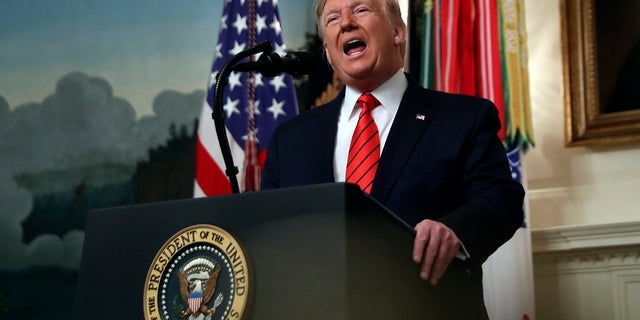
President Donald Trump speaks in the Diplomatic Room of the White House Sunday. (AP Photo/Andrew Harnik)
A public reading of the call transcript would mark the latest effort by Trump to thwart the impeachment inquiry
against him by congressional Democrats. The president has repeatedly
denied Democratic claims that he withheld crucial military aid to Kiev
in order to press Zelensky to investigate former Vice President
Joe Biden and his son, Hunter.
Several witnesses have raised
concerns over the call. Army Lt. Col. Alexander Vindman, who serves as a
director on the National Security Council (NSC), testified privately
before Congress this week that he was alarmed by Trump's request to
Zelensky.
“Everybody knows I did nothing wrong,” Trump told the
Examiner. “Bill Clinton did things wrong; Richard Nixon did things
wrong. I won’t go back to [Andrew] Johnson because that was a little
before my time. But they did things wrong. I did nothing wrong.”
During
the interview, Trump said he was being responsible by reviewing aid to
Ukraine, a country with a history of endemic corruption.
“We are giving them money, we are giving them weapons,” he said. “We have an obligation to look at corruption.”
School officials in Austin, Texas, have made changes to the sex-education curriculum for middle school students – and a lot of parents are not happy with the results.
Planned Parenthood, one of the backers of the new plan, called it “LGBTQ inclusive, science-based and much needed,” according to the Austin American-Statesman.
A group called Texas Values led the opposition to the plan – and says it intends to fight its passage, which came in a unanimous vote early Tuesday morning after a large crowd gathered Monday night for the school board’s meeting.
The values group claims to have collected petition signatures from 5,000 people who oppose the curriculum – though Austin's KEYE-TV reported that parents can block their children from taking any or all of the lessons.
David
Walls, a parent and vice president of Texas Values, told the newspaper
that his group believes the plan encourages students to engage in
same-sex relationships.
“It’s not appropriate for school,” Walls
said. “It’s not appropriate for a government body to encourage students
to engage in any kind of sexual activity.”
On Thursday, Texas
Values posted a Twitter message mocking the school board’s preference
for the gender-neutral term “parent” over “mother” and “father.”
“What’s so scary about mom and dad?” the group wrote, using a Halloween theme.
Community member Barbara Bucklin told Austin radio station KUT that “gender identity” didn’t seem an appropriate topic for young children.
“Should you be suggesting to a 5-year-old or an 8-year-old or a 10-year-old that maybe they’re not a girl?” Bucklin asked.
“Should you be suggesting to a 5-year-old or an 8-year-old or a 10-year-old that maybe they’re not a girl?” — Barbara Bucklin, opponent of sex-ed curriculum changes
But
Michelle Rusnak, the district’s health and physical education
supervisor, said the goal of the plan is to represent LGBTQ views
fairly, not to impose them.
“It’s about acceptance,” she told the American-Statesman.
“It’s about acceptance.” — Michelle Rusnak, school district’s health and physical education supervisor
Prior to Tuesday’s vote, school officials had already made changes to the revised curriculum proposal based on parents’ input, according to the newspaper.
For
example, officials agreed to delay discussions of sexual orientation
and HIV until fifth grade, rather than third grade. They also deleted
the term “anal sex” from a lesson about preventing HIV and STDs,
although the term is used in a lesson on abstinence, and they canceled a
video that included depictions of gay and mixed-race couples.
“There’s
no doubt that the topic of sex education in public schools elicits
strong reactions,” board member Kristin Ashy told the crowd Monday
night. “Tonight offers itself as an example of these reactions.”
Students whose parents approve of the plan will begin learning the new lessons in May, reports said.
President Trump, a born-and-bred New Yorker, announced Thursday that he has changed his permanent residence to Palm Beach, Fla., because of the way politicians in New York City and the state of New York have treated him.
“I
cherish New York, and the people of New York, and always will, but
unfortunately, despite the fact that I pay millions of dollars in city,
state and local taxes each year, I have been treated very badly by the
political leaders of both the city and state. Few have been treated
worse,” the president tweeted.
“I hated having to make this
decision, but in the end it will be best for all concerned. As
President, I will always be there to help New York and the great people
of New York. It will always have a special place in my heart!”
The New York Times originally obtained the court documents
for Trump’s change of address from Trump Tower in New York City to the
location of his Mar-a-Lago Club in Palm Beach, where he's built a
residence. First lady Melania Trump also changed her residence to the
same location in an identical document.
“If I maintain another
place or places of abode in some other state or states, I hereby declare
that my above-described residence and abode in the State of Florida
constitutes my predominant and principal home, and I intend to continue
it permanently as such,” the Trump file read.
“I
formerly resided at 721 Fifth Avenue,” the document said. Trump, raised
in the borough of Queens, moved into the skyscraper in midtown
Manhattan in 1983.
The document lists Trump’s “other places of
abode” as 1600 Pennsylvania Avenue, aka the White House, and his private
golf club in Bedminster, N.J.
Trump has spent 99 days at his
Florida resort since becoming president, while he’s spent only 20 days
at Trump Tower, according to NBC News.
In
response to Trump, New York Gov. Andrew Cuomo tweeted: "Good riddance.
It's not like @realDonaldTrump paid taxes here anyway... He's all yours,
Florida."
Democratic presidential candidate Sen. Elizabeth Warren
accused the president of making the move so he can shield his tax
information from New York authorities.
"Donald Trump doesn't want
the state of New York to see his taxes—I wonder why," Warren wrote.
"Let's call this out for what it is: Corruption, plain and simple. Under
my anti-corruption plan, all presidential candidates would be required
to release their tax returns."
New York City Mayor Bill de Blasio, who ended his own run for the presidency, echoed Cuomo's remarks.
"Don't let the door hit you on the way out or whatever," de Blasio wrote.
Trump
is due to make an appearance in New York City this weekend to attend an
MMA fight at Madison Square Garden. He's scheduled to spend Saturday
night at Trump Tower.
While Trump said his change of residence was
due to poor treatment by New York officials, some have speculated he
could be doing so for tax purposes. Florida does not have a state income
tax or an inheritance tax and has long been a haven for wealthy former
New Yorkers.
In August, Heritage Foundation chief economist Steve Moore appeared on “The Daily Briefing” to say that New Yorkers fleeing to Florida for tax purposes may be the “biggest economic story” in the country.
He
said there are four so-called "states of the apocalypse” – New York,
New Jersey, Connecticut, and Illinois – from where residents are fleeing
in droves due to high taxes and state budget issues.
Moore said the states benefitting the most from this population movement are Florida, Tennessee, Texas, Utah and North Carolina.