Presumptuous Politics

Saturday, November 9, 2019

Last victim of Mexico border killings to be laid to rest

 
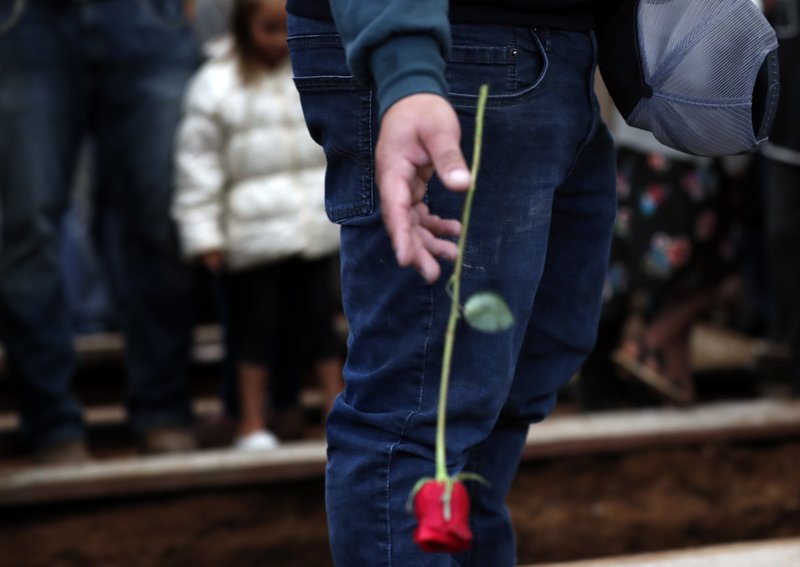
A mourner drops a red rose into a freshly dug grave at the cemetery in Colonia Le Baron, Mexico, Friday, Nov. 8, 2019, during the burial service for Rhonita Miller and four of her young children who were murdered by drug cartel gunmen. The bodies of Miller and four of her children were taken in a convoy of pickup trucks and SUVS, on the same dirt-and-rock mountainous road where they were killed Monday, for burial in the community of Colonia Le Baron in Chihuahua state. (AP Photo/Marco Ugarte)

COLONIA LEBARON, Mexico (AP) — Family and friends prepared to bury on Saturday the last victim of a cartel ambush that slaughtered nine American women and children from a community of U.S.-Mexican dual citizens in a corner of northern Mexico where having gangsters in their midst has long been an unavoidable fact of life.
Christina Langford Johnson jumped out of her vehicle and waved her hands to show she was no threat to the attackers and was shot twice in the heart, community members say. Her daughter Faith Marie Johnson, 7 months old, was found unharmed in her car seat.
Her burial ceremony, the third in as many days, culminates an outpouring of grief in the closely knit community with family ties in two Mexican states and across the border in many western U.S. states.
The shocking attack has many in the small farming town of La Mora, established in Sonora state by their Mormon ancestors decades ago, wondering whether they should stay or leave to flee the cartel threat.
On Friday, the bodies of Rhonita Miller and four of her children were brought from La Mora to Colonia LeBaron in neighboring Chihuahua state by a convoy of pickup trucks and SUVS that followed the same dirt-and-rock mountainous road where they were killed. Many residents of the two communities that lie a five-hour, bone-jarring drive apart are related. They are not affiliated with The Church of Jesus Christ of Latter-Day Saints.
The three simple wooden coffins arrived at the cemetery about a mile east of Colonia LeBaron off a rural road flanked by cotton fields and were lowered into three graves under white tents set up to guard from the intermittent rain.
“Nita,” as she was affectionately known, was laid to rest in the middle grave with the remains of her 8-month-old twins, Titus and Tiana, in her arms. Twelve-year-old Howard Jr. and 10-year-old Kristal were buried in their own coffins on either side.
Kenny Miller, Rhonita Miller’s father-in-law, said she was “like an angel” and the children “little angels.”
Miller said that with the eyes of the world upon these communities, he hopes their deaths may not be in vain and can spotlight what he deems a nationwide concern with thousands of Mexicans mourning missing and dead loved ones amid record-setting homicide levels.
“We’ve got terrorists here,” he said.
“I would like this to be used for people who have no voice,” Miller said, “and I think ‘Nita’ would approve wholeheartedly.”
What had been a largely peaceful existence in a fertile valley ringed by rugged mountains and desert scrub about 70 miles (112 kilometers) from the border with Arizona became increasingly dangerous in recent years as the cartels exerted their power and battled each other in a region that is a drug smuggling hotbed.
But La Mora, a hamlet of about 300 people where residents raise cattle and cultivate pomegranates and other crops “will be forever changed” following the killings Monday as the women traveled with their children to visit relatives, a tearful David Langford told mourners at the funeral for his wife, Dawna Ray Langford, and their 11-year-old and 2-year-old sons.
“One of the dearest things to our lives is the safety of our family,” said Langford. “And I won’t feel safe. I haven’t for a few years here.”
On the other side of the mountains in Chihuahua, Colonia LeBaron has been largely peaceful since the 2009 killing of one of its members who was an anti-crime activist prompted Mexican authorities to establish a security base. But the police presence in La Mora was negligible until the women and children were killed and authorities sent a swarm of soldiers and state and federal police officers to the area.
How long they stay could be crucial to the community’s future, residents said.
The governments of Chihuahua and Sonora said in a statement Friday that an “important number” of security agents had been deployed to the state border region that the road traverses since the “lamentable” attack, resulting in arrests and seizures of weapons, drugs and stolen vehicles.
“We will not waver, I reiterate, not a single step backward,” Sonora state security commissioner Óscar Alberto Aparicio Avendaño was quoted as saying.
The motive in the killings still isn’t known, though Mexican authorities have suggested the victims were in the wrong place at the wrong time as competing cartels fought over turf and may have mistaken the SUVs the women and children were in for rivals who travel in similar vehicles. Residents of La Mora dispute the theory that the victims were not targeted.
Joe Darger, of Salt Lake City, said his daughter who lives in Utah but maintains a second home in La Mora won’t be spending more time in a place that had been part of her family’s life, at least for now.
“Until there’s answers, she’s not bringing her kids,” Darger said in La Mora after traveling there to attend the funerals.
The biggest concern for residents is finding out why the women and children were massacred. The answer will help them decide whether to stay or leave.
“I just think the innocence is gone,” Darger said. “And so unless people feel safe, they’re going to look for other places they can feel safe.”
He added: “It’s a matter of what do we do going forward? That’s the question.”
___
Associated Press Writer Maria Verza in Mexico City contributed to this report.

Tom Steyer’s top aide resigns following bribery allegations

Democratic presidential candidate Tom Steyer, left, addresses an environmental justice forum. Friday, Nov. 8, 2019, in Orangeburg, S.C. (AP Photo/Meg Kinnard)

The campaign manager for Tom Steyer has resigned, following news he was secretly attempting to bribe local politicians for votes. In a Friday statement released by his team, Pat Murphy’s resignation was made effective immediately.
This comes after the Associated Press reported Murphy was reaching out to politicians in Iowa and offering money in exchange for endorsing Steyer’s campaign. When asked about the allegations against his aide, the presidential candidate said no payments were given to Iowa officials.
“We haven’t given any money to anyone in Iowa, nor are we planning to,” stated Steyer. “There’s no way we would ever do that.”
Following an investigation into those claims, the campaign said the behavior was not acceptable and will not be tolerated.
“Our campaign policy is clear: that we will not engage in this kind of activity, or any kind of communication that could be perceived as improper,” stated campaign manager Heather Hargreaves. “Violation of this policy is not tolerated.”
The campaign’s statement went on to say Steyer and his team will continue building on his momentum in Iowa and across the country.
Murphy has since apologized for his alleged propositions. So far, no evidence has come forward proving these bribes.

President Trump launches nationwide grassroots initiative for black voters

President Donald Trump gestures as he speaks at his Black Voices for Trump rally Friday, Nov. 8, 2019, in Atlanta. (AP Photo/John Bazemore)
President Trump is kicking off his nationwide campaign initiative to garner more black voters ahead of 2020. During his Friday speech in downtown Atlanta, the president announced his ‘Black Voices for Trump’ initiative.
A supporter of President Donald Trump waits for Trump to arrive for a Black Voices for Trump rally Friday, Nov. 8, 2019, in Atlanta. (AP Photo/John Bazemore)

President Trump claimed Democrats have taken advantage of the black vote, despite many African Americans continuing to struggle with poverty. He touted his administration’s efforts to lower unemployment rates among the nation’s black youth.
“African American youth unemployment…has now reached the lowest number ever recorded in the history of our country,” stated the president. “This was so important to me — we’re doing really well.

The president also took a swing at Democrats for their alleged attempts to censor religion.
“African American churches have always been lifted up and they’ve always been the conscience of our nation,” said President Trump. “Yet, Democrats now want to drive faith out of the public square and attack Christians.”
The Trump campaign reportedly chose the location because it’s an epicenter of black life, including the region’s fast growing population. The trip marks his second visit to Georgia this year.

A supporter of President Donald Trump holds a Trump campaign banner as he waits for Trump to arrive for Black Voices for Trump rally Friday, Nov. 8, 2019, in Atlanta. (AP Photo/John Bazemore)

Friday, November 8, 2019

Democrats Achievements 2016-2019 Cartoons


Ivanka Trump: Whistleblower’s ID irrelevant to impeachment


RABAT, Morocco (AP) — Ivanka Trump on Friday echoed her father’s view that the House impeachment investigation is an attempt to overturn the 2016 election. But, in an interview with The Associated Press, she parted ways with President Donald Trump by calling the identity of the impeachment whistleblower “not particularly relevant.”
The Republican president and some of his allies have been pressing the news media to publicize the whistleblower’s name, but Ivanka Trump said the person’s motives were more important. And she declined to speculate on what they may have been.
“The whistleblower shouldn’t be a substantive part of the conversation,” she told the AP, saying the person “did not have firsthand information.”
She added that, “to me, it’s not particularly relevant aside from what the motivation behind all of this was.”
In a wide-ranging, 25-minute interview, Ivanka Trump also addressed her family’s criticism of Democrat Joe Biden and his son Hunter, whether she wants four more years in the White House and the possible future sale of her family’s landmark Washington hotel, which she helped develop and referred to as “my baby.”
She said she shares her father’s oft-repeated view that the impeachment investigation is about “overturning the results of the 2016 election.” House Democrats, by contrast, maintain the inquiry is about whether Trump abused his office by putting his political interests first.
“Basically since the election, this has been the experience that our administration and our family has been having,” Ivanka Trump said of persistent criticism of the president. “Rather than wait, under a year, until the people can decide for themselves based on his record and based on his accomplishments, this new effort has commenced.”
Asked whether impeachment marked a low point for the president, she demurred: “I think when Americans are winning, we’re feeling great, so I wouldn’t consider it a low point. I think Americans are prospering like never before.”
Ivanka Trump noted that the whistleblower was not among administration officials who heard the president ask Ukraine’s leader during a July 25 telephone conversation to investigate Biden, a former vice president who’s currently a leading contender for the 2020 Democratic presidential nomination to challenge Trump.
While her brothers Don Jr. and Eric have been vocal critics of the impeachment inquiry, Ivanka Trump has largely stayed out of the discussion. She did recently tweet a quote from Thomas Jefferson about the “enemies and spies” who surrounded him and added that “some things never change, dad.”
In the interview, she again placed her father in august company when it comes to being the target of criticism, saying, “This has been the experience of most.”
“Abraham Lincoln was famously, even within his own Cabinet, surrounded by people who were former political adversaries,” she said.
She rejected any suggestion that her family has been profiting off the presidency even as President Trump and his allies have criticized the involvement of Biden’s son with a Ukrainian oil venture when Biden was vice president.
Hunter Biden served on the board of a Ukrainian gas company at the same time his father was leading the Obama administration’s diplomatic dealings with Kyiv. Though the timing raised concerns among anti-corruption advocates, there has been no evidence of wrongdoing by either the former vice president or his son.
Still, Ivanka Trump said the Bidens had “created wealth as a derivative” of public service while her family had made its money in business before her father became president.
Good government groups, however, have criticized the president for unethically mixing official business with promotion of his own interests.
Trump is the first president in modern history who has not separated himself from his business holdings. He makes frequent trips to his for-profit golf clubs, collects dues at his members-only properties and hosts fundraisers and foreign delegations at hotels that bear his family’s name.
Ivanka Trump said she hasn’t been involved in discussions about the possible sale of the president’s landmark Washington hotel after nearly three years of ethics complaints and lawsuits accusing him of trying to profit off the presidency. She led the acquisition and development of the hotel a few blocks from the White House.
But, a possible future sale “should satisfy the critics,” she said.
The president’s daughter is wrapping up a three-day visit to Morocco, where she has been promoting a U.S. program aimed at empowering women in developing countries.
___
Follow Darlene Superville on Twitter: http://www.twitter.com/dsupervilleap

Yovanovitch communicated with Dem staffer on 'delicate' issue after complaint, emails show, despite testimony


Former U.S. Ambassador to Ukraine Marie Yovanovitch, a key witness in House Democrats' impeachment inquiry, communicated via her personal email account with a Democratic congressional staffer concerning a "quite delicate" and "time-sensitive" matter -- just two days after the whistleblower complaint that kickstarted the inquiry was filed, and a month before the complaint became public, emails obtained Thursday by Fox News' "Tucker Carlson Tonight" show.
The emails appear to contradict Yovanovitch's deposition on Capitol Hill last month, in which she told U.S. Rep. Lee Zeldin, R-N.Y., about an email she received Aug. 14 from the staffer, Laura Carey -- but indicated under oath that she never responded to it.
The communication came "from the Foreign Affairs Committee," and "they wanted me to come in and talk about, I guess, the circumstances of my departure," Yovanovitch testified, describing Carey's initial email. "I alerted the State Department, because I'm still an employee, and so, matters are generally handled through the State Department."
Yovanovitch continued: "So, she emailed me. I alerted the State Department and, you know, asked them to handle the correspondence. And, she emailed me again and said, you know, 'Who should I be in touch with?'"
Fox News is told it is a breach of normal procedure for congressional staff to reach out to a current State Department employee at their personal email address for official business.
Asked directly whether she responded to Carey's overtures, Yovanovitch testified only that someone in the "Legislative Affairs Office" at the State Department had responded to Carey, to the best of her knowledge.
Yovanovitch did not indicate that she had responded to Carey's first email in any way, and testified explicitly that she did not reply to Carey's follow-up email concerning whom she should contact at the State Department.
However, emails obtained by Fox News' "Tucker Carlson Tonight" showed that in fact, Yovanovitch had responded to Carey's initial Aug. 14 email, writing that she "would love to reconnect and look forward to chatting with you."
On Aug. 14, Carey reached out to Yovanovitch with pleasantries about the last time the two had "crossed paths" -- "when I was detailed to" the Senate Foreign Relations Committee -- before noting that Carey had resigned from the State Department to join the House Foreign Affairs Committee staff performing oversight work.
"I'm writing to see if you would have time to meet up for a chat — in particular, I’m hoping to discuss some Ukraine-related oversight questions we are exploring," Carey then wrote to Yovanovitch. "I'd appreciate the chance to ground-truth a few pieces of information with you, some of which are quite delicate/time-sensitive and, thus, we want to make sure we get them right."
Carey continued: "Could you let me know if you have any time this week or next to connect? Happy to come to a place of your choosing, or if easier, to speak by phone at either of the numbers below. I'm also around this weekend if meeting up over coffee works."
On Aug. 15, Yovanovitch responded: "Thanks for reaching out -- and congratulations on your new job. I would love to reconnect and look forward to chatting with you. I have let EUR [Bureau of European and Eurasian Affairs] know that you are interested in talking and they will be in touch with you shortly."
On Aug. 19, Carey wrote, "Great -- thanks for the response and I look forward to hearing from them. As mentioned, it would be ideal to connect this week... assuming this week is doable for you schedule-wise?"
Zeldin told Fox News on Thursday it was "greatly concerning" that Yovanovitch may have testified incorrectly that she did not personally respond to Carey's email.
"I would highly suspect that this Democratic staffer's work was connected in some way to the whistleblower's effort, which has evolved into this impeachment charade," Zeldin said. "We do know that the whistleblower was in contact with [House Intelligence Committee Chairman] Adam Schiff's team before the whistleblower had even hired an attorney or filed a whistleblower complaint even though Schiff had lied to the public originally claiming that there was no contact. Additionally, while the contents of the email from this staffer to Ambassador Yovanovitch clearly state what the conversation would be regarding, Yovanovitch, when I asked her specifically what the staffer was looking to speak about, did not provide these details."
Zeldin added: "I specifically asked her whether the Democratic staffer was responded to by Yovanovitch or the State Department. It is greatly concerning that Ambassador Yovanovitch didn't answer my question as honestly as she should have, especially while under oath."
"It is greatly concerning that Ambassador Yovanovitch didn't answer my question as honestly as she should have, especially while under oath."
— U.S. Rep. Lee Zeldin, R-N.Y.
A Democratic House Foreign Affairs Committee spokesperson, however, characterized the outreach as innocuous, saying it was related to Yovanovitch's public ouster as the envoy to Ukraine.
"The committee wanted to hear from an ambassador whose assignment was cut short under unusual circumstances," the spokesperson said. "This staff outreach was part of monthslong efforts that culminated in the September 9 launch of an investigation into these events. Congress has a constitutional duty to conduct oversight. The State Department doesn’t tell Congress how to do that job, and should be more concerned with the culture of retaliation and impunity that has festered under this administration."
Neither Carey nor the State Department immediately responded to Fox News' requests for comment.
President Trump ordered Yovanovitch to be recalled from her post this past May following allegations of partisanship and political bias. Democrats have suggested her service was terminated so that the Trump administration could carry out illicit foreign policy with Ukraine.
George Kent, a career official at the State Department, told House investigators conducting the impeachment inquiry that a Ukrainian official told him Trump attorney Rudy Giuliani had conspired with Yuriy Lutsenko, the then-prosecutor general of Ukraine, to "throw mud" as part of a “campaign of slander” against Yovanovitch.
That accusation came out in testimony released earlier Thursday.
"Well, Mr. Giuliani was almost unmissable starting in mid-March," Kent told investigators. "As the news campaign, or campaign of slander against, not only Ambassador Yovanovitch unfolded, he had a very high media presence, so he was on TV, his Twitter feed ramped up and it was all focused on Ukraine."
"Tucker Carlson Tonight" investigative producer Alex Pfeiffer contributed to this report.

Reps. Hunter and Gohmert: War crimes charges against 3 military combat veterans should be thrown out by Trump


Fox News reported this week that President Trump plans to take “imminent action” regarding war crimes charges against three former members of the U.S. military. We urge the president to throw out the charges against all three.
The three brave Americans who stepped forward to defend our country are: former Army 1st Lt. Clint Lorance, former Army Green Beret Maj. Matt Golsteyn, and former Navy SEAL Special Operations Chief Eddie Gallagher.
Fox News’ Pete Hegseth, who spoke with President Trump about the cases over the weekend, said the president is keen to act before Veterans Day, which is Monday.
Every commonsense, patriotic American would undoubtedly celebrate the dismissal of all the charges against Lorance, Golsteyn and Gallagher.
So it should not come as a surprise that Washington establishment-types are already attempting to derail action by the president that would clear the three men.
Unfortunately, rather than working diligently to implement the commander in chief’s decision, some news reports said Defense Secretary Mark Esper has urged the president not to intervene in the cases, claiming he has “full confidence in the military justice system.”
According to these reports, Pentagon leaders believe presidential intervention would be “damaging to the integrity of the military judicial system.”
What these Washington elites fail to acknowledge is that the military justice system has neglected our nation’s warriors time and time again. President Trump’s instincts to act on their behalf are further proof of his tireless commitment to our rank-and-file men and women in uniform.
We and other members of the Congressional Justice for Warriors Caucus stand wholeheartedly in favor of dismissing the charges against the three former service members. We’ve reviewed their cases, met with the accused and have seen the evidence. Or, more accurately, the lack of evidence.
These three men are American heroes who have been accused of crimes during combat far from our shores, when they were risking their lives on behalf of the rest of us here at home. When the circumstances are viewed holistically, they did what our country asked of them.
The three deserve our gratitude and thanks. Instead, they find themselves at the mercy of a broken military justice system for simply doing their jobs.
We created the Congressional Justice for Warriors Caucus not just to help warfighters like Clint, Eddie and Matt, but also to make the structural reforms needed to ensure miscarriages of justice like those suffered by these men never happen again.
The blind confidence in the military justice system by some at the Pentagon is grossly misplaced. We have seen firsthand the politicized nature of the military judicial process and have discovered more instances of prosecutorial misconduct than we can mention.
Moreover, our broken Uniform Code of Military Justice denies our service members basic rights and weights the scales of justice against the accused.
Take these examples:
In the Lorance case, the prosecution claimed Afghans killed during a combat patrol in their country were simply civilians. However, prosecutors failed to disclose or produce fingerprint and DNA evidence proving that at least two of the three “victims” were Taliban bombmakers with ties to improvised explosive devices that detonated at locations where U.S. troops were killed.
In the Gallagher case, prosecutors purposely installed spyware on the defense team’s computers. If that wasn’t enough, the prosecution’s own witness admitted to the crime Gallagher was accused of committing. Rather than dismiss the charges, the prosecutors stuck with their theory and unnecessarily prolonged the trial.
In the Golsteyn case, Army prosecutors pursued charges years after an investigation cleared Golsteyn of wrongdoing. When their case began to fall apart, they changed their theory weeks before the trial was scheduled to begin by enlisting possible members of the Taliban in Afghanistan as their key witnesses. Let us repeat that: the U.S. Army is working to have Taliban terrorists testify against an American soldier.
One cannot be aware of these grave injustices and still believe that the military judicial process is a flawless institution that administers justice fairly in every case. These cases illustrate why we joined with our colleagues in forming the Congressional Justice for Warriors Caucus.
In addition to commending President Trump for reportedly planning to take action in the cases of Lorance, Gallagher and Golsteyn, we respectfully request that the president come to the aid of other American heroes: Army Sgt. Derrick Miller and Master Sgt. John Hatley. This appeal is sure to rattle the top echelon at the Pentagon.
In the case of Sgt. Miller, he was convicted of premeditated murder and sentenced to life in prison for killing a Taliban operative who had grabbed Miller’s gun during an interrogation.
Prosecutors threatened Miller’s witness with potential life in prison as an accessory to get him to implicate Miller.
Miller’s other witness was an Afghan interpreter who was promised U.S. citizenship in exchange for changing his testimony to incriminate Miller. It is worth noting that Miller is out on parole now, but still carries the stigma of a murder conviction and deserves to have his name cleared.
Hatley was a respected and highly decorated soldier who was convicted of the premeditated murder of four Iraqi detainees. Despite a thorough investigation by the Army’s Criminal Investigation Division (CID), no physical or forensic evidence was uncovered to support the allegations against him.
There were no bodies, no casings, and no one reported missing. All it took was one accusation in the wake of the Abu-Ghraib prison scandal from a soldier he had recently disciplined.
Hatley was ultimately convicted based on the testimony of soldiers who changed their stories after prosecutors threatened them with potential life sentences as co-conspirators.
Over the coming months, we will continue working as a caucus to make needed reforms to the Uniform Code of Military Justice and stand with our service members who are wrongly accused.
In the meantime, President Trump has the opportunity to take action immediately. We hope and pray he does the right thing and follows through on utilizing his executive authority on behalf of our heroes. We hope Americans across the country let their voices be heard on behalf of our brave and patriotic warriors as well.
Rep. Louie Gohmert is a Republican representing Texas in the U.S. House.

6 GOP House members: Democrats obsessed with impeachment, ignore border crisis


House Democrats are so obsessed with impeaching President Trump and trying to undermine the Trump administration that they are doing nothing to fix real problems Americans care about, like border security.
In fact, House Democrats are so determined to undercut the president’s agenda that they refuse to recognize the national security vulnerabilities on our southwest border.
We saw these vulnerabilities firsthand as part of a trip last weekend to the Rio Grande Valley, the most trafficked part of the border.
The Rio Grande Valley was at the heart of the spring migrant crisis, accounting for nearly half of the families and children law enforcement apprehended in the past year.
To paint a fuller picture of how cartels, gangs and other bad actors are taking advantage of weaknesses in the Rio Grande Valley, here are a few recent examples.
In only three days last week, law enforcement seized nearly 1,000 pounds of marijuana worth over a quarter-million dollars. In a five-day period last week, agents interdicted more than $3 million worth of cocaine.
Border Patrol agents arrested known members of the MS-13 and the 18th Street Gang in the sector earlier this fall.
The area is also a hotbed for human smuggling. Last month, agents stopped four separate smuggling attempts, catching a total of 28 illegal immigrants, including five Chinese nationals.
These are only examples of what law enforcement was able to accomplish.
Securing the Rio Grande Valley is one of President Trump’s top priorities. Fortunately, we’re making progress in achieving that goal.
The administration is in the process of building more than 100 miles of a border wall system in the region, updating inadequate barriers and filling gaps in existing wall – all making it harder to cross undetected.
Our group was among the first people to see new construction in areas where no wall existed before.
This new wall is made of steel bollards filled with concrete and designed to make it extremely difficult to defeat. It’s also equipped with sensors and cameras.
Additionally, the administration is building a levee wall system in floodplains to stop illegal traffic and help manage flooding.
We know that walls work. Illegal traffic has dropped at least 90 percent in San Diego, El Paso, Tucson and Yuma since wall went up in the 1990s and 2000s.
In addition, agents and operators in the field – as well as Department of Homeland Security leadership – have consistently told Congress that building walls is a crucial part of securing the border.
We also visited facilities that housed a record number of migrant families and children who arrived at our border this year.
We saw the Rio Grande Valley Centralized Processing Center, which was designed in 2014 with this demographic shift in mind. This facility is much larger than Border Patrol station facilities. It was staffed with personnel trained to care for children and stocked with necessary supplies like snacks, children’s clothing and diaper-changing stations.
Thankfully, President Trump and his administration have acted to stem the flow of migrants that overwhelmed these facilities and drained resources and personnel from across the department.
The administration secured critical agreements with Mexico, Guatemala, Honduras and El Salvador to improve security cooperation across the region and reduce exploitation of our immigration laws.
While the administration has successfully reduced border apprehensions in recent months, we are still stuck working with a broken system that only Congress can fix.
On the border, we heard time and time again from law enforcement that legislative fixes are needed to improve border security and stop the exploitation of our immigration laws.
Regrettably, House Democrats have no interest in closing loopholes that smugglers, criminals, and cartels are abusing at the expense of vulnerable children and families.
On top of that, government funding talks have stalled over Democratic opposition to future border wall funding.
Border security and closing immigration loopholes used to be bipartisan priorities. Even President Barack Obama supported securing the border. In fact, the Obama administration bragged about its efforts to crack down on illegal border crossings.
In 2014, Obama said: “Our message is absolutely don’t send your children … on trains or through a bunch of smugglers. That is our direct message to families in Central America … if they do make it, they’ll get sent back.”
The only thing that has changed is that President Trump was elected on a pledge to secure the border.
Now, instead of working on a bipartisan basis to both secure the border and prevent a humanitarian crisis from happening again, House Democrats are focusing all their energy on trying to impeach the president. It’s shameful that they are putting a partisan exercise over our national security.

Thursday, November 7, 2019

Democratic Coup Cartoons


Mexico farm town prepares funerals after 9 Americans slain


Framed by heavily armed Mexican authorities, relatives of the LeBaron family mourn at the site where nine U.S. citizens, three women and six children related to the extended LeBaron family, were slaughtered when cartel gunmen ambushed three SUVs along a dirt road near Bavispe, at the Sonora-Chihuahua border, Mexico, Wednesday, Nov 6, 2019. Three women and six of their children, related to the extended LeBaron family, were gunned down in an attack while traveling along Mexico's Chihuahua and Sonora state border on Monday. (AP Photo/Marco Ugarte)

LA MORA, Mexico (AP) — Under a strong security presence, this remote farming community prepared to hold the first funerals Thursday for some of the nine American women and children killed by drug cartel gunmen.
Dozens of high-riding pickups and SUVS, many with U.S. license plates from as far away as North Dakota, bumped across dirt and rock roads over desert, arid grasslands and pine-covered mountains Wednesday as night fell on this community of about 300 people. Many of the residents are dual U.S. and Mexican citizens who consider themselves Mormon but are not affiliated with The Church of Jesus Christ of Latter-day Saints.
At least 1,000 visitors were expected to bunk down in the hamlet overnight ahead of Thursday’s funerals, filling floor space in the 30 or so homes or sleeping in tents they brought with them. At least one cow was slaughtered to help feed the masses, as well as the few dozen Mexican soldiers guarding the entrance to La Mora.
Steven Langford, who was mayor of La Mora from 2015 to 2018, said he expected the killings to have a “major” impact on the community. Once upon a time he didn’t think about moving around the area in the middle of night, but in the last 10 to 15 years things “got worse and worse and worse.” As many as half of the residents could move away, he feared.

Youtube video thumbnail

“It was a massacre, 100% a massacre,” said Langford, whose sister Christina Langford was one of the women killed. “I don’t know how it squares with the conscience of someone to do something so horrible.”
When gunmen opened fire on them Monday, the Mexican army, the National Guard and Sonora state police were not there to protect them. It took them about eight hours just to arrive.
To many, the bloodshed seemed to demonstrate once more that the government has lost control over vast areas of Mexico to drug traffickers.
“The country is suffering very much from violence,” said William Stubbs, a pecan and alfalfa farmer who serves on a community security committee in the American-dominated hamlet of Colonia LeBaron. “You see it all over. And it ain’t getting better. It’s getting worse.”
The lack of law enforcement in rural areas like the northern states of Chihuahua and Sonora once led the dual U.S.-Mexican residents of places like Colonia LeBaron to form their own civilian defense patrols.
Stubbs said that after the 2009 killing of anti-crime activist Benjamin LeBaron, residents positioned themselves each night for two years with high-powered binoculars to keep watch from the large “L″ for “LeBaron” that stands on a hillside above the town.
Since then, he said, the cartels have left Le Baron and the town of Galeana a few kilometers to the north alone. But he said they have watched the cartels get stronger in the past two decades, with nearby communities in the mountains suffering from violence and extortion.
This week, he said, the military told him that the town of Zaragoza had been about 50% abandoned.
The army’s chief of staff, Gen. Homero Mendoza, said Wednesday the attack that killed three American mothers and six of their children started at 9:40 a.m. Monday, but the nearest army units were in the border city of Agua Prieta, about 100 miles (160 kilometers) and 3½ hours away.
Soldiers didn’t start out for the scene until 2:30 p.m. and didn’t arrive until 6:15 p.m. — even while five surviving children lay hiding in the mountains with bullet wounds.
“There are areas where the government’s control is very fragile,” said Alejandro Hope, a Mexican security analyst.
President Andrés Manuel López Obrador created the militarized National Guard after he took office last December to help law enforcement, but its 70,000 troops have to cover a vast territory.
“The government’s main policy tool, the National Guard, is not where it should be,” Hope said. “It should be in the mountains, and it’s not there.”
He noted that Sonora and Chihuahua states, with over 160,000 square miles (420,000 square kilometers) between them, have only about 4,100 National Guard agents stationed there, or about one for every 40 square miles.
Questions have also arisen over whether the army can do its job even when it is present. On Oct. 17, in Sinaloa state, soldiers were forced to release the captured son of imprisoned drug lord Joaquin “El Chapo” Guzman to avoid further bloodshed after Sinaloa cartel gunmen counterattacked in greater numbers in the city of Culiacan.
Colonia Le Baron is a place where the U.S. influence is evident everywhere: pickup trucks with license plates from California, Idaho, Colorado, Washington, and English-speaking customers eating hamburgers at Ray’s Restaurant, Coffee & Grill. Many of the dual citizens were born here, and their families have been here for decades.
Stubbs predicted that some people will move their families to the United States out of fear but will ultimately come back, as happened after the 2009 killing.
He dismissed López Obrador’s “hugs, not bullets” security strategy of trying to solve underlying social problems instead of battling drug cartels with military force.
“I’m really shocked actually of his way of thinking, and it ain’t going to solve the problems,” Stubbs said.
Residents know they can’t fight the cartels on their own.
“We’re not experts in military and war and weapons,” Stubbs said. “We’re farmers, and we have great families and big families, and we definitely want our families to be peaceful.”
Mexican officials said the attackers may have mistaken the group’s large SUVs for those of a rival gang. The Juarez drug cartel and its armed wing, known as “La Linea,” or “The Line,” are fighting a vicious turf war against a faction of the Sinaloa cartel known as the “Salazar.”
“Those who attacked the occupants (of the vehicles), they let the children go, so we can deduce that it was not a targeted attack” on the families, said Mendoza, the army chief of staff.
Most of the victims lived in La Mora, about 70 miles (110 kilometers) south of Douglas, Arizona. Many in the hamlet are related to the extended LeBaron family.
The killers were believed to be from La Linea, whose gunmen entered Sinaloa cartel territory the previous day and set up an armed outpost on a hilltop near La Mora and an ambush farther up the road. The Juarez cartel apparently wanted to prevent Sinaloa gunmen from entering their territory in Chihuahua state.
On Wednesday dozens of army soldiers, federal and state police and National Guard troops provided security along the bumpy route from Chihuahua state to La Mora, in neighboring Sonora, retracing in reverse the route the victims were on when they were ambushed. People in the caravan clapped the agents on the back in thanks and gave them food, bottles of water and baseball caps.
Langford said he and others come and go frequently between La Mora and the United States, working north of the border to build lives and families in a place he described as a “paradise” for children to grow up. Behind the lot where he and his wife raised 11 kids, they are fond of fishing and swimming.
“We’ve always known the dangers. We’ve seen the people doing their deal. We always had the policy, ‘We don’t bother them.’ We never dreamed something like this could happen,” said Langford. “Now this place is going to become a ghost town. A lot of people are going to leave.”

CartoonDems