FILE
– In this July 17, 2019 file photo, three migrants who had managed to
evade the Mexican National Guard and cross the Rio Grande onto U.S.
territory walk along a border wall set back from the geographical
border, in El Paso, Texas, as seen from Ciudad Juarez, Mexico. (AP
Photo/Christian Chavez)
The Trump administration is preparing to acquire privately owned land
along the Mexico border to build new sections of the border wall.
Thursday reports said President Trump’s team is preparing the paperwork
to start buying privately held land as soon as this week. Administration officials said they may use the Declaration of Taking
Act to speed up legal proceedings. In the past, Washington had to pay
landowners and battle legal challenges for access to their land to build
border infrastructure. This time, the president may use emergency
powers to expedite wall construction. This comes amid efforts to increase security along the U.S.-Mexico
border. Acting CBP Commissioner Mark Morgan said there is significant
progress being made to secure the border, despite Congress and the lower
courts fighting their efforts.
Acting
Customs and Border Protection director Mark Morgan speaks with
reporters in the briefing room at the White House, Thursday, Nov. 14,
2019, in Washington. (AP Photo/Alex Brandon)
During a Thursday press conference, Morgan noted that the Trump
administration’s strategies are successfully sending a message to
Mexico’s drug cartels and other criminal organizations contributing to
the national security crisis at the border. The commissioner reported that the U.S. is continuing to see an
overall decline in migrant apprehensions and an increase in drug
seizures. “The month of October has continued with that trend, reaching a 14
percent decline compared to September — with just over 42,000
apprehensions,” stated Morgan. “Last month on the southwest border, CBP
seized more than 47,000 pounds of drugs — a 50 percent increase from
this time last year.” He added though there is progress, there still needs to be more wall
constructed in order to put the cartels permanently out of business.
FILE – In this Jan. 30, 2010, file photo, former Vice President Joe
Biden, left, with his son Hunter, right, at the Duke Georgetown NCAA
college basketball game in Washington. (AP Photo/Nick Wass, File)
OAN Newsroom
UPDATED 6:27 PM PT — Friday, November 14, 2019
A top Ukrainian diplomat is saying U.S military aid was never tied to
an investigation into Joe and Hunter Biden’s corruption. On Thursday,
Ukraine’s Foreign Minister Vadym Prystaiko said U.S. envoy to the EU
Gordon Sondland never linked aid to probes into the Bidens.
The minister said the Bidens were mentioned during U.S.-Ukrainian
talks, but emphasized there was no conditionality attached to the
investigation.
On Wednesday, two witnesses in an open impeachment hearing claimed a ‘quid pro quo’ took place. Prior to that, witnesses in closed-door depositions made similar claims.
Colonel Alexander Vindman reportedly listened in on the July phone
call between President Trump and his Ukrainian counterpart. The White
House Ukraine expert told the House panel that the release of a military
aid package to Ukraine was “contingent” on the Ukrainian government
investigating Joe Biden and his son Hunter.
“If Ukrainians took a partisan position, they would significantly
undermine the possibility of future bipartisan support,” stated Vindman.
“Losing bipartisan support, they would then lose access to potentially
hundreds of millions of dollars in security assistance funds.”
Former
National Security Council Director for European Affairs Lt. Col.
Alexander Vindman returns to the Capitol to review transcripts of his
testimony in the impeachment inquiry of President Donald Trump, in
Washington, Thursday, Nov. 7, 2019. (AP Photo/J. Scott Applewhite)
The colonel went on to say that the call went well until a meeting
between the two presidents was suggested. Former EU Ambassador Gordon
Sondlond then “proceeded to discuss the deliverable required in order to
get the meeting and alluded to investigations.”
“The Ukrainians saw this meeting as critically important in order to
solidify the support for their most important international partner,”
said Vindman. “When Ambassador Sondland started to speak about Ukraine
delivering specific investigations in order to secure the meeting with
the President, Ambassador Bolton cut the meeting short.”
Ukrainian lawmakers have said impeachment proceedings in the U.S. may hurt bilateral ties.
“Of course, I see the risk of losing bipartisan support,” stated MP
Volodymyr Ariev. “But I suppose that American politicians are going to
be more wise than some Ukrainian leaders or politicians.”
Ukrainian officials also said anticorruption probes into energy
company Burisma never formally stopped and never had a connection to
U.S. military aid.
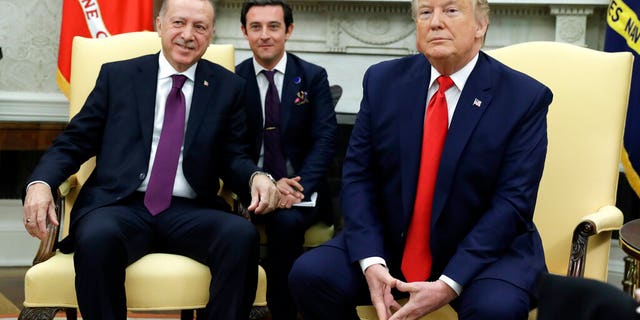
President Trump tore into House Democrats' ongoing impeachment inquiry Wednesday
during a press conference with Turkey President Recep Tayyip Erdogan,
decrying the hearsay-laden "witch hunt" and saying he hadn't watched
that day's public hearing "for one minute."
"This is a sham, and
shouldn't be allowed -- it was a situation that as caused by people who
couldn't have allowed it to happen. I want to find out who's the
whistleblower," the president said, claiming that the whistleblower
behind the impeachment inquiry has made provably inaccurate statements.
"I'm
going to be releasing, I think on Thursday, [another] transcript, which
actually was the first of the two [phone calls with Ukraine's leader],"
he said.
The White House has already released a transcript
of Trump's July 25 call with Ukraine's president, in which the two
discussed past U.S. "support" for Ukraine, as well as Ukraine's issues
with corruption. On the call, Trump asked Ukraine to investigate reports
that Ukraine was involved in 2016 election interference. The president
also mentioned Joe Biden's push to have Ukraine's chief prosecutor
fired, and suggested the country look into the matter.
Asked at
the press conference about acting ambassador to Ukraine Bill Taylor's
testimony about an alleged July 26 phone call between the president
and U.S. envoy to the European Union Gordon Sondland, Trump said: "I
know nothing about that -- first time I've heard it."
Taylor testified, for
the first time, that the president was overheard by a member of his
staff on July 26 asking Sondland about “the investigations,” to which
Sondland responded that “the Ukrainians were ready to move forward.”
Taylor said that following Sondland’s call with Trump, the member of his
staff asked what Trump thought about Ukraine.
“Ambassador
Sondland responded that President Trump cares more about the
investigations of Biden, which Giuliani was pressing for,” Taylor said,
revealing new information from his prior testimony last month. “At the
time I gave my deposition on October 22, I was not aware of this
information. I am including it for completeness.”
At
the press conference, the president pointed to Sondland's written
testimony: "The one thing I've seen that Sondland said, he did speak to
me for a brief moment, he did speak to me for a brief moment -- [he
testified previously that] I said, no 'quid pro quo,' under any
circumstances. And that's true. In any event, it's more second-hand
information. ... The only thing, and I guess Sondland has stayed with
his testimony, that there was no quid-pro-quo, pure and simple."
Trump
added that witnesses summoned by Democrats during the impeachment
hearings had produced "all third-hand information" and unreliable
hearsay. "This statement that I made, the whole call that I made with
the president of Ukraine, was a perfect one. ... I'd much rather focus
on peace in the Middle East."
Despite a BBC report that Erdogan
had recently thrown a letter from Trump in the trash, Erdogan began the
news conference by telling reporters Trump was a "good friend." Trump
reciprocated, calling the autocrat a "great president" and claiming that
Turkey had a "great relationship with the Kurds."
Erdogan announced
that between six months to two years from now, Turkey could repatriate
about one million refugees into a safe zone established in northern
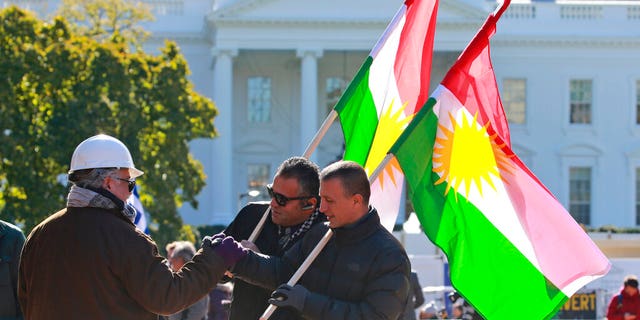
Syria. Outside the White House, dozens of Kurds and their supporters
waved Kurdish and American flags in protest.
The
press conference came after the two leaders met in the White House, and
followed a meeting with five Republican senators, including Ted Cruz of
Texas and Lindsey Graham of South Carolina. (After Trump urged his
Erdogan to call on “a friendly reporter from Turkey," Graham reportedly turned to an ABC News reporter to
remark, “There aren’t any others left.” The president joked afterward
that the Turkish reporter Erdogan called on appeared to work for the
Turkish government.)
Trump and Erdogan in the Oval Office. (AP Photo/ Evan Vucci)
In a statement late Wednesday, Graham vowed that
the United States "cannot and will not abandon our Syrian Democratic
Forces (SDF) allies," and added: "I realize Turkey has legitimate
national security concerns regarding certain Kurdish elements of the
U.S.-led counter-ISIS coalition, but Turkey’s incursion into Syria has
been incredibly disruptive. I believe it is possible to deal with
Turkey’s national security concerns by creating a Safe Zone, but Turkey
cannot do it through force of arms.
“As to Turkey’s purchase of
the S-400 Russian missile system: it is almost a universally held
position in Congress that the S-400 is incompatible with the F-35
fighter," Graham continued. "Turkey’s activation of the Russian S-400
will require the U.S. to keep Turkey from the F-35 program and issue
sanctions. I’m hopeful we can find a way forward with the S-400 where
Turkey’s national security needs can be met without compromising the
F-35 program."
Erdogan and Trump had a difficult agenda for their
talks, which included Turkey's decision to buy a Russian air defense
system despite Ankara's membership in NATO and its incursion into
neighboring Syria to attack Kurdish forces that have fought with the
U.S. against the Islamic State (ISIS) group.
Despite those
disputes, Trump said the two countries were poised to agree to increase
U.S. goods and services trade with Turkey, which totaled about $24
billion in 2017.
Trump defended his decision to invite Erdogan
despite Turkey’s widely denounced advance into Syria. He said that he
and Turkey’s president have been “very good friends” for a long time and
understand each other’s country.
“We’re
going to be expanding,” Trump said. “We think we can bring trade up
very quickly to about $100 billion between our countries.”
The
president was "pleased" that Turkey was increasing spending on its own
defense, and noted that other NATO allies have been lagging behind.
"I
know that the ceasefire, while complicated, is moving forward -- and
moving forward at a very rapid clip," Trump said, later adding
that Turkey's acquisition of advanced Russian military equipment
presents "serious challenges."
Demonstrators hold Kurdistan flags in front of the White House as
thy protest Erdogan's visit Wednesday. (AP Photo/Steve Helber)
Republican lawmakers have pressed Erdogan about why
Turkey bought the S-400 Russian air defense missile system. The U.S. and
fellow NATO nations say the S-400 would aid Russian intelligence and
compromise a U.S.-led fighter jet program.
The U.S. has since
kicked Erdogan out of a multinational program producing components of
America's high-tech F-35 fighter jet. In response, Erdogan attended an
air show this summer in Moscow and expressed interest in buying the
latest Russian Su-35 fighter jets.
"We have a lot of trade with
Turkey, but it could be many times higher ... We intend to bring it up
to about $100 billion, which would be about four times what it is now,"
Trump said.
Trump also said Turkey has been helping the U.S. "a lot" in fighting ISIS.
Meanwhile,
in the Senate, two Democrats introduced legislation denouncing Turkey's
targeting of journalists, political opponents, dissidents, minorities
and others. They said the Turkish government has imprisoned more than
80,000 Turkish citizens, closed more than 1,500 nongovernmental
organizations on terrorism-related grounds and dismissed or suspended
more than 130,000 civil servants from their jobs.
In October,
Trump moved U.S. forces out of the way of invading Turkish troops, a
decision that critics said amounted to abandoning America's Kurdish
allies, but that Trump defended as an important end to an otherwise
"endless" military engagement in the Middle East.
Trump
administration officials have said Trump told Turkey not to invade
Syria. But when Erdogan insisted, they say, Trump decided to move 28
Green Berets operating on the Turkey-Syria border so they wouldn't be
caught in a crossfire between Turkish-backed forces and the Kurds.
"I think a tremendous amount of progress is being made," Trump said. Fox News' Chad Pergram and The Associated Press contributed to this report.
All eyes were on moderate House Democrats in swing districts Wednesday night, after the first day of public hearings in the impeachment inquiry against President Trump
wrapped up with no major revelations -- but also highlighted weaknesses
in Democrats' key witnesses, who relied primarily on second-hand
information and never once interacted with the president.
At one point in Wednesday's hearing, Rep. Mike Quigley, D-Ill., even appeared to embrace hearsay testimony, claiming
that "hearsay can be much better evidence than direct" and that
"countless people have been convicted on hearsay because the courts have
routinely allowed and created, needed exceptions to hearsay." It was
unclear which of those limited exceptions would apply to Wednesday's
testimony -- and whether Quigley's argument would persuade critical
swing-vote Democrats.
The House is now comprised of 431 members,
meaning Democrats need 217 yeas to impeach Trump. There are currently
233 Democrats, so Democrats can only lose 16 of their own and still
impeach the president. 31 House Democrats represent more moderate
districts that Trump carried in 2016.
Freshman Rep. Elissa
Slotkin, D-Mich. -- who flipped a GOP district in 2018 that Trump won by
7 points in 2016 -- told Fox News that she was tentatively weighing all
the evidence.
"My constituents expect me to make an objective
decision," Slotkin said as the hearings concluded, "not one based on an
hour of testimony."
Slotkin went on to acknowledge that launching an impeachment inquiry was a "politically tough thing to do."
"I'm
not waking up in the morning looking for some golden poll," Slotkin
said, insisting that she would analyze all testimony carefully in the
coming days.
Reports have emerged that,
should Trump be impeached by a majority vote in the House, Senate
Republicans might strategically hold a lengthy trial to "scramble" the
2020 Democratic presidential primary -- including by requiring several
of the contenders to remain in Washington to handle the trial. Trump is
all but certain to be acquitted by the GOP-controlled Senate in the
event of impeachment, given that a two-thirds vote is required in the
Senate to remove the president.
As the public hearing wrapped up
on Wednesday, the panel voted 13-9, along party lines, to table a
Republican motion to subpoena the whistleblower -- signaling that not
many minds had been swayed.
A
GOP source close to the House Intelligence Committee told Fox News late
Wednesday that Republicans have full confidence in counsel Steve
Castor, and he will continue to lead the questioning in the next round
of public impeachment hearings. GOP members were pleased with his
questioning today, the source said.
The day offered one previously
undisclosed allegation. Career diplomat William Taylor, the charge
d’affaires in Kiev, offered testimony, for the first time, that the
president was overheard by a member of his staff on July 26 asking EU
Ambassador Gordon Sondland about “the investigations,” to which Sondland
supposedly responded that “the Ukrainians were ready to move forward.”
Taylor said that following Sondland’s call with Trump, the member of his
staff asked what Trump thought about Ukraine.
“Ambassador
Sondland responded that President Trump cares more about the
investigations of Biden, which Giuliani was pressing for,” Taylor said,
revealing new information from his prior testimony last month. “At the
time I gave my deposition on October 22, I was not aware of this
information. I am including it for completeness.”
But, Republicans
pointed out that Taylor's testimony was unverifiable hearsay, several
layers deep -- and that Sondland has previously testified that Trump
explicitly told him there were "no quid pro quo’s of any kind" with
Ukraine, including one in which military aid would be conditioned on any
politically motivated investigations.
"'Ambassador Taylor recalls
that Mr. [Tim] Morrison told Ambassador Taylor that I told Mr. Morrison
that I had conveyed this message to Mr. [Andriy] Yermak on September 1,
2019, in connection with Vice President Pence’s visit to Warsaw and a
meeting with President [Volodymyr] Zelensky,'" Ohio GOP Rep. Jim Jordan
said, incredulously reading a statement from Sondland.
"We’ve got
six people having four conversations in one sentence, and you just told
me this is where you got your 'clear understanding,'" Jordan continued,
as Taylor appeared to laugh. "Ambassador, you weren't on the call, were
you? You've never talked to Chief of Staff [Mick] Mulvaney? You've never
met the president. ... And you're their star witness?"
Even CNN analyst Jeffrey Toobin noted that Democrats had a "problem," in
that their key witnesses Wednesday had never directly interacted with
Trump. "And, that's a problem if you're going to impeach the president,"
Toobin said.
Jordan also reminded viewers that President Obama
had declined to provide lethal aid to Ukraine, even after Russia's
invasion. Trump, on the other hand, eventually provided Javelin
missiles. And, Ukraine's president has said he felt no pressure, improper or otherwise, from the Trump administration to engage in any investigations.
Trump,
for his part, said he was too busy to watch on Wednesday and denied
having such a phone call. "First I've heard of it," he said when asked.
At a news conference with Turkey's leader, Trump vowed to release another transcript of an earlier call with Ukraine on Thursday. He called Democrats' efforts a hopeless "witch hunt."
The
president pointed to Sondland's written testimony: "The one thing I've
seen that Sondland said, he did speak to me for a brief moment, he did
speak to me for a brief moment -- [he testified previously that] I said,
no 'quid pro quo,' under any circumstances, and that's true. In any
event, it's more second-hand information. ... The only thing, and I
guess Sondland has stayed with his testimony, that there was no
quid-pro-quo, pure and simple."
Media observers questioned whether
the proceedings ultimately would sway any opinions, or make things any
easier for moderate Democrats. ABC News' George Stephanopoulos mused
on-air, "part of me is wondering, what do facts matter anymore in these
debates?"
Meanwhile, Christian Jacobs, 50, sat in a beach bar in
St. Petersburg, wearing a fedora and reluctantly watching the drama on
television, as The Associated Press put it.
"I
did not want this," Jacobs, a Democrat, said, glancing at the TV and
vaping. He said he had been leaning closer toward impeachment.
"I'm so afraid, left to his own devices, what else he may do," Jacobs said of Trump.
"I did not want this." — Christian Jacobs, 50, wearing fedora and sipping marijuana vape pen
Anthony
Harris, cutting hair in Savannah, Georgia, had the hearing on in his
shop, but he said, "It's gotten to the point now where people are even
tired of listening."
Lawmakers largely signaled that the hours of
partisan back-and-forth did not appear to leave a singular moment etched
in the public consciousness the way the Watergate proceedings or former
President Clinton's impeachment did.
"No real surprises, no bombshells," said committee member Rep. Chris Stewart, R-Utah.
Taylor and Kent had defied White House instructions not to appear. Both received subpoenas.
They
were among a dozen current and former officials who already testified
behind closed doors. Wednesday was the start of days of public hearings
expected to stretch into next week.
All day, the diplomats
testified about how an ambassador was fired, the new Ukraine government
was confused and they discovered an "irregular channel" -- a shadow U.S.
foreign policy orchestrated by the president's personal lawyer Rudy
Giuliani which raised alarms in diplomatic and national-security
circles.
For their part, Republican lawmakers observed that the president -- not unelected career bureaucrats -- dictated foreign policy.
At its core, the inquiry has stemmed from Trump’s July 25 phone call when he asked Zelensky for "a favor."
The White House already has released a transcript of
the call, in which the two discussed past U.S. "support" for Ukraine,
as well as Ukraine's issues with corruption. On the call, Trump asked
Kiev to investigate reports that Ukraine was involved in 2016 election interference.
Later
on, the president also mentioned former Vice President Joe Biden's push
to have Ukraine's chief prosecutor fired, and suggested the country
look into the matter.
The call came a day after former Special
Counsel Robert Mueller's widely derided appearance on Capitol Hill
appeared to leave Democrats' hopes for impeachment dashed. Fox News' Chad Pergram, Brooke Singman and The Associated Press contributed to this report.
Rep. Paul Gosar,
R-Ariz., slammed his former colleague Katie Hill who had criticized his
cryptic Epstein tweets, telling her she taught the country a new word:
"throuple."
Hill criticized Gosar over a series of tweets that
spelled out "Epstein didn't kill himself." The saying has been appearing
in memes and on social media. Hill blasted him for "tweeting out real
conspiracy theories."
"No like this actually happened. Real
members of Congress tweeting out real conspiracy theories. In an
acrostic no less," Hill tweeted.
Gosar fired back, "You’re
surprised by me? You single-handedly taught an entire country a new
word. #throuple," Gosar reacted. "And wth is up with that tattoo?
Relax."
"Throuple," which is a term to describe a three-person
relationship, was the arrangement Hill reportedly had with her estranged
husband and a female campaign staffer. Hill accused her estranged
husband of leaking the nude photos as "revenge porn" amid their messy
divorce. Hill's attorneys also vehemently denied allegations made in
a DailyMail story that one of the nude photos shows a “Nazi-era Iron
Cross” tattoo.
Gosar drew some attention to his Twitter account on
Wednesday with a series of tweets he wrote in reaction to the
ongoing testimony of U.S. diplomat Bill Taylor and State Department
official George Kent as the first witnesses in a public impeachment
hearing of President Trump, sharing videos and articles that memorialized the event.
"Evidence
of a link between foreign aid and political investigations simply does
not exist. The longer this circus continues the clearer it becomes that
@realDonaldTrump has done absolutely nothing wrong," Gosar wrote on his
official Twitter account.
Before that, "President @realDonaldTrump
voluntarily chose to release the transcript of his phone call which
clearly shows he did nothing wrong. This impeachment circus is a total
sham, and Adam Schiff is the clown at the center of it all."
And,
before that, "Schiff’s star witness is crumbling under pressure. He
wasn’t listening to the phone call and he has never even met President
Trump."
However, the Daily Wire and
others took notice that as readers scrolled down Gosar's profile, the
first letters of each tweet spelled, "Epstein didn't kill himself."
The "Epstein didn't kill himself" meme has spread like wildfire after the death of convicted pedophile Jeffrey Epstein.
The New York City medical examiner determined he had taken his own
life, but vocal skeptics have suggested otherwise during random
blurt-outs on television and other signs.
In a statement to Fox
News, Gosar stressed that his tweets were all "substantive" but appeared
to have some more fun in the process.
"All of the tweets pertained to testimony from today’s hearing.
Rest assured, they are substantive.
Every one of them.
All of them.
5 were brilliant.
1 was ok.”
In other words, "Area 51."
Hill
resigned from Congress earlier this month after she was accused of
having multiple inappropriate relationships with subordinates, including
a congressional staffer that prompted an investigation from the House
Ethics Committee.
Donald Trump Jr. reacted to the first day of public hearings in the impeachment inquiry against his father on Wednesday saying, ‘‘I’ve never seen anything more ridiculous.”
The first day of public hearings wrapped up with no major revelations -- but he said it also highlighted weaknesses in Democrats' key witnesses, who relied primarily on second-hand information.
Speaking on “Hannity” on Wednesday night, Trump was quick to point that out.
"You
see exactly what America voted against in 2016, career government
bureaucrats doing their thing,” the executive vice president of the
Trump Organization said.
“Everything was hearsay, ‘I heard it from
a friend, who heard it from a friend, how heard it from a friend.’ I’m
saying, ‘this is a joke.’”
At one point in Wednesday's hearing, Rep. Mike Quigley, D-Ill., even appeared to embrace hearsay testimony, claiming
that "hearsay can be much better evidence than direct" and that
"countless people have been convicted on hearsay because the courts have
routinely allowed and created, needed exceptions to hearsay." It was
unclear which of those limited exceptions would apply to Wednesday's
testimony -- and whether Quigley's argument would persuade critical
swing-vote Democrats.
Trump commented on Quigley’s statements
telling Sean Hannity, “Then I heard the Democrats, and this is when you
realize how bad or, frankly, nonexistent their case is, ‘well hearsay is
often times much better than regular evidence.’ I’m saying, ‘did that
guy say that with a straight face?’”
Trump then compared Quigley’s comments to “the telephone game we learned about in Kindergarten.”
“So
it’s better to have heard it from a friend who heard it from a friend
who heard it from a friend than to have heard it with your own ears? I
mean that’s the level of insanity that you’re seeing from these
bureaucrats who’ve taken an anti-Trump position,” he said.
Earlier
Wednesday Trump Jr. also tweeted about Quigley’s comments writing, “Can
you believe this insanity? “Heresay [sic] can be much better evidence
than DIRECT EVIDENCE” according to Democrat Mike Quigley. Are you
fricken kidding me? 3rd and 4th party info better than hearing it
yourself?”
On "Hannity" Trump said, “When Republicans start questioning, [House Intelligence Committee Chairman] Adam Schiff
changes the rules, changes the goal posts, pretends they can’t even ask
that question anymore. It’s never ending. It’s a comedy at this point.”
The House is now comprised of 431 members, meaning Democrats need 217 yeas to impeach Trump.
There are currently 233 Democrats, so Democrats can only lose 16 of
their own and still impeach the president. 31 House Democrats represent
more moderate districts that Trump carried in 2016.
Trump
Jr. told Hannity on Wednesday that the left “is not looking to govern,
they’re not looking to do anything, they are looking to try to resist.
Because they know they can’t beat Trump in the polls, they’re going to
try to impeach and it’s not going to work in the long run and the
American people see through it. They are sick of this garbage.” Fox News’ Gregg Re contributed to this report.
WASHINGTON (AP) — The closed doors of the Trump impeachment investigation are swinging wide open.
When
the gavel strikes at the start of the House hearing Wednesday morning,
America and the rest of the world will have the chance to see and hear
for themselves for the first time about President Donald Trump’s actions
toward Ukraine and consider whether they are, in fact, impeachable
offenses.
It’s a remarkable moment, even for a White House full of them.
All on TV, committee leaders will set the stage,
then comes the main feature: Two seasoned diplomats, William Taylor,
the graying former infantry officer now charge d’affaires in Ukraine,
and George Kent, the deputy assistant secretary in Washington, telling
the striking, if sometimes complicated story of a president allegedly
using foreign policy for personal and political gain ahead of the 2020
election.
So
far, the narrative is splitting Americans, mostly along the same lines
as Trump’s unusual presidency. The Constitution sets a dramatic, but
vague, bar for impeachment, and there’s no consensus yet that Trump’s
actions at the heart of the inquiry meet the threshold of “high crimes
and misdemeanors.”
Whether
Wednesday’s proceedings begin to end a presidency or help secure
Trump’s position, it’s certain that his chaotic term has finally arrived
at a place he cannot control and a force, the constitutional system of
checks and balances, that he cannot ignore.
The
country has been here just three times before, and never against the
backdrop of social media and real-time commentary, including from the
president himself.
“These
hearings will address subjects of profound consequence for the Nation
and the functioning of our government under the Constitution,” said
Democratic Rep. Adam Schiff of California, the chairman of the
Intelligence Committee leading the inquiry, in a memo to lawmakers.
Schiff
called it a “solemn undertaking,” and counseled colleagues to “approach
these proceedings with the seriousness of purpose and love of country
that they demand.”
“Total impeachment scam,” tweeted the president, as he does virtually every day.
Impeachments
are rare, historians say, because they amount to nothing short of the
nullification of an election. Starting down this road poses risks for
both Democrats and Republicans as proceedings push into the 2020
campaign.
Unlike
the Watergate hearings and Richard Nixon, there is not yet a “cancer on
the presidency” moment galvanizing public opinion. Nor is there the
national shrug, as happened when Bill Clinton’s impeachment ultimately
didn’t result in his removal from office. It’s perhaps most like the
partisanship-infused impeachment of Andrew Johnson after the Civil War.
Trump
calls the whole thing a “witch hunt,” a retort that echoes Nixon’s own
defense. Republicans say Democrats have been trying to get rid of this
president since he first took office, starting with former special
counsel Robert Mueller’s investigation into Russian interference to help
Trump in the 2016 election.
Democratic
House Speaker Nancy Pelosi was initially reluctant to launch a formal
impeachment inquiry. As Democrats took control of the House in January,
Pelosi said impeachment would be “too divisive” for the country. Trump,
she said, was simply “not worth it.”
After
Mueller’s appearance on Capitol Hill in July for the end of the Russia
probe, the door to impeachment proceedings seemed closed.
But the next day Trump got on the phone.
For
the past month, witness after witness has testified under oath about
his July 25 phone call with Ukraine’s newly elected president, Volodymyr
Zelenskiy, and the alarms it set off in U.S. diplomatic and national
security circles.
In
a secure room in the Capitol basement, current and former officials
have been telling lawmakers what they know. They’ve said an earlier
Trump call in April congratulating Zelenskiy on his election victory
seemed fine. The former U.S. reality TV host and the young Ukrainian
comedian hit it off.
But in the July call, things turned.
An
anonymous whistleblower first alerted officials to the phone call. “I
have received information from multiple U.S. Government officials that
the President of the United States is using the power of his office to
solicit interference from a foreign country in the 2020 election,” the
person wrote in August to the House and Senate Intelligence committees.
Democrats fought for the letter to be released to them as required.
“I am deeply concerned,” the whistleblower wrote.
Trump
insisted the call was “perfect.” The White House released a rough
transcript. Pelosi, given the nod from her most centrist freshman
lawmakers, opened the inquiry.
“The president has his opportunity to prove his innocence,” she told Noticias Telemundo on Tuesday.
Defying
White House orders not to appear, witnesses have testified that Trump’s
acting chief of staff, Mick Mulvaney, was withholding U.S. military aid
to the budding democracy until the new Ukraine government conducted
investigations Trump wanted into Democrats in the 2016 election and his
potential 2020 rival, Joe Biden, and his son, Hunter.
It
was all part of what Taylor, the long-serving top diplomat in Ukraine,
called the “irregular” foreign policy being led by Trump’s personal
attorney, Rudy Giuliani, outside of traditional channels.
Taylor
said it was “crazy” that the Trump administration was withholding U.S.
military assistance to the East European ally over the political
investigations, with Russian forces on Ukraine’s border on watch for a
moment of weakness.
Kent,
the bowtie-wearing State Department official, told investigators there
were three things Trump wanted of Ukraine: “Investigations, Biden,
Clinton.”
On
Friday, the public is scheduled to hear from Marie Yovanovitch, the
former U.S. ambassador to Ukraine, who told investigators she was warned
to “watch my back” as Trump undercut and then recalled her.
Eight more witnesses will testify in public hearings next week.
“What
this affords is the opportunity for the cream of our diplomatic corps
to tell the American people a clear and consistent story of what the
president did,” said Rep. Mike Quigley, D-Ill., a member of the
Intelligence panel.
“It takes a lot of courage to do what they are doing,” he said, “and they are probably just going to be abused for it.”
Republicans,
led on the panel by Rep. Devin Nunes, a longtime Trump ally from
California, will argue that none of those witnesses has first-hand
knowledge of the president’s actions. They will say Ukraine never felt
pressured and the aid money eventually flowed, in September.
Yet Republicans are struggling to form a unified defense of Trump. Instead they often fall back on criticism of the process.
Some
Republicans align with Trump’s view, which is outside of mainstream
intelligence findings, that Ukraine was involved in 2016 U.S. election
interference. They want to hear from Hunter Biden, who served on the
board of a gas company in Ukraine, Burisma, while his father was the
vice president. And they are trying to bring forward the still-anonymous
whistleblower, whose identity Democrats have vowed to protect.
The
framers of the Constitution provided few details about how the
impeachment proceedings should be run, leaving much for Congress to
decide. Democrats say the White House’s refusal to provide witnesses or
produce documents is obstruction and itself impeachable.
Hearings
are expected to continue and will shift, likely by Thanksgiving, to the
Judiciary Committee to consider actual articles of impeachment.
The House, which is controlled by Democrats, is expected to vote by Christmas.
That would launch a trial in the Senate, where Republicans have the majority, in the new year.
___
Associated Press writer Mary Clare Jalonick in Washington contributed to this report.
President Trump’s senior adviser Jared Kushner and other White House officials are planning to set up web cameras to livestream construction along the border wall, according to a report.
Kushner
first offered the proposal during a July meeting, pitching the idea as a
way to confront criticism that Trump has not followed through on his
signature 2016 campaign promise, The Washington Post reported, citing
unnamed officials
U.S.
Army Corps of Engineers and senior U.S. Customs and Border Protection
officials have told Kushner they’re opposed to the initiative because
certain construction contractors do not want their proprietary
techniques shown to competitors, the sources told the Post.
Trump
reportedly asked Kushner to reinvent messaging and communication about
the border wall project after the government shutdown last year. The
current website for the CBP shows information about construction along
the border, but a new site, currently being designing by Trump
administration’s chief digital officer Ory Rinat, will reportedly
incorporate the live camera feeds, allowing the public to visibly track
the wall’s progress.
Under the Trump administration, 81 miles of
border wall, most of which was built as "replacement" barrier to
reinforce older fencing, has been completed. The new barriers built of
steel bollards stand anywhere from 18 to 30 feet tall.
An
additional 155 miles of border fencing is currently under construction.
And 273 miles are under “preconstruction,” according to the most recent
CBP data. The Trump administration aims to build a total of 400 to 500
miles of border wall to complete the project. The project has been
facing delays as officials work to acquire privately held land in Texas
along the U.S.-Mexico border. It has cost taxpayers $10 million to date,
the Post reported.


 Trump and Erdogan in the Oval Office. (AP Photo/ Evan Vucci)
 Demonstrators hold Kurdistan flags in front of the White House as
thy protest Erdogan's visit Wednesday. (AP Photo/Steve Helber)
Demonstrators hold Kurdistan flags in front of the White House as
thy protest Erdogan's visit Wednesday. (AP Photo/Steve Helber)




 CNN’s Scott Jennings once again took liberals to the cleaners on the Abrego Garcia case, the ‘Maryland man...
