All eyes were on moderate House Democrats in swing districts Wednesday night, after the first day of public hearings in the impeachment inquiry against President Trump
wrapped up with no major revelations -- but also highlighted weaknesses
in Democrats' key witnesses, who relied primarily on second-hand
information and never once interacted with the president.
At one point in Wednesday's hearing, Rep. Mike Quigley, D-Ill., even appeared to embrace hearsay testimony, claiming
that "hearsay can be much better evidence than direct" and that
"countless people have been convicted on hearsay because the courts have
routinely allowed and created, needed exceptions to hearsay." It was
unclear which of those limited exceptions would apply to Wednesday's
testimony -- and whether Quigley's argument would persuade critical
swing-vote Democrats.
The House is now comprised of 431 members,
meaning Democrats need 217 yeas to impeach Trump. There are currently
233 Democrats, so Democrats can only lose 16 of their own and still
impeach the president. 31 House Democrats represent more moderate
districts that Trump carried in 2016.
Freshman Rep. Elissa
Slotkin, D-Mich. -- who flipped a GOP district in 2018 that Trump won by
7 points in 2016 -- told Fox News that she was tentatively weighing all
the evidence.
"My constituents expect me to make an objective
decision," Slotkin said as the hearings concluded, "not one based on an
hour of testimony."
Slotkin went on to acknowledge that launching an impeachment inquiry was a "politically tough thing to do."
"I'm
not waking up in the morning looking for some golden poll," Slotkin
said, insisting that she would analyze all testimony carefully in the
coming days.
Reports have emerged that,
should Trump be impeached by a majority vote in the House, Senate
Republicans might strategically hold a lengthy trial to "scramble" the
2020 Democratic presidential primary -- including by requiring several
of the contenders to remain in Washington to handle the trial. Trump is
all but certain to be acquitted by the GOP-controlled Senate in the
event of impeachment, given that a two-thirds vote is required in the
Senate to remove the president.
As the public hearing wrapped up
on Wednesday, the panel voted 13-9, along party lines, to table a
Republican motion to subpoena the whistleblower -- signaling that not
many minds had been swayed.
A
GOP source close to the House Intelligence Committee told Fox News late
Wednesday that Republicans have full confidence in counsel Steve
Castor, and he will continue to lead the questioning in the next round
of public impeachment hearings. GOP members were pleased with his
questioning today, the source said.
The day offered one previously
undisclosed allegation. Career diplomat William Taylor, the charge
d’affaires in Kiev, offered testimony, for the first time, that the
president was overheard by a member of his staff on July 26 asking EU
Ambassador Gordon Sondland about “the investigations,” to which Sondland
supposedly responded that “the Ukrainians were ready to move forward.”
Taylor said that following Sondland’s call with Trump, the member of his
staff asked what Trump thought about Ukraine.
“Ambassador
Sondland responded that President Trump cares more about the
investigations of Biden, which Giuliani was pressing for,” Taylor said,
revealing new information from his prior testimony last month. “At the
time I gave my deposition on October 22, I was not aware of this
information. I am including it for completeness.”
But, Republicans
pointed out that Taylor's testimony was unverifiable hearsay, several
layers deep -- and that Sondland has previously testified that Trump
explicitly told him there were "no quid pro quo’s of any kind" with
Ukraine, including one in which military aid would be conditioned on any
politically motivated investigations.
"'Ambassador Taylor recalls
that Mr. [Tim] Morrison told Ambassador Taylor that I told Mr. Morrison
that I had conveyed this message to Mr. [Andriy] Yermak on September 1,
2019, in connection with Vice President Pence’s visit to Warsaw and a
meeting with President [Volodymyr] Zelensky,'" Ohio GOP Rep. Jim Jordan
said, incredulously reading a statement from Sondland.
"We’ve got
six people having four conversations in one sentence, and you just told
me this is where you got your 'clear understanding,'" Jordan continued,
as Taylor appeared to laugh. "Ambassador, you weren't on the call, were
you? You've never talked to Chief of Staff [Mick] Mulvaney? You've never
met the president. ... And you're their star witness?"
Even CNN analyst Jeffrey Toobin noted that Democrats had a "problem," in
that their key witnesses Wednesday had never directly interacted with
Trump. "And, that's a problem if you're going to impeach the president,"
Toobin said.
Jordan also reminded viewers that President Obama
had declined to provide lethal aid to Ukraine, even after Russia's
invasion. Trump, on the other hand, eventually provided Javelin
missiles. And, Ukraine's president has said he felt no pressure, improper or otherwise, from the Trump administration to engage in any investigations.
Trump,
for his part, said he was too busy to watch on Wednesday and denied
having such a phone call. "First I've heard of it," he said when asked.
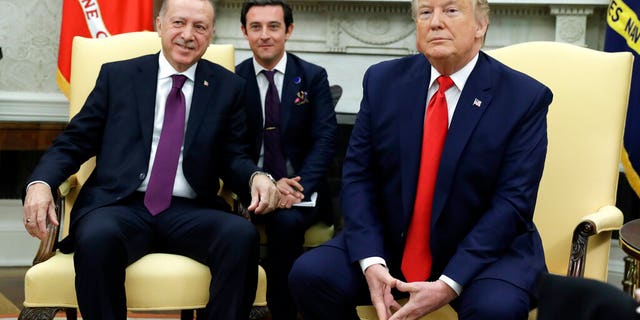
At a news conference with Turkey's leader, Trump vowed to release another transcript of an earlier call with Ukraine on Thursday. He called Democrats' efforts a hopeless "witch hunt."
The
president pointed to Sondland's written testimony: "The one thing I've
seen that Sondland said, he did speak to me for a brief moment, he did
speak to me for a brief moment -- [he testified previously that] I said,
no 'quid pro quo,' under any circumstances, and that's true. In any
event, it's more second-hand information. ... The only thing, and I
guess Sondland has stayed with his testimony, that there was no
quid-pro-quo, pure and simple."
Media observers questioned whether
the proceedings ultimately would sway any opinions, or make things any
easier for moderate Democrats. ABC News' George Stephanopoulos mused
on-air, "part of me is wondering, what do facts matter anymore in these
debates?"
Meanwhile, Christian Jacobs, 50, sat in a beach bar in
St. Petersburg, wearing a fedora and reluctantly watching the drama on
television, as The Associated Press put it.
"I
did not want this," Jacobs, a Democrat, said, glancing at the TV and
vaping. He said he had been leaning closer toward impeachment.
"I'm so afraid, left to his own devices, what else he may do," Jacobs said of Trump.
"I did not want this."
— Christian Jacobs, 50, wearing fedora and sipping marijuana vape pen
Anthony
Harris, cutting hair in Savannah, Georgia, had the hearing on in his
shop, but he said, "It's gotten to the point now where people are even
tired of listening."
Lawmakers largely signaled that the hours of
partisan back-and-forth did not appear to leave a singular moment etched
in the public consciousness the way the Watergate proceedings or former
President Clinton's impeachment did.
"No real surprises, no bombshells," said committee member Rep. Chris Stewart, R-Utah.
Taylor and Kent had defied White House instructions not to appear. Both received subpoenas.
They
were among a dozen current and former officials who already testified
behind closed doors. Wednesday was the start of days of public hearings
expected to stretch into next week.
All day, the diplomats
testified about how an ambassador was fired, the new Ukraine government
was confused and they discovered an "irregular channel" -- a shadow U.S.
foreign policy orchestrated by the president's personal lawyer Rudy
Giuliani which raised alarms in diplomatic and national-security
circles.
For their part, Republican lawmakers observed that the president -- not unelected career bureaucrats -- dictated foreign policy.
At its core, the inquiry has stemmed from Trump’s July 25 phone call when he asked Zelensky for "a favor."
The White House already has released a transcript of
the call, in which the two discussed past U.S. "support" for Ukraine,
as well as Ukraine's issues with corruption. On the call, Trump asked
Kiev to investigate reports that Ukraine was involved in 2016 election interference.
Later
on, the president also mentioned former Vice President Joe Biden's push
to have Ukraine's chief prosecutor fired, and suggested the country
look into the matter.
The call came a day after former Special
Counsel Robert Mueller's widely derided appearance on Capitol Hill
appeared to leave Democrats' hopes for impeachment dashed.
Fox News' Chad Pergram, Brooke Singman and The Associated Press contributed to this report.