An appearance by conservative writer Ann Coulter at the University of California at Berkeley drew a crowd of protesters Wednesday night, in the latest episode of "cancel culture" on the nation's college campuses.
"Multiple" mask-wearing protesters were arrested, campus police confirmed on Twitter.
Covering
faces is a violation of campus protest policy, the Bay Area's FOX
2 reported. The station said as many as seven people were arrested.
Video
posted online showed Coulter being quickly escorted past protesters
into the building where the event, titled, “Adios, America,” was held.
It was hosted by the Berkeley campus' College Republicans.
Coulter
started speaking about 15 minutes late because attendees had trouble
getting through a “human chain” of protesters who tried to block
ticketholders from getting inside the building.
“They can protest
all they want and shout their slogans – free speech – I’m cool with
that, but I am not cool with having somebody block our way getting in,”
said Derrick Main, a Marin County Republican Central Committee member.
He told FOX 2 he paid $45 for his ticket.
“They can protest all they want and shout their slogans ... but I am not cool with having somebody block our way getting in.” — Derrick Main, speech attendee
Conservative writer Andy Ngo posted video that appeared to show a woman having her ticket stolen.
Some of the protesters said they were there to promote left-wing causes.
“We’re here to show our support for DACA and also to protest white supremacy,” Hamid Hakimi, a student protester, told Berkeleyside.
Some protesters said they wanted to see the event shut down, but others agreed Coulter had a right to speak.
“I think it’s important that we hear people like her speak to know that this is real,” a student named Aurora told FOX 2.
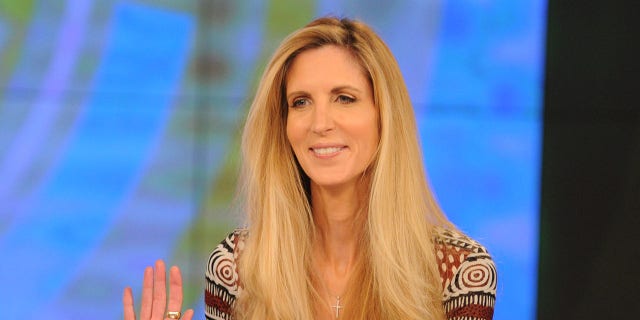
Ann Coulter appears on "The View" in 2017. (Getty Images)
“What we’re doing by protesting is showing that her
specific speech is not welcome here,” student Gianluca Pedrani told the
station.
“What we’re doing by protesting is showing that her specific speech is not welcome here.” — Gianluca Pedrani, student
There were two protesters inside the event, but only one was removed because the other agreed to be silent, FOX 2 reported.
The
Berkeley campus is frequently the center for free speech debates. in
September 2017 a scheduled four-day event dubbed Free Speech Week was canceled over safety concerns. Protesters had sought to silence a featured speaker, provocateur Milo Yiannopoulos.
Earlier that year, Coulter canceled an event on the campus, also over safety concerns. She called the situation "a dark day for free speech in America."
“¡Adios, America!: The Left's Plan to Turn Our Country Into a Third World Hellhole,” is a book written by Coulter in 2015.
Senate
Judiciary Committee Chairman Lindsey Graham, R-S.C., told Fox News
Wednesday that Department of Justice Inspector General Michael
Horowitz's report on allegations of Foreign Intelligence Surveillance
Act (FISA) warrant abuse during the 2016 election will be released on
Dec. 9.
During an appearance on "Hannity"
Wednesday, host Sean Hannity noted Horowitz will be coming before
Graham's committee on Dec. 11 to testify on the matter and went on to
ask Graham not to allow a Friday night document "dump" that could
muffle the coverage of the news.
In response, Graham smiled and nodded.
"It'll be December 9th -- you'll get the report," the South Carolina lawmaker said.
"That's locked."
Horowitz told congressional lawmakers in an October letter that his investigation and ensuing report were nearing their conclusion.
The "lengthy"
draft report "concerns sensitive national security and law enforcement
matters," Horowitz wrote in the letter, adding that he anticipated "the
final report will be released publicly with few redactions."
Horowitz noted that he did not anticipate a need to prepare or issue "separate classified and public versions of the report."
"After
we receive the final classification markings from the Department and
the FBI, we will then proceed with our usual process for preparing a
final report, including ensuring that appropriate reviews occur for
accuracy and comment purposes," Horowitz wrote in the letter. "Once
begun, we do not anticipate the time for that review to be lengthy."
Graham further
broke news on "Hannity" when he confirmed he is sending a letter to
Secretary of State Mike Pompeo requesting the transcripts of three phone
calls the senator said then-Vice President Joe Biden had with
then-Ukrainian President Petro Poroshenko.
Graham
said the phone calls coincided with the timeframe in which a Ukrainian
prosecutor, once praised for going after the head of natural gas company
Burisma Holdings -- a person Graham said was known as the "dirtiest guy
in Ukraine" by one top American official -- was fired.
Burisma was the company on which Hunter Biden, the son of the 2020 Democratic candidate, sat on the board.
"I want
to know are there any transcripts or readouts of the phone calls
between the vice president and the president of Ukraine in February
[2016] after the raid on the gas company president's house," said
Graham. "After this raid, Hunter Biden kicks in. Hunter Biden's business
partner meets with [then-Secretary of State] John Kerry, and Vice
President Biden on three occasions makes a phone call to the president
of Ukraine and goes over there in March and they fire the guy, and this
is the same man that the ambassador wanted investigated in 2015."
Graham
added he found it "odd" that instead of lauding the Ukrainian
prosecutor, Viktor Shokin, for investigating the Burisma chairman, he
was instead relieved of his duties.
He said that in 2015,
President Barack Obama's ambassador to Ukraine, Geoffrey Pyatt, said in a
speech he wanted Shokin to be more forceful in his investigation of
domestic corruption.
"The one person he named as being a sleazebag was the president of Burisma," Graham remarked. Fox News' Gregg Re, Mike Emanuel and Brooke Singman contributed to this report.
Justice
Department Inspector General Michael Horowitz appears at the launch of
the Procurement Collusion Strike Force at the Justice Department in
Washington, Tuesday, Nov. 5, 2019. (AP Photo/Cliff Owen)
The DOJ watchdog is highlighting the elevated level of spending at
the FBI in its latest report of the bureau’s finances. In the report,
Inspector General Michael Horowitz said the FBI is spending $42 million
per year on payments to its informants.
Video: Inspector General Michael E. Horowitz
discusses today’s report on the FBI’s Management of its Confidential
Human Source Validation Processes.
However, only 20 percent of the informants reportedly meet the
bureau’s standards. Horowitz found at least one of the FBI’s informants
was a registered child sex offender.
The bureau reportedly has a mounting backlog of new informants
awaiting validation, which the IG said may hinder the FBI’s operations.
“Ineffective management and oversight of confidential sources can
result in jeopardizing FBI operations — placing FBI agents, sources,
subjects of investigation and the public in harm’s way,” stated
Horowitz. “The FBI agreed with all of our recommendations to improve its
management and oversight over this important program.”
The IG also found the FBI failed to provide agents with clear
guidelines on how to work with informants, which made its spending on
informants even less efficient.
President Trump is saying China is not stepping up as trade
negotiations get increasingly complicated and a Phase One deal is
further delayed. On Wednesday, trade officials close to the White House
said that a partial deal could get pushed back to next year.
China is reportedly pushing for an extensive tariff rollback while
the U.S. is demanding a deal that addresses intellectual property and
technology transfer issues. While touring an Apple assembly plant in
Austin, Texas, the president said he will not sign an inadequate deal.
“China would much rather make a trade deal than I would,” stated
President Trump. “I haven’t wanted to do it yet…because I don’t think
they’re stepping up to the level that I want.”
Speaking during a cabinet meeting on Tuesday, the president said he’s
considering raising tariffs on China if they can’t make a deal. Another
round of tariffs is set to go into effect December 15th.
The Trump administration had originally planned to sign the deal at
the APEC Summit in Chile this month, but that event was canceled amid
violent protests in the capital city. Talks have since hit a snag as
Beijing pushes for a full tariff rollback from the U.S.
Chinese media has since reported that although Beijing wants a deal, they are pessimistic it will get done.
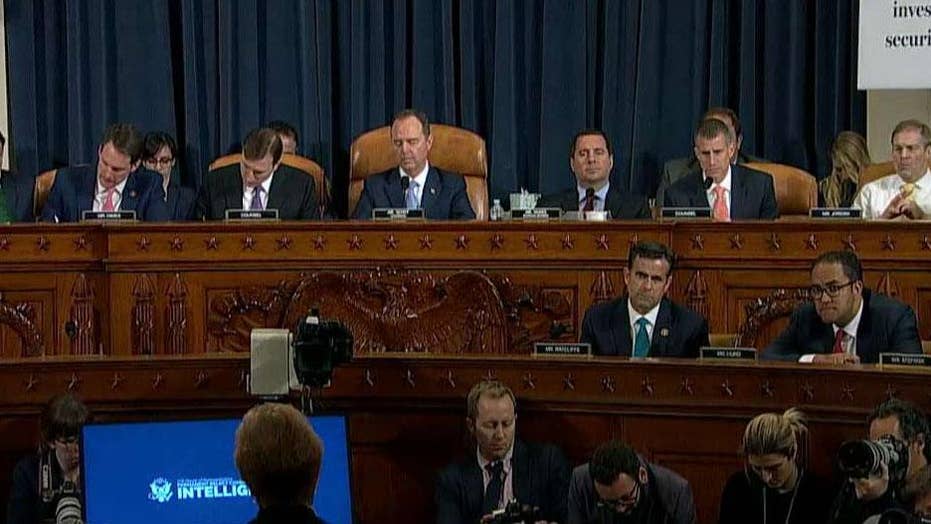
WASHINGTON (AP) —
Two top national security aides who listened to President Donald Trump’s
call with Ukraine are preparing to testify in the impeachment hearings,
launching a week of back-to-back sessions as Americans hear from those
closest to the White House.
Lt.
Col. Alexander Vindman, an Army officer at the National Security
Council, and Jennifer Williams, his counterpart at Vice President Mike
Pence’s office, both say they had concerns as Trump spoke on July 25
with the newly elected Ukraine president about political investigations
into Joe Biden.
After
they appear Tuesday morning, the House will hear in the afternoon from
former NSC official Timothy Morrison and Kurt Volker, the former Ukraine
special envoy.
In all, nine current and former U.S. officials are testifying in a pivotal week as the House’s historic impeachment inquiry
accelerates and deepens. Democrats say Trump demanded that Ukraine
investigate his Democratic rivals in return for U.S. military aid it
needed to resist Russian aggression and that may be grounds for removing the 45th president. Trump says he did no such thing and the Democrats just want him gone.
“I
did not think it was proper to demand that a foreign government
investigate a U.S. citizen,” said Vindman, an Iraq War veteran. He said
there was “no doubt” what Trump wanted from Ukrainian President
Volodymyr Zelenskiy.
It
wasn’t the first time Vindman, a 20-year military officer, was alarmed
over the administration’s push to have Ukraine investigate Democrats, he
testified.
Earlier,
during an unsettling July 10 meeting at the White House, Ambassador
Gordon Sondland told visiting Ukraine officials that they would need to
“deliver” before next steps, which was a meeting Zelenskiy wanted with
Trump, the officer testified.
“He
was talking about the 2016 elections and an investigation into the
Bidens and Burisma,” Vindman testified, referring to the gas company in
Ukraine where Hunter Biden served on the board.
“The Ukrainians would have to deliver an investigation into the Bidens,” he said. “There was no ambiguity.”
On
both occasions, Vindman said, he took his concerns about the shifting
Ukraine policy to the lead counsel at the NSC, John Eisenberg.
Williams,
a longtime State Department official who is detailed to Pence’s
national security team, said she too had concerns during the phone call,
which the aides monitored as is standard practice.
When
the White House produced a rough transcript later that day, she put it
in the vice president’s briefing materials. “I just don’t know if he
read it,” Williams testified in a closed-door House interview.
Sondland, the wealthy donor
whose routine boasting about his proximity to Trump has brought the
investigation to the president’s doorstep, is set to testify Wednesday.
Others have testified that he was part of a shadow diplomatic effort
with the president’s personal lawyer, Rudy Guiliani, outside of official
channels that raised alarms.
Pence’s
role throughout the impeachment inquiry has been unclear, and the vice
president’s aide is sure to be questioned by lawmakers looking for
answers.
The
White House has instructed officials not to appear, and most have
received congressional subpoenas to compel their testimony.
Trump
has already attacked Williams, associating her with “Never Trumpers,”
even though there is no indication the career State Department official
has shown any partisanship.
The
president wants to see a robust defense by his GOP allies on Capitol
Hill, but so far so far Republicans have offered a changing strategy as
the fast-moving probe spills into public view.
That
is likely to change this week as Republicans mount a more aggressive
attack on all the witnesses as the inquiry reaches closer into the White
House and they try to protect Trump.
In
particular, Republicans are expected to try to undercut Vindman,
suggesting he reported his concerns outside his chain of command, which
would have been Morrison, not the NSC lawyer.
Those
appearing in public have already given closed-door interviews to
investigators, and transcripts from those depositions have largely been
released.
Under
earlier questioning, Republicans wanted Vindman to disclose who else he
may have spoken to about his concerns, as the GOP inch closer to
publicly naming the still anonymous whistleblower whose report sparked
the inquiry.
GOP
Sen. Ron Johnson, who was deeply involved in other White House meetings
about Ukraine, offered a sneak preview of this strategy late Monday
when he compared Vindman, a Purple Heart veteran, to the “bureaucrats”
who “never accepted Trump as legitimate.”
“They
react by leaking to the press and participating in the ongoing effort
to sabotage his policies and, if possible, remove him from office. It is
entirely possible that Vindman fits this profile, said Johnson, R-Wis.
Vindman told the House investigators in his earlier testimony he was not the government whistleblower.
The
witnesses are testifying under penalty of perjury, and Sondland already
has had to amend his earlier account amid contradicting testimony from
other current and former U.S. officials.
Morrison
has referred to Burisma as a “bucket of issues” — the Bidens,
Democrats, investigations — he had tried to “stay away” from.
Sondland
met with a Zelenskiy aide on the sidelines of a Sept. 1 gathering in
Warsaw, and Morrison, who was watching the encounter from across the
room, testified that the ambassador told him moments later he pushed the
Ukrainian for the Burisma investigation as a way for Ukraine to gain
access to the military funds.
Volker
provided investigators with a package of text messages with Sondland
and another diplomat, William Taylor, the charge d’affaires in Ukraine,
who grew alarmed at the linkage of the investigations to the aid.
Taylor, who testified publicly last week, called that “crazy.”
A
wealthy hotelier who donated $1 million to Trump’s inauguration,
Sondland is the only person interviewed to date who had direct
conversations with the president about the Ukraine situation.
Morrison
said Sondland and Trump had spoken about five times between July 15 and
Sept. 11 — the weeks that $391 million in U.S. assistance was withheld
from Ukraine before it was released.
Trump has said he barely knows Sondland.
Besides
Sondland, the committee will hear on Wednesday from Laura Cooper, a
deputy assistant secretary of defense, and David Hale, a State
Department official. On Thursday, David Holmes, a State Department
official in Kyiv, and Fiona Hill, a former top NSC staff member for
Europe and Russia, will appear.
___
Associated
Press writers Jill Colvin and Hope Yen in Washington and Bruce
Schreiner in Louisville, Kentucky, contributed to this report.
David
Hale, the State Department’s No. 3 official, testified in a Nov.
6 closed-door deposition that no one in the Trump administration or any
"government channel" ever mentioned former Vice President Joe Biden or
his son Hunter as a reason for withholding aid from Ukraine, according
to a transcript of his remarks released late Monday by House Democrats in their impeachment inquiry.
Democrats
have argued that the White House improperly pressured Ukraine to look
into the Bidens and Burisma Holdings, the natural gas company where
Hunter Biden held a lucrative role despite limited expertise while
his father oversaw Ukraine policy as vice president. George Kent, a
State Department official who has also testified in the impeachment
investigation, said he flagged Hunter Biden's apparent conflict of interest to the Obama administration at the time.
However,
Hale said, he saw the Bidens referenced only in media reports -- as
well as in a "speculative" email from former U.S. Ambassador to Ukraine Marie Yovanovitch, who testified last week. Hale is scheduled to testify publicly Wednesday.
Yovanovitch
"mentioned that Mayor [Rudy] Giuliani might have been motivated
to sully Vice President Biden's reputation by reminding the world of
the issue regarding his son's activities in Ukraine," Hale testified,
referring to President Trump's personal attorney.
"When
the whistleblower reports and all that came out of that, that's when I
first saw this," Hale, the under secretary of state for political
affairs, testified.
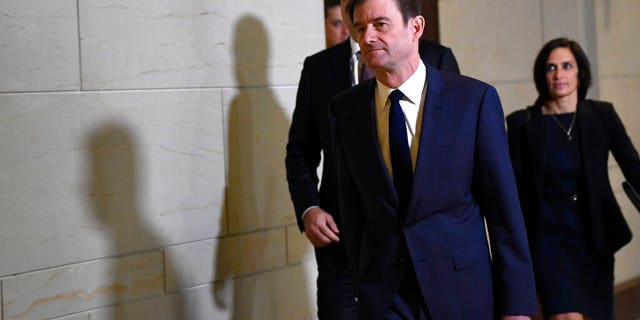
David Hale, Under Secretary of State for Political Affairs,
arrives on Capitol Hill in Washington, Wednesday, Nov. 6, 2019, to be
interview for the impeachment inquiry. (AP Photo/Susan Walsh)
Separately, Hale recalled that representatives from
key executive departments -- including the Treasury Department, Office
of Management and Budget, Department of Homeland Security and State
Department -- "endorsed the resumption of military aid" to Ukraine.
Under
questioning from Democrats, Hale acknowledged he was "out of the loop"
on a variety of matters, and that Ambassador to the European Union
Gordon Sondland didn't brief him about "discussions he was having with
his Ukraine counterparts to either condition the White House meeting or
the aid on these investigations." Additionally, Hale noted that he was
similarly "out of the loop" on acting White House Chief of Staff Mick
Mulvaney's discussions with the president concerning Ukraine aid.
Mulvaney has acknowledged that
White House assistance to Ukraine was tied to the country's broader
anti-corruption efforts, although he did not state that the aid was
linked to a probe of the Bidens in particular.
"This is a corrupt
place. Everyone knows this is a corrupt place ... Plus, I'm not sure
that the other European countries are helping them out either," Mulvaney
said last month. He added: "Did [Trump] also mention to me, in the
past, the corruption related to the DNC server? Absolutely. No question
about that, but that's it, and that's why we held up the money ... The
look back to what happened in 2016 certainly was part of the thing that
he was worried about in corruption with that nation, and that is
absolutely appropriate."
Also late Monday, Democrats released testimony from State Department official David Holmes,
who said in his Nov. 15 deposition that the conversation he overheard
between Trump and Sondland during a lunch in Ukraine was so distinctive —
even extraordinary — that nobody needed to refresh his memory.
Holmes testified
that he told "a number of friends of mine" about the call because it
was "like, a really extraordinary thing" to be "part of" a lunch in
which "someone called the president." He insisted he didn't go into
detail about the call while he boasted about it, but estimated that he
may have told as many as six friends.
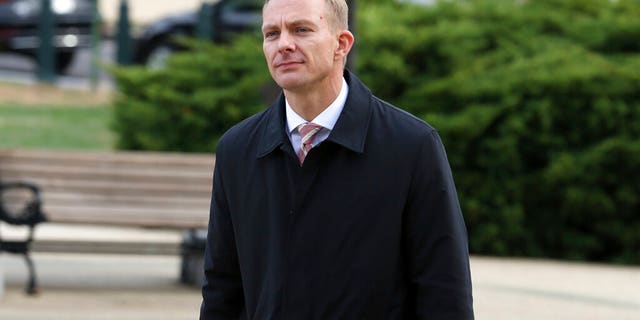
David Holmes appearing on Capitol Hill last week to testify before
congressional lawmakers. (AP Photo/Jose Luis Magana, File)
"I've never seen anything like this," Holmes told
House investigators, "someone calling the president from a mobile phone
at a restaurant, and then having a conversation of this level of candor,
colorful language. There's just so much about the call that was so
remarkable that I remember it vividly."
Holmes testified that
after a bottle of wine, Sondland "said that he was going to call
President Trump to give him an update. Ambassador Sondland placed a call
on his mobile phone, and I heard him announce himself several times,
along the lines of: 'Gordon Sondland holding for the president.' It
appeared that he was being transferred through several layers of
switchboards and assistances. I then noticed Ambassador Sondland’s
demeanor change, and understood that he had been connected to President
Trump."
The
conversation between the president and the ambassador July 26 came one
day after the call between Trump and Ukraine President Volodymyr
Zelensky that led to the impeachment inquiry.
Holmes' account of
the conversation in Kiev was the first to include Trump personally
calling about the investigations into Democrats and Joe Biden.
Holmes,
who joined Sondland and others during the lunch meeting, told
investigators Trump was talking so loudly he could hear the president
clearly on the ambassador's phone.
"I then heard President Trump
ask, quote, 'So he's going to do the investigation?'" Holmes testified.
"Ambassador Sondland replied that 'He's going to do it,' adding that
President Zelensky will, quote, 'do anything you ask him to.'"
Holmes said he didn't take notes of the conversation he overheard between Trump and Sondland but remembered it "vividly."
Pressed
during the interview if anyone helped him recall the details, Holmes
said, "that wouldn’t have been needed, sir, because, as I said, the
event itself was so distinctive that I remember it very clearly."
Holmes
said Sondland announced that the president was "in a bad mood." And,
Holmes said he "asked Ambassador Sondland if it was true that the
president did not give a sh-- about Ukraine. Ambassador Sondland agreed
that the president did not give a sh-- about Ukraine..nope, not at all,
doesn’t give a sh-- about Ukraine."
Holmes said the president
"only cares about 'big stuff.'" Holmes testified that Sondland said that
didn't mean war with Russia, but "this Biden investigation that
Giuliani is pushing."
During a meeting between then-National
Security Advisor John Bolton and Zelensky’s top aide Andriy Bogdan in
Kiev, Holmes served as note-taker. Holmes indicated Bolton was
frustrated "about Giuliani's influence with the president, making clear
that there was nothing he could do about it."
"I
came to believe it was the president's political agenda" that Guiliani
was pursuing in Ukraine, Holmes went on, "because Mr. Giuliani was
promoting that investigations issue, which later I came to understand,
including through these various interactions, that was -- that the
president cared about."
Holmes, a political counselor at the U.S. Embassy in Ukraine, is scheduled to testify publicly Thursday. Fox News' Ashley Cozzolino, Chad Pergram and The Associated Press contributed to this report.
"It was, like, a really extraordinary thing." — State Department official David Holmes, on overhearing Trump's call with Gordon Sondland in a restaurant
For
his part, Trump has insisted Democrats had been out to get him any way
they could. The president has noted, for example, that The Washington
Post discussed the push to impeach Trump just minutes after he took office in 2017 -- and, the Ukraine whistleblower's lawyer openly called for a "coup" and impeachment
around the same time. Prominent Democrats, including Michigan Rep.
Rashida Tlaib, rang in 2019 with colorful vows to impeach Trump.
House
Judiciary Committee Ranking Member Doug Collins, R-Ga., sent a letter
Monday to the panel's chairman, Rep. Jerry Nadler, D-N.Y., panning what
he called the "Democrat impeachment crusade" for lacking the "due
process protections afforded in all past presidential impeachments,
including those protections afforded to President Clinton by
Republicans."
Collins continued, "It is an unfair process for many
other reasons, chief among them the fact that minority questions are
not being answered in depositions and the president’s counsel has had no
voice in the fact-gathering phase of this impeachment inquiry."
For
his part, Trump revealed Monday he was considering an invitation from
House Speaker Nancy Pelosi, D-Calif., to provide his own account to the
House, possibly by submitting written testimony. That would be an
unprecedented moment in this constitutional showdown between the two
branches of U.S. government.
Trump tweeted:
“Even though I did nothing wrong, and don’t like giving credibility to
this No Due Process Hoax, I like the idea & will, in order to get
Congress focused again, strongly consider it!”
But, a Democratic
official working on the impeachment probe told Fox News on Monday that
they weren't taking the offer seriously.
"If President Trump were
serious about providing information to our investigation, he’d stop
obstructing his administration from providing documents and people to
provide testimony," the official said. "There are people who could
testify, including John Bolton and Mick Mulvaney. This is not serious.
We're not going to play that game."
Tuesday’s sessions at the
House Intelligence Committee are to start with Vindman, an Army officer
at the National Security Council, and Jennifer Williams, his counterpart
at Vice President Mike Pence’s office.
The witnesses, both
foreign policy experts, said they listened with concern as Trump spoke
on July 25 with the newly elected Ukraine president. The government
whistleblower’s complaint about that call led the House to launch the
impeachment investigation.
Vindman and Williams said they were
uneasy as Trump talked to Zelensky about investigations of the Bidens.
Vindman also said he reported the call to NSC lawyers.
Williams said she found it "unusual" and inserted the White House's readout of it in Pence's briefing book.
"I
did not think it was proper to demand that a foreign government
investigate a U.S. citizen," Vindman said, adding there was "no
doubt" what Trump wanted.
Pence's role remained unclear. "I just don't know if he read it," Williams testified in a closed-door House interview.
Vindman
also lodged concerns about Sondland, relaying details from
the explosive July 10 meeting at the White House and saying the
ambassador pushed visiting Ukraine officials for the investigations
Trump wanted.
"He was talking about the 2016 elections and an investigation into the Bidens and Burisma," Vindman testified.
Morrison
referred to Burisma as a "bucket of issues" -- the Bidens, Democrats,
investigations -- from which he had tried to "stay away."
Along
with Volker's testimony, their accounts further complicated Sondland’s
testimony and characterized Trump as more central to the action.
Sondland
met with a Zelensky aide on the sidelines of a Sept. 1 gathering in
Warsaw, Poland, and Morrison, who was watching the encounter from across
the room, testified that the ambassador told him moments later he
pushed the Ukrainian for the Burisma investigation as a way for Ukraine
to gain access to the military funds.
Volker
provided investigators with a package of text messages with Sondland
and Taylor, who said he grew alarmed at the possible linkage of the
investigations to the aid.
Republicans are certain to mount a more
aggressive attack on all the witnesses as the inquiry has reached
closer into the White House.
The president has aimed to see a
robust defense by his GOP allies on Capitol Hill, but so far they have
offered a changing strategy as the fast-moving probe spilled into public
view.
Republicans first complained the witnesses were offering
only hearsay, without first-hand knowledge of Trump’s actions. But, as
more witnesses came forward bringing testimony closer to Trump, they
more recently have said the president was innocent because the military
money eventually was released.
Senate Majority Leader Mitch
McConnell, R-Ky., during an appearance Monday in Louisville, Kentucky,
acknowledged the House will likely vote to impeach the president.
But,
the GOP leader said he "can't imagine" a scenario in which there would
be enough support in the Senate -- a supermajority 67 votes -- to remove
Trump from office.
McConnell said House Democrats "are seized
with 'Trump derangement syndrome,'" a catch-phrase used by the
president's supporters. He said the inquiry seemed "particularly
ridiculous since we're going into the presidential election and the
American people will have an opportunity in the very near future to
decide who they want the next president to be."
Pelosi, though, said the president could speak for himself.
"If
he has information that is exculpatory, that means ex, taking away,
culpable, blame, then we look forward to seeing it," she said in a CBS
News interview that aired Sunday. Trump "could come right before the
committee and talk, speak all the truth that he wants if he wants," she
said.
Senate Minority Leader Chuck Schumer, D-N.Y., said Trump
"should come to the committee and testify under oath, and he should
allow all those around him to come to the committee and testify under
oath." He said the White House's insistence on blocking witnesses from
cooperating raised the question: "What is he hiding?"
The White
House has instructed officials not to appear, and most have received
congressional subpoenas to compel their testimony.
Those appearing
in public already have given closed-door interviews to investigators,
and transcripts from those depositions largely have been released.
Sondland is
to appear Wednesday. The wealthy hotelier, who donated $1 million to
Trump’s inauguration, was the only person interviewed to date who had
direct conversations with the president about the Ukraine situation.
Morrison
said Sondland and Trump had spoken about five times between July 15 and
Sept. 11 — the weeks that $391 million in U.S. assistance was withheld
from Ukraine before it was released.
Trump has said he barely knew Sondland.
Besides
Sondland, the committee is set to hear Wednesday from Laura Cooper, a
deputy assistant secretary of defense, and David Hale.
Hale, the State Department’s No. 3 official, testified in a Nov. 6 closed-door deposition that
no one in the Trump administration or any "government channel" ever
mentioned former Vice President Joe Biden or his son Hunter as a reason
for withholding aid from Ukraine, according to a transcript of his remarks released late Monday by House Democrats.
Hale
said he saw the Bidens referenced only in media reports -- as well as
in a "speculative" email from former U.S. Ambassador to Ukraine Marie Yovanovitch, who testified last week. Hale is scheduled to testify publicly Wednesday. Fox News' Chad Pergram, Brooke Singman, and The Associated Press contributed to this report.
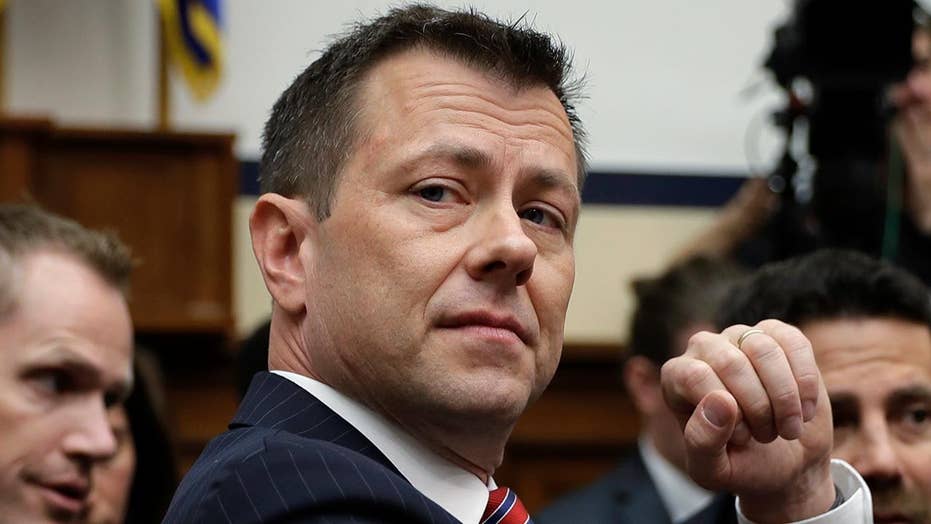
The Department of Justice released documents Monday outlining a slew of "security violations" and flagrantly "unprofessional conduct" by anti-Trump ex-FBI agent Peter Strzok
-- including his alleged practice of keeping sensitive FBI documents on
his unsecured personal electronic devices, even as his wife gained
access to his cell phone and discovered evidence that he was having an
affair with former FBI attorney Lisa Page.
The DOJ was seeking to dismiss Strzok’s
lawsuit claiming he was unfairly fired and deserves to be reinstated as
chief of the counterespionage division at the FBI. In its filing, the DOJ included an August 2018 letter
to Strzok from the DOJ's Office of Professional Responsibility (OPR),
which found in part that Strzok had engaged in a "dereliction of
supervisory responsibility" by failing to investigate the potentially
classified Hillary Clinton emails that had turned up on an unsecured
laptop belonging to Anthony Weiner as the 2016 election approached.
The situation became so dire, OPR said, that
a case agent in New York told federal prosecutors there that he was
"scared" and "paranoid" that "somebody was not acting appropriately" and
that "somebody was trying to bury this."
The
New York prosecutors then immediately relayed their concerns to the
DOJ, effectively going over Strzok's head -- and leading, eventually, to
then-FBI Director James Comey's fateful announcement just prior to
Election Day that emails possibly related to the Clinton probe had been
located on Weiner's laptop.
Additionally, DOJ and OPR noted that
although Strzok claimed to have "double deleted" sensitive FBI materials
from his personal devices, his wife nonetheless apparently found
evidence of his affair on his cell phone -- including photographs and a
hotel reservation "ostensibly" used for a "romantic encounter." Strzok
didn't consent to turning over the devices for review, according to OPR,
even as he acknowledged using Apple's iMessage service for some FBI
work.
"[My wife] has my phone. Read an angry note I wrote but
didn't send you. That is her calling from my phone. She says she wants
to talk to [you]. Said we were close friends nothing more," one of
Strzok's text to Page read, according to the filing.
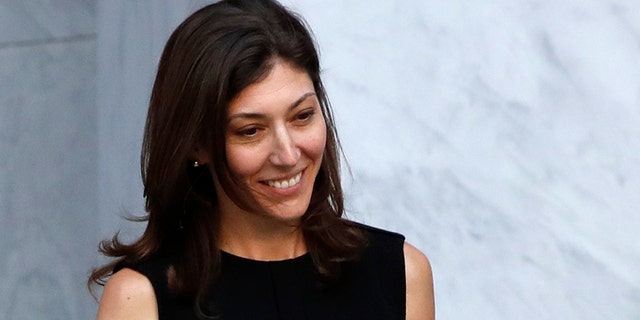
Former FBI lawyer Lisa Page leaves the Rayburn House Office
Building after a closed doors interview with the House Judiciary and
House Oversight and Government Reform committees, Friday, July 13, 2018,
on Capitol Hill in Washington. (AP Photo/Jacquelyn Martin)
"Your wife left me a vm [voicemail]. Am I supposed to
respond? She thinks we're having an affair. Should I call and correct
her understanding? Leave this to you to address?" Page responded.
Strzok
then wrote, "I don't know. I said we were [] close friends and nothing
more. She knows I sent you flowers, I said you were having a tough
week."
Strzok's wife allegedly threatened to send Page's husband some of the photographs from Strzok's phone.
OPR
and the DOJ also included a slew of Strzok and Page's anti-Trump text
messages, which Strzok sent as he was overseeing the 2016 Clinton email
investigation.
An after-hours email sent to Aitan Goelman, a
partner with Zuckerman Spaeder LLP and one of Strzok’s lawyers, was not
immediately returned.’
Strzok, a veteran counterintelligence agent
who led FBI investigations into Hillary Clinton’s use of a private
email server and ties between the Trump campaign and Russia, was removed
from Special Counsel Robert Mueller’s team after his anti-Trump texts
with Page came to light. He was fired from the FBI last August.
The
motion claimed that Strzok cannot succeed on any of his claims. The
document said his key role within the agency on some of its
highest-profile investigations “imposed on him a higher burden of
caution with respect to his speech.”
Strzok, who joined the FBI in
1998 and rose to deputy assistant director of the agency’s
counterintelligence division, exchanged over 40,000 text messages on
government-issued phones from August 2015 through May 2018, the motion
said. One of the messages called then-candidate Trump a “disaster” and
suggested that”[w]e’ll stop” him.
Republicans interpreted the
text as Strzok saying that he would work to prevent Trump from being
elected, but his lawsuit says the message was actually meant to reassure
Page, with whom he was having an affair, that the American people would
not support a Trump candidacy.
"She knows I sent you flowers, I said you were having a tough week." — Text from Peter Strzok to Lisa Page, after Strzok's wife uncovered evidence of apparent affair
Trump
seized on these messages and used Strzok as a favorite target during
the Russia investigation. Trump identified these messages as proof that
the investigators were biased in their investigation.
“It is
because of those text messages, and the paramount importance of
preserving the FBI’s ability to function as a trusted, nonpartisan
institution, that Plaintiff was removed from his position, and not
because of any alleged disagreement with Plaintiff's viewpoints on
political issues or Tweets from the President,” the motion claimed.
The
motion—which identified Attorney General William Barr as the
defendant-- claimed that Strzok’s allegation that his due process rights
were infringed upon would be soundly rejected due to his position on
FBI’s Senior Executive Service at the time of his firing. The department
also claimed that he was “given ample notice and opportunity to be
heard."
Goelman said at the time that Strzok filed the lawsuit
said in a statement, "While many in law enforcement have faced attacks
by this president, Pete Strzok has been a constant target for two years.
It’s indisputable that his termination was a result of President
Trump’s unrelenting retaliatory campaign of false information, attacks
and direct appeals to top officials."
The
lawsuit also says the Justice Department set out to smear Strzok's
reputation and humiliate him when it disclosed nearly 400 text messages
he had sent or received. Fox News' Brooke Singman, Andrew O'Reilly and the Associated Press contributed to this report.