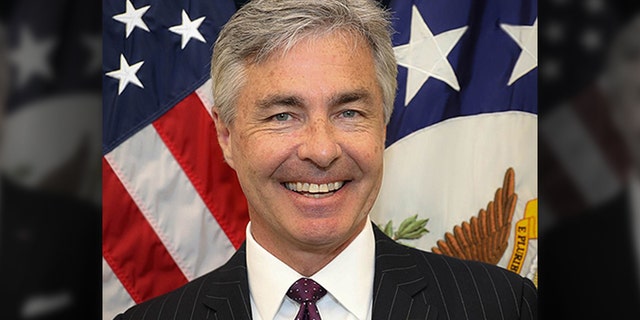
President Trump has nominated retired Rear Adm. Kenneth Braithwaite to assume the position of Navy secretary after the Pentagon ousted Richard Spencer on Sunday amid the ongoing controversy surrounding the handling of a high-profile Navy SEAL case.
Trump
had clashed with the Navy over its plan to convene a review board that
could have led to the loss of SEAL Edward "Eddie" Gallagher's Trident
pin. The president said Gallagher will retire with the pin, and he's
chosen Braitwaite to replace Spencer.
The current U.S. ambassador to Norway and a retired Navy rear admiral, Braithwaite, 59, a native of Michigan, served on the Pentagon's
Trump transition team and was nominated by the president to his current
role in 2018, after the post had been vacant for nearly two years.
In
his capacity as ambassador, Braithwaite scrimmaged with Norway in
September after Trump expressed his displeasure that the country's
defense spending was at 1.62 percent of its gross domestic product (GDP)
-- below the North Atlantic Treaty Organization (NATO) countries'
pledge to spend at least 2 percent. Trump repeatedly has called on Oslo
to boost its defense expenditures, noting the Scandanavian country's
close proximity to Russia.
President Trump on Sunday nominated retired Rear Adm. Kenneth John Braithwaite to become the next Navy secretary.
"Norway is both a founding member of NATO and a key
member of the alliance, and is financially capable of meeting these
commitments," Braithwaite said. "I have emphasized that it is important
for Norway to show leadership and reach the two-percent goal well before
2024."
Braithwaite, if confirmed, would report directly to the president and Defense Secretary Mark Esper to
oversee all aspects of the Navy. A 1984 graduate of the U.S. Naval
Academy with a degree in political science, he later earned a Master’s
degree in government administration from the University of
Pennsylvania in 1995.
Braithwaite trained as a naval aviator, and after 21 years of military service, was the first of his class to earn a flag rank.
In
his first assignment in 1986, he flew anti-submarine missions as a
member of Patrol Squadron 17, stationed at Naval Air Station Barbers
Point in Hawaii, tracking Soviet submarines throughout the Northern and
Western Pacific regions. After a two-year stint in Naval aviation,
Braithwaite became a public affairs officer and rose to chief of public
affairs for Naval Base Philadelphia in 1990.
He initially went to
work on legislative affairs on Capitol Hill, including strategic
communications and public affairs. His job titles included special
assistant in the Navy’s Office of Legislative Affairs and director
of public affairs aboard the aircraft carrier USS America, before
leaving active duty and joining the reserves in 1993.
He assumed
command of the Naval fleet tasked with providing support to the joint
task force commander at Guantanamo Bay, Cuba, in October 2001, shortly
after the terror attacks of Sept. 11.
Braithwaite deployed
overseas several times in the Navy reserves. In 2003, he served a naval
support role as part of the fleet involved in the initial invasion into Iraq.
A
portion of his command supported the naval operations to capture the
port of Umm Qasr in March 2003, which marked the first military
confrontation during the Iraq War to regain control of a key port that
played an important role in the shipment of humanitarian supplies to
Iraqi civilians.
He later deployed to assist with relief efforts after a major 2005 earthquake in Pakistan.
Aside
from his naval service, Braithwaite also served as executive and state
director to U.S. Sen. Arlen Specter of Pennsylvania from 1997-2000.
A
successful businessman, Braithwaite also served in executive positions
at ARCO, a prominent American oil company, and Ascension Health in
Washington, D.C.
In March 2007, Braithwaite was named the senior
vice president of the Hospital & Healthsystem Association of
Pennsylvania and executive director of its Delaware Valley Healthcare
Council lobbying group, which represented more than 50 acute-care
hospitals and 50 other facilities providing health care services to
Southeastern Pennsylvania. That same year, he was promoted to the rank
of rear admiral.
Although Braithwaite's tenure in the Navy and
public service has been seen as relatively free of controversy, he
slammed then-President George W. Bush's proposed cuts to Medicare and
Medicaid as "draconian" in 2008.
Braithwaite retired from the
Naval Reserve in 2011 as a highly decorated rear admiral, his last post
being vice chief of information and head of Naval Reserve public
affairs.
He's
married with two children. His father, Kenneth J. Braithwaite Sr.,
served in World War II and survived being shot in the head soon after
storming Normandy Beach on D-Day, June 6, 1944.
Trump announced the nomination Sunday on Twitter,
writing: "Admiral and now Ambassador to Norway Ken Braithwaite will be
nominated by me to be the new Secretary of the Navy. A man of great
achievement and success, I know Ken will do an outstanding job!"
New York Gov. Andrew Cuomo sparked unnecessary fears on Sunday when he denounced a hoax bomb threat against Times Square, NYPD and City Hall sources told The Post.
The NYPD investigated a Saturday social media post threatening to blast Times Square with
two pounds of explosives, determined the post was a hollow threat, and
decided not to issue a statement on it, lest they stoke public fear —
but that didn’t stop Cuomo from putting out a grandstanding press
release on Sunday.
“There
is no indication that this threat is credible, but with that said,
state police will be on the ground working with NYPD and partners to
step up patrols in the area during the day,” reads the statement, which a
Cuomo spokesperson said was released out of an “abundance of caution.”
A City Hall source called the move “a classic Cuomo publicity stunt.”
While
Cuomo pledged his state cops would work with NYPD, he never actually
spoke with city cops before issuing his declaration, an NYPD source
said, calling it an “odd way of addressing the situation without
contacting PD.”
“Cuomo is always looking for attention, especially
when it involves the city,” another police source added, noting that
Cuomo and Mayor Bill de Blasio “are clearly not friends.”
The
threat went up on Reddit on Saturday and made a reference to “killing
all minorities,” a high ranking police source told The Post.
Another
law enforcement source said the poster threatened “they are bringing
two pounds of explosives to Times Square in New York and ‘setting it
off,’ warning people, ‘don’t go today.’ ”
No
details were made available on how the NYPD determined the threat was
not credible, but the department beefed-up patrols in Midtown on Sunday
as a precaution. Additional reporting by Craig McCarthy and Carl Campanile.
CNN reports that an FBI attorney tampered with documents related to the Carter Page application. How much does it matter?
this
the tip of a scandalous iceberg? Or is it a signal that Inspector
General Michael Horowitz’s much-anticipated report on investigative
irregularities in the Trump-Russia probe will be much ado about nothing much?
A low-ranking FBI
lawyer altered a document that was somehow related to the Obama Justice
Department’s application to the Foreign Intelligence Surveillance Court
(FISC) for a national-security surveillance warrant. The application,
approved by the FISC in October 2016, targeted former Trump campaign
adviser Carter Page — an American citizen, former naval intelligence
officer, and apparent FBI cooperating witness — as a clandestine agent
of Russia.
Apparently,
the document tampering made at least one of the application’s factual
assertions seem more damning than it actually was. The FBI attorney, who
has not been identified, is also said to have falsified an email in an
effort to provide back-up support for the fabricated claim. The lawyer,
who was reportedly pushed out of the bureau when the tampering incident
came to light, was interviewed in Horowitz’s inquiry and is said to be a
subject of the related criminal investigation being conducted by
Connecticut U.S. Attorney John Durham. The
news was broken on Thursday night by CNN. That in itself is
noteworthy. Former FBI Deputy Director Andrew McCabe is a CNN
contributor, and former FBI General Counsel James Baker is a frequent
CNN guest. The IG’s probe has scrutinized the conduct of both.
CNN
commentators also include other former federal law-enforcement
officials, who have ties to the bureau and to some of the former
officials under scrutiny. CNN’s news story about the evidence tampering
is sourced to “several people briefed on the matter,” who were not
identified. The IG report is scheduled to be released on Dec. 9, and
witnesses have recently been permitted to review a draft of it under
tight restrictions. The ‘premise’ of the investigation
CNN
adds that some of the witnesses interviewed expect the IG’s report will
“find mistakes in the FBI’s handling of the FISA process, but that
those mistakes do not undermine the premise for the FBI’s
investigation.” The network describes that premise as the conclusion
“that Russia interfered in the 2016 election.”
HALIFAX,
Nova Scotia (AP) — The secretary of the U.S. Navy said Saturday he
doesn’t consider a tweet by President Donald Trump an order and would
need a formal order to stop a review of a sailor who could lose his
status as a Navy SEAL.
“I
need a formal order to act,” Navy Secretary Richard Spencer said, and
referred to the tweet. “I don’t interpret them as a formal order.”
Trump
insisted last Thursday the Navy “will NOT be taking away Warfighter and
Navy SEAL Eddie Gallagher’s Trident Pin,” inserting himself into an
ongoing legal review of the sailor’s ability to hold onto the pin that
designates him a SEAL.
The
Navy on Wednesday notified Chief Petty Officer Edward Gallagher that he
will face a review early next month to determine if he should remain on
the elite force.
Gallagher
was acquitted of a murder charge in the stabbing death of an Islamic
State militant captive, but a military jury convicted him of posing with
the corpse while in Iraq in 2017. He was then demoted to chief.
Spencer,
speaking on the sidelines of the Halifax International Security Forum
in Canada, said if the president requests the process to stop, the
process stops.
“Good order and discipline is also obeying the orders of the President of the United States,” he said.
Despite
the differing views with the president over the appropriate handling of
the case, Spencer told reporters that he has not threatened to resign
over the issue. But he acknowledged that he serves at the pleasure of
the president.
“The
president the United States is the commander in chief. He’s involved in
every aspect of government and he can make decisions and give orders as
appropriate,” he said.
Gallagher’s
lawyers have accused the Navy of trying to remove the SEAL designation
in retaliation for Trump’s decision last week to restore Gallagher’s
rank.
Gallagher
filed a complaint with the inspector general accusing a rear admiral of
insubordination for defying Trump’s actions. Rear Adm. Collin Green is
the Naval Special Warfare commander.
Under
the review procedure, a five-person board will convene Dec. 2 behind
closed doors. It will include one SEAL officer and four senior enlisted
SEALs, according to the two U.S. officials. Gallagher can appear once
before the board on Dec. 4 but without his lawyers. He can dispute the
evidence given to the board that will include his conviction and call
witnesses.
Gallagher
can appeal any final decision that will be made by the Naval Personnel
Board, which will take into account Green’s input and the board’s
recommendations.
Trump’s
initial order in Gallagher only referred to restoring his rank, but it
did not explicitly pardon the SEAL for any wrongdoing.
Green
also notified three SEAL officers who oversaw Gallagher during the
deployment — Lt. Cmdr. Robert Breisch, Lt. Jacob Portier and Lt. Thomas
MacNeil — that they are also being reviewed, according to the officials.
Removing their Trident pins means they will no longer be SEALs but could remain in the Navy.
TIJUANA,
Mexico (AP) — Nkeze wasn’t home when Cameroonian militants came
knocking, probably to deliver their signature ultimatum to join their
separatist movement or have his writing arm cut off.
The
24-year-old economics student escaped to Douala, the country’s largest
city, only to learn that the government wanted to arrest him for
participating in a university protest. He then flew to Ecuador and
traveled through eight countries to the U.S. border with Mexico,
including a trek through Panamanian jungle where he saw corpses and
refugees crying for shelter, food and water.
In
his quest to settle with relatives in Houston, Nkeze now faces a
potentially insurmountable obstacle: a new American ban forbids anyone
from applying for asylum at the U.S.-Mexico border if they traveled
through another country to get there.
“When
you find yourself on U.S. soil, you are well-protected,” Nkeze said,
sounding upbeat as he waited in Tijuana for a chance to make his case.
“You are protected by human rights.” He spoke to The Associated Press on
the condition that he be identified only by his last name due to safety
concerns.
The U.S. is increasingly aligning itself with wealthy countries in Europe and elsewhere to make asylum a more distant prospect.
On
Thursday, American authorities sent a Honduran man from El Paso, Texas,
to Guatemala. It marked the first time the U.S. government directed an
asylum-seeker back to that country under the new policy, which gave him
an option to file a claim there. He decided against filing a claim and
returned to Honduras, according to Guatemala’s foreign ministry.
Asylum
was once almost an afterthought, until an unprecedented surge of
migrants made the United States the world’s top destination in 2017,
according to the United Nations Refugee Agency. The U.S. held its leading position last year, followed by Peru, Germany, France and Turkey.
Nearly
half of the roughly 1 million cases in backlogged U.S. immigration
courts are asylum claims, with most from Guatemala, El Salvador and
Honduras.
Trump
has called asylum “a scam” and declared that the country is “full.” In
nine months, the administration returned more than 55,000 asylum-seekers
to Mexico to wait for their cases to wind through U.S. courts. Another
asylum ban on anyone who crosses the border illegally from Mexico is
temporarily blocked in court.
It’s unclear how the ban will be rolled out.
The
U.S. Homeland Security Department did not comment on Thursday’s initial
flight, which got a bare-bones announcement from Guatemala’s foreign
ministry. The U.S. has struck agreements with Guatemala, El Salvador and
Honduras that aim to send back asylum-seekers who pass through their
countries, but the Central American nations are woefully unprepared to
accept large numbers.
The
U.N. Refugee Agency said Tuesday that the ban is at odds with
international law and “could result in the transfer of highly vulnerable
individuals to countries where they may face life-threatening dangers.”
Asylum
is designed for people fleeing persecution based on their race,
religion, nationality, political beliefs or membership in a social
group. It isn’t intended for people who migrate for economic reasons,
but many consider it their best hope of escaping poverty and violence.
The
U.S. isn’t alone in asking other countries to block migrants. After
about 1 million refugees traveled through Turkey and Greece to seek
safety in Europe, the European Union agreed in 2016 to pay Turkey
billions of euros to keep them in refugee camps.
The
EU has also funded the Libyan Coast Guard to stop Africans from
crossing the Mediterranean, where thousands have drowned. Libyan forces
have kept refugees in squalid conditions and inflicted torture.
Since
2001, Australia has intermittently blocked boats from Asia and detained
asylum-seekers on Christmas Island, a tiny Australian territory, or
sent them to Papua New Guinea and Nauru, an island nation of 10,000
people. Australia pays detention costs.
The
U.S. long resettled more refugees than any other country, raising its
ceiling to 110,000 during President Barack Obama’s last year in office.
That practice has been sharply curtailed since Trump took office, with
the country planning to resettle no more than 18,000 refugees in 2020.
“There’s
this race to the bottom around the world, and governments are looking
to each other and trying to figure out what’s the harshest policy they
can get away with,” said David FitzGerald, a sociology professor at
University of California at San Diego and author of “Refuge Beyond
Reach: How Rich Democracies Repel Asylum-seekers.”
Cameroonians
hoping to follow Nkeze’s path face mounting obstacles. Ecuador, the
main gateway from Europe, began requiring visas for Cameroonians and 10
other nationalities in August, including six in Africa. Under heavy
pressure from Trump, Mexico is bottling up Cameroonians and other
U.S.-bound asylum-seekers near its southern border with Guatemala.
Nkeze
walked through Panama’s remote, mostly roadless Darien Gap in less than
four days on his way to the U.S. After giving his tent and raincoat to a
woman who was clinging to life, he slept on a stone and prayed for
clear skies and morning light. Only about a dozen in his group of 40 men
could keep up in a race to a refugee camp on the other side of the
jungle.
When
his 20-day transit permit in Mexico expired, Nkeze helped a friend at a
Tijuana juice factory for a cut of his earnings and lived at a no-frills
hotel in the city’s red-light district.
Even
before the ban, asylum was difficult to get in the U.S. Judges granted
only 21% of cases, or 13,248 out of 62,382, in the 2018 fiscal year.
Nkeze can also ask for two variations of asylum, but they are even
harder to obtain, with 3% succeeding under “withholding of removal” law
and only 2% under the U.N. Convention Against Torture.
“They
essentially want you to bring a note from your torturer before they are
willing to let you stay in the U.S,” said Stephen Yale-Loehr, professor
of immigration law practice at Cornell University.
Nkeze
may have caught a break when a federal judge in San Diego ruled Tuesday
that anyone who appeared at a U.S. border crossing before the ban was
announced July 16 and waited for their names to be called should be
exempt.
He
waited for five months in Tijuana for his turn on a list of nearly 9,000
people seeking asylum at a San Diego border crossing.
When
his name was finally called Nov. 12, he wore a Mexican flag pin on the
chest of his jacket as Mexican authorities escorted him to U.S. border
inspectors. He said it was a show of appreciation.
He was immediately taken into immigration custody and is being held in an Arizona detention center.
___
Associated Press writer Sonia Perez D. in Guatemala City contributed to this report.
FILE
- In this Tuesday, Nov. 12, 2019, file photo, the U.S. Capitol is seen
as the sun sets in Washington. Negotiations on a package of spending
bills to fund the federal government have produced a key breakthrough,
though considerably more work is needed to wrap up the long-delayed
measures. Top lawmakers of the House and Senate Appropriations
committees on Saturday, Nov. 23, confirmed agreement on allocations for
each of the 12 spending bills. (AP Photo/Manuel Balce Ceneta, File)
WASHINGTON
(AP) — Negotiations on a package of spending bills to fund the federal
government have produced a key breakthrough, though considerably more
work is needed to wrap up the long-delayed measures.
Top
lawmakers of the House and Senate Appropriations committees on Saturday
confirmed agreement on allocations for each of the 12 spending bills, a
step that allows negotiations on the $1.4 trillion budget bundle to
begin in earnest to try to pass the measures by a Dec. 20 deadline.
Sen. Richard Shelby, R-Ala., and Rep. Nita Lowey, D-N.Y., announced the agreement on Saturday through aides.
The
measures would fill in the details on this summer’s hard-won budget and
debt deal. The pact is sought by a broad spectrum of GOP defense hawks,
Democrats pressing to maintain recent gains in domestic programs, and a
dwindling cadre of Washington pragmatists eager to demonstrate that
they can make divided government work in an increasingly toxic
atmosphere.
The
talks come as the Democratic-controlled House is driving toward
impeaching President Donald Trump, whose demands for billions of dollars
more for additional wall construction along the U.S.-Mexico border have
slowed the process.
Trump
has little interest in the often-arcane appropriations process, other
than to obtain wall funding and to boast about record Pentagon funding.
The annual spending bills are, however, a top priority for top lawmakers
like Speaker Nancy Pelosi, D-Calif., and Senate Majority Leader Mitch
McConnell, R-Ky., who have wrestled over appropriations for decades.
Trump
has been limited in success in winning wall funding from Congress,
where there is relatively little enthusiasm for the project among his
GOP allies and strong opposition from most Democrats. Congress provided
just $1.4 billion in wall funding last year.
But
Trump has won considerably more money through transfers from Pentagon
accounts by exploiting budget rules. He is seeking $8.6 billion,
including $5 billion for the Department of Homeland Security, but would
win far less under the tentative accord.
Lawmakers
passed a stopgap measure this week to fund the government through Dec.
20. Saturday’s pact opens the door to a final agreement by that date,
though the spending bundling is probably more likely to spill over into
next year.
More than 60 lawsuits filed by California against the Trump administration in less than three years have cost the state's taxpayers $21 million, according to reports.
Since
Trump took office in 2017, California’s Attorney General Xavier Becerra
has sued the administration over issues including Trump's travel
ban, protecting DACA and sanctuary cities, fighting family separations
at the U.S.-Mexico border and plans to construct the border wall,
according to FOX 40 of Sacramento.
Earlier this year, California
challenged Trump’s declaration of an emergency at the southern border
and most recently, Becerra sued the administration over the rollback of
the Endangered Species Act.
Republican strategist Tim Rosales says Becerra’s lawsuits are more about politics than policy, FOX 40 reported.
“This
is politics,” he told the station. “It’s politics by Becerra. He wants
to make a national name for himself. He wants to get himself on the
evening news and this is how you do it if you're the attorney general of
California.”
"It’s politics by Becerra. He wants to
make a national name for himself. He wants to get himself on the evening
news and this is how you do it if you're the attorney general of
California.” — Tim Rosales, GOP strategist
He added that the Trump campaign is fundraising off California’s lawsuits in every other state.
“He’s
gaining support in dozens of other states that look at California and
they say, ‘Hey, look what California is doing,’” Rosales said. “And
California is kind of leading the way in terms of the progressive left
and the far left, and that’s where we’re at right now.”
Becerra’s
office claims the state's lawsuits have never added up to more than
1 percent of the state Department of Justice’s budget.
"He’s
protecting our values,” Democratic political consultant Ed Emerson told
FOX 40. “Separating children from their families, detaining them for
unlimited amounts of time and keeping them in cages. This is not who we
are and California has to step in.”
He said that while the Trump campaign may be fundraising off California’s lawsuits, “so are we.”
In a statement to FOX 40,
Becerra said, “The fact is, I don’t wake up in the morning planning to
pick a fight with the administration. We file lawsuits to stop the Trump
administration from breaking the law and taking actions which would
hurt Californians.”
As of last May, California has gotten favorable rulings in at least 25 of the cases, The Mercury News of San Jose reported.
California's lawsuits
against the Trump administration surpass the 48 lawsuits that Texas
filed against the Obama administration, according to FOX 40.
The New York state lawmaker elected to replace a politician busted for stealing Superstorm Sandy
money has herself raised ethics questions — after trying to score
$100,000 for a group that doesn’t exist, The Post has learned.
Assemblywoman
Mathylde Frontus (D-Brooklyn) tried to land the cash for the Southern
Brooklyn Community Think Tank, which she promised to set up days after
her November 2018 election to “change the face of politics” in the area.
Frontus
said she couldn’t understand all the fuss over her failed
political-pork request. “It’s not an entity, it’s just a name,” said
Frontus, who previously founded two Coney Island-based social services
nonprofits. “It’s not something real.”
Assembly spokesman Mike Whyland insisted Frontus didn’t break any laws because the think tank is merely an “idea.”
But
she never filed paperwork with state or federal authorities to
establish the group — despite asking Assembly Speaker Carl Heastie for
the funding, which he refused.
“How do you ask for $100,000 in
funding for a group that doesn’t exist and think it’s OK?” said one
Brooklyn legislator. “This request reeks of corruption and raises many
legal and ethical questions.”
“How do you ask for
$100,000 in funding for a group that doesn’t exist and think it’s OK?
This request reeks of corruption and raises many legal and ethical
questions.” — Brooklyn legislator
Frontus vowed to create the think tank days after winning the election to replace disgraced ex-Assemblywoman Pam Harris,
who was convicted of misusing Superstorm Sandy repair funds.Government
watchdogs slammed Frontus’ request, saying just asking for the money
raises red flags.
“Elected officials should not [try to] direct
public money to groups they are affiliated with because it creates an
appearance of favoritism,” said Alex Camarda, senior policy advisor for
the good government group Reinvent Albany.
Heastie, he believes,
“rightly turned down” Frontus’ request. State law says lawmakers cannot
“participate in any state contracting decision” that results in payment
to themselves, family or an entity in which they have more than a $1,000
stake. Violators face fines of up to $40,000.
Frontus wrote in
her application to Heastie that the think tank would “promote civic
engagement in southern Brooklyn” and operate under the auspices of the
Jewish Community Council of Greater Coney Island, according to the
funding request obtained by The Post.
She said the group would
hold regular “meetings to retrieve community input regarding key social
problems.” The $100,000, she wrote, would pay for a full-time
coordinator, equipment and supplies.
However, Frontus admitted to
The Post she never filed any paperwork to establish the think tank. Nor,
did she bother to set up social-media accounts for it.
The only online postings reporters could find for the nonprofit were made by the assemblywoman’s work Facebook page.
Albany legislators have a long history of skirting the law at the expense of nonprofits they founded.
Disgraced ex-state Sen. Pedro Espada Jr. was found guilty in 2012 of looting more than $500,000. Former state Sen. Shirley Huntley was convicted stealing from a charity to go on shopping sprees.
The JCC did not return messages.


 President Trump on Sunday nominated retired Rear Adm. Kenneth John Braithwaite to become the next Navy secretary.


