Back when he was New York’s mayor, Mike Bloomberg routinely feuded with the press over his whereabouts.
He
doggedly refused to release his weekend schedule, even if he was
traveling out of town, favoring his own privacy over the public’s right
to know.
Now, as of Sunday, he’s running for president. But one organization that won’t be covering him aggressively is Bloomberg News.
This
is a journalistic giant, churning out 5,000 stories a day, some of them
market-moving. Bloomberg News has 2,700 journalists spread across 150
bureaus around the globe, along with a television network, a magazine
and those extremely lucrative Wall Street terminals.
But after the
77-year-old billionaire jumped into the Democratic race, the news
service’s editor-in-chief, John Micklethwait, issued an edict to his
staff.
“We will continue our tradition of not investigating Mike
(and his family and foundation),” the memo said. And that prohibition
would extend to his rivals in the party because “We cannot treat Mike’s
Democratic competitors differently.”
So everyone from Biden to Bernie to Booker to Bloomberg is off-limits for investigation.
But its team “will continue to investigate the Trump administration as the government of the day.”
If
you wanted to come up with a policy that would seem to favor Bloomberg
and his re-adopted party—he ran for mayor as a Republican—while
disadvantaging the man whose job he wants, it would be hard to beat
this.
I get that it’s a messy situation, but this is a compromise that satisfies precisely no one.
If Bloomberg’s family (and presumably Joe Biden’s son) are off-limits, are Donald Trump’s kids still fair game?
Bloomberg
News has always been squeamish about covering its founder. A similarly
restrictive policy was in place during Mayor Bloomberg’s 12-year tenure.
But now he’s running for the highest office in the land. What issue
doesn’t in some way touch on the presidential campaign?
When the ex-mayor flirted with a 2016 run, Kathy Kiely resigned as Bloomberg News’ political editor because of the same policy.
“I
think that when you're running a political operation as we were that
you should follow every story aggressively, and I felt that we weren't
able to follow this story aggressively,” Kiely told me on “Media Buzz.”
“And that I thought compromised us as an organization. I certainly --- I
certainly felt it compromised me as an editor.”
Megan Murphy,
Bloomberg’s former Washington bureau chief, tweeted that the policy was
“ridiculous” and “not journalism.” She said she threatened to resign
over a similar memo during that 2016 exploration.
The Micklethwait
memo also addresses Bloomberg Opinion. The two top editors, Tim O’Brien
(an MSNBC contributor) and David Shipley, are taking leaves to join the
Bloomberg campaign. Meanwhile, the rest of the editorial board is being
suspended and the section will refuse to publish any outside op-ed on
the 2020 campaign. Closed for business.
The company says it will
assign a reporter to follow the Bloomberg campaign, writing about
speeches, policies and polls. The initial story on the launch said the
candidate is “offering his own mix of moderate policy stances and
experience in business, government and philanthropy as the way to beat
President Donald Trump.”
The editor-in-chief says he doesn’t want
to lay down too many rules so they can adapt to changing circumstances,
and will reassess the situation if Bloomberg wins the nomination.
This
is a dilemma not seen since William Randolph Hearst blatantly used his
newspapers to promote his 1904 presidential bid. But Bloomberg’s company
dwarfs that early 20th-century enterprise.
Other media companies
examine their owners, or corporate parents, with little fuss. The
Washington Post reports on Jeff Bezos and Amazon. ABC sometimes has to
cover Disney. CNN had to cover Time Warner and now AT&T. It’s a fact
of life in the era of corporate media.
Mike Bloomberg, to his
everlasting credit, took a $10-million payout from a Wall Street firm to
launch an incredibly successful business news operation. Many talented
journalists have worked there over the years. It’s a shame that this
short-sighted move could taint its reputation for journalistic
independence.
House Intelligence Committee Chairman Adam Schiff,
D-Calif., announced Monday that Democrats "are now preparing a report"
for the House Judiciary Committee, signaling that his panel is wrapping
up its work and that the next phase of the impeachment inquiry against
President Trump is imminent.
Calling the evidence against the
president "overwhelming, unchallenged and damning," Schiff nevertheless
asserted that investigative work would continue, and left open the
possibility that Democrats would hold additional hearings. But all
scheduled public hearings before Schiff's panel wrapped up on a testy note last week, and no new proceedings are planned.
"As
required under House Resolution 660, the Committees are now preparing a
report summarizing the evidence we have found this far, which will be
transmitted to the Judiciary Committee soon after Congress returns from
the Thanksgiving recess," Schiff wrote in a letter to congressional
colleagues.
He noted that the report "will catalog the instances
of non-compliance with lawful subpoenas as part of our report to the
Judiciary Committee, which will allow that committee to consider whether
an article of impeachment based on obstruction of Congress is warranted
along with an article or articles based on this underlying conduct or
other presidential misconduct. Such obstruction was the basis of the
third article of impeachment against President Richard Nixon."
In a worrying omen for moderate Democrats in swing districts that could have factored into Schiff's decision, polls have shown that independents are souring on the impeachment process. Fifty percent of independents questioned in an NPR/PBS/Marist poll conducted
Nov. 11-15 did not support impeaching and removing Trump from office,
with just 42 percent backing such a move. That’s a slight dip in support
compared with the previous NPR/PBS/Marist poll – conducted the first
week in October – when support stood at 45 percent.
Once
it receives Schiff's report, the House Judiciary Committee has the
option of drafting articles of impeachment outright or holding further
hearings. Under a resolution passed by House Democrats on the Rules Committee this
past October, Trump and the White House potentially would have more
rights to defend themselves in any potential Judiciary Committee
hearings. For example, attorneys for the president could participate in
such proceedings.
But, in a bid for leverage, Chairman Jerrold
Nadler, D-N.Y., would be allowed under the rules to deny "specific
requests" by Trump representatives if the White House continued refusing
to provide documents or witnesses sought by Democratic investigators.
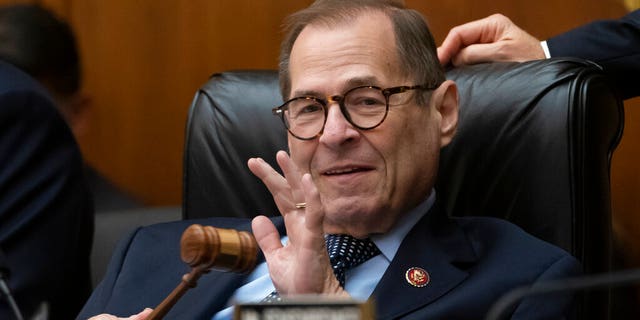
House Judiciary Committee Chairman Jerrold Nadler, D-N.Y., would
oversee the next phase of the impeachment inquiry. (AP Photo/J. Scott
Applewhite)
A possible timetable for impeachment has been
unclear. It’s generally thought the Judiciary Committee may hold a
"markup" in which it writes articles of impeachment in mid-December. If
that were to happen, it's possible the full House could vote on articles
of impeachment sometime close to Christmas. That would be a similar
timeframe to the impeachment of former President Bill Clinton: The House
impeached Clinton just before Christmas in 1998. The Senate trial then
began in January 1999.
Fox News reported last week that Democrats
were considering four articles of impeachment against the president:
Abuse of power, bribery, contempt of Congress, and obstruction of
justice.
At a meeting with top GOP senators and Trump
administration officials at the White House last Thursday, Fox News is
told there was a consensus that should Trump be impeached by the House,
the GOP-controlled Senate should hold a full trial, rather than ignore
the issue.
"Frankly, I want a trial," Trump declared Friday on “Fox & Friends.”
"Frankly, I want a trial." — President Trump
Trump has argued that U.S. Ambassador to the European Union Gordon Sondland's testimony before the Intelligence Committee was
a total exoneration. "I just noticed one thing and that would mean it’s
all over," Trump said on the White House lawn before reading from
handwritten notes taken during Sondland’s testimony. Sondland testified
about a conversation with Trump during which he asked the president what
he wanted from Ukraine.
"It was a very short, abrupt
conversation," the ambassador said. "He was not in a good mood, and he
just said, 'I want nothing. I want nothing. I want no quid pro quo. Tell
Zelensky to do the right thing.' Something to that effect."
Reports have surfaced that
Republicans were considering even holding a long trial to disrupt the
2020 presidential primaries. Several Democrats seeking to unseat Trump
-- including Kamala Harris, Amy Klobuchar, Elizabeth Warren and Bernie
Sanders -- are senators who would need to divert at least some of their
campaigning time toward a potential trial.
Should the House
approve impeachment articles and trigger a trial in the
Republican-controlled Senate, Trump’s allies are already indicating they
will look more closely at allegations involving Democrats -- including
Trump's allegations of corruption against Joe and Hunter Biden involving
their Ukraine dealings.
Additionally, Republicans would likely
focus on Ukrainian meddling in the 2016 election, and defend the
president's push for investigations in that area before releasing any
foreign aid. Numerous media outlets, and a Ukrainian court,
have confirmed that Ukrainian actors meddled in the election, despite
claims by Democrats and many media personalities that the allegations
amount to a "conspiracy theory."
However, the House theoretically
could pass articles of impeachment, but delay a vote to send them to the
Senate for consideration -- perhaps to delay handing Senate Majority
Leader Mitch McConnell, R-Ky., control over the proceedings.
"I
think most everybody agreed there's not 51 votes to dismiss it before
the managers get to call their case," Senate Judiciary Committee
Chairman Lindsey Graham, R-S.C., told Fox News after huddling with other
top Republican senators and White House officials. "The idea you would
dismiss the trial before they presented the cases is a non-starter.
You're not going to get a motion to dismiss."
But, Graham
indicated that any Senate trial wouldn't be pleasant for at least one
Democratic presidential frontrunner. On Thursday, Graham penned a letter
to Secretary of State Mike Pompeo requesting the release of any
documents related to contacts between Biden former Ukrainian President
Petro Poroshenko, and to a meeting between son Hunter Biden’s business
partner and former Secretary of State John Kerry.
The letter pertained to Biden's successful push to have Ukraine's top prosecutor fired by threatening to withhold $1 billion in U.S. aid when he was vice president and in charge of Ukraine policy. The prosecutor was probing Burisma holdings, where Hunter Biden held a highly lucrative role on the board despite having little relevant experience.
Already, some witnesses in the impeachment probe have raised concerns about the Biden's dealings in Ukraine.
Deputy Assistant Secretary of State George Kent, for example, testified behind closed doors last
month that he had qualms about the younger Biden's role on the board of
Burisma. And former U.S. Ambassador to Ukraine Marie Yovanovitch said
she was "aware" of a potential issue, because Obama administration
officials prepped her for questions about Hunter Biden during her
confirmation process.
"I was aware of it because as I told you
before in the deposition, there had been a -- in terms of the
preparation for my Senate confirmation hearings for Ukraine, there was a
question about that and a select answer, so I was aware of it,"
Yovanovitch said.
She added that she was told that if the matter came up, she should refer questions to other departments. Fox News' Jason Donner, Paul Steinhauser, and Brooke Singman contributed to this report.
Eddie Gallagher, the Navy SEAL
at the center of a high-profile standoff between President Trump and
some top officials in the Navy, will retire from active duty and will
not take part in a review board over his conduct in 2017 while deployed,
a Navy spokesman said late Monday.
Gallagher, a highly decorated
SEAL who received two Bronze Stars with V for valor, was acquitted of
murder in the stabbing death of an Islamic State militant captive but
was convicted of posing with the corpse.
Lt. Cmdr. Clay Doss, the Navy spokesman, said there will be no additional information due to privacy concerns.
The announcement was not a surprise. Secretary of Defense Mark Esper said earlier that he was given a direct order by Trump to allow Gallagher to retire without losing his status as a Navy SEAL.
Esper
on Sunday asked for Richard V. Spencer, the secretary of the Navy, to
step down over the handling of the case. Esper claimed that Spencer made
overtures to the White House to rig the disciplinary process to ensure
that Gallagher would keep his Trident.
“I am deeply troubled by
this conduct shown by a senior DOD official,” Esper said on Sunday.
“Unfortunately, as a result, I have determined that Secretary Spencer no
longer has my confidence to continue in his position. I wish Richard
well.”
Spencer’s ousting was not a consequence of standing up for
military justice – but rather was for taking the matter into his own
hands and not going through the proper military channels, the senior
U.S. official told Fox News. He was fired for “lack of candor,” the
official added.
Spencer,
for his part, issued a statement that appeared to suggest his ouster
was a direct result of the Gallagher review. He said, "I no longer share
the same understanding with the Commander in Chief who appointed me, in
regards to the key principle of good order and discipline." Fox News' Jennifer Griffin, Vandana Rambaran, Alex Pappas and Andrew O'Reilly contributed to this report
Michigan
Democratic Rep. Brenda Lawrence, a prominent supporter of Kamala Harris
who has previously supported the impeachment inquiry into President Trump,
abruptly announced Sunday that she no longer saw any "value" in the
process and called for her fellow Democrats to throw their support
behind a symbolic censure resolution.
Lawrence's about-face came as polls have shown that independents are souring on the idea of impeaching and removing Trump from office, including in critical battleground states like Wisconsin, even as House Democrats aggressively presented their poll-tested "bribery" case against the president over the past two weeks.
"We are so close to an election," Lawrence said Sunday on a Michigan radio program,
noting that Trump stands little chance of being convicted by the
GOP-controlled Senate. "I will tell you, sitting here knowing how
divided this country is, I don't see the value of taking him out of
office. But I do see the value of putting down a marker saying his
behavior is not acceptable. It's in violation of the oath of office of a
president of the United States, and we have to be clear that you cannot
use your power of the presidency to withhold funds to get a foreign
country to investigate an American citizen for your own personal gain.
There's no way around that."
Lawrence continued: "I want him
censured. I want it on the record that the House of Representatives did
their job and they told this president and any president coming behind
him that this is unacceptable behavior and, under our Constitution, we
will not allow it. ... I am a Democrat, but I am an independent United
States of America citizen."
Lawrence occupies a safely Democratic
district that includes eastern Detroit, and her reluctance to move
forward with impeachment suggested that moderate Democrats in swing
districts may also be getting cold feet now that all scheduled hearings
in the probe wrapped up last week.
Recent surveys indicate
that even Democratic voters are losing interest in impeachment.
Meanwhile, 50 percent of independents questioned in an NPR/PBS/Marist poll conducted
Nov. 11-15 did not support impeaching and removing Trump from office,
with just 42 percent backing such a move. That’s a noticeable dip in
support compared with the previous NPR/PBS/Marist poll – conducted the
first week in October – when support stood at 45 percent.
And, a Gallup poll conducted
the first two weeks of November indicated that 45 percent of
independent voters supported impeaching and removing the president –
with 53 percent opposing the move. That’s a switch from October, when
the previous Gallup survey put the split at 53-44 percent.
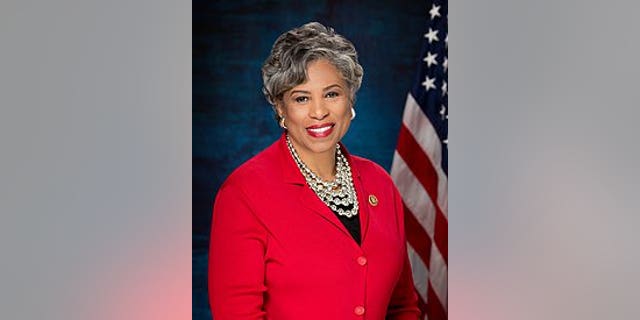
Michigan Democratic Rep. Brenda Lawrence said she no longer sees
any "value" in impeachment, and called for a censure resolution. (House
of Representatives)
Republicans could also use a Senate trial to turn the tables and damage Democrats politically, should the House vote to impeach.
The Washington Examiner noted that in a radio interview Oct. 4, before support for impeachment fell sharply, Lawrence was far more supportive of the proceedings against the president.
"I
feel strongly that for my legacy, for my time in history, sitting here
at this table with an oath of office to protect this country, to protect
the democracy of the United States of America, I cannot sit silent,
that I must move forward with [impeachment] because this is egregious,"
Lawrence said in October.
The House is now comprised of 431
members, meaning Democrats need 217 yeas to impeach Trump. There are
currently 233 Democrats, so Democrats can only lose 16 of their own and
still impeach the president. 31 House Democrats represent more moderate
districts that Trump carried in 2016.
There
have been signs close to home for Lawrence that Democrats should
consider pulling the ripcord on the impeachment process. In an editorial
last week, The Detroit News wrote that the House "should censure, not impeach" the president.
"Democrats
still don't have the strong case they're seeking to justify removing
President Donald Trump from office," the paper wrote. "Censure amounts
to a public shaming. ... But it also recognizes the offense does not
merit removal from office. That, too, seems appropriate, given the
inconclusive testimony so far."
Earlier
this month, freshman Rep. Elissa Slotkin, D-Mich. -- who flipped a GOP
district in 2018 that Trump won by 7 points in 2016 -- told Fox News
that she was tentatively weighing all the evidence.
"My
constituents expect me to make an objective decision," Slotkin said as
the hearings concluded, "not one based on an hour of testimony."
Slotkin went on to acknowledge that launching an impeachment inquiry was a "politically tough thing to do."
The
censure process is not prescribed by the Constitution, and amounts
essentially to a condemnation of conduct, without any substantive
consequence, by a majority vote in either the House or the Senate.
"I don't see the value of taking him out of office. ... I want him censured." — Michigan Democratic Rep. Brenda Lawrence
President Andrew Jackson was
censured in a largely political process by the Senate in 1834, although
it was expunged three years later. Several other U.S. presidents have
been reprimanded by Congress, including Abraham Lincoln, James Buchanan,
and William Howard Taft.
Still, top Democrats have signaled they will go ahead with impeachment, at least for now. House Intelligence Committee Chairman Adam Schiff, D-Calif.,
announced Monday that Democrats "are now preparing a report" for the
House Judiciary Committee, indicating that his panel is wrapping up its
work and that the next phase of the impeachment inquiry is imminent.
Calling
the evidence against the president "overwhelming, unchallenged and
damning," Schiff nevertheless asserted that investigative work would
continue, and left open the possibility that Democrats would hold
additional hearings. But all scheduled public hearings before Schiff's
panel wrapped up on a testy note last week, and no new proceedings are planned.
"As
required under House Resolution 660, the Committees are now preparing a
report summarizing the evidence we have found this far, which will be
transmitted to the Judiciary Committee soon after Congress returns from
the Thanksgiving recess," Schiff wrote in a letter to congressional
colleagues.
He noted that the report "will catalog the instances
of non-compliance with lawful subpoenas as part of our report to the
Judiciary Committee, which will allow that committee to consider whether
an article of impeachment based on obstruction of Congress is warranted
along with an article or articles based on this underlying conduct or
other presidential misconduct. Such obstruction was the basis of the
third article of impeachment against President Richard Nixon."
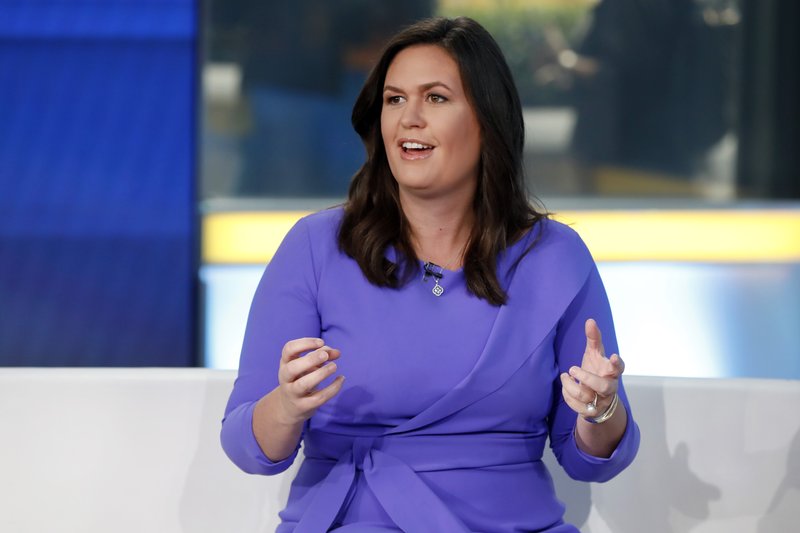
FILE
- In this Friday, Sept. 6, 2019, file photo, Fox News contributor Sarah
Sanders makes her first appearance on the "Fox & Friends"
television program in New York. Former White House press secretary
Sanders is laying the groundwork for a possible run for governor of
Arkansas in 2022. (AP Photo/Richard Drew, File)
HOT
SPRINGS, Ark. (AP) — With paid speeches, a book coming out and
appearances on cable news, Sarah Sanders is following the traditional
route for former press secretaries after leaving the White House as
President Donald Trump’s chief spokeswoman. But she’s also getting
reacquainted with her home state of Arkansas and laying the groundwork
for a potential governor’s race in three years.
Sanders
has begun headlining Republican Party dinners around Arkansas, allowing
her to reconnect with the state she called home before joining the
Trump White House and offer GOP insiders a preview of what she’d look
like as a candidate for the job her dad, Mike Huckabee, held for more
than a decade. Speaking to a ballroom packed with more than 500 people
in Hot Springs last week, the former press secretary known for her
televised sparring with reporters joked about being greeted by applause
when she comes to the podium.
“It’s very different than what I’m used to,” she said.
Sanders
and her husband, a political consultant, moved to Little Rock in late
July with their three children. Since leaving the White House, she’s
joined Fox News as a contributor and announced that she has a book
coming out next year about her time as press secretary. She’s also
delivered paid speeches and is working as a consultant for several
corporations. She waived her speaking fees for local GOP speeches.
Trump
has encouraged her to run for governor in 2022, when Republican Gov.
Asa Hutchinson is barred by term limits from seeking reelection.
Sanders
says she’s seriously looking at running for governor and is taking
steps needed in case she decides to do so, but that her GOP appearances
are about helping the party next year and aren’t about 2022.
“I
think there are two types of people that run for office: people that
are called and people that just want to be somebody, that want a title. I
feel like in some ways, I’ve already hit a pretty good political
title,” Sanders told The Associated Press in an interview.
“If
I do (run), it will because I feel called to do it and because I feel I
can offer something to the state and I can do something to help move
the state further ahead and grow it in a positive way and I fit what the
state needs at that time,” she said.
Sanders’
speeches are so far drawing sold-out crowds, with more than 600
attending an event she headlined in northwest Arkansas earlier this
month. At the Hot Springs event, Sanders talked about her time in the
White House, while also a mother. She told a crowd that included several
people in red “Make America Great Again” hats about her toddler getting
ahold of her phone and sending an emoji-laden tweet from her official
White House account, and choked up when she talked about visiting troops
overseas with the president on Christmas last year.
“Probably
the biggest thing she has is 100 percent name ID and that’s so
difficult to obtain,” said Sen. John Boozman, whose 2010 campaign
Sanders managed. “I think almost every Arkansan knows who Sarah Huckabee
Sanders is.”
Sanders
is looking at a race that was already drawing some of the state’s top
GOP figures. Lt. Gov. Tim Griffin in August said he’s running and has
appeared in TV ads paid for by a nonprofit promoting lower taxes and
STEM education. Another potential candidate, Attorney General Leslie
Rutledge, is frequently on TV in public service announcements on vaping
and other issues. Another potential candidate is state Senate President
Jim Hendren, who is Hutchinson’s nephew. No Democrats have announced or
said they’re taking a look at the race.
Sanders
remains a blank slate on many state issues that would likely come up in
a heated primary. They include the state’s Medicaid expansion, which
has sharply divided Republicans since it was approved six years ago.
Sanders steered clear of state policy in her Hot Springs speech and said
she wants to avoid distracting from Hutchinson’s agenda.
“It’s
time to let the governor do his job and I don’t think it’s helpful for
me to try to play a game from the side. That doesn’t help him. That
doesn’t help the state,” she said.
Such reticence may not be enough for some Republicans if Sanders moves closer toward a gubernatorial bid.
“If
she wants the role of governor, she needs to start speaking on the
issues that confront our state and let us see what it is she would do
and why she should be the candidate we would support,” Republican state
Rep. Les Warren said.
WASHINGTON
(AP) — After two weeks of public hearings, Democrats could soon turn
the impeachment process over to the House Judiciary Committee. They’re
moving “expeditiously” ahead as House Speaker Nancy Pelosi has
instructed.
At
some point in the coming weeks, the House intelligence panel will submit
a report to the Judiciary panel, and then Democrats will consider
drafting articles of impeachment on President Donald Trump’s dealings
with Ukraine and the administration’s attempts to block the
investigation. The articles could cover matters beyond Trump’s efforts
to push Ukraine to investigate Democrats, including special counsel
Robert Mueller’s investigation, but no decisions have been made.
There
could be several steps along the way, including a Judiciary committee
vote, a House floor vote and, finally, a Senate trial.
What’s next in impeachment:
INTELLIGENCE COMMITTEE WRAPS UP
Democrats
on the House intelligence committee believe they have enough evidence
to write a report and move forward. But it’s still unclear whether they
will hear any last-minute testimony.
Democratic
House intelligence committee Chairman Adam Schiff said Sunday he won’t
foreclose the possibility of his committee undertaking more depositions
and hearings in the impeachment inquiry of President Donald Trump.
Schiff said on CNN’s “State of the Union” that his committee continues
to conduct investigative work, but he won’t let the Trump administration
stall the inquiry.
Schiff’s
staff and others are compiling the panel’s findings to submit to the
House Judiciary Committee, which is expected to open its own hearings to
consider articles of impeachment and a formal recommendation of
charges. He said his committee may need to file addendums to its report
so that the Judiciary Committee can move ahead.
“The investigation isn’t going to end,” Schiff said.
Several
potentially key witnesses — former national security adviser John
Bolton, acting White House chief of staff Mick Mulvaney, Energy
Secretary Rick Perry and Secretary of State Mike Pompeo, among others —
have so far declined to provide testimony or documents on Trump’s
orders.
Democrats
have said they don’t want to get tied up in lengthy court battles to
force those witnesses to cooperate with subpoenas. But they could still
hear testimony if one of them changed their mind, or if other key
witnesses emerged.
“We’ve
heard and seen compelling evidence that the president committed serious
wrongdoing,” says Texas Rep. Joaquin Castro, a member of the
intelligence panel. “There are other witnesses, including some principal
witnesses that we would have liked to have heard from, but the evidence
has been pretty damning that the president committed an impeachable
act.”
Time
is running short if the House is to vote on impeachment by Christmas,
which Democrats privately say is the goal. The intelligence panel is
expected to spend the Thanksgiving week writing, and maybe even
completing, a report of evidence gathered through more than six weeks of
closed-door depositions and public hearings.
Once
the report is done, the panel could vote to pass it on to the House
Judiciary Committee. That could happen as soon as the first week of
December, when lawmakers return from the Thanksgiving break.
___
JUDICIARY TAKES CHARGE
Pelosi
has instructed the intelligence panel, along with other committees that
have investigated Trump, to submit evidence to the House Judiciary
Committee. That panel is then expected to hold hearings and vote on
articles of impeachment — a process that could take up the first two
weeks of December.
The
articles of impeachment are expected to mostly focus on Ukraine, though
discussions continue. Democrats are considering an overall “abuse of
power” article against Trump, which could be broken into categories like
bribery or extortion. The article would center on the Democrats’
assertion, based on witness testimony, that Trump used his office to
pressure Ukraine into politically motivated investigations.
Additional
articles of impeachment could include obstruction of Congress and
obstruction of justice. The latter could incorporate evidence from
Mueller’s report.
___
HOUSE FLOOR VOTE
The
Judiciary panel could take several days to debate the articles and then
vote on them — sending impeachment to the House floor, where they could
immediately be called up for consideration. Debate on impeachment would
be handled similarly to any other bill or resolution.
If
articles of impeachment reach the House floor, Democrats will be
looking to peel off Republicans to make the vote bipartisan. So far,
however, it appears few, if any, Republicans will break ranks. Not a
single Republican backed the resolution launching the impeachment
hearings.
Once an impeachment vote is done, Democrats would appoint impeachment managers for a Senate trial.
___
SENATE TRIAL
House
Democrats are hoping to be finished with an impeachment vote by
Christmas, sending articles to the Republican-controlled Senate for a
trial in 2020. Unless political dynamics change, Trump is expected to
have the backing of majority Republicans in that chamber to be
acquitted.
It’s
still unclear how long a trial would last, what it would look like or
what witnesses might be called. Top White House officials met Thursday
with Republican senators to discuss strategy but made no decisions about
the length of a trial or other tactics, two people familiar with the
session said.
Participants
in the meeting expressed more interest in voting as soon as they have
the 51 votes needed to acquit Trump than in setting a specific timetable
for the proceedings, according to one Senate GOP aide.
That
aide and a senior White House official said a trial lasting two weeks
was discussed, but not agreed to. The aides spoke on condition of
anonymity to describe a private meeting.
___
Associated Press writer Alan Fram contributed to this report.
President Trump has nominated retired Rear Adm. Kenneth Braithwaite to assume the position of Navy secretary after the Pentagon ousted Richard Spencer on Sunday amid the ongoing controversy surrounding the handling of a high-profile Navy SEAL case.
Trump
had clashed with the Navy over its plan to convene a review board that
could have led to the loss of SEAL Edward "Eddie" Gallagher's Trident
pin. The president said Gallagher will retire with the pin, and he's
chosen Braitwaite to replace Spencer.
The current U.S. ambassador to Norway and a retired Navy rear admiral, Braithwaite, 59, a native of Michigan, served on the Pentagon's
Trump transition team and was nominated by the president to his current
role in 2018, after the post had been vacant for nearly two years.
In
his capacity as ambassador, Braithwaite scrimmaged with Norway in
September after Trump expressed his displeasure that the country's
defense spending was at 1.62 percent of its gross domestic product (GDP)
-- below the North Atlantic Treaty Organization (NATO) countries'
pledge to spend at least 2 percent. Trump repeatedly has called on Oslo
to boost its defense expenditures, noting the Scandanavian country's
close proximity to Russia.
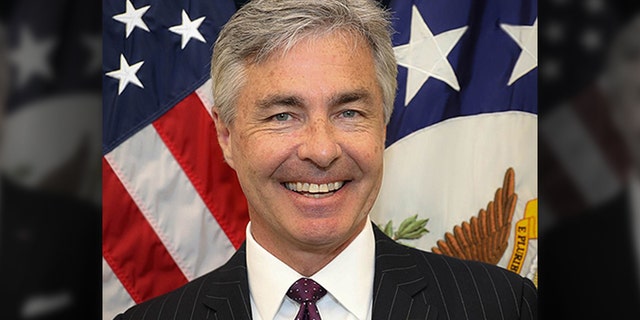
President Trump on Sunday nominated retired Rear Adm. Kenneth John Braithwaite to become the next Navy secretary.
"Norway is both a founding member of NATO and a key
member of the alliance, and is financially capable of meeting these
commitments," Braithwaite said. "I have emphasized that it is important
for Norway to show leadership and reach the two-percent goal well before
2024."
Braithwaite, if confirmed, would report directly to the president and Defense Secretary Mark Esper to
oversee all aspects of the Navy. A 1984 graduate of the U.S. Naval
Academy with a degree in political science, he later earned a Master’s
degree in government administration from the University of
Pennsylvania in 1995.
Braithwaite trained as a naval aviator, and after 21 years of military service, was the first of his class to earn a flag rank.
In
his first assignment in 1986, he flew anti-submarine missions as a
member of Patrol Squadron 17, stationed at Naval Air Station Barbers
Point in Hawaii, tracking Soviet submarines throughout the Northern and
Western Pacific regions. After a two-year stint in Naval aviation,
Braithwaite became a public affairs officer and rose to chief of public
affairs for Naval Base Philadelphia in 1990.
He initially went to
work on legislative affairs on Capitol Hill, including strategic
communications and public affairs. His job titles included special
assistant in the Navy’s Office of Legislative Affairs and director
of public affairs aboard the aircraft carrier USS America, before
leaving active duty and joining the reserves in 1993.
He assumed
command of the Naval fleet tasked with providing support to the joint
task force commander at Guantanamo Bay, Cuba, in October 2001, shortly
after the terror attacks of Sept. 11.
Braithwaite deployed
overseas several times in the Navy reserves. In 2003, he served a naval
support role as part of the fleet involved in the initial invasion into Iraq.
A
portion of his command supported the naval operations to capture the
port of Umm Qasr in March 2003, which marked the first military
confrontation during the Iraq War to regain control of a key port that
played an important role in the shipment of humanitarian supplies to
Iraqi civilians.
He later deployed to assist with relief efforts after a major 2005 earthquake in Pakistan.
Aside
from his naval service, Braithwaite also served as executive and state
director to U.S. Sen. Arlen Specter of Pennsylvania from 1997-2000.
A
successful businessman, Braithwaite also served in executive positions
at ARCO, a prominent American oil company, and Ascension Health in
Washington, D.C.
In March 2007, Braithwaite was named the senior
vice president of the Hospital & Healthsystem Association of
Pennsylvania and executive director of its Delaware Valley Healthcare
Council lobbying group, which represented more than 50 acute-care
hospitals and 50 other facilities providing health care services to
Southeastern Pennsylvania. That same year, he was promoted to the rank
of rear admiral.
Although Braithwaite's tenure in the Navy and
public service has been seen as relatively free of controversy, he
slammed then-President George W. Bush's proposed cuts to Medicare and
Medicaid as "draconian" in 2008.
Braithwaite retired from the
Naval Reserve in 2011 as a highly decorated rear admiral, his last post
being vice chief of information and head of Naval Reserve public
affairs.
He's
married with two children. His father, Kenneth J. Braithwaite Sr.,
served in World War II and survived being shot in the head soon after
storming Normandy Beach on D-Day, June 6, 1944.
Trump announced the nomination Sunday on Twitter,
writing: "Admiral and now Ambassador to Norway Ken Braithwaite will be
nominated by me to be the new Secretary of the Navy. A man of great
achievement and success, I know Ken will do an outstanding job!"
New York Gov. Andrew Cuomo sparked unnecessary fears on Sunday when he denounced a hoax bomb threat against Times Square, NYPD and City Hall sources told The Post.
The NYPD investigated a Saturday social media post threatening to blast Times Square with
two pounds of explosives, determined the post was a hollow threat, and
decided not to issue a statement on it, lest they stoke public fear —
but that didn’t stop Cuomo from putting out a grandstanding press
release on Sunday.
“There
is no indication that this threat is credible, but with that said,
state police will be on the ground working with NYPD and partners to
step up patrols in the area during the day,” reads the statement, which a
Cuomo spokesperson said was released out of an “abundance of caution.”
A City Hall source called the move “a classic Cuomo publicity stunt.”
While
Cuomo pledged his state cops would work with NYPD, he never actually
spoke with city cops before issuing his declaration, an NYPD source
said, calling it an “odd way of addressing the situation without
contacting PD.”
“Cuomo is always looking for attention, especially
when it involves the city,” another police source added, noting that
Cuomo and Mayor Bill de Blasio “are clearly not friends.”
The
threat went up on Reddit on Saturday and made a reference to “killing
all minorities,” a high ranking police source told The Post.
Another
law enforcement source said the poster threatened “they are bringing
two pounds of explosives to Times Square in New York and ‘setting it
off,’ warning people, ‘don’t go today.’ ”
No
details were made available on how the NYPD determined the threat was
not credible, but the department beefed-up patrols in Midtown on Sunday
as a precaution. Additional reporting by Craig McCarthy and Carl Campanile.