Presumptuous Politics

Thursday, November 28, 2019

Ken Cuccinelli, acting DHS deputy, forced to leave bar after being assailed by Martin O'Malley


Acting deputy Homeland Security Secretary Ken Cuccinelli was reportedly forced to leave an event on Thanksgiving eve after former Maryland Gov. Martin O’Malley blasted him for carrying out the Trump administration's immigration policies.
The incident allegedly took place at the Dubliner, an Irish pub on Capitol Hill where Cuccinelli and O’Malley were said to be attending an event with fellow graduates of Gonzaga College High School, according to the Washington Post, which first reported the encounter.
“Martin O’Malley just drove Ken Cuccinelli out of the Dubliner in DC w/ a passion-laced and shame-invoking tirade on behalf of immigrant refugee children!!!” Siobhan Arnold, who's identified as a Villanova University media relations associate and was reportedly at the bar, tweeted late Wednesday.
Speaking to the Post, Arnold said O’Malley used Cuccinelli’s grandparents in a bid to shame him, a remark which she said Cuccinelli barely responded to.
“O’Malley was shouting,” Arnold told the Post. “I don’t think Cuccinelli was responding. I think he’s like, ‘Time to go. Just got here and I’m leaving.’ He pretty much retreated.”
O’Malley, the former Democratic governor of Maryland from 2006 to 2014, and a 2016 presidential candidate who withdrew his White House bid after an early defeat in the Iowa caucuses, defended his actions to the Post.
“We all let him know how we felt about him putting refugee immigrant kids in cages -- certainly not what we were taught by the Jesuits at Gonzaga,” O’Malley said in a text to the Post, adding that Cuccinelli is “the son of immigrant grandparents who cages children for a fascist president.”
A DHS spokesman did not immediately respond to Fox News’ request for comment.
Cuccinelli has been known as one of the Trump administration's most vocal immigration hardliners. He was appointed acting deputy DHS secretary earlier this month under new acting Secretary Chad Wolf, after serving as acting U.S. Citizenship and Immigration Services director. Cuccinelli, along with acting Customs and Border Protection Commissioner Mark Morgan, had been one of the favorites among immigration hawks to lead the department.
But Cuccinelli is not the first Trump administration official to be harassed for his work involving enforcement of President Trump’s immigration policies.
Former Homeland Security Secretary Kirstjen Nielsen was repeatedly heckled for her role in the administration, and was forced, last year, to cut a working dinner short at a Mexican restaurant in Washington after protesters harassed her, shouting “shame!” Former White House Press Secretary Sarah Sanders was also forced to leave a Virginia restaurant during the same time period. Those incidents took place after Trump signed an executive order to stop the administration’s controversial family separation policy.
The president has repeatedly said that the administration has no plans to reinstate that policy and has sought to place blame on former President Barack Obama instead.
“Obama separated the children, just so you understand. President Obama separated the children,” Trump said in April.  “The cages that were shown, very inappropriate, they were built by President Obama and the Obama administration –not by Trump."
He added: “The press knows it, you know it, we all know it. I’m the one that stopped it.”
Initial images of cages with children inside that spread on social media last year indeed were from the Obama administration. The photos, taken in 2014 by The Associated Press, were wrongly described as illustrating imprisonment under the Trump administration.
But while family separations happened under Obama, it became more widespread during the border crisis that occurred during the early part of the Trump administration.
The Associated Press contributed to this report.

Hong Kong protesters praise Trump, Congress for law; Beijing calls move sinister


Pro-democracy protesters in Hong Kong cheered President Trump and members of Congress for passing two laws that support the months-long uprising that has crippled the city while Beijing's anger over the legislation was on full display, calling the move a "nakedly hegemonic act" before summoning the top American diplomat in the country in protest.
The protests in Hong Kong started in June in response to, in part, an extradition bill that would have sent alleged criminals to China to stand trial. The bill never went forward, but the protests remained and only grew in size and violence since June.
Trump signed the bills, which were approved by near-unanimous consent in the House and Senate, even as he expressed some concerns about complicating the effort to work out a trade deal with China's President Xi Jinping.
Up until Wednesday's announcement, Trump did not indicate whether or not he would sign the bill. Secretary of  State Mike Pompeo refused to answer a reporter's question about the president's leanings as recent as Tuesday.
The Hong Kong Human Rights and Democracy Act, which was sponsored by Sen. Marco Rubio, R-Fla., requires that the U.S. conducts yearly reviews into Hong Kong’s autonomy from Beijing. If ever found unsatisfactory, the city's special status for U.S. trading could be tossed.
"I signed these bills out of respect for President Xi, China, and the people of Hong Kong," Trump said in a statement. "They are being enacted in the hope that Leaders and Representatives of China and Hong Kong will be able to amicably settle their differences leading to long term peace and prosperity for all."
The statement did little to calm Beijing. The Chinese foreign ministry said in a statement that the bill will only "strengthen the resolve of the Chinese people, including the Hong Kong people, and raise the sinister intentions and hegemonic nature of the U.S."
The statement continued, "The US side ignored facts, turned black to white, and blatantly gave encouragement to violent criminals who smashed and burned, harmed innocent city residents, trampled on the rule of law and endangered social order."
The statement, which was obtained by Reuters, said the U.S. plot "is doomed" and threatened vague "countermeasures."
The Hong Kong and Macau Affairs Office called the U.S. the "largest black hand causing chaos in Hong Kong."
Carrie Lam's administration said it "strongly opposes and regrets" the laws, according to London’s Independent newspaper. Her office said "Democracy is alive and well" there and pointed to the recent elections that overwhelmingly favored antigovernment candidates.
Protesters, however, cheered the bill and, according to the New York Times, see the measure as a warning to Beijing and Hong Kong.
"I hope it can act as a warning to Hong Kong and Beijing officials, pro-Beijing people and the police," Nelson Lam, 32, told the Times. "I think if they know that what they do may lead to sanctions, then they will become restrained when dealing with protests. We just want our autonomy back. We are not their foe."
The Associated Press contributed to this report

Wednesday, November 27, 2019

2019 Democratic Turkey Cartoons


Impeachment fight leaves voters cold in contested Wisconsin


RACINE, Wis. (AP) — There’s not a lot that Republicans and Democrats in this political battlefield agree on, but the impeachment probe into President Donald Trump may have surfaced one: The public hearings aren’t moving the needle.
“Everything they say, it’s so repetitive. To me, it’s like they’re beating their heads against the wall,” said Harry Rose, a 78-year-old retired factory worker and Trump supporter in Racine County, a swing county in the swing state of Wisconsin.
Nicole Morrison, a 36-year-old nurse who can’t see herself voting for Trump in 2020, had a similar review.
“There’s so much information that sometimes it’s hard to decide which is the truth and which is just rumors,” she said. “So I just don’t pay attention to it.”
After 30 hours of televised hearings, a dozen witnesses, at least a couple of major revelations and scores of tweeted rebuttals, voters in Wisconsin and nationwide aren’t changing their minds about removing the president. If they came into the inquiry defensive of Trump, they likely still are. And if they were inclined to think the president abused his power, they didn’t need televised hearings to prove it.
“For the most part, most Americans already have pretty solidified views of the president,” said Josh Schwerin, senior strategist for the Democratic super PAC Priorities USA. “There’s a small segment of the population that can be moved, and they’re not paying as close attention to the day-to-day ins and outs of the impeachment hearings.”
It’s a disappointing — if not unexpected — response for Democrats, who hoped to use the hearings to sway public opinion. Without that backing, it’s virtually impossible to imagine Republican senators voting to convict Trump.
It’s also a reaction that leaves the political impact of this dramatic chapter in American history remarkably uncertain. If the division on the question holds, and independents remain disengaged, it is possible that impeachment and Senate trial may ultimately play little role in Trump’s reelection bid next year.
Two polls released this week showed the public remains roughly evenly divided over whether Trump should be impeached and removed from office. Although there was a one-time increase in support after the inquiry launched, polls have since remained stable.
A CNN survey conducted over the weekend showed 50% of Americans believe Trump should be impeached and removed from office, roughly the same as in late October and in late September. Meanwhile, Trump’s job approval has remained steady. A Quinnipiac University survey of registered voters nationwide also conducted this past weekend found a similar split on whether Trump should be impeached and removed, and just 13% of those who have an opinion say they might change their mind.
In Wisconsin, views on impeachment appear to be slightly more negative. A Marquette University Law School poll of Wisconsin registered voters that was conducted during the first week of the impeachment hearings showed 47% of registered voters approve of the job Trump is doing, and more expressed opposition than support for impeachment and removal, 53% to 40%, figures largely unchanged from October.
The poll was conducted before U.S. Ambassador to the European Union Gordon Sondland and former top aide Fiona Hill offered testimony that largely corroborated allegations that Trump tried to pressure a foreign government into investigating his political rival Joe Biden.
The entrenched divisions are clear even in Racine County, a place with a history of shifting political winds. The county voted for Democrat Barack Obama in 2008 and 2012, and then swung to support Trump in 2016.
The county, just south of Milwaukee, is divided between the Democratic-leaning electorate in and surrounding Racine, and the more conservative electorate in the rural and suburban areas. Most of the county’s residents worked white-collar jobs in 2019, like administrative services and sales, and the median household income was just under $65,000, slightly above the state average.
If Democrats hope to win it back, they’ll have to persuade voters like Jo-Ann Knutson to come back. The 70-year-old retiree lives in downtown Racine and voted for Trump in 2016 because she didn’t like Democrat Hillary Clinton. She’s been watching the impeachment hearings, but she’s still not sure what to think.
Trump “is not my favorite person, and I don’t care for how he talks about people, but I have not made a firm decision because I don’t think all of the facts are out yet,” she said.
Knutson remembered watching the impeachment proceedings for President Richard Nixon, when she said “you were sure” because there were taped recordings and other firsthand evidence of wrongdoing. Now, she thinks Democrats’ case is based on overheard conversations — and she believes there’s still a possibility Trump could be exonerated, she said.
Knutson said she has “no clue” who she’ll vote for next year.
Morrison, the nurse, also says she’s undecided, though she typically leans Democratic. Impeachment isn’t swaying her, though, because she says she can’t trust what she hears about the president anymore.
“I feel like we’ve been hearing since the second that he was elected president he needs to be impeached,” she said. “So why waste my time to listen to it?”
Democrats will also have to reach some of their key constituencies that stayed home in 2016 — minorities and young voters. And there’s some sign in Racine that the impeachment proceedings could have the opposite effect, if they further cement a sense of disillusionment with Washington.
Darius Nunn, the 40-year-old owner of Clarity Cutz, a barbershop that largely serves the city’s black community, sometimes puts the news on the television in his shop, “but when it begins to get heated, we turn on some basketball.”
On a recent day, the barbershop’s TV showed a Chris Brown concert. Nunn said his clients are interested in what’s going on in Washington but doubtful that Trump will experience any consequences for his actions — and he could see them staying home again next November.
“A lot of people (in 2016), they didn’t have any faith in the voting system,” he said. “To the urban community ... the disenfranchised people, they don’t believe in the system at all. There’s justice for few when there should be justice for all.”
Republicans, meanwhile, will need to maintain their coalition of white working-class voters and suburban moderates to hold onto a swing state like Wisconsin. That means persuading those voters to focus on the economy.
There are signs of success for Republicans on that front. Several Republicans across Racine County said that though they didn’t like Trump’s tone and were tired of the controversies, they were happy with the economy — and expected nothing less from the president to begin with.
“He’s probably guilty of something. … I thought he might run into problems because it’s just the way he is,” said Scott Davis, a 67-year-old landscaper from Sturtevant, a manufacturing town that’s a key base for Republican votes in the county.
But Davis said his business has flourished, and he lauded Trump’s handling of the economy. Controversies or not, Davis said he sees no reason not to support the president in 2020.
“In a lot of ways, (Trump’s) not suited to be president, but he’s done a lot of good for the country,” Davis said. “I would probably vote for him again, just because of the economy.”
David Titus, a 68-year-old retired banker from just outside Racine, said Trump “runs his mouth too much,” but he’s still satisfied with the president’s performance.
“I like what he’s done. I don’t like the way he’s doing it,” he said.
Titus predicted, however, that the impeachment proceedings could backfire. He said he’s heard from others who are fed up of the fighting and just want the president to be allowed to do his job.
“I think the longer it goes, the worse it gets for the Democrats,” he said.

Trump knew about whistleblower complaint before Ukraine aid released


President Trump was briefed about the whistleblower complaint prompted by his dealings with Kiev before the White House lifted a hold on more than $391 million in aid to Ukraine, according to people familiar with the matter.
The president was briefed about the complaint in August by White House counsel Pat Cipollone and John Eisenberg, an attorney with the White House National Security Council, the people said. The complaint triggered the impeachment inquiry by Democrats in the House, which Trump has dismissed as a hoax.
The inquiry alleges that Trump abused the power of his office by pressing Ukraine to open investigations that could benefit him politically at a time when he had ordered congressionally approved Ukraine aid put on hold. The White House has defended the president’s actions, in part by saying there was no link between suspending the aid and the president’s request for investigations because the hold on the money was lifted in September.
The August briefing Trump received from the White House lawyers, which was earlier reported by the New York Times, indicates Trump was aware of the whistleblower complaint before he ordered the hold on aid lifted.
A White House spokeswoman didn’t respond to a request for comment.

Trump tears into impeachment inquiry, defends military pardons at Florida 'homecoming rally'


President Trump took the stage in Sunrise, Fla. Tuesday night to address supporters at what his reelection campaign rally dubbed a “homecoming rally”  before the start of his Thanksgiving break at Mar-a-Lago, his new primary residence.
Tuesday's rally marked his first official campaign visit to the Sunshine State since he changed his state of residence from New York, and he made a point of telling Florida voters that “less than one year from now I will join voters across the Sunshine State, my home, as we head to the polls.”
Trump claimed his residency change was motivated by the poor treatment he was receiving from New York politicians investigating him. However, Florida's far more attractive tax rates could have played some part in the decision as well.
"Welcome home to Florida," Gov. Ron DeSantis, told Trump before joking he was more excited to welcome first lady Melania Trump to the state.
Winning Florida will be crucial for the president’s reelection. Trump won the state over Hillary Clinton by 110,000 votes, but Tuesday's rally took place in one of the most Democratic areas of the state. Clinton overwhelmingly won Broward County, where Sunrise is located, in 2016.
About 200 anti-Trump protesters rallied on a street outside the BB&T Center before the president arrived. They raised a helium-filled “Baby Trump” balloon, and some chanted, “Lock him up.”
However thousands inside the arena broke out in chants of  "four more years," and "USA, USA." During Vice President Mike Pence's introductory remarks, a chant of "Conan, Conan" broke out when Pence mentioned the Belgian Malinois that played a starring role in the raid that killed Islamic State leader Abu Bakr al-Baghdadi.
"Our troops are coming home and Conan the hero dog is just fine," Pence told the crowd.
The president touted his administration's record on the economy, noting that the stock market just reached another all-time high: "Everybody's getting rich and I'm working my a-- off." He also noted the 6.7 million new jobs created under his administration and the almost 600,000 jobs created in Florida since 2016.
Trump also worked to butter up voters as he described his supporters as the "super-elite."
"You people are successful as hell," he told them. "You're smarter. You're better looking. You're sharper."
Trump also spent time discussing recent controversies, including an unannounced trip he paid to Walter Reed National Military Medical Center on a Saturday earlier this month, assuring the crowd that if he "didn't feel great," he "wouldn't be ranting and raving" to crowds so large.
Trump also defended his decision earlier this month to pardon two soldiers accused or convicted of war crimes, including Army 1st Lt. Clint Lorance, who was six years into a 19-year sentence for second-degree murder after he ordered his soldiers to open fire and kill three men in Afghanistan.
"We're going to take care of our warriors," the president said, referring to officers who reportedly opposed the pardons as "the deep state." "I will always stick up for our fighters, people can sit in their air-conditioned offices and complain."
He then pivoted to impeachment, accusing what he called "the radical left Democrats" of "trying to rip our nation apart."
"First it was the Russia hoax, total hoax, a failed overthrow attempt and the biggest fraud in the history of our country," Trump said. "Now the same maniacs are pushing the deranged impeachment, a witch hunt the same as before."
The president pointed to polls that show the public to be ambivalent about impeachment.
"A lot of bad things are happening to them," he said. "You see what's happening in the polls? Everybody said, 'You know what? That's real bulls---.'"
Trump also criticized the media's coverage of the House Intelligence Committee's public impeachment hearings, saying he "won these last two weeks so solidly, but anyone who read The New York Times or The Washington Post "would have no idea we won."
The president repeated his assertion that Ukraine President Volodymyr Zelensky said there was "no pressure" to investigate the Bidens.
"The Ukrainian foreign minister said 'Ambassador [to the European Union Gordon] Sondland did not tell us about assistance,'" said Trump. "I have never had a direct link between security aid and an investigation."
Trump said Republicans asked him if they could keep the impeachment debate going longer. "They said,' Sir, can we keep this sucker going a little longer? We've never seen anything like it in the polls."
The president also implored congressional Democrats to take action on the USMCA trade agreement, vowing that it would be an improvement on "the NAFTA catastrophe, if [House Speaker] Nancy Pelosi will ever sign it."
"We're waiting months, she doesn't want to give the people of our country a victory," said Trump. "She and the Democrats have done nothing, they're doing nothing.
"Nancy's on track to go down as the single worst and least productive Speaker of the House in our history."
The Associated Press contributed to this report.

Trump vows not to change the name of Thanksgiving despite cries from the 'radical left'


President Trump told supporters at a rally held in Sunrise, Fla., Tuesday that he wouldn’t allow the “radical left” to change the name of Thanksgiving.
The president, who recently switched his residency from New York to Florida, claimed at his "homecoming rally" that the left wants to change the name of the upcoming secular holiday after what he previously described as “a war on Christmas.”
“As we gather together for Thanksgiving, you know, some people want to change the name Thanksgiving,” Trump began Tuesday night. “They don't want to use the term Thanksgiving. And that was true also with Christmas. But now everybody's using Christmas again. Remember this?”
While campaigning before the 2016 election, Trump vowed he was “a good Christian,” and therefore, would ensure people could “say ‘Merry Christmas’ again” in stores and public places instead of being obliged to opt for the more secular greeting “Happy Holidays,” according to The Hill.
“But now we're going to have to do a little work on Thanksgiving,” Trump continued at the Florida rally. “People have different ideas. Why it shouldn't be called Thanksgiving. But everybody in this room, I know, loves the name Thanksgiving. And we're not changing.”
Twitter users used the hashtag “#WhatLiberalsCallThanksgiving” to mock the president’s remarks. One person, who said she was Native American, pointed to how she prefers to instead name the fourth Thursday of November a “#nationaldayofmourning."
Since 1970, Native Americans in New England have organized an annual protest dubbed the National Day of Mourning on the same day as Thanksgiving, gathering at noon on Cole’s Hill in Plymouth.
“Many Native Americans do not celebrate the arrival of the Pilgrims and other European settlers,” according to a plaque erected at the protest site by the Town of Plymouth on behalf of the United American Indians of New England.
“Thanksgiving Day is a reminder of the genocide of millions of their people, the theft of their lands, and the relentless assault on their culture,” the plaque states.
Also at the Florida rally, Trump said “Americans have so much to be thankful for,” this year.
“The economy is booming. Wages are rising. Crime is falling. Poverty is plummeting. Confidence is soaring. And America is stronger than ever before,” the president said. He also spoke of his administration’s work to create new jobs, take care of the American worker, build a border wall and protect veterans.
“For years and years and years, I was like you. I was a civilian,” Trump said of his previous Thanksgiving celebrations. “I loved my life. My life was so much simpler. It was so nice and soft and easy. You build a building and you have fun. But I'd always see you turn on the news…”
Trump said the mistreatment of veterans is what inspired him to run for president. He also said Americans should be thankful for “the rebuilding the awesome power of the United States military,” pointing to the recent death of Islamic State leader Abu Bakr al-Baghdadi during a raid in Syria.  The president also defended his decision to pardon three service members caught up in the military justice system last week, who he says were being targeted by the “deep state.”
“It was a beautiful, beautiful thing. We gave a pardon because we're going to take care of our warriors,” Trump said. “I will always stick up for our great fighters. People can sit there in air-conditioned offices and complain.”
He also accused "the radical left Democrats" of "trying to rip our nation apart," first with the "Russia hoax" and now with House impeachment hearings.

Tuesday, November 26, 2019

Mike Bloomberg Cartoons


Bloomberg News punts on candidate Bloomberg and Dems, but not Trump


Back when he was New York’s mayor, Mike Bloomberg routinely feuded with the press over his whereabouts.
He doggedly refused to release his weekend schedule, even if he was traveling out of town, favoring his own privacy over the public’s right to know.
Now, as of Sunday, he’s running for president. But one organization that won’t be covering him aggressively is Bloomberg News.
This is a journalistic giant, churning out 5,000 stories a day, some of them market-moving. Bloomberg News has 2,700 journalists spread across 150 bureaus around the globe, along with a television network, a magazine and those extremely lucrative Wall Street terminals.
But after the 77-year-old billionaire jumped into the Democratic race, the news service’s editor-in-chief, John Micklethwait, issued an edict to his staff.
“We will continue our tradition of not investigating Mike (and his family and foundation),” the memo said. And that prohibition would extend to his rivals in the party because “We cannot treat Mike’s Democratic competitors differently.”
So everyone from Biden to Bernie to Booker to Bloomberg is off-limits for investigation.
But its team “will continue to investigate the Trump administration as the government of the day.”
If you wanted to come up with a policy that would seem to favor Bloomberg and his re-adopted party—he ran for mayor as a Republican—while disadvantaging the man whose job he wants, it would be hard to beat this.
I get that it’s a messy situation, but this is a compromise that satisfies precisely no one.
If Bloomberg’s family (and presumably Joe Biden’s son) are off-limits, are Donald Trump’s kids still fair game?
Bloomberg News has always been squeamish about covering its founder. A similarly restrictive policy was in place during Mayor Bloomberg’s 12-year tenure. But now he’s running for the highest office in the land. What issue doesn’t in some way touch on the presidential campaign?
When the ex-mayor flirted with a 2016 run, Kathy Kiely resigned as Bloomberg News’ political editor because of the same policy.
“I think that when you're running a political operation as we were that you should follow every story aggressively, and I felt that we weren't able to follow this story aggressively,” Kiely told me on “Media Buzz.” “And that I thought compromised us as an organization. I certainly --- I certainly felt it compromised me as an editor.”
Megan Murphy, Bloomberg’s former Washington bureau chief, tweeted that the policy was “ridiculous” and “not journalism.” She said she threatened to resign over a similar memo during that 2016 exploration.
The Micklethwait memo also addresses Bloomberg Opinion. The two top editors, Tim O’Brien (an MSNBC contributor) and David Shipley, are taking leaves to join the Bloomberg campaign. Meanwhile, the rest of the editorial board is being suspended and the section will refuse to publish any outside op-ed on the 2020 campaign. Closed for business.
The company says it will assign a reporter to follow the Bloomberg campaign, writing about speeches, policies and polls. The initial story on the launch said the candidate is “offering his own mix of moderate policy stances and experience in business, government and philanthropy as the way to beat President Donald Trump.”
The editor-in-chief says he doesn’t want to lay down too many rules so they can adapt to changing circumstances, and will reassess the situation if Bloomberg wins the nomination.
This is a dilemma not seen since William Randolph Hearst blatantly used his newspapers to promote his 1904 presidential bid. But Bloomberg’s company dwarfs that early 20th-century enterprise.
Other media companies examine their owners, or corporate parents, with little fuss. The Washington Post reports on Jeff Bezos and Amazon. ABC sometimes has to cover Disney. CNN had to cover Time Warner and now AT&T. It’s a fact of life in the era of corporate media.
Mike Bloomberg, to his everlasting credit, took a $10-million payout from a Wall Street firm to launch an incredibly successful business news operation. Many talented journalists have worked there over the years. It’s a shame that this short-sighted move could taint its reputation for journalistic independence.

Schiff's panel 'now preparing' impeachment report, signaling next phase of inquiry


House Intelligence Committee Chairman Adam Schiff, D-Calif., announced Monday that Democrats "are now preparing a report" for the House Judiciary Committee, signaling that his panel is wrapping up its work and that the next phase of the impeachment inquiry against President Trump is imminent.
Calling the evidence against the president "overwhelming, unchallenged and damning," Schiff nevertheless asserted that investigative work would continue, and left open the possibility that Democrats would hold additional hearings.  But all scheduled public hearings before Schiff's panel wrapped up on a testy note last week, and no new proceedings are planned.
"As required under House Resolution 660, the Committees are now preparing a report summarizing the evidence we have found this far, which will be transmitted to the Judiciary Committee soon after Congress returns from the Thanksgiving recess," Schiff wrote in a letter to congressional colleagues.
He noted that the report "will catalog the instances of non-compliance with lawful subpoenas as part of our report to the Judiciary Committee, which will allow that committee to consider whether an article of impeachment based on obstruction of Congress is warranted along with an article or articles based on this underlying conduct or other presidential misconduct. Such obstruction was the basis of the third article of impeachment against President Richard Nixon."
In a worrying omen for moderate Democrats in swing districts that could have factored into Schiff's decision, polls have shown that independents are souring on the impeachment process. Fifty percent of independents questioned in an NPR/PBS/Marist poll conducted Nov. 11-15 did not support impeaching and removing Trump from office, with just 42 percent backing such a move. That’s a slight dip in support compared with the previous NPR/PBS/Marist poll – conducted the first week in October – when support stood at 45 percent.
Once it receives Schiff's report, the House Judiciary Committee has the option of drafting articles of impeachment outright or holding further hearings. Under a resolution passed by House Democrats on the Rules Committee this past October, Trump and the White House potentially would have more rights to defend themselves in any potential Judiciary Committee hearings. For example, attorneys for the president could participate in such proceedings.
But, in a bid for leverage, Chairman Jerrold Nadler, D-N.Y., would be allowed under the rules to deny "specific requests" by Trump representatives if the White House continued refusing to provide documents or witnesses sought by Democratic investigators.

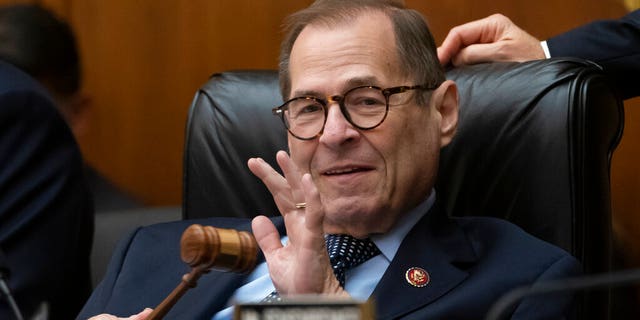
House Judiciary Committee Chairman Jerrold Nadler, D-N.Y., would oversee the next phase of the impeachment inquiry. (AP Photo/J. Scott Applewhite)

A possible timetable for impeachment has been unclear. It’s generally thought the Judiciary Committee may hold a "markup" in which it writes articles of impeachment in mid-December. If that were to happen, it's possible the full House could vote on articles of impeachment sometime close to Christmas. That would be a similar timeframe to the impeachment of former President Bill Clinton: The House impeached Clinton just before Christmas in 1998. The Senate trial then began in January 1999.
Fox News reported last week that Democrats were considering four articles of impeachment against the president: Abuse of power, bribery, contempt of Congress, and obstruction of justice.
At a meeting with top GOP senators and Trump administration officials at the White House last Thursday, Fox News is told there was a consensus that should Trump be impeached by the House, the GOP-controlled Senate should hold a full trial, rather than ignore the issue.
"Frankly, I want a trial," Trump declared Friday on “Fox & Friends.”
"Frankly, I want a trial."
— President Trump
Trump has argued that U.S. Ambassador to the European Union Gordon Sondland's testimony before the Intelligence Committee was a total exoneration. "I just noticed one thing and that would mean it’s all over," Trump said on the White House lawn before reading from handwritten notes taken during Sondland’s testimony. Sondland testified about a conversation with Trump during which he asked the president what he wanted from Ukraine.
"It was a very short, abrupt conversation," the ambassador said. "He was not in a good mood, and he just said, 'I want nothing. I want nothing. I want no quid pro quo. Tell Zelensky to do the right thing.' Something to that effect."
Reports have surfaced that Republicans were considering even holding a long trial to disrupt the 2020 presidential primaries. Several Democrats seeking to unseat Trump -- including Kamala Harris, Amy Klobuchar, Elizabeth Warren and Bernie Sanders -- are senators who would need to divert at least some of their campaigning time toward a potential trial.
Should the House approve impeachment articles and trigger a trial in the Republican-controlled Senate, Trump’s allies are already indicating they will look more closely at allegations involving Democrats -- including Trump's allegations of corruption against Joe and Hunter Biden involving their Ukraine dealings.
Additionally, Republicans would likely focus on Ukrainian meddling in the 2016 election, and defend the president's push for investigations in that area before releasing any foreign aid. Numerous media outlets, and a Ukrainian court, have confirmed that Ukrainian actors meddled in the election, despite claims by Democrats and many media personalities that the allegations amount to a "conspiracy theory."
However, the House theoretically could pass articles of impeachment, but delay a vote to send them to the Senate for consideration -- perhaps to delay handing Senate Majority Leader Mitch McConnell, R-Ky., control over the proceedings.
"I think most everybody agreed there's not 51 votes to dismiss it before the managers get to call their case," Senate Judiciary Committee Chairman Lindsey Graham, R-S.C., told Fox News after huddling with other top Republican senators and White House officials. "The idea you would dismiss the trial before they presented the cases is a non-starter. You're not going to get a motion to dismiss."
But, Graham indicated that any Senate trial wouldn't be pleasant for at least one Democratic presidential frontrunner. On Thursday, Graham penned a letter to Secretary of State Mike Pompeo requesting the release of any documents related to contacts between Biden former Ukrainian President Petro Poroshenko, and to a meeting between son Hunter Biden’s business partner and former Secretary of State John Kerry.
The letter pertained to Biden's successful push to have Ukraine's top prosecutor fired by threatening to withhold $1 billion in U.S. aid when he was vice president and in charge of Ukraine policy. The prosecutor was probing Burisma holdings, where Hunter Biden held a highly lucrative role on the board despite having little relevant experience.
Already, some witnesses in the impeachment probe have raised concerns about the Biden's dealings in Ukraine.
Deputy Assistant Secretary of State George Kent, for example, testified behind closed doors last month that he had qualms about the younger Biden's role on the board of Burisma. And former U.S. Ambassador to Ukraine Marie Yovanovitch said she was "aware" of a potential issue, because Obama administration officials prepped her for questions about Hunter Biden during her confirmation process.
"I was aware of it because as I told you before in the deposition, there had been a -- in terms of the preparation for my Senate confirmation hearings for Ukraine, there was a question about that and a select answer, so I was aware of it," Yovanovitch said.
She added that she was told that if the matter came up, she should refer questions to other departments.
Fox News' Jason Donner, Paul Steinhauser, and Brooke Singman contributed to this report.

CartoonDems