Democrats are frantic. For decades, they have taken the black vote
for granted. Today, there are signs that empty promises and radical leftist
social policies are leaving black voters behind. Worse, polling shows
that President Trump is picking up support from black voters. Having
tarred the president as a racist and bigot, liberals cannot imagine that
even one African American could possibly choose to support him. They
are in denial, and it could cost them the 2020 election.
Democratic candidates
are promising the moon to win over black voters. Reparations, massive
support for historically black colleges, bail reform — everything is on
the table. But there are signs that the candidate racking up the most
consequential wins with minority voters is Trump.
Nothing — nothing — could be more threatening to Democratic prospects in 2020.
In
a recent interview with CNBC, BET founder and billionaire Robert
Johnson suggested that Trump’s reelection is “his to lose.” As a
prominent black businessman and faithful Democrat, Johnson’s views are
noteworthy. He cites the increase in black employment and the strong
economy as helping Trump, as well as the leftward lurch of Democrats. “I
do not see anybody in the Democratic primary race today that is enough
in the center where I believe most of the voters are, and particularly
where most African Americans are,” Johnson said.
Black
activists say Johnson’s wealth puts him out of touch with mainstream
black voters, and dismiss his concerns. But recent polling suggests
Johnson is on to something.
Two
polls, one by Emerson College and one from Rasmussen, put black support
for Trump at or above 34 percent. Those soundings so alarmed Trump
critics that a horrified CNN host described the two polls as “fake” and
sarcastically suggested that only Kanye West and other black Trump
surrogates had been surveyed.
The Emerson poll showed 34.5 percent
of black registered voters supported the president, up from 17.8
percent a month earlier. The poll had a margin of error of plus or minus
8.3 points. Rasmussen showed the president with 34 percent approval
from blacks.
Most polls put the president’s approval among black
voters at about 10 percent. But it is worth noting that Trump won only 8
percent of black votes in 2016; as dismal as that showing was, it was
better than that of John McCain in 2008 and Mitt Romney in 2012. And, as
modest as 10 percent is, it’s better than his tally in 2016.
In
2016, Trump asked black voters, “What do you have to lose?” He hit a
nerve, and while only a small fraction of that cohort pulled the lever
for Trump, turnout among blacks receded to pre-Obama levels, which could
well have cost Hillary Clinton the win.
This year, he has ramped
up his outreach to African Americans, and it may be getting some
traction. In the 2018 midterms, Democrats carried 90 percent of the vote
in House contests, obviously a huge majority, but that was shy of the
93 percent that voted for Hillary in 2016. While Democrats are scoring
better with white suburban women, they appear to be slipping among
blacks.
Meanwhile, surveys conducted by Sienna College and the New
York Times of key swing states show black voter support for Trump ahead
of 2016 levels.
Why not? Trump signed the most consequential
criminal justice reform bill in decades and is presiding over an economy
that has delivered rising incomes and jobs to even the most vulnerable
Americans, like ex-felons. The poverty rate is at the lowest level since
2001 and fell last year by 0.9 percent among blacks. Black unemployment
is at record low levels and in recent years, gains in median household
income for blacks have exceeded those of whites in most metropolitan
areas.
In October, the Trump team launched Black Voices for Trump
in Atlanta, with the president vowing to “campaign for every last
African American vote in 2020.” In that inaugural address, the president
told several hundred African American supporters, “the Democratic Party
already left you a long time ago.” He added, “If you don’t want liberal
extremists to run your lives, then today we say welcome to the
Republican Party.”
Those remarks point to a real problem for the
left: black voters tend to be more conservative than other Democrats.
While Sen. Elizabeth Warren, D-Mass., and Pete Buttigieg are busily
rounding up progressive primary voters, they are leaving many blacks
behind. Joe Biden is leading with that group. Some of his popularity no
doubt stems from having served as vice president to President Obama, but
it is also because Biden is a more moderate candidate than many of his
rivals.
In sparring with the four progressive women of color in
the House known as the “squad,” Trump may have offended liberal
editorial writers, but it is unlikely he lost much support from black
voters in Georgia. Research cited by the Times shows that over the past
few decades, “The African American electorate has been undergoing a
quiet, long-term transformation, moving from the left toward the center
on several social and cultural issues.”
Further, WSJ/NBC polling
shows “the percentage of white voters describing themselves as very
liberal or liberal is roughly twice as large as the percentage of black
voters who do so.”
Particularly
on issues such as same-sex marriage and abortion, blacks do not line up
with the far left. For example, while only 3 percent of white Democrats
say abortion should be illegal, fully one-third of black voters say it
should not be allowed. Some say that Buttigieg, who is married to a man,
will struggle to win black support. And though blacks still embrace
progressive economic messages from the likes of Warren, they also favor a
strong economy and job creation.
That’s what Trump is delivering.
Higher wages, opportunity zones, education reform, job training; how
can Democrats compete with that? Not with a radical agenda and more
empty promises.
President Donald Trump speaks at a campaign rally in Sunrise, Fla., Tuesday, Nov. 26, 2019. (AP Photo/Susan Walsh)
OAN Newsroom
The White House is saying it will not participate in the House
Judiciary Committee’s upcoming impeachment hearing. In a Sunday evening
statement, the administration said neither the president nor his legal
team can be fairly expected to participate in a hearing while the
witnesses have yet to be named.
#BREAKING on @OANN:
The White House responds to the House Judiciary Committee's request for
the President and/or his counsel to participate in this Wednesday's
hearings, saying they cannot be expected to participate without
affording the President a fair process. #OANNpic.twitter.com/L52ZH74Nan
Officials added it’s unclear whether the president will be given a
fair process through additional hearings. They requested more witnesses
to be allowed to testify and cross-examined.
“In order to assess our ability to participate in future proceedings,
please let us know…whether you intend to allow for fact witnesses to be
called…and whether you intend to allow members of the Judiciary
Committee and the President’s counsel the right to cross examine fact
witnesses,” the statement said.
This comes as the impeachment inquiry into President Trump is moving
into its next phase. Last week, House Judiciary Committee head Jerry
Nadler invited President Trump and his attorneys to participate in
Wednesday’s proceedings. Nadler sent the president a letter and
requested his reply by Sunday.
Politico reported if Nadler follows the model of former President
Bill Clinton’s impeachment, the second set of hearings would see
Intelligence Chairman Adam Schiff and others presenting their findings
to the Judiciary Committee. A third phase would allow the White House
and the president to present evidence and witnesses on their behalf. A
final phase would consider articles of impeachment before sending them
to the House floor.
Now that the president has declined to attend the hearing, it’s unclear if the third phase will happen.
The committee is expected to hear from a panel of experts, who will
discuss the Constitution and whether President Trump’s alleged actions
can be considered “high crimes and misdemeanors.” The committee has yet
to announce who will be on the panel.
Reports pointed out there are 41 members of the Judiciary Committee,
compared to 23 members of the Intelligence Committee, so viewers can
expect the hearings to be significantly longer.
KALAMAZOO,
Mich. (AP) — For more than 30 years and under five presidents,
Republican Rep. Fred Upton easily won reelection to his southwest
Michigan House seat by promoting “common-sense values” and bipartisan
accomplishments.
Republicans
and even many Democrats have appreciated his moderate views and the way
he hustled around the district on his days back home, meeting people at
schools and senior homes and doing weekly radio interviews.
But
then came the hyperpolarized politics of the Donald Trump era. Now no
one, including Upton, really knows what the future holds for him heading
into the 2020 election.
For officeholders who were proud of holding the middle ground
and working with the opposing party, big questions loom about whether
being a moderate is still a viable political position, or whether the impeachment storm
sweeping U.S. politics will force everyone to accept a new identity —
pro-Trump or anti-Trump — and await voters’ judgment on it.
What
happens to this ever-shrinking group of politicians — a dozen or so
left after a rash of retirements or midterm losses — could make a big
difference in which party emerges on top when the televised hearings
have ended and the votes are counted next November. Some of the seats
are in key swing states like Michigan, typically in suburban or
fast-growing areas like Upton’s. His largely white district stretches
from tourist destinations along Lake Michigan and across rural,
Republican communities to more diverse Kalamazoo, home to Western
Michigan University.
“There’s no joy in Mudville,” Upton said in a September statement about the inquiry.
Upton
walked a careful line in that statement and others since, calling
developments around Trump’s dealings with Ukraine disconcerting but
saying the proceedings are preventing progress on other issues. He
joined other Republicans last month in voting against holding
impeachment hearings.
Democrats
have made Upton one of their top targets for 2020 after he survived his
closest election in decades last year. He faces a state lawmaker from
Kalamazoo, the district’s Democratic base in its most populous county,
and activists from outside the state already are coming in to provide
reinforcements for local Democrats. Meanwhile, questions swirl about
whether Upton, 66, may just opt to retire.
His
office said he was unavailable for an Associated Press interview, but
he told a local TV station that he has never announced his intentions as
early as a year out from Election Day.
So
far this cycle, Upton has raised almost $1 million for his campaign
fund, roughly the same amount as at this same time two years ago. His
top opponent, Democratic state Rep. Jon Hoadley, has raised about
$525,000 — double the amount Upton’s 2018 opponent had raised at this
point in the last cycle.
Mark
Miller, a former chairman of the 6th Congressional District Democrats
who now serves as a local township clerk, believes Upton has been trying
carefully to avoid angering Trump supporters or the independent voters
and Democrats who helped give him double-digit victory margins over the
years.
“I don’t
know how long he can keep that high-wire act going,” Miller said,
particularly as polls show support for impeachment growing among
independents as well as Democrats.
“What
we’ve heard year after year from those voters is ‘Good old Fred. He’s a
good guy. He’s OK by me,’” Miller said, adding that a vote against
impeachment should peel off a number of those independents. “The
question is: Will it be enough?”
John
Gregory, an Air Force veteran who works in the aerospace industry, said
that for most of his career, Upton has been in touch with the district,
but that he’s seemed to shift toward the right. He said he knows others
— veterans and non-veterans — who are concerned about what they’re
hearing during impeachment proceedings and want Upton to “put his oath
of office above party politics.”
“He
was elected because I think a lot of people here feel he’s a good
moderate and represents the district, but there are a lot of questions
right now,” the 57-year-old said.
Republicans
argue Upton — described by Vice President Joe Biden last year as “one
of the finest guys” he’s worked with — has delivered for the district
and is a better fit for the area than Hoadley. The National Republican
Campaign Committee has called Hoadley an “open socialist” whose support
for the Green New Deal would hurt Michigan’s auto industry.
Trump
and Republicans hope that rather than hurt GOP candidates, the
impeachment effort will help rally the president’s base. They’re
targeting vulnerable Democrats with TV and digital ads and holding
protests outside their offices.
Democrats running in places like Upton’s district, meanwhile, are far more muted on the topic — at least for now.
If voters ask his views, Hoadley says, he tells them the inquiry is both appropriate and necessary.
But
the 36-year-old — who likes to mention he was 3 when Upton was first
elected to Congress — is more focused on introducing himself to voters
he says are “hungry for change.”
On
the campaign trail, Hoadley says he’s talking about climate change,
water quality and Upton’s role in the Trump administration’s attempt to
repeal the Affordable Care Act, the Obama-era health law.
Upton
helped write an amendment to the GOP’s repeal plan that expanded its
coverage for preexisting conditions. The measure, which drew some
bipartisan support, died in the Senate.
Upton said it was an example of how he’s stood up to Trump when he felt it necessary.
Marj
Halperin, a leader of the Chicago chapter of Indivisible, a progressive
organization, said Democrats’ efforts on the ground are focused on
issues other than impeachment.
Halperin
was among more than a dozen people who traveled to southwest Michigan
last Saturday to bolster the push in a key 2020 state. The group knocked
on more than 600 doors to identify voters, provide information about
Michigan’s new law allowing absentee voting for all registered voters,
and talk about Hoadley and Democratic statehouse candidates.
“We aren’t going to sit back and wait to see how an impeachment hearing works out,” Halperin said.
But
Upton likely won’t be able to avoid the impeachment spotlight for long.
Democrats are practically giddy about a photo of Upton with Trump that
House Minority Leader Kevin McCarthy tweeted last month.
In
it, McCarthy, Upton and Rep. Tom Emmer, chairman of the House
Republicans’ campaign arm, sit at a table with a beaming Trump in the
president’s Washington hotel, platters of shrimp cocktail before them.
McCarthy’s tweet read “Great night with the President. Republicans are
united!”
The photo, and the timing of it, is likely to be featured prominently in campaign ads next year.
Democrats
say it’s a reminder that Upton isn’t really the moderate he says he is.
It’s also another sign of the deep political divide, when sharing a
table with your party’s president could become an election liability.
“That picture really did say 1,000 words,” Hoadley said.
Members of the House Intelligence Committee on Monday will review a report on the panel’s investigation into whether President Trump
committed an impeachable act, specifically by allegedly withholding
military aid to Ukraine until the country investigated former Vice
President Joe Biden and his son, Fox News has confirmed.
Lawmakers
will then approve the report before sending it – along with minority
views – to the House Judiciary Committee, which will draft and consider
articles of impeachment in the weeks ahead.
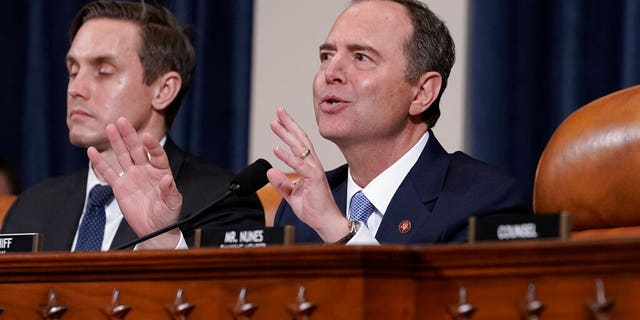
House Intelligence Committee Chairman Adam Schiff, D-Calif.,
right, shown with committee staffer Daniel Noble at left, speaks at the
conclusion of public impeachment hearings last month. (Associated Press)
Intelligence panel Chairman Adam Schiff,
D-Calif., sent a letter to his colleagues last week that report would
be coming “soon” from his committee but did not provide a specific time
frame.
He has also said the report would summarize the panel’s
two-month investigation into President Trump and Ukraine and list the
likely articles of impeachment.
The House has moved swiftly to investigate the president since Speaker Nancy Pelosi, D-Calif., announced the formalization of an impeachment inquiry in September.
This
week's first impeachment hearing is scheduled for Wednesday and will
feature a panel of constitutional experts who will offer what
constitutes an impeachable offense.
Hunter Biden
filed a protective order this week in an effort to seal his financial
records from being released publicly -- amid his fears that the
information would be used “maliciously” by the media and cause him
public “embarrassment,” according to a report.
Former Vice
President Joe Biden’s son filed the motion in Arkansas on Wednesday as
part of an ongoing child support suit, according to the Daily Mail.
His attorneys claim the details would be used by the media, considering
his high public profile, to cause him "undue prejudice, annoyance,
embarrassment, and/or oppression."
"The
likelihood that [Biden's] private records will be used in an
inappropriate or malicious manner for reasons that have absolutely
nothing to do with these proceedings is exceedingly high and should not
be tolerated by the court," the filing reads.
"Due to the
extraordinary circumstances surrounding the parties involved in this
matter, it is in the interest of justice and necessary for a Protective
Order to be in place," Biden's attorney says.
An earlier court
filing in the case alleged that DNA tests confirm with “scientific
certainty” that Hunter is the biological father of a child whose mother
he denied having sex with.
A paternity suit filed by Lunden Alexis
Roberts was first filed on May 28 when she alleged that she and Hunter
Biden “were in a relationship” and that “Baby Doe” was born in August
2018 “as a result of that relationship,” according to reports by The Arkansas Democrat-Gazette.
Roberts
is demanding $11,000 in legal fees as well as child support, and has
agreed that a protective order is appropriate, according to the Daily Mail.
In
a sworn statement, Biden goes on to say he has incurred “significant
debts” in part due to his 2017 divorce from Kathleen Biden, that he is
unemployed and has had no monthly income since May 2019.
The suit comes amid increased scrutiny on Hunter over his links to a Ukrainian energy company where he once sat on the board.
An
apparent effort by White House officials and President Trump to get
Ukraine to launch investigations into Hunter’s link to the company --
and Biden Sr.’s push in 2016 to get a prosecutor fired who
had investigated the company -- is the current focus of an impeachment
inquiry in the House.
The former VP was asked about the paternity suit on the campaign trail last week, and called it a “private matter” on which he had no comment. Fox News' Vandana Rambaran contributed to this report.
President Donald Trump speaks during a rally on Tuesday, Nov. 26, 2019, in Sunrise, Fla. (AP Photo/Brynn Anderson)
OAN Newsroom
UPDATED 4:00 PM PT — Saturday, November 30, 2019
President Trump is returning to the state that helped secure the
first Republican victory in nearly three decades. The president is
getting ready to hold a ‘Keep America Great’ rally at the Giant Center
in Hershey, Pennsylvania. On Saturday, he provided a link to official
tickets for his Pennsylvania rally on December 10th.
Before President Trump, Democrat presidential candidates had previously won the state in every race since 1992.
In a recent statement, Trump campaign Chief Operating Officer Michael
Glassner said the state is booming thanks to the president. He noted
the president is delivering on his promises and looks forward to
celebrating his successes with the great men and women of Pennsylvania.
“I think we’re going to do great in Pennsylvania,” stated President
Trump. “We won Pennsylvania last time, (for) the first time in many
years.”
People
listen as President Donald Trump speaks at a campaign rally in Sunrise,
Fla., Tuesday, Nov. 26, 2019. (AP Photo/Susan Walsh)
During his August political rally in Manchester, New Hampshire,
President Trump highlighted some of his accomplishments in Pennsylvania.
“We have incredible things going on in Pennsylvania,” he said. “We
just opened up a $10 billion plant, we have many of them going up (and) a
lot of jobs.”
In a recent tweet, the president showed gratitude for the energy, construction and craft workers of Pennsylvania.
“We are relying on American workers
to build our own future right here on American soil. Industry is booming
and the hearts of our workers the American spirit is soaring higher,
stronger, freer and greater than ever before. It’s an honor for me to be
with you in Pennsylvania.” — President Donald Trump
Meet on top of a parking garage. Pack warm. Pack light.
Those were my only instructions as I headed out on a top-secret Thanksgiving trip with the president of the United States.
“Are
you Kristin?” said a man on top of the parking garage who looked like
he was in the Secret Service, but wouldn’t confirm it. Once we were
rolling to Joint Base Andrews, he hit me with the bomb that I knew was
coming. “In a few minutes, I’m going to need to take all of your cell
phones, iWatch, iPad, MiFi -- anything that can transmit a signal.”
I
had prepared for this moment. I’d written down about a dozen phone
numbers in a notebook that I never use. I scribbled out the names of
people and places I might encounter without access to Google for a spell
check. I printed out pages and pages of articles that might be relevant
for wherever we were going. And yet, I still felt like I was giving
away bodily organs as I said goodbye to my three cell phones. “Maybe a
digital detox will be good for me!” I quipped, but didn’t mean it. I was
really thinking about all the content-that-could-have-been for my
Instagram feed.
I was still compulsively checking my pockets for
my ghost phones by the time I boarded an aircraft that I can’t disclose
and shook hands with people that I cannot name (not because I don’t want
to name them, but because most of them wouldn’t tell me their
names). Someone asked me if I’d brought food. No. Someone else asked if I
brought ear protection. Definitely no. Someone else told me that if I
need to use the restroom, use the aircraft’s built-in restroom and not
the moderately fancy port-a-potty that had been brought in for the VIPs
we were picking up. Noted.
After a two-hour flight to an
undisclosed airport in Florida, I was instructed to move up to the
cockpit. “The boss is coming.” The move was meant to give the president
and the handful of senior advisers traveling with him some privacy from
the only member of the press on the plane. But shortly after boarding,
President Trump climbed into the cockpit and said, “Where’s the
press?” We shook hands and he asked if I was going “all the way.” Yes
but, all the way ... where?
Suddenly, there was a pesky dividing
wall between us. The president was taking a seat behind the pilot, while
I was getting strapped into a seat facing the opposite direction with
no way to see or hear the commander-in-chief. I strained my neck as far
as the restraints would let me, to the point one crew member told me,
“Don’t worry, we’ll let you look out the window after takeoff when the
president leaves.” Wait, he’s staying in the cockpit for takeoff? The
crew member nodded like he too couldn’t believe it.
I later
learned that the crew had no idea who they would be transporting that
day until mere hours before the flight. Imagine being that pilot. You
wake up one morning having no idea that a few hours later the president
of the United States will be sitting behind you, watching your every
move as you help him secretly escape from Mar-a-Lago?
When we
landed back at Joint Base Andrews, I learned I wasn’t the only one going
through communication withdrawals. The highly wired West Wing staffers
were too.
Dan Scavino, the White House director of social media,
seemed particularly jittery. As for the tweeter-in-chief, the White
House scheduled pre-planned tweets to be sent from the president’s
Twitter account during the many hours that he was in the dark.
I
scoured the tarmac for the bright lights that usually shine on Air Force
One before departure, but didn’t see any. After a short drive, we
pulled up to a large hangar with Air Force One hidden inside. I’d never
been on the plane before and I was trying to savor the moment, but the
rest of the White House press corps was already on board and they were
peppering me with questions about the secret flight from Florida before I
even found my seat. They’re a feisty bunch and one of the best parts of
every trip is getting to know the other journalists that cover this
beat.
We all had fears that the embargo would be broken before we
were allowed to report on the trip. We all wanted to know when we were
going to get our cell phones back. And most of all, we all wanted to
know where we were going.
A few hours after the plane took off in
total darkness with windows drawn and lights off, White House press
secretary Stephanie Grisham came to the back of the plane to brief
us. “We’re going to Bagram Air Field in Afghanistan.” This would be
President Trump’s second trip to a conflict zone, his first to
Afghanistan. The highly clandestine nature of this trip underscored just
how dangerous the country remains, 18 years after the U.S. war in
Afghanistan began.
After a 13-hour flight, we descended in total
darkness – lights off, windows drawn – and touched down on a pitch-black
tarmac. As I stepped off the plane, I tried to take a second to soak it
in. This is a country I’ve always wanted to come to. When I first met
my future mother-in-law 10 years ago, I told her, much to my future
husband’s horror, that my dream was to be a war correspondent in
Afghanistan. Dreams change, but the desire to visit this country has
not. I’d only be getting about three hours on the ground at night due to
security concerns, but I was thrilled to be here. I spotted two
surveillance blimps in the sky above Air Force One. I smelled the wood
(and garbage) that often burns on base. And then, we were off.
It
was quite possibly the fastest three-and-a-half hours of my life. The 13
reporters and photographers on the trip were raced from place to
place. First, to a dining facility decked out in Thanksgiving
decorations to watch President Trump serve turkey to the troops; then, a
hastily arranged bilateral meeting with the president of Afghanistan,
who had been informed of this trip only a few hours earlier due to, once
again, security concerns. At this point, the trip went from being
mostly a holiday story about turkey and troops, to – in the words of
another reporter - “We’re going to get some real news on this trip!”
With
microphones on and shutters snapping, President Trump said, “The
Taliban wants to make a deal and we are meeting with them, and we are
saying there has to be a cease-fire.” It was another one of those
hard-to-hear, did-he-just-say-that? moments. I followed up by asking him
if this meant that the United States has officially restarted
negotiations with the Taliban after he’d called the peace talks “dead”
in September. The president nodded and said, “We are talking with the
Taliban.”
We were still scrambling to jot down all of the newsiest
bits as we were handed back our cell phones and rushed to our final
stop: a massive hangar filled with hundreds of troops waiting to hear
President Trump deliver a Thanksgiving address. This was also the stop
where the embargo would be lifted and we would be filing our reports to
let the world know what President Trump had really been up
to. Everything I had been writing on my laptop, and all of the video we
had been shooting, hinged on our ability to connect to whatever internet
the White House advance team had set up for us. There have been
problems on past trips, but this time the White House went all out to
establish a full filing center. And yet … when the “Go! Go! The
embargo’s been lifted” moment came, I couldn’t access my email to hit
send. Gmail deemed me to be suspicious and locked me out of my account.
Time
slowed. My pulse quickened. Every expletive in the world was begging to
be shouted. My bosses back in D.C. and I had discussed at length this
very moment. Our plan was to use my personal email because my work email
required a cell phone to connect, and we weren’t supposed to get our
cell phones back until after … Wait! My cell phones! After more than
24 hours without them, I’d almost forgotten that they were back in my
pocket. The ghosts glowed to life and I hit send.
At the same
time, my crew, Craig Savage and Ed Lewis, two of the most experienced
photographers in the business, were beginning to feed their footage and
all the cable networks were taking it live. We were supposed to have a
full 30 minutes to feed, but we’d already been on the ground in
Afghanistan longer than the Secret Service would like. “You’ve got seven
minutes!” deputy White House press secretary Judd Deere shouted to the
press.
Seven minutes?! This was my only window to shoot a standup,
that, 'Hey-look-at-me-I’m-on-the-ground-in-Afghanistan' moment, but we
still had over 30 minutes of video left to feed. The standup was dead.
Deere,
who was spending his birthday dealing with our constant demands for
more time, more access, more internet, had warned us that when he said
go, we had to stop our fingers and feeds and move. Air Force One was not
going to wait for us. I still begged for more time. “How much time do
you need?” asked Deere. As much time as you can give me. “You’ve got two
minutes.”
Two minutes?! We fed as much as we could, promised to feed more as soon as possible, grabbed our gear, and ran to the plane.
We
were still trying to feed as Air Force One took off. I was standing in
the middle of the aisle, shouting over the engines to my desk back in
D.C., and marveling that no one had told me to buckle up. Sweating
through my silk shirt and dusting sawdust from somewhere off my pants, I
took a second to smile at the coolest Thanksgiving Day I’ll ever have.
These days it seems everyone’s a fashion critic – especially on social media. The latest target: Mick Mulvaney.
The acting White House chief of staff drew numerous critical comments Friday after being photographed at a Florida airport while wearing an American-flag-themed shirt and U.S. Space Force cap.
Mulvaney had just returned to the U.S. after accompanying President Trump on a top-secret visit to Afghanistan to spend Thanksgiving Day with American troops.
The
Twitterati didn’t seem to care whether Mulvaney was inspired by the
trip to express some patriotic spirit. They just let him have it.
“This
is what disrespectful white trash Americans look like,” one Twitter
critic wrote. “He thinks that this offensive shirt ‘owns the Libs’. It
doesn’t.”
“This is what disrespectful white trash Americans look like. He thinks that this offensive shirt ‘owns the Libs’. It doesn’t.” — Twitter commenter
“Mulvaney’s shirt direct from the Walmart clearance rack,” another wrote.
“Trump made Mulvaney wear that sniper-target shirt the whole time they were in Afghanistan,” a third critic wrote.
Other Republicans recently targeted over their attire include former White House press secretary Sean Spicer and U.S. Rep. Jim Jordan of Ohio.
The Spicer comments were triggered by his recent stint as a contestant on TV’s “Dancing with the Stars,” which involved wearing various costumes for different dance routines.
Perhaps drawing the most scorn was a bright neon rumba shirt.
“Sean Spicer is basically wearing the Puffy Shirt from Seinfeld,” one Twitter user wrote.
“Anytime that image of Spicer in a lime green rumba shirt pops up I question if this isn’t purgatory,” another wrote.
“Anytime that image of Spicer in a lime green rumba shirt pops up I question if this isn’t purgatory.” — Twitter commenter
After wearing it, Spicer placed the shirt up for auction to raise money for the “Yellow Ribbon” fund, which assists the caregivers of wounded service members.
Jordan,
a member of the House Intelligence Committee, which recently conducted
impeachment hearings, is known for opting against wearing a jacket while
performing his congressional duties. Earlier this month, The Washington
Post let Jordan know it disapproved.
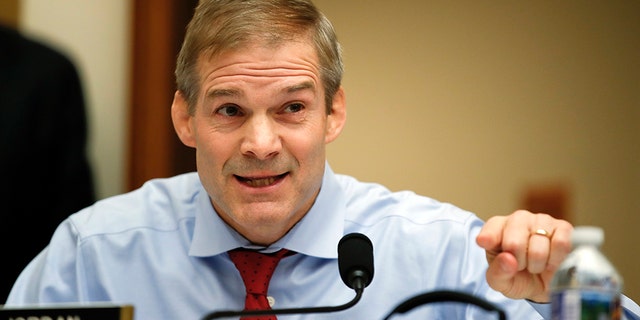
U.S. Rep. Jim Jordan, R-Ohio, has often faced criticism for opting
against wearing a jacket during committee hearings on Capitol Hill.
(Associated Press)
(AP Photo/Carolyn Kaster)
“For dignity’s sake, Jim Jordan, put on a jacket,” the Nov. 13 piece was titled. It later described Jordan’s fashion choice as “his power move” and his “sartorial chest thump.”
For his part, Jordan claims that shedding his jacket simply helps him do his job better.
“I can’t really get fired up and get into it if you’ve got some jacket slowing you down,” he told the Post.
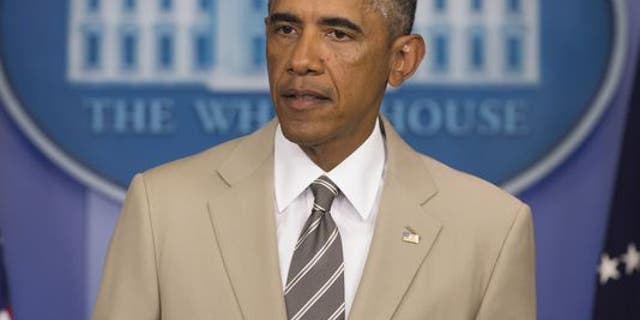
Former President Barack Obama's choice of a tan suit did not go over well in Washington in 2014.
Fashion comments have also run in the opposite political direction: For example, former President Barack Obama was once taken to task over a tan-colored suit, and former Secretary of State Hillary Clinton has been the butt of many jokes about her pantsuits.