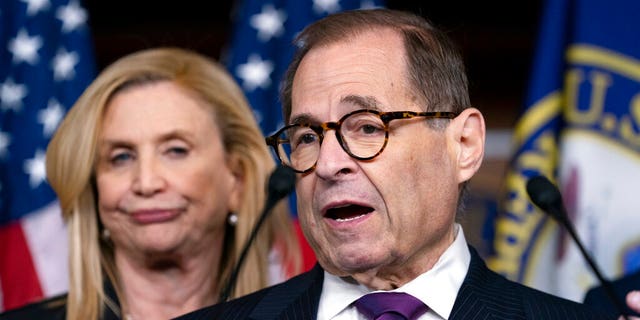
Sean Hannity slammed the House Intelligence Committee impeachment inquiry report
released Tuesday, calling it "nothing but an insane, convoluted
14,000-word diatribe concocted by their fearless, compromised, corrupt,
coward, congenital liar" House Intelligence Committee chairman Adam Schiff.
"The
report is chock full of nothing but conspiracy theories, left-wing
opinions, conjecture, hearsay, witnesses, complaints about Donald
Trump's foreign policy by people that think they're more important than a
duly elected president and a whole lot of outright lies," Hannity said
on his television program Tuesday.
The host criticized Schiff for the timing of the report's release.
"And
let's not lose sight of something very important. Schiff's rambling
report was released just hours before the first official proceeding,"
Hannity said. "There's no time to mount any legal defense, President
Trump isn't even in the country, and they knew that, too."
Hannity continued to criticize Schiff's credibility and his role in the report.
"A
congenital liar compromised. Adam Schiff, who conducted the
investigation, wrote the report," Hannity said. "He is a known repeated
congenital liar. He lied repeatedly about Trump Russia collusion."
The
Democratic-controlled House Judiciary Committee will move to the
forefront of President Trump’s impeachment inquiry Wednesday morning
with a hearing featuring four legal scholars, but no fact witnesses.
Hannity moved his focus to House Judiciary Committee Chairman Jerrold Nadler.
"[Nadler
is] going to attempt to rush the impeachment sham across the finish
line and get it done before Christmas. Like it or not, Nadler's planning
on, well, jamming impeachment down all of our throats," Hannity said.
"They don't care about the country. They've done nothing for us for
three years except hate on Donald Trump." Fox News' Gregg Re contributed to this report.
The Democratic-controlled House Judiciary Committee will move to the forefront of President Trump’s impeachment inquiry Wednesday morning with a hearing featuring four legal scholars, but no fact witnesses.
In
the same pillared room that hosted last month's House Intelligence
Committee hearings, lawmakers will hear from Stanford law professor
Pamela Karlan, Harvard law professor and Bloomberg columnist Noah
Feldman, University of North Carolina law professor Michael Gerhardt,
and George Washington University law professor Jonathan Turley.
All are Democrat witnesses except for Turley -- a point that did not escape the notice of the president Tuesday evening.
"They
get three constitutional lawyers ... and we get one," Trump said during
a bilateral meeting with Canadian Prime Minister Justin Trudeau in
London. "That's not sounding too good, and that's the way it is. We
don't get a lawyer, we don't get any witnesses -- we want Biden, we want
the son Hunter, where's Hunter? We want Schiff. We want to interview
these people. Well, they said no. We can't do it."
Following opening
statements from Judiciary Committee Chairman Jerry Nadler, D-N.Y., and
ranking member Rep. Doug Collins, R-Ga., the witnesses will be sworn in
and give opening statements of ten minutes apiece, followed by
questioning.
The Judiciary Committee could approve articles of
impeachment against the president within days. However, a senior member
of House Speaker Nancy Pelosi's leadership team told Fox News Tuesday
evening that it seems unlikely the full House can vote on impeaching
Trump before Christmas, saying it's "too complex" a process.
“I just don’t see it,” the source said. “It’s too big.”
In
the meantime, Democrats are trying to pass the annual defense bill.
Congress has to fund the federal government by Dec. 20 or risk another
shutdown. The House and Senate are expected to approve several of the
annual 12 spending bills and then pass an interim spending bill for the
remainder – or perhaps glom the remainders together and approve them for
the rest of the fiscal year.
The United States-Mexico-Canada
Agreement (USMCA) also looms large. If the decision is made to forge
ahead with the USMCA this calendar year, then there is almost no way
Congress can tackle impeachment. Democrats would face both a messaging
problem and a floor traffic problem. Fox News has been told repeatedly
in recent days that the USMCA is not ripe and action on that will likely
take place after the turn of the year.
Nevertheless, Democrats have moved aggressively on impeachment. Late Tuesday, the intelligence committee voted to adopt and issue its scathing report on the findings from its impeachment inquiry, accusing Trump of misusing his office to seek foreign help in the 2020 presidential race.
The
13-9 party-line vote on the 300-page report was a necessary step before
the document could be transferred to the Judiciary Committee. The
report included call logs documenting apparent conversations involving
Trump attorney Rudy Giuliani, House Intelligence Committee ranking
member Devin Nunes R-Calif., and Soviet-born businessman Lev Parnas, who
was arrested in October.
"We have Americans and foreigners
contact us every single day with information," Nunes told Fox News'
"Hannity" on Tuesday night. "I was talking with Rudy Giuliani, and we
were talking about how [Special Counsel Robert] Mueller bombed out."
Nunes
added that it was possible he had spoken to Parnas.
Separately, Republicans called for phone records belonging to House
Intelligence Committee Chairman Adam Schiff, D-Calif., who has
acknowledged that he should have been "more clear" about his communications with the whistleblower at the center of the impeachment inquiry.
While
invited to participate in the opening Judiciary hearing, the White
House declined. “This baseless and highly partisan inquiry violates all
past historical precedent, basic due process rights, and fundamental
fairness,” White House counsel Pat Cipollone wrote in a letter to Nadler on Sunday.
Cipollone
accused Nadler of "purposely" scheduling the proceedings to coincide
with Trump's attendance at the NATO Leaders' Meeting in London. He also
said Nadler provided "vague" details about the hearing, and that only
then-unnamed academics -- and not "fact witnesses" -- would apparently
be attending.
Wednesday's hearing is expected to mirror the format
used by the House Intelligence Committee last month. The proceedings
start with a 45 minute period for the Democrats, most likely led by
Judiciary Committee counsel Norm Eisen. Republicans will then get 45
minutes.
Then, the hearing will go to five-minute rounds for each
of the 41 members. The five-minute round alone should consume three
hours and 25 minutes.
Fox News expects the House to hold a vote
series around 1:30 p.m. ET, forcing a recess in the committee. There
will probably be some parliamentary fighting and stunting, which could
delay proceedings further.
White House Press Secretary Stephanie
Grisham and other administration officials have long argued that
Democrats are wasting valuable legislative time with their impeachment
probe.
“At the end of a one-sided sham process, Chairman [Adam]
Schiff and the Democrats utterly failed to produce any evidence of
wrongdoing by President Trump,” Grisham said Tuesday, adding that
Democrats' impeachment report "reflects nothing more than their
frustrations" and "reads like the ramblings of a basement blogger
straining to prove something when there is evidence of nothing.”
During
a press conference Tuesday, House GOP Leader Kevin McCarthy called on
Democrats to end the impeachment “nightmare," saying “They’re concerned
if they do not impeach this president, they can't beat him in an
election."
The Schiff-led Intelligence Committee conducted
extensive interviews with witnesses connected to the Trump
administration’s relationship with Ukraine after an anonymous
whistleblower filed a complaint alleging that during a July 25 phone
call, Trump tried to pressure Ukrainian President Volodymyr Zelensky to
help Rudy Giuliani investigate Democratic activities in 2016 as well as
former vice president Joe Biden and his son Hunter.
"The President
engaged in this course of conduct for the benefit of his own
presidential reelection, to harm the election prospects of a political
rival, and to influence our nation’s upcoming presidential election to
his advantage," the Democrats' report said. "In doing so, the President
placed his own personal and political interests above the national
interests of the United States, sought to undermine the integrity of the
U.S. presidential election process, and endangered U.S. national
security."
Schiff also tweeted: "The impeachment inquiry uncovered
overwhelming and uncontested evidence that President Trump abused the
powers of his office to solicit foreign interference in our election for
his own personal, political gain."
Schiff’s committee held
closed-door sessions before opening up the inquiry to public hearings,
which featured testimony from witnesses including National Security
Council official Lt. Col. Alexander Vindman, U.S. Ambassador to the EU
Gordon Sondland, and former U.S. Ambassador to Ukraine Marie
Yovanovitch.
The report concluded that Trump withheld nearly $391
million in military aid from Ukraine, conditioning its delivery as well
as a White House visit for Zelensky on a public announcement that
Zelensky was conducting the investigations. It also accuses Trump of
committing obstruction by instructing witnesses not to comply with
congressional subpoenas.
Republicans drafted a report of their own, which rejected the Democratic majority's claims.
"The
evidence presented does not prove any of these Democrat allegations,
and none of the Democrats’ witnesses testified to having evidence of
bribery, extortion, or any high crime or misdemeanor,” the GOP report
said.
If the House should vote to impeach, the Senate would hold a trial, where a two-thirds majority would be needed to convict.
A
Senate trial could also dig deeper into at least one of the issues
Trump once sought to have investigated: Joe Biden's role ousting a
Ukraine prosecutor who had been looking into the natural gas firm
Burisma Holdings, where his son Hunter had a lucrative board role. Fox News' Chad Pergram, Ronn Blitzer, and The Associated Press contributed to this report.
The Trump administration filed an emergency request with the U.S. Supreme Court Monday,
arguing that the D.C. Circuit Court of Appeals had no legal basis for
blocking the planned resumption of federal executions after a 16-year
hiatus.
The request was sent by Solicitor General Noel Francisco
to Chief Justice John Roberts, who will decide whether the Court will
review the case.
The emergency request came hours after the D.C. court upheld a ruling blocking the Trump administration’s plan. The Justice
Department had asked the court to block the injunction put in place by a
district court judge that stalled the executions of four convicted
murderers, Reuters reported.
Attorney General William Barr said in July the federal government would resume capital punishment and
scheduled the executions of five death-row inmates for December and
January, ending an unofficial decade-long moratorium on federal
executions. Barr said the DOJ owed it to the victims’ families to carry out the law/
A
judge temporarily halted the executions after some of the chosen
inmates challenged the new execution procedures. The inmates argued that
the government was circumventing proper methods in order to wrongly
execute inmates quickly.
A
federal execution has not taken place since 2003. In the last 16 years,
a protracted legal battle has drawn out over the drugs used in lethal
injections. Fox News’ Alex Pappas and The Associated Press contributed to this report.
The media didn’t wake up until Elizabeth Warren started sinking in the polls.
For
much of the year, she basically skated on a health care plan that is
political suicide. But as the Massachusetts senator surged toward
front-runner status, the poll-obsessed press essentially said hey, it’s
working. Medicare for All is popular with the party’s progressive wing,
Warren has a plan for everything, they’re all geniuses.
And yet, here was a leading Democratic candidate
promising to run against President Trump by taking away private health
insurance from 150 million Americans. It didn’t take a political genius
to realize that this would be an unmitigated disaster in a general
election.
But
now that Warren has dropped from 27 to 16 percent in the Real Clear
Politics polling average, you can hear the sound of pundits slapping
their foreheads across America: Holy cow, what a blunder for her to
embrace Medicare for All.
The Washington Post,
in a front-page piece Sunday, describes the “political turbulence that
Warren has experienced in recent weeks as she has attempted to extricate
herself from a policy dilemma that has blunted her steady rise to the
top ranks of the Democratic nominating contest.”
The New York Times
warned the other day that “prominent Democratic leaders are sounding
increasingly vocal alarms to try to halt political momentum for
‘Medicare for All’…rather than enter an election year with a sweeping
health care proposal that many see as a liability for candidates up and
down the ballot.”
And the Daily Beast,
describing Warren’s “self-inflicted wound,” quoted an unnamed aide to a
2020 Democrat calling the proposal “f*** poison. You touch it, you turn
to dust.”
Yet the press should have been all over this months
ago. There was a blind spot, it seems to me, because journalists spend
too much time on liberal Twitter, where government-run health insurance
is beloved. And Warren did not get the usual front-runner scrutiny as
her substantive campaign caught on, certainly not compared to the
pummeling of Joe Biden.
And the biggest beneficiary has been Pete Buttigieg, a relative moderate who has campaigned against her approach.
The
senator had signed onto the Bernie Sanders plan to make sure he
couldn’t outflank her on the left, and now she’s paying the price.
Obviously,
articles were written about Medicare for All and how it might be risky.
Moderators dutifully asked Warren about it in several debates, and she
repeatedly ducked questions on whether middle-class taxes would have to
rise, focusing instead on what she claimed would be lower costs. But
after each debate most journalists just moved on, and there was little
follow-up in the Trump-centric environment.
Finally, Warren
unveiled a gargantuan $20-trillion tax plan that simply fueled questions
about paying for the massive program. And then she retreated, saying
she wouldn’t push Medicare for All until the third year of her
presidency—ostensibly to allow more transition time but in reality to
slide the plan onto the back burner.
Warren and Sanders argue that
they need big bold ideas to energize their voters. But there’s a reason
that Nancy Pelosi says she’s not a fan of the plan, and that Barack
Obama cautions left-leaning Democrats about touting a revolution.
The
Post story said Warren had been warned that Medicare for All was a time
bomb. Barney Frank, her fellow Massachusetts liberal, said he’d
privately told her that backing Bernie on health care was “a terrible
mistake” and that her shift should have come earlier.
“The irony
is that a candidate whose political identity has been built in part on
her reputation as a policy wonk — a potential president who boasts of
having a plan for nearly every challenge facing everyday Americans — has
been tripped up by a policy issue that has dominated politics and
defined her party for years.”
The Times piece says many in the
party “are gravely concerned about the impact that having a presidential
nominee who backs Medicare for All at the top of the ticket would have
on the most vulnerable Democratic candidates.” The paper quotes Rhode
Island Gov. Gina Raimondo as saying, “When you say Medicare for all,
it’s a risk. It makes people feel afraid.”
Many Democrats with
short memories forget how hard it was for Obama to pass the Affordable
Care Act by a single vote, and that the flawed program has finally
become popular after Trump repeatedly tried to abolish it. Allowing
people to opt into Medicare, as Biden, Buttigieg and some others favor,
would be a significant step forward for the party. Junking the program
in favor of mandated government care — taking away people’s choice — was
always pie in the sky.
But until Warren lost her polling lead, that obvious fact remained hidden in plain sight.
Rep. Mark Meadows,
R-N.C., on Monday downplayed leaked reports that said the Justice
Department’s inspector general's probe into the start of the FBI's Russia investigation determined that there was enough information to justify the agency's probe into members of the Trump campaign.
Meadows was asked about a report in the Washington Post that said Inspector General Michael Horowitz's report justified the FBI's action at the time. The New York Times,
citing two unnamed sources, reported that the findings are expected to
contradict some of the theories that President Trump has mentioned.
The
former chairman of the House's Freedom Caucus said that all the reports
are "based on speculation on information which has been leaked."
"There
is little doubt in my mind that it will not be one the FBI’s finest
days when the report is released," he said. "No one other than Horowitz
and his team knows what’s in the report and they have left no stone
unturned."
The reports, if true, would be seen as a potential
setback for President Trump, who has insisted that the FBI's
investigation was a witch hunt from the beginning and a blatant attempt
by Democrats to overthrow his presidency.
Horowitz, who has not
commented on the over year-and-a-half investigation, told Congress in a
letter last month that he intended to make as much of the report public
as possible, with minimal redactions. The report is due next week.
A key question examined by Horowitz has been the FBI’s application for a secret warrant to monitor Carter Page, a former Trump campaign aide.
The
Justice Department and the FBI obtained warrants in 2016 to monitor
Page. Page told Fox News earlier this month he was "frustrated" he had
not been interviewed in Horowitz's probe.
The warrant was renewed
multiple times by judges, but Republican critics have decried the fact
that the FBI relied in part in its application on uncorroborated
information obtained by Christopher Steele, a former British spy who had been paid by Hillary Clinton’s campaign to conduct opposition research.
The
government did disclose to the court the political loyalties of the
people who hired Steele, according to Democrats on the House
intelligence committee who released their own memo last year aimed at
countering Republican allegations of law enforcement misconduct.
Horowitz
provided a draft copy to Attorney General William Barr in September,
and the Justice Department has since been conducting a classification
review.
The Post, citing unnamed sources, reported that Barr
disagrees with the report’s conclusion. He reportedly questioned whether
or not the CIA, or other agencies hold information that could change
the inspector general’s conclusion.
Barr has praised Horowitz in the past and called him “fiercely independent.”
"Inspector
General Horowitz is a fiercely independent investigator, a superb
investigator who I think has conducted this particular investigation in
the most professional way, and I think his work, when it does come out,
will be a credit to the department," Barr said earlier this month.
The
Justice Department told Fox News in a statement that "uncovered
significant information that the American people will soon be able to
read for themselves. Rather than speculating, people should read the
report for themselves next week, watch the Inspector General’s testimony
before the Senate Judiciary Committee, and draw their own conclusions
about these important matters."
Trump has tweeted about the
Foreign Intelligence Surveillance Act and told “Fox & Friends”
earlier this month that "what they have coming out is historic." Fox News' Brooke Singman, Jake Gibson and the Associated Press contributed to this report
The North Korean foreign ministry said on Tuesday that Washington would decide what “Christmas gift” it would receive if the United States fails to change its “hostile policies” on denuclearization before the end of the year, according to the state-run Korean Central News Agency.
Ri Thae Song, North Korea’s vice minister of foreign affairs in charge of relations with the United States, warned of an approaching end-of-year deadline, saying that President Trump’s
recent calls for more talks is “nothing but a foolish trick hatched to
keep the DPRK bound to dialogue and use it in favor of the political
situation and election in the U.S.,” Reuters reported.
He referred to North Korea by the initials of its formal name, the Democratic People’s Republic of Korea.
“The
DPRK has done its utmost with maximum perseverance not to backtrack
from the important steps it has taken on its own initiative,” Ri said in
his statement. “What is left to be done now is the U.S. option and it
is entirely up to the U.S. what Christmas gift it will select to get.”
North
Korea has been ramping up missile tests and other military
demonstrations in recent months in an apparent pressure tactic over the
talks. Negotiations have faltered since a February summit between Kim
Jong-un and Trump in Vietnam which broke down after the U.S. rejected
North Korean demands for broad sanctions relief in exchange for a
partial surrender of its nuclear capabilities.
Kim later issued
his end-of-year deadline and has also said the North would seek a “new
path” if the U.S. persists with sanctions and pressure. Working-level
talks last month in Sweden broke down over what the North Koreans
described as the Americans’ “old stance and attitude.”
On Tuesday,
Ri did not clarify what he meant by a “Christmas gift,” but a Reuters
breaking news editor speculated on Twitter that North Korea could be
threatening a satellite launch, an outright ICBM test, a SLBM test far
from Korean Peninsula or a nuclear test.
In a November 18
statement, Foreign Ministry adviser Kim Kye Gwan suggested North Korea
had no interest in meeting with Trump at another summit unless the U.S.
offered substantial concessions before the deadline. The statement
issued through KCNA came in response to a tweet from Trump that urged
Kim to “act quickly, get the deal done” and hinted at another summit
between them, saying “See you soon!”
“Three
rounds of DPRK-U.S. summit meetings and talks were held since June last
year, but no particular improvement has been achieved in the DPRK-U.S.
relations,” the statement began. “The U.S. only seeks to earn time,
pretending it has made progress in settling the issue of the Korean
Peninsula.”
“We are no longer interested in such talks that bring
nothing to us. As we have got nothing in return, we will no longer gift
the U.S. president with something he can boast of, but get compensation
for the successes that President Trump is proud of as his
administrative achievements.” The Associated Press contributed to this report.
Ronan Farrow,
the Pulitzer Prize-winning journalist, said in an interview published
Saturday his relationship with Hillary Clinton cooled when word began to
spread he was looking into allegations against Hollywood mogul Harvey Weinstein.
Farrow told the Financial Times in
2011 he was selected by Clinton, then the secretary of state, to
work as a special adviser on global youth issues. He said they worked
together for years but noticed a change in their relationship when word
got out he was looking into Weinstein - one of her top fundraisers.
Farrow
did not elaborate on how Clinton found out about his interest in
Weinstein or how exactly the relationship cooled. After-hours
emails from Fox News to representatives for Clinton and Farrow were not
immediately returned. The paper said a Clinton spokesman did not comment
for its article.
Farrow told the paper, “It’s remarkable how
quickly even people with a long relationship with you will turn if you
if you threaten the centers of power or sources of funding around them.
Ultimately, there are a lot of people out there who operate in that way.
They’re beholden to powerful interests, you become radioactive very
quickly.”
Farrow and The New York Times won Pulitzers in 2018 for
stories outlining sexual misconduct allegations against Weinstein. The
producer, 67, has pleaded not guilty to charges he raped a woman in a
Manhattan hotel room in 2013 and performed a forcible sex act on a
different woman in 2006. He is free on $1 million bail and maintains
that any sexual activity was consensual.
Clinton, for her part, took days after the New York Times broke the Weinstein story to issue a statement. CNN reported that she said she was “shocked and appalled” by the revelations.
“The
behavior described by women coming forward cannot be tolerated. Their
courage and the support of others is critical in helping to stop this
kind of behavior,” the statement read.
The White House announced in a fiery letter Sunday night that President Trump
and his lawyers won't participate in the House Judiciary Committee’s
first impeachment hearing scheduled for Wednesday -- even accusing the
panel's Democratic chairman, Jerry Nadler, of "purposely" scheduling the
proceedings when Trump would be attending the NATO Leaders' Meeting in
London.
The five-page letter came as the Democratic majority on
the House Intelligence Committee was preparing to approve a report on
Tuesday that will outline possible charges of bribery or “high crimes
and misdemeanors,” the constitutional standard for impeachment. After
receiving the report, the Judiciary Committee would prepare actual
charges.
“This baseless and highly partisan inquiry violates all
past historical precedent, basic due process rights, and fundamental
fairness,” wrote White House counsel Pat Cipollone, continuing the West
Wing’s attack on the procedural form of the impeachment proceedings.
Cipollone said Nadler provided only "vague" details about the hearing,
and that unnamed academics -- and not "fact witnesses" -- would
apparently be attending.
"As for the hearing scheduled for
December 4, we cannot fairly be expected to participate in a hearing
while the witnesses are yet to be named and while it remains unclear
whether the Judiciary Committee will afford the president a fair process
through additional hearings," Cipollone said. "More importantly, an
invitation to an academic discussion with law professors does not begin
to provide the President with any semblance of a fair process.
Accordingly, under the current circumstances, we do not intend to
participate in your Wednesday hearing."
He continued: "When the
Judiciary Committee scheduled a similar hearing during the Clinton
impeachment process, it allowed those questioning the witnesses
two-and-a-half weeks' notice to prepare, and it scheduled the hearing on
a date suggested by the president's attorneys. Today, by contrast, you
have afforded the president no scheduling input, no meaningful
information and so little time to prepare that you have effectively
denied the administration a fair opportunity to participate. ... READ THE FULL WHITE HOUSE LETTER
Cipollone's
letter made clear that his response applied only to the Wednesday
hearing, at least for now. Cipollone demanded more information from
Democrats on how they intended to conduct further hearings before Trump
would decide whether to participate in those hearings, amid sagging national support for Democrats' probe.
Specifically,
Cipollone demanded to know whether Republicans would be able to
cross-examine and call their own fact witnesses, including House
Intelligence Committee Chairman Adam Schiff, D-Calif.
Rep. Jerrold Nadler, D-N.Y., chairman of the House Judiciary Committee.
(AP)
House-passed rules provide the
president and his attorneys the right to cross-examine witnesses and
review evidence before the committee, but little ability to bring
forward witnesses of their own.
"If [Schiff] chooses not to
(testify), then I really question his veracity in what he’s putting in
his report,” said Rep. Doug Collins, the top Republican on the Judiciary
Committee. "It’s easy to hide behind a report," Collins added. "But
it’s going to be another thing to actually get up and have to answer
questions.”
Schiff has come under scrutiny from Republicans, in part because of his overtly partisan comments and his previous claim in
a televised interview that "we have not spoken directly with the
whistleblower." A Schiff spokesperson later narrowed that claim in
October, telling Fox News that Schiff himself "does not know the
identity of the whistleblower, and has not met with or spoken with the
whistleblower or their counsel" for any reason.
An
aide to Schiff insisted that when Schiff mentioned "we" had not spoken
to the whistleblower, he was referring to members of the full House
intelligence committee, rather than staff. NBC National Security
reporter Ken Dilanian flagged Schiff's explanation as "deceptive" late
Wednesday, and Schiff acknowledged he "should have been more clear"
concerning whistleblower contacts.
The panel of constitutional
scholars who will testify on Wednesday will weigh in on the question
of whether the president committed an impeachable offense by allegedly withholding of military aid to Ukraine until it investigated former Vice President Joe Biden.
During impeachment hearings last month, a career State Department official testified
that in January or February 2015, he "became aware that [Joe Biden's
son] Hunter Biden was on the board" of Ukrainian company Burisma
Holdings while his father Joe Biden was overseeing Ukraine policy as
vice president -- and that he raised concerns about potential conflicts
of interest at the time. Joe Biden has openly bragged about pressuring Ukraine to fire its top prosecutor by threatening to withhold $1 billion in critical U.S. aid., all while Burisma was under scrutiny.
Republicans
had urged President Trump not to attend the Democrats' hearings,
arguing that his presence would validate a process they have repeatedly
derided as partisan. In his letter, Cipollone repeatedly derided what
he called Democrats' "fundamentally unfair" process.
"Inviting the
Administration now to participate in an after-the-fact constitutional
law seminar -- with yet-to-be-named witnesses -- only demonstrates
further the countless procedural deficiencies that have infected this
inquiry from its inception and shows the lack of seriousness with which
you are undertaking these proceedings," Cipollone wrote.
Nadler had written the president
last week announcing a hearing for Dec. 4 at 10 a.m., and notified him
of the committee’s intentions to provide him with “certain privileges”
while they consider "whether to recommend articles of impeachment to the
full House.” Nadler also extended an invitation to the president,
asking whether “you and your counsel plan to attend the hearing or make a
request to question the witness panel.”
With polls showing
support for impeachment flagging, Democrats were aiming for a final
House vote by Christmas, which would set the stage for a likely Senate
trial in January. Surveys have shown that independents are souring on the idea of impeaching and removing Trump from office, including in critical battleground states like Wisconsin, even as House Democrats aggressively presented their focus-group-tested "bribery" case against the president over the past two weeks.
“I
do believe that all evidence certainly will be included in that report
so the Judiciary Committee can make the necessary decisions that they
need to,” said Rep. Val Demings, D-Fla., a member of both the
Intelligence and Judiciary committees.
She said Democrats had not
yet finalized witnesses for the upcoming Judiciary hearings and were
waiting to hear back from Trump on his plans to present a defense.
“If he has not done anything wrong, we’re certainly anxious to hear his explanation of that,” Demings said.
The House Judiciary's impeachment hearings will follow last month's hearings by the House Intelligence Committee, which heard from 12 witnesses during five days of testimony.
Trump
has previously suggested that he might be willing to offer written
testimony under certain conditions, though aides suggested they did not
anticipate Democrats would ever agree to them.
“The
Democrats are holding the most ridiculous Impeachment hearings in
history. Read the Transcripts, NOTHING was done or said wrong!” Trump
tweeted Saturday.
Late Sunday, Trump tweeted a link to a Fox News opinion piece written by legal analyst Gregg Jarrett, and quoted the piece as saying the president had done "nothing impeachable." Fox News' Brooke Singman and The Associated Press contributed to this report.