FILE
- In this Oct. 14, 2019, file photo, a worker loads imported goods on a
truck at a distribution company outside the container port in Qingdao
in east China's Shandong province. China's trade with the United States
sank again in November as negotiators worked on the first stage of a
possible deal to end a tariff war. (Chinatopix via AP, File)
BEIJING
(AP) — China’s trade with the United States sank again in November as
negotiators worked on the first stage of a possible deal to end a tariff
war.
Exports
to the United States fell 23% from a year earlier to $35.6 billion,
customs data showed Sunday. Imports of American goods were off 2.8% at
$11 billion, giving China a surplus with the United States of $24.6
billion.
Exports to some other countries including France rose, helping to offset the loss.
China’s
global exports were off 1.1% from a year earlier at $221.7 billion
despite weakening worldwide demand. Imports were up 0.3% at $183
billion, giving China a global surplus of $38.7 billion.
Hopes
for a settlement to the fight over Beijing’s technology ambitions and
trade surplus rose after President Donald Trump’s announcement of a
“Phase 1” agreement following talks in October. But there has been no
sign of agreement on details nearly two months later.
The dispute has disrupted global trade in goods from soybeans to medical equipment and threatens to depress economic growth.
Trump
put off a tariff increase in October but penalties already imposed by
both sides on billions of dollars of imports stayed in place. Another
U.S. increase is due on Sunday on $160 billion of Chinese goods. That
would extend penalties to almost everything Americans buy from China.
Chinese
spokespeople have expressed hope for a settlement “as soon as
possible,” but Trump spooked financial markets last week by saying he
might be willing to wait until after the U.S. presidential election late
next year.
Financial markets have repeatedly risen on optimism about the talks only to fall back when no progress is announced.
The
“Phase 1” agreement doesn’t cover contentious issues including U.S.
complaints that Beijing steals or pressures companies to hand over
technology. Economists warn tensions could rise again next year and the
bulk of tariff hikes are likely to stay in place for some time.
For
the first 11 months of 2019, China’s total global exports were off 0.3%
at $2.3 trillion despite the tariff war. Imports were down 4.5% at $1.8
trillion, adding to signs Chinese domestic demand is cooling.
China’s
exporters have been hurt by the U.S. tariff hikes but its overall
economy has been unexpectedly resilient. Growth in the world’s
second-largest economy slipped to 6% over a year earlier in the three
months ending in September, down from the previous quarter’s 6.2% but
still among the world’s strongest.
Weaker
Chinese demand has global repercussions, depressing demand for
industrial raw materials and components from other Asian economies and
oil, iron ore and other commodities from Brazil, Australia and other
suppliers.
The
Ministry of Finance announced Friday that China was waiving punitive
import duties on U.S. soybeans and pork, keeping a promise announced in
September.
A
sticking point is Beijing’s insistence that Washington roll back its
most recent penalties on Chinese goods as part of the “Phase 1” deal.
Beijing said last month the U.S. side agreed, but Trump dismissed that.
A Chinese spokesman repeated Thursday that Beijing expects such a move in a “Phase 1” agreement.
SEOUL,
South Korea (AP) — North Korea said Sunday that it carried out a “very
important test” at its long-range rocket launch site that it reportedly
rebuilt after having partially dismantled it at the start of
denuclearization talks with the United States last year.
The
announcement comes amid dimming prospects for a resumption of
negotiations, with the North threatening to seek “a new way” if it
fails to get major U.S. concessions by year’s end. North Korea has said
its resumption of nuclear and long-range missile tests depends on the
United States.
Saturday’s
test at the Sohae Satellite Launching Ground will have “an important
effect on changing the strategic position of (North Korea) once again in
the near future,” an unidentified spokesman from the North’s Academy of
National Defense Science said in a statement, carried by the country’s
official Korean Central News Agency.
North
Korea didn’t say what the test included. Kim Dong-yub, an analyst at
Seoul’s Institute for Far Eastern Studies, said that North Korea likely
tested for the first time a solid-fuel engine for an intercontinental
ballistic missile.
The
use of solid fuel increases a weapon’s mobility and reduces the amount
of launch preparation time. The long-range rockets that North Korea used
in either ICBM launches or satellite liftoffs in recent years all used
liquid propellants.
CNN
reported Friday that a new satellite image indicated North Korea may be
preparing to resume testing engines used to power satellite launchers
and intercontinental ballistic missiles at the site.
Seoul’s
Defense Ministry said in a brief statement later Sunday that South
Korea and the United States are closely monitoring activities at the
Sohae site and other key North Korean areas.
On
Saturday, President Donald Trump and South Korean President Moon Jae-in
discussed developments related to North Korea, and the two leaders
committed to continuing close communication, the White House said in a
statement. Moon’s office also released a similar statement, saying the
two leaders had a 30-minute phone conversation at Trump’s request.
The
North Korean test “is meant to improve military capabilities and to
shore up domestic pride and legitimacy,” said Leif-Eric Easley, a
professor at Ewha University in Seoul. “With the activity at Sohae,
Pyongyang is also trying to raise international concerns that it may
intensify provocations and walk away from denuclearization talks next
year.”
The
Sohae launching center in Tongchang-ri, a seaside region in western
North Korea, is where the North has carried out banned satellite
launches in recent years, resulting in worldwide condemnation and U.N.
sanctions over claims that they were disguised tests of long-range
missile technology.
North
Korea has said its satellite launches are part of its peaceful space
development program. But many outside experts say ballistic missiles and
rockets used in satellite launches share similar bodies, engines and
other technology. None of North Korea’s three intercontinental ballistic
missile tests in 2017 was conducted at the Sohae site, but observers
said the site was used to test engines for ICBMs.
After
his first summit with North Korean leader Kim Jong Un in Singapore in
June last year, Trump said Kim told him that North Korea was “already
destroying a major missile engine testing site” in addition to
committing to “complete denuclearization” of the Korean Peninsula.
Satellite
imagery later showed the North dismantling a rocket engine-testing
stand and other facilities at the Sohae site. Last March, South Korea’s
spy agency and some U.S. experts said that North Korea was restoring
the facilities, raising doubts about whether it was committed to
denuclearization.
U.S.-North
Korea diplomacy has largely remained deadlocked since the second summit
between Trump and Kim in Vietnam in February due to disputes over how
much sanctions relief the North must get in return for dismantling its
key nuclear complex — a limited disarmament step.
North
Korea has since warned that the U.S. must abandon hostile policies and
come out with new acceptable proposals by the end of this year or it
would take an unspecified new path. In recent months, North Korea has
performed a slew of short-range missile and other weapons launches and
hinted at lifting its moratorium on nuclear and long-range missiles.
North
Korea said the results of Saturday’s test were submitted to the Central
Committee of the ruling Workers’ Party. The North said last week that
the Central Committee will hold a meeting in late December to discuss
unspecified “crucial issues” in line with “the changed situation at home
and abroad.”
At
the United Nations, a statement released by North Korea’s U.N.
ambassador, Kim Song, said Saturday that denuclearization had “already
gone out of the negotiation table.”
The
statement accused the Trump administration of persistently pursuing a
“hostile policy” toward the country “in its attempt to stifle it.” The
statement was a response to Wednesday’s condemnation by six European
countries of North Korea’s 13 ballistic missile launches since May.
The
North Korean diplomat accused the Europeans — France, Germany, Britain,
Belgium, Poland and Estonia — of playing “the role of pet dog of the
United States in recent months.”
“We
regard their behavior as nothing more than a despicable act of
intentionally flattering the United States,” the ambassador said.
___
Associated Press writer Edith M. Lederer at the United Nations contributed to this report.
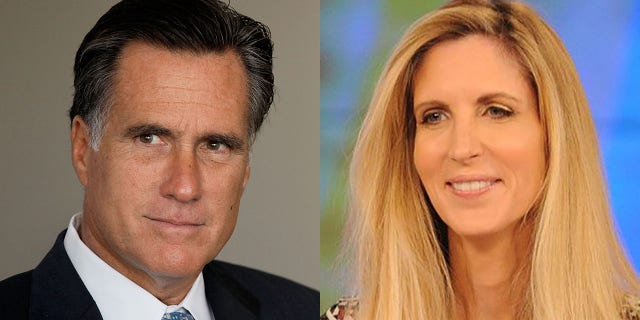
Conservative writer Ann Coulter took a shot Saturday night at three Senate Republicans who reportedly were the only remaining members of the GOP who hadn’t signed a Senate colleague’s resolution condemning the House impeachment inquiry against President Trump.
A story in The Hill on Friday had identified the trio as Sens. Lisa Murkowski of Alaska, Susan Collins of Maine and Mitt Romney of Utah -- lawmakers who’ve each opposed Trump from time to time from within the GOP tent.
Coulter offered her reaction to the story in a Twitter message.
“BREAKING:
The Hill newspaper names 3 GOP senators as possible votes to convict
Trump,” Coulter wrote. “Turns out they’re all legendarily feckless old
ladies: Lisa Murkowski, Susan Collins, & Mitt Romney.”
Within a few hours the tweet had gained more than 16,000 likes and 4,000 retweets.
“The RINO’s want Trump impeached? I’m shocked!!,” one Twitter user commented.
“Disappointed; but not surprised about Romney,” another wrote.
“I
have faith in Susan Collins after standing up for Brett Kavanaugh,”
another commenter wrote. “I have no faith in Lisa Murkowski or Mitt
Romney for this [if nothing] else [requires] integrity.”
The resolution defending President Trump was introduced Thursday by Sen. Lindsey Graham, R-S.C., chairman of the House Judiciary Committee, and had been signed by every Senate Republican except the trio, Graham told The Hill on Friday.
U.S. Sen. Mitt Romney, R-Utah, was on the receiving end Saturday
night of one of the latest Twitter barbs from conservative writer Ann
Coulter.
Graham’s resolution calls on House Democrats to allow
Trump to “confront his accusers” and to allow Republicans to issue
subpoenas to witnesses of their choosing, according to The Hill.
Neither
Murkowski, nor Collins, nor Romney has endorsed the impeachment inquiry
or the removal of Trump from the presidency, the story noted, adding
that all three have simply refrained from taking a position on the
matter so far.
Murkowski
said Thursday that she hadn’t read Graham’s resolution, while Romney
said he hadn’t read it but planned to do so, The Hill reported, adding
that it hadn’t heard back yet from Collins’ office.
Senate Majority Leader Mitch McConnell has backed Graham’s resolution but hasn’t stated whether he will call for a Senate vote on the matter, The Hill reported.
Coulter,
meanwhile, has been a frequent critic of Trump as well. For example,
she has repeatedly chided the president over delays in getting
construction of a U.S.-Mexico border wall underway, and last February
referred to the president's State of the Union address as “the lamest, sappiest, most intentionally tear-jerking SOTU ever.”
The president has often opted not to return fire -- but last March referred to Coulter as a "Wacky Nut Job,"
insisting he was "winning on the Border" despite having "an entire
Democrat Party of Far Left Radicals against me (not to mention certain
Republicans who are sadly unwilling to fight)."
President Trump addressed a crowd of more than 4,000 people at the Israeli American Council (IAC) National Summit in Florida on Saturday night, saying Israel and America have an "unbreakable bond."
Trump
delivered the keynote address at the summit, which took place in
Hollywood, Fla., and was welcomed by the crowd chanting "four more
years." The Israeli American Council is financially backed by one of
Trump's top supporters, billionaire Sheldon Adelson.
In the first
address by a sitting U.S. president at the IAC Summit, Trump
said America and Israel's relationship is "stronger now than ever
before."
"I have stood firmly and proudly with the state of
Israel," Trump said. He said he kept his promises and that Israel "never
had a greater friend in the White House than your president Donald
Trump."
The
president spoke about the latest move by his administration to
strengthen Israel's position and undermine Palestinian claims regarding
land sought for a future state. Last month, Secretary of State Mike
Pompeo announced that the U.S. government is easing its stance on
Israeli settlements in the West Bank.
Pompeo essentially rejected
a 1978 State Department legal opinion holding that civilian settlements
in the occupied territories are “inconsistent with international law.”
He
also said the White House was reversing an Obama administration
directive that allowed the U.N. Security Council to pass a resolution
declaring the settlements a “flagrant violation” of international law.
While
the announcement received praise from Israeli officials -- including
Israel’s Prime Minister Benjamin Netanyahu, who called it “historic” --
the international community, which overwhelmingly considers the
settlements illegal, did not take the news favorably.
In a
statement sent to Fox News, Federica Mogherini, vice president of the
European Union, said: “The European Union's position on Israeli
settlement policy in the occupied Palestinian territory is clear and
remains unchanged: all settlement activity is illegal under
international law and it erodes the viability of the two-state solution
and the prospects for a lasting peace.”
Trump
already broke with his predecessors by deciding to recognize Jerusalem
as Israel’s capital, moving the U.S. Embassy to that city and supporting
Israeli sovereignty over the contested Golan Heights region. In
Hollywood on Saturday, Trump mentioned all those decisions.
He said recognizing Jerusalem as Israel’s capital is a "great, great thing."
Trump
talked about Israeli security and said, "My administration made clear
Israel's absolute right to self-defense," as he referenced the latest
round of fighting between Gaza and Israel.
Last month, two days of
violence left at least 32 Palestinians dead. During the fighting,
the Israel Defense Forces said it was “raining rockets” across the
country, with Islamic Jihads firing one projectile every
seven minutes. Since then, a senior commander of the terror group was
killed by the Israeli military in a targeted airstrike.
Trump also told the crowd of Israeli Americans, “Today the ISIS caliphate has been 100 percent obliterated."
He noted that a few weeks ago, U.S. special forces killed the founder and leader of ISIS, Abu Bakr al-Baghdadi.
Trump
held a rally in Sunrise, Fla., last week where he also mentioned his
unprecedented moves in strengthening U.S.- Israeli relations, which
included supporting Israeli sovereignty over the contested Golan Heights
region.
It’s a message the president seems to be pushing in his reelection campaign.
As
Trump addressed the crowd at the IAC Summit on Saturday night, Trump
also spoke about anti-Semitism and said his administration is committed
to curbing the problem.
He said "we must not ignore the vile poison" and said his administration is "using every single weapon at our disposal."
He
brought up former New York University (NYU) student Adela Cojab to the
stage. She said she experienced anti-Semitism on her college campus,
including witnessing a student who was a member of a pro-Palestinian
group on campus, Students for Justice in Palestine (SJP), burn an
Israeli flag.
Her lawyers filed charges of anti-Semitism and a hostile environment for Jewish students at New York University, and they were notified last month that the Department of Education had opened a full-scale investigation into their allegations.
The
complaint sent to the Department of Education said: “SJP is a radical
organization affiliated with terror groups, bent on adopting a policy of
anti-normalization of Jewish groups, and on isolating, demonizing and
ultimately destroying the Jewish state.”
Cojab, who was the
president of an Israel advocacy group at NYU and was a representative
for Jewish students in student government, graduated in May and filed
the complaint one month before.
NYU
spokesman John Beckman told Fox News Saturday that the university "has
not received any direct notice from the Department of Education
indicating that there is an OCR investigation."
"If there is, we
know that any allegations that the University has been anything less
than highly supportive of or deeply concerned about its Jewish community
are untrue and unfair, and ignore the real record," Beckman said,
continuing: "That those involved in disrupting the pro-Israel rave in
Washington Square Park in 2018 were referred to the University's student
conduct office; that NYU and its president rejected and criticized
attempts to ostracize pro-Israel groups; that the University has
publicly, repeatedly, and vigorously repudiated BDS proposals both at
NYU and elsewhere ... and ... that NYU is the only U.S. [university] to
have opened its own dedicated academic campus in Israel, has flatly
rejected any and all calls to close it, and continues to be committed to
it."
National Students for Justice in Palestine (NSJP) did not
immediately respond to Fox News’ request for comment. However, in a
statement sent to Fox News, NYU’s SJP chapter said: “NYU Students for
Justice in Palestine and NYU Jewish Voice for Peace believe Palestinian
liberation and Jewish liberation go hand in hand. We work tirelessly
against anti-racism, Islamophobia and anti-Semitism. The fact that
around half of SJP is Jewish, along with our interfaith work where an
Israeli Jewish woman and a Palestinian Muslim woman crafted a BDS
resolution on human rights, is evidence of just that.”
On Saturday night, Cojab thanked President Trump for his work on anti-Semitism.
Trump also brought up U.S. Special Envoy to Monitor and Combat Anti-Semitism Elan Carr to the stage.
Trump spoke at the 6th annual IAC Summit. Vice President Mike Pence was the keynote speaker at the conference the year before.
President
Trump's trip to Florida on Saturday also featured a separate address to
members of Florida's Republican Party at the Statesman's Dinner in
Aventura. The Florida GOP did not allow news media coverage of the
event.
The trip came hours after Trump celebrated Iran's decision
to free a Chinese-American scholar from Princeton University who had
been held since 2016. The U.S., in turn, released an Iranian scientist
in its custody.
"We are also working to free hostages unjustly
detained around the world including in Iran," Trump told the crowd on
Saturday night. The Associated Press contributed to this report.
KABUL,
Afghanistan (AP) — U.S. peace envoy Zalmay Khalilzad held on Saturday
the first official talks with Afghanistan’s Taliban since President
Donald Trump declared a near-certain peace deal with the insurgents dead
in September.
The
talks will initially focus on getting a Taliban promise to reduce
violence, with a permanent cease-fire being the eventual goal, said a
U.S. statement. Khalilzad is also trying to lay the groundwork for
negotiations between Afghans on both sides of the protracted conflict.
The
meetings being held in the Middle Eastern State of Qatar, where the
Taliban maintain a political office, follow several days of talks in
Afghanistan’s capital, Kabul, where Khalilzad met with Afghan President
Ashraf Ghani.
The Taliban have so far refused direct talks with Ghani calling him a U.S. puppet.
Ghani
leads the Afghan government with Chief Executive Abdullah Abdullah in a
power-sharing agreement brokered by the United States after the
presidential elections in 2014 were so deeply mired in corruption that a
clear winner could not be determined.
To
head off a conflict Washington stepped in and forced the two leading
candidates — Ghani and Abdullah — to share power in a so-called Unity
Government that has been largely paralyzed because of the relentless
bickering between the two leaders.
The
Afghan government is now embroiled in a fresh elections standoff.
Presidential polls on Sept. 28 again ended in accusations of misconduct,
with no results yet announced.
Repeat
leading contender Abdullah has challenged the recounting of several
hundred thousand ballots, accusing his opponent Ghani of trying to
manipulate the tally.
Meanwhile,
Khalilzad’s return to his peace mission followed Trump’s surprise
Thanksgiving Day visit to Afghanistan in which he said talks with the
Taliban were back on.
While
Khalilzad is talking to the Taliban about reducing violence, the U.S.
military in its daily report said overnight on Saturday U.S. airstrikes
killed 37 Taliban and operations by the Afghan National Security Forces
killed another 22 of the militants.
The
insurgents have continued to carry put near daily strikes against
military outposts throughout the country. They now hold sway over nearly
half of Afghanistan.
Trump
has expressed frustration with America’s longest war repeatedly saying
he wants to bring the estimated 12,000 U.S. soldiers home and calling on
Afghanistan’s own police and military to step up. The Afghan government
has also been criticized for its relentless corruption.
FILE
- In this Monday, March 25, 2019 file photo, Former Ambassador to the
U.N Nikki Haley speaks at the 2019 American Israel Public Affairs
Committee (AIPAC) policy conference, at the Washington Convention Center
in Washington. Former South Carolina Gov. Nikki Haley says in an
interview that a man who gunned down nine worshipers at an African
American church in 2015 ‘hijacked’ the ideals many connected to the
Confederate battle flag. Haley said that the flag had meant service,
sacrifice and heritage to some.
Former
South Carolina Gov. Nikki Haley said in an interview that a man who
gunned down nine worshipers at an African American church in 2015
“hijacked” the ideals many connected to the Confederate battle flag.
Haley
told conservative political commentator and Blaze TV host Glenn Beck
that the flag had meant “service, and sacrifice and heritage” to some. An interview excerpt on social media Friday drew criticism from many who said the flag represents treason and racial hatred.
As
governor, following the murders at the church in Charleston, Haley
openly backed removal of the flag that had flown over the South Carolina
Statehouse.
In
the Beck interview, Haley, a former United Nations ambassador for
President Donald Trump, praised the people who were murdered by Dylan
Roof as “amazing people” who loved their church and community. Then she
discussed Roof, an avowed white supremacist who, following the killings,
was seen in photos with the flag.
“And
here is this guy that comes out with this manifesto holding the
Confederate flag, and had just hijacked everything that people thought
of — and we don’t have hateful people in South Carolina. There’s always
the small minority that’s always going to be there. But, people saw it
as service and sacrifice and heritage. But once he did that, there was
no way to overcome it,” Haley said.
Critics included state Sen. Marlon Kimpson. “I find these comments ignorant of history and the facts,” he said on Twitter.
Friday afternoon, Haley posted a tweet
saying she stands by her 2015 call to remove the flag. She included a
link to her 2015 remarks backing removal of the flag, saying it was
revered by many in the state, while many consider it “a deeply offensive
symbol of a brutally oppressive past.”
LOS
ANGELES (AP) — Pacific Gas and Electric announced Friday it has reached
a tentative $13.5 billion settlement resolving all major claims related
to the deadly, devastating Northern California wildfires of 2017-2018
that were blamed on its outdated equipment and negligence.
The
utility says the deal, which still requires court approval, represents a
key step in leading it out of Chapter 11 bankruptcy.
The
deal is expected to resolve all claims arising from a series of deadly
2017 Northern California wildfires and the 2018 Camp Fire, which killed
85 people and all but incinerated the town of Paradise. It also resolves
claims from the 2015 Butte Fire and Oakland’s 2016 Ghost Ship Fire.
“From
the beginning of the Chapter 11 process, getting wildfire victims
fairly compensated, especially the individuals, has been our primary
goal,” Bill Johnson, PG&E Corporation’s CEO and president, said in a
statement Friday. “We want to help our customers, our neighbors and our
friends in those impacted areas recover and rebuild after these tragic
wildfires.”
In
most cases the 2017 and 2018 fires were blamed on power lines, and two
attorneys representing more than 5,000 Northern California fire victims
hailed the settlement.
“I
think it’s a fantastic result,” said attorney Rich Bridgford of
Bridgford, Gleason & Artinian, adding it will not only compensate
thousands of devastated fire victims but also require PG&E to put
billions into overhauling its infrastructure to prevent future
disasters.
“You
have to be mindful of the fact that PG&E is in bankruptcy,” he
added. “This means they are required to perform a delicate balancing act
aimed at achieving dual goals of deterring bad past behavior on the one
hand and on the other hand keeping the utility financially viable so
that it can function and keep power flowing. We believe the settlement
achieves this delicate balance.”
The
2018 Camp Fire was California’s deadliest and destroyed nearly 18,000
structures. The series of wildfires that spread across a wide stretch of
Northern California in 2017 killed dozens and burned tens of thousands
of structures.
“The
goal of the litigation from the very beginning has been to change their
behavior, and that is their lack of safety standards and the way they
manage and maintain their equipment,” attorney James Frantz said of
PG&E.
The
settlement is still subject to a number of conditions involving
PG&E’s Chapter 11 bankruptcy reorganization plans, which must be
completed by June 30, 2020.
Friday’s
proposal responds to pressure from Gov. Gavin Newsom to give wildfire
victims more than the utility originally offered, but it still relies on
the bankruptcy judge’s approval as part of the proceedings. A February
hearing at which an official estimation of losses will be made still
looms for the utility and could upend any settlement deals.
“We
appreciate all the hard work by many stakeholders that went into
reaching this agreement,” PG&E’s Johnson said. “With this important
milestone now accomplished, we are focused on emerging from Chapter 11
as the utility of the future that our customers and communities expect
and deserve.”
PG&E
said the proposed settlement is the third it has reached as it works
through its Chapter 11 case. The utility previously reached a $1 billion
settlement with cities, counties and other public utilities and an $11
billion agreement with insurance companies and other entities that have
paid claims relating to the 2017 and 2018 fires.
TEHRAN,
Iran (AP) — Iran and the U.S. conducted a prisoner exchange Saturday
that saw a detained Princeton scholar released for an Iranian scientist
held by America, marking a rare diplomatic breakthrough between Tehran
and Washington after months of tensions.
In
a trade conducted in Zurich, Switzerland, Iranian officials handed over
Chinese-American graduate student Xiyue Wang, detained in Tehran since
2016, for scientist Massoud Soleimani, who had faced a federal trial in
Georgia.
While
the exchange represents a rare win for both countries, it comes as Iran
still faces crushing American sanctions and the aftermath of nationwide
protests that reportedly saw over 200 people killed. Meanwhile, Western
detainees from the U.S. and elsewhere remain held by Tehran. They are
likely to be used as bargaining chips for future negotiations amid
Iran’s unraveling nuclear deal with world powers.
Wang’s
release had been rumored over recent days, with one lawyer involved in
his case tweeting out a Bible verse about an angel freeing the apostle
Peter just hours before Iranian Foreign Minister Mohammad Javad Zarif
broke the news in his own tweet.
“Glad
that Professor Massoud Soleimani and Mr. Xiyue Wang will be joining
their families shortly,” Zarif wrote. “Many thanks to all engaged,
particularly the Swiss government.”
President
Donald Trump shortly after acknowledged Wang was free in a statement
from the White House, saying the Princeton scholar would be “returning
to the United States.”
“Mr.
Wang had been held under the pretense of espionage since August 2016,”
Trump said. “We thank our Swiss partners for their assistance in
negotiating Mr. Wang’s release with Iran.”
The
Swiss Embassy in Tehran looks out for America’s interests in the
country as the U.S. Embassy there has been closed since the 1979 student
takeover and 444-day hostage crisis.
Brian
Hook, the U.S. special representative for Iran, accompanied the Iranian
scientist Soleimani to Switzerland to make the exchange and will return
with Wang, according to a U.S. official who spoke on condition of
anonymity as the information had yet to be released. Hook and Wang were
en route to Landstuhl hospital at Ramstein Air Base in Germany where
Wang will be examined by doctors, the official said. Hook is expected to
return to the U.S. from Germany alone, as Wang is expected to be
evaluated for several days.
Although
Hook was present for the swap, the official said Trump’s national
security adviser Robert O’Brien played the lead role in the negotiations
dating from his time as the special representative for hostage affairs
at the State Department.
Iran’s
state-run IRNA news agency later reported that Soleimani was with
Iranian officials in Switzerland. Soleimani was expected to return to
Iran in the coming hours. Zarif later posted pictures of himself on
Twitter with Soleimani in front of an Iranian government jet and later
with the two talking on board.
Wang
was sentenced to 10 years in prison in Iran for allegedly
“infiltrating” the country and sending confidential material abroad. His
family and Princeton University strongly denied the claims. Wang was
arrested while conducting research on the Qajar dynasty that once ruled
Iran for his doctorate in late 19th and early 20th century Eurasian
history, according to Princeton.
Hua Qu, the wife of Xiyue Wang, released a statement saying “our family is complete once again.”
“Our
son Shaofan and I have waited three long years for this day and it’s
hard to express in words how excited we are to be reunited with Xiyue,”
she said. “We are thankful to everyone who helped make this happen.”
Princeton University spokesman Ben Chang said the school was aware of Wang’s release.
“We are working with the family and government officials to facilitate his return to the United States,” Chang said.
Iran’s
Revolutionary Court tried Wang. That court typically handles espionage
cases and others involving smuggling, blasphemy and attempts to
overthrow its Islamic government. Westerners and Iranian dual nationals
with ties to the West often find themselves tried and convicted in
closed-door trials in these courts, only later to be used as bargaining
chips in negotiations.
Soleimani
— who works in stem cell research, hematology and regenerative medicine
— was arrested by U.S. authorities on charges he had violated trade
sanctions by trying to have biological material brought to Iran. He and
his lawyers maintain his innocence, saying he seized on a former
student’s plans to travel from the U.S. to Iran in September 2016 as a
chance to get recombinant proteins used in his research for a fraction
of the price he’d pay at home.
Tensions
have been high between Iran and the U.S. since President Donald Trump
unilaterally withdrew America from Tehran’s nuclear deal with world
powers in May 2018. In the time since, the U.S. has imposed harsh
sanctions on Iran’s economy. There also have been a series of attacks
across the Mideast that the U.S. blames on Iran.
Zarif in September said in an interview with NPR that he had pushed for an exchange of Wang for Soleimani.
“I
have offered to exchange them, because as foreign minister I cannot go
to our court and simply tell them, ‘Release this man,’” Zarif said then.
“I can go to the court and tell them, ‘I can exchange this man for an
Iranian,’ and then ... have a legal standing in the court.”
However,
it remains unclear whether this exchange will have a wider effect on
Iranian-U.S. relations. Iran has accused the U.S. without evidence of
being behind the mid-November protests over gasoline prices. Meanwhile,
the U.S. has said it seized Iranian missiles bound for Yemen, where
Tehran backs rebel forces there that have been fighting a yearslong war
with Saudi Arabia. Iran’s Supreme Leader Ayatollah Ali Khamenei has
ruled out direct talks between the nations.
In
June, Iran released Nizar Zakka, a U.S. permanent resident from Lebanon
who advocated for internet freedom and has done work for the U.S.
government. The U.S. deported Iranian Negar Ghodskani in September, who
had been brought from Australia and later sentenced to time served for
conspiracy to illegally export restricted technology from the U.S. to
Iran.
Other
Americans held in Iran include the octogenarian businessman Baquer
Namazi who has been held for over two years and diagnosed with epilepsy.
Both
Baquer Namazi and his son Siamak Namazi, also a dual national who has
been held for over three years, are serving a 10-year sentence after
they were convicted of collaborating with a hostile power.
An
Iranian-American art dealer Karan Vafadari and his Iranian wife, Afarin
Neyssari, received 27-year and 16-year prison sentences, respectively.
Also held is U.S. Navy veteran Michael White, who is serving a 10-year
sentence.
Former
FBI agent Robert Levinson, who vanished in Iran in 2007 while on an
unauthorized CIA mission, remains missing as well. Iran says that
Levinson is not in the country and that it has no further information
about him, but his family holds Tehran responsible for his
disappearance.
U.S.
Secretary of State Mike Pompeo, while saying Wang would soon be able to
go home to his family, acknowledged other Americans remain held by
Iran.
“The
United States will not rest until we bring every American detained in
Iran and around the world back home to their loved ones,” Pompeo said in
a statement.
___
Gambrell
reported from Dubai, United Arab Emirates. Associated Press writer
Matthew Lee in Washington contributed to this report.