The Mexican cartels are coming under increased pressure from U.S. lawmakers.
Sen. Tom Cotton, R-Ark., is expected to introduce on Wednesday a bill to subject certain foreign criminal organizations – namely the cartels
– to the same level of sanctions as terror groups. It comes after
President Trump last month announced that plans were in motion to
designate the drug-trafficking enterprises south of the border as
foreign terrorist organizations, or FTOs.
“Criminal
organizations and drug cartels like the one responsible for last
month’s attack in Mexico ought to be treated just like terrorist groups
in the eyes of the U.S. government,” Cotton told Fox News in a
statement, referring to the early November slaying of nine U.S. citizens
from the Mormon community in the northern state of Sonora.
“This
bill would help stop cartel violence by ensuring these groups, and
anyone who helps them, face dire consequences for their actions,” he
added.
Referred to as the Significant Transnational Criminal
Organization Designation Act, the legislation – an amendment to the
Immigration and Nationality Act – enables the federal government to
impose on the most significant Transnational Criminal Organizations
(TCOs) the same sanctions that apply to FTOs.
The sanctions
include prohibiting organization members and their immediate
families admission to the United States, freezing assets, and seeking
civil and criminal penalties against individuals providing material
assistance or resources to the organization.
Moreover, the bill
mandates that the president submit a report to Congress with the
government’s findings on the Nov. 4, 2019 attack on U.S. citizens in
northern Mexico once the investigation is completed, including whether
the organization responsible should be designated a significant TCO.
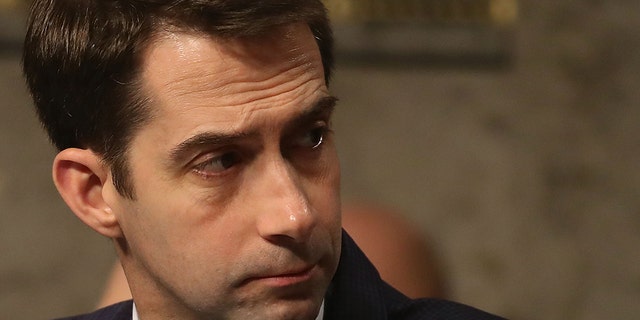
Sen. Tom Cotton, R-Ark., participates in a Senate Armed Services
Committee hearing on Capitol Hill, on Jan. 25, 2018 in Washington, D.C.
(Photo by Mark Wilson/Getty Images)
The
bill is sponsored by GOP Sens. Marsha Blackburn of Tennessee, John
Cornyn of Texas, Ted Cruz of Texas, Lindsey Graham of South Carolina,
Josh Hawley of Missouri, David Perdue of Georgia, Mitt Romney of
Utah and Ben Sasse of Nebraska.
The act defines “membership in a
significant transnational criminal organization” as direct members
and/or their spouse and child. But it carves out an exemption for those
“who did not know, or should not reasonably have known, that his or her
spouse or parent was a member of a significant transnational criminal
organization or whom the Attorney General has reasonable grounds to
believe has renounced” to such membership.
Mexican national guardsmen patrol near Bavispe, at the Sonora-Chihuahua border, Mexico, Wednesday, Nov. 6, 2019.
(AP)
The bill comes at a time when cartel
violence is spiking and the U.S. is battling unprecedented levels of
drug-related deaths and overdoses. New Acting Homeland Security Secretary Chad Wolf has also vowed to go after cartels and other gangs fueling chaos at the border.
Meanwhile,
it remains to be seen if and when Trump's FTO designation on the
cartels will come to fruition, a move that has generated both praise and
criticism. Terrorist designations are handled by the U.S. State
Department. Once a group has been slapped with such a designation, known
members are prohibited from entering the country, and it is then
illegal for those in the U.S. to intentionally provide support to them.
Financial institutions are also barred from doing any type of business
with the organization or its members.
“The FTO designation is an
important step in a positive direction for U.S. national security. Too
many Americans have died as the ruthless cartels have made billions by
terrorizing communities and killing at unprecedented levels. It's clear
President Trump always places the safety of Americans first,” noted
Derek Maltz, a former special agent in charge of the Drug Enforcement
Administration Special Operations Division in New York. “Designating the
cartels as terrorists and implementing a focused operational plan will
save a tremendous amount of lives.”
The
FTO tag could also mean that an American in an inner-city gang selling
street drugs that originated from south of the border could be
prosecuted under anti-terrorism laws – possibly being given a life
sentence.
A boy pauses as he speaks next to the coffins of Dawna Ray
Langford, 43, and her sons Trevor, 11, and Rogan, 2, who were killed by
drug cartel gunmen, during the funeral at a family cemetery in La Mora,
Sonora state, Mexico, Thursday, Nov. 7, 2019.(AP Photo/Marco Ugarte)
According
to the latest annual assessment from the DEA, Mexican drug trafficking
organizations pose the greatest crime threat to the U.S. and are
continuing to “expand their control of the opioids market” in
conjunction with the deadly spike in overdoses in recent years. However,
officials have also lamented that “the scope of violence generated by
Mexican crime groups has been difficult to measure due to restricted
reporting by the government and attempts by groups to mislead the
public.”
Moreover, Mexico’s homicide rate – routinely driven by
cartel-connected violence – is on the path to reaching record levels
this year, even higher than the record numbers set in 2018 when more
than 30,000 people were killed.
Bernie Sanders faced pushback from union members in Las Vegas on Tuesday over how the Democratic presidential candidate would fund a government-subsidized health care plan that would force union members to forfeit the benefits they’ve spent years bargaining for.
The
77-year-old independent U.S. senator from Vermont addressed a town hall
meeting hosted by Culinary Union Local 226 and its parent union, Unite
Here. Though union members in the crowd were widely supportive of
Sanders – shouting “Bernie! Bernie!” as he wheeled out his stance on
immigration, criminal justice and climate change – a group of about 12
people began to heckle the senator when he came to health care,
according to the Washington Examiner.
“We have, in this country, a dysfunctional, broken and cruel health care system,” Sanders told the audience, according to the Las Vegas Sun. “We spend twice as much per person on health care as do the people of any other country.”
Elodia
Muñoz -- one of 550 Culinary members to strike against the Frontier
hotel for more than six years between 1991 and 1998 – questioned why she
should vote for a candidate who supports Medicare-for-All after all her
effort, the Las Vegas Review-Journal reported. Under the government plan, all Americans, including union members, would lose private insurance plans.
During
Sanders’ response, the crowd began to chant: “Union health care! Union
health care!" One man also shouted: "How are you gonna pay for it?"
The same union hosted Sen. Elizabeth Warren, D-Mass., on Monday and will host former Vice President Joe Biden on Wednesday.
In
his bid for the party’s presidential nomination, Biden has called for
allowing employees to keep their current health plans, positioning
himself against Warren and Sanders who’ve both advocated for
Medicare-for-All. The International Association of Firefighters, which
has endorsed Biden, has called Medicare-for-All a non-starter, according
to the Examiner.
"You'll
be able to keep your negotiated plans," Biden told a group of union
members in August. "You've worked like hell, you gave up wages for it."
Warren
has recently backed away from her once-orthodox approach toward a
government-run health care system after seeing her poll numbers
deteriorate over the past month in national surveys and, more
importantly, in polls in Iowa and New Hampshire, the first two states to
hold contests in the primary and caucus presidential nominating
calendar.
Speaking in Las Vegas on Tuesday, Sanders discussed his
efforts to pass legislation throughout his career that aligns with
union issues, including raising the minimum wage, forcing employers to
recognize union elections and deterring corporate greed. He also cited
his experience negotiating with companies that employ Unite
Here workers, such as American Airlines. Still, union benefits remain
the main factor that keeps membership high.
Culinary Union President Ted Pappageorge later chastised the crowd for heckling Sanders.
“We’re
gonna let candidates speak without any kind of heckling. If you want to
heckle, go outside and heckle. We want to learn. The town halls are to
learn. Frankly, not to learn from the hecklers, but the candidates,"
Pappageorge told the crowd. "Second, I want to be very clear to
everybody, this union stands very strongly that every American deserves
to have good, quality health care. It’s a right, it should never be a
privilege in this country.” Fox News' Paul Steinhauser and Tara Prindiville contributed to this report.
Rep. Karen Bass, D-Calif., said Tuesday she's willing to impeach President Trump again if he wins reelection in 2020.
TMZ
founder Harvey Levin presented Bass with a scenario in which Trump wins
a second term but Democrats take over the Senate from the Republicans.
"There's
no such thing, really, as double jeopardy in an impeachment trial
because it's political," Levin said. "Suppose he gets reelected... and
you win back the Senate in a big way. If you did that, would you
be inclined to take a second bite at the apple and reintroduce the exact
same impeachment articles and then send it through again a second if
you have a Democratic Senate on your side?"
"So, you know, yes,
but I don't think it would be exactly the same and here's why," Bass
responded, "because even though we are impeaching him now, there's still
a number of court cases, there's a ton of information that could come
forward. For example, we could get his bank records and find out that
he's owned 100 percent by the Russians."
She
continued, "You are absolutely right in your scenario, but the only
thing I would say slightly different is, it might not be the same
articles of impeachment because the odds are we would have a ton more
information, and then the odds of that, sadly enough, is that, you know,
he probably has other examples of criminal behavior."
Earlier
in the day, Bass spoke with Fox News' Neil Cavuto and expressed her
"rock-solid" confidence that House Democrats had enough votes to pass
articles of impeachment. The Democrats unveiled two impeachment articles
earlier in the day: one for abuse of power and one for obstruction of
Congress.
Trump, at a rally in Pennsylvania Tuesday night, decried their efforts as "impeachment lite."
WASHINGTON (AP) — A Justice Department inspector general report on the early days of the Russia investigation
identified problems that are “unacceptable and unrepresentative of who
we are as an institution,” FBI Director Chris Wray says in detailing
changes the bureau plans to make in response.
In
an interview Monday with The Associated Press, Wray said the FBI had
cooperated fully with the inspector general — which concluded in its
report that the investigation into ties between the Trump campaign and
Russia was legitimate but also cited serious flaws — and accepted all
its recommendations.
Wray
said the FBI would make changes to how it handles confidential
informants, how it applies for warrants from the secretive Foreign
Intelligence Surveillance Court, how it conducts briefings on foreign
influence for presidential nominees and how it structures sensitive
investigations like the 2016 Russia probe. He said he has also
reinstated ethics training.
“I
am very committed to the FBI being agile in its tackling of foreign
threats,” Wray said. “But I believe you can be agile and still
scrupulously follow our rules, policies and processes.”
President
Donald Trump challenged his FBI director in a tweet Tuesday, claiming
the bureau is “badly broken” and incapable of being fixed.
“I
don’t know what report current Director of the FBI Christopher Wray was
reading, but it sure wasn’t the one given to me,” Trump wrote on
Twitter. “With that kind of attitude, he will never be able to fix the
FBI, which is badly broken despite having some of the greatest men &
women working there!”
Wray
was not FBI director when the Russia investigation began and has so far
avoided commenting in depth on the probe, one of the most politically
sensitive inquiries in bureau history and one that President Donald
Trump has repeatedly denounced as a “witch hunt.” Wray’s comments Monday
underscore the balancing act of his job as he tries to embrace
criticism of the Russia probe that he sees as legitimate while limiting
public judgment of decisions made by his predecessors.
He
said that though it was important to not lose sight of the fact that
Inspector General Michael Horowitz found the investigation justified and
did not find it to be tainted by political bias, “The American people
rightly expect that the FBI, when it acts to protect the country, is
going to do it right — each time, every time.
“And,” he added, “urgency is not an excuse for not following our procedures.”
The
report found that the FBI was justified in opening its investigation in
the summer of 2016 into whether the Trump campaign was coordinating
with Russia to tip the election in the president’s favor. But it also
identified “serious performance failures” up the bureau’s chain of
command, including 17 “significant inaccuracies or omissions” in
applications for a warrant from the secretive Foreign Intelligence
Surveillance Court to monitor the communications of former Trump
campaign adviser Carter Page and subsequent warrant renewals.
The
errors, the watchdog said, resulted in “applications that made it
appear that the information supporting probable cause was stronger than
was actually the case.”
Wray
declined to say if there was one problem or criticism that he found
most troubling, but noted, “As a general matter, there are a number of
things in the report that in my view are unacceptable and
unrepresentative of who we are as an institution.”
“This is a serious report,” he added, “and we take it serious.”
_____
Follow Eric Tucker on Twitter at http://www.twitter.com/etuckerAP
WASHINGTON
(AP) — House Democrats are poised to unveil two articles of impeachment
Tuesday against President Donald Trump — abuse of power and obstruction
of Congress. Trump, meanwhile, insisted he did “NOTHING” wrong and that
impeaching a president with a record like his would be “sheer Political
Madness!”
Democratic leaders say Trump put U.S. elections and national security at risk when he asked Ukraine to investigate his rivals, including Democrat Joe Biden.
Speaker
Nancy Pelosi declined during an event Monday evening to discuss the
articles or the coming announcement. Details were shared by multiple
people familiar with the discussions but not authorized to discuss them
and granted anonymity.
When
asked if she has enough votes to impeach the Republican president,
Pelosi leader said she would let House lawmakers vote their conscience.
“On
an issue like this, we don’t count the votes. People will just make
their voices known on it,” Pelosi said at The Wall Street Journal CEO
Council. “I haven’t counted votes, nor will I.”
The outcome, though, appears increasingly set as the House prepares to vote, as it has only three times in history against a U.S. president.
Trump,
who has declined to mount a defense in the impeachment proceedings,
tweeted Tuesday just as the five Democratic House committee chairmen
prepared to make their announcement.
“To
Impeach a President who has proven through results, including producing
perhaps the strongest economy in our country’s history, to have one of
the most successful presidencies ever, and most importantly, who has
done NOTHING wrong, is sheer Political Madness! #2020Election,” he wrote
on Twitter.
The president also spent part of Monday tweeting against the impeachment proceedings. He and his allies have called the process “absurd.”
Pelosi
convened a meeting of the impeachment committee chairmen at her office
in the Capitol late Monday following an acrimonious, nearly 10-hour
hearing at the Judiciary Committee, which could vote as soon as this
week.
“I think
there’s a lot of agreement,” Rep. Eliot Engel of New York, the
Democratic chairman of the Foreign Affairs committee, told reporters as
he exited Pelosi’s office. “A lot of us believe that what happened with
Ukraine especially is not something we can just close our eyes to.”
At the Judiciary hearing, Democrats said Trump’s push to have Ukraine investigate rival Joe Biden while withholding U.S. military aid ran counter to U.S. policy and benefited Russia as well as himself.
“President
Trump’s persistent and continuing effort to coerce a foreign country to
help him cheat to win an election is a clear and present danger to our
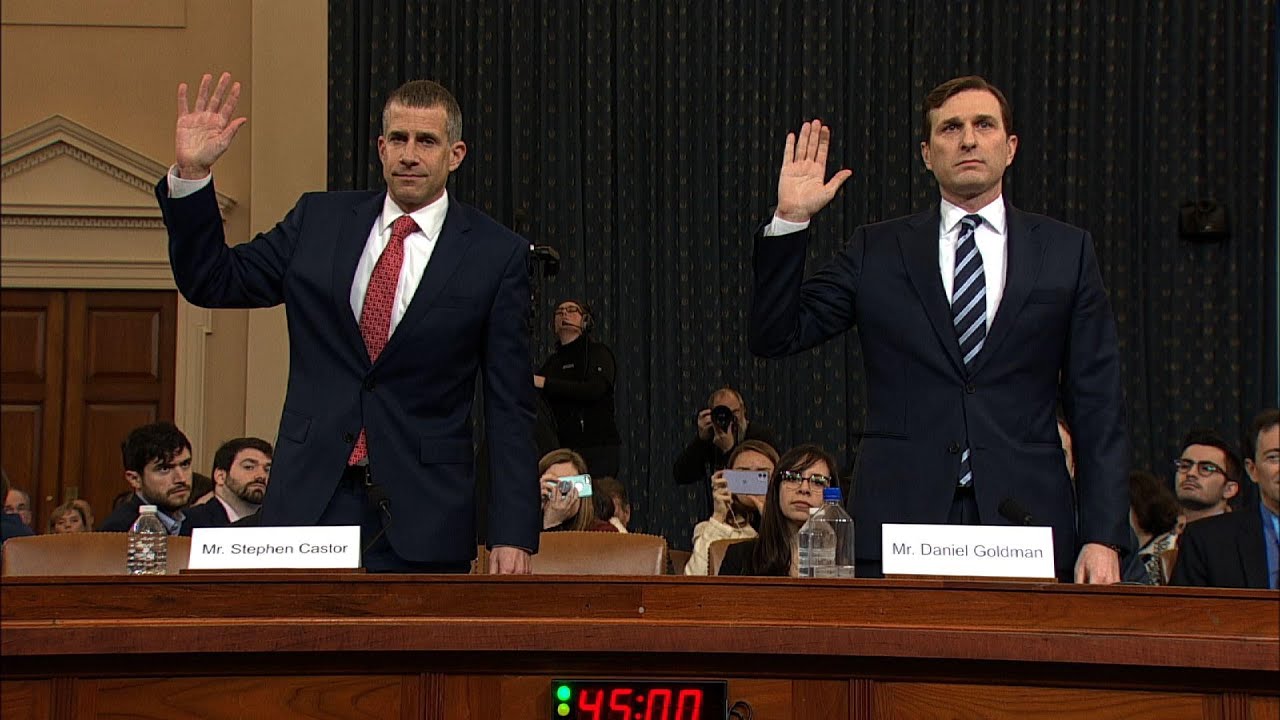
free and fair elections and to our national security,” said Dan Goldman,
the director of investigations at the House Intelligence Committee,
presenting the finding of the panel’s 300-page report of the inquiry.
Republicans
rejected not just Goldman’s conclusion of the Ukraine matter; they also
questioned his very appearance before the Judiciary panel. In a series
of heated exchanges, they said Rep. Adam Schiff, the chairman of the
Intelligence Committee, should appear rather than sending his lawyer.
From the White House, Trump tweeted repeatedly, assailing the “Witch Hunt!” and “Do Nothing Democrats.”
In drafting the articles of impeachment, Pelosi
is facing a legal and political challenge of balancing the views of her
majority while hitting the Constitution’s bar of “treason, bribery or
other high crimes and misdemeanors.”
Some
liberal lawmakers wanted more expansive charges encompassing the
findings from former special counsel Robert Mueller’s probe of Russian
interference in the 2016 election. Centrist Democrats preferred to keep
the impeachment articles more focused on Trump’s actions toward Ukraine.
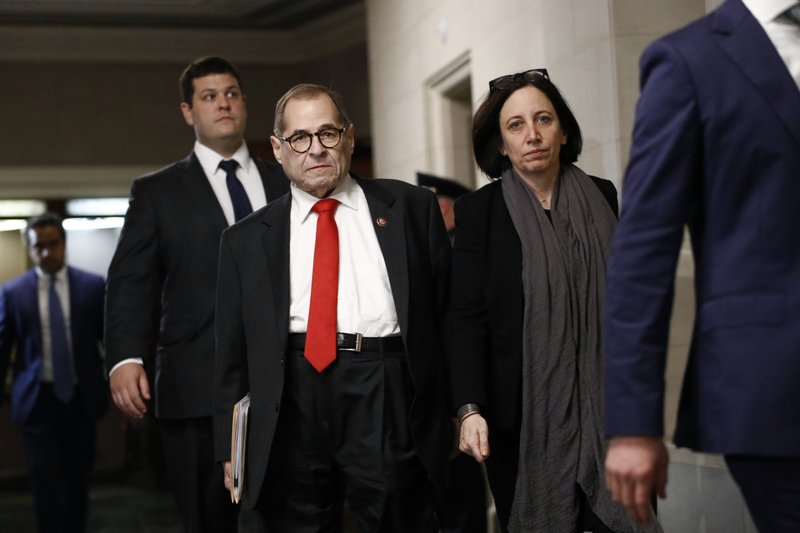
Rep. Jerrold Nadler, D-N.Y., was blunt as he opened Monday’s hearing, saying, “President Trump put himself before country.”
Trump’s conduct, Nadler said at the end of the daylong hearing, “is clearly impeachable.”
Rep.
Doug Collins of Georgia, the top Republican on the committee, said
Democrats are racing to jam impeachment through on a “clock and a
calendar” ahead of the 2020 presidential election.
“They
can’t get over the fact that Donald Trump is the president of the
United States, and they don’t have a candidate that can beat him,”
Collins said.
In
one testy exchange, Republican attorney Stephen Castor dismissed the
transcript of Trump’s crucial call with Ukraine as “eight ambiguous
lines” that did not amount to the president seeking a personal political
favor.
Democrats
argued vigorously that Trump’s meaning could not have been clearer in
seeking political dirt on Biden, his possible opponent in the 2020
election.
The
Republicans tried numerous times to halt or slow the proceedings, and
the hearing was briefly interrupted early on by a protester shouting,
“We voted for Donald Trump!” The protester was escorted from the House
hearing room by Capitol Police.
The White House is refusing to participate
in the impeachment process. Trump and and his allies acknowledge he
likely will be impeached in the Democratic-controlled House, but they
also expect acquittal next year in the Senate, where Republicans have
the majority.
The president was focused instead on Monday’s long-awaited release of the Justice Department report
into the 2016 Russia investigation. The inspector general found that
the FBI was justified in opening its investigation into ties between the
Trump presidential campaign and Russia and that the FBI did not act
with political bias, despite “serious performance failures” up the
bureau’s chain of command.
Democrats say Trump abused his power in a July 25 phone call
when he asked Ukrainian President Volodymyr Zelenskiy for a favor in
investigating Democrats. That was bribery, they say, since Trump was
withholding nearly $400 million in military aid that Ukraine depended on
to counter Russian aggression.
Pelosi
and Democrats point to what they call a pattern of misconduct by Trump
in seeking foreign interference in elections from Mueller’s inquiry of
the Russia probe to Ukraine.
In
his report, Mueller said he could not determine that Trump’s campaign
conspired or coordinated with Russia in the 2016 election. But Mueller
said he could not exonerate Trump of obstructing justice in the probe and left it for Congress to determine.
___
Associated Press writers Julie Pace, Laurie Kellman, Matthew Daly and Eric Tucker contributed to this report.
In the hours after U.S. Attorney John Durham announced Monday that he did not "agree"
with key findings by Justice Department Inspector General Michael E.
Horowitz, speculation swirled over what Durham has uncovered in his
ongoing review into potential surveillance abuses against President
Trump's team.
Durham's inquiry has had a broader scope than
Horowitz's, including a focus on foreign actors as well as the CIA,
while Horowitz concentrated his attention on the DOJ and FBI.
Additionally, Durham's criminal review has had additional investigative resources not available to Horowitz.
"Based
on the evidence collected to date, and while our investigation is
ongoing, last month we advised the Inspector General that we do not
agree with some of the report’s conclusions as to predication and how
the FBI case was opened," Durham said in his statement, adding that his
"investigation is not limited to developing information from within
component parts of the Justice Department" and "has included developing
information from other persons and entities, both in the U.S. and
outside of the U.S."
Still, Horowitz's report offered
several clues as to potential avenues that Durham may be pursuing. For
example, Horowitz noted that the FBI omitted exculpatory statements by
former Trump aide George Papadopoulos in its Foreign Intelligence
Surveillance Act (FISA) court warrant application to surveil another
ex-Trump aide, Carter Page.
Horowitz noted that the bureau, in its
FISA application and subsequent renewals, completely failed to mention
that Page had been "approved as an operational contact" and served as a
valuable asset, presumably for the CIA, from 2008 to 2013.
Papadopoulos previously told Fox News he was convinced the CIA was behind an "operation" in which he met intelligence community informants in London in late 2016 who tried to probe whether the Trump campaign had ties to Russia. He later said he would head to Greece to obtain money in a safe from the FBI or CIA that he said was intended to entrap him.
Even
though Papadopoulos told a confidential FBI source that "to his
knowledge, no one associated with the Trump campaign was collaborating
with Russia or with outside groups like Wikileaks in the release of
[Clinton/DNC] emails," the FISA application conspicuously "did not
include the statements Papadopoulos made to this [confidential source]
that were in conflict with information included in the FISA
application," Horowitz found.
The FISA application also omitted
"Page's consensually monitored statements" to an FBI confidential
informant in August 2016 that Page had 'literally never met' or 'said
one word' to Paul Manafort," contrary to the FBI's claims that Page was
conspiring with Russia by "acting as an intermediary for Manafort." And,
the FISA documents omitted key statements by Maltese Professor Joseph
Mifsud to the FBI, including Mifsud's assertion that he had "no advance
knowledge" that Russia had any hacked emails, and therefore "did not
make any offers or proffer any information to Papadopoulos" when the two
met.
Additionally, according to Horowitz's report, the CIA viewed
the now-discredited dossier from British ex-spy Christopher Steele as
an "internet rumor," even though key bureau officials including former
FBI Director James Comey sought to include the dossier in its highly
sensitive intelligence community assessment on Russian interference,
known as the ICA.
Sources previously told Fox News that a late-2016 email chain indicated Comey told bureau subordinates that then-CIA Director John Brennan insisted the dossier be included in the ICA. A Brennan representative pointed the finger back at Comey.
The
FBI also relied on the dossier to obtain its secret surveillance
warrant to surveil Page, and an FBI lawyer told Horowitz that probable
cause against Page was "probably 50/50" without the dossier. Horowitz
found that the FISA application's basis to argue that there was probable
cause to surveil Page "drew almost entirely" from Steele's dossier.
It
has long been reported that the ultimately successful Page
application relied heavily on information from Steele – whose anti-Trump
views have been well-documented – and cited Page’s suspected Russia
ties. In its warrant application, the FBI inaccurately assured the FISA court on numerous occasions that
a Yahoo News article independently corroborated Steele's claims about
Page's Russian contacts, and did not clearly state that Steele worked
for a firm hired by Hillary Clinton's campaign and the Democratic
National Committee (DNC).
The FBI told the FISA court it did "not
believe that [Steele] directly provided ... to the press" information
concerning Page. However, Horowitz wrote that he found "no documentation
demonstrating that Steele was asked by the FBI whether he was the
source of the Yahoo News article disclosure or told the FBI he was not."
And,
even after the FBI obtained information that "more strongly indicated
that Steele had directly provided information to Yahoo News around the
time of the Sept. 23 article," Horowitz found, "no revisions were made
to the FBI's assessment, contained in Renewal Application No. 3, that
Steele had not directly provided the information to the press."
Contrary to repeated on-air assurances
by CNN analyst Asha Rangappa, who prominently bills herself as a
"former FBI special agent" even though she worked as a university
admissions officer for most of her career after serving only a brief
time in the bureau, Horowitz found that the FBI did not verify several
key facts in subsequent renewal applications for the Page FISA warrant.
In some cases, evidence available to the FBI actually contradicted claims in the FISA application.
"The
agents ... also did not follow, or appear to even know, the
requirements in the Woods Procedures to re-verify the factual assertions
from previous [FISA] applications," Horowitz wrote. For example,
Horowitz found, the FBI inaccurately asserted to the FISA court that
Page "did not provide any specific details" to refute or clarify media
reporting about his activities with Russian agents. Additionally, the
FBI inaccurately told the court that Page made "vague statements" to
minimize his Russian contacts.
Separately, Horowitz found that the
FBI offered to pay Steele "significantly" for information pertaining to
Michael Flynn, Trump's ex-national security advisor who is fighting to overturn his guilty plea
on one count of making false statements to the FBI. Flynn, who suffered
financial pressures leading up to the guilty plea, has accused the FBI
of hiding exculpatory evidence, doctoring key witness reports, and
seeking to create a process crime for political reasons.
Much of the Steele dossier has been proved discredited or unsubstantiated, including the dossier's claims that the Trump campaign was paying hackers in the United States out of a non-existent Russian consulate in Miami, or that ex-Trump lawyer Michael Cohen traveled to Prague to conspire with Russians.
Special
Counsel Robert Mueller also was unable to substantiate the dossier's
claims that Page had received a promise of a large payment relating to
the sale of a 19-percent share of Rosneft, a Russian oil giant, or that a
lurid blackmail tape involving the president existed.
Horowitz's
report similarly found no evidence to support that bribery claim, even
after a review of text messages from a source cited by the FBI.
Horowitz's
report Monday said his investigators found no intentional misconduct or
political bias surrounding efforts to launch that 2016 probe and to
seek a highly controversial FISA warrant to surveil Page in the early
months of the investigation. Still, it found "significant concerns with
how certain aspects of the investigation were conducted and supervised." Fox News' Alex Pappas contributed to this report.
President Trump blasted FBI Director Christopher Wray on Tuesday morning over his response to the Justice Department inspector general's report
on the origins of the FBI's Russia investigation and use of Foreign
Intelligence Surveillance Act (FISA) warrants to monitor former Trump
campaign adviser Carter Page.
The IG report found that while there
were a significant number of concerns regarding the FBI's practices in
obtaining the FISA warrant and other aspects of the probe, there was no
evidence of political bias or impropriety regarding their motives in the
investigation. Wray has accepted these findings, but Trump signaled
Tuesday he doesn't think Wray is taking the concerns seriously enough.
"I
don’t know what report current Director of the FBI Christopher Wray was
reading, but it sure wasn’t the one given to me. With that kind of
attitude, he will never be able to fix the FBI, which is badly broken
despite having some of the greatest men & women working there!" he
tweeted.
In an ABC interview, Wray highlighted the IG report's
conclusion that there was no political bias or improper motive behind
the FBI's launching of the Russia probe, stating, "I think it's
important that the inspector general found that in this particular
instance the investigation was opened with appropriate predication and
authorization."
When asked if he had any evidence that the FBI
unfairly targeted Trump's campaign, Wray said, "I don't," and appeared
to take offense to the notion that the FBI is part of a "deep state."
"I
think that's the kind of label that is a disservice to the 37,000 men
and women who work at the FBI who I think tackle their jobs with
professionalism, with rigor, with objectivity, with courage ... so
that's not a term I would ever use to describe our workforce and I think
it's an affront to them,” he said.
At the same time, Wray acknowledged the bureau errors cited in the IG report.
In
an interview with The Associated Press, Wray said the report identified
problems that are "unacceptable and unrepresentative of who we are as
an institution." He said the FBI would make changes to how it handles
confidential informants, how it applies for warrants from the secretive
Foreign Intelligence Surveillance Court, how it conducts briefings on
foreign influence for presidential nominees and how it structures
sensitive investigations like the 2016 Russia probe. He said he has also
reinstated ethics training.
"I am very committed to the FBI being
agile in its tackling of foreign threats," Wray said. "But I believe
you can be agile and still scrupulously follow our rules, policies and
processes."
This followed a letter to Inspector General Horowitz,
in which Wray said, "the FBI accepts the Report’s findings and embraces
the need for thoughtful, meaningful remedial action."
While the IG
report went into great detail regarding the FBI's failures during the
Russia probe, the conclusion that there was no political bias runs
contrary to Trump's theory that Obama administration officials were
unfairly targeting his campaign.
Attorney
General Bill Barr, meanwhile, issued a lengthy statement in which he
heavily criticized the FBI's conduct during the investigation, but made a
point to note that "most of the misconduct identified by the Inspector
General was committed in 2016 and 2017 by a small group of now-former
FBI officials."
Barr specifically praised Wray for his cooperation
with the IG investigation, and said he has "full confidence in Director
Wray and his team at the FBI, as well as the thousands of dedicated
line agents who work tirelessly to protect our country." The Associated Press contributed to this report.
CAPITOL HILL – There are important roll call votes on Capitol Hill -- but votes on articles of impeachment against President Trump would be monumental.
Think
about votes cast in 2009 and and 2010 for or against ObamaCare. A
failed effort to undo ObamaCare in 2017. Votes in 2008 to salvage the
economy with the Troubled Asset Relief Program (TARP). Votes last
Congress on tax reform. Various votes to fund the government and hike
the debt ceiling. And, in the Senate, votes to confirm Supreme Court
Justices Neil Gorsuch and Brett Kavanaugh.
News organizations and
political firms have traved major votes on the floors of the House and
Senate each year. Some of those votes may define a career. Look at the
nay vote cast by the late Sen. John McCain, R-Ariz., to end Republican
efforts to unwind ObamaCare. Separately, voters in Maine and Colorado
respectively took note of the votes by Republican Sens. Susan Collins
and Cory Gardner to confirm Kavanaugh last fall. That vote is sure to
resonate in the reelection bids for Collins and Gardner next year.
All
of those votes have been major, reverberating throughout a given
Congress – and even for decades to come. Despite multiple efforts to gut
ObamaCare, it has remained the law of the land. Still, “aye” ballots
for ObamaCare proved to help end the congressional careers of
many House and Senate Democrats. Republicans weaponized that vote
against those Democrats. Some paid with their political lives in 2010
and beyond. Lots of House Republicans lost the House for the same reason
last year because of their votes for the tax bill and for trying to
repeal ObamaCare.
We won’t know if the votes by Collins and
Gardner for Kavanaugh will sway the outcomes of their Senate contests
next year. But, barring illness, the 54-year-old Kavanaugh could serve
on the high court for decades. The decisions by Collins and Gardner to
confirm Kavanaugh are likely to echo in American jurisprudence for
years.
These are all high-profile roll call votes, as weighty as
can be. But, there is yet one more, hyper-elite classification of House
and Senate votes, more consequential than the rest. These are votes to
go to war and to impeach a president.
These momentous votes have
filtered through the decades. Rep. Barbara Lee, D-Calif., is still known
as the only House member to oppose the war resolution following Sept.
11, 2001. The late Rep. Jeannette Rankin, R-Mont., was the first woman
ever elected to Congress, but in addition to her trailblazing for women,
historians have recalled her votes opposing U.S. involvement in World
War I and World War II.
“I cannot vote for war,” said Rankin when
she opposed the U.S. declaring war against Germany in World War I.
Rankin’s words about war were emblazoned on the base of her statue in
the U.S. Capitol Visitor’s Center. It’s one of two statues from Montana
in the official congressional collection.
Other lawmakers voted
against the U.S. entering World War I. But, Rankin was the only member
of either body to vote “nay” after Japan bombed Pearl Harbor. Many
prominent members, including future Senate Minority Leader Everett
Dirksen, R-Ill., then a congressman, tried to persuade Rankin to vote
“aye” so the tally would be unanimous. But, Rankin resisted. Her
position was so unpopular that she abstained from voting on future war
declarations against Germany and Italy. Her political career ended soon
afterwards.
This brings us to present day.
The
House Judiciary Committee is likely to entertain three to five articles
of impeachment for Trump. The House would not simply throw a broad
resolution on the floor with members voting up or down to impeach. These
articles would be honed and massaged, narrow and concrete. Members
would focus on what they accused the president of doing, such as an
indictment. It’s then up to the Judiciary Committee to actually approve
the articles and send them to the House floor. The House must then vote
to adopt or reject those articles.
Without question, these votes
on articles of impeachment would be the most critical ballots cast in
the 116th Congress. They could be the cardinal votes many lawmakers
would make during their congressional tenures. That said, 55 House
members who voted on the impeachment of then-President Bill Clinton in
1998 have remained in the House.
In 1974, the House Judiciary
Committee considered five articles of impeachment and approved three for
then-President Richard Nixon. Nixon resigned before the articles went
to the House floor. In 1998, the Judiciary Committee prepared four
articles of impeachment but the full House okayed only two of them.
Details
of the articles would paramount, so members of Congress from both
parties would want to evaluate the articles -- study them, ponder them,
and then, with a deep sigh, decide how to vote.
We always hear an
array of TV commercials from upstarts and political neophytes just
before each congressional election, boasting about how if you elect
them, they’ll head to Washington and have the courage “to take the tough
votes.”
Well, congratulations, members of the 116th Congress. You won the lottery.
Americans are likely to remember how all current 431 members of the House voted, yea or nay, on each article of impeachment.
Think
of the vulnerable, freshmen Democrats who helped propel their party to
the majority in 2018, representing districts Trump won in 2016. There
are 31 such Democrats. Look closely at how freshmen Democrats like Reps.
Kendra Horn of Oklahoma, Anthony Brindisi of New York and Joe
Cunningham of South Carolina vote.
Republicans wouldn’t be out of
the woods yet, either. Consider the challenges of an impeachment vote
for swing-district Republicans including Reps. Fred Upton of Michigan,
John Katko of New York and Don Bacon of Nebraska.
Potential
articles of impeachment have centered on “bribery” -- specifically
mentioned in Article II, Section 4 of the Constitution -- abuse of
power, contempt of Congress and obstruction of justice. All such
potential articles would be fissionable enough to incinerate many a
political career if a lawmaker were to vote the wrong way.
But, one potential article of impeachment would be practically thermonuclear: treason.
Again,
Article II, Section 4 of the Constitution mentions “treason” as a
defined transgression worthy of impeachment. One could see how House
Democrats might try to make a case for treason with President Trump.
The
House essentially accused Sen. William Blount of Tennessee of treason
in the republic’s first impeachment in 1797. The House argued Blount
covertly worked with Britain to acquire territory in the south. The
House impeached Federal Judge West Hughes Humphreys in 1862 for
supporting the Confederacy. No other House impeachments have ever
wandered into treason as possible grounds for impeachment.
This
speaks to why the House may impeach President Trump on some articles and
not others. That’s why members are so curious to learn what the
articles may be and decide how to vote on each individual.
It’s just a simple question, right? Binary. Yea or nay? Members do this all day long.
But,
votes on the impeachment of Trump are likely to be the most momentous
of a lawmaker’s career. And, the decisions lawmakers make will pulsate
through the American experience like no other ballot they cast before.


 Sen. Tom Cotton, R-Ark., participates in a Senate Armed Services
Committee hearing on Capitol Hill, on Jan. 25, 2018 in Washington, D.C.
(Photo by Mark Wilson/Getty Images)
Sen. Tom Cotton, R-Ark., participates in a Senate Armed Services
Committee hearing on Capitol Hill, on Jan. 25, 2018 in Washington, D.C.
(Photo by Mark Wilson/Getty Images)
 Mexican national guardsmen patrol near Bavispe, at the Sonora-Chihuahua border, Mexico, Wednesday, Nov. 6, 2019.
(AP)
Mexican national guardsmen patrol near Bavispe, at the Sonora-Chihuahua border, Mexico, Wednesday, Nov. 6, 2019.
(AP)
 A boy pauses as he speaks next to the coffins of Dawna Ray
Langford, 43, and her sons Trevor, 11, and Rogan, 2, who were killed by
drug cartel gunmen, during the funeral at a family cemetery in La Mora,
Sonora state, Mexico, Thursday, Nov. 7, 2019.(AP Photo/Marco Ugarte)
A boy pauses as he speaks next to the coffins of Dawna Ray
Langford, 43, and her sons Trevor, 11, and Rogan, 2, who were killed by
drug cartel gunmen, during the funeral at a family cemetery in La Mora,
Sonora state, Mexico, Thursday, Nov. 7, 2019.(AP Photo/Marco Ugarte)