From the moment Donald Trump
was inaugurated, Washington Democrats have been myopically focused on
politically targeting his administration and impeaching him.
Set aside their three separate impeachment votes before anything with Ukraine ever happened.
Recall
the dissemination of a fake Russian collusion conspiracy theory, built
on a debunked dossier and aided by rogue senior FBI officials.
Remember the failed attempt to convict President Trump on a baseless obstruction of justice allegation.
And,
most recently, consider the evidence-free hysteria over a secondhand
allegation about a call Democrats hadn’t heard and a transcript they
hadn’t read at the time – culminating in an official impeachment
procedure.
The impeachment began as it ultimately stayed: a
disorganized kangaroo court. Secret depositions, manipulative leaks and
wild allegations seized Congress.
Democrats
began an effort to overturn an election behind the closed doors of a
sensitive compartmented information facility used for classified
information. They leaked only anti-Trump information and kept Americans
in the dark from context for weeks.
And it’s certainly no wonder
that Democrats guarded the full set of facts from the public as long as
they could. In the weeks of open hearings, their case didn’t just render
little evidence – it fell apart at the faintest sign of scrutiny.
Officials
like America’s acting ambassador to Ukraine, William Taylor, admitted
to never having been a party to any conversations, negotiations or
discussions providing firsthand knowledge.
Former Ambassador to
Ukraine Marie Yovanovitch didn’t finish her opening statement before
acknowledging she could bring no testimony regarding any quid pro quo
allegations against the president – or, the entire basis of the
impeachment.
Even the “star witness” – Ambassador to the European
Union Gordon Sondland – admitted he had no evidence “other than his
assumptions.” In other words: he had nothing at all.
This came
even as Congress heard from multiple witnesses with firsthand accounts,
directly undercutting the anti-Trump allegations.
Officials like
former special envoy to Ukraine Kurt Volker and former National Security
Council Russia specialist Tim Morrison were emphatic that there was no
political quid pro quo, that the Ukrainians never communicated a belief
otherwise, and that President Trump never ordered anything of the sort.
Remarkably,
we even heard from Ukrainian President Volodymyr Zelensky and his top
aide, Andriy Yermak, disputing the allegations from Ukraine’s
perspective.
While the Democrats had rumors and innuendo
suggesting something was true, President Trump had direct witnesses
testifying that the allegations were false.
Despite all this,
Democrats pushed forward and introduced articles of impeachment Monday.
It should be noted these articles came after Democrats made an 11th-hour
rule change in the House Judiciary Committee, lowering the threshold
for impeachment.
Democrats then quietly removed “bribery” from
their list of allegations, after they had conducted polling that led
them to allege it in the first place.
Through it all, President
Trump and the White House were given virtually no rights – other than an
offer to have an attorney present during the last week, when the cake
had already been baked.
After
a bungled process, a weak fact pattern, and a crumbling narrative, it’s
now beyond any doubt: there is no policy priority too important and no
lack of evidence too glaring that will prevent Washington Democrats from
going after this president.
It has been the Democrats’
single-minded goal this entire Congress. They are an angry mob seeking
validation. An impeachment machine in search of a cause.
But this
effort to undermine the president will fail, just like their other
attempts. Americans will see through it. And if Washington Democrats
ever decide they’re ready to accept the results of the 2016 election,
we’ll be ready to work with them on issues that matter to American
families: creating more jobs, lowering health care costs, securing the
border, fighting the opioid crisis and more.
Until
then, while they focus on fruitless political investigations, we’ll
keep working with the president to deliver on his commitments and
improve everyday lives across the country. While Democrats check off
impeachment votes, the president will keep checking off his promises.
And
when all is said and done, it will be said of House Democrats: When
they couldn’t bring themselves to support President Trump, they consoled
themselves by making every effort to undermine those who did – the
American voters.
The
House Judiciary Committee is poised to be the scene of another major
partisan clash Thursday as lawmakers press ahead with two articles of impeachment against President Trump, ahead of an initial vote expected by day's end likely to advance the measures to the floor.
The
final "markup" process began Wednesday evening, immediately breaking
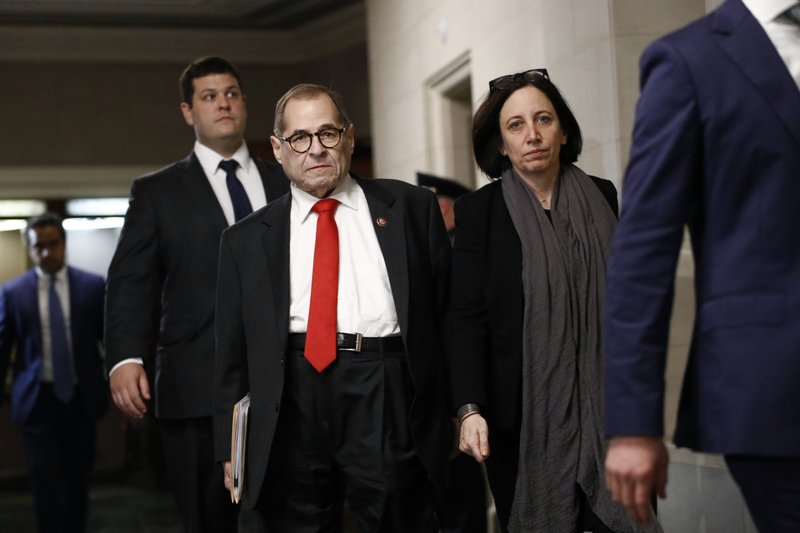
out into fiery disagreement. Committee Chairman Rep. Jerrold Nadler,
D-N.Y., argued that it would be unsafe to wait until the 2020 election
to remove Trump from office.
"We
cannot rely on an election to solve our problems when the president
threatens the very integrity of that election," Nadler claimed during
Wednesday's session.
Democrats from districts that supported Trump
in 2016, however, have been less enthusiastic. Recent polls have shown
declining support for impeachment in key swing states, with two polls
released Wednesday indicating that most Americans did not want Trump
removed.
Politico reported earlier this week that
the numbers were making a "small group" of moderate Democrats, who have
held seats in districts where Trump won in 2016, nervous about how to
vote. They instead have suggested Trump be censured,
which would prevent the GOP from holding a potentially damaging Senate
trial and give them political cover in the upcoming election.
The
House is now composed of 431 current members, meaning Democrats would
need 217 yeas to impeach Trump. There are currently 233 Democrats, so
Democrats could lose only 16 of their own and still impeach the
president. Among the House Democrats, 31 represent more moderate
districts that Trump carried in 2016.
Freshman Rep. Elissa
Slotkin, D-Mich. – who flipped a GOP district in 2018 that Trump won by
seven points in 2016 – told Fox News last month that she was tentatively
weighing all the evidence. On Wednesday, she confirmed that she's still undecided.
"The
phones are ringing off the hook," she told CNN. "We literally can't
pick up the phones fast enough -- and it's people on both sides of it."
Republicans,
meanwhile, have vociferously opposed the impeachment effort. The
committee's ranking member, Rep. Doug Collins of Georgia, stated that
Democrats have been trying to impeach Trump since he took office. He
echoed the White House's argument that the impeachment was politically
motivated theater, long in the works and foreshadowed openly by Democrats for months, if not years.
He
and Rep. Jim Sensenbrenner, R-Wis., each argued that unlike previous
presidents who have faced impeachment, Trump was not accused of an
offense actually defined by law: neither "abuse of power" nor
"obstruction of Congress" is a recognized federal or state crime. Those
are the two offenses outlined in the articles of impeachment before the
committee. (The separate charge of contempt of Congress, according to
the DOJ's Office of Legal Counsel, exempts the president for
separation-of-powers reasons.)
The markup is expected to go until
Thursday afternoon. If the committee votes to approve the articles of
impeachment, as expected, there will likely be an impeachment vote on
the House floor in the middle of next week.
The articles center on
Trump's efforts to pressure Ukraine to launch an investigation into his
political rivals – namely, former vice president Joe Biden – while
withholding aid. Democrats argue Trump wrongly used U.S. aid and the
prospect of a White House meeting as leverage, but Trump denies doing
so. Fox News' Chad Pergram and Mike Emanuel contributed to this report.
House
Democrats avoided a political pitfall Tuesday, limiting themselves to
two articles of impeachment rather than a kitchen-sink approach that
included Russia, Putin, the Trump hotel, caustic tweets and whatever
else they could conjure up.
But the brief appearance by Nancy
Pelosi, Jerry Nadler and Adam Schiff, for all their efforts at
solemnity, seemed like a predictable step on a predictable path toward
impeachment in the House and acquittal in the Senate.
And
that leaves us, as always, with roughly half the country believing that
President Trump did commit high crimes and misdemeanors, and half who
think Pelosi’s party is doing this solely to overturn the 2016 election.
So
the question becomes who do you believe: the Democrats or the GOP? The
media or the president? Inspector General Michael Horowitz or Attorney
General Bill Barr?
For so many people, the answer is one side or the other, or…no one at all.
This goes beyond impeachment, beyond Ukraine and Russia, beyond the Carter Page FISA warrant. The Washington Post is
running a series based on confidential documents, comparable to the
Pentagon papers, showing how the Bush, Obama and Trump administrations
lied about the war in Afghanistan by claiming progress as things kept
getting worse.
And many years before Trump popularized the phrase
fake news, confidence in the media began to slide, fueled by blunders
and bias.
Ben Domenech, founder of the Federalist, told the New York Times there has been a steady decline in trust in the gatekeepers of American life:
“Everything
from politics to faith to sports has been revealed as corrupted or
corruptible. And every mismanaged war, failed hurricane response,
botched investigation and doping scandal furthers this view.” That, he
said, “allows individuals to retreat to their own story lines, fantasies
and tales in which their tribe is always good or under attack, and the
other always craven and duplicitous.”
A very concise snapshot of where we are.
Christopher
Wray is either doing his job or, as Trump tweeted about the man he
appointed, “with that kind of attitude, he will never be able to fix the
FBI.”
Despite the IG’s findings of no political bias, Barr
continues to insist that the Trump campaign was “clearly spied upon,”
telling NBC’s Pete Williams that the nation has been upended by a “bogus
narrative” that’s been “hyped by an irresponsible media.” And they all
work for the same administration.
Twitter is the modern embodiment
of this tribal culture. Angry people on both sides will wave away this
question and go on the attack, saying that Trump is innocent or guilty,
that the deep state is insidious or fictitious, that FBI chief
What’s
more, they will denounce the motives of reporters, analysts, columnists
and anchors and declare them to be either Trump-haters or in the tank
for Trump–or for just being horrible human beings. There is plenty of
unfair journalism and commentary out there, to be sure, but also the
demonizing of decent people trying to do their jobs.
And we have plenty of company.
As
the Times piece by Peter Baker puts it: “Much of the public may not
trust Mr. Trump, according to surveys, but it likewise does not trust
his opponents all that much either — or the news media that he complains
is out to get him. Americans have been down on banks, big business, the
criminal justice system and the health care system for years, and fewer
have confidence in churches or organized religion now than at any point
since Gallup started asking in 1973.”
Public distrust in
government, at least in the modern era, has its roots in Vietnam, and in
Watergate (which led to the Nixon impeachment). Distrust in “the
system” is nothing new: remember the racially divided furor over the
O.J. verdict? And media malfeasance has a long history: Seven years
after the Washington Post won a Pulitzer for its Watergate reporting,
the paper had to return a Pulitzer for the phony Janet Cooke story about
an 8-year-old heroin addict.
Even a party-line impeachment is
familiar ground: Just 21 years ago, House Republicans brought articles
against Bill Clinton in a sex-and-lies scandal that was followed by
acquittal in the Senate.
If the Trump impeachment feels different,
it’s because the battle is part of a culture war that transcends
politics and plays out in an oversaturated media environment. It’s
because this president uses his vast platform, and digital bully pulpit,
to wage war on political rivals, critics and the media. It’s because
some Democrats really have been trying to get him out of office since he
was inaugurated. It’s because some in the press really do think he’s an
illegitimate president and have a visceral animosity toward him.
There
is a larger cost that will outlast the Trump presidency, a further
erosion of trust and a deepening division that have come to define
America.
The Mexican cartels are coming under increased pressure from U.S. lawmakers.
Sen. Tom Cotton, R-Ark., is expected to introduce on Wednesday a bill to subject certain foreign criminal organizations – namely the cartels
– to the same level of sanctions as terror groups. It comes after
President Trump last month announced that plans were in motion to
designate the drug-trafficking enterprises south of the border as
foreign terrorist organizations, or FTOs.
“Criminal
organizations and drug cartels like the one responsible for last
month’s attack in Mexico ought to be treated just like terrorist groups
in the eyes of the U.S. government,” Cotton told Fox News in a
statement, referring to the early November slaying of nine U.S. citizens
from the Mormon community in the northern state of Sonora.
“This
bill would help stop cartel violence by ensuring these groups, and
anyone who helps them, face dire consequences for their actions,” he
added.
Referred to as the Significant Transnational Criminal
Organization Designation Act, the legislation – an amendment to the
Immigration and Nationality Act – enables the federal government to
impose on the most significant Transnational Criminal Organizations
(TCOs) the same sanctions that apply to FTOs.
The sanctions
include prohibiting organization members and their immediate
families admission to the United States, freezing assets, and seeking
civil and criminal penalties against individuals providing material
assistance or resources to the organization.
Moreover, the bill
mandates that the president submit a report to Congress with the
government’s findings on the Nov. 4, 2019 attack on U.S. citizens in
northern Mexico once the investigation is completed, including whether
the organization responsible should be designated a significant TCO.
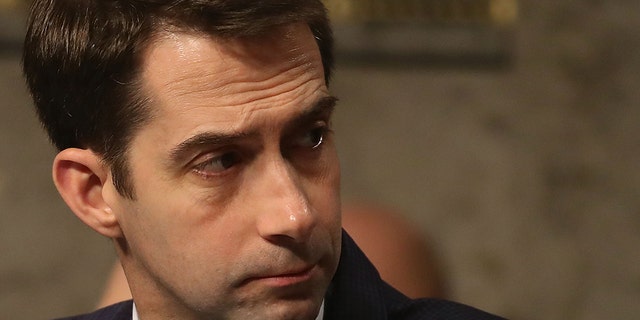
Sen. Tom Cotton, R-Ark., participates in a Senate Armed Services
Committee hearing on Capitol Hill, on Jan. 25, 2018 in Washington, D.C.
(Photo by Mark Wilson/Getty Images)
The
bill is sponsored by GOP Sens. Marsha Blackburn of Tennessee, John
Cornyn of Texas, Ted Cruz of Texas, Lindsey Graham of South Carolina,
Josh Hawley of Missouri, David Perdue of Georgia, Mitt Romney of
Utah and Ben Sasse of Nebraska.
The act defines “membership in a
significant transnational criminal organization” as direct members
and/or their spouse and child. But it carves out an exemption for those
“who did not know, or should not reasonably have known, that his or her
spouse or parent was a member of a significant transnational criminal
organization or whom the Attorney General has reasonable grounds to
believe has renounced” to such membership.
Mexican national guardsmen patrol near Bavispe, at the Sonora-Chihuahua border, Mexico, Wednesday, Nov. 6, 2019.
(AP)
The bill comes at a time when cartel
violence is spiking and the U.S. is battling unprecedented levels of
drug-related deaths and overdoses. New Acting Homeland Security Secretary Chad Wolf has also vowed to go after cartels and other gangs fueling chaos at the border.
Meanwhile,
it remains to be seen if and when Trump's FTO designation on the
cartels will come to fruition, a move that has generated both praise and
criticism. Terrorist designations are handled by the U.S. State
Department. Once a group has been slapped with such a designation, known
members are prohibited from entering the country, and it is then
illegal for those in the U.S. to intentionally provide support to them.
Financial institutions are also barred from doing any type of business
with the organization or its members.
“The FTO designation is an
important step in a positive direction for U.S. national security. Too
many Americans have died as the ruthless cartels have made billions by
terrorizing communities and killing at unprecedented levels. It's clear
President Trump always places the safety of Americans first,” noted
Derek Maltz, a former special agent in charge of the Drug Enforcement
Administration Special Operations Division in New York. “Designating the
cartels as terrorists and implementing a focused operational plan will
save a tremendous amount of lives.”
The
FTO tag could also mean that an American in an inner-city gang selling
street drugs that originated from south of the border could be
prosecuted under anti-terrorism laws – possibly being given a life
sentence.
A boy pauses as he speaks next to the coffins of Dawna Ray
Langford, 43, and her sons Trevor, 11, and Rogan, 2, who were killed by
drug cartel gunmen, during the funeral at a family cemetery in La Mora,
Sonora state, Mexico, Thursday, Nov. 7, 2019.(AP Photo/Marco Ugarte)
According
to the latest annual assessment from the DEA, Mexican drug trafficking
organizations pose the greatest crime threat to the U.S. and are
continuing to “expand their control of the opioids market” in
conjunction with the deadly spike in overdoses in recent years. However,
officials have also lamented that “the scope of violence generated by
Mexican crime groups has been difficult to measure due to restricted
reporting by the government and attempts by groups to mislead the
public.”
Moreover, Mexico’s homicide rate – routinely driven by
cartel-connected violence – is on the path to reaching record levels
this year, even higher than the record numbers set in 2018 when more
than 30,000 people were killed.
Bernie Sanders faced pushback from union members in Las Vegas on Tuesday over how the Democratic presidential candidate would fund a government-subsidized health care plan that would force union members to forfeit the benefits they’ve spent years bargaining for.
The
77-year-old independent U.S. senator from Vermont addressed a town hall
meeting hosted by Culinary Union Local 226 and its parent union, Unite
Here. Though union members in the crowd were widely supportive of
Sanders – shouting “Bernie! Bernie!” as he wheeled out his stance on
immigration, criminal justice and climate change – a group of about 12
people began to heckle the senator when he came to health care,
according to the Washington Examiner.
“We have, in this country, a dysfunctional, broken and cruel health care system,” Sanders told the audience, according to the Las Vegas Sun. “We spend twice as much per person on health care as do the people of any other country.”
Elodia
Muñoz -- one of 550 Culinary members to strike against the Frontier
hotel for more than six years between 1991 and 1998 – questioned why she
should vote for a candidate who supports Medicare-for-All after all her
effort, the Las Vegas Review-Journal reported. Under the government plan, all Americans, including union members, would lose private insurance plans.
During
Sanders’ response, the crowd began to chant: “Union health care! Union
health care!" One man also shouted: "How are you gonna pay for it?"
The same union hosted Sen. Elizabeth Warren, D-Mass., on Monday and will host former Vice President Joe Biden on Wednesday.
In
his bid for the party’s presidential nomination, Biden has called for
allowing employees to keep their current health plans, positioning
himself against Warren and Sanders who’ve both advocated for
Medicare-for-All. The International Association of Firefighters, which
has endorsed Biden, has called Medicare-for-All a non-starter, according
to the Examiner.
"You'll
be able to keep your negotiated plans," Biden told a group of union
members in August. "You've worked like hell, you gave up wages for it."
Warren
has recently backed away from her once-orthodox approach toward a
government-run health care system after seeing her poll numbers
deteriorate over the past month in national surveys and, more
importantly, in polls in Iowa and New Hampshire, the first two states to
hold contests in the primary and caucus presidential nominating
calendar.
Speaking in Las Vegas on Tuesday, Sanders discussed his
efforts to pass legislation throughout his career that aligns with
union issues, including raising the minimum wage, forcing employers to
recognize union elections and deterring corporate greed. He also cited
his experience negotiating with companies that employ Unite
Here workers, such as American Airlines. Still, union benefits remain
the main factor that keeps membership high.
Culinary Union President Ted Pappageorge later chastised the crowd for heckling Sanders.
“We’re
gonna let candidates speak without any kind of heckling. If you want to
heckle, go outside and heckle. We want to learn. The town halls are to
learn. Frankly, not to learn from the hecklers, but the candidates,"
Pappageorge told the crowd. "Second, I want to be very clear to
everybody, this union stands very strongly that every American deserves
to have good, quality health care. It’s a right, it should never be a
privilege in this country.” Fox News' Paul Steinhauser and Tara Prindiville contributed to this report.
Rep. Karen Bass, D-Calif., said Tuesday she's willing to impeach President Trump again if he wins reelection in 2020.
TMZ
founder Harvey Levin presented Bass with a scenario in which Trump wins
a second term but Democrats take over the Senate from the Republicans.
"There's
no such thing, really, as double jeopardy in an impeachment trial
because it's political," Levin said. "Suppose he gets reelected... and
you win back the Senate in a big way. If you did that, would you
be inclined to take a second bite at the apple and reintroduce the exact
same impeachment articles and then send it through again a second if
you have a Democratic Senate on your side?"
"So, you know, yes,
but I don't think it would be exactly the same and here's why," Bass
responded, "because even though we are impeaching him now, there's still
a number of court cases, there's a ton of information that could come
forward. For example, we could get his bank records and find out that
he's owned 100 percent by the Russians."
She
continued, "You are absolutely right in your scenario, but the only
thing I would say slightly different is, it might not be the same
articles of impeachment because the odds are we would have a ton more
information, and then the odds of that, sadly enough, is that, you know,
he probably has other examples of criminal behavior."
Earlier
in the day, Bass spoke with Fox News' Neil Cavuto and expressed her
"rock-solid" confidence that House Democrats had enough votes to pass
articles of impeachment. The Democrats unveiled two impeachment articles
earlier in the day: one for abuse of power and one for obstruction of
Congress.
Trump, at a rally in Pennsylvania Tuesday night, decried their efforts as "impeachment lite."
WASHINGTON (AP) — A Justice Department inspector general report on the early days of the Russia investigation
identified problems that are “unacceptable and unrepresentative of who
we are as an institution,” FBI Director Chris Wray says in detailing
changes the bureau plans to make in response.
In
an interview Monday with The Associated Press, Wray said the FBI had
cooperated fully with the inspector general — which concluded in its
report that the investigation into ties between the Trump campaign and
Russia was legitimate but also cited serious flaws — and accepted all
its recommendations.
Wray
said the FBI would make changes to how it handles confidential
informants, how it applies for warrants from the secretive Foreign
Intelligence Surveillance Court, how it conducts briefings on foreign
influence for presidential nominees and how it structures sensitive
investigations like the 2016 Russia probe. He said he has also
reinstated ethics training.
“I
am very committed to the FBI being agile in its tackling of foreign
threats,” Wray said. “But I believe you can be agile and still
scrupulously follow our rules, policies and processes.”
President
Donald Trump challenged his FBI director in a tweet Tuesday, claiming
the bureau is “badly broken” and incapable of being fixed.
“I
don’t know what report current Director of the FBI Christopher Wray was
reading, but it sure wasn’t the one given to me,” Trump wrote on
Twitter. “With that kind of attitude, he will never be able to fix the
FBI, which is badly broken despite having some of the greatest men &
women working there!”
Wray
was not FBI director when the Russia investigation began and has so far
avoided commenting in depth on the probe, one of the most politically
sensitive inquiries in bureau history and one that President Donald
Trump has repeatedly denounced as a “witch hunt.” Wray’s comments Monday
underscore the balancing act of his job as he tries to embrace
criticism of the Russia probe that he sees as legitimate while limiting
public judgment of decisions made by his predecessors.
He
said that though it was important to not lose sight of the fact that
Inspector General Michael Horowitz found the investigation justified and
did not find it to be tainted by political bias, “The American people
rightly expect that the FBI, when it acts to protect the country, is
going to do it right — each time, every time.
“And,” he added, “urgency is not an excuse for not following our procedures.”
The
report found that the FBI was justified in opening its investigation in
the summer of 2016 into whether the Trump campaign was coordinating
with Russia to tip the election in the president’s favor. But it also
identified “serious performance failures” up the bureau’s chain of
command, including 17 “significant inaccuracies or omissions” in
applications for a warrant from the secretive Foreign Intelligence
Surveillance Court to monitor the communications of former Trump
campaign adviser Carter Page and subsequent warrant renewals.
The
errors, the watchdog said, resulted in “applications that made it
appear that the information supporting probable cause was stronger than
was actually the case.”
Wray
declined to say if there was one problem or criticism that he found
most troubling, but noted, “As a general matter, there are a number of
things in the report that in my view are unacceptable and
unrepresentative of who we are as an institution.”
“This is a serious report,” he added, “and we take it serious.”
_____
Follow Eric Tucker on Twitter at http://www.twitter.com/etuckerAP
WASHINGTON
(AP) — House Democrats are poised to unveil two articles of impeachment
Tuesday against President Donald Trump — abuse of power and obstruction
of Congress. Trump, meanwhile, insisted he did “NOTHING” wrong and that
impeaching a president with a record like his would be “sheer Political
Madness!”
Democratic leaders say Trump put U.S. elections and national security at risk when he asked Ukraine to investigate his rivals, including Democrat Joe Biden.
Speaker
Nancy Pelosi declined during an event Monday evening to discuss the
articles or the coming announcement. Details were shared by multiple
people familiar with the discussions but not authorized to discuss them
and granted anonymity.
When
asked if she has enough votes to impeach the Republican president,
Pelosi leader said she would let House lawmakers vote their conscience.
“On
an issue like this, we don’t count the votes. People will just make
their voices known on it,” Pelosi said at The Wall Street Journal CEO
Council. “I haven’t counted votes, nor will I.”
The outcome, though, appears increasingly set as the House prepares to vote, as it has only three times in history against a U.S. president.
Trump,
who has declined to mount a defense in the impeachment proceedings,
tweeted Tuesday just as the five Democratic House committee chairmen
prepared to make their announcement.
“To
Impeach a President who has proven through results, including producing
perhaps the strongest economy in our country’s history, to have one of
the most successful presidencies ever, and most importantly, who has
done NOTHING wrong, is sheer Political Madness! #2020Election,” he wrote
on Twitter.
The president also spent part of Monday tweeting against the impeachment proceedings. He and his allies have called the process “absurd.”
Pelosi
convened a meeting of the impeachment committee chairmen at her office
in the Capitol late Monday following an acrimonious, nearly 10-hour
hearing at the Judiciary Committee, which could vote as soon as this
week.
“I think
there’s a lot of agreement,” Rep. Eliot Engel of New York, the
Democratic chairman of the Foreign Affairs committee, told reporters as
he exited Pelosi’s office. “A lot of us believe that what happened with
Ukraine especially is not something we can just close our eyes to.”
At the Judiciary hearing, Democrats said Trump’s push to have Ukraine investigate rival Joe Biden while withholding U.S. military aid ran counter to U.S. policy and benefited Russia as well as himself.
“President
Trump’s persistent and continuing effort to coerce a foreign country to
help him cheat to win an election is a clear and present danger to our
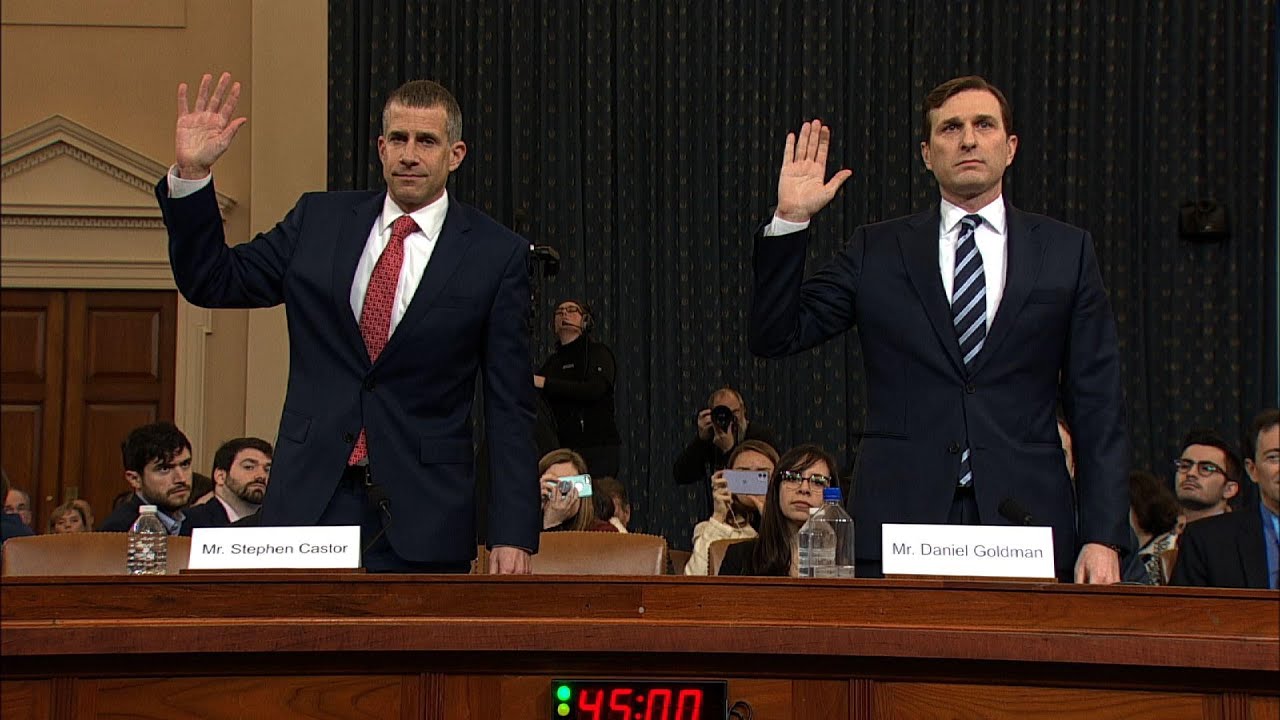
free and fair elections and to our national security,” said Dan Goldman,
the director of investigations at the House Intelligence Committee,
presenting the finding of the panel’s 300-page report of the inquiry.
Republicans
rejected not just Goldman’s conclusion of the Ukraine matter; they also
questioned his very appearance before the Judiciary panel. In a series
of heated exchanges, they said Rep. Adam Schiff, the chairman of the
Intelligence Committee, should appear rather than sending his lawyer.
From the White House, Trump tweeted repeatedly, assailing the “Witch Hunt!” and “Do Nothing Democrats.”
In drafting the articles of impeachment, Pelosi
is facing a legal and political challenge of balancing the views of her
majority while hitting the Constitution’s bar of “treason, bribery or
other high crimes and misdemeanors.”
Some
liberal lawmakers wanted more expansive charges encompassing the
findings from former special counsel Robert Mueller’s probe of Russian
interference in the 2016 election. Centrist Democrats preferred to keep
the impeachment articles more focused on Trump’s actions toward Ukraine.
Rep. Jerrold Nadler, D-N.Y., was blunt as he opened Monday’s hearing, saying, “President Trump put himself before country.”
Trump’s conduct, Nadler said at the end of the daylong hearing, “is clearly impeachable.”
Rep.
Doug Collins of Georgia, the top Republican on the committee, said
Democrats are racing to jam impeachment through on a “clock and a
calendar” ahead of the 2020 presidential election.
“They
can’t get over the fact that Donald Trump is the president of the
United States, and they don’t have a candidate that can beat him,”
Collins said.
In
one testy exchange, Republican attorney Stephen Castor dismissed the
transcript of Trump’s crucial call with Ukraine as “eight ambiguous
lines” that did not amount to the president seeking a personal political
favor.
Democrats
argued vigorously that Trump’s meaning could not have been clearer in
seeking political dirt on Biden, his possible opponent in the 2020
election.
The
Republicans tried numerous times to halt or slow the proceedings, and
the hearing was briefly interrupted early on by a protester shouting,
“We voted for Donald Trump!” The protester was escorted from the House
hearing room by Capitol Police.
The White House is refusing to participate
in the impeachment process. Trump and and his allies acknowledge he
likely will be impeached in the Democratic-controlled House, but they
also expect acquittal next year in the Senate, where Republicans have
the majority.
The president was focused instead on Monday’s long-awaited release of the Justice Department report
into the 2016 Russia investigation. The inspector general found that
the FBI was justified in opening its investigation into ties between the
Trump presidential campaign and Russia and that the FBI did not act
with political bias, despite “serious performance failures” up the
bureau’s chain of command.
Democrats say Trump abused his power in a July 25 phone call
when he asked Ukrainian President Volodymyr Zelenskiy for a favor in
investigating Democrats. That was bribery, they say, since Trump was
withholding nearly $400 million in military aid that Ukraine depended on
to counter Russian aggression.
Pelosi
and Democrats point to what they call a pattern of misconduct by Trump
in seeking foreign interference in elections from Mueller’s inquiry of
the Russia probe to Ukraine.
In
his report, Mueller said he could not determine that Trump’s campaign
conspired or coordinated with Russia in the 2016 election. But Mueller
said he could not exonerate Trump of obstructing justice in the probe and left it for Congress to determine.
___
Associated Press writers Julie Pace, Laurie Kellman, Matthew Daly and Eric Tucker contributed to this report.