WASHINGTON
(AP) — There’s a campaign going on in Washington that even the most
garrulous members of Congress aren’t eager to talk about: to be part of a
team of uncertain size, with a risky mission, to be named by a leader
who isn’t talking about what she’s looking for or when she’ll decide.
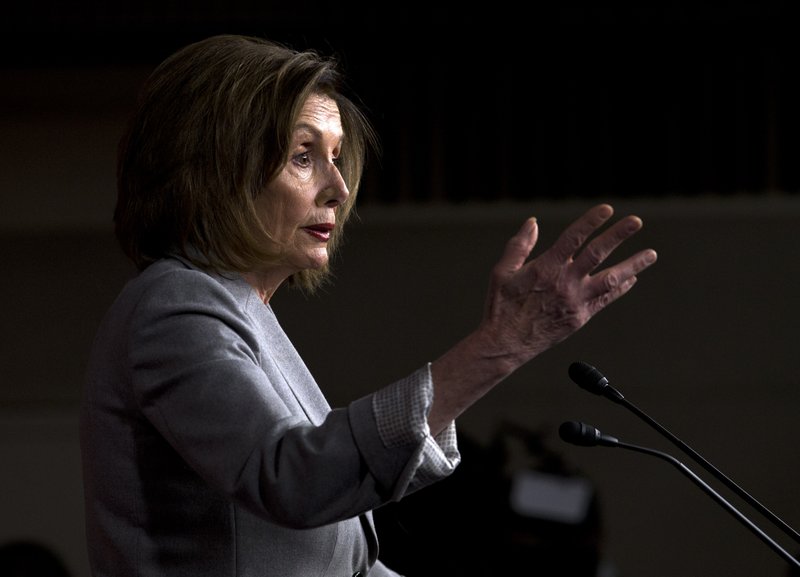
Welcome to the race within the House to win a spot on the Democratic team that will prosecute the impeachment case against President Donald Trump. House Speaker Nancy Pelosi is the sole decider, but she offered no hints Thursday as the impeachment saga accelerated toward an expected vote next week by the full House — and, in January, a Senate trial.
“When the time is right, you’ll know who the people are,” she told reporters Thursday.
But
they’ll have to be the right people, by Pelosi’s measure, to press the
Democrats’ case that they are defending the Constitution against a
president who put betrayed his oath by pushing a foreign country to help
him in the 2020 elections.
The
impeachment managers will have to withstand the scrutiny and risk of
prosecuting the case against Trump from the floor of the Republican-held
Senate, before a global audience. And be willing to face the
near-certainty of defeat, as the Senate appears unlikely to convict and
remove Trump from office.
“They’re
ugly,” Rep. Steve Chabot, R-Ohio, said of the Senate proceedings. He
would know, as a manager of former President Bill Clinton’s trial two
decades ago. “I have a lot of sympathy for the House managers that are
going to be picked.”
Plenty
of ambitious people are quietly jockeying for the job by writing Pelosi
letters nominating themselves, spreading the word or just hoping their
work impresses her. The campaigns are exceptionally sensitive, since
lobbying Pelosi or looking to gain fame or campaign funds from
impeachment could backfire. But the widely televised public hearings
before the House Intelligence Committee and the House Judiciary
Committee are thought to have served a kind of audition for the most
likely Democrats to be appointed to the team.
The
competition has kept aides, reporters and lawmakers talking for weeks.
But few, if any, seem to have solid insight into Pelosi’s plans.
Yet
a few things seemed likely. Almost certainly, the team won’t include
Democratic freshmen from Trump-won districts who are the most at risk in
their reelection bids this year.
The
group seems certain to be diverse in race and gender, providing a
contrast to the 13 white, male Republican lawmakers who prosecuted the
case against Clinton. (Trump’s defense at the trial will be conducted by
his legal team, not lawmakers.)
Pelosi
also has suggested in private that she’s concerned about “geographic
diversity” on the team, according to a Democratic aide who was not
authorized to speak publicly about her thinking.
That
means she’s likely to name at least one manager from someplace other
than the robustly Democratic U.S. coasts, which could help counter the
GOP argument that impeachment is a partisan, elitist exercise to topple
Trump from power.
She’ll
also want managers who have legal experience as well as deep knowledge
of the case against Trump. That likely means members drawn from the
rosters of the House Judiciary and Intelligence Committees that led the
investigation and wrote the articles of impeachment.
The
members who check the most boxes start with the chairmen of both
panels. Intelligence Committee Chairman Adam Schiff of California has
drawn widespread praise — and Trump’s ferocious scorn — for his
investigation of the president’s pressure on Ukraine to investigate the
family of Democratic hopeful Joe Biden. Schiff, a former prosecutor, is
exceptionally close to Pelosi. She yielded the podium to him at a recent
press conference and opted to watch his statement from the audience,
alongside reporters.
Nadler
is a veteran of the Clinton impeachment proceedings, led his panel
through the consideration of the articles and will be the sponsor of the
legislation when it comes to the full House.
No
matter whom Pelosi names, the team will have a sensitive, high-profile
role in a process that’s only been undertaken three times in American
history.
After
the House vote to impeach Trump, it is expected to inform the Senate
that it has authorized the managers to conduct the trial in the Senate.
According to a November report on the process by the Congressional
Research Service, the Senate then informs the House when the managers
can present the articles. Doing so will kick off a solemn sequence of
pageantry, wherein the House prosecutors cross the Capitol and enter the
Senate chamber, presided over by Chief Justice John Roberts and
populated with senators who act as the jury.
The
House members then read the resolution containing the articles and
leave until the Senate invites them back for the trial. The prosecutors,
possibly assisted by outside counsel, present the evidence against
Trump and respond to any of the president’s lawyers or senators.
WASHINGTON
(AP) — Democratic White House hopefuls agree President Donald Trump
must be defeated next year. But the unity ends there.
Sen.
Elizabeth Warren of Massachusetts and Mayor Pete Buttigieg of South
Bend, Indiana, are locked in an increasingly acrimonious feud that
threatens to change the tone of the Democratic primary. The tension was
on display Thursday as the candidates knocked one another as being
spineless in standing up to the rich or throwing out wildly unrealistic proposals.
That
followed a week of barbs between Warren and Buttigieg as they called on
the other to be more forthcoming about their past. Buttigieg pressed
Warren to reveal her previous legal work for corporations while Warren
said Buttigieg should open his private fundraisers and detail the companies he worked for as a consultant at McKinsey & Co. a decade ago.
The hits mark a shift in a Democratic primary
that has so far been largely devoid of tension, to the point that some
candidates refused obvious opportunities to slam one another when they shared a debate stage last month.
But as they prepare to debate again next week, that reluctance has
dissipated and a clear battle is emerging between Warren and Sen. Bernie
Sanders of Vermont, who are leading the call for major overhauls to
American life, and Buttigieg and former Vice President Joe Biden, who
are urging pragmatism.
The
scrapping serves as a proxy for the ideological fight that Democrats
will need to resolve quickly next year if they are to rally behind a
nominee who can inspire the energy and motivation that will be required
to beat Trump.
“It’s
too early to say how this thing is going to play out,” said David
Axelrod, who was a senior adviser to former President Barack Obama and
said the growing intensity of the primary reflects how strongly
Democrats feel about the need to win next year.
As
the fight deepens, so too do the potential risks for those involved.
For Buttigieg, the exchanges are doing little to endear him with the
voters he needs to rebuild the type of coalition that twice elected
Obama. He’s already struggling to appeal to minorities and acknowledged
on Thursday that younger voters are siding with more progressive
candidates such as Sanders.
“It
is certainly the case that often younger candidates tend to attract
more support from older voters,” the 37-year-old Buttigieg told CBS on
Thursday. “The Sanders campaign definitely has more young voters. I was a
big fan of Bernie Sanders when I was 18 years old.”
More
fundamentally, the attention on Buttigieg’s ties to big donors and his
past consulting work leaves him vulnerable to being portrayed as a
status quo politician instead of a fresh face who could usher
generational change into Washington.
He
faced new criticism on Thursday for his past consulting work, including
a study he helped produce for the U.S. Postal Service. Buttigieg’s
campaign said that he was “part of a team tasked with generating ideas
to increase revenue like selling greeting cards and increasing the use
of flat rate boxes” and that he “never worked on cost-cutting or
anything involving staff reorganization or the privatization of
essential post office services.”
But
Mark Dimondstein, president of the American Postal Workers Union, which
represents over 200,000 postal service workers and retirees, blamed the
study for leading to “the closing of many processing centers.”
“I
can’t honestly say what section or paragraphs of the reports he was
involved with,” Dimondstein, whose union hasn’t endorsed a candidate,
told The Associated Press. “But I will say generally, shame on anybody
that was part of facilitating these McKinsey reports. This is the
opposite of what the people of this country need.”
Warren
faces potential trouble of her own. Her strident positions against
corporations could alienate voters who work for such firms and would
otherwise support a Democrat against Trump. And her plateau in some
polls coincides with persistent prodding from Buttigieg over how she
would pay for her “Medicare for All” proposal, including its cost and
elimination of private insurance coverage.
Yet
she’s also forced Buttigieg’s hand in some cases. He began opening his
fundraisers this week, leading to some awkward moments.
Liberal
protesters followed Buttigieg across Manhattan over two days as he
courted major donors at four events. Not knowing the specific addresses
of his events, they marched to the apartment buildings of several
wealthy donors until they found him.
On
Wednesday night, roughly two dozen people, mostly Sanders and Warren
supporters, interrupted Buttigieg’s event repeatedly. One protester
entered the Upper West Side brownstone yelling “Where’s Mayor Pete?” as
the presidential contender addressed roughly 60 donors upstairs,
according to a pool report.
Less than 10 minutes later, protesters began banging pots and pans outside, shouting, “Wall Street Pete!”
Buttigieg
tried to turn the disruption into a joke. “Wow, they’re excited,” he
said, turning to his military experience. “One of the things you learn
on a deployment is dealing with distracting noises.”
Neither
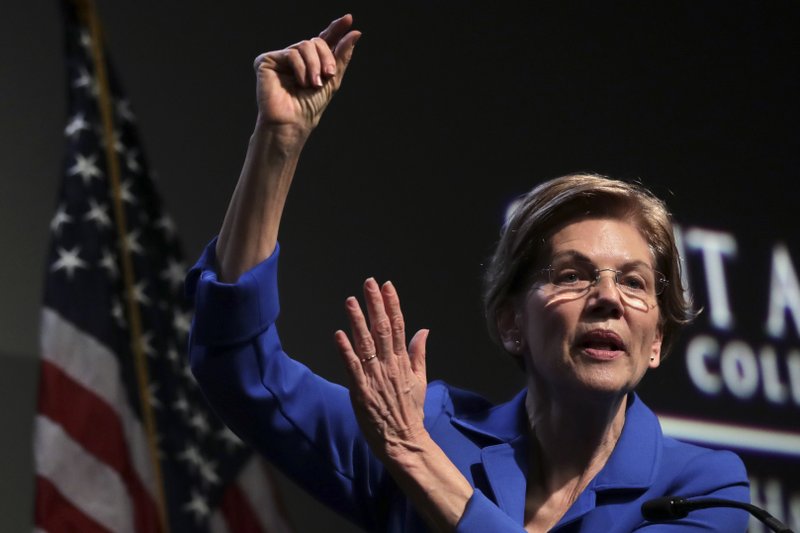
candidate is backing away from the fight. Without mentioning Buttigieg,
Warren seemed to refer to him in a speech she delivered Thursday in New
Hampshire.
“I’m
not betting my agenda on the naive hope that if Democrats adopt
Republican critiques of progressive policies or make vague calls for
unity that somehow the wealthy and well-connected will stand down,” she
said.
Until
recently, Warren and Sanders have focused much of their attention on
Biden, who remains the front-runner in many national polls. Warren is
testing strategies for confronting both men, who are battling to become
the voice of moderation in the race.
In
the same speech on Thursday in which she made thinly veiled criticisms
of Buttigieg, Warren also decried Biden’s past comment to wealthy donors
that “nothing would fundamentally change” if he’s elected.
The
former vice president has largely stayed out of the Warren-Buttigieg
dust-up, which could prove wise if Biden wants to improve his standing
in early voting states. During the 2004 Iowa caucuses, for instance,
former Vermont Gov. Howard Dean and Missouri Rep. Dick Gephardt clashed
bitterly as voting neared, only to be defeated by Massachusetts Sen.
John Kerry.
“My
latest feeling is that Biden is undervalued in this race,” Axelrod
said. “He has so lowered expectations that if he were to win Iowa or
come close, he’s going to be in pretty good shape.”
___
Beaumont
reported from Des Moines, Iowa. Associated Press writers Steve Peoples
in New York and Michelle R. Smith in Providence, R.I., contributed to
this report.
U.K. Prime Minister Boris Johnson vowed to “get Brexit done” by Jan. 31, 2020 with “No ifs, no buts, no maybes” Friday morning following his Conservative Party’s landslide victory in the country’s general election.
A
sudden burst in London-listed companies brought European markets to
record peaks early Friday following Johnson’s victory as investors
celebrated the probable end of more than three and half years of
political turmoil in Britain once the United Kingdom settles on a deal to leave the European Union, Reuters reported.
“This
election means that getting Brexit done is now the irrefutable,
irresistible unarguable decision of the British people. With this
election, I think we put an end to all those miserable threats of a
second referendum,” Johnson told supporters early Friday.
“In this
election, your voices have been heard and it’s about time too because
we politicians have squandered this three years in squabbles about
Brexit,” he continued. “I will put an end to all of that nonsense and we
will get Brexit done on time by the 31st of January. No ifs, no buts,
no maybes. Leaving the European Union as one United Kingdom, taking back
control of our laws, borders, money, our trade, immigration system,
delivering on the democratic mandate of the people.”
Johnson also
promised that it was his Conservative Party’s top priority is to
massively increase investments in the National Health Service and “make
this country the cleanest, greenest on Earth with our far-reaching
environmental program.” “You voted to be carbon neutral by 2015 and you
also voted to be Corbyn neutral by Christmas and we’ll do that too,” he
said.
The prime minister is scheduled to meet with Queen
Elizabeth II at Buckingham Palace, where she will formally ask him to
form a new government in her name. President Trump also tweeted his
support for Johnson after his victory, hinting that “Britain and the
United States will now be free to strike a massive new Trade Deal after
BREXIT.”
Labour Party Chairman Ian Lavery told the BBC that he
believes his party’s decision to support a second referendum on Brexit
ultimately established distrust with voter, ultimately pushing them to
put their faith in the Conservative Party at the ballot box in 2019.
“The
fact that we went for a second referendum is the real issue in the
Labour party. People feel like there’s a lack of trust, people feel like
they are let down,” Lavery said.
Former Prime Minister David
Cameron also congratulated Johnson, saying that election result "gives
us a very strong and decisive government."
The Conservatives Party
won 43.6 percent of the popular vote compared to the Labour Party’s
32.2 percent following Thursday night’s election. The Tories won by an
11.3 margin, the largest for the Conservatives since 1987. This compares
to 2017 when the Labour Party lost the popular vote by only 2.4
percent.
Gobsmacked
Republicans made known their fury and frustration late Thursday as
House Judiciary Committee Chairman Jerry Nadler, D-N.Y.,
abruptly wrapped up an all-day marathon hearing on the adoption of
two articles of impeachment against President Trump by delaying planned
votes on the matter until Friday morning.
"It is now very late at
night," Nadler said shortly before midnight in D.C. "I want the members
on both sides of the aisle to think about what has happened over these
last two days, and to search their consciences before we cast their
final votes. Therefore, the committee will now stand in recess until
tomorrow morning at 10 a.m., at which point I will move to divide the
question so that each of us may have the opportunity to cast up-or-down
votes on each of the articles of impeachment, and let history be our
judge."
Ranking Rep. Doug Collins, R-Ga., raised an immediate
objection as Nadler began leaving, saying it was "the most bush-league
stunt” he had ever seen.
"Mr. Chairman, there was no consulting
with the ranking member on your schedule for tomorrow -- you just blew
up schedules for everyone?" Collins asked incredulously. "You chose not
to consult the ranking member on a scheduling issue of this magnitude?
This is the kangaroo court we're talking about. Not even consult? Not
even consult? 10 a.m. tomorrow?"
He later told reporters: “This is
why people don't like us. This crap like this is why people are having
such a terrible opinion of Congress. What Chairman Nadler just did, and
his staff, and the rest of the majority who sat there quietly and said
nothing, this is why they don't like us. They know it's all about games.
It's all about the TV screens. They want the primetime hit. This is
Speaker Pelosi and Adam Schiff and the others directing this committee. I
don't have a chairman anymore. I guess I need to just go straight to
Ms. Pelosi and say, what TV hit does this committee need to do? This
committee has lost all relevance. I'll see y'all tomorrow."
Texas
GOP Rep. Louie Gohmert called out the tactic as "Stalinesque," and other
Republicans essentially heckled Nadler's conduct as unbelievable and
"outrageous." Gohmert also openly suggested that Democrats wanted to
have the vote when more people would be watching on television, and that
they wanted to be able to say they had a "three-day trial" in the
Judiciary Committee, even if they called no fact witnesses to appear
before the panel.
“The claim that Republicans promised Judiciary
Democrats that Thursday’s markup would end by 5:00 p.m. is false,"
Jessica Andrews, a spokeswoman for the House Judiciary Committee
Republicans, told Fox News. "Republicans were prepared to offer an
arsenal of appropriate amendments to address the clear deficiencies in
the articles of impeachment and were told that the committee would be
voting on articles Thursday evening. Judiciary Democrats broke their
promise as the cameras and lights were fading. They chose, instead, to
reconvene when ratings would be higher and the integrity of our
committee would be at a historic low.”
There is no more time
remaining for actual debate on the articles of impeachment under the
41-member Judiciary Committee's rules. On Friday morning, Fox News
expects the panel to vote to adopt each article of impeachment on a
party-line vote after a hearing that could last between 45 minutes to
around 2 hours.
Then, the articles will likely head to the Rules
Committee, which controls access to the House floor and sets the
parameters of debate there, before the full House votes on whether to
impeach the president. That final vote is expected next Wednesday or
Thursday. Should the House impeach the president next week, the matter
would go to the GOP-controlled Senate for a trial and virtually certain acquittal.
The last-minute confrontation on Thursday night was one final striking moment in
long day full of them, where seemingly nothing was off-limits -- from
Hunter Biden's rampant drug use to a Republican congressman's past
drunken-driving arrest.
Hours earlier, Rep. Hank Johnson,
D-Ga., claimed that Ukrainian President Volodymyr Zelensky looked "as
if his daughter was downstairs in the basement, duct-taped" when he
publicly undermined Democrats' case by declaring at the United Nations
that he felt no undue pressure from the president to conduct any political investigations.
"The
picture of President Trump and President Zelensky meeting in New York
in September at the UN -- big chair for President Trump, little chair
for President Zelensky. Big, 6-foot-4 President Trump, five-foot-eleven
President Zelensky. ... There's an imbalance of power in that
relationship," Johnson said, as some attendees laughed. Republicans,
including Donald Trump Jr., responded by mocking Johnson online for once suggesting that the island of Guam could capsize due to overpopulation, and for deriding Trump supporters in highly personal terms.
"JUST IN: Democrats want to impeach the President for [checks notes] being too tall," the White House tweeted, as the hearing, which began at 9 a.m. ET, extended all the way into the late-night hours.
There was even some intrigue during breaks in the proceedings when a Reuters photographer, Josh Roberts, was caught on camera approaching the dais and furtively taking photographs of private documents that Louisiana GOP Rep. Mike Johnson said belonged to Republicans.
Roberts was later escorted out of the Capitol building, and Florida GOP
Rep. Matt Gaetz announced at the hearing that Roberts had in fact
photographed Democrats' desks. Reuters posted wire photos apparently showing the desk of Rep. Ted Lieu, D-Calif., who was not in attendance at the hearing.
"Media spy games," House Intelligence Committee ranking member Devin Nunes, R-Calif., tweeted.
Democrats,
for their part, accused Republicans of plotting procedural tricks. As
the clock approached midnight, New York Democratic Rep. Hakeem Jeffries
complained that Senate Majority Leader Mitch McConnell, R-Ky., had vowed
in an interview with Fox News' Sean Hannity earlier on Thursday night that he would coordinate any Senate trial with the White House.
"There will be no difference between the President's position and our position in how to handle this," McConnell said.
In
the meantime, though, all eyes were on the 31 moderate House Democrats
from districts Trump won in 2016, most of whom have remained mum on how
they'll vote, as support for impeachment has flatlined in several battleground-state polls.
The House is comprised of 431 members, meaning Democrats would need 217
yeas to impeach Trump. There currently have been 233 Democrats, so they
could lose only 16 of their own and still impeach the president.
During
the day's markup, as members debated the language of the impeachment
resolutions, Republicans repeatedly pointed out that Trump was not
accused of any offense actually defined anywhere by law: neither "abuse
of power" nor "obstruction of Congress" was a recognized federal or
state crime.
Early in the hearing, Rep. Jim Sensenbrenner, R-Wis.,
supported Ohio GOP Rep. Jim Jordan's amendment to strike Democrats'
"abuse of power" article of impeachment entirely, arguing, "There was no
impeachable offense here."
But, Rep. Eric Swalwell,
D-Calif., responded that impeachment articles did not necessarily have
to include statutory crimes -- and that Trump’s actions would satisfy
criminal statutes such as bribery anyway.
This led Gohmert, R-Texas, to retort, "Well then, why aren't they in this impeachment document?"
Democrats had floated the idea of formally accusing Trump of bribery, after focus groups suggested
voters would like that term more. But, the idea fell out of favor after
news of the focus group leaked, and analysts pointed out that Trump's
conduct didn't seem to constitute bribery.
Later in the day,
Gohmert observed that the Trump administration ultimately provided
lethal aid to Ukraine, unlike former President Barack Obama, who also
withheld military aid to Ukraine and "just let people die over there" by
providing only nonlethal assistance.
Gohmert went on to object to
the "obstruction of Congress" article of impeachment as "tyrannical,"
saying it violated separation-of-powers principles for Congress to
impeach the president whenever he failed to cooperate fully with their
investigations.
Under Obama, the White House repeatedly refused
Republicans' document requests concerning the "Fast and Furious"
gunrunning scandal, leading Congress to hold then-Attorney General Eric
Holder in contempt. No impeachment proceedings were commenced.
Democrats
countered that it simply was not "credible" that Trump was withholding
aid to Ukraine for legitimate anticorruption evidence, even though he
also withheld $100 million in assistance to Lebanon this year.
"The
president has been talking about foreign corruption and the misuse of
American taxpayers' [funds]" since before the 2016 election, Johnson,
R-La., said, emphasizing that it was in-character for the president to
rein in excess spending for NATO and elsewhere.
"Everybody
knows the president s concerned about the misuse of taxpayer dollars
overseas. It's one of his primary driving forces. It's one of his main
talking points... Oh, Ukraine, the third-most corrupt nation in the
world, is the only one he wasn't concerned about? It just doesn't make
sense. Let's stop with the games."
At a particularly heated moment
in the hearing, Gaetz, R-Fla., brought up Hunter Biden's admitted past
substance abuse issues -- and Johnson, D-Ga., shot back by alluding to
Gaetz's own past arrest for drunken driving.
Gaetz was arguing
that Biden was incompetent and corrupt, citing his lucrative job on the
board of the Ukrainian natural gas company Burisma Holdings while his
father was overseeing Ukraine policy as vice president. The impeachment
inquiry began after Trump suggested the Ukrainians look into Joe Biden's
successful effort to pressure Ukraine to fire its top prosecutor by
withholding $1 billion in critical U.S. aid -- at a time when Burisma
was under criminal scrutiny.
The Florida lawmaker referenced an article in The New Yorker,
which included interviews with Hunter Biden and reported on a 2016 car
crash in which the younger Biden was involved. According to that
story, employees at a rental car agency claimed they found a crack pipe
inside the vehicle. It also quoted Hunter Biden describing his attempts
to buy crack cocaine in a Los Angeles homeless encampment.
"The
pot calling the kettle black is not something we should do," Johnson
said. "I don’t know what members, if any, have had any problems with
substance abuse, been busted in DUI. I don't know, but if I did, I
wouldn't raise it against anyone on this committee." Johnson added: "I
don't think it’s proper."
Separately, Gaetz introduced a December 2017 article in The New York Times
discussing Nadler's contemplation about impeaching the president years
ago. Democrats, Gaetz and other Republicans said, have been trying to
impeach and remove the president ever since he stunned the world by
defeating Hillary Clinton, first by peddling discredited allegations that his campaign criminally conspired with Russians.
Impeachment, Republicans argued, was politically motivated theater, long in the works and foreshadowed openly by Democrats for months, if not years.
The two-day markup began late Wednesday and saw Republicans lambasting Democrats and the media for pushing discredited claims about the Trump campaign's Russia ties. The rapid pace of the markup and vote came as numerous polls showed declining support for impeachment in key swing states.
For
example, impeachment and removal was opposed by 50.8 percent of voters
in Michigan, 52.2 percent of voters in Pennsylvania, and 57.9 percent of
voters in Wisconsin, according to the Firehouse/Optimus December
Battleground State Poll.
Two other polls released Wednesday showed that most Americans did not want Trump impeached and removed.
Politico reported earlier this week that
the numbers were making a "small group" of moderate Democrats, who have
held seats in districts where Trump won in 2016, nervous about how to
vote. They instead have suggested Trump be censured instead,
which would prevent the GOP from holding a potentially damaging Senate
trial and give them political cover in the upcoming election.
As the members debated Wednesday night, the White House Office of Management and Budget released a lengthy legal justification for
the withholding of aid to Ukraine, which was obtained by Fox News. OMB
classified the temporary pause in providing the aid to Ukraine as a
"programmatic delay" that was necessary and proper under the law to
"ensure that funds were not obligated prematurely in a manner that could
conflict with the President's foreign policy."
Rep. Pramila
Jayapal, D-Wash., accused OMB of an "after-the-fact coverup" by writing
its justification -- prompting Collins to respond, stunned, by noting
that a Senate Democrat had requested the letter.
"It is amazing
that this is an after-the fact coverup since it was asked by a
Democratic senator," Collins said. "So, that's an after-the-fact
coverup? ... This is exactly what I thought would happen when we came
back from lunch."
Collins went on to point out that Zelensky repeatedly has said that he did not feel that Trump pressured him in any way,
and that Democrats have taken to "belittling" Zelensky by calling him
an "actor" and "weak" only because he undermined their case.
Jayapal
also lamented that Trump hadn't followed official "talking points"
provided by career bureaucrats while on his July phone call with
Zelensky, prompting Republicans to respond that the president, as an
elected official, is ultimately in charge of foreign policy.
When
Democrats repeatedly argued that Trump's suspension of foreign aid had
cost Ukrainian lives, Collins angrily responded that, even according to
the same media reports cited by Democrats, no causal link had been shown
between any Ukrainian casualties and the temporary aid hold up.
"People died!" Swalwell said late in the evening, charging that Collins wanted to ignore reality.
Collins
called the arguments a "cheap shot" and "hogwash," reiterating that the
Democrats' claims were entirely speculative, and that they were falsely
claiming he'd said no one in Ukraine died.
"That is the most
amazing, amazing, lack of honesty and integrity that I have ever seen,"
Collins said emphatically. "In wars, people die. Is that difficult to
understand? It's not hard to understand. And, to say that.
... Besmirching the folks who died, that's just amazing to me, even for
this majority. To sit there and keep repeating the lie, after lie,
after lie. ... People died when there was money we released earlier. Are
we going to claim that was because we didn't give them enough money? I
don't know. I get it. Y'all have an agenda to push, and the clock is
ticking."
Hardline Democrats in safe districts haven't budged on
impeachment. California Rep. Karen Bass, for example, said earlier this
week she's open to impeaching Trump again even if he were to win the 2020 election.
"This
is the other side of it being political -- you’ve got about 30
House Democrats who are in districts won by Donald Trump and they
realize that they are going to pay a political price if they go along
with impeachment," Fox News contributor Charles Hurt, the opinion editor of The Washington Times, told "Fox & Friends" Wednesday.
Freshman
Rep. Elissa Slotkin, D-Mich. -- who flipped a GOP district in
2018 that Trump won by 7 points in 2016 -- told Fox News last month that
she was tentatively weighing all the evidence. On Wednesday, she confirmed she's still undecided.
"The
phones are ringing off the hook," she told CNN. "We literally can't
pick up the phones fast enough -- and it's people on both sides of it."
In
the meantime, Gaetz offered some advice to swing-district Democrats who
vote to impeach the president: "For the upcoming year, rent, don't buy,
here in Washington, D.C." Fox News' Chad Pergram, Ronn Blitzer, Julia Musto, Marisa Schultz and Andrew O'Reilly contributed to this report.
The
Republican-controlled Senate on Wednesday afternoon confirmed Lawrence
VanDyke to the 9th Circuit Court of Appeals, marking President Trump's
50th successful appellate court appointment in just three years in
office, and his second to the historically liberal 9th Circuit in as
many days.
By contrast, President Barack Obama nominated a total
of 55 circuit judges who were confirmed over eight years -- and Obama's
nominees were, on average, approximately ten years older. The White
House has dramatically transformed the 9th Circuit, a powerful court with jurisdiction over nine states and Guam that has long been a thorn in the president's side.
Of
the 30 active seats on the 9th Circuit, 10 have now been appointed by
Trump, and 14 by Republican presidents. Only nine of the court's 19
semi-retired "senior status" judges were appointed by Democrats, with 10
by Republicans. That's a major change from early last year, when only six of the active judges on the 9th Circuit were chosen by Republicans.
"FIFTY
CIRCUIT COURT JUDGES!" tweeted Carrie Severino, the conservative
Judicial Crisis Network's chief counsel and policy director. "Despite
unrelenting Democratic obstruction and smear campaigns," she wrote,
Trump and his Senate allies "have answered the call of the American
people."
VanDyke's confirmation, by a 51-44 vote, came just 24
hours after Patrick Bumatay, an openly gay Filipino man, was also seated
on the San Francisco-based 9th Circuit. Both nominees were fiercely
opposed by Democrats, including the senators from their home states --
Nevada Sens. Jacky Rosen and Catherine Cortez Masto for VanDyke,
and California Sens. Dianne Feinstein and Kamala Harris for Bumatay.
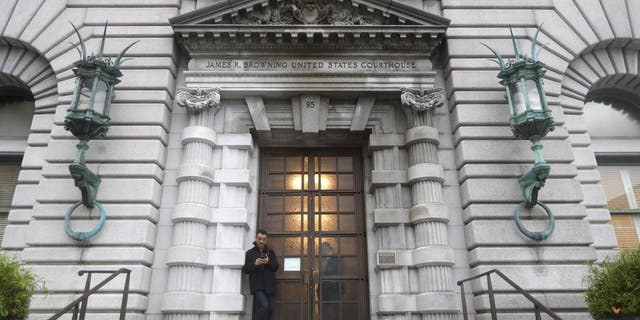
The 9th Circuit Court of Appeals in San Francisco has long drawn
the ire of President Trump, who has called it "disgraceful." It's now
being transformed. (AP)
But, the White House has long ignored the so-called "blue slip" process
of seeking advice from home-state senators in the judicial confirmation
process, as it pressed ahead with its goal of transforming the federal
appellate bench for generations.
"As the 9th Circuit shifts to
become more conservative and better parallels the Supreme Court's
ideological baseline, I could only imagine fewer liberal 9th Circuit
decisions and fewer overturned 9th Circuit decisions generally," legal
scholar and judicial data guru Adam Feldman, who blogs at Empirical SCOTUS, told Fox News.
The
confirmations have not been easy for the White House -- or its
nominees. VanDyke, a deputy assistant attorney general in the
environmental and natural resources division, broke down in tears during a Senate Judiciary Committee hearing in October, as he disputed suggestions that he would not be fair to members of the LGBTQ community.
The
ostensibly nonpartisan American Bar Association (ABA), which rated
VanDyke unqualified, sent a letter to committee leadership alleging that
people they interviewed expressed this concern, and that VanDyke
himself "would not say affirmatively that he would be fair to any
litigant before him, notably members of the LGBTQ community."
“There
was a theme that the nominee lacks humility, has an ‘entitlement’
temperament, does not have an open mind, and does not always have a
commitment to being candid and truthful,” the letter added.
The
ABA did note that VanDyke, a Harvard Law School graduate and former
solicitor general for Montana and Nevada, is "clearly smart." VanDyke is
a former Nevada solicitor general who also waged an expensive campaign
for a seat on the Montana Supreme Court in 2014.
"I did not say
that," VanDyke told Sen. Josh Hawley, R-Mo., tears welling up in his
eyes. "No, I did not say that. I do not believe that. It is a
fundamental belief of mine that all people are created in the image of
God. They should all be treated with dignity and respect, senator."
VanDyke
also said that he was not given a fair opportunity to respond to the
allegations during his ABA interview. He said when he was confronted
with the concerns about his views, he began to answer but was told they
were running out of time, and described himself as “much more hurt than
I’ve ever been to get that” assessment from the ABA.
That
interview was conducted by Marcia Davenport, the lead evaluator. Hawley
noted that Davenport once contributed to the campaign of a judicial
candidate who was running against VanDyke.
"I find that absolutely
unbelievable," Hawley said, stating it "probably explains the totally
ad hominem nature of this disgraceful letter."
Conservative
groups came to VanDyke's defense: "Even for the ABA, this is beyond the
pale," the Judicial Crisis Network's Carrie Severino said in a
statement, accusing the ABA of "bias against conservative nominees to
the judiciary."
Bumatay, the nominee confirmed to the 9th Circuit
on Tuesday, served as an assistant U.S. attorney for the Southern
District of California. He was confirmed in a 53-40 party-line vote, and
received a “Qualified” rating from the ABA.
He was nominated last year, but the Senate never took up his confirmation, and it eventually expired.
“Patrick
Bumatay lacks the knowledge and experience necessary for the 9th
Circuit," Feinstein said. "He also acknowledged working on the
separation of immigrant families while at the Justice Department and
refused to answer questions about other controversial issues."
The conservative Americans for Prosperity (AFP), however, praised Bumatay's credentials.
“In
Patrick Bumatay, the president has nominated a highly qualified and
experienced individual, committed to supporting and defending the
Constitution – rather than seeking to legislate from the bench," Casey
Mattox, AFP's vice president for legal and judicial strategy, said in a
statement. "We applaud Chairman Graham and the members of the Senate
Judiciary Committee for their support of Bumatay and Senator McConnell
for his continued commitment to confirming fair and qualified nominees
to the federal bench.”
Speaking to top Republican lawmakers and Justice Department officials in the East Room of the White House in November, Trump celebrated
the appointment of his 150th federal judge, which he called
a "profoundly historic milestone and a truly momentous achievement." As
of Dec. 11, Trump has appointed a total of 120 judges to federal
district courts, which sit below appellate courts -- with dozens more in
the pipeline.
The event featured a series of humorous moments as Trump's onetime rivals took the microphone. Sen. Lindsey Graham, for example, fondly recalled the time Trump had given out his personal phone number on
the campaign trail and compared him to a "dog" -- and how the two
quickly settled their score shortly after Trump took office.
"The
defining moment of your president was the Kavanaugh hearing," Graham
said. "This room would be empty if we had failed Brett Kavanaugh. Brett
Kavanaugh lived a life we should all be proud of. He worked hard. And
the way he was treated was the worst experience I've had in politics. A
lot of people would have pulled the plug on him. Mr. President, thank
you for not pulling the plug."
Trump
singled out Senate Majority Leader Mitch McConnell, R-Ky., for a
standing ovation, saying his impact in methodically confirming judges in
the Senate was "truly amazing." Trump went on to joke that it was "so
easy" to get Supreme Court justices confirmed, in a nod to the
contentious Brett Kavanaugh hearings last year.
"Generations from
now, Americans will know that Mitch McConnell helped save the
constitutional rule of law in America -- it's true," Trump said. Fox News' Ronn Blitzer contributed to this report.
Eric Holder, who headed the U.S. Justice Department under former President Barack Obama, penned
a column late Wednesday in which he calls Attorney General William Barr
an unfit successor due to "nakedly partisan" actions and loyalty to
President Trump.
Barr
has been a favorite target of Trump critics since becoming attorney
general in February following the departure of Jeff Sessions. Barr's
detractors see him as a high-ranking enabler of the president who may
use the department to serve Trump's personal and political interests.
In an interview with Fox News earlier this year, Barr said he was ready for the criticism.
His
supporters, however, see Barr as a major player in determining the
origins of what became the Russia investigation. The White House and
Republicans in Congress say they want to know more about why the FBI
decided to investigate the Trump's 2016 campaign's possible ties to
Moscow — what Trump has often called a partisan “witch hunt.”
Writing
in The Washington Post, Holder's criticism of Barr is wide-ranging.
He points to a comment Barr made last month at a Federalist Society
event, asserting that Barr made the "outlandish suggestion that Congress
cannot entrust anyone but the president himself to execute the law."
"This
is a stunning declaration not merely of ideology but of loyalty: to the
president and his interests," Holder writes. "It is also revealing of
Barr's own intent: to serve not at a careful remove from politics, as
his office demands, but as an instrument of politics — under the direct
'control' of President Trump."
Attorneys general and their
relationship with presidents have long been closely watched. Kris Olson,
a former U.S. attorney in Oregon, wrote about the close
relationships that usually hang in the balance. A president can remove
his attorney general at will, but the person is "also intrinsically tied
with the politics of the administration."
Holder, in 2013, did not hide his closeness with Obama. During a radio interview, he called himself Obama’s “wingman.”
"I’m
still enjoying what I’m doing, there’s still work to be done. I’m still
the president’s wingman, so I’m there with my boy. So we’ll see,"
Holder told Tom Joyner's radio show, according to Politico.
Critics
quickly seized upon Holder's term "wingman" because the attorney
general is traditionally considered a role independent of the president
— even though the job holder is appointed by the president.
Continuing in the Post, Holder
writes about his initial reluctance to go public with his criticism of
Barrr but adds he is in a unique position where his voice is needed. He
says Barr's actions "demand a response from someone who held the same
office.”
Holder
also writes that he was infuriated as he watched Barr comment on the
ongoing John Durham criminal investigation into the origins of the FBI
probe into Trump’s 2016 campaign. Barr, at the time, said he thought
"spying occurred" by the government into the Trump campaign and then,
according to The New York Times, clarified that he was "concerned" it
occurred.
Holder warns that Durham could see his good reputation meet the same fate as Barr’s — becoming "irrevocably lost."
From the moment Donald Trump
was inaugurated, Washington Democrats have been myopically focused on
politically targeting his administration and impeaching him.
Set aside their three separate impeachment votes before anything with Ukraine ever happened.
Recall
the dissemination of a fake Russian collusion conspiracy theory, built
on a debunked dossier and aided by rogue senior FBI officials.
Remember the failed attempt to convict President Trump on a baseless obstruction of justice allegation.
And,
most recently, consider the evidence-free hysteria over a secondhand
allegation about a call Democrats hadn’t heard and a transcript they
hadn’t read at the time – culminating in an official impeachment
procedure.
The impeachment began as it ultimately stayed: a
disorganized kangaroo court. Secret depositions, manipulative leaks and
wild allegations seized Congress.
Democrats
began an effort to overturn an election behind the closed doors of a
sensitive compartmented information facility used for classified
information. They leaked only anti-Trump information and kept Americans
in the dark from context for weeks.
And it’s certainly no wonder
that Democrats guarded the full set of facts from the public as long as
they could. In the weeks of open hearings, their case didn’t just render
little evidence – it fell apart at the faintest sign of scrutiny.
Officials
like America’s acting ambassador to Ukraine, William Taylor, admitted
to never having been a party to any conversations, negotiations or
discussions providing firsthand knowledge.
Former Ambassador to
Ukraine Marie Yovanovitch didn’t finish her opening statement before
acknowledging she could bring no testimony regarding any quid pro quo
allegations against the president – or, the entire basis of the
impeachment.
Even the “star witness” – Ambassador to the European
Union Gordon Sondland – admitted he had no evidence “other than his
assumptions.” In other words: he had nothing at all.
This came
even as Congress heard from multiple witnesses with firsthand accounts,
directly undercutting the anti-Trump allegations.
Officials like
former special envoy to Ukraine Kurt Volker and former National Security
Council Russia specialist Tim Morrison were emphatic that there was no
political quid pro quo, that the Ukrainians never communicated a belief
otherwise, and that President Trump never ordered anything of the sort.
Remarkably,
we even heard from Ukrainian President Volodymyr Zelensky and his top
aide, Andriy Yermak, disputing the allegations from Ukraine’s
perspective.
While the Democrats had rumors and innuendo
suggesting something was true, President Trump had direct witnesses
testifying that the allegations were false.
Despite all this,
Democrats pushed forward and introduced articles of impeachment Monday.
It should be noted these articles came after Democrats made an 11th-hour
rule change in the House Judiciary Committee, lowering the threshold
for impeachment.
Democrats then quietly removed “bribery” from
their list of allegations, after they had conducted polling that led
them to allege it in the first place.
Through it all, President
Trump and the White House were given virtually no rights – other than an
offer to have an attorney present during the last week, when the cake
had already been baked.
After
a bungled process, a weak fact pattern, and a crumbling narrative, it’s
now beyond any doubt: there is no policy priority too important and no
lack of evidence too glaring that will prevent Washington Democrats from
going after this president.
It has been the Democrats’
single-minded goal this entire Congress. They are an angry mob seeking
validation. An impeachment machine in search of a cause.
But this
effort to undermine the president will fail, just like their other
attempts. Americans will see through it. And if Washington Democrats
ever decide they’re ready to accept the results of the 2016 election,
we’ll be ready to work with them on issues that matter to American
families: creating more jobs, lowering health care costs, securing the
border, fighting the opioid crisis and more.
Until
then, while they focus on fruitless political investigations, we’ll
keep working with the president to deliver on his commitments and
improve everyday lives across the country. While Democrats check off
impeachment votes, the president will keep checking off his promises.
And
when all is said and done, it will be said of House Democrats: When
they couldn’t bring themselves to support President Trump, they consoled
themselves by making every effort to undermine those who did – the
American voters.
The
House Judiciary Committee is poised to be the scene of another major
partisan clash Thursday as lawmakers press ahead with two articles of impeachment against President Trump, ahead of an initial vote expected by day's end likely to advance the measures to the floor.
The
final "markup" process began Wednesday evening, immediately breaking
out into fiery disagreement. Committee Chairman Rep. Jerrold Nadler,
D-N.Y., argued that it would be unsafe to wait until the 2020 election
to remove Trump from office.
"We
cannot rely on an election to solve our problems when the president
threatens the very integrity of that election," Nadler claimed during
Wednesday's session.
Democrats from districts that supported Trump
in 2016, however, have been less enthusiastic. Recent polls have shown
declining support for impeachment in key swing states, with two polls
released Wednesday indicating that most Americans did not want Trump
removed.
Politico reported earlier this week that
the numbers were making a "small group" of moderate Democrats, who have
held seats in districts where Trump won in 2016, nervous about how to
vote. They instead have suggested Trump be censured,
which would prevent the GOP from holding a potentially damaging Senate
trial and give them political cover in the upcoming election.
The
House is now composed of 431 current members, meaning Democrats would
need 217 yeas to impeach Trump. There are currently 233 Democrats, so
Democrats could lose only 16 of their own and still impeach the
president. Among the House Democrats, 31 represent more moderate
districts that Trump carried in 2016.
Freshman Rep. Elissa
Slotkin, D-Mich. – who flipped a GOP district in 2018 that Trump won by
seven points in 2016 – told Fox News last month that she was tentatively
weighing all the evidence. On Wednesday, she confirmed that she's still undecided.
"The
phones are ringing off the hook," she told CNN. "We literally can't
pick up the phones fast enough -- and it's people on both sides of it."
Republicans,
meanwhile, have vociferously opposed the impeachment effort. The
committee's ranking member, Rep. Doug Collins of Georgia, stated that
Democrats have been trying to impeach Trump since he took office. He
echoed the White House's argument that the impeachment was politically
motivated theater, long in the works and foreshadowed openly by Democrats for months, if not years.
He
and Rep. Jim Sensenbrenner, R-Wis., each argued that unlike previous
presidents who have faced impeachment, Trump was not accused of an
offense actually defined by law: neither "abuse of power" nor
"obstruction of Congress" is a recognized federal or state crime. Those
are the two offenses outlined in the articles of impeachment before the
committee. (The separate charge of contempt of Congress, according to
the DOJ's Office of Legal Counsel, exempts the president for
separation-of-powers reasons.)
The markup is expected to go until
Thursday afternoon. If the committee votes to approve the articles of
impeachment, as expected, there will likely be an impeachment vote on
the House floor in the middle of next week.
The articles center on
Trump's efforts to pressure Ukraine to launch an investigation into his
political rivals – namely, former vice president Joe Biden – while
withholding aid. Democrats argue Trump wrongly used U.S. aid and the
prospect of a White House meeting as leverage, but Trump denies doing
so. Fox News' Chad Pergram and Mike Emanuel contributed to this report.