Rep. Jerrold Nadler, the chairman of the House Judiciary Committee,
wrote that President Trump is a threat to the Constitution and should be
removed from office, according to the committee's 658-page report on
the articles of impeachment resolution against Trump that was
submitted early Monday.
The majority wrote that President Trump abused
his office by soliciting the interference of Ukraine in the 2020
election and then obstructed the impeachment inquiry into his conduct.
The
report was released at 12:30 a.m. ET., and included a dissent from the
committee's minority that called the case for impeachment "not only weak
but dangerously lowers the bar for future impeachments."
Trump is
accused, in the first article, of abusing his presidential power
by asking Ukraine to investigate his 2020 rival Joe Biden while holding
military aid as leverage, and, in the second, of obstructing Congress by
blocking the House’s efforts to probe his actions.
The president insists he did nothing wrong and blasts the Democrats’ effort daily as a sham and harmful to America.
Nadler
wrote that Trump should be removed and "disqualification to hold and
enjoy any office of honor, trust, or profit under the United States.”
No
Republicans have so far signaled that they will support the articles of
impeachment, but a small handful of Democrats who represent GOP-leaning
districts have said they may join Republicans in voting against them.
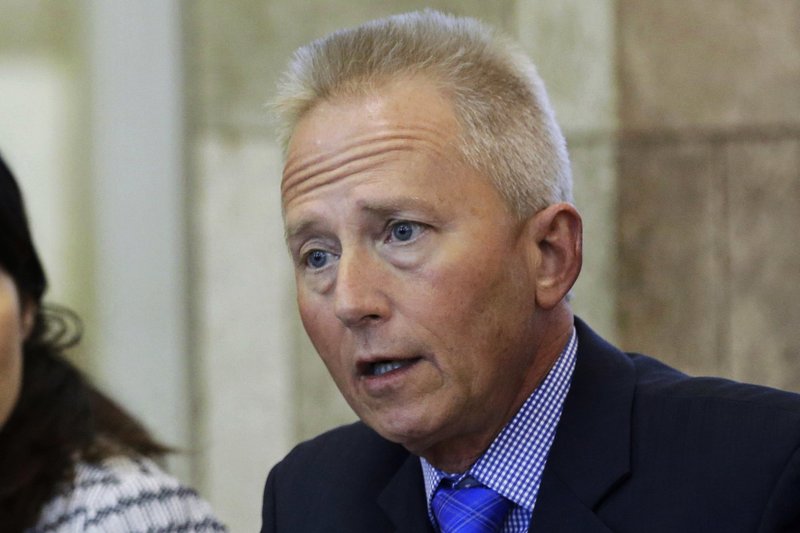
FILE
- In this Jan. 14, 2016, file photo, then state Sen. Jeff Van Drew,
D-Cape May Court House, speaks at a Senate Budget and Appropriations
Committee meeting in Trenton, N.J. Drew, who has long opposed House
Democrats' impeachment effort, discussed switching parties in a meeting
with President Donald Trump, an administration official said Saturday,
Dec. 14, 2019. (AP Photo/Mel Evans, File)
WASHINGTON
(AP) — A House freshman from New Jersey who was planning to break with
his party and vote against impeaching President Donald Trump will become
a Republican, a GOP official said Saturday.
Top
House Republicans have been told of Rep. Jeff Van Drew’s decision,
according to a GOP official familiar with the conversations. The
lawmaker had discussed switching parties in a meeting with Trump at the
White House on Friday, an administration official said Saturday.
Van
Drew’s decision underscores the pressures facing moderate Democrats
from Trump-leaning districts as next week’s impeachment vote approaches.
Van Drew won his southern New Jersey district by 8 percentage points
last year, but Trump carried it by 5 points in 2016 and Van Drew was
considered one of the more vulnerable House Democrats going into next
November’s congressional elections.
There
are 31 House Democrats who represent districts Trump carried in the
2016 election, and many of them have been nervous about the political
repercussions they would face by voting to impeach Trump. The House
Republican campaign committee has already run ads targeting many of
them, but most are expected to support Trump’s impeachment.
A
senior Democratic aide said Van Drew had not notified House Democratic
leaders about his decision. All the aides spoke on condition of
anonymity to describe private conversations.
The
senior Democratic aide provided what was described as a poll conducted
earlier this month by Van Drew’s campaign showing that by more than a
2-1 margin, people in his district would prefer a different candidate
than Van Drew in the Democratic primary and general election.
Rumors
surfaced last week that Van Drew might switch parties, and he
repeatedly denied them to reporters. But he reaffirmed his plan to
oppose impeachment, barring new evidence.
``It
doesn’t mean that I agree with everything the president may have said
or done. It means that I don’t believe that these are impeachable
offenses,`` he said in an interview Thursday.
Van Drew and a spokesperson did not answer their cellphones or return text messages on Saturday.
Trump put out a congratulatory tweet early Sunday. “Thank you for your
honesty Jeff. All of the Democrats know you are right, but unlike you,
they don’t have the “guts” to say so!”
Even
with his defection, there remains no doubt that the
Democratic-controlled House will vote to impeach Trump on a near
party-line vote.
Democrats
will still control the chamber by 232-198, plus an independent and four
vacancies. Until now, Van Drew and Rep. Collin Peterson of Minnesota
were the only Democrats expected to vote against impeachment, with
perhaps a small handful of others joining them. House Republicans seem
on track to oppose impeachment unanimously.
Van
Drew was a longtime state senator. His congressional district had been
under Republican control for nearly two decades before he was elected.
The
House is set to approve two articles of impeachment against Trump this
coming week. Democrats, who hold the majority, expect support from all
but a few of their members. No Republicans are expected to join them.
The Republican-controlled Senate is then all but certain to acquit Trump after a trial in January.
Van
Drew has argued that the process is likely just to further divide the
country and it would be better to let voters decide Trump’s fate in next
year’s election.
In
the first article of impeachment, Trump is accused of abusing his
presidential power by asking Ukraine to investigate his 2020 rival Joe
Biden while holding military aid as leverage. In the second article,
he’s accused of obstructing Congress by blocking the House’s efforts to
investigate his actions.
___
Associated Press writer Jonathan Lemire contributed to this story.
FILE
- In this April 25, 2018, file photo, attendees visit the Ford booth
during Auto China 2018 show held in Beijing, China. China’s government
says it will postpone planned punitive tariffs on U.S.-made automobiles
and other goods following an interim trade deal with Washington.
Sunday, Dec. 15, 2019’s announcement came after Washington agreed to
postpone a planned tariff hike on $160 billion of Chinese goods and to
cut in half penalties that already were imposed. (AP Photo/Ng Han Guan,
File)
BEIJING
(AP) — China’s government says it will postpone planned punitive
tariffs on U.S.-made automobiles and other goods following an interim
trade deal with Washington.
Sunday’s
announcement came after Washington agreed to postpone a planned tariff
hike on $160 billion of Chinese goods and to cut in half penalties that
already were imposed.
“China
hopes to work with the United States on the basis of equality and
mutual respect to properly address each other’s core concerns and
promote the stable development of Chinese-U.S. economic and trade
relations,” said a Cabinet statement.
U.S.
Trade Representative Robert Lighthizer said that under Friday’s
agreement, China committed to buy $40 billion of American farm products
over the next two years. He said China also promised to end its
long-standing practice of pressuring companies to hand over their
technology as a condition of market access.
Beijing
had planned to impose 25% duties on American-made autos on Sunday,
which would have raised the total charge to 40%. Hardest hit were
Germany’s BMW AG and Daimler AG’s Mercedes unit, which ship U.S.-made
SUVs and other cars to China.
Other goods were targeted for 10% and 5% penalties.
This
image made from undated video provided by Zola shows a scene of its
advertisement. Under pressure from a conservative advocacy group, The
Hallmark Channel has pulled the ads for wedding-planning website Zola
that featured same-sex couples, including two brides kissing. The
family-friendly network, which is in the midst of its heavily watched
holiday programming, removed the ads because the controversy was a
distraction, a spokesperson said in an interview on Saturday, Dec. 14,
2019. (Zola via AP)
NEW
YORK (AP) — Under pressure from a conservative advocacy group, The
Hallmark Channel has pulled ads for a wedding-planning website that
featured two brides kissing at the altar.
The family-friendly network, which is in the midst of its heavily watched holiday programming, removed the ads because the controversy was a distraction, a spokesperson said in an interview Saturday.
“The
debate surrounding these commercials on all sides was distracting from
the purpose of our network, which is to provide entertainment value,”
said a statement provided by Molly Biwer, senior vice president for
public affairs and communications at Hallmark.
In
an interview, she added: “The Hallmark brand is never going to be
divisive. We don’t want to generate controversy, we’ve tried very hard
to stay out of it ... we just felt it was in the best interest of the
brand to pull them and not continue to generate controversy.”
There
was immediate criticism on Twitter. Ellen DeGeneres asked Hallmark:
“Isn’t it almost 2020? What are you thinking? Please explain. We’re all
ears.”
Biwer
confirmed that a conservative group, One Million Moms, part of the
American Family Association, had complained about the ads to Bill
Abbott, CEO of Crown Media Family Networks, Hallmark’s parent company.
A
post on the group’s website said that Abbott “reported the
advertisement aired in error.” The group also wrote: “The call to our
office gave us the opportunity to confirm the Hallmark Channel will
continue to be a safe and family-friendly network.”
Zola
had submitted six ads, and four had a lesbian couple. After Hallmark
pulled those ads, but not two featuring only opposite-sex couples, Zola
pulled its remaining ads, the company said.
“The
only difference between the commercials that were flagged and the ones
that were approved was that the commercials that did not meet Hallmark’s
standards included a lesbian couple kissing,” said Mike Chi, Zola’s
chief marketing officer, in a statement sent to the AP. ”Hallmark
approved a commercial where a heterosexual couple kissed.
“All kisses, couples and marriages are equal celebrations of love and we will no longer be advertising on Hallmark,” Chi said.
In one of the pulled ads,
two brides stand at the altar and wonder aloud whether their wedding
would be going more smoothly if they had used a wedding planning site
like Zola. The lighthearted ad ends with the two brides sharing a quick
kiss on the altar.
Actress
Sandra Bernhard, who played one of the first openly bisexual characters
on network TV in “Roseanne,” also criticized Hallmark’s decision.
“All
the groovy gay ladies i know won’t be watching your Christmas schlock,”
she wrote on Twitter, addressing Hallmark. “They’ll be out celebrating
with their ’families’ wives, children, friends on & on & getting
married in chic ensembles. Didn’t you all get the memo? Family is all
inclusive.”
The developments came as Hallmark appeared to be considering more same-sex themed content.
Asked
about the possibility of holiday movies based on same-sex
relationships, Abbott was quoted in The Hollywood Reporter in
mid-November as saying on its TV podcast: “We’re open to really any type
of movie of any type of relationship.”
A Trump supporter took center stage at an Iowa campaign event for 2020 presidential candidate Sen. Bernie Sanders, I-Vt., on Saturday, where he stood up and delivered a message to President Trump.
Sanders
sensed trouble from the beginning when he saw the young man approach
the microphone and said, "Oh, he's looking at his phone. I'm in
trouble."
After being given the mic to ask Sanders a question, the
man addressed the commander in chief directly, offering him words of
encouragement.
"Mr. Trump, keep going man. You're doing a good job," he said. "You know what, I'm a liberal."
The
man was then briefly cut off by boos from the crowd before Sanders
urged them to let him finish. The man said he voted for Sanders during
the 2016 Democratic primary but is now fully behind the president.
"I
don't agree with anything you say. I used to. I voted for you in 2016,"
he said. "And I've been to Vietnam and seen what socialism has done.
It's destroyed the lives [of many]."
The crowd mockingly laughed at his claims before he hit back, and reiterated the failures of socialism.
"You
can laugh all you want," he shouted. "Donald Trump is helping our
country. All right? He's a good man... Socialism does not work."
Bernie
and the unidentified man continued to shout over one another until the
man was escorted out of the room by what appeared to be law enforcement. Fox News' Andrew Craft contributed to this report.
DES
MOINES, Iowa (AP) — Kim Motl doesn’t work in the health insurance
industry. But her friends and neighbors do. So when she saw Sen.
Elizabeth Warren recently in Fort Dodge, Iowa, Motl pressed the
Democratic presidential candidate about her “Medicare for All” plan,
which would replace private insurance with a government-run system.
“What
about the little guys that work in the insurance business, that support
our communities? The secretary that works for them, but maybe supports
their family, what happens to them?” the 64-year-old housing advocate
asked the senator.
“What happens to all of those people who lose their jobs?” Motl asked in a later interview.
Warren
reassured her that jobs would not be lost because of her plan. But the
exchange is a reminder that while railing against the insurance industry
can score points with the progressive Democratic base, it can also
alienate potential supporters in Iowa, where voters will usher in the
presidential primary in less than two months.
Nearly
17,000 Iowans are either directly employed by health insurance
companies or employed in related jobs, according to data collected by
America’s Health Insurance Plans, an industry advocacy group. Des
Moines, the seat of the state’s most Democratic county, is known as one
of America’s insurance capitals partly because of the high number of
health insurance companies and jobs in the metro area. Wellmark Blue
Cross Blue Shield’s health insurance headquarters employs roughly 1,700
in the metro area, and that’s just one of the 16 health insurance
companies domiciled in Iowa, according to the Iowa Insurance Division.
For
many Iowans, the Medicare for All debate is personal, and the prospect
of losing a job could influence whom they support in the Feb. 3
caucuses.
Tamyra
Harrison, vice-chair of the East Polk Democrats, says she has heard
worries at her local Democratic meetings about “the effect it would have
on people that work in the insurance industry, and those that have
small businesses in the area.”
“They’re
concerned about the repercussions on people living here that maybe the
Democrats aren’t thinking of” when they’re talking about eliminating
private insurance, she said.
The
Democrats’ health care plans vary widely in terms of the speed and
scope with which they would affect health care industry jobs, but
experts say every plan marks a substantial reconfiguring of one of the
country’s biggest industry and thus all would affect thousands of jobs
nationwide.
Some,
including Warren and Sen. Bernie Sanders of Vermont, have called for
replacing private insurance with a government plan. Asked about this
last month in Iowa, Warren said, “Some of the people currently working
in health insurance will work in other parts of insurance — in life
insurance, in auto insurance, in car insurance,” or for the new
government-run system. She also cited five years of “transition support”
for displaced workers built into the plan.
Sanders
has previously argued that his plan would see “all kinds of jobs opened
up in health care,” and his bill includes a fund to help retrain and
transition private insurance workers out of their current jobs.
Former
Vice President Joe Biden and Mayor Pete Buttigieg of South Bend,
Indiana, would leave room for private insurers, but also include a
public option, which they have acknowledged could ultimately put
insurance companies out of business. Sen. Cory Booker of New Jersey is
trying to walk a line on the issue, having signed onto Sanders’ Medicare
for All bill in the Senate but on the campaign trail shied away from
eliminating private insurance entirely.
Even
those who say they would keep private insurance companies face risks.
Buttigieg revealed this week that he worked for Blue Cross Blue Shield
in Michigan during his time as a consultant at McKinsey & Co. He
said he “doubts” his work contributed to layoffs the company later
announced and has instead sought to highlight the impact of his
opponents’ plans.
“There
are some voices in the Democratic primary right now who are calling for
a policy that would eliminate the job of every single American working
at every single insurance company in the country,” he said.
Economists
say the jobs impact of any shift away from private health care would be
felt nationwide by hundreds of thousands of Americans. It’s not just
jobs at private insurance companies that could be affected; those
working on processing insurance claims at hospitals and other
administrative health care jobs could be reduced as well.
According
to the Bureau of Labor Statistics, in 2018, nearly 386,000 Americans
were employed by health and medical insurance carriers — but some
analysts found the number of jobs lost from eliminating private
insurance could be much higher. Economists at the University of Michigan
found in an analysis of Sanders’ Medicare for All bill that the jobs of
nearly 747,000 health insurance industry workers, and an additional
1.06 million health insurance administrative staffers, would no longer
be needed if Medicare for All became law.
In Iowa, however, the issue could be particularly problematic.
Around
Des Moines, “you can’t swing a dead cat without finding someone who
works at an insurance provider or a company,” said Mary McAdams, chair
of the Ankeny Area Democrats. She said she believes Democrats in her
area aren’t as concerned about what would happen to their jobs if
private insurance were eliminated because they don’t have much
allegiance to their companies to begin with.
“They know full well these companies would drop them like a habit,” she said.
The
economic repercussions of eliminating private insurance jobs could go
beyond simply the loss of local jobs, as Paula Dierenfield, a Republican
lawyer and the executive director of the Federation of Iowa Insurers,
points out.
“This
is an industry that employs thousands of employees in high-quality
jobs,” she said. “All of those employees pay income taxes, sales taxes,
property taxes, and the companies that they work for also pay millions
in premium taxes, as well as property taxes. So it would have a
significant impact on the Iowa economy generally as well as here in the
Des Moines metro area.”
The
peripheral effects of eliminating insurance jobs worry Marcia
Wannamaker, a real estate agent from West Des Moines who raised her
concerns about the fate of private insurance during a recent
question-and-answer session with Biden.
“It’s really going to cut our jobs,” Wannamaker said.
She
later noted in an interview that if the private insurance industry
shrinks, people working for such companies would lose their jobs.
“Then that trickles down to the housing. They’re going to have to move.
I just think it’s going to be a disaster,” she said. “When you sell
real estate, these people buy homes. It’s just part of how the Iowa —
and especially in Des Moines, the economy works.”
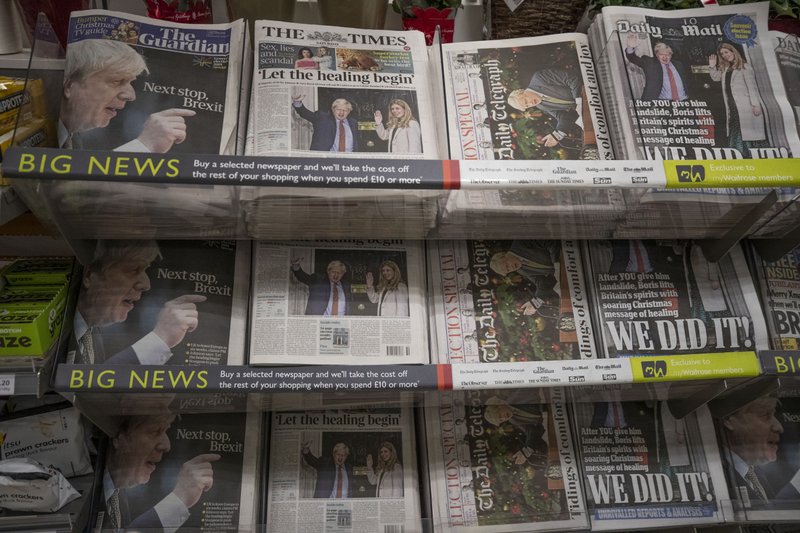
LONDON
(AP) — British Prime Minister Boris Johnson was heading to northern
England on Saturday to meet newly elected Conservative Party lawmakers
in the working class heartland that turned its back on the opposition
Labour Party in this week’s election and helped give him an 80-seat
majority.
In a
victory speech outside 10 Downing Street on Friday, Johnson called for
an end to the acrimony that has festered throughout the country since
the divisive 2016 Brexit referendum, and urged Britain to “let the
healing begin.”
Johnson’s
campaign mantra to “get Brexit done″ and widespread unease with the
leadership style and socialist policies of opposition leader Jeremy
Corbyn combined to give the ruling Conservatives 365 seats in the House
of Commons, its best performance since party icon Margaret Thatcher’s
last victory in 1987. Labour slumped to 203 seats, its worst showing
since 1935.
While
Johnson was on a victory lap Saturday, Corbyn — who has pledged to
stand down next year — was under fire from within his own party.
Former
lawmaker Helen Goodman, one of many Labour legislators to lose their
seat in northern England, told BBC radio that “the biggest factor was
obviously the unpopularity of Jeremy Corbyn as the leader.”
Armed
with his hefty new majority, Johnson is set to start the process next
week of pushing Brexit legislation through Parliament to ensure Britain
leaves the EU by the Jan. 31 deadline. Once he’s passed that hurdle —
breaking three years of parliamentary deadlock — he has to seal a trade
deal with the bloc by the end of 2020.
Johnson
owes his success, in part, to traditionally Labour-voting working class
constituencies in northern England that backed the Conservatives
because of the party’s promise to deliver Brexit. During the 2016
referendum, many of those communities voted to leave the EU because of
concerns that immigrants were taking their jobs and neglect by the
central government in London.
___
Follow AP’s full coverage of Brexit and British politics at https://www.apnews.com/Brexit.
Inspector General Michael Horowitz's long-awaited report this week on
FBI and Justice Department surveillance abuses does not provide the
name of an unidentified FBI supervisory special agent (SSA) who made a
series of apparent oversights in the bureau's so-called "Crossfire
Hurricane" probe into the Trump campaign.
However, a review of
Horowitz's findings leaves little doubt that the unnamed SSA is Joe
Pientka -- someone who could soon play a prominent role in the ongoing
prosecution of Michael Flynn, as the former Trump national security
adviser fights to overturn his guilty plea on a single charge of making
false statements.
Specifically, Horowitz's report
states that "SSA 1" was one of the FBI agents to interview Flynn at the
White House on Jan. 24, 2017, in a seemingly casual conversation that
would later form the basis for his criminal prosecution.
It was previously reported
that the interviewing agents were Peter Strzok, who was later fired by
the FBI for misconduct and anti-Trump bias, and Pientka, whom Strzok previously identified as his notetaker for the Flynn interview. Flynn's attorney has also mentioned Pientka's role during past court proceedings. Of the two agents, only Strzok is openly named in the Horowitz report, which strongly indicates that the other is Pientka.
"SSA
1," Horowitz's report states, may have helped mislead the Foreign
Intelligence Surveillance Court (FISC) about material facts concerning
former Trump adviser Carter Page and British ex-spy Christopher Steele,
whose unverified dossier played a central role in the FBI's warrant to
surveil Page.
Page has not been charged with any wrongdoing, even
though the FBI flatly called him a foreign "agent" in its surveillance
warrant application. And former Special Counsel Robert Mueller's Russia investigation,
which concluded earlier this year, found no evidence that the Trump
campaign had engaged in a criminal conspiracy with Russians to influence
the 2016 election, despite multiple outreach efforts by Russian actors.
On
Aug. 1, 2016, just after the official inception of the FBI’s
investigation into the Trump campaign, Strzok and Pientka traveled
overseas to meet with the Australian officials who had spoken with Trump
adviser George Papadopoulos in May of that year. The officials had
overhead Papadopoulos mention his now-infamous conversation with Joseph
Mifsud about suggestions of potential Russian leaks of Hillary Clinton’s
emails, apparently touching off what would become the Russia probe.
SSA
1 was given a supervisory role on the Crossfire Hurricane team,
overseeing agents and reporting directly to Strzok. The special agent
created the electronic sub-file to which the Steele reports would be
uploaded and, according to Horowitz, these reports were used to support
the probable cause in the Page FISA applications.
Then, on
Sept. 23, 2016, Yahoo News published an article describing U.S.
government efforts to determine whether Page was in communication with
Kremlin officials. The article seemed to closely track information from
one of Steele’s reports. As a result, one FBI case agent who reported to
SSA 1 believed Steele was the source, according to Horowitz.
SSA
1 apparently thought the same, as his notes from a Sept. 30, 2016,
meeting said: “Control issues -- reports acknowledged in Yahoo
News.” When questioned by Horowitz's office, the agent explained he was
concerned -- but not sure -- that Steele was the Yahoo News source.
The
drafts of the Page FISA application, however, tell a different story.
Horowitz found that until Oct. 14, 2016, drafts state that Steele was
responsible for the leak that led to the Yahoo News article. One draft
specifically states that Steele “was acting on his/her own volition and
has since been admonished by the FBI.”
These assertions, which
could have pointed to political motivations by their source soon before
the 2016 presidential election, were changed to the following: Steele’s
“business associate or the law firm that hired the business associate
likely provided this information to the press.”
Horowitz found no facts to support this assessment.
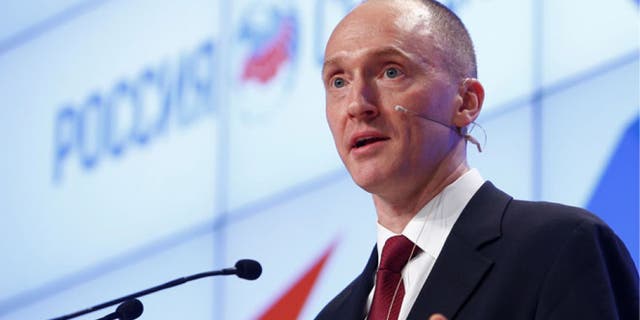
Former Trump adviser Carter Page was falsely accused of being a "foreign agent" in the FBI's secret surveillance warrant.
And, even after receiving “additional information
about Steele’s media contacts, the Crossfire Hurricane team did not
change the language in any of the three renewal applications regarding
the FBI’s assessment of Steele’s role in the September 23 article,"
Horowitz found.
On Oct. 11, 2016, Steele met with then-State
Department official Jonathan Winer and Deputy Assistant Secretary
Kathleen Kavalec. Steele informed Kavalec that a Russian cyber-hacking
operation targeting the 2016 U.S. elections was paying the culprits from
“the Russian Consulate in Miami.” Kavalec later met with an FBI liaison
and explained to them that Russia did not have a consulate in Miami.
SSA 1 was informed of Steele’s incorrect claim about the Russian
Consulate on Nov. 18, 2016, but the FISA court was never provided this
information, according to the IG report.
Additionally, the agent
was aware of Page’s denials to an FBI confidential human source (CHS)
that he knew Russian officials Igor Sechin and Igor Divyekin – officials
that Steele alleged Page had secret meetings with in Moscow in July
2016. In fact, Horowitz found that SSA 1 “knew as of October 17 that
Page denied ever knowing Divyekin."
"This
inconsistency was also not noted during the Woods Procedures on the
subsequent FISA renewal applications, and none of the three later FISA
renewal applications included Page’s denials to the CHS," Horowitz
wrote, referring to the FBI's practice of reverifying facts in its FISA
application before seeking renewals.
SSA 1 also had the
responsibility for “confirming that the Woods File was complete and for
double-checking the factual accuracy review to confirm that the file
contained appropriate documentation for each of the factual assertions
in the FISA application," according to Horowitz.
But Horowitz
found numerous instances “in which factual assertions relied upon in the
first FISA application targeting Carter Page were inaccurate,
incomplete or unsupported by appropriate documentation, based upon
information the FBI had in its possession at the time the application
was filed."
In particular, the FBI misled the FISC by asserting
that Steele’s prior reporting "has been corroborated and used in
criminal proceedings.” Horowitz's review found there was no
documentation to support this statement; SSA 1 told Horowitz they
“speculated.”
SSA
1 was also aware, according to Horowitz, that Steele had relayed his
information to officials at the State Department, and he had
documentation showing Steele had told the team he provided the reports
to his contacts at the State Department. Despite this, the FISC was
informed that Steele told the FBI he “only provided this information to
the business associate and the FBI.”
After Steele was terminated
as an FBI source for leaking to the media, there was a meeting with
Crossfire Hurricane team members and Justice Department official Bruce
Ohr, whose wife had been hired by Steele employer Fusion GPS. SSA 1 told
Horowitz that Ohr likely left the meeting with the impression that he
should contact the FBI if Steele contacted him; Ohr told Horowitz that
SSA 1 became his initial point of contact when relaying Steele’s
information to the FBI.
Pientka was selected to provide an Aug.
17, 2016 FBI security briefing to the Trump campaign once the FBI was
informed that Flynn would be in attendance. According to Pientka, the
briefing gave him “the opportunity to gain assessment and possibly have
some level of familiarity” with Flynn. He was there to “record” anything
“specific to Russia or anything specific to our investigation.”
Pientka
found the opportunity to interact with Flynn “useful” because he was
able to compare Flynn’s “norms” from the briefing with Flynn’s conduct
at his Jan. 24, 2017, interview. It was this assessment that
purportedly helped lead Pientka to conclude that Flynn was not lying
when questioned about his interactions with the Russians after the
election and his calls with Russian Ambassador Sergey Kislyak.
With Strzok's termination from the FBI, Pientka is perhaps the only remaining FBI witness against Flynn.
Horowitz's descriptions of SSA 1's conduct came as U.S. Attorney John Durham announced Monday that he did not "agree" with
some of the inspector general's conclusions, stunning observers while
also highlighting Durham's broader criminal mandate and scope of review.
Durham is focusing on foreign actors as well as the CIA, while Horowitz
concentrated his attention on the Justice Department and FBI.
"Based
on the evidence collected to date, and while our investigation is
ongoing, last month we advised the Inspector General that we do not
agree with some of the report’s conclusions as to predication and how
the FBI case was opened," Durham said in his statement, adding that his
"investigation is not limited to developing information from within
component parts of the Justice Department" and "has included developing
information from other persons and entities, both in the U.S. and
outside of the U.S."
Pientka is hardly the only bureau employee to
come under scrutiny. Prior to the FBI's warrant application to monitor
Page, the FBI reached out to the CIA and other intelligence agencies for
information on Page, Horowitz discovered. The CIA responded in an
email by telling the FBI that Page had contacts with Russians from 2008
to 2013, but that Page had reported them to the CIA and was serving as a
CIA operational contact and informant on Russian business and
intelligence interests.
An FBI lawyer then doctored the CIA's
email about Page to make it seem as though the agency had said only that
Page was not an active source. And, the FBI included Page's contacts
with Russians in the warrant application as evidence he was a foreign
"agent," without disclosing to the secret surveillance court that Page
was voluntarily working with the CIA concerning those foreign contacts.
For several years, Democrats and analysts at The New York Times, The Washington Post and CNN have
repeatedly claimed that key claims in the Clinton-funded anti-Trump
dossier had been corroborated and that the document was not critical to
the FBI's warrant to surveil Page. Horowitz repudiated that claim, with
the FBI's legal counsel even describing the warrant to surveil Page as
"essentially a single source FISA" wholly dependent on the dossier.
Among
the unsubstantiated claims in the dossier: that ex-Trump lawyer Michael
Cohen traveled to Prague to conspire with Russian hackers; that the
Trump campaign was paying hackers working out of a nonexistent Russian
consulate in Miami; that a lurid blackmail tape of Trump existed and
might be in Russian possession; and that Page was bribed with a 19
percent share in a Russian company.
The FBI declined Fox News' request for an on-the-record comment late Friday. Wilson Miller contributed to this report.