WASHINGTON
(AP) — Congress has headed home for the holidays leaving plans and a
possible timeline for President Donald Trump’s impeachment trial in
disarray.
Democratic
House Speaker Nancy Pelosi insisted Thursday that Senate Republicans
must provide details on witnesses and testimony before she would send
over the charges for Trump’s trial. No deal, replied Senate Majority
Leader Mitch McConnell after meeting with his Senate Democratic
counterpart.
“We remain at an impasse,” he said.
As
darkness fell and lawmakers prepared to depart for the year, McConnell
wondered from the Senate floor why in the world the Republicans should
give ground to persuade House Democrats “to send us something we do not
want.”
McConnell
and the Democrats’ Senate leader, Chuck Schumer of New York, met for
about 20 minutes in their first attempt to negotiate the contours of an
agreement on running the rare Senate impeachment trial that was expected
to start in January.
McConnell
favors a swift trial, without the new witnesses Democrats want, and he
holds a clear tactical advantage if he can keep his 53-member Senate
majority united. Schumer, who also met privately with Pelosi, has to bet
that GOP senators won’t hold the line and Republicans will peel away as
public pressure mounts for a fuller trial.
For the record, Sen. Lindsey Graham of South Carolina said he had met with Trump and “he is demanding his day in court.”
McConnell,
who has drawn criticism for saying he won’t be an impartial juror, said
the Democrats were “too afraid″ to send the charges to the Senate,
where Trump would be expected to be acquitted by the Republican
majority.
We’ll see, he said, “whether the House Democrats ever work up the courage to take their accusations to trial.”
Pelosi
said that McConnell “says it’s OK for the foreman of the jury to be in
cahoots with the lawyers of the accused. That doesn’t sound right to
us.”
Dismissing
the idea that Democrats would hold off the proceeding indefinitely to
prevent Trump from being acquitted, Schumer said there will almost
certainly be a trial.
“There’s an obligation under the Constitution to have a trial,” Schumer told The Associated Press.
He
noted that even the Democratic senators campaigning for the party’s
presidential nomination, with early state voting starting in February,
are prepared to return to Washington to sit for the days-long
proceedings. “The Constitution requires it,” he said.
Wednesday
night’s House vote, almost entirely along party lines, made the
president just the third in U.S. history to be impeached. The House impeached Trump
on two charges — abusing his presidential power and obstructing
Congress — stemming from his pressure on Ukraine to announce
investigations of his political rival as Trump withheld U.S. aid.
Pelosi’s
procedural delay in taking the next step — apparently in search of
leverage with Senate Republicans in locking in trial arrangements —
threw a wrench into the expected timing.
“So
far we haven’t seen anything that looks fair to us,” she had said
Wednesday night. On Thursday at the Capitol, she said, “We’d like to see
a fair process, but we’ll see what they have and will be ready for
whatever it is.”
Trump mocked on Twitter: “Now the Do Nothing Party want to Do Nothing with the Articles.”
Both parties said public opinion was with them after the House impeachment vote.
Trump claimed polling showed him leading all potential Democratic opponents for next fall’s election.
Pelosi
said, “We’ve been hearing from people all over the country. Seems like
people have a spring in their step because the president was held
accountable for his reckless behavior.”
With
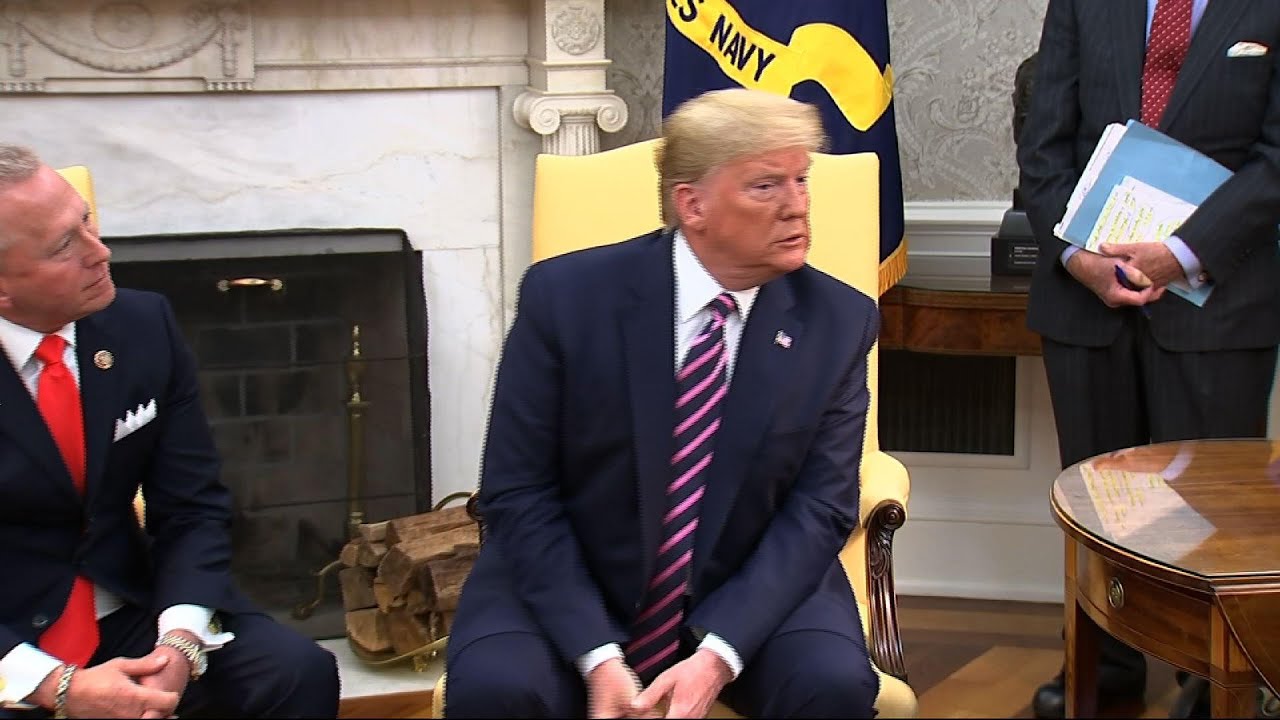
elections in mind, Trump welcomed Democratic Rep. Jeff Van Drew into
the GOP after the New Jersey freshman said he would be changing parties
because he opposed impeachment.
Pelosi,
pressed about next steps for impeachment, wouldn’t say. She and her
Democrats are insisting on more witnesses, testimony and documents than
McConnell appears willing to provide before they name the House
“managers” who would prosecute Trump in the Senate.
“The
next thing will be when we see the process that is set forth in the
Senate,” Pelosi said. “Then we’ll know the number of managers we may
have to go forward and who we would choose.”
Not yet.
On
the Senate floor, McConnell described the House actions against Trump
as “the most rushed, least thorough and most unfair impeachment inquiry
in modern history.”
Fighting
back using McConnell’s own words, Schumer said the Republican leader
was plotting the “most rushed, least thorough and most unfair”
impeachment trial in history by declining to agree to call witnesses,
including former Trump national security adviser John Bolton, who
declined to testify before the House.
“McConnell
claimed the impeachment was motivated by partisan rage,” said Schumer.
“This from the man who said proudly, ‘I am not impartial.’
“What hypocrisy.”
___
Associated Press writers Alan Fram and Lisa Mascaro contributed to this report.
Sen. Bernie Sanders sparked a range of responses on social media after Thursday night's Democratic presidential debate in Los Angeles with a comment he made as a moderator was asking him about recent comments by former President Barack Obama.
“Senator Sanders, you are the oldest candidate onstage … ” Politico magazine’s Tim Alberta began.
"And I’m white as well," the 78-year-old Sanders interjected before Alberta could finish.
"Yes,"
Alberta replied, amid what seemed like an awkward silence at Loyola
Marymount University. Alberta then continued with his question.
“How do you respond to what the former president had to say?”
Alberta had asked Sanders to respond to comments Obama made in Singapore earlier in the week.
“Former
President Obama said this week when asked who should be running
countries that if women were in charge you’d see a significant
improvement on just about everything,” Alberta pointed out. “He also
said, ‘If you look at the world and look at the problems, it’s usually
old people, usually old men not getting out of the way.'”
Sanders
responded: “I got a lot of respect for Barack Obama. I think I disagree
with him on this one," prompting some audible laughter from the
audience. “Maybe a little self-serving, but I do disagree.”
He then said the U.S. was becoming an "oligarchy" with an economy that serves only the "one percent."
“Here
is the issue. The issue is where power resides in America. And it’s not
white or black or male or female. We are living in a nation
increasingly becoming an oligarchy. We have a handful of billionaires
who spend hundreds of millions of dollars buying elections and
politicians.
“You have more income and wealth inequality today
than at any time since the 1920s. We are the only major country on Earth
not to guarantee health care for all people, which is why we need
Medicare-for-all. We are facing an existential crisis of climate change…
“The
issue is not old or young or male or female,” Sanders continued. “The
issue is working people standing up. Taking on the billionaire class.
And creating a government and an economy that works for all. Not just
the one percent.”
But some critics on social media fired back at
Sanders, saying his age, gender and race were all factors that helped
him become wealthy.
“But @BernieSanders would like us to believe
that being a White male doesn't give him and his ilk any systemic
advantages,” one Twitter user wrote.
Others accused Sanders of being a hypocrite -- given he criticizes the rich but reportedly owns three homes.
Several
pointed to what they described as “awkward silence” and “crickets” in
the crowd after Sanders’ “I’m white as well,” quip failed to resonate.
But mostly people online seemed unsure what the comment meant. Some
asked Sanders to explain what he was trying to say while others had
their own interpretations.
“Does this count as "White Supremacy" ???” one user wrote, tagging Sanders and Obama.
Another user asked: “Can you elaborate as to that response?”
“Oof! "And I'm White As Well" is not the bumper sticker Bernie Sanders needs,” a third chimed in.
One user seemed to defend Sanders, saying that being a white man was now considered "political baggage."
"Of
course white men have privilege. But in today's environment, it's
political baggage as well. It was a question about diversity and on that
page, all that goes against Sanders. It was a self deprecating moment,"
she wrote.
One person applauded the remark, saying Sanders was acknowledging his own “white privilege.”
“Bernie
Sanders, so far, is the only white candidate to say this tonight and
recognize white privilege. I think that's worth something,” Charlotte
Clymer wrote.
Another
user said Sanders' remark was "his middle finger to the gender and
racial purity test of the left. Basically saying, stop getting (fake)
distracted on what gender or race I am and listen to what I have to
say."
The debate came a day after a highly contentious vote to
impeach President Donald Trump, which showed in dramatic relief how
polarized the nation is over his presidency. With the
Republican-controlled Senate likely to acquit him, the stakes are high
for Democrats to select a challenger who can defeat Trump in November.
The
forum highlighted the choice Democrats will have to make between
progressive and moderate, older and younger, men and women and the
issues that will sway the small but critical segment of voters who will
determine the election. The candidates sharply disagreed about the role
of money in politics, the value and meaning of experience and the
direction of the American health care system The Associated Press contributed to this report.
Long-simmering tensions boiled over at Thursday night's 2020 Democratic presidential primary debate in Los Angeles, as a blunt one-on-one sparring match erupted between Pete Buttigieg and Elizabeth Warren over their fundraising -- just minutes after businessman Andrew Yang slammed Democrats' "obsession" with President Trump and impeachment.
Warren, a U.S. senator from Massachusetts, began the fiery exchange by criticizing Buttigieg's recent lavish fundraiser
in Napa, Calif., saying he was cavorting with "billionaires in wine
caves" -- prompting Buttigieg to retort that Warren, a
multimillionaire, was a populist in name only.
"You know,
according to Forbes magazine, I'm literally the only person on this
stage who is not a millionaire or billionaire," Buttigieg, the mayor of
South Bend, Ind., said. "This is the problem with issuing purity tests
you yourself cannot pass." BIDEN SAYS 'YES' WHEN ASKED ABOUT SACRIFICING BLUE-COLLAR JOBS FOR CLEAN ENERGY
Democrats,
Buttigieg argued, are "in the fight" of their "lives," and need all the
support they can get -- whether from the wealthy or otherwise. He added
that he'd gladly accept a donation from Warren if she were to offer
one.
"We shouldn't try to [defeat Trump] with one hand tied behind our back," Buttigieg said.
Sen. Bernie Sanders,
I-Vt., then dismissively referred to Butitigeg as an "energetic guy,"
sarcastically saying he could "take on" former Vice President Joe Biden's
corporate connections as the two secretly courted big-money donors,
drawing jeers. Sanders noted that Biden has 44 billionaire contributors,
while Buttigieg was "trailing" with only 39.
Sen. Amy Klobuchar of Minnesota then interjected: "I did not come here to listen to this argument. ... I have never even been to a wine cave."
"I did not come here to listen to this argument. ... I have never even been to a wine cave." — Sen. Amy Klobuchar, D-Minn.
She went on to say she wanted the Supreme Court's
Citizens United decision overturned by constitutional amendment. The
2010 decision declared unconstitutional the federal regulation of
campaign expenditures by corporations and unions in connection with
campaigns.
It was just one of several Klobuchar moments during the
debate that resonated in the debate hall at Loyola Marymount University
-- even as conservative commentators winced.
"The
'moderate' Klobuchar just advocated for a constitutional amendment that
would give government control over free political speech," the Wall
Street Journal's Kimberly Strassel wrote on Twitter. "This is
'moderation' in today's Democratic Party."
Separately, Klobuchar
unloaded on Buttigieg, after he remarked: "If you want to talk about the
capacity to win, try putting together a coalition to bring you back to
office with 80 percent of the vote as a gay dude in Mike Pence's Indiana."
Klobuchar
shot back: “If you had won in Indiana, that would be one thing. You
tried and you lost by 20 points.” That was an unsparing reference to
Buttigieg's failed bid to become Indiana state treasurer.
She
also remarked, "When we were in the last debate, mayor, you basically
mocked the 100 years of experience on the stage. ... You should respect
our experience."
The spat over fundraising erupted shortly
after Yang threw cold water on the media's "obsession" with impeachment,
saying Americans become frustrated "the more we act like Donald Trump
is the cause of all our problems."
Iowa caucuses near
It
was a heated beginning to a wide-ranging debate with less than seven
weeks to go until Iowa’s caucuses kick off, and just a day after House
Democrats voted to impeach Trump.
The winnowed field of seven Democratic presidential contenders was on
the debate stage for a sixth and final time in 2019.
"If you
turned on cable network news today, you would think [Trump's] our
president because of some combination of Russia, racism, Facebook,
Hillary Clinton and emails all mixed together," Yang said. "But
Americans around the country know different. We blasted away 4 million
manufacturing jobs that were primarily based in Ohio, Michigan,
Pennsylvania, Wisconsin, Missouri."
He added, to applause: "What
we have to do, is we have to stop being obsessed over impeachment ...
and start actually digging in and solving the problems that got Donald
Trump elected in the first place."
"What we have to
do, is we have to stop being obsessed over impeachment ... and start
actually digging in and solving the problems that got Donald Trump
elected in the first place." — Andrew Yang
(At
the end of the debate, Yang sounded a note of self-deprecation: "I know
what you're thinking, America. How am I still on the stage with them?")
But, other Democrats largely echoed their previous attacks on the president's dealings with Ukraine, and his assertions of executive privilege to block administration officials from testifying.
“The
president is not king in America,” said Klobuchar, who is preparing to
serve as a juror as Trump's impeachment shifts from the House to a
Senate trial. Alluding to President Richard Nixon, she added, "If the
president claims that he is so innocent, then why doesn't he have all
the president's men testify?" MCCONNELL HEADS BACK TO SENATE FLOOR LATE THURSDAY, SAYS DEMS BREAKING PRECEDENT, NOT SURE WHAT THEY'RE DOING
Klobuchar
went on to call Trump's actions a "global Watergate." Democrats'
inference that Trump is guilty because he does not voluntarily permit
his deputies to testify has rankled Republicans, who assert the importance of the presumption of innocence.
Biden then knocked Trump's argument that less than half of Americans support his removal from office.
“He's
dumbing down the presidency beyond what I even thought he would do,”
Biden said. “We need to restore the integrity of the presidency.”
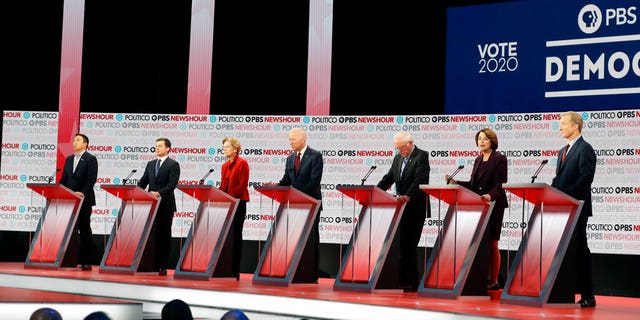
Democratic presidential candidates from left, entrepreneur Andrew
Yang, South Bend Mayor Pete Buttigieg, Sen. Elizabeth Warren, D-Mass.,
former Vice President Joe Biden, Sen. Bernie Sanders, I-Vt., Sen. Amy
Klobuchar, D-Minn., and businessman Tom Steyer stand on stage during a
Democratic presidential primary debate Thursday, Dec. 19, 2019, in Los
Angeles. (Associated Press)
Later, Democrats largely defended Trump's breakthrough U.S.-Mexico-Canada Agreement, which the House passed hours earlier.
However,
candidates railed against Trump's economy, despite multiple indicators
that the economy is doing well. The U.S. unemployment rate stands at a
half-century low of 3.5 percent, backed by consistently strong job gains
in recent months that have largely squelched fears of a recession that
had taken hold over the summer.
“This economy is not working for most of us," Buttigieg said.
"The middle class is getting killed,” Biden added. He said the economy was not "on kilter."
In response to a question as to whether he would commit to running for a second term if elected, amid a Politico report that
he has privately said he would retire after four years in the White
House, the 77-year-old Biden announced that he would not -- saying his
focus is on winning a first term.
When a moderator told the
70-year-old Warren she would be the oldest president ever elected upon
her inauguration, she retorted that she would also be the youngest woman
ever elected to the presidency, drawing applause.
Thursday night's televised contest, sponsored by PBS NewsHour and Politico, brought seven rivals to heavily Democratic California, the biggest prize in the primary season and home to 1 in 8 Americans.
Declining viewership
The
debate could turn out to be the least-watched so far, as the holidays
approach and impeachment drama dominates the news. Viewership has
declined in each round though five debates, and even campaigns have
grumbled that the candidates would rather be on the ground in early
voting states than again taking the debate stage.
Republicans have slammed
House Democrats' plan to delay a Senate trial. Hours before the debate,
Noah Feldman, the Harvard Law School professor who testified for
Democrats at the impeachment inquiry earlier this month, wrote an explosive op-ed asserting
that if Democrats do not forward the impeachment articles to the Senate
as dictated by the Constitution, then Trump was never even impeached at
all. The Constitution dictates that after impeachment by a majority in
the House, a two-thirds vote is needed in the Senate to remove a
president from office.
Asked why polls show
that many Americans oppose impeaching and removing Trump, Biden called
impeachment a "constitutional necessity," regardless of what the numbers
show.
Warren, for her part, accused Trump of corruption, without addressing the popularity of impeachment.
Klobuchar
also suggested that the U.S. would "probably" need to relocate
Americans away from places impacted by climate change, including
possibly Miami.
Yang, meanwhile, advanced the idea of using thorium to help address the nation's energy needs.
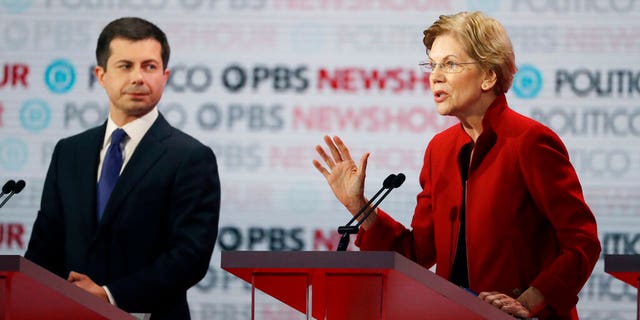
Democratic presidential candidate Sen. Elizabeth Warren, D-Mass.,
right, speaks as South Bend Mayor Pete Buttigieg listens during a
Democratic presidential primary debate Thursday, Dec. 19, 2019, in Los
Angeles. (Associated Press)
No clear front-runner
The
lack of a clear front-runner in the Democratic field came as Democrats
complained that there would be a notable lack of diversity onstage
Thursday as compared to earlier debates. For the first time this cycle,
the debate didn't feature a black or Latino candidate.
The race in
California has largely mirrored national trends, with Biden, Sanders
and Warren clustered at the top of the field, followed by Buttigieg,
Klobuchar, Yang and billionaire philanthropist Tom Steyer.
Conspicuously missing from Thursday's lineup was former New York City Mayor Michael Bloomberg,
a billionaire who is unable to qualify for the contests because he is
not accepting campaign donations. But even if he's not on the podium,
Bloomberg has been felt in the state: He's running a deluge of TV
advertising in California to introduce himself to voters who probably
know little, if anything, about him.
Bloomberg's late entry into
the contest last month highlighted the overriding issue in the contest
-- electability, a sign of the unease within the Democratic Party about
its crop of candidates and whether any is strong enough to unseat an
incumbent president. The eventual nominee will be tasked with splicing
together the party's disparate factions — a job Hillary Clinton struggled with after defeating Sanders in a long and bitter primary fight in 2016. DEBATE IS ON: DEAL REACHED IN UNION DISPUTE THAT THREATENED TO SIDETRACK SHOWDOWN
Biden adviser Symone Sanders said to expect another robust exchange on health care.
“This
is an issue that is not going away and for good reason, because it is
an issue that in 2018 Democrats ran on and won," she said.
Jess
O'Connell with Buttigieg's campaign said the candidate will “be fully
prepared to have an open and honest conversation about where there are
contrasts between us and the other candidates. This is a really
important time to start to do that. Voters need time to understand the
distinctions between these candidates.” The key issues: health care and higher education.
The
unsettled race has seen surges at various points by Biden, Warren,
Sanders and Buttigieg, though it's become defined by that cluster of
shifting leaders, with others struggling for momentum. Sen. Kamala
Harris of California, once seen as among the top tier of candidates,
shelved her campaign this month, citing a lack of money. And Warren has
become more aggressive, especially toward Buttigieg, as she tries to
recover from shifting explanations of how she’d pay for “Medicare for
All” without raising taxes.
In a replay of 2016, the shifting race
for the Democratic nomination has showcased the rift between the
party's liberal wing, represented by Sanders and Warren, and candidates
parked in or near the political center, including Biden, Buttigieg and
Bloomberg.
Two candidates who didn’t make the stage will still
make their presence felt for debate watchers with ads reminding viewers
they’re still in the race. APPELLATE COURT DEMANDS HOUSE DEMS EXPLAIN WHETHER IMPEACHMENT VOTE RENDERS THEIR LEGAL CASE 'MOOT'
Sen.
Cory Booker of New Jersey and former Housing Secretary Julián Castro
aired television ads targeted to primary voters during the debate.
Booker’s was his first television ad, and in it he said even though he
wasn't on the debate stage, “I’m going to win this election anyway.” It
aired as part of a $500,000 campaign, running in Iowa, New Hampshire,
Nevada and South Carolina, as well as New York, Washington, D.C., and
Los Angeles.
A pro-Booker super PAC is also going up with an ad in Iowa highlighting positive reviews of Booker’s past debate performances.
Meanwhile,
Castro is running an ad, in Iowa, in which he argues the state should
no longer go first in Democrats’ nominating process because it doesn’t
reflect the diversity of the Democratic Party.
Both candidates
failed to hit the polling threshold to qualify for the debates and have
in recent weeks become outspoken critics of what they say is a debate
qualification process that favors white candidates over minorities. Fox News' Paul Steinhauser and The Associated Press contributed to this report.
Senate Majority Leader Mitch McConnell,
R-Ky., incredulously returned to the Senate floor late Thursday to
declare that the Senate and House Democrats were at an "impasse" over whether the House would transmit its articles of impeachment against President Trump to the GOP-controlled Senate for a constitutionally mandated trial.
McConnell,
speaking after a meeting with Senate Minority Leader Chuck Schumer,
D-N.Y., said the top Democrat had insisted on "departing from
the unanimous bipartisan precedent that 100 senators approved before the
beginning of President [Bill] Clinton's trial" concerning logistics.
The
back-and-forth rhetoric comes as Noah Feldman, the Harvard Law School
professor who testified for Democrats at the impeachment inquiry earlier
this month, wrote an explosive op-ed
asserting that if Democrats do not forward the impeachment articles to
the Senate as dictated by the Constitution, then Trump was never even
impeached at all. The Constitution dictates that after impeachment by a
majority in the House, a two-thirds vote is needed in the Senate to
remove a president from office.
Feldman cautioned that impeachment
"means the House sending its approved articles of impeachment to the
Senate, with House managers standing up in the Senate and saying the
president is impeached."
Therefore,
"if the House does not communicate its impeachment to the Senate, it
hasn’t actually impeached the president," Feldman said. "If the articles
are not transmitted, Trump could legitimately say that he wasn’t truly
impeached at all."
(Pursuant to House procedures,
a president impeached by the House in one Congress can be tried by a
Senate in the next Congress, but impeachment managers would need to be
re-appointed by the new House.)
Schumer had requested a "special
pre-trial guarantee of certain witnesses whom the House Democrats,
themselves, did not bother to pursue as they assemble their case,"
McConnell said. He noted that in 1999, "all 100 senators endorsed a
common-sense solution" to divide the process into two stages: one laying
the groundwork for rules on matters such as opening statements, with
another handling "mid-trial questions such as witnesses."
"Some
House Democrats imply they are withholding the [impeachment] articles
for some kind of leverage," McConnell said. "I admit, I'm not sure what
leverage there is in refraining from sending us something we do not
want. Alas, if they can figure that out, they can explain."
He
continued: "Following weeks of pronouncements about the urgency of the
situation, urgent situation, the prosecutors appear to have developed
cold feet. Democrat prosecution seems to gotten cold feet, and to be
unsure about whether they want to proceed to the trial, like I said, a
very unusual spectacle. And in my view, certainly not one that reflects
well on the House.
"So
we'll see we'll see whether House Democrats ever want to work up the
courage to actually take their accusation to trial," McConnell
concluded, after slamming Democrats for advancing a "muddled" message on
the topic. "Let me close with this, Mr. President. I am proud the
Senate came together today to confirm more well-qualified nominees and
pass major legislation for the American people."
For his part,
Trump called for an immediate Senate trial: "So after the Democrats gave
me no Due Process in the House, no lawyers, no witnesses, no nothing,
they now want to tell the Senate how to run their trial," he tweeted
late Thursday. "Actually, they have zero proof of anything, they will
never even show up. They want out. I want an immediate trial!"
Earlier in the day, McConnell delivered a separate address, which Schumer bashed as a "30-minute partisan stem-winder."
"This
particular House of Representatives has let its partisan rage at this
particular president create a toxic new precedent that will echo well
into the future,” McConnell said on the floor.
"Is the president’s
case so weak that none of the president’s men can defend him under
oath?" Schumer asked. "If the House’s case is so weak, why is Leader
McConnell so afraid of witnesses and documents?"
Late Wednesday, House Speaker Nancy Pelosi, D-Calif., floated the possibility that
the House would not send the articles of impeachment to the Senate,
where McConnell likely would oversee a strong defense of the president
that could prove politically damaging for vulnerable Democrats.
"We’ll make a decision... as we go along." Pelosi told reporters, adding that "we'll see what the process will be on the Senate side."
On Thursday, Pelosi hastily shot down questions on impeachment and sending the articles to the Senate, prompting mockery from top GOP officials.
In 1998, after the impeachment of President Bill Clinton,
the House sent the charges off to the Senate within minutes. This time
around, the House may want to hold onto the articles as leverage to
extract concessions from Senate Republicans -- or to bury impeachment,
as it proves increasingly unpopular among moderates in key battleground states.
New Jersey Gov. Phil Murphy, a Democrat, is expected to sign a bill into law that would allow illegal immigrants to obtain drivers’ licenses, according to reports.
The
bill headed to the governor’s desk Monday after it was approved in
separate votes in the New Jersey Assembly and Senate during the final
legislative session of the year. Murphy has not said when he plans to
sign the bill, but he had repeatedly asked the Democrat-led legislature to push it forward.
Immigrants
who gathered in Trenton, the state capital, to support passage of the
bill celebrated Monday at a local church, as seen in a video posted on
Twitter by Cosecha Movement, an immigrant advocacy group.
Supporters
argue the measure could increase safety because many immigrants without
legal documentation already drive without licenses and insurance.
“The
legislation advanced on the Assembly floor and by the Senate today is
fair and responsible,” Assembly Speaker Craig Coughlin, a Democrat, told
The Wall Street Journal. “It brings us one step closer to ensuring all
motor vehicles and drivers are insured, thereby creating safer roadways
for all New Jersey residents.” The legislation
would give illegal immigrants over age 16 the "Green Light" to obtain
driver's licenses and learners’ permits. Under the terms, foreign
documents such as passports or a driver's license can be submitted and
used in the application process. A Social Security number is not
required.
Thirteen states, including Delaware and New York, and
the District of Columbia permit immigrants without legal status to
obtain drivers licenses, according to the National Conference of State
Legislatures.
The
New Jersey bill also includes safeguards to protect the identities of
illegal immigrants from federal agencies – something critics say will
contribute to voter fraud and pose both a public safety and national
security risk.
“How does giving illegal immigrants, who we know
have already broken the law once, an official government document going
to make us safer?” Assemblyman Ron Dancer, a Republican, told the Journal.
“How
does giving illegal immigrants, who we know have already broken the law
once, an official government document going to make us safer?” — Assemblyman Ron Dancer, R-N.J.
Speaking
on "Fox & Friends" Tuesday, Acting Department of Homeland Security
(DHS) Secretary Chad Wolf said the legislation would restrict the
agency’s access to Department of Motor Vehicles (DMV) data in federal
investigations.
"It's very similar to what we see with sanctuary
policies around the country that, again, are not protecting the
communities and the law enforcement officers trying to do their job[s],"
Wolf said. “And, that's really concerning from a 'protecting the
homeland' perspective."
The
legislation sets up a two-tiered driver’s license system. One license
would conform to federal REAL ID requirements that include proof of
legal residency. Another license would permit people without a legal
status to obtain a license.
Cosecha Movement celebrated the
legislation’s passage in New Jersey following a two-year campaign to
obtain the "right to drive without fear of ICE detention."
“This
legislation means that I can take my kids to school, go to work and go
to hospitals with peace of mind,” Caritina Hernandez, a Cosecha leader,
told Insider NJ.
“For many years, parents like me had to live our daily lives with fears
that we would be unjustly pulled over, fined, given court dates or even
worse, be separated from our families all because we are not allowed to
drive legally in NJ – this ends today.”
The
New Jersey bill was passed by the state legislature the same day New
York's law permitting illegal immigrants to obtain drivers’ licenses
took effect Monday. An inlfux of applicants flooded DMV offices across
the state as immigrants -- with documents in hand -- suddenly became
eligible to apply for licenses regardless of their U.S. citizenship
status. Fox News' Julia Musto, Fox Business' Audrey Conklin and the Associated Press contributed to this report.
A group of centrist Democrats
ejected Rep. Jeff Van Drew, D-N.J., from its ranks Tuesday, voting to
rescind his membership "indefinitely," as he is likely to switch over to
the GOP, a senior aide to the Blue Dog Coalition told Fox News.
Van Drew's ousting from the coalition follows the resignations of five aides from Van Drew's office Sunday. They said they could no longer work for the congressman as he looks to make the jump across the aisle.
"Sadly,
Congressman Van Drew's decision to join the ranks of the Republican
Party led by Donald Trump does not align with the values we brought to
this job when we joined his office," the aides wrote in a letter
addressed to Van Drew's chief of staff, Allison Murphy.
The
congressman told reporters Tuesday that the exodus of aides was dictated
to them by nameless officials who threatened that they would never hold
another position in the Democratic Party if they did not resign,
according to Politico.
“They were told to,” Van Drew claimed, adding: “They had to or they wouldn’t work again.”
Van
Drew didn't specify if he knew that any threats were made to the aides,
but said “it would be very hard for them to work” if they stayed with
him after he switched parties.
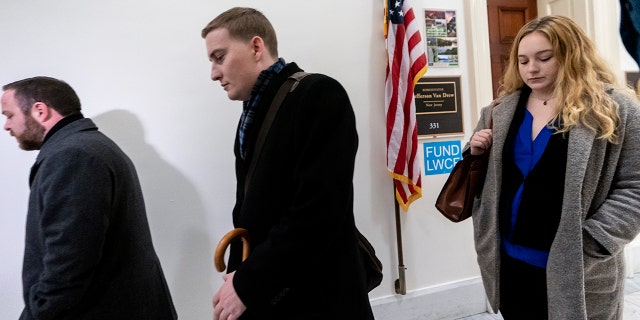
Deputy Chief of Staff Justin O'Leary, center, joins other top
aides to New Jersey Rep. Jeff Van Drew, a House Democrat who plans to
switch and become a Republican, as leave their office after turning in
their joint letter of resignation, on Capitol Hill in Washington,
Monday, Dec. 16, 2019. (Associated Press)
House Republican Leader Kevin McCarthy, who
reportedly has tried to convince Van Drew to join the GOP, said he has
sent some of his staffers to assist Van Drew temporarily as he deals
with the loss of personnel.
"We believe in helping people," McCarthy said, according to Roll Call.
The
Blue Dog Coalition told Fox News on Tuesday that it ousted the
congressman after reports he was considering switching political
parties.
“Per our by laws, which require all members to be a
member of the Democratic Party, Congressman Van Drew is no longer a
member of the Blue Dog Coalition,” Rep. Stephanie Murphy, D-Fla., and
co-chair of the Coalition, told Fox News.
Van Drew has been one of only two Democrats to vote against formalizing the impeachment inquiry against
President Trump and has been an outspoken critic of the probe from the
start. The House is expected to vote on two articles of impeachment on
Wednesday.
The freshman represents a southern New Jersey district
that Trump carried in 2016 and was expected to face a difficult
reelection next year.
He
has not formally announced that he is switching parties, but has
instead said: "People kind of know that I'm going in a direction, but I
haven’t announced anything."
A New Mexico state senator was reportedly convicted on misdemeanor aggravated drunken driving and reckless driving charges Tuesday -- nearly six months after he rear-ended a driver stopped at a red light in the state.
Sen.
Richard Martinez, a Democrat, failed a field sobriety test and injured
himself and the two people in the other car in the June crash. He also
refused to take a breathalyzer test, The Albuquerque Journal reported. ARIZONA LAWMAKER ARRESTED FOR DUI, REPORTEDLY TELLS OFFICER, 'YOU'LL GET YOURS'
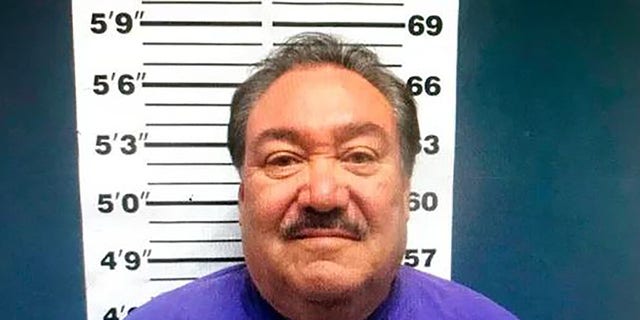
New Mexico state Sen. Richard Martinez, a Democrat, refused to
take a breathalyzer test after injuring himself and two people in
another car in a June DUI crash, authorities say.
(Española Police Department )
Martinez
has served in the state’s Senate since 2001 and previously said he would
not resign after his arrest. He pleaded not guilty to the charges.
After
his conviction, top Democrats in the state said they would recommend
asking him to leave as chairman of the Senate Judiciary Committee, but
Senate Majority Leader Peter Wirth and Senate President Pro Tem Mary Kay
Papen said they would let Martinez or voters decide his fate in the
Senate. They said they would deliver their recommendation next month.
“The
defendant made the choice to drink. Second, he made the choice to drive
impaired. Third, the consequences,” Mark Probasco, a special prosecutor
with the state attorney general’s office said, according to The
Journal. “No one is above the law, not even a senator — not even this
defendant."
"The defendant made the choice to drink.
Second, he made the choice to drive impaired. Third, the consequences.
No one is above the law, not even a senator — not even this defendant." — Mark Probasco, special prosecutor with New Mexico state attorney general’s office
Martinez
originally told officers he had only “a beer or two,” but later
admitted he had multiple glasses of wine. His attorney claimed the crash
was an accident and said he failed the sobriety test because he was
dazed from hitting the windshield.
The officer who arrested Martinez said the senator was slurring his speech and had alcohol on his breath.
He faces up to 180 days in jail as he goes up for reelection next year.
A former Republican state senator in New Mexico was defeated last year after she was convicted for DUI in 2018, The Journal reported. The Associated Press contributed to this report.
President Trump
on Wednesday will be far away from Capitol Hill -- and the Washington
establishment he has long criticized as an irredeemable "swamp" -- as
the Democrat-controlled House of Representatives prepares to impeach him in a likely party-line vote on charges of obstruction of Congress and abuse of power.
Instead, the president will be on friendly turf in downtown Battle Creek, Mich.,
hosting a rally that may rank among his most defiant -- a marked
contrast from the approach of former President Bill Clinton, who mostly
stayed under the radar during his own impeachment proceedings in 1998.
There
will be unusually tight security near the Capitol building in
Washington on Wednesday, Fox News was told, and some of those measures
were visible Tuesday night. House Democrats will convene to adopt the
rules for the impeachment debate shortly after 9 a.m. ET, followed by
six hours of debate evenly divided between Republicans and Democrats.
Some members will be afforded only one minute to speak, and no
amendments to the impeachment resolutions will be permitted.
The
final vote sequence will likely begin well into the evening hours, with
one vote held on each article of impeachment, Fox News was told.
The stage
was set late Tuesday night by the House Rules Committee, which approved
the procedures for Wednesday's impeachment proceedings in a 9-4
party-line vote after a marathon day of contentious hearings.
Wednesday "promises to be a long day," Rules Committee Chairman Jim McGovern, D-Mass., told reporters.
It
will likely end with Trump becoming just the third U.S. president ever
to be impeached -- a history-making development that Trump has said
reflects far worse on congressional Democrats than it does on him.
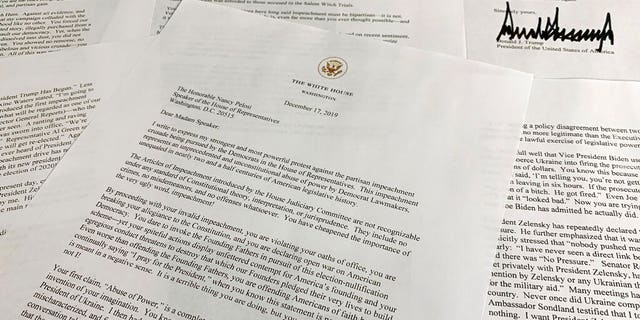
In a blistering, no-holds-barred six-page letter Tuesday to House Speaker Nancy Pelosi, D-Calif.,
Trump lambasted the Democrats' impeachment inquiry as an "open war on
American Democracy," writing that Pelosi has violated her oath of office
and "cheapened the importance of the very ugly word, impeachment!"
"Everyone,
you included, knows what is really happening," Trump said. "Your chosen
candidate lost the election in 2016, in an Electoral College landslide
(306-227), and you and your party have never recovered from this
defeat. So you have spent three straight years attempting to overturn
the will of the American people and nullify their votes. You view
democracy as your enemy!"
Conceding the House vote, Trump said he wanted to set his words down “for the purpose of history.”
"You
are the ones interfering in America's elections," Trump wrote. "You are
the ones subverting America's Democracy. You are the ones Obstructing
Justice. You are the ones bringing pain and suffering to our Republic
for your own selfish personal, political, and partisan gain." READ IT: TRUMP LETTER SAYS DEMOCRATS WANTED IMPEACHMENT FOR YEARS, CAN'T HANDLE 2016 ELECTION LOSS
A letter from President Trump to House Speaker Nancy Pelosi is
seen Tuesday, Dec. 17, 2019, in Washington. (Associated Press)
Trump specifically hammered Pelosi for daring "to
invoke the Founding Fathers in pursuit of this election-nullification
scheme," and "even worse," for "offending Americans of faith by
continually saying 'I pray for the President,' when you know this
statement is not true, unless it is meant in a negative sense."
"It is a terrible thing you are doing," Trump added, "but you will have to live with it, not I!"
Concerning
the obstruction-of-Congress impeachment count, Trump attacked Democrats
for "trying to impeach the duly elected President of the United States
for asserting Constitutionally based privileges that have been asserted
on a bipartisan basis by administrations of both political parties
throughout our nation's history."
And, regarding the abuse-of-power charge, Trump noted that it was former Vice President Joe Biden who had "bragged" on video about having Ukraine's
allegedly corrupt prosecutor fired by threatening to withhold $1
billion in critical U.S. aid. But, House Republicans have been barred by
Democrats from calling witnesses that would help them make the case
that Trump's concerns about Ukraine corruption were legitimate.
"More
due process was afforded to those accused in the Salem Witch trials,"
Trump wrote, observing that even Ukrainian President Volodymyr Zelensky
has repeatedly said at the United Nations that he felt no pressure from the White House to conduct political investigations in exchange for military aid.
"More due process was afforded to those accused in the Salem Witch trials." — President Trump, to House Speaker Nancy Pelosi
The
president argued that Democrats were trying to distract Americans from
the strong economy and historically low unemployment numbers, and
pointed out that Democrats have openly called for impeachment since the day he took office.
Michigan
Democratic Rep. Rashida Tlaib, Trump noted, announced that "We're going
to impeach the motherf---er" all the way back in January -- long before
Trump's mentioned Biden's possible corruption in a phone call with
Zelensky.
Democrats' persistent but unsubstantiated allegations
that the Trump campaign had conspired with Russians to influence the
2016 election, the president observed, ultimately "dissolved into dust,"
but not before the nation had to endure years of "turmoil and torment."
(Also on Tuesday, in a highly unusual public statement, the secretive
Foreign Intelligence Surveillance Court slammed the FBI for
its misleading warrant applications to surveil a former Trump aide
during the Russia probe, and demanded immediate corrective action.)
But
Pelosi, who warned earlier this year that impeachment would need to be
bipartisan, called Trump's letter "ridiculous." She reaffirmed that
Democrats would go ahead with impeachment, even though they lack any
Republican support in the House.
“Very sadly, the facts have made
clear that the President abused his power for his own personal,
political benefit and that he obstructed Congress,” Pelosi wrote to
colleagues. “In America, no one is above the law.”
One by one this
week, centrist Democratic lawmakers, including many first-term freshmen
who built the House majority and could risk their reelection in
districts where the president is popular, announced they would follow
Pelosi's lead and vote to impeach.
Polls have shown that Trump is now leading his top Democratic rivals, and that impeachment is actually helping Trump in key battleground states that might decide the 2020 election.
Nationally, a Fox News poll this week found that 50 percent of respondents want Trump impeached and removed from office, even as Trump's job approval ticked up.
Voters in swing districts have increasingly voiced their frustrations at heated town halls as their representatives have said they will support impeachment. Rep. Elissa Slotkin, D-Mich., who represents a district Trump won in 2016, pointedly ignored protesters as she backed impeachment at an event this week.
For
her part, Rep. Abby Finkenauer, D-Iowa, referred to the oath she took
in January as she was sworn into office as guiding her decision. She
announced support for both articles of impeachment to “honor my duty to
defend our Constitution and democracy from abuse of power at the highest
levels.”
One new Democratic congressman, Jared Golden of Maine,
said he would vote to impeach on abuse of power but not obstruction, in
an apparent effort to appease both sides on the issue.
And a
freshman Democrat, Jeff Van Drew of New Jersey, is indicating he will
switch parties to become a Republican after opposing impeachment.
Earlier this year, Michigan conservative Rep. Justin Amash left the GOP
when he favored impeachment. Amash is now an independent.
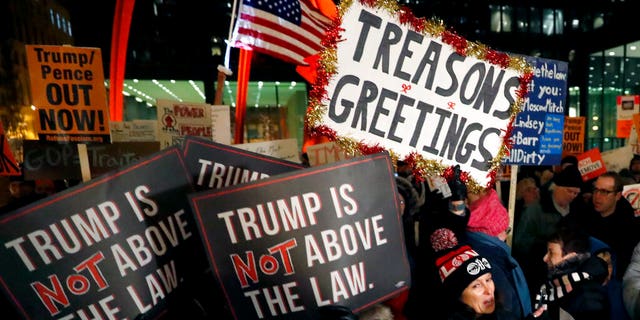
A crowd gathers on Federal Plaza for a protest against President
Trump on the eve of a scheduled vote by the U.S. House of
Representatives on the two articles of impeachment against the
president, Tuesday, Dec. 17, 2019, in Chicago. (Associated Press)
After Trump's likely impeachment by a majority vote in the House, attention will soon shift to the Senate, which,
under the Constitution, is required to hold a trial on the charges.
That trial is expected to begin in January, and a two-thirds vote would
be needed to convict Trump and remove him from office.
Senate
Majority Leader Mitch McConnell, R-Ky., has embraced the partisan nature
of impeachment, dropping pretenses of fairness -- such as those adopted
by Democrats, which he has characterized as superficial and
transparently phony, even as they refused GOP witness requests, called
numerous hearsay witnesses, and introduced articles of impeachment that
do not track any criminal statute.
“I'm not an impartial juror,”
McConnell declared, saying that Democrats' procedures in the House were
exclusively one-sided. The Republican-majority chamber is all but sure
to acquit the president; McConnell has announced
that he intends to spend Wednesday confirming new federal judges to
lifetime appointments every two hours while Democrats are debating and
voting on impeachment.
“Impeachment
is a political decision,” McConnell said. "The House made a partisan
political decision to impeach. I would anticipate we will have a largely
partisan outcome in the Senate. I’m not impartial about this at all.''
McConnell struck back Tuesday at his Democratic counterpart's calls for an in-depth impeachment trial featuring multiple new witnesses, dismissing the push as a "fishing expedition" that would set a "nightmarish precedent."
"The Senate is meant to act as judge and jury, to hear a trial,
not to re-run the entire fact-finding investigation because angry
partisans rushed sloppily through it,” he said on the Senate floor.
"The
Senate is meant to act as judge and jury, to hear a trial, not to
re-run the entire fact-finding investigation because angry partisans
rushed sloppily through it.” — Senate Majority Leader Mitch McConnell
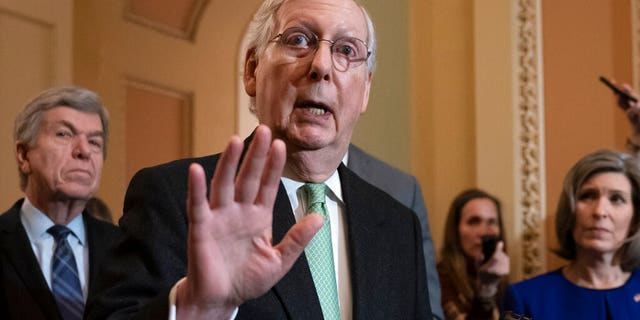
Senate Majority Leader Mitch McConnell, R-Ky., joined by Sen. Roy
Blunt, R-Mo., left, and Sen. Joni Ernst, R-Iowa, dismisses the
impeachment process against President Trump, saying, "I'm not an
impartial juror. This is a political process," as he meets with
reporters at the Capitol in Washington, Tuesday, Dec. 17, 2019.
(Associated Press)
In a Sunday letter, Senate Democratic Leader Chuck Schumer
had called for the chamber to subpoena new documents and call witnesses
who had been blocked by the White House during the impeachment inquiry
on the House side.
McConnell claimed that such investigative
steps, though, were part of the House role -- not a mission for the
Senate. He warned that entertaining Schumer’s proposal to do House
lawmakers’ “homework” could invite a string of future “dubious” and
“frivolous” impeachment inquiries.
He stressed the fact-finding
mission should have been completed during the impeachment inquiry led by
House Intelligence Committee Chairman Rep. Adam Schiff,
D-Calif. McConnell accused the House of doing a rush job, and said
Schumer is now looking "to make Chairman Schiff's sloppy work more
persuasive."
Even after voting to impeach Trump, the House still
would need to vote formally to send the impeachment articles to the
Senate. In 1998, the House approved the resolution to send the articles
to the Senate about 10 minutes after the House voted to impeach
then-President Bill Clinton. But, Democrats might delay sending the
articles to the GOP-held Senate this time around, in a bid to influence
the proceedings there.
Such
an unprecedented move, however, would likely only further inflame
Republicans and moderates who have already looked with skepticism on the
impeachment proceedings.
"The allegations against the President
are incredibly, incredibly serious," Virginia Democratic Rep. Abigail
Spanberger, who flipped a GOP seat in 2018, told constituents this week.
A constituent quickly retorted: "They're incredible bulls--t." Fox News' Chad Pergram, Adam Shaw, and The Associated Press contributed to this report.