MADISON,
Wis. (AP) — One of President Donald Trump’s top reelection advisers
told influential Republicans in swing state Wisconsin that the party has
“traditionally” relied on voter suppression to compete in battleground
states, according to an audio recording of a private event obtained by
The Associated Press. The adviser said later that his remarks referred
to frequent and false accusations that Republicans employ such tactics.
Justin
Clark, a senior political adviser and senior counsel to Trump’s
reelection campaign, made the remarks on Nov. 21 as part of a
wide-ranging discussion about strategies in the 2020 campaign, including
more aggressive use of Election Day monitoring of polling places.
“Traditionally
it’s always been Republicans suppressing votes in places,” Clark said
at the event. “Let’s start protecting our voters. We know where they
are. ... Let’s start playing offense a little bit. That’s what you’re
going to see in 2020. It’s going to be a much bigger program, a much
more aggressive program, a much better-funded program.”
Asked about the remarks by AP, Clark said he was referring to false accusations that the GOP engages in voter suppression.
“As
should be clear from the context of my remarks, my point was that
Republicans historically have been falsely accused of voter suppression
and that it is time we stood up to defend our own voters,” Clark said.
“Neither I nor anyone I know or work with would condone anyone’s vote
being threatened or diluted and our efforts will be focused on
preventing just that.”
Clark
made the comments Nov. 21 in a meeting of the Republican National
Lawyers Association’s Wisconsin chapter. Attendees included the state
Senate’s top Republican, Scott Fitzgerald, along with the executive
director of the Wisconsin Republican Party.
Audio
of the event at a country club in Madison obtained by the liberal group
American Bridge was provided to AP by One Wisconsin Now, a
Madison-based liberal advocacy group.
The
roughly 20-minute audio offers an insider’s glimpse of Trump’s
reelection strategy, showing the campaign focusing on voting locations
in Wisconsin, Michigan and Pennsylvania, which form the the so-called
“blue wall” of traditional Democratic strength that Trump broke through
to win in 2016. Both parties are pouring millions of dollars into the
states, anticipating they’ll be just as critical in the 2020
presidential contest.
Republican
officials publicly signaled plans to step up their Election Day
monitoring after a judge in 2018 lifted a consent decree in place since
1982 that barred the Republican National Committee from voter
verification and other “ballot security” efforts. Critics have argued
the tactics amount to voter intimidation.
The
consent decree was put in place after the Democratic National Committee
sued its Republican counterpart, alleging the RNC helped intimidate
black voters in New Jersey’s election for governor. The federal lawsuit
claimed the RNC and the state GOP had off-duty police stand at polling
places in urban areas wearing armbands that read “National Ballot
Security Task Force,” with guns visible on some.
Without
acknowledging any wrongdoing, the RNC agreed to the consent decree,
which restricted its ability to engage in activities related to ballot
security. Lifting of the consent decree allows the RNC to “play by the
same rules” as Democrats, said RNC communications director Michael
Ahrens.
“Now
the RNC can work more closely with state parties and campaigns to do
what we do best, ensure that more people vote through our unmatched
field program,” Ahrens said.
Although
the consent decree forced the Trump campaign to conduct its own poll
monitoring in 2016, the new rules will allow the RNC to use its
multi-million dollar budget to handle those tasks and coordinate with
other Republican groups on Election Day, Clark said.State directors of
election day operations will be in place in Wisconsin and every
battleground state by early 2020, he said.
In 2016, Wisconsin had 62 paid Trump staff working to get out the vote; in 2020, it will increase to around 100, Clark said.
Trump supports the effort, he said in the audio recording.
“We’ve
all seen the tweets about voter fraud, blah, blah, blah,” Clark said.
“Every time we’re in with him, he asks what are we doing about voter
fraud? What are we doing about voter fraud?’ The point is he’s committed
to this, he believes in it and he will do whatever it takes to make
sure it’s successful.”
Clark
said Trump’s campaign plans to focus on rural areas around mid-size
cities like Eau Claire and Green Bay, areas he says where Democrats
“cheat.” He did not explain what he meant by cheating and did not
provide any examples.
“Cheating
doesn’t just happen when you lose a county,” Clark said. “Cheating
happens at the margin overall. What we’re going to be able to do, if we
can recruit the bodies to do it, is focus on these places. That’s where
our voters are.”
There is no evidence of widespread voter fraud in Wisconsin.
“If
there’s bad behavior on the part of one side or the other to prevent
people from voting, this is bad for our democracy,” Wisconsin Democratic
Gov. Tony Evers said in reaction to Clark’s comments. “And frankly, I
think will whoever does that, it will work to their disadvantage. It
will make them look, frankly, stupid.”
Wisconsin’s
attorney general, Democrat Josh Kaul, represented the Democratic
National Committee in a 2016 New Jersey lawsuit that argued the GOP was
coordinating with Trump to intimidate voters. Kaul argued then that
Trump’s campaign “repeatedly encouraged his supporters to engage in
vigilante efforts” in the guise of ferreting out potential voter fraud.
The Republican Party disputed any coordination.
“It
is vital that Wisconsinites have free and fair access to the polls, and
that we protect the security and integrity of our elections,” Kaul said
in a statement in reaction to Clark’s comments. “The Wisconsin
Department of Justice has been and will continue working with other
agencies to protect our democratic process.”
Mike
Browne, deputy director of One Wisconsin Now, said Clark’s comments
suggest the Trump campaign plans to engage in “underhanded tactics” to
win the election.
“The
strategy to rig the rules in elections and give themselves an unfair
partisan advantage goes to Donald Trump, the highest levels of his
campaign and the top Republican leadership,” Browne said. “It’s clear
there’s no law Donald Trump and his right-wing machine won’t bend, break
or ignore to try to win the presidency.”
WASHINGTON
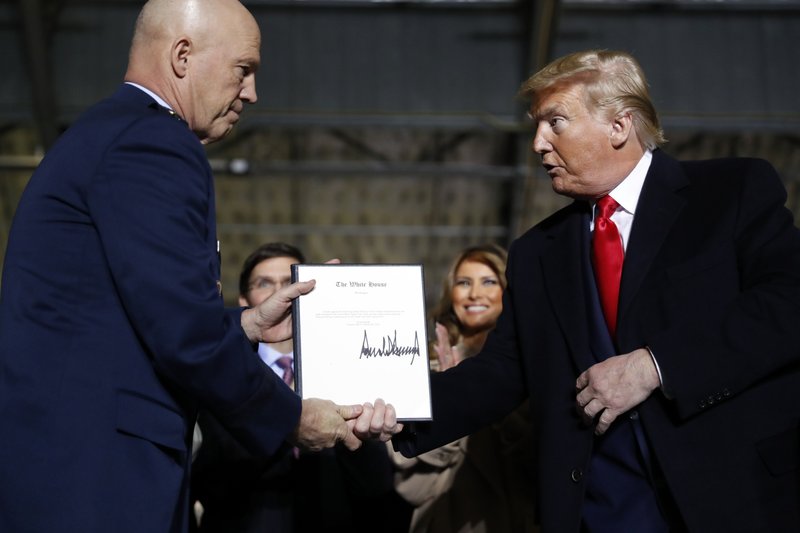
(AP) — President Donald Trump on Friday celebrated the launch of Space
Force, the first new military service in more than 70 years.
In
signing the 2020 National Defense Authorization Act that includes Space
Force, Trump claimed a victory for one of his top national security
priorities just two days after being impeached by the House.
It is part of a $1.4 trillion government spending package
— including the Pentagon’s budget — that provides a steady stream of
financing for Trump’s U.S.-Mexico border fence and reverses unpopular
and unworkable automatic spending cuts to defense and domestic programs.
“Space
is the world’s new war-fighting domain,” Trump said Friday during a
signing ceremony at Joint Base Andrews just outside Washington. “Among
grave threats to our national security, American superiority in space is
absolutely vital. And we’re leading, but we’re not leading by enough,
and very shortly we’ll be leading by a lot.”
Later
Friday, as he flew to his Florida resort aboard Air Force One, Trump
signed legislation that will keep the entire government funded through
Sept. 30.
Space
Force has been a reliable applause line at Trump’s political rallies,
but for the military it’s seen more soberly as an affirmation of the
need to more effectively organize for the defense of U.S. interests in
space — especially satellites used for navigation and communication.
Space Force is not designed or intended to put combat troops in space.
Defense
Secretary Mark Esper told reporters Friday, “Our reliance on
space-based capabilities has grown dramatically, and today outer space
has evolved into a warfighting domain of its own.” Maintaining dominance
in space, he said, will now be Space Force’s mission.
Space
has become increasingly important to the U.S. economy and to everyday
life. The Global Positioning System, for example, provides navigation
services to the military as well as civilians. Its constellation of
about two dozen orbiting satellites is operated by the 50th Space Wing
from an operations center at Schriever Air Force Base in Colorado.
In a report last February, the Pentagon asserted that China and Russia
have embarked on major efforts to develop technologies that could allow
them to disrupt or destroy American and allied satellites in a crisis
or conflict.
“The United States faces serious and growing challenges to its freedom to operate in space,” the report said.
When
he publicly directed the Pentagon in June 2018 to begin working toward a
Space Force, Trump spoke of the military space mission as part of a
broader vision of achieving American dominance in space.
Trump got his Space Force, which many Democrats opposed. But it is not in the “separate but equal” design he wanted.
Instead
of being its own military department, like the Navy, Army and Air
Force, the Space Force will be administered by the Secretary of the Air
Force. The law requires that the four-star general who will lead Space
Force, with the title of Chief of Space Operations, will be a member of
the Joint Chiefs of Staff, but not in Space Force’s first year. Trump
said its leader will be Air Force Gen. John W. Raymond, the commander of
U.S. Space Command.
Space
Force is the first new military service since the Air Force was spun
off from the Army in 1947. Space Force will be the provider of forces to
U.S. Space Command, a separate organization established earlier this
year as the overseer of the military’s space operations.
The division of responsibilities and assets between Space Force and Space Command has not been fully worked out.
Space
Force will be tiny, compared to its sister services. It will initially
have about 200 people and a first-year budget of $40 million. The
military’s largest service, the Army, has about 480,000 active-duty
soldiers and a budget of about $181 billion. The Pentagon spends about
$14 billion a year on space operations, most of which is in the Air
Force budget.
Kaitlyn
Johnson, a space policy expert at the Center for Strategic and
International Studies, sees the creation of Space Force as an important
move but doubts it will prove as momentous as Trump administration
officials suggest. Vice President Mike Pence has touted Space Force as
“the next great chapter in the history of our armed forces.” And Esper
earlier this week called this an “epic moment” in recent American
military history.
Johnson
says Democrats’ opposition to making Space Force a separate branch of
the military means it could be curtailed or even dissolved if a Democrat
wins the White House next November.
“I
think that’s a legitimate concern” for Space Force advocates, she said.
“Just because it’s written into law doesn’t mean it can’t be
unwritten,” she said, adding, “Because of the politics that have started
to surround the Space Force, I worry that that could damage its impact
before it even has time to sort itself out” within the wider military
bureaucracy.
Some
in Congress had been advocating for a Space Force before Trump entered
the White House, but his push for legislation gave the proposal greater
momentum.
Trump’s
first defense secretary, Jim Mattis, was initially cool to the idea,
arguing against adding new layers of potentially expensive bureaucracy.
Mattis’ successor, Esper, has been supportive of Space Force. In
September he said it will “allow us to develop a cadre of warriors who
are appropriately organized, trained and equipped to deter aggression
and, if necessary, to fight and win in space.” He added, “The next big
fight may very well start in space, and the United States military must
be ready.”
WASHINGTON
(AP) — President Donald Trump is in sunny Florida after his historic
impeachment, while plans for his speedy trial back in Washington
remained clouded. Senate leaders jockeying for leverage have failed to
agree on procedures for the trial.
Trump
is still expected to be acquitted of both charges in the Senate, where
Republicans have the majority, in what will be only the third
presidential impeachment trial in U.S. history. Proceedings are expected
to begin in January.
But
the impasse between Senate Majority Leader Mitch McConnell and
Democratic Leader Chuck Schumer over whether there will be new witnesses
and testimony — along with House Speaker Nancy Pelosi’s refusal so far
to send the articles of impeachment to the Senate — have left the
situation unresolved.
“Nancy
Pelosi is looking for a Quid Pro Quo with the Senate. Why aren’t we
Impeaching her?” Trump tweeted, mocking one of the accusations against
him before heading out for a two-week stay at his Mar-a-Lago resort for
the holidays.
McConnell,
Trump’s most powerful GOP ally in the Senate, welcomed the president’s
emerging defense team Friday for a walk-through of the Senate chamber.
White House counsel Pat Cipollone and legislative affairs director Eric
Ueland came to Capitol Hill to assess logistics.
A
six-term veteran of the Senate, McConnell is acting very much though he
has the votes to ensure a trial uncluttered by witnesses — despite the
protests of top Democrats Pelosi and Schumer.
“We
have this fascinating situation where, following House Democrats’ rush
to impeachment, following weeks of pronouncements about the urgency of
this situation, the prosecutors have now developed cold feet,”
McConnell, R-Ky., said late Thursday as senators left town for the year.
“We’ll
continue to see how this develops, and whether the House Democrats ever
work up the courage to take their accusations to trial.”
McConnell
has all but promised an easy acquittal of the president. He appears to
have united Republicans behind an approach that would begin the trial
with presentations and arguments, lasting perhaps two weeks, before he
tries drawing the proceedings to a close. The Senate will reconvene Jan.
3.
That has
sparked a fight with Pelosi and Schumer, who are demanding trial
witnesses who refused to appear during House committee hearings,
including acting White House Chief of Staff Mick Mulvaney and former
national security adviser John Bolton.
“They
should have witnesses and documentation,” Pelosi told The Associated
Press. “This could be something very beneficial to the country, if the
facts are there.”
Schumer’s
leverage is limited, though his party can force votes on witnesses once
a trial begins. He appears to be counting on public opinion, and
political pressure on vulnerable Republican incumbents like Susan
Collins of Maine, to give Democrats the 51 votes they need.
“You
wouldn’t get them to say, ‘I’m going to vote to kick President Trump
out of office,’” Schumer said in an interview. “But you might get them
to vote for witnesses, you might get them to vote for documents, and
we’ll see where it falls from there.”
McConnell
isn’t budging. After a 20-minute meeting with Schumer on Thursday, he
declared the talks at an impasse and instructed senators to return on
Jan. 6 ready to vote.
McConnell
appears ready to impose a framework drawn from the 1999 trial of Bill
Clinton, who was acquitted of two articles of impeachment. That trial
featured a 100-0 vote on arrangements that established two weeks of
presentations and argument before a partisan tally in which Republicans
called a limited number of witnesses, including Monica Lewinsky for a
videotaped deposition.
McConnell
said Thursday: “I continue to believe that the unanimous bipartisan
precedent that was good enough for President Clinton ought to be good
enough for this president, too. Fair is fair.”
There’s
a risk that Schumer’s protests — which started Sunday with a letter to
McConnell requesting four witnesses — could cement GOP unity. Endangered
Republican senators including Cory Gardner of Colorado and Martha
McSally of Arizona need strong turnout by the GOP base to win, and will
be hard-pressed to take Schumer’s side.
Trump,
meanwhile, has been hoping the trial will serve as an opportunity for
vindication. He continues to talk about parading his own witnesses to
the chamber, including former Vice President and 2020 Democratic
candidate Joe Biden and House Intelligence Committee Chairman Adam
Schiff, D-Calif., who led the fact-finding phase of the impeachment
investigation.
A former FBI analyst
was sentenced to seven days in jail Friday after admitting he illegally
accessed an email address belonging to a right-wing Washington lobbyist
as part of his efforts to expose an alleged smear campaign against Special Counsel Robert Mueller.
The
former FBI analyst -- Mark Tolson, 60, -- pleaded guilty in a federal
court in Alexandria, Va., in September to a misdemeanor charge of
computer fraud and abuse, according to Politico.
Tolson said, with help from his wife Sarah Gilbert Fox, he accessed an email account belonging to GOP lobbyist Jack Burkman, photographed “emails of interest,” and tried to hand them over both to the FBI and the press, The Washington Post
reported. Fox had worked for Burkman from October 2017 to summer 2018
and had his email password, authorities said. She was not charged.
Tolson
reportedly told a federal judge that he accessed the emails without
permission in October 2018 after Burkman announced a press conference
where he was going to accuse Mueller of sexual assault. The special
counsel was investigating Russian meddling and potential collusion with
Trump campaign associates during the 2016 presidential election at the
time.
Tolson said he accessed Burkman’s email in an attempt to
prove he paid women to fabricate the allegations, reports said. The
press conference was never held. Also in October 2018, the special
counsel's office notified the FBI of an alleged scheme accusing Burkman
of offering women money to make false allegations against
Mueller. Burkman-- identified in court papers as J.B.-- denied giving
anyone money for testimony, the Post reported.
Tolson
was also ordered to pay a $500 fine and serve 50 hours of community
service. The judge said he could begin his week-long jail sentence after
the holidays, Politico reported. Fox News’ Brooke Singman and Alex Pappas contributed to this report.
WASHINGTON
(AP) — Congress has headed home for the holidays leaving plans and a
possible timeline for President Donald Trump’s impeachment trial in
disarray.
Democratic
House Speaker Nancy Pelosi insisted Thursday that Senate Republicans
must provide details on witnesses and testimony before she would send
over the charges for Trump’s trial. No deal, replied Senate Majority
Leader Mitch McConnell after meeting with his Senate Democratic
counterpart.
“We remain at an impasse,” he said.
As
darkness fell and lawmakers prepared to depart for the year, McConnell
wondered from the Senate floor why in the world the Republicans should
give ground to persuade House Democrats “to send us something we do not
want.”
McConnell
and the Democrats’ Senate leader, Chuck Schumer of New York, met for
about 20 minutes in their first attempt to negotiate the contours of an
agreement on running the rare Senate impeachment trial that was expected
to start in January.
McConnell
favors a swift trial, without the new witnesses Democrats want, and he
holds a clear tactical advantage if he can keep his 53-member Senate
majority united. Schumer, who also met privately with Pelosi, has to bet
that GOP senators won’t hold the line and Republicans will peel away as
public pressure mounts for a fuller trial.
For the record, Sen. Lindsey Graham of South Carolina said he had met with Trump and “he is demanding his day in court.”
McConnell,
who has drawn criticism for saying he won’t be an impartial juror, said
the Democrats were “too afraid″ to send the charges to the Senate,
where Trump would be expected to be acquitted by the Republican
majority.
We’ll see, he said, “whether the House Democrats ever work up the courage to take their accusations to trial.”
Pelosi
said that McConnell “says it’s OK for the foreman of the jury to be in
cahoots with the lawyers of the accused. That doesn’t sound right to
us.”
Dismissing
the idea that Democrats would hold off the proceeding indefinitely to
prevent Trump from being acquitted, Schumer said there will almost
certainly be a trial.
“There’s an obligation under the Constitution to have a trial,” Schumer told The Associated Press.
He
noted that even the Democratic senators campaigning for the party’s
presidential nomination, with early state voting starting in February,
are prepared to return to Washington to sit for the days-long
proceedings. “The Constitution requires it,” he said.
Wednesday
night’s House vote, almost entirely along party lines, made the
president just the third in U.S. history to be impeached. The House impeached Trump
on two charges — abusing his presidential power and obstructing
Congress — stemming from his pressure on Ukraine to announce
investigations of his political rival as Trump withheld U.S. aid.
Pelosi’s
procedural delay in taking the next step — apparently in search of
leverage with Senate Republicans in locking in trial arrangements —
threw a wrench into the expected timing.
“So
far we haven’t seen anything that looks fair to us,” she had said
Wednesday night. On Thursday at the Capitol, she said, “We’d like to see
a fair process, but we’ll see what they have and will be ready for
whatever it is.”
Trump mocked on Twitter: “Now the Do Nothing Party want to Do Nothing with the Articles.”
Both parties said public opinion was with them after the House impeachment vote.
Trump claimed polling showed him leading all potential Democratic opponents for next fall’s election.
Pelosi
said, “We’ve been hearing from people all over the country. Seems like
people have a spring in their step because the president was held
accountable for his reckless behavior.”
With
elections in mind, Trump welcomed Democratic Rep. Jeff Van Drew into
the GOP after the New Jersey freshman said he would be changing parties
because he opposed impeachment.
Pelosi,
pressed about next steps for impeachment, wouldn’t say. She and her
Democrats are insisting on more witnesses, testimony and documents than
McConnell appears willing to provide before they name the House
“managers” who would prosecute Trump in the Senate.
“The
next thing will be when we see the process that is set forth in the
Senate,” Pelosi said. “Then we’ll know the number of managers we may
have to go forward and who we would choose.”
Not yet.
On
the Senate floor, McConnell described the House actions against Trump
as “the most rushed, least thorough and most unfair impeachment inquiry
in modern history.”
Fighting
back using McConnell’s own words, Schumer said the Republican leader
was plotting the “most rushed, least thorough and most unfair”
impeachment trial in history by declining to agree to call witnesses,
including former Trump national security adviser John Bolton, who
declined to testify before the House.
“McConnell
claimed the impeachment was motivated by partisan rage,” said Schumer.
“This from the man who said proudly, ‘I am not impartial.’
“What hypocrisy.”
___
Associated Press writers Alan Fram and Lisa Mascaro contributed to this report.
Sen. Bernie Sanders sparked a range of responses on social media after Thursday night's Democratic presidential debate in Los Angeles with a comment he made as a moderator was asking him about recent comments by former President Barack Obama.
“Senator Sanders, you are the oldest candidate onstage … ” Politico magazine’s Tim Alberta began.
"And I’m white as well," the 78-year-old Sanders interjected before Alberta could finish.
"Yes,"
Alberta replied, amid what seemed like an awkward silence at Loyola
Marymount University. Alberta then continued with his question.
“How do you respond to what the former president had to say?”
Alberta had asked Sanders to respond to comments Obama made in Singapore earlier in the week.
“Former
President Obama said this week when asked who should be running
countries that if women were in charge you’d see a significant
improvement on just about everything,” Alberta pointed out. “He also
said, ‘If you look at the world and look at the problems, it’s usually
old people, usually old men not getting out of the way.'”
Sanders
responded: “I got a lot of respect for Barack Obama. I think I disagree
with him on this one," prompting some audible laughter from the
audience. “Maybe a little self-serving, but I do disagree.”
He then said the U.S. was becoming an "oligarchy" with an economy that serves only the "one percent."
“Here
is the issue. The issue is where power resides in America. And it’s not
white or black or male or female. We are living in a nation
increasingly becoming an oligarchy. We have a handful of billionaires
who spend hundreds of millions of dollars buying elections and
politicians.
“You have more income and wealth inequality today
than at any time since the 1920s. We are the only major country on Earth
not to guarantee health care for all people, which is why we need
Medicare-for-all. We are facing an existential crisis of climate change…
“The
issue is not old or young or male or female,” Sanders continued. “The
issue is working people standing up. Taking on the billionaire class.
And creating a government and an economy that works for all. Not just
the one percent.”
But some critics on social media fired back at
Sanders, saying his age, gender and race were all factors that helped
him become wealthy.
“But @BernieSanders would like us to believe
that being a White male doesn't give him and his ilk any systemic
advantages,” one Twitter user wrote.
Others accused Sanders of being a hypocrite -- given he criticizes the rich but reportedly owns three homes.
Several
pointed to what they described as “awkward silence” and “crickets” in
the crowd after Sanders’ “I’m white as well,” quip failed to resonate.
But mostly people online seemed unsure what the comment meant. Some
asked Sanders to explain what he was trying to say while others had
their own interpretations.
“Does this count as "White Supremacy" ???” one user wrote, tagging Sanders and Obama.
Another user asked: “Can you elaborate as to that response?”
“Oof! "And I'm White As Well" is not the bumper sticker Bernie Sanders needs,” a third chimed in.
One user seemed to defend Sanders, saying that being a white man was now considered "political baggage."
"Of
course white men have privilege. But in today's environment, it's
political baggage as well. It was a question about diversity and on that
page, all that goes against Sanders. It was a self deprecating moment,"
she wrote.
One person applauded the remark, saying Sanders was acknowledging his own “white privilege.”
“Bernie
Sanders, so far, is the only white candidate to say this tonight and
recognize white privilege. I think that's worth something,” Charlotte
Clymer wrote.
Another
user said Sanders' remark was "his middle finger to the gender and
racial purity test of the left. Basically saying, stop getting (fake)
distracted on what gender or race I am and listen to what I have to
say."
The debate came a day after a highly contentious vote to
impeach President Donald Trump, which showed in dramatic relief how
polarized the nation is over his presidency. With the
Republican-controlled Senate likely to acquit him, the stakes are high
for Democrats to select a challenger who can defeat Trump in November.
The
forum highlighted the choice Democrats will have to make between
progressive and moderate, older and younger, men and women and the
issues that will sway the small but critical segment of voters who will
determine the election. The candidates sharply disagreed about the role
of money in politics, the value and meaning of experience and the
direction of the American health care system The Associated Press contributed to this report.
Long-simmering tensions boiled over at Thursday night's 2020 Democratic presidential primary debate in Los Angeles, as a blunt one-on-one sparring match erupted between Pete Buttigieg and Elizabeth Warren over their fundraising -- just minutes after businessman Andrew Yang slammed Democrats' "obsession" with President Trump and impeachment.
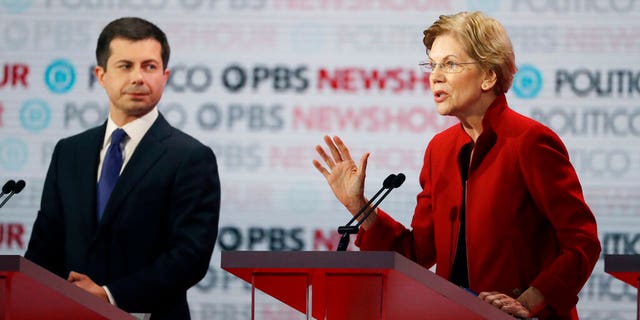
Warren, a U.S. senator from Massachusetts, began the fiery exchange by criticizing Buttigieg's recent lavish fundraiser
in Napa, Calif., saying he was cavorting with "billionaires in wine
caves" -- prompting Buttigieg to retort that Warren, a
multimillionaire, was a populist in name only.
"You know,
according to Forbes magazine, I'm literally the only person on this
stage who is not a millionaire or billionaire," Buttigieg, the mayor of
South Bend, Ind., said. "This is the problem with issuing purity tests
you yourself cannot pass." BIDEN SAYS 'YES' WHEN ASKED ABOUT SACRIFICING BLUE-COLLAR JOBS FOR CLEAN ENERGY
Democrats,
Buttigieg argued, are "in the fight" of their "lives," and need all the
support they can get -- whether from the wealthy or otherwise. He added
that he'd gladly accept a donation from Warren if she were to offer
one.
"We shouldn't try to [defeat Trump] with one hand tied behind our back," Buttigieg said.
Sen. Bernie Sanders,
I-Vt., then dismissively referred to Butitigeg as an "energetic guy,"
sarcastically saying he could "take on" former Vice President Joe Biden's
corporate connections as the two secretly courted big-money donors,
drawing jeers. Sanders noted that Biden has 44 billionaire contributors,
while Buttigieg was "trailing" with only 39.
Sen. Amy Klobuchar of Minnesota then interjected: "I did not come here to listen to this argument. ... I have never even been to a wine cave."
"I did not come here to listen to this argument. ... I have never even been to a wine cave." — Sen. Amy Klobuchar, D-Minn.
She went on to say she wanted the Supreme Court's
Citizens United decision overturned by constitutional amendment. The
2010 decision declared unconstitutional the federal regulation of
campaign expenditures by corporations and unions in connection with
campaigns.
It was just one of several Klobuchar moments during the
debate that resonated in the debate hall at Loyola Marymount University
-- even as conservative commentators winced.
"The
'moderate' Klobuchar just advocated for a constitutional amendment that
would give government control over free political speech," the Wall
Street Journal's Kimberly Strassel wrote on Twitter. "This is
'moderation' in today's Democratic Party."
Separately, Klobuchar
unloaded on Buttigieg, after he remarked: "If you want to talk about the
capacity to win, try putting together a coalition to bring you back to
office with 80 percent of the vote as a gay dude in Mike Pence's Indiana."
Klobuchar
shot back: “If you had won in Indiana, that would be one thing. You
tried and you lost by 20 points.” That was an unsparing reference to
Buttigieg's failed bid to become Indiana state treasurer.
She
also remarked, "When we were in the last debate, mayor, you basically
mocked the 100 years of experience on the stage. ... You should respect
our experience."
The spat over fundraising erupted shortly
after Yang threw cold water on the media's "obsession" with impeachment,
saying Americans become frustrated "the more we act like Donald Trump
is the cause of all our problems."
Iowa caucuses near
It
was a heated beginning to a wide-ranging debate with less than seven
weeks to go until Iowa’s caucuses kick off, and just a day after House
Democrats voted to impeach Trump.
The winnowed field of seven Democratic presidential contenders was on
the debate stage for a sixth and final time in 2019.
"If you
turned on cable network news today, you would think [Trump's] our
president because of some combination of Russia, racism, Facebook,
Hillary Clinton and emails all mixed together," Yang said. "But
Americans around the country know different. We blasted away 4 million
manufacturing jobs that were primarily based in Ohio, Michigan,
Pennsylvania, Wisconsin, Missouri."
He added, to applause: "What
we have to do, is we have to stop being obsessed over impeachment ...
and start actually digging in and solving the problems that got Donald
Trump elected in the first place."
"What we have to
do, is we have to stop being obsessed over impeachment ... and start
actually digging in and solving the problems that got Donald Trump
elected in the first place." — Andrew Yang
(At
the end of the debate, Yang sounded a note of self-deprecation: "I know
what you're thinking, America. How am I still on the stage with them?")
But, other Democrats largely echoed their previous attacks on the president's dealings with Ukraine, and his assertions of executive privilege to block administration officials from testifying.
“The
president is not king in America,” said Klobuchar, who is preparing to
serve as a juror as Trump's impeachment shifts from the House to a
Senate trial. Alluding to President Richard Nixon, she added, "If the
president claims that he is so innocent, then why doesn't he have all
the president's men testify?" MCCONNELL HEADS BACK TO SENATE FLOOR LATE THURSDAY, SAYS DEMS BREAKING PRECEDENT, NOT SURE WHAT THEY'RE DOING
Klobuchar
went on to call Trump's actions a "global Watergate." Democrats'
inference that Trump is guilty because he does not voluntarily permit
his deputies to testify has rankled Republicans, who assert the importance of the presumption of innocence.
Biden then knocked Trump's argument that less than half of Americans support his removal from office.
“He's
dumbing down the presidency beyond what I even thought he would do,”
Biden said. “We need to restore the integrity of the presidency.”
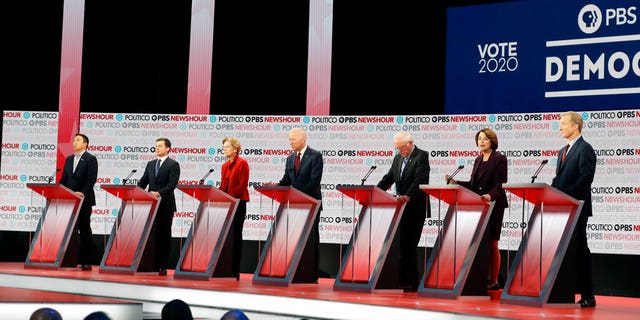
Democratic presidential candidates from left, entrepreneur Andrew
Yang, South Bend Mayor Pete Buttigieg, Sen. Elizabeth Warren, D-Mass.,
former Vice President Joe Biden, Sen. Bernie Sanders, I-Vt., Sen. Amy
Klobuchar, D-Minn., and businessman Tom Steyer stand on stage during a
Democratic presidential primary debate Thursday, Dec. 19, 2019, in Los
Angeles. (Associated Press)
Later, Democrats largely defended Trump's breakthrough U.S.-Mexico-Canada Agreement, which the House passed hours earlier.
However,
candidates railed against Trump's economy, despite multiple indicators
that the economy is doing well. The U.S. unemployment rate stands at a
half-century low of 3.5 percent, backed by consistently strong job gains
in recent months that have largely squelched fears of a recession that
had taken hold over the summer.
“This economy is not working for most of us," Buttigieg said.
"The middle class is getting killed,” Biden added. He said the economy was not "on kilter."
In response to a question as to whether he would commit to running for a second term if elected, amid a Politico report that
he has privately said he would retire after four years in the White
House, the 77-year-old Biden announced that he would not -- saying his
focus is on winning a first term.
When a moderator told the
70-year-old Warren she would be the oldest president ever elected upon
her inauguration, she retorted that she would also be the youngest woman
ever elected to the presidency, drawing applause.
Thursday night's televised contest, sponsored by PBS NewsHour and Politico, brought seven rivals to heavily Democratic California, the biggest prize in the primary season and home to 1 in 8 Americans.
Declining viewership
The
debate could turn out to be the least-watched so far, as the holidays
approach and impeachment drama dominates the news. Viewership has
declined in each round though five debates, and even campaigns have
grumbled that the candidates would rather be on the ground in early
voting states than again taking the debate stage.
Republicans have slammed
House Democrats' plan to delay a Senate trial. Hours before the debate,
Noah Feldman, the Harvard Law School professor who testified for
Democrats at the impeachment inquiry earlier this month, wrote an explosive op-ed asserting
that if Democrats do not forward the impeachment articles to the Senate
as dictated by the Constitution, then Trump was never even impeached at
all. The Constitution dictates that after impeachment by a majority in
the House, a two-thirds vote is needed in the Senate to remove a
president from office.
Asked why polls show
that many Americans oppose impeaching and removing Trump, Biden called
impeachment a "constitutional necessity," regardless of what the numbers
show.
Warren, for her part, accused Trump of corruption, without addressing the popularity of impeachment.
Klobuchar
also suggested that the U.S. would "probably" need to relocate
Americans away from places impacted by climate change, including
possibly Miami.
Yang, meanwhile, advanced the idea of using thorium to help address the nation's energy needs.
Democratic presidential candidate Sen. Elizabeth Warren, D-Mass.,
right, speaks as South Bend Mayor Pete Buttigieg listens during a
Democratic presidential primary debate Thursday, Dec. 19, 2019, in Los
Angeles. (Associated Press)
No clear front-runner
The
lack of a clear front-runner in the Democratic field came as Democrats
complained that there would be a notable lack of diversity onstage
Thursday as compared to earlier debates. For the first time this cycle,
the debate didn't feature a black or Latino candidate.
The race in
California has largely mirrored national trends, with Biden, Sanders
and Warren clustered at the top of the field, followed by Buttigieg,
Klobuchar, Yang and billionaire philanthropist Tom Steyer.
Conspicuously missing from Thursday's lineup was former New York City Mayor Michael Bloomberg,
a billionaire who is unable to qualify for the contests because he is
not accepting campaign donations. But even if he's not on the podium,
Bloomberg has been felt in the state: He's running a deluge of TV
advertising in California to introduce himself to voters who probably
know little, if anything, about him.
Bloomberg's late entry into
the contest last month highlighted the overriding issue in the contest
-- electability, a sign of the unease within the Democratic Party about
its crop of candidates and whether any is strong enough to unseat an
incumbent president. The eventual nominee will be tasked with splicing
together the party's disparate factions — a job Hillary Clinton struggled with after defeating Sanders in a long and bitter primary fight in 2016. DEBATE IS ON: DEAL REACHED IN UNION DISPUTE THAT THREATENED TO SIDETRACK SHOWDOWN
Biden adviser Symone Sanders said to expect another robust exchange on health care.
“This
is an issue that is not going away and for good reason, because it is
an issue that in 2018 Democrats ran on and won," she said.
Jess
O'Connell with Buttigieg's campaign said the candidate will “be fully
prepared to have an open and honest conversation about where there are
contrasts between us and the other candidates. This is a really
important time to start to do that. Voters need time to understand the
distinctions between these candidates.” The key issues: health care and higher education.
The
unsettled race has seen surges at various points by Biden, Warren,
Sanders and Buttigieg, though it's become defined by that cluster of
shifting leaders, with others struggling for momentum. Sen. Kamala
Harris of California, once seen as among the top tier of candidates,
shelved her campaign this month, citing a lack of money. And Warren has
become more aggressive, especially toward Buttigieg, as she tries to
recover from shifting explanations of how she’d pay for “Medicare for
All” without raising taxes.
In a replay of 2016, the shifting race
for the Democratic nomination has showcased the rift between the
party's liberal wing, represented by Sanders and Warren, and candidates
parked in or near the political center, including Biden, Buttigieg and
Bloomberg.
Two candidates who didn’t make the stage will still
make their presence felt for debate watchers with ads reminding viewers
they’re still in the race. APPELLATE COURT DEMANDS HOUSE DEMS EXPLAIN WHETHER IMPEACHMENT VOTE RENDERS THEIR LEGAL CASE 'MOOT'
Sen.
Cory Booker of New Jersey and former Housing Secretary Julián Castro
aired television ads targeted to primary voters during the debate.
Booker’s was his first television ad, and in it he said even though he
wasn't on the debate stage, “I’m going to win this election anyway.” It
aired as part of a $500,000 campaign, running in Iowa, New Hampshire,
Nevada and South Carolina, as well as New York, Washington, D.C., and
Los Angeles.
A pro-Booker super PAC is also going up with an ad in Iowa highlighting positive reviews of Booker’s past debate performances.
Meanwhile,
Castro is running an ad, in Iowa, in which he argues the state should
no longer go first in Democrats’ nominating process because it doesn’t
reflect the diversity of the Democratic Party.
Both candidates
failed to hit the polling threshold to qualify for the debates and have
in recent weeks become outspoken critics of what they say is a debate
qualification process that favors white candidates over minorities. Fox News' Paul Steinhauser and The Associated Press contributed to this report.
Senate Majority Leader Mitch McConnell,
R-Ky., incredulously returned to the Senate floor late Thursday to
declare that the Senate and House Democrats were at an "impasse" over whether the House would transmit its articles of impeachment against President Trump to the GOP-controlled Senate for a constitutionally mandated trial.
McConnell,
speaking after a meeting with Senate Minority Leader Chuck Schumer,
D-N.Y., said the top Democrat had insisted on "departing from
the unanimous bipartisan precedent that 100 senators approved before the
beginning of President [Bill] Clinton's trial" concerning logistics.
The
back-and-forth rhetoric comes as Noah Feldman, the Harvard Law School
professor who testified for Democrats at the impeachment inquiry earlier
this month, wrote an explosive op-ed
asserting that if Democrats do not forward the impeachment articles to
the Senate as dictated by the Constitution, then Trump was never even
impeached at all. The Constitution dictates that after impeachment by a
majority in the House, a two-thirds vote is needed in the Senate to
remove a president from office.
Feldman cautioned that impeachment
"means the House sending its approved articles of impeachment to the
Senate, with House managers standing up in the Senate and saying the
president is impeached."
Therefore,
"if the House does not communicate its impeachment to the Senate, it
hasn’t actually impeached the president," Feldman said. "If the articles
are not transmitted, Trump could legitimately say that he wasn’t truly
impeached at all."
(Pursuant to House procedures,
a president impeached by the House in one Congress can be tried by a
Senate in the next Congress, but impeachment managers would need to be
re-appointed by the new House.)
Schumer had requested a "special
pre-trial guarantee of certain witnesses whom the House Democrats,
themselves, did not bother to pursue as they assemble their case,"
McConnell said. He noted that in 1999, "all 100 senators endorsed a
common-sense solution" to divide the process into two stages: one laying
the groundwork for rules on matters such as opening statements, with
another handling "mid-trial questions such as witnesses."
"Some
House Democrats imply they are withholding the [impeachment] articles
for some kind of leverage," McConnell said. "I admit, I'm not sure what
leverage there is in refraining from sending us something we do not
want. Alas, if they can figure that out, they can explain."
He
continued: "Following weeks of pronouncements about the urgency of the
situation, urgent situation, the prosecutors appear to have developed
cold feet. Democrat prosecution seems to gotten cold feet, and to be
unsure about whether they want to proceed to the trial, like I said, a
very unusual spectacle. And in my view, certainly not one that reflects
well on the House.
"So
we'll see we'll see whether House Democrats ever want to work up the
courage to actually take their accusation to trial," McConnell
concluded, after slamming Democrats for advancing a "muddled" message on
the topic. "Let me close with this, Mr. President. I am proud the
Senate came together today to confirm more well-qualified nominees and
pass major legislation for the American people."
For his part,
Trump called for an immediate Senate trial: "So after the Democrats gave
me no Due Process in the House, no lawyers, no witnesses, no nothing,
they now want to tell the Senate how to run their trial," he tweeted
late Thursday. "Actually, they have zero proof of anything, they will
never even show up. They want out. I want an immediate trial!"
Earlier in the day, McConnell delivered a separate address, which Schumer bashed as a "30-minute partisan stem-winder."
"This
particular House of Representatives has let its partisan rage at this
particular president create a toxic new precedent that will echo well
into the future,” McConnell said on the floor.
"Is the president’s
case so weak that none of the president’s men can defend him under
oath?" Schumer asked. "If the House’s case is so weak, why is Leader
McConnell so afraid of witnesses and documents?"
Late Wednesday, House Speaker Nancy Pelosi, D-Calif., floated the possibility that
the House would not send the articles of impeachment to the Senate,
where McConnell likely would oversee a strong defense of the president
that could prove politically damaging for vulnerable Democrats.
"We’ll make a decision... as we go along." Pelosi told reporters, adding that "we'll see what the process will be on the Senate side."
On Thursday, Pelosi hastily shot down questions on impeachment and sending the articles to the Senate, prompting mockery from top GOP officials.
In 1998, after the impeachment of President Bill Clinton,
the House sent the charges off to the Senate within minutes. This time
around, the House may want to hold onto the articles as leverage to
extract concessions from Senate Republicans -- or to bury impeachment,
as it proves increasingly unpopular among moderates in key battleground states.