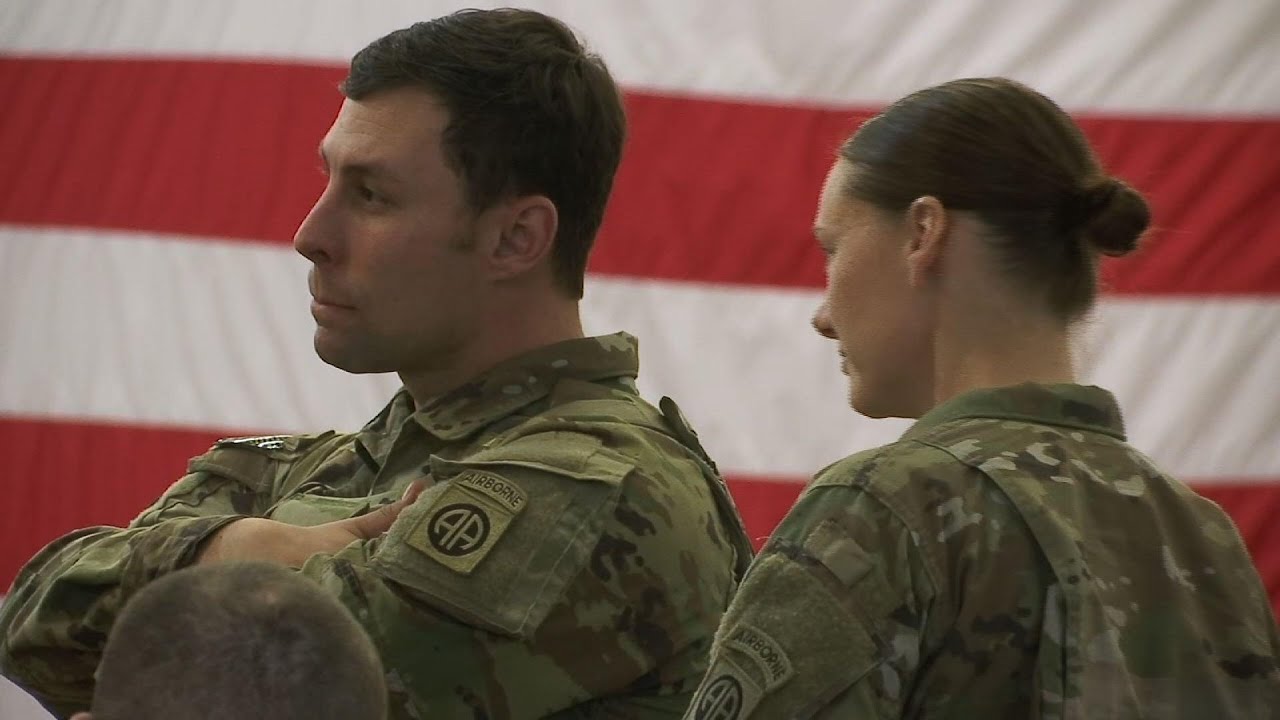
FORT
BRAGG, N.C. (AP) — Hundreds of U.S. soldiers deployed Saturday from
Fort Bragg, North Carolina, to Kuwait to serve as reinforcements in the
Middle East amid rising tensions following the U.S. killing of a top
Iranian general.
Lt.
Col. Mike Burns, a spokesman for the 82nd Airborne Division, told The
Associated Press 3,500 members of the division’s quick-deployment
brigade, known officially as its Immediate Response Force, will have
deployed within a few days. The most recent group of service members to
deploy will join about 700 who left earlier in the week, Burns said.
A
loading ramp at Fort Bragg was filled Saturday morning with combat gear
and restless soldiers. Some tried to grab a last-minute nap on wooden
benches. Reporters saw others filing onto buses.
The
additional troop deployments reflect concerns about potential Iranian
retaliatory action in the volatile aftermath of Friday’s drone strike
that killed Gen. Qassem Soleimani, the head of Iran’s elite Quds Force who has been blamed for attacks on U.S. troops and American allies going back decades.
President
Donald Trump ordered the airstrike near Baghdad’s international
airport. Iran has vowed retribution, raising fears of an all-out war,
but it’s unclear how or when a response might come.
Reporters
weren’t able to interview the soldiers leaving Fort Bragg on Saturday,
but an airman loading one of the cargo planes told an Army cameraman he
was making New Year’s plans when he got a call to help load up the
soldiers, according to video footage released by the military.
“We’re
responsible for loading the cargo. Almost our whole squadron got
alerted. Like a bunch of planes are coming over here,” the unnamed
airman said. “I was getting ready to go out for New Year’s when they
called me.”
In
the gray early morning light Saturday, Army video showed soldiers
dressed in camouflage fatigues filing into planes, carrying rucksacks
and rifles. Humvees were rolled onto another cargo plane and chained in
place for the flight to the Middle East.
Burns
said the soldiers within the Immediate Response Force train constantly
to be ready to respond quickly to crises abroad. When called by their
superiors, they have two hours to get to base with their gear and must
maintain a state of readiness so that they can be in the air headed to
their next location within 18 hours.
“So
whether they were on leave, whether they were home drinking a beer,
whether they were, you know, hanging out, throwing the kids up in the
yard, you get the call and it’s time to go,” he said.
He said that soldiers typically keep individual “go-bags” of their personal gear with them at their living quarters.
The
wife of a member of the 82nd Airborne who deployed earlier this week
said his departure was so abrupt she didn’t have the chance to say
goodbye in person or by phone.
April
Shumard said she was at work on New Year’s Eve and he was watching
their five children when he texted her that he had to rush to base. He
wasn’t sure if it was a drill or a deployment. She said her husband has
been in the military since 2010 and has already deployed twice to
Afghanistan. But with those prior deployments, the family had much more
time to prepare and say goodbye. This time, she got a second message
confirming he was leaving, and he departed in a plane on the afternoon
of New Year’s Day.
“The
kids kept going, ‘When’s Dad going to be home?’” said Shumard, 42.
“It’s literally thrown me for a loop. And him as well. He’s still in
disbelief of where he’s gone. Our heads are spun.”
She
said that Fayetteville is a tight-knit community, and she expects
people to work together to support families who are suddenly missing a
parent.
“This
was so last-minute,” she said, urging people to reach out to 82nd
Airborne families. “Just try to help out whoever you know who might need
some babysitting or help or just get some groceries and bring it to
their house.”
Similarly,
Bri’anna Ferry’s husband got the call on New Year’s Eve, and she said
he was on a plane to the Middle East within hours. She fears he could
miss milestones with their young daughter but also wants him to focus on
his mission.
“I told him, don’t worry about us. We’ll be fine,” she said. “Focus on your mission.”
This
undated photo released by the official website of the office of the
Iranian supreme leader, shows Maj. Gen. Esmail Ghaani. Supreme Leader
Ayatollah Ali Khamenei later on Friday appointed Qassem Soleimani's
deputy, Maj. Gen. Esmail Ghaani as the new commander of the
Revolutionary Guard's Quds Force. Soleimani was killed in the U.S.
airstrike in Iraq. (Office of the Iranian Supreme Leader via AP)
TEHRAN,
Iran (AP) — A new Iranian general has stepped out of the shadows to
lead the country’s expeditionary Quds Force, becoming responsible for
Tehran’s proxies across the Mideast as the Islamic Republic threatens
the U.S. with “harsh revenge” for killing its previous head, Qassem
Soleimani.
The
Quds Force is part of the 125,000-strong Revolutionary Guard, a
paramilitary organization that answers only to Iran’s Supreme Leader
Ayatollah Ali Khamenei. The Guard oversees Iran’s ballistic missile
program, has its naval forces shadow the U.S. Navy in the Persian Gulf
and includes an all-volunteer Basij force.
Like
his predecessor, a young Esmail Ghaani faced the carnage of Iran’s
eight-year war with Iraq in the 1980s and later joined the newly founded
Quds, or Jerusalem, Force.
While
much still remains unknown about Ghaani, 62, Western sanctions suggest
he’s long been in a position of power in the organization. And likely
one of his first duties will be to oversee whatever revenge Iran intends
to seek for the U.S. airstrike early Friday that killed his longtime
friend Soleimani.
“We
are children of war,” Ghaani once said of his relationship with
Soleimani, according to Iran’s state-run IRNA news agency. “We are
comrades on the battlefield and we have become friends in battle.”
The
Guard has seen its influence grow ever-stronger both militarily and
politically in recent decades. Iran’s conventional military was
decimated by the execution of its old officer class during the 1979
Islamic Revolution and later by sanctions.
A
key driver of that influence comes from the elite Quds Force, which
works across the region with allied groups to offer an asymmetrical
threat to counter the advanced weaponry wielded by the U.S. and its
regional allies. Those partners include Iraqi militiamen, Lebanon’s
Hezbollah and Yemen’s Houthi rebels.
In
announcing Ghaani as Soleimani’s replacement, Ayatollah Ali Khamenei
called the new leader “one of the most prominent commanders” in service
to Iran.
The Quds Force “will be unchanged from the time of his predecessor,” Khamenei said, according to IRNA.
Soleimani
long has been the face of the Quds Force. His fame surged after
American officials began blaming him for deadly roadside bombs targeting
U.S. troops in Iraq. Images of him, long a feature of hard-line
Instagram accounts and mobile phone lockscreens, now plaster billboards
calling for Iran to avenge his death.
But
while Soleimani’s exploits in Iraq and Syria launched a thousand
analyses, Ghaani has remained much more in the shadows of the
organization. He has only occasionally come up in the Western or even
Iranian media. But his personal story broadly mirrors that of Soleimani.
Born
on Aug. 8, 1957 in the northeastern Iranian city of Mashhad, Ghaani
grew up during the last decade of monarchy. He joined the Guard a year
after the 1979 revolution. Like Soleimani, he first deployed to put down
the Kurdish uprising in Iran that followed the shah’s downfall.
Iraq
then invaded Iran, launching an eight-year war that would see 1 million
people killed. Many of the dead were lightly armed members of the
Guard, some of whom were young boys killed in human-wave assaults on
Iraqi positions.
Volunteers
“were seeing that all of them are being killed, but when we ordered
them to go, would not hesitate,” Ghaani later recounted. “The commander
is looking to his soldiers as his children, and in the soldier’s point
of view, it seems that he received an order from God and he must to do
that.”
He
survived the war to join the Quds Force shortly after its creation. He
worked with Soleimani, as well as led counterintelligence efforts at the
Guard. Western analysts believe while Soleimani focused on nations to
Iran’s west, Ghaani’s remit was those to the east like Afghanistan and
Pakistan. However, Iranian state media has not elaborated on his time in
the Guard.
In
2012, the U.S. Treasury sanctioned Ghaani, describing him as having
authority over “financial disbursements” to proxies affiliated with the
Quds Force. The sanctions particularly tied Ghaani to an intercepted
shipment of weapons seized at a port in 2010 in Nigeria’s most-populous
city, Lagos.
Authorities
broke into 13 shipping containers labeled as carrying “packages of
glass wool and pallets of stone.” They instead found 107 mm Katyusha
rockets, rifle rounds and other weapons. The Katyusha remains a favored
weapon of Iranian proxy forces, including Iraqi militias and the
Lebanese militant group Hezbollah.
An Iranian and his Nigerian partner later received five-year prison sentences over the shipment,
which appeared bound for Gambia, then under the rule of dictator Yahya
Jammeh. Israeli officials had claimed the rockets would be shipped to
militants in the Gaza Strip, while Nigerian authorities alleged that
local politicians could use the arms in upcoming elections.
Also
in 2012, Ghaani drew criticism from the U.S. State Department after
reportedly saying that “if the Islamic Republic was not present in
Syria, the massacre of people would have happened on a much larger
scale.” That comment came just after gunmen backing Syrian President
Bashar Assad killed over 100 people in Houla in the country’s Homs
province.
“Over
the weekend we had the deputy head of the Quds Force saying publicly
that they were proud of the role that they had played in training and
assisting the Syrian forces — and look what this has wrought,”
then-State Department spokeswoman Victoria Nuland said at the time.
In January 2015, Ghaani indirectly said that Iran sends missiles and weapons to Palestinians to fight Israel.
“The
U.S. and Israel are too small to consider themselves in line with
Iran’s military power,” Ghaani said at the time. “This power has now
appeared alongside the oppressed people of Palestine and Gaza in the
form of missiles and weapons.”
Now,
Ghaani is firmly in control of the Quds Force. While Iran’s leaders say
they have a plan to avenge Soleimani’s death, no plan has been
announced as the country prepares for funerals for the general starting
Sunday.
Whatever that plan for revenge is, Ghaani likely will be involved.
“That
Qaani survived at such high ranks in the (Guard), and remained
Soleimani’s deputy for so long, says a lot about the trust both Khamenei
and Soleimani had in him,” said Afshon Ostovar, the author of a book on
the Guard. “I suspect he’ll have little difficulty filling Soleimani’s
shoes when it comes to operations and strategy.”
___
Gambrell reported from Dubai, United Arab Emirates.
TEHRAN,
Iran (AP) — Thousands of mourners accompanied a casket carrying the
remains of the slain Gen. Qassem Soleimani through two major Iranian
cities Sunday as part of a grand funeral procession across the Islamic
Republic amid soaring tensions between Iran and the U.S.
President
Donald Trump has threatened to bomb 52 sites in Iran if it retaliates
by attacking Americans. The U.S. Embassy in Saudi Arabia separately
warned Americans “of the heightened risk of missile and drone attacks.”
Meanwhile, Iran vowed to take an even-greater step away from its
unraveling nuclear deal with world powers as a response to Soleimani’s
slaying.
The U.S. drone strike killing Soleimani in Iraq Friday
escalated the crisis between Tehran and Washington after months of
trading attacks and threats that put the wider Middle East on edge. The
conflict is rooted in Trump pulling out of Iran’s atomic accord.
Iran
has promised “harsh revenge” for the U.S. attack, which shocked
Iranians across all political lines. Many saw Soleimani as a pillar of
the Islamic Republic at a moment when it is beset by U.S. sanctions and
recent anti-government protests.
Retaliation
for Soleimani could potentially come through the proxy forces which he
oversaw as the head of an elite unit within the paramilitary
Revolutionary Guard. Soleimani’s longtime deputy Esmail Ghaani already has taken over as the Quds Force’s commander.
Late
Saturday, a series of rockets launched in Baghdad fell inside or near
the Green Zone, which houses government offices and foreign embassies,
including the U.S. Embassy.
Trump
wrote on Twitter afterward that the U.S. had already “targeted 52
Iranian sites (representing the 52 American hostages taken by Iran many
years ago), some at a very high level & important to Iran & the
Iranian culture.”
Trump did not identify the targets but added that they would be “HIT VERY FAST AND VERY HARD.”
The
1954 Hague Convention, of which the U.S. is a party, bars any military
from “direct hostilities against cultural property.” However, such sites
can be targeted if they have been re-purposed and turned into a
legitimate “military objective,” according to the International Committee of the Red Cross.
Iran,
home to 24 UNESCO World Heritage sites, has in the past reportedly
guarded the sprawling tomb complex of the Islamic Republic’s founder,
Ayatollah Ruhollah Khomeini, with surface-to-air missiles.
After
thousands in Baghdad on Saturday mourned Soleimani and others killed in
the strike, authorities flew the general’s body to the southwestern
Iranian city of Ahvaz. An honor guard stood by early Sunday as mourners
carried the flag-draped coffins of Soleimani and other Guard members off
the tarmac.
The
caskets then moved slowly through streets choked with mourners wearing
black, beating their chests and carrying posters with Soleimani’s
portrait. Demonstrators also carried red Shiite flags, which
traditionally both symbolize the spilled blood of someone unjustly
killed and call for their deaths to avenged.
Officials
brought Soleimani’s body to Ahvaz, a city that was a focus of fighting
during the bloody, 1980-88 war between Iraq and Iran in which the
general slowly grew to prominence. After that war, Soleimani joined the
Guard’s newly formed Quds, or Jersualem, Force, an expeditionary force
that works with Iranian proxy forces in countries like Iraq, Lebanon and
Yemen.
Authorities
then took Soleimani’s body to Mashhad later Sunday. His remains will go
to Tehran and Qom on Monday for public mourning processions, followed
by his hometown of Kerman for burial Tuesday.
This
marks the first time Iran honored a single man with a multi-city
ceremony. Not even Khomeini received such a processional with his death
in 1989. Soleimani on Monday will lie in state at Tehran’s famed Musalla
mosque as the revolutionary leader did before him.
Soleimani was the architect of Iran’s regional policy of mobilizing militias
across Iraq, Syria and Lebanon, including in the war against the
Islamic State group. He was also blamed for attacks on U.S. troops and
American allies going back decades.
Though
it’s unclear how or when Iran may respond, any retaliation was likely
to come after three days of mourning declared in both Iran and Iraq.
Iranian
officials planned to meet Sunday night to discuss taking a fifth step
away from its 2015 nuclear deal with world powers, one that could be
even greater than planned, Foreign Ministry spokesman Abbas Mousavi told
journalists.
“In the world of politics, all developments are interconnected,” Mousavi said.
Iran
previously has broken limits of its enrichment, its stockpiles and its
centrifuges, as well as restarted enrichment at an underground facility.
After
the airstrike early Friday, the U.S.-led coalition has scaled back
operations and boosted “security and defensive measures” at bases
hosting coalition forces in Iraq, a coalition official said on condition
of anonymity according to regulations.
Meanwhile,
the U.S. has dispatched another 3,000 troops to neighboring Kuwait, the
latest in a series of deployments in recent months as the standoff with
Iran has worsened. Protesters held demonstrations in dozens of U.S.
cities Saturday over Trump’s decisions to kill Soleimani and deploy more
troops to the Mideast.
In
a thinly veiled threat, one of the Iran-backed militias, Asaib Ahl
al-Haq, or League of the Righteous, called on Iraqi security forces to
stay at least a kilometer (0.6 miles) away from U.S. bases starting
Sunday night. However, U.S. troops are invariably based in Iraqi
military posts alongside local forces.
The
Iranian parliament on Sunday opened with lawmakers in unison chanting:
“Death to America!” Parliament speaker Ali Larijani compared Soleimani’s
killing to the 1953 CIA-backed coup that cemented the shah’s power and
to the U.S. Navy’s shootdown of an Iranian passenger plane in 1988 that
killed 290 people. He also described American officials as following
“the law of the jungle.”
“Mr. Trump! This is the voice of Iranian nation. Listen!” Larijani said as lawmakers chanted.
A
spokesman for Iran’s armed forces, Gen. Abolfazl Shekarchi, likewise
threatened the U.S. by saying Iran and the “resistance front will decide
the time, place and way” revenge will be carried out.
Iraq’s
parliament is meeting for an emergency session Sunday. Its government
has come under mounting pressure to expel the 5,200 American troops who
are based in the country to help prevent a resurgence of the Islamic
State group.
The
U.S. has ordered all citizens to leave Iraq and temporarily closed its
embassy in Baghdad, where Iran-backed militiamen and their supporters
staged two days of violent protests
in which they breached the compound. Britain and France have warned
their citizens to avoid or strictly limit travel in Iraq, as London said
it would begin escorting ships through the Strait of Hormuz. Oman, long
an interlocutor between Iran and the West, urged Tehran and Washington
on Sunday to pursue dialogue.
No
one was hurt in the embassy protests, which came in response to U.S.
airstrikes that killed 25 Iran-backed militiamen in Iraq and Syria. The
U.S. blamed the militia for a rocket attack that killed a U.S.
contractor in northern Iraq.
___
Gambrell
reported from Dubai, United Arab Emirates. Associated Press writers Aya
Batrawy in Dubai, Qassim Abdul-Zahra in Baghdad, Zeina Karam and Sarah
El Deeb in Beirut and Kelvin Chan in London contributed to this report.
President Trump issued a stern warning to Iran on
Saturday through a series of Twitter messages intended to deter the
country from retaliating after the U.S.-ordered airstrike that killed Iran's Gen. Qassem Soleimani last week.
"Iran
is talking very boldly about targeting certain USA assets as revenge
for our ridding the world of their terrorist leader who had just killed
an American, & badly wounded many others, not to mention all of the
people he had killed over his lifetime, including recently hundreds of
Iranian protesters," Trump tweeted.
The president continued: "He
was already attacking our Embassy, and preparing for additional hits in
other locations. Iran has been nothing but problems for many years."
Soleimani,
head of the Islamic Revolutionary Guard Corps' elite Quds Force, was
killed in an airstrike Friday in Baghdad that was ordered by President
Trump.
"Let this serve as a WARNING that if Iran strikes any
Americans, or American assets, we have targeted 52 Iranian sites
(representing the 52 American hostages taken by Iran many years ago),
some at a very high level & important to Iran & the Iranian
culture, and those targets, and Iran itself, WILL BE HIT VERY FAST AND
VERY HARD," Trump wrote Saturday, explicitly laying out that the U.S.
will act if Iran retaliates.
Following Soleimani's death, Iranian
Supreme Leader Ayatollah Ali Khamenei said "harsh retaliation is waiting
for the criminals whose filthy hands spilled his blood."
Iranian President Hassan Rouhani promised to "take revenge for this heinous crime."
The Iran-backed militias
that spawned in Iraq, known as the Popular Mobilization Forces (PMF),
have been quick to threaten revenge on U.S. personnel and interests.
Killed alongside Soleimani at the airport in Baghdad was his close
confidante Abu Mahdi al-Mohandas, the deputy head of the PMF.
Trump has made it clear that he expects the Iranians to stop threatening the United States.
"The USA wants no more threats!" Trump had tweeted. Fox News' Danielle Wallace and Hollie McKay contributed to this report.
Reporting from Washington — The Obama
administration is acknowledging its transfer of $1.7 billion to Iran
earlier this year was made entirely in cash, using non-U.S. currency, as
Republican critics of the transaction continued to denounce the
payments.
Treasury Department spokeswoman Dawn Selak said in a
statement late Tuesday that the cash payments were necessary because of
the “effectiveness of U.S. and international sanctions,” which isolated
Iran from the international finance system.
The $1.7 billion was
the settlement of a decades-old arbitration claim between the U.S. and
Iran. An initial $400 million of euros, Swiss francs and other foreign
currency was delivered on pallets Jan. 17, the same day Tehran agreed to
release four American prisoners.
The Obama administration had
claimed the events were separate, but recently acknowledged the cash was
used as leverage until the Americans were allowed to leave Iran. The
remaining $1.3 billion represented estimated interest on the Iranian
cash the U.S. had held since the 1970s. The administration had
previously declined to say if the interest was delivered to Iran in
physical cash, as with the principal, or via a more regular banking
mechanism.
Earlier Tuesday, officials from the State, Justice and Treasury
departments held a closed-door briefing for congressional staff on the
payments, according to a Capitol Hill aide familiar with the session.
The officials said the $1.3 billion was paid in cash on Jan. 22 and Feb.
5. The aide was not authorized to speak publicly and requested
anonymity.
The money came from a little-known fund administered by
the Treasury Department for settling litigation claims. The so-called
Judgment Fund is taxpayer money Congress has permanently approved in the
event it’s needed, allowing the president to bypass direct
congressional approval to make a settlement. The U.S. previously paid
out $278 million in Iran-related claims by using the fund in 1991.
Republicans
have decried the payments as ransom, a charge the Obama administration
has rejected. On Tuesday, a group of Republican senators announced their
support for legislation that would bar payments from the Judgment Fund
to Iran until Tehran pays the nearly $55.6 billion that U.S. courts have
judged that it owes to American victims of Iranian terrorism.
“President
Obama’s disastrous nuclear deal with Iran was sweetened with an illicit
ransom payment and billions of dollars for the world’s foremost state
sponsor of terrorism,” said Sen. Marco Rubio (R-Fla.), the bill’s
primary sponsor.
Rep. Ed Royce (R-Fullerton), chairman of the House Foreign Affairs
Committee, also introduced a bill that prohibits cash payments to Iran
and demands transparency on future settlements. “Sending the
world’s leading state sponsor of terror pallets of untraceable cash
isn’t just terrible policy,” Royce said. “It’s incredibly reckless, and
it only puts bigger targets on the backs of Americans. ... This cash
bonanza has emboldened Iran’s radical regime, and undermined America’s
national security.”
More Americans are now employed than ever recorded before in our history.
We have created more than 400,000 manufacturing jobs since my election.
Manufacturing jobs growing at the fastest rate in more than THREE DECADES.
Economic growth last quarter hit 4.2 percent.
New unemployment claims recently hit a 49-year low.
Median household income has hit highest level ever recorded.
African-American unemployment has recently achieved the lowest rate ever recorded.
Hispanic-American unemployment is at the lowest rate ever recorded.
Asian-American unemployment recently achieved the lowest rate ever recorded.
Women’s unemployment recently reached the lowest rate in 65 years.
Youth unemployment has recently hit the lowest rate in nearly half a century.
Lowest unemployment rate ever recorded for Americans without a high school diploma.
Under my Administration, veterans’ unemployment recently reached its lowest rate in nearly 20 years.
Almost 3.9 million Americans have been lifted off food stamps since the election.
The Pledge to America’s Workers has resulted in employers committing
to train more than 4 million Americans. We are committed to VOCATIONAL
education.
95 percent of U.S. manufacturers are optimistic about the future—the highest ever.
Retail sales surged last month, up another 6 percent over last year.
Signed the biggest package of tax cuts and reforms in history. After
tax cuts, over $300 billion poured back in to the U.S. in the first
quarter alone.
As a result of our tax bill, small businesses will have the lowest top marginal tax rate in more than 80 years.
Helped win U.S. bid for the 2028 Summer Olympics in Los Angeles.
Helped win U.S.-Mexico-Canada’s united bid for 2026 World Cup.
Opened ANWR and approved Keystone XL and Dakota Access Pipelines.
Record number of regulations eliminated.
Enacted regulatory relief for community banks and credit unions.
Obamacare individual mandate penalty GONE.
My Administration is providing more affordable healthcare options
for Americans through association health plans and short-term duration
plans.
Last month, the FDA approved more affordable generic drugs than ever
before in history. And thanks to our efforts, many drug companies are
freezing or reversing planned price increases.
We reformed the Medicare program to stop hospitals from overcharging
low-income seniors on their drugs—saving seniors hundreds of millions
of dollars this year alone.
Signed Right-To-Try legislation.
Secured $6 billion in NEW funding to fight the opioid epidemic.
We have reduced high-dose opioid prescriptions by 16 percent during my first year in office.
Signed VA Choice Act and VA Accountability Act, expanded VA
telehealth services, walk-in-clinics, and same-day urgent primary and
mental health care.
Increased our coal exports by 60 percent; U.S. oil production recently reached all-time high.
United States is a net natural gas exporter for the first time since 1957.
Withdrew the United States from the job-killing Paris Climate Accord.
Cancelled the illegal, anti-coal, so-called Clean Power Plan.
Secured record $700 billion in military funding; $716 billion next year.
NATO allies are spending $69 billion more on defense since 2016.
Process has begun to make the Space Force the 6th branch of the Armed Forces.
Confirmed more circuit court judges than any other new administration.
Confirmed Supreme Court Justice Neil Gorsuch and nominated Judge Brett Kavanaugh.
Withdrew from the horrible, one-sided Iran Deal.
Moved U.S. Embassy to Jerusalem.
Protecting Americans from terrorists with the Travel Ban, upheld by Supreme Court.
Issued Executive Order to keep open Guantanamo Bay.
Concluded a historic U.S.-Mexico Trade Deal to replace NAFTA. And negotiations with Canada are underway as we speak.
Reached a breakthrough agreement with the E.U. to increase U.S. exports.
Imposed tariffs on foreign steel and aluminum to protect our national security.
Imposed tariffs on China in response to China’s forced technology
transfer, intellectual property theft, and their chronically abusive
trade practices.
Net exports are on track to increase by $59 billion this year.
Improved vetting and screening for refugees, and switched focus to overseas resettlement.
We have begun BUILDING THE WALL. Republicans want STRONG BORDERS and
NO CRIME. Democrats want OPEN BORDERS which equals MASSIVE CRIME.
Faith leaders pray over President Donald Trump during an
"Evangelicals for Trump Coalition Launch" at King Jesus International
Ministry Friday in Miami. (Associated Press)
President Trump blasted three of the four freshmen congressional Democrats known as "The Squad" in front of an audience of his evangelical supporters in Miami on Friday, accusing them of holding anti-Semitic views.
“These people hate Israel. They hate Jewish people,” Trump said at the launch of his "Evangelicals for Trump" group inside a megachurch.
“I won’t name them. I won’t bring up the name of Omar, Tlaib, AOC. I
won’t bring that name up. Won’t bring it up. I will not bring it up." The president was referring to U.S. Reps. Ilhan Omar, D-Minn.; Rashida Tlaib, D-Mich.; and Alexandria Ocasio-Cortez, D-N.Y. The Squad member he did not mention was U.S. Rep. Ayanna Pressley, D-Mass.
The
three lawmakers have drawn the ire of conservatives for their criticism
of Israel since taking office last January. Omar and Tlaib were among
17 members of Congress who voted against a resolution to condemn the Boycott, Divestment and Sanctions (BDS) movement in July.
Omar
was accused of anti-Semitism last year for her criticism of Israel and
tweeting that a prominent lobbying group was paying members of Congress to support the country. The comment drew rebuke from Democrats as well as Republicans.
Trump later urged Israeli Prime Minister Benjamin Netanyahu to block Omar and Tlaib from visiting Israel, resulting in an outcry from Democratic lawmakers. Israel later did block the lawmakers just before a planned visit.
Tlaib had requested to visit her grandmother in the
Israeli-occupied West Bank but abruptly canceled her plans after she was
given permission on humanitarian grounds.
In March 2019, the House overwhelmingly passed a measure in March 2019 condemning anti-Semitism, Islamophobia and other forms of hatred.
Trump
has gone after the Squad members in the past. In July, he said they
should go back “crime-infested places from which they came” in an inflammatory tweet that was described by many as racist.
Trump
spoke to more than 5,000 Christians, including a large group of
Latinos, at El Rey Jesús church, just days after he was the subject of a
scathing editorial in Christianity Today magazine that called for his
removal from office. Thousands of the faithful lifted their hands and
prayed over Trump as he began speaking and portrayed himself as a
defender of faith.
The
president made no mention of the editorial, which ran in a magazine
founded by the late Rev. Billy Graham. Campaign officials said the Miami
event was in the works well before the editorial.
Mark Galli, the Christianity Today editor who wrote the editorial, retired Friday.
“We're
defending religion itself. A society without religion cannot prosper. A
nation without faith cannot endure," said Trump, who also tried to
paint his Democratic rivals for the 2020 election as threats to
religious liberty. “We can't let one of our radical left friends come in
here because everything we've done will be gone in short order.”
The
kickoff of “Evangelicals for Trump” will be followed in the weeks ahead
by the launches of “Catholics for Trump” and “Jewish Voices for Trump." The Associated Press contributed to this report.
White House senior adviser Jared Kushner and Republican National Committee Chairwoman Ronna McDaniel will reportedly headline a donor "thank you" event to celebrate the Trump 2020 Campaign and the RNC's large fundraising haul Saturday in Palm Beach, Fla.
The
event is scheduled to be held at conservative billionaire Bill Koch’s
house and is slated to have a host of Trump donors in attendance,
Politico reported. TRUMP CAMPAIGN BLOWS PAST 2020 DEMS WITH LATEST FUNDRAISING HAUL, SITTING ON OVER $100M
The Trump 2020 Campaign and the RNC announced last week that they jointly raised $463 million last year, far beyond Democrats.
The Trump campaign reported brought in $46 million in the fourth quarter of 2019 with a total of $143 million in 2019.
Unlike his brothers David and Charles who sat out the 2016 election, Bill has thrown his support behind the president.
David Koch, who was Bill Koch's twin brother, died Aug. 23 at age 79.
Trump
isn’t scheduled to be at the event, but he will host a fundraiser later
in the month at Mar-a-Lago in Palm Beach, according to Politico.
Trump
held an evangelical rally near Miami on Friday where he launched his
“Evangelicals for Trump” coalition, claiming Democrats are pursuing an
“anti-religious” agenda.