U.S. Rep. Adam Smith, D-Wash., became the target of social media trolls and other critics – including Donald Trump Jr. – on Thursday for his abrupt reversal regarding when House Speaker Nancy Pelosi should deliver articles of impeachment to the U.S. Senate.
Early
Thursday, Smith said he believed Pelosi was looking to establish
negotiating leverage with the Senate by withholding the two articles of
impeachment against President Trump, which the House approved last
month. The articles charge the president with abuse of power and
obstruction of Congress in relation to a July phone call with the
president of Ukraine.
But ultimately, Smith said, he believed Senate Majority Leader Mitch McConnell, R-Ky., was in charge of the Senate and should determine that body’s course of action regarding a Trump impeachment trial.
“I
think it was perfectly advisable for the speaker to try to leverage
that to get a better deal,” Smith told CNN, but adding “at this point,
it doesn’t look like that’s going to happen.”
“I think it is time
to send the impeachment to the Senate and let Mitch McConnell be
responsible for the fairness of the trial,” Smith said. “He ultimately
is.”
But just a short time later, Smith posted on Twitter what seemed to be a complete reversal from the statements he made on TV.
“I
misspoke this morning,” Smith wrote. “I do believe we should do
everything we can to force the Senate to have a fair trial. If the
Speaker believes that holding on to the articles for a longer time will
help force a fair trial in the Senate, then I wholeheartedly support
that decision.”
Critics quickly took note of the sudden retreat by
Smith, the 54-year-old chairman of the House Armed Services Committee,
and suggested that perhaps he was surrendering to pressure from
Democratic Party leaders.
“Hahahaha someones not allowed to think
for himself and got in trouble for breaking with Nancy’s narrative,”
Donald Trump Jr. wrote. “This has been the problem with the sham
impeachment from day one, no one actually believes this BS except for
the lunatic fringe who have hijacked the whole Democratic party.”
“Bang
bang Nancy’s silver hammer went down on Adam Smith’s head …” political
commentator Doug Heye wrote, alluding to an old Beatles song.
Smith’s flip-flop wasn’t playing well in his home state, either.
“He
has no courage of his convictions, and had to deny his own words an
hour later,” said Dori Monson, host of a Seattle radio show, according
to MyNorthwest.com.
Later, Smith tried to clarify his remarks during an appearance on Monson’s program.
“All I was saying was, ‘At the end of the day, we can’t force the Senate any more than they can force us,'” Smith told Monson, according to MyNorthwest.com. “‘We have to try to leverage them and persuade them.'” Fox News' Brooke Singman contributed to this story.
Secretary of State Mike Pompeo fired back at one of his predecessors in an exclusive interview with Fox News' "The Ingraham Angle" Thursday, saying that John Kerry was indulging in a "fantasy" by claiming that Iran had reined in its destabilizing behavior after signing the 2015 nuclear deal.
"It’s
a fantasy to think that the nuclear deal was good for the United States
of America, protecting the American people," Pompeo told Laura
Ingraham. "There were terror campaigns, there were missile systems that
were enhanced, improved during the [period of the] JCPOA [nuclear deal]
-- the money that the Iranian regime was permitted to have underwrote
the very Shia militias that were the ones that took on and ultimately
killed an American."
Kerry told MSNBC Wednesday night that there
is "no way at all" the world is safer after Trump ordered a drone strike
that killed Quds Force Gen. Qassem Soleimani at Baghdad's airport last
week. The former senator from Massachusetts and 2004 Democratic
presidential nominee also claimed that Trump was "fixated on undoing
anything Barack Obama did ... [and] willing to run the risk of outright
war in the effort to fulfill his fantasy."
"This
isn’t about undoing what Obama did," Pompeo told Ingraham Thursday.
"This is about protecting and defending the American people. President
Trump has been incredibly resolute in that."
During an address to
the nation on Wednesday, hours after Iran fired 16 missiles at two Iraqi
airbases housing American servicemembers in response to Soleimani's
death, Trump claimed: "The missiles fired last night at us and our
allies were paid for with the funds made available by the last
administration." Pompeo doubled down on that claim, emphasizing
that money paid to Iran by the Obama administration "ultimately ends up
in the hands of people who wanted to do Americans harm."
In
September 2016, the Treasury Department acknowledged that $1.7 billion
was transferred from the U.S. to Iran in foreign hard currency. An
initial $400 million delivery was sent to Tehran Jan. 17, the same day
Iran agreed to release four American prisoners. The remaining $1.3
billion was paid in subsequent weeks. The $1.7 billion was the
settlement of a 37-year-old dispute between the U.S. and Iran over a
$400 million payment made by the last Shah of Iran. In addition to those
payments by the U.S., billions of dollars in Iranian assets held in
financial institutions overseas were unfrozen as part of the nuclear
deal.
"All
the things that we are now confronting are a direct result of the
resources that the regime had available as a result of that terrible
nuclear deal," Pompeo said.
Pompeo also responded to criticism of a
classified briefing to lawmakers Wednesday that was meant to explain
the rationale behind the Soleimani strike. Democrats have said they do
not believe the intelligence shown in the briefing proved that Soleimani
represented an immediate threat to U.S. interests, while Sen. Mike Lee, R-Utah, called the briefing "lame" and "insane," describing it as the worst he had sat through in his time on Capitol Hill.
"I
thought we did a dynamite job," said Pompeo, who took part in the
briefing. "I mean that in the truest sense, but we did our level best to
present them with all the facts that we could in that setting." The
secretary of state also insisted that Soleimani was planning "a series
of imminent attacks" when he was killed.
"We
don’t know precisely when -- and we don’t know precisely where," Pompeo
said. "But it was real ... There was a real opportunity here and there
was a real necessity here. We made the right decision. The president
made the right call."
When Ingraham asked whether the
administration could trust Congress with classified information, Pompeo
said: "Well, we shared an awful lot with them yesterday ... I think
there are a number of people who are using this as a political ax to
grind. I think that’s most unfortunate."
Pompeo
also responded to the apparent downing of a Ukrainian International
Airlines plane by Iran early Wednesday that killed all 176 people on
board. U.S., Canadian and British officials said earlier Thursday it is
"highly likely" that the jet was struck by an Iranian missile.
"I’ve
seen the reporting. I can only say that we need to get to the bottom of
this very, very quickly," said Pompeo, who added that while a
mechanical failure could have caused the crash, "if, in fact, it’s the
case that there was something more insidious to this, the American
people should know that this would have been Iranian malfeasance that
caused it."
BEIJING (AP) — Global stock markets and oil prices rebounded Thursday as anxiety over potential U.S.-Iranian conflict eased.
London and Frankfurt opened higher and Tokyo gained more than 2%. Shanghai and Hong Kong also advanced.
Markets
sank Wednesday after Tehran launched missiles at bases housing
Americans in Iraq in retaliation for the killing of an Iranian general.
Anxiety subsided after reports indicated no Americans were killed and
President Donald Trump said Iran “appears to be standing down.”
The
lack of casualties “gave the markets more confidence that the Iranians
had instigated little more than the intention to make a public show of
force mainly to save face at home,” said Stephen Innes of AxiTrader in a
report.
In
early trading, London’s FTSE 100 gained 0.4% to 7,609.67 and
Frankfurt’s DAX rose 1.5% to 13,520.35. France’s CAC 40 added 0.6% to
6,068.31.
On Wall Street, futures for the benchmark S&P 500 and Dow Jones Industrial Average were up nearly 0.4%.
On Wednesday, the S&P 500 rose 0.5% while the Dow advanced 0.6%. The Nasdaq composite rose 0.7% to a record.
In
Asia, Tokyo’s Nikkei 225 powered ahead 2.3% to 23,739.87 and Hong
Kong’s Hang Seng rose 1.7% to 28,561.00. The Shanghai Composite Index
added 0.9% to 3,094.88.
Seoul’s Kospi rose 1.6% to 2,186.45 and Sydney’s S&P-ASX 200 added 0.8% to 6,874.20. India’s Sensex rose 1.4% to 41,409.69.
Taiwan and Southeast Asian markets also advanced while New Zealand declined.
Trump said he would add economic sanctions on Iran but the United States is “ready to embrace peace with all who seek it.”
Oil
prices rebounded Thursday after first surging on news of the Iranian
attack and then falling back once tensions appeared to be easing.
Benchmark
U.S. crude gained 43 cents to $60.05 per barrel in electronic trading
on the New York Mercantile Exchange. On Wednesday, the contract fell
$3.09 to settle at $59.61. It traded as high as $65.65 following the
missile attack.
Brent
crude, used to price international oils, advanced 52 cents to $65.96
per barrel in London. It fell $2.83 the previous session to $65.44.
Gold had a similar whipsaw day. It climbed as high as $1,604.20 per ounce before settling at $1,560.10.
Also
Thursday, China reported consumer prices rose 4.5% in December over a
year earlier, propelled by surging pork prices due to an outbreak of
disease.
In currency trading, the dollar gained to 109.34 yen from Wednesday’s 109.08 yen. The euro advanced to $1.1120 from $1.1105.
An Indiana congressman who served in Afghanistan as a member of the Navy Reserve spoke out on behalf of America's military veterans Wednesday after U.S. Rep. Ilhan Omar, D-Minn., claimed she suffered from post-traumatic stress disorder.
U.S.
Rep. Jim Banks, a Republican, said Omar's comments were a "disgrace,"
calling the remarks "offensive to our nation's veterans who really do
have PTSD after putting their life on the line to keep America safe."
Omar
had made her remarks during a news conference with other Democrats on
Wednesday, at which she said she "felt ill" because of "everything that
is taking place" in the Middle East -- a reference to the recent U.S. tensions between the U.S. and Iran,
including last week's U.S. airstrike in Baghdad and Iran's missile
attacks early Wednesday against airbases in Iraq where U.S. service
members are stationed.
"And I think every time I hear about ...
I hear of conversations around war, I find myself being stricken with
PTSD," she said. "And I find peace knowing that I serve with great
advocates for peace and people who have shown courage against war."
After
Banks took issue with her comments, Omar posted a reply on Twitter,
making reference to her youth in war-torn Somalia. After leaving her
homeland with her family near the start of the Somali Civil War in 1991,
she would spend four years at a Kenyan refugee camp before immigrating
to the U.S. in 1995.
"Hi Jim, I survived war as a child and deal
with post-traumatic stress disorder—much like many who have served or
lived through war," she wrote in the tweet, which was addressed to Banks
but not tagged. "It’s shameful that you as a member of Congress would
erase the PTSD of survivors."
But Banks doubled down on his
comments later Wednesday evening, posting a video that showed Omar and
other Democrats giggling in the background as their colleague, U.S. Rep.
Sheila Jackson Lee, D-Texas, spoke to reporters about the more than
4,000 U.S. service members killed in Iraq over the years.
"Your
words and actions at today’s press conference reveal your feelings
toward our soldiers serving abroad and the video speaks for itself,"
Banks wrote, including a video of the news conference shared by Rep.
Jody Hice, R-Ga.
Omar posted another message about a half-hour
later, elaborating that she had "lived in a war zone" and had "seen what
conflict does to families and communities.""If you aren't familiar with Banks, he's been with the Navy since 2012,"
one Twitter user wrote, "and was deployed to Afghanistan about 6 years
ago. So he knows a little something about PTSD."
Democratic presidential hopefuls Elizabeth Warren and Bernie Sanders
faced criticism online Wednesday for participating in a conference call
with an Iranian-American advocacy group just a day after Iran launched a ballistic missile attack in Iraq aimed at U.S. military personnel. The
group was the National Iranian American Council (NIAC), which critics
claim lobbies in Washington on behalf of the Iranian government.
The “#NoWarWithIran Strategy Call,”
hosted by MoveOn.org, another advocacy group and political action
committee first organized in 1998 in response to former President Bill
Clinton’s impeachment, also included commentary from Jamal Abdi,
president of NIAC. U.S. Reps. Barbara Lee and Ro Khanna, both California
Democrats, and others also participated.
Charlie
Kirk, founder of Turning Point USA, called Warren and Sanders
“disgraceful” for participating in the call with “pro-Iran group NIAC
the day after Iran bombed our military bases.”
“Whose side are the Democrat frontrunners actually on?” he asked.
“How
is this conference call with Sanders/Warren/ pro-Iran lobby group NIAC,
with ties to Tehran & Iranian govt (who just bombed our military
bases) different than the claims they made against Trump??” another user
asked. “Are they conspiring with the enemy to overthrow our govt??
Start impeachment?”
"Willingness to engage with NIAC - the
Khomeini lobby in DC - should be automatic disqualification for any
candidate," another user wrote.
NIAC has been accused by other
members of the Iranian-American community of working as part of a
U.S.-based pro-Islamic jihad alliance. A former CIA officer alleged in a 2009 brief that NIAC
was actively working to influence Democrats -- in Congress and the
Obama administration -- to push a foreign policy that would benefit
Tehran’s cleric regime. A federal judge ordered NIAC to pay more than
$180,000 in 2013 after its failed defamation lawsuit against
Iranian-American writer Hassan Daioleslam, who published pieces showing
NIAC's links to the regime, the Washington Free Beacon reported.
The
U.S. District Court for the District of Columbia said the work of
NIAC’s founder, Trita Parsi, was "not inconsistent with the idea that he
was first and foremost an advocate for the regime." Parsi lobbied
Congress and met with Obama administration officials before the signing
of the 2015 Iran nuclear deal. Documents uncovered during the defamation
lawsuit also showed correspondence between NIAC and Iran’s Foreign
Minister Mohammad Javad Zarif.
The group, meanwhile, insists it
works independently from the Iranian government. According to its
official website, NIAC is a “nonprofit dedicated to strengthening the
voice of Iranian Americans and promoting greater understanding between
the American and Iranian people.”
On the call, Warren, D-Mass.,
and Sanders, an independent from Vermont, both slammed President Trump
for what was described as his “march to war” with Iran that they claim
first began in May 2018 when he announced the U.S. withdrawal from the Iran nuclear deal with world powers.
Trump
had signed a presidential memorandum withdrawing the U.S. from the
controversial agreement signed by his predecessor, former President
Barack Obama. He said he will be re-instituting the highest level of
sanctions and warned other countries against helping the Iranian
government. The deal had allowed the Iranian regime to garner up to $150
billion in cash – most of which was used to fund state-run terrorist
operations, the Free Beacon reported.
The conference call came
after Wednesday morning's firing of as many as 15 ballistic missiles at
two bases in Iraq housing U.S. troops in a major retaliation by the
rogue regime after the U.S. airstrike that killed Iranian Quds Force
Gen. Qassem Soleimani at Baghdad International Airport last week.
Iranian
efforts to killed American service members were thwarted by the
military's Early Warning Systems, Defense Secretary Mark Esper and Gen.
Mark Milley, chairman of the Joint Chiefs of Staff, told
reporters Wednesday. No U.S. casualties were reported.
“There
seems to be a pause in the hostilities for now, and I hope it endures
but let’s be clear – this is a crisis of Donald Trump’s making,” Warren
told those who dialed in Wednesday night. “The first job of the
president of the United States is to keep America safe, but this
president’s reckless actions have made us far less safe.
“He
started this back in 2018 when he tore up the Iran nuclear deal. Iran
had agreed not to advance its nuclear program, and the international
community had already certified that Iran was following the terms of the
deal. Our allies wanted to stay in it but not Donald Trump.
“Instead he decided just to tear it up,” she said.
Warren
also accused Trump of “tweeting threats of war crimes” when he
threatened attacks on Iranian cultural sites, which she said was “not in
America’s favor and it is wrong.” Trump had subsequently said he would
take no action that violated international law.
Speaking later on
in the hour-long call, Sanders accused Trump of telling “the same old
lies” told by the Bush administration in 2002-03 that he said lead to
the deaths of 4,500 “brave American soldiers,” the death of “hundreds of
thousands of Iraqis” and veterans suffering from PTSD still today.
“When
I think back in my lifetime to the disastrous wars, the unnecessary
wars that have taken place. I think back to Vietnam where people I knew
got killed, where my generation suffered so terribly – 59,000 dead, God
knows how many wounded. People still sleeping out on the streets today
from that war,” Sanders also said, recounting his personal history of
America fighting in foreign wars oversees.
“I think the lesson is
that war should be avoided in every way that we can. War is the last
response, not the first response,” he continued. “I will do everything I
can to prevent this war.”
“I’ll be working to make sure that we
pass a War Powers Act that makes it clear that the Constitution says
that it is the Congress – not the president – who determines whether
this country goes to war. And that I’m afraid Congress has forgotten
about that under Republican and Democratic administrations. And we’re
going to do everything we can to pass that resolution.
Sanders
closed out his remarks referencing health care, climate change and
homelessness – issues that he said were more deserving of U.S.
investment than a potential war with Iran.
MoveOn
used the call to promote #NoWarWithIran rallies to be held Thursday
across the U.S. in an effort to show public opposition against war with
Iran. Both Warren and Sanders urged listeners to attend their nearest
event. Move On said more than 7,000 people dialed into the call. More
than 70,000 also listened to the call on Facebook Live.
More Democrats are urging House Speaker Nancy Pelosi to send the articles of impeachment against President Trump to the Senate so a trial can get underway.
Those joining the list include Sen. Dianne Feinstein from Pelosi's home state of California, as well as Sens. Joe Manchin of West Virginia and independent Angus King of Maine, who caucuses with the Democrats.
“The
longer it goes on the less urgent it becomes,” Feinstein told
Politico about Pelosi's withholding of the articles approved last month,
charging Trump with abuse of power and obstruction of Congress. “So if
it’s serious and urgent, send them over. If it isn’t, don’t send it
over.”
Manchin
agreed with Feinstein that the House “should move on” and deliver the
articles to Senate Majority Leader Mitch McConnell.
"It is time," King said Tuesday, according to NBC News.
Pelosi
has been holding on to the articles since December in an effort to get
McConnell, R-Ky., to agree to certain conditions for a trial, such as
allowing witnesses to testify.
“We need to get folks to testify
and we need more information ... but nonetheless, I’m ready,” Sen. Jon
Tester, D-Mont., said, according to Politico. “I don’t know what leverage we have. It looks like the cake is already baked.”
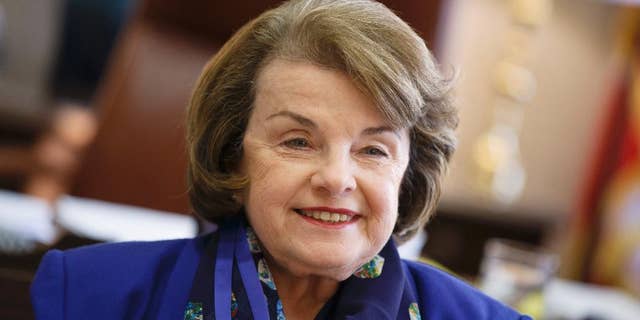
Sen. Dianne Feinstein, D-Calif., is seen in her Capitol
Hill office in Washington, Feb. 11, 2015. (Associated Press)
Sen. Richard Blumenthal, D-Conn. and Sen. Chris Coons, D-Del., also said it was time.
“We are reaching a point where the articles of impeachment should be sent,” Blumenthal told reporters.
Former national security adviser John Bolton
on Monday said he would be willing to testify in a Senate trial if he
was subpoenaed and Sen. Mitt Romney, R-Utah, said he wants to hear from
him.
Still, McConnell said Tuesday he has the votes to move forward with a trial without any witnesses.
House
Intelligence Committee Chairman Adam Schiff has also left open the
possibility that Bolton could appear before the House if the Senate
doesn't call him.
Pelosi said she plans to hold on to the impeachment articles until she learns about how the Senate trial will proceed. Fox News' Marisa Schultz contributed to this report.
WASHINGTON
(AP) — President Donald Trump faces one of the greatest tests of his
presidency after Iran launched ballistic missiles at Iraqi bases housing
U.S. troops. It was Iran’s most brazen direct assault on America since
the 1979 seizing of the U.S. Embassy in Tehran.
The
strikes pushed Tehran and Washington perilously close to war, and put
the world’s attention on Trump as he weighs whether to respond with more
military force. The president huddled with his national security
advisers on Tuesday night, but offered no immediate indication of
whether he would retaliate. He said in a tweet that “All is well!” and
announced plans to address the nation on Wednesday morning.
The
Iranian strikes came days after Trump authorized the targeted killing
of Gen. Qassem Soleimani, the head of Iran’s elite Quds Force. Iran had
pledged to retaliate, though its actions did not appear to result in any
American casualties, according to a U.S. official. The missiles
targeted two bases — one in the northern Iraqi city in Irbil and the
other at Ain al-Asad in western Iraq.
A
lack of U.S. casualties could give Trump an opening to de-escalate the
mounting tensions with Iran and pull the nation back from the brink of
war. Trump, who is facing reelection at the end of the year, campaigned
for president on a promise to keep the United States from engaging in
“endless war.”
Still,
Trump’s rhetoric in recent days has been menacing. Just hours before
Tuesday’s missile strikes, the president told reporters in the Oval
Office: “If Iran does anything that they shouldn’t be doing, they’re
going to be suffering the consequences, and very strongly.”
Democrats called on Trump avoid a military escalation with Iran.
Rep.
Eliot Engel, D-N.Y., the chairman of the House Foreign Affairs
Committee, said the administration needs to quickly “extricate us from
what could lead into a full-fledged war with terrible casualties.” Engel
said he feared the situation ”spirals out of control.”
The fallout for Trump’s order to kill Soleimani has been swift.
Iran
announced that it would no longer be bound by the 2015 nuclear
agreement and vowed to retaliate against the U.S., its allies and
American interests. Iraq’s parliament also voted to expel U.S. troops
from Iraq, which would undermine efforts to fight Islamic State
militants in the region and strengthen Iran’s influence in the Mideast.
The
counterattack by Iran came as Trump and his top advisers were under
pressure to disclose more details about the intelligence that led to the
American strike that killed Soleimani.
Trump
said Tuesday that his decision saved American lives and that members of
Congress would get a briefing on the reasons for the U.S. attack.
“They were planning something,” he said of the Iranians.
So
far, Trump and top national security officials have justified the
airstrike with general statements about the threat posted by Soleimani,
who commanded proxy forces outside Iran and was responsible for the
deaths of American troops in Iraq.
But the details have been scarce.
“He’s
no longer a monster. He’s dead,” Trump said. “And that’s a good thing
for a lot of countries. He was planning a very big attack and a very bad
attack for us and other people and we stopped him and I don’t think
anybody can complain about it.”
Soleimani
was targeted while he was at an airport in Baghdad with Abu Mahdi
al-Muhandis, a veteran Iraqi militant who also was killed.
Trump
said they weren’t in Baghdad to discuss vacation plans or visit a “nice
resort,” but were there to talk over “bad business.”
The
lack of detail didn’t sit well with Democrats, who recall how President
George W. Bush justified his invasion of Iraq by accusing Saddam
Hussein of having what turned out to be non-existent weapons of mass
destruction. Lawmakers in recent days have been pressing for more
details about why Trump ordered the killing — a decision that previous
administrations passed up because of fears it would unleash even more
violence.
Soleimani
traveled often and relatively openly, with visits to Baghdad more
frequent in recent months. He also often showed up in Syria, including
along the border between Iraq and Syria.
Senate
Minority Leader Chuck Schumer and Sen. Bob Menendez, the top Democrat
on the Senate Foreign Relations Committee, have called on Trump to
declassify the written notification he sent to Congress after the
strike. The notification was required under the War Powers Resolution
Act of 1973, which requires the president to report to Congress when
American forces are sent into hostile situations.
“The
president must come to Congress and present clear and compelling
intelligence as to why the strike against Soleimani was absolutely
necessary,” Menendez said in a speech on the Senate floor. “In the wake
of all its misleading statements we must make clear to the
administration that the president by himself does not have the authority
to launch a war against Iran.”
Trump
stressed that the strike was in retaliation for Iranian attacks and
that the U.S. is prepared to attack again — “very strongly.” He also
said that while he eventually wants to pull U.S. troops out of Iraq, now
is not the time because it would allow Iran to gain a bigger foothold
there.
Trump’s top national security officials made several public appearances on Tuesday to further defend the strike.
“We
had deep intelligence indicating there was active plotting to put
American lives at risk,” and Iraqi lives too, said Secretary of State
Mike Pompeo.
Asked
if the threat was imminent in days or weeks, Defense Secretary Mark
Esper said: “I think it’s more fair to say days, for sure.”
Esper
said the intelligence was precise — “razor thin.” He said top
Republicans and Democrats in the House and Senate plus the chairmen and
vice chairmen of the intelligence committees in both chambers were
getting a classified briefing Tuesday afternoon on what led to the
decision to kill Soleimani. He said other lawmakers will be provided
general details about the attack.
He
said Soleimani was in Baghdad to coordinate additional attacks against
the U.S. “To somehow suggest that he wasn’t a legitimate target, I
think, is fanciful,” Esper said.
Democratic lawmakers were not yet convinced it was the right decision.
Sen.
Dianne Feinstein, D-Calif., called the U.S. strike on Soleimani a
mistake and said, “I have yet to see how killing this man will prevent
Iran from posing an even greater threat against the United States and
our interests.”
___
Associated Press writer Kevin Freking contributed to this report.
TEHRAN,
Iran (AP) — Iran struck back at the United States early Wednesday for
killing a top Revolutionary Guard commander, firing a series of
ballistic missiles at two military bases in Iraq that house American
troops in a major escalation between the two longtime foes.
It
was Iran’s most direct assault on America since the 1979 seizing of the
U.S. Embassy in Tehran, and Iranian state TV said it was in revenge for
the U.S. killing of Revolutionary Guard Gen. Qassem Soleimani, whose
death last week in an American drone strike near Baghdad prompted angry
calls to avenge his slaying. A U.S. and Iraqi officials said there were
no immediate reports of casualties, though buildings were still being
searched. The Iraqi government later confirmed there were no casualties
among Iraqi forces.
A
presenter on Iranian state television later claimed, without offering
evidence, that the strikes killed “at least 80 terrorist U.S soldiers”
and also damaged helicopters, drones and other equipment at the Ain
al-Asad air base.
The
strikes, which came as Iran buried Soleimani, raised fears that the two
longtime foes were closer to war. But there were some indications that
there would not be further retaliation on either side, at least in the
short term.
‘All
is well!’ President Donald Trump tweeted shortly after the missile
attacks, adding, ‘So far, so good’ regarding casualties. Moments
earlier, Iran’s foreign minister tweeted that Tehran had taken “&
concluded proportionate measures in self-defense,” adding that Tehran
did “not seek escalation” but would defend itself against further
aggression.
In
Tehran, Supreme Leader Ayatollah Ali Khamenei called the missile strike
on the U.S. bases in Iraq a “slap in the face” of the Americans, adding
that military retaliation is not sufficient. “The corrupt presence of
the U.S. in the region should come to end,” he said.
The
killing of Soleimani — a national hero to many in Iran — and strikes by
Tehran came as tensions have been rising steadily across the Mideast
after Trump’s decision to unilaterally withdraw America from Tehran’s
nuclear deal with world powers. They also marked the first time in
recent years that Washington and Tehran have attacked each other
directly rather than through proxies in the region. It raised the
chances of open conflict erupting between the two enemies, who have been
at odds since Iran’s 1979 Islamic Revolution and the subsequent U.S.
Embassy takeover and hostage crisis.
Adding
to the chaos and overall jitters, a Ukrainian airplane with at least
170 people crashed after takeoff just outside Tehran on Wednesday
morning, killing all on board, state TV reported. The plane had taken
off from Imam Khomeini International Airport and mechanical issues were
suspected, the report said.
Iran
initially announced only one missile strike, but U.S. officials
confirmed both. U.S. defense officials were at the White House, likely
to discuss options with Trump, who launched the attack on Soleimani
while facing an upcoming impeachment trial in the Senate.
Iran’s
Revolutionary Guard warned the U.S. and its regional allies against
retaliating over the missile attack on the Ain al-Asad air base in
Iraq’s western Anbar province. The Guard issued the warning via a
statement carried by Iran’s state-run IRNA news agency.
“We
are warning all American allies, who gave their bases to its terrorist
army, that any territory that is the starting point of aggressive acts
against Iran will be targeted,” the Guard said. It also threatened
Israel.
After
the strikes, a former Iranian nuclear negotiator posted a picture of the
Islamic Republic’s flag on Twitter, appearing to mimic Trump who posted
an American flag following the killing of Soleimani and others Friday.
Ain
al-Asad air base was first used by American forces after the 2003
U.S.-led invasion that toppled dictator Saddam Hussein, and later saw
American troops stationed there amid the fight against the Islamic State
group in Iraq and Syria. It houses about 1,500 U.S. and coalition
forces. The U.S. also acknowledged another missile attack targeting a
base in Irbil in Iraq’s semi-autonomous Kurdish region.
The
Iranians fired a total of 15 missiles, two U.S. officials said. Ten hit
Ain al-Asad and one the base in Irbil. Four failed, said the officials,
who were not authorized to speak publicly about a military operation.
Two
Iraqi security officials said at least one of the missiles appeared to
have struck a plane at the Ain al-Asad base, igniting a fire. There were
no immediate reports of casualties from the attacks, according to the
officials, who spoke on condition of anonymity as they had no permission
to talk to journalists.
About
70 Norwegian troops also were on the air base but no injuries were
reported, Brynjar Stordal, a spokesperson for the Norwegian Armed Forces
told The Associated Press.
Trump
visited the sprawling Ain al-Asad air base, about 100 kilometers (60
miles) west of Baghdad, in December 2018, making his first presidential
visit to troops in the region. Vice President Mike Pence also has
visited the base.
“As
we evaluate the situation and our response, we will take all necessary
measures to protect and defend U.S. personnel, partners and allies in
the region,” said Jonathan Hoffman, an assistant to the U.S. defense
secretary.
Wednesday’s
missile strikes happened a few hours after crowds in Iran mourned
Soleimani at his funeral. It also came the U.S. continued to reinforce
its own positions in the region and warned of an unspecified threat to
shipping from Iran in the Mideast waterways, crucial routes for global
energy supplies. U.S. embassies and consulates from Asia to Africa and
Europe issued security alerts for Americans. The FAA also warned of a
“potential for miscalculation or mis-identification” for civilian
aircraft in the Persian Gulf amid in an emergency flight restriction.
A
stampede broke out Tuesday at Soleimani’s funeral, and at least 56
people were killed and more than 200 were injured as thousands thronged
the procession, Iranian news reports said. Shortly after Wednesday’s
missile attack, Soleimani’s shroud-wrapped remains were lowered into the
ground as mourners wailed at the grave site.
Tuesday’s
deadly stampede took place in Soleimani’s hometown of Kerman as his
coffin was being borne through the city in southeastern Iran, said
Pirhossein Koulivand, head of Iran’s emergency medical services.
There
was no information about what set off the crush in the packed streets,
and online videos showed only its aftermath: people lying apparently
lifeless, their faces covered by clothing, emergency crews performing
CPR on the fallen, and onlookers wailing and crying out to God.
Hossein
Salami, Soleimani’s successor as leader of the Revolutionary Guard,
earlier addressed a crowd of supporters in Kernan and vowed to avenge
Soleimani.
“We
tell our enemies that we will retaliate but if they take another action
we will set ablaze the places that they like and are passionate about,”
Salami said.
Soleimani
was laid to rest between the graves of Enayatollah Talebizadeh and
Mohammad Hossein Yousef Elahi, two former Guard comrades killed in
Iran’s 1980s war with Iraq. They died in Operation Dawn 8, in which
Soleimani also took part. It was a 1986 amphibious assault that cut Iraq
off from the Persian Gulf and led to the end of the war that killed 1
million.
The
funeral processions in major cities over three days have been an
unprecedented honor for Soleimani, seen by Iranians as a national hero
for his work leading the Guard’s expeditionary Quds Force.
The
U.S. blames him for killing U.S. troops in Iraq and accused him of
plotting new attacks just before he was killed. Soleimani also led
forces supporting Syrian President Bashar Assad in that country’s civil
war. Russian President Vladimir Putin met with Assad in Syria on Tuesday
amid the tensions between Washington and Tehran.
Soleimani’s
slaying has also led Tehran to abandon the remaining limits of its 2015
nuclear deal with world powers while in Iraq, pro-Iranian factions in
parliament have pushed to oust American troops from Iraqi soil.
The
FAA warning issued barred U.S. pilots and carriers from flying over
areas of Iraqi, Iranian and some Persian Gulf airspace. The region is a
major East-West travel hub and home to Emirates airline and Dubai
International Airport, the world’s busiest for international travel. It
earlier issued warnings after Iran shot down a U.S. military
surveillance drone last year that saw airlines plan new routes to avoid
the Strait of Hormuz, the narrow mouth of the Persian Gulf.
The
U.S. Maritime Administration warned ships across the Mideast, citing
the rising threats. Oil tankers were targeted in mine attacks last year
that the U.S. blamed on Iran. Tehran denied responsibility, although it
did seize oil tankers around the Strait of Hormuz, through which 20% of
the world’s crude oil travels.
The U.S. Navy’s Bahrain-based 5th Fleet said it would work with shippers in the region to minimize any possible threat.
___
Gambrell
reported from Dubai, United Arab Emirates. Associated Press writers
Matthew Lee, Lolita C. Baldor and Zeke Miller in Washington, Qassim
Abdul-Zahra in Baghdad and Zeina Karam in Beirut contributed.