Russian
President Vladimir Putin, right, Syrian President Bashar Assad, left,
and Russian Defense Minister Sergei Shoigu, center, visit the Umayyad
Mosque in Damascus, Syria, Tuesday, Jan. 7, 2020. Putin has traveled to
Syria to meet with President Bashar Assad, a key Iranian ally. The rare
visit Tuesday comes amid soaring tensions between Iran and the United
States following the U.S. drone strike last week that killed a top
Iranian general who led forces supporting Assad in Syria's civil war.
(Alexei Nikolsky/Sputnik, Kremlin Pool Photo via AP)
UNITED
NATIONS (AP) — Russia scored a victory for its close ally Syria on
Friday, using its veto threat to force the U.N. Security Council to
adopt a resolution significantly reducing the delivery of cross-border
humanitarian aid and cutting off critical medical assistance to over one
million Syrians in the northeast.
Britain’s
U.N. Ambassador Karen Pierce accused Russia of playing politics with
humanitarian aid for the first time in the nearly nine-year Syrian
conflict, and “playing dice with the lives of Syrian people in the
northeast.”
U.S.
Ambassador Kelly Craft accused Russia of “triumphantly” supporting
Syrian President Bashar Assad’s goveernment “to starve its opposition.”
And she warned: “Syrians will suffer needlessly ... (and) Syrians will
die as a result of this resolution.”
The
resolution adopted by the U.N.’s most powerful body reduces the number
of crossing points for aid deliveries from four to just two, from Turkey
to the mainly rebel-held northwest as Russia demanded. It also cuts in
half the year-long mandate that has been in place since cross-border
deliveries began in 2014 to six months, as Moscow insisted.
The
vote capped months of contentious negotiations and came on the day the
current mandate for cross-border aid deliveries to Syria expires. It
also reflected the deep divisions that have prevented the Security
Council, which is charged with maintaining international peace and
security, from taking any significant action to end the Syrian conflict.
The
resolution that was finally voted on by the 15-member council, received
11 “yes” votes and 4 abstentions from Russia, China, the United States
and United Kingdom.
Indonesia’s
deputy U.N. ambassador Muhsin Syihab, who voted in favor of the
resolution, said afterward he believed all council members were “equally
unhappy.”
Germany,
Belgium and Kuwait, backed by the U.S., Britain, France and other
council nations, initially wanted to add a fifth crossing point and
extend the mandate for a year. But to meet Russia’s demands and avoid a
total cutoff of cross-border aid they watered-down their resolution to
two points for six months.
Russia’s
U.N. Ambassador Vassily Nebenzia said last month that cross-border aid
was meant to be a temporary response to the Syrian conflict and the
situation on the ground has changed. He said the Jordan crossing point
hasn’t been used “for a lengthy period of time” and the volume through
the Iraqi crossing “is insignificant ... and could be done from Syria”
so only the Turkish crossing points are needed — points he reiterated on
Friday.
By
contrast, the U.N. humanitarian office said it has been supporting 4
million Syrians through cross-border aid deliveries — 2.7 million in the
northwest and 1.3 million in the northeast.
According
to the U.N., 40 percent of all medical, surgical and health supplies to
the northeast, along with water and sanitation supplies, are delivered
through the Al Yarubiyah crossing point in Iraq.
U.N.
humanitarian chief Mark Lowcock told the Security Council in November
that the U.N. provided 1.1 million people with food through cross-border
deliveries in October, double the number in January.
“There is no alternative to the cross-border operation,” he stressed. “There is no Plan B.”
Many
countries that voted for the resolution expressed disappointment that
more crossing points weren’t included, but said they did so to save
lives in Idlib province and other opposition areas in the northwest.
Germany’s
U.N. Ambassador Christoph Heusgen, who co-sponsored the resolution,
stressed “the heavy price” it came with. He appealed to Russia to get
more than eight trucks with medical aid waiting at the now-closed Iraqi
border crossing at Al Yarubiyah into northeast Syria.
Craft,
the U.S. ambassador, said all U.N. officials agree that the
humanitarian situation in Syria is worsening, and she called the
watered-down resolution demanded by Russia “shocking, comprehensive
indifference to human suffering.” She said: “In abstaining, we are
lending a voice to four million Syrians entering the heart of winter.”
Pierce,
the British ambassador, said: “We won’t vote to stop vital aid from
reaching Syria, but neither will we vote in favor of a resolution that
reduces aid provision to vulnerable populations and puts lives at risk.”
Nebenzia said he abstained even though Russia got just two crossing
points from Turkey — Bab al-Salam and Bab al-Hawa — and a six-month
extension because Moscow didn’t agree with everything in the German and
Belgium sponsored resolution.
China’s
U.N. Ambassador Zhang Jun said Beijing has always had “reservations”
about cross-border humanitarian deliveries to Syria. He called for “the
will of its government” to be respected in such deliveries, a point
Nebenzia also stressed.
But Pierce said cross-border deliveries do not require consent from the Syrian government.
Nebenzia
said aid is getting into the northeast, where Syrian Kurds established
an autonomous zone in 2012 and were U.S. partners on the ground in
fighting the Islamic State extremist group. A Turkish offensive in
October against Syrian Kurdish militants led the U.S. to abandon its
Kurdish allies, both countries drawing strong criticism.
Nebenzia
said Russia supported a provision in the resolution requesting
Secretary-General Antonio Guterres to report to the Security Council by
the end of February “on the feasibility of using alternative modalities
for the (Iraqi) border crossing of Al Yarubiyah in order to ensure that
humanitarian assistance, including medical and surgical supplies,
reaches people in need throughout Syria through the most direct routes.”
The
resolution also calls on U.N. humanitarian agencies “to improve
monitoring of the delivery and distribution of United Nations relief
consignments and their delivery inside Syria.”
Syria’s
U.N. Ambassador Bashar Ja’afari told the council that since the
beginning of the conflict, the government “has made efforts to deliver
aid without any discrimination” and its priority is to improve the
humanitarian situation in the country.
Pierce
responded saying Britain will be pursuing Syria’s aid deliveries to its
own people in the future, “and we will be holding what he said to
account.” She said she will also take JaĆ”fari’s words “as a commitment”
to allow humanitarian organizations access to Syria to distribute
humanitarian assistance to people most in need.
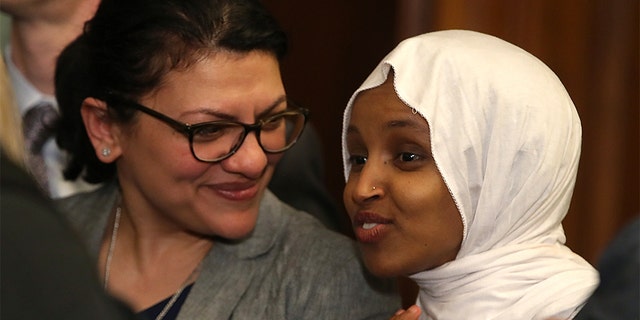
Reps. Ilhan Omar, D-Minn., and Rashida Tlaib, D-Mich., expressed outrage Friday after a report said the Trump administration was considering an expansion of the nation's travel ban to cover more countries.
In
a statement, White House spokesman Hogan Gidley neither confirmed nor
denied the expansion report but defended the existing policy.
“The
Travel Ban has been very successful in protecting our Country and
raising the security baseline around the world," Gidley said. "While
there are no new announcements at this time, common-sense and national
security both dictate that if a country wants to fully participate in
U.S. immigration programs, they should also comply with all security and
counter-terrorism measures -- because we do not want to import
terrorism or any other national security threat into the United States."
Nevertheless, Omar and Tlaib both addressed the travel ban Friday.
“What
do 5 out of 7 of these countries have in common? They are
Muslim-majority countries the President already tried to ban,” Omar
tweeted.
It wasn't clear whether she was referring to the currently banned countries or a potential list.
“We need to pass the #NoBanAct immediately to stop this madness," she added.
Tlaib called the ban “Straight up racism!”
“No
more waiting,” she tweeted. “Too many Muslims have been intentionally
targeted, discriminated against, separated from their families and
denied opportunities solely based on their faith.”
The
administration’s travel ban, which has been through several rounds of
litigation and iterations, currently includes seven countries (with
certain exceptions) not allowed to fly to the United States: Iran,
Libya, Somalia, Syria, Yemen, Venezuela and North Korea.
Some
confusion ensued at airports across the country in 2017 -- about who was
allowed in and who wasn’t -- after President Trump signed the original
travel ban into law through an executive order just seven days after
taking office. Massive protests added to the disorder.
Trump’s
first version of the travel ban -- dubbed by critics as "the Muslim ban"
because it called for a 90-day travel from Muslim-majority countries
Iraq, Iran, Libya, Somalia, Sudan and Yemen -- proposed blocking refugee
admissions for 120 days and suspended travel from Syria and was
immediately blocked by the courts.
U.S. Reps. Rashida Tlaib, D-Mich., left, and Ilhan Omar,
D-Minn., at a news conference in Washington, March 13, 2019. (Getty
Images)
A watered-down version was eventually upheld by the Supreme Court in a 5-4 vote.
The
list of banned countries could potentially be doubled from seven to 14,
two people familiar with the proposal told the Associated Press. Iraq,
Sudan and Chad could be on the list, a different person said.
The
added countries would most likely be Muslim-majority - a point of
controversy as Trump openly floated the possibility of banning all
Muslims from entering the U.S. while running for president.
The expanded ban would reportedly be part of a hyper-focus on immigration for the 2020 election.
A document outlining the plan has been circulating around the West Wing, but the listed countries have been blacked out.
Rep. Pramila Jayapal, D-Wash., called the proposal "xenophobic."
“An
expanded Muslim Ban will worsen our relationships with countries around
the world. It won't do anything to make our country safer. It will harm
refugees, alienate our allies and give extremists propaganda for
recruitment," she said.
Trump
criticized the Justice Department in 2017 for making changes to the
original ban, tweeting they “should have stayed with the original Travel
Ban, not the watered down, politically correct version they submitted
to S.C.” The Associated Press contributed to this report.
FILE
– In this Sept. 10, 2019 file photo, government contractors erect a
section of
Pentagon-funded border wall along the Colorado River in Yuma,
Ariz. (AP Photo/Matt York)
OAN Newsroom
UPDATED 8:05 PM PT — Friday, January 10, 2020
Acting Homeland Security Secretary Chad Wolf provided an update on
the construction of the U.S. border wall on Friday. While speaking in
Yuma, Arizona, Wolf marked a milestone for the Trump administration by
announcing 100 new miles of southern border wall have been completed.
The new border wall system reduces illegal border
crossings. The results don’t lie. Watch today’s press conference at
1:20 ET/11:20 AZ time. Livestream link here: https://t.co/krvcaSbSg3
Homeland Security officials later posted a video to Twitter, saying
new stretches of the wall were constructed in every border state “from
California to Texas.”
New wall has been constructed in every border state from California to Texas – a milestone for the entire country. pic.twitter.com/S505hRonte
Republican Sen. Martha McSally also joined him on the trip. She said
Border Patrol agents will now be able to stop illegal activity because
border walls work.
Wolf provided assurances that Homeland Security keeps the safety and well-being of the local communities.
“We continue to be transparent on
everything that we do. We continue to reach out to land owners. We
continue to engage local communities, local representatives, elected
officials and the like. So there’s nothing that we’re trying to hide
here, we’re very transparent about it. We’ll continue to be very
cognizant of any environmental issues that we address.”
– Chad Wolf, Acting Secretary of Homeland Security
Good discussion with Yuma Mayor Nicholls and
Arizona Border Sheriffs Wilmot, Dannels and Napier this morning. These
sheriffs are responsible for over 90% the Arizona-Mexico border and are
doing a fantastic job. pic.twitter.com/O7ooKTlEYh
In
this Wednesday, Jan. 8, 2020 photo, rescue workers search the scene
where a Ukrainian plane crashed in Shahedshahr, southwest of the capital
Tehran, Iran. (AP Photo/Ebrahim Noroozi)
OAN Newsroom
UPDATED 8:30 PM PT — Friday, January 10, 2020
Iranian state media is saying human error led to a Ukrainian flight
to be shot down. Friday evening reports cited Iranian military
officials, who reportedly said the nation “unintentionally” shot down
the Boeing 737.
BREAKING: Iran admits it accidentally shot down a
Ukrainian passenger plane, reversing course just days after claiming it
crashed due to mechanical failure. https://t.co/sCqmbSagyL
The flight was brought down shortly after takeoff from Tehran’s
international airport on Wednesday. All 176 passengers on board were
killed in the crash, including 63 Canadian citizens.
In
this Wednesday, Jan. 8, 2020 photo, bodies of the victims of a
Ukrainian plane crash are collected by rescue team at the scene of the
crash in Shahedshahr, southwest of the capital Tehran, Iran. Iran on
Friday denied Western allegations that one of its own missiles downed a
Ukrainian jetliner that crashed outside Tehran, and called on the U.S.
and Canada to share any information they have on the crash, which killed
all 176 people on board. (AP Photo/Ebrahim Noroozi)
Canadian Prime Minister Justin Trudeau earlier claimed the evidence
showed Iranian military involvement. His remarks came after reports
quoted senior U.S. Defense and Intelligence officials, who said the
plane was hit by an anti-aircraft missile system.
“We have intelligence from multiple sources, including our allies and
our own intelligence,” stated Trudeau. “The evidence indicates that the
plane was shot down by an Iranian surface-to-air missile.”
Canadian PM Trudeau: “We have intelligence from
multiple sources, including our allies and our own intelligence. The
evidence indicates that the plane was shot down by an Iranian
surface-to-air missile. This may well have been unintentional.” pic.twitter.com/51fqLgrCBs
President Trump has also said he does not believe mechanical failure
caused the Ukrainian jet to crash. On Thursday, he said the plane was
flying in a pretty rough neighborhood and somebody could have made a
mistake.
“At some point, they’ll release the black box,” he said. “I have a feeling that something very terrible happened.”
A large group of demonstrators gathered outside the Statehouse in Trenton, N.J., on Thursday to protest a controversial bill that would remove religion as a legal reason for parents not vaccinating public school students.
The
bill passed the state House last month but stalled in the Senate. But
senators reportedly reached a deal Thursday that is expected to result
in Senate approval on Monday, reports said.
The proposal would then head to Gov. Phil Murphy, a Democrat who hasn't been clear about whether he backs the plan or not.
The
latest development came despite some 1,000 "anti-vaxx" protesters
showing up Thursday. Many shouted “Kill the bill!” after a Republican,
state Sen. Declan O’Scanlon, who had called for an amendment to give
parents who choose not to vaccinate their children another choice
besides homeschooling, agreed to cast the deciding vote in favor of it.
Parents
who don't allow their children to be vaccinated can send them to
private school and daycare, O'Scanlon said, adding that another
amendment says public schools must accept an unvaccinated child if
there’s evidence a vaccine harmed one of their siblings.
“I think we need to do all we can to maximize vaccine compliance,” O'Scanlon added.
“I think we need to do all we can to maximize vaccine compliance.” — New Jersey state Sen. Declan O’Scanlon
Some
protesters shouted “Murderer!” and “Traitor!” from inside the Senate
gallery as lawmakers voted 18-15 to approve the amendments.
“This
type of amendment will once again allow the wealthy to buy their way out
of a law via private schools,” Sue Collins, co-founder of the New
Jersey Coalition for Vaccination Choice told NJ.com. “Unless you have enough money, your religious beliefs are not valid.”
“This
type of amendment will once again allow the wealthy to buy their way
out of a law via private schools. Unless you have enough money, your
religious beliefs are not valid.” — Sue Collins, co-founder, New Jersey Coalition for Vaccination Choice
Andrea
Kelly chooses not to vaccinate her children and protested Thursday
because she said she can’t afford to send her children to a private
school.
Beata Savreski, the mother of three boys, drove to the capital for the first time to make her voice heard.
“I want to preserve our rights as parents,” she said.
Republican state Sen. Gerald Cardinale called the bill “a deliberate attack on religious freedom.”
State
Senate President Stephen Sweeney, a Democrat, said the bill is a
“public health issue” and said he expects it to pass on Monday when the
chamber reconvenes.
“We’re
either going to get it done now or we’re going to get it done in the
next session, but by all means this is getting done,” Sweeney told NorthJersey.com. “It’s
the right health care policy and it’s based on science, unlike what
[the protesters are] chanting and saying. They have a right to their
opinion.”
It’s not the first time the protesters have voiced their
disapproval. They came out to the Statehouse in large numbers when the
state Assembly passed the bill last month.
The bill was prompted by a recent outbreak of measles in New Jersey.
More than 1,200 cases of measles were reported in 31 states in 2019, the federal Centers for Disease Control and Prevention reported.
If Murphy signs the bill into law, it would take effect six months later.
Flush with campaign cash and facing down a possible Senate impeachment trial, President Trump headlined his first major rally of the election year Thursday in Ohio -- and almost immediately, the president capitalized on his order to take out Iranian
commander Qassem Soleimani after the military leader was said to have
orchestrated an attack on the U.S. Embassy in Iraq.
In unequivocal terms, Trump slammed House Democrats' nonbinding War Powers Resolution, which passed earlier in the day in a rebuke to the Soleimani strike. Trump went on to suggest that Democrats, including House Speaker Nancy Pelosi and "Liddle' pencil-neck"
House Intelligence Committee Chairman Adam Schiff, D-Calif., would have
tipped off the media about the operation had they known about it.
"They're
saying, 'You should get permission from Congress, you should come in
and tell us what you want to do -- you should come in and tell us, so
that we can call up the fake news that's back there, and we can leak
it,'" Trump said. "Lot of corruption back there."
The president
added that it would have been impractical to have alerted Congress,
given the "split-second" nature of the decision to kill Soleimani.
Separately,
Trump said he hoped former Vice President Joe Biden would become the
Democrats' presidential nominee, and pledged he would highlight what he
called the Bidens' corruption all throughout the campaign.
"He
will hear, 'Where's Hunter?',' every single debate nine times at the
podium," Trump vowed, in reference to Biden's son, who largely has
stayed out of public view after it emerged that he held lucrative
overseas board roles while his father was vice president.
Republicans have accused Hunter Biden, who recently was determined to have fathered a child with an Arkansas ex-stripper, of selling access to his father.
Trump was speaking before a packed crowd
in Toledo after apparently pulling back from the brink of war with Iran
earlier this week, and just hours after officials announced that Iran likely shot down a civilian airliner carrying
dozens of Canadians, apparently by mistake. Canadian Prime Minister
Justin Trudeau suggested the U.S. might bear responsibility, and he declined to condemn Iran.
For the most part, the rally focused on the Iran strike and the response to it from the political left.
"The
radical left Democrats have expressed outrage over the termination of
this horrible terrorist," Trump said. "Instead, they should be outraged
by Soleimani's savage crimes and the fact that his countless victims
were denied justice for so long."
Trump said he had acted swiftly
after the earlier attack at the U.S. Embassy in Baghdad and essentially
overruled a commander who said the military response would not arrive
until the next day. The situation, Trump said, easily could have become
"another Benghazi" -- a reference to the deadly 2012 attack at the U.S.
consulate in Libya.
"I said, 'nope, get in the planes right now,
have them there immediately!'" Trump said. "And, they got there
immediately. ... If you dare threaten our citizens, you do so at your
own grave peril."
Former President Obama, Trump added, had erred
by giving billions to Iran as part of the mostly defunct Iran nuclear
deal, including a massive cash payout loaded onto U.S. aircraft.
"By
subsidizing Iran's maligned conduct, the last administration was
leading the world down the path of war," Trump said. "We are restoring
our world to the path of peace, peace through strength."
The
campaign event offered Trump an opportunity to spotlight before a
friendly crowd his decision to order the deadly drone strike
against Soleimani, while keeping the U.S. -- at least for the moment --
out of a wider military conflict.
Trump also emphasized the booming economy, including a strong stock market and historically low unemployment rates.
"Unemployment
has reached the lowest level in over 51 years," Trump said.
"African-American, Hispanic American and Asian American unemployment
have all reached the lowest rates ever, ever, ever recorded. Wages are
rising fast, and the biggest percentage increase -- makes me happy --
are for blue-collar workers. Forty million American families are now
benefiting from the Republican child-tax credit, each receiving an
average of over $2,200 a year."
Trump added that getting rid of
"job-killing regulations" had helped spur the industrial sector. He
later invoked the destructive and widespread "yellow vest" protests in
France, which had started out of frustration with high taxes on gas.
"If you dare threaten our citizens, you do so at your own grave peril." — President Trump
"America
lost 60,000 factories under the previous administration ... They're all
coming back," Trump said. "And, right now, just in a very short period
of time, we've added 12,000 brand new factories and many more are coming
in."
The United States–Mexico–Canada Agreement [USMCA], Trump
said, would improve the economy further and make the U.S. automobile
industry in particular more competitive.
The Democrats' policies,
Trump argued, have produced chaos and poverty. Trump specifically ripped
Pelosi, D-Calif., for living in a mansion in San Francisco, even as her
"disgusting" district filled with homeless people defecating on the
streets.
Trump additionally touted the recent appellate court ruling
that green-lit funding for his border wall, slammed "late-term abortion
and ripping babies right from the mother's womb right up until the
mother's womb," and highlighted Obama's broken promise to ensure
Americans could keep their doctors under his health-care plan.
"We will protect patients with preexisting conditions, and we will protect your preexisting physician," Trump vowed.
The
president's reelection campaign already had used Facebook ads to
highlight Trump’s decision to strike Soleimani, regarded as Iran’s
second-most-powerful official.
"We caught a total monster, and we
took him out, and that should have happened a long time ago,” Trump said
before departing Washington earlier in the day.
Last week’s
killing of Soleimani brought long-simmering tensions between the U.S.
and Iran to a boil. Iran, in retaliation, fired a barrage of missiles
this week at two military bases in neighboring Iraq that have housed
hundreds of U.S. troops. But, with no reported injuries to U.S. or Iraqi
troops, Trump said he had no plans to take further military action
against Iran and instead would enact more sanctions against the Islamic
Republic.
The Iran crisis, which momentarily overshadowed Trump's
looming impeachment trial, also has opened a new front in the 2020
presidential campaign for Trump, who in 2016 campaigned in part on a
promise to end American involvement in "endless wars."
Trump
entered the election year flush with over $100 million in campaign
cash, a low unemployment rate and an unsettled field of Democrats
seeking to challenge him. Yet, polling showed he remained vulnerable.
Back
in December, an AP-NORC poll showed Trump's approval rating at 40
percent. No more recent major polls have emerged to gauge support for
the president in the wake of the targeted killing of Soleimani, though
opinions of Trump have changed little over the course of his presidency.
Trump
has never fallen into historic lows for a president’s approval ratings,
but Gallup polling showed his December rating registered lower than
that of most recent presidents at the same point in their first terms.
Notably, approval of Trump and Obama in the Decembers before their
reelection bids was roughly the same.
For Trump to win reelection,
securing Ohio's 18 electoral votes will be critical. He won Ohio by
eight points in 2016, after Obama held the state in 2008 and 2012. The
visit to Toledo marked Trump's 15th appearance in Ohio as president.
Trump
has anchored his reelection messaging around a solid national economy
with an unemployment rate of 3.5 percent. But, people in parts of the
industrial Midwest have said they've been left behind, especially as the
manufacturing sector has struggled over the past year in response to
slower worldwide economic growth and trade tensions with China.
Labor
Department figures showed construction and factory jobs slumping in
Ohio. In nearby Michigan, manufacturers were shedding workers as well,
but so were that state’s employers in the health care, education and
social assistance sectors.
But, the Toledo area pointed at an even
more alarming trend in an otherwise healthy economy. The Glass City has
shedded over 6 percent of its white-collar jobs in the professional and
business services sector over the past year, causing the total number
of jobs to slump slightly from a year ago.
As an incumbent, Trump
has been able to use his position to build a massive campaign cash
reserve at a time when Democrats have been raising and spending theirs
in a competitive primary. Although many White House hopefuls, most
notably Vermont Sen. Bernie Sanders and former South Bend, Ind., Mayor
Pete Buttigieg, have pulled in massive sums, there has been no clear
front-runner, and many party officials have been girding for a
protracted contest that could further bleed the eventual nominee of
resources.
Trump,
meanwhile, raised $46 million in the final quarter of 2019 and had over
$102 million cash on hand at the end of the year. The Republican
National Committee [RNC], which hasn’t faced as strict a set of
contribution limits as the candidate, raised even more. Under the
current rules, the RNC won’t have to release its December fundraising
numbers until the end of the month.
Asked how much he was willing
to spend on his reelection, Trump said, "I literally haven't even
thought about it." He added: "I will say this: Because of the
impeachment hoax, we're taking in numbers that nobody ever expected. You
saw the kind of numbers we're reporting. We're blowing everybody away." Fox News' Andrew O'Reilly and The Associated Press contributed to this report.
U.S. Rep. Adam Smith, D-Wash., became the target of social media trolls and other critics – including Donald Trump Jr. – on Thursday for his abrupt reversal regarding when House Speaker Nancy Pelosi should deliver articles of impeachment to the U.S. Senate.
Early
Thursday, Smith said he believed Pelosi was looking to establish
negotiating leverage with the Senate by withholding the two articles of
impeachment against President Trump, which the House approved last
month. The articles charge the president with abuse of power and
obstruction of Congress in relation to a July phone call with the
president of Ukraine.
But ultimately, Smith said, he believed Senate Majority Leader Mitch McConnell, R-Ky., was in charge of the Senate and should determine that body’s course of action regarding a Trump impeachment trial.
“I
think it was perfectly advisable for the speaker to try to leverage
that to get a better deal,” Smith told CNN, but adding “at this point,
it doesn’t look like that’s going to happen.”
“I think it is time
to send the impeachment to the Senate and let Mitch McConnell be
responsible for the fairness of the trial,” Smith said. “He ultimately
is.”
But just a short time later, Smith posted on Twitter what seemed to be a complete reversal from the statements he made on TV.
“I
misspoke this morning,” Smith wrote. “I do believe we should do
everything we can to force the Senate to have a fair trial. If the
Speaker believes that holding on to the articles for a longer time will
help force a fair trial in the Senate, then I wholeheartedly support
that decision.”
Critics quickly took note of the sudden retreat by
Smith, the 54-year-old chairman of the House Armed Services Committee,
and suggested that perhaps he was surrendering to pressure from
Democratic Party leaders.
“Hahahaha someones not allowed to think
for himself and got in trouble for breaking with Nancy’s narrative,”
Donald Trump Jr. wrote. “This has been the problem with the sham
impeachment from day one, no one actually believes this BS except for
the lunatic fringe who have hijacked the whole Democratic party.”
“Bang
bang Nancy’s silver hammer went down on Adam Smith’s head …” political
commentator Doug Heye wrote, alluding to an old Beatles song.
Smith’s flip-flop wasn’t playing well in his home state, either.
“He
has no courage of his convictions, and had to deny his own words an
hour later,” said Dori Monson, host of a Seattle radio show, according
to MyNorthwest.com.
Later, Smith tried to clarify his remarks during an appearance on Monson’s program.
“All I was saying was, ‘At the end of the day, we can’t force the Senate any more than they can force us,'” Smith told Monson, according to MyNorthwest.com. “‘We have to try to leverage them and persuade them.'” Fox News' Brooke Singman contributed to this story.
Secretary of State Mike Pompeo fired back at one of his predecessors in an exclusive interview with Fox News' "The Ingraham Angle" Thursday, saying that John Kerry was indulging in a "fantasy" by claiming that Iran had reined in its destabilizing behavior after signing the 2015 nuclear deal.
"It’s
a fantasy to think that the nuclear deal was good for the United States
of America, protecting the American people," Pompeo told Laura
Ingraham. "There were terror campaigns, there were missile systems that
were enhanced, improved during the [period of the] JCPOA [nuclear deal]
-- the money that the Iranian regime was permitted to have underwrote
the very Shia militias that were the ones that took on and ultimately
killed an American."
Kerry told MSNBC Wednesday night that there
is "no way at all" the world is safer after Trump ordered a drone strike
that killed Quds Force Gen. Qassem Soleimani at Baghdad's airport last
week. The former senator from Massachusetts and 2004 Democratic
presidential nominee also claimed that Trump was "fixated on undoing
anything Barack Obama did ... [and] willing to run the risk of outright
war in the effort to fulfill his fantasy."
"This
isn’t about undoing what Obama did," Pompeo told Ingraham Thursday.
"This is about protecting and defending the American people. President
Trump has been incredibly resolute in that."
During an address to
the nation on Wednesday, hours after Iran fired 16 missiles at two Iraqi
airbases housing American servicemembers in response to Soleimani's
death, Trump claimed: "The missiles fired last night at us and our
allies were paid for with the funds made available by the last
administration." Pompeo doubled down on that claim, emphasizing
that money paid to Iran by the Obama administration "ultimately ends up
in the hands of people who wanted to do Americans harm."
In
September 2016, the Treasury Department acknowledged that $1.7 billion
was transferred from the U.S. to Iran in foreign hard currency. An
initial $400 million delivery was sent to Tehran Jan. 17, the same day
Iran agreed to release four American prisoners. The remaining $1.3
billion was paid in subsequent weeks. The $1.7 billion was the
settlement of a 37-year-old dispute between the U.S. and Iran over a
$400 million payment made by the last Shah of Iran. In addition to those
payments by the U.S., billions of dollars in Iranian assets held in
financial institutions overseas were unfrozen as part of the nuclear
deal.
"All
the things that we are now confronting are a direct result of the
resources that the regime had available as a result of that terrible
nuclear deal," Pompeo said.
Pompeo also responded to criticism of a
classified briefing to lawmakers Wednesday that was meant to explain
the rationale behind the Soleimani strike. Democrats have said they do
not believe the intelligence shown in the briefing proved that Soleimani
represented an immediate threat to U.S. interests, while Sen. Mike Lee, R-Utah, called the briefing "lame" and "insane," describing it as the worst he had sat through in his time on Capitol Hill.
"I
thought we did a dynamite job," said Pompeo, who took part in the
briefing. "I mean that in the truest sense, but we did our level best to
present them with all the facts that we could in that setting." The
secretary of state also insisted that Soleimani was planning "a series
of imminent attacks" when he was killed.
"We
don’t know precisely when -- and we don’t know precisely where," Pompeo
said. "But it was real ... There was a real opportunity here and there
was a real necessity here. We made the right decision. The president
made the right call."
When Ingraham asked whether the
administration could trust Congress with classified information, Pompeo
said: "Well, we shared an awful lot with them yesterday ... I think
there are a number of people who are using this as a political ax to
grind. I think that’s most unfortunate."
Pompeo
also responded to the apparent downing of a Ukrainian International
Airlines plane by Iran early Wednesday that killed all 176 people on
board. U.S., Canadian and British officials said earlier Thursday it is
"highly likely" that the jet was struck by an Iranian missile.
"I’ve
seen the reporting. I can only say that we need to get to the bottom of
this very, very quickly," said Pompeo, who added that while a
mechanical failure could have caused the crash, "if, in fact, it’s the
case that there was something more insidious to this, the American
people should know that this would have been Iranian malfeasance that
caused it."